Market Definition
The Global Space Economy Investment Market encompasses the full spectrum of capital formation, capital allocation, and financial intermediation activities directed toward the development, commercialization, and operation of space-based assets, space-enabling technologies, space-derived data services, and terrestrial infrastructure whose function depends upon or substantially benefits from access to the space environment, including the equity investment, debt financing, government procurement, public-private partnership funding, and multilateral institutional capital flows that collectively define the financial architecture sustaining the growth and diversification of the global space economy across government-sponsored exploration programs, national security space systems, commercial satellite communications, Earth observation, navigation, space transportation, in-space manufacturing, satellite servicing, lunar economy development, and emerging deep space resource utilization ventures. The investment scope of this market encompasses venture capital and growth equity funding deployed into early and growth-stage space technology companies developing launch vehicles, smallsat platforms, propulsion systems, satellite communication payloads, Earth observation analytics platforms, space situational awareness services, and novel in-space infrastructure concepts, private equity and strategic corporate investment by aerospace primes, telecommunications companies, defense contractors, and industrial conglomerates acquiring or partnering with space technology innovators to accelerate capability development and market position establishment, sovereign wealth fund and institutional asset manager allocations to listed and unlisted space economy companies as the investable space sector universe expands through initial public offerings, special purpose acquisition company transactions, and the maturation of established commercial space enterprises toward profitability and dividend-generating stability, government space agency program budgets and national space office procurement expenditures funding launch services, satellite development, crewed spaceflight, scientific exploration, and space situational awareness systems across the major spacefaring nations of the United States, China, Russia, Europe, India, Japan, and a growing cohort of emerging space nations, national defense ministry investment in military satellite communications, intelligence surveillance and reconnaissance constellations, missile warning systems, space domain awareness networks, and resilient positioning navigation and timing infrastructure whose strategic importance to national security is driving sustained and in many nations accelerating capital commitment, multilateral development bank and international financial institution co-investment in space-enabled development applications including satellite-based agricultural monitoring, disaster response, climate observation, and telecommunications infrastructure serving underserved populations in developing economies, and the project finance and infrastructure fund capital being directed toward the ground station networks, satellite manufacturing facilities, launch range infrastructure, and spectrum and orbital resource management systems that constitute the essential enabling physical infrastructure of the commercial space economy. The technology and application landscape within this investment market spans the complete range of space economy verticals including broadband and narrowband satellite communications serving consumer, enterprise, maritime, aviation, and government connectivity markets, very high resolution and hyperspectral Earth observation systems providing geospatial intelligence, environmental monitoring, agricultural analytics, urban planning, and infrastructure inspection services, global navigation satellite system augmentation and alternative positioning navigation and timing services, space launch services spanning reusable orbital launch vehicles, dedicated smallsat launchers, rideshare mission services, and emerging super-heavy lift systems, in-orbit services including satellite refueling, life extension, debris removal, inspection and repair, and orbital manufacturing of materials and structures enabled by microgravity and vacuum environment conditions, lunar surface access and cislunar transportation infrastructure supporting both scientific exploration and the early commercial development of lunar resources, space tourism and commercial human spaceflight experiences spanning suborbital and orbital flight services, and the ground-based data analytics, artificial intelligence processing, and enterprise software platforms that convert raw space-derived data into the actionable intelligence products delivering commercial and governmental value to end-user markets across agriculture, maritime, energy, insurance, financial services, defense, and humanitarian response sectors. The value chain of this investment market extends from foundational research institutions and university space engineering programs generating the scientific and technical knowledge base, through deep technology venture investors providing pre-commercial capital to early-stage space technology developers, established aerospace system integrators and satellite manufacturers translating technology into commercial products, launch service providers delivering the transportation infrastructure connecting Earth-surface assets to orbital operating environments, satellite ground system operators managing the command, control, and data downlink infrastructure of space-based assets, downstream data analytics and application service companies delivering commercially monetizable space-derived intelligence to enterprise and government end users, and the capital markets infrastructure of investment banks, space-focused funds, stock exchanges, and rating agencies whose financial intermediation functions are enabling the progressive maturation of the space economy from a government-dependent strategic sector toward a diversified commercially self-sustaining investment asset class.
Market Insights
The global space economy investment market is operating with exceptional dynamism and structural breadth in 2026, characterized by the concurrent advance of multiple commercially maturing space economy verticals from technology demonstration toward revenue-generating operations, the progressive diversification of the investor base from a historically narrow cohort of specialized space funds and strategic aerospace investors toward mainstream institutional asset managers, sovereign wealth funds, infrastructure investors, and retail capital market participants attracted by the expanding universe of publicly listed and investable space economy companies, and the intensifying competition between the United States, China, Europe, India, and a growing number of emerging space nations to establish commercial and strategic leadership positions across the space economy verticals that are expected to generate the largest economic and geopolitical returns over the coming two decades. The global space economy investment market was valued at approximately USD 630 billion in 2025 and is projected to expand at a compound annual growth rate of 9 percent through 2036, reaching approximately USD 1.6 trillion by the end of the forecast period, a trajectory reflecting the structural demand for space-derived services across global communications, Earth observation, navigation, and national security applications, the accelerating commercialization of space transportation driven by launch cost reduction and reusability innovation, the broadening of investable space economy verticals to include in-orbit services, lunar infrastructure, and space-enabled sustainability applications, and the progressive mainstreaming of space economy investment as an asset class with recognized risk-return characteristics attractive to diversified institutional portfolios. The competitive investment landscape encompasses the large United States aerospace and defense primes who continue to anchor the institutional capital end of the space investment spectrum through major government program revenues and strategic commercial acquisitions, the growing cohort of commercially-oriented new space companies whose reusability-driven launch economics, high-volume smallsat production techniques, and software-defined satellite architecture innovations have attracted multi-billion USD private investment rounds that have established them as peers to established aerospace contractors in market capitalization and program ambition, national space agencies and state-owned enterprise space corporations in China, Russia, India, Japan, and the European Space Agency member states whose government procurement and investment decisions continue to define the trajectory of major space economy sectors including human spaceflight, deep space exploration, and national security space systems, and the expanding universe of space-focused venture capital firms, growth equity funds, and dedicated space economy investment vehicles whose sector specialization, technical due diligence capability, and portfolio network effects are providing the financial ecosystem infrastructure required to sustain a high-volume flow of early-stage space company formations and technology development programs.
A defining commercial development reshaping the investment landscape of the space economy is the emergence of large-scale low Earth orbit broadband satellite constellations as the first truly mass-market commercial space product, whose deployment by multiple operators is simultaneously demonstrating the commercial viability of manufacturing and deploying hundreds to thousands of satellites on reusable launch vehicles at per-satellite costs that were unimaginable a decade ago, generating the recurring subscription revenue streams from consumer, maritime, aviation, and enterprise connectivity customers that are providing the first large-scale commercial revenue base for space economy investment returns outside the legacy geostationary satellite communications sector. The capital investment deployed in low Earth orbit broadband constellation development by multiple competing operators represents the largest single concentration of private commercial space investment in history and is generating cascading investment demand across the entire space economy supply chain, from satellite component manufacturing and payload integration facilities to launch vehicle production capacity, ground station networks, user terminal manufacturing, and the cloud computing and network operations infrastructure required to manage the complex handoff and routing functions of large low Earth orbit satellite communication networks serving millions of simultaneous users across global coverage areas. The competitive dynamics of the low Earth orbit broadband market are creating investment pressure for constellation operators to accelerate deployment timelines, expand coverage footprints, and improve terminal cost and performance characteristics in order to establish customer relationships and market share positions before competing constellations reach comparable service quality levels, generating a capital deployment velocity in the broadband constellation segment that is absorbing a substantial fraction of available commercial space investment capital and that is simultaneously providing the launch cadence and satellite manufacturing volume that is driving the cost reductions in space transportation and smallsat production whose benefits are progressively available to the full range of space economy verticals beyond broadband connectivity.
The Earth observation segment of the space economy investment market has undergone a transformation from a government-dominated scientific and intelligence discipline toward a commercially vibrant and rapidly diversifying data economy whose investment dynamics are increasingly driven by the commercial value of geospatial intelligence, environmental monitoring, and infrastructure analytics services to enterprise and government customers in agricultural, insurance, financial services, energy, real estate, and humanitarian response sectors, creating a data product and analytics service revenue model that is attracting both venture capital to early-stage Earth observation startups and strategic investment from established data analytics, enterprise software, and geographic information system companies seeking to integrate space-derived data streams into their existing product platforms. The proliferation of very high resolution optical, synthetic aperture radar, hyperspectral, and radio frequency signal intelligence satellite constellations operated by commercial Earth observation companies is generating a massive and diversifying stream of raw satellite imagery and derived data products whose commercial value is increasingly realized not through the imagery itself but through the artificial intelligence-processed analytics, change detection algorithms, and predictive intelligence models that convert multi-temporal satellite observations into actionable business intelligence for commodity traders, infrastructure asset managers, environmental compliance officers, agricultural yield forecasters, and national security analysts. Investment in the Earth observation data analytics layer, encompassing the artificial intelligence platform companies, geospatial software developers, and vertical market application developers that transform raw satellite data into sector-specific commercial products, is attracting a growing share of total Earth observation investment as investors recognize that the data processing and application layer captures the majority of commercial value in the Earth observation value chain and that the marginal cost of processing additional satellite data through existing analytics platforms is substantially lower than the capital cost of adding additional satellite capacity to the observation network, creating favorable unit economics for analytics-focused Earth observation investment relative to capital-intensive satellite hardware investment.
From a regional investment perspective, the United States continues to dominate the global space economy investment landscape by total capital deployment, accounting for the majority of private commercial space investment globally through its concentration of commercially mature launch service operators, large low Earth orbit constellation program operators, established satellite communications and Earth observation companies, a deep venture capital ecosystem with demonstrated space sector expertise, and the largest national space agency budget of any single nation that provides the government procurement anchor underpinning the financial viability of the commercial space supply chain. Europe represents a market of significant strategic reassessment and investment acceleration, with the European Space Agency and its member state national space agencies increasing investment in sovereign launch capability, satellite navigation, Earth observation, and space situational awareness programs following geopolitical developments that elevated the strategic priority of European autonomous space access and the commercial European space ecosystem’s competitiveness relative to United States commercial space operators. China represents the most significant challenger to United States space economy investment dominance over the forecast period, with state-directed investment in satellite communications, Earth observation, crewed spaceflight, lunar exploration, and commercial launch services advancing across all space economy verticals simultaneously under a national space development strategy whose ambition, funding scale, and institutional coordination represent a comprehensive effort to establish Chinese leadership across the full space economy investment landscape. India, Japan, the United Arab Emirates, South Korea, and Australia represent an important and growing cohort of emerging and re-energized spacefaring nations whose government investment in national space programs, commercial space regulatory frameworks, and indigenous space industry development is creating new nodes of space economy investment activity that are diversifying the geographic concentration of space economy capital deployment and creating new market opportunities for international technology partnerships, launch service contracts, and Earth observation data distribution agreements.
Key Drivers
Dramatic Reduction in Space Access Costs Through Launch Vehicle Reusability and High-Volume Smallsat Production Unlocking Commercial Viability Across New Space Economy Verticals
The single most transformative structural driver enabling the expansion of the global space economy investment market across new commercial verticals and attracting mainstream institutional capital to space economy asset classes that were previously considered too capital-intensive or commercially unproven for non-specialist investment is the dramatic and ongoing reduction in the cost of accessing space that has been achieved through the development and operational maturation of reusable orbital launch vehicles, the industrialization of smallsat bus manufacturing through high-volume production techniques borrowed from consumer electronics and automotive manufacturing, and the consequent reduction in the minimum viable capital commitment required to develop and operate a commercially meaningful space-based system from a level accessible only to government agencies and the largest aerospace primes to a level reachable by venture-backed startup companies with addressable commercial market opportunities of sufficient scale to justify the investment. The reduction in launch cost per kilogram to low Earth orbit achieved by reusable launch vehicle operators relative to the expendable launch vehicle economics that prevailed for the first six decades of the space age represents a fundamental improvement in the unit economics of space-based business models whose downstream effect on space economy investment is analogous to the effect of semiconductor cost reduction on the digital economy, enabling the development of applications that were technically conceivable but economically infeasible under previous cost structures and creating new categories of commercially viable space economy investment that are attracting capital from investors who previously had no rational basis for space sector allocation. The commercial implications of launch cost reduction are amplifying across the space economy investment landscape through multiple reinforcing mechanisms, including the enabling of large constellation deployments that achieve global coverage through hundreds or thousands of relatively inexpensive satellites whose combined capability exceeds that of small numbers of expensive traditional satellites, the reduction of mission failure consequences to commercial operators as the lower per-satellite investment makes constellation replenishment and technology refresh economically feasible within normal commercial planning cycles, the opening of space economy participation to smaller national space agencies, university research programs, and startup companies whose limited budgets can now access orbital deployment through rideshare and dedicated smallsat launch services at price points incompatible with expendable launch economics, and the generation of the launch cadence volume that is driving further manufacturing learning curve improvements in launch vehicle production that are establishing a positive feedback cycle of cost reduction and market expansion that is expected to sustain below-historical-average space access costs across the forecast period.
National Security Imperatives and the Strategic Competition Between Major Spacefaring Powers Driving Sustained Government Investment and Commercial Space Ecosystem Development
The intensifying strategic competition between the United States, China, Russia, and the growing cohort of spacefaring nations for leadership, capability, and resilience across the military, intelligence, and economic dimensions of the space domain is generating a powerful and politically durable demand driver for government space investment that is simultaneously providing the procurement anchor revenues that underpin the financial viability of the commercial space industry supply chain, the technology development funding that advances space capabilities toward commercial application readiness, and the strategic imperative for allied nations to develop indigenous space capabilities whose pursuit is creating new national space program investment streams across Europe, Asia-Pacific, and the Middle East. The dependency of modern military operations, national intelligence collection, and critical infrastructure management on satellite-delivered services including position navigation and timing, secure communications, missile warning, imagery intelligence, maritime domain awareness, and signals intelligence has elevated space from a supporting enabler to a warfighting domain whose contested and congested character is driving defense ministry investment in space resilience, redundancy, and offensive and defensive space capabilities at a pace and priority that is generating sustained growth in national security space budgets across the major spacefaring nations independent of broader defense spending constraints. The commercial space industry’s role as a critical enabler of national security space capabilities, demonstrated most compellingly by the operational contribution of commercial satellite imagery and broadband communication services to the conflict in Ukraine, has fundamentally altered the procurement philosophy of national defense establishments toward a model of deliberate commercial space capability leverage that is providing commercial Earth observation, satellite communications, launch service, and space situational awareness companies with long-term government revenue streams that substantially improve their investment attractiveness to commercial capital markets. The strategic technology competition between the United States and China across space economy verticals including launch services, broadband constellations, satellite manufacturing, lunar exploration, and space-based solar power is generating national industrial policy investment in commercial space company development in both countries that is analogous to the government-supported commercial aerospace industry development programs that created the modern commercial aviation industry, providing capital, technology, and procurement support to commercial space companies whose competitive success is assessed as contributing to national strategic objectives beyond the immediate commercial return on investment that private capital markets apply as the primary investment criterion.
Key Challenges
Orbital Congestion, Space Debris Proliferation, and Spectrum and Orbital Slot Resource Constraints Creating Systemic Risk for Large-Scale Space Economy Investment
The most consequential long-term systemic challenge threatening the sustainability and investment value of the growing global space economy is the accelerating proliferation of active satellites, defunct spacecraft, spent rocket stages, and fragmentation debris in the most commercially valuable low Earth orbit altitude bands, creating a conjunction risk environment that is increasing the probability of collision events generating new debris clouds and potentially initiating the cascade of collisions whose cumulative effect could render specific orbital altitude bands operationally unusable for extended periods, destroying the asset value of commercial satellite constellations whose business models depend on the long-term accessibility and navigability of these orbital environments and whose insurance and financing terms are progressively incorporating orbital congestion risk premiums that increase the capital cost of space economy investment. The commercial investment implications of orbital congestion extend beyond the physical collision risk affecting individual satellites to the systemic financial risk created by the possibility that a major collision event or deliberate antisatellite weapon test generating a significant debris cloud in a heavily utilized orbital band could simultaneously impair the operational continuity of multiple commercial satellite constellations, create insurance loss events of unprecedented scale, and generate regulatory responses imposing operational restrictions on satellite constellation operations that would materially affect the revenue generation capacity and financial projections underlying the investment theses of the affected companies and their investors. The management of orbital congestion risk requires coordinated international action on space debris mitigation standards, active debris removal investment, conjunction assessment information sharing, and traffic management protocol development whose pace of implementation is substantially lagging the growth rate of the active satellite population, creating a structural governance gap between the commercial investment pace that declining launch costs are enabling and the orbital environment management infrastructure whose development is necessary to ensure the long-term sustainability of the orbital operating environment on which space economy investment value depends. The spectrum and orbital slot resource constraint challenge is compounding the orbital congestion problem for commercial space investment by creating regulatory and competitive barriers to the expansion and renewal of satellite communication constellations whose business models require continuous spectrum access and orbital position assignments that are subject to allocation processes administered by the International Telecommunication Union and national regulatory bodies whose procedures were designed for an era of far fewer and larger satellites and whose adaptation to the realities of large constellation coordination is proceeding through negotiation processes whose outcomes create material regulatory uncertainty for the investment timelines and spectrum access assumptions underlying commercial space company financial projections.
Revenue Model Immaturity and Path to Profitability Uncertainty in Capital-Intensive New Space Ventures Creating Investor Confidence and Valuation Challenges
A structurally significant investment challenge confronting the space economy investment market, particularly the venture and growth equity segments that have deployed the majority of private commercial space capital over the preceding decade, is the widespread immaturity of revenue models and the extended and uncertain timelines to profitability for the most capital-intensive new space ventures whose technology development programs have consumed multi-billion USD investment rounds but whose commercial revenue generation has lagged original investment thesis projections, creating valuation reassessment pressures, investor confidence challenges, and follow-on financing difficulties that are creating a financial stress environment in the new space company cohort whose resolution through consolidation, business model revision, or insolvency will materially reshape the competitive landscape of several space economy verticals over the near-term forecast period. The fundamental challenge of achieving profitability in capital-intensive space ventures arises from the combination of the large and front-loaded capital expenditure required to develop, manufacture, and deploy functional space systems before any revenue is generated, the long development timelines from initial investment to operational service that expose ventures to multiple years of cash burn before the commercial product is available for customer evaluation and subscription, the competitive market dynamics in segments such as broadband connectivity and Earth observation where multiple well-funded operators are simultaneously building competing service offerings that compress the pricing power and market share available to individual operators relative to the assumptions of pre-competition investment models, and the technical execution risk inherent in space system development programs that regularly encounter engineering challenges, manufacturing delays, and launch anomalies that extend development timelines and increase total investment to profitability beyond initial projections. The public market experience of several high-profile space economy companies that achieved initial public offering valuations during the special purpose acquisition company transaction wave of 2021 and subsequently experienced significant share price deterioration as revenue growth, profitability timelines, and competitive differentiation failed to meet the optimistic projections embedded in their initial valuations has created a more cautious and financially rigorous investor evaluation framework for space economy investment that is improving the quality of due diligence applied to new investment decisions but is simultaneously raising the revenue traction, gross margin, and competitive differentiation evidence thresholds that space economy companies must demonstrate to access capital at valuations supportive of continued investment and operational scaling.
Market Segmentation
- Segmentation By Investment Type
- Venture Capital (Seed, Series A, Series B, and Growth Rounds)
- Private Equity and Buyout Investment
- Strategic Corporate Investment and M&A
- Government Procurement and Program Budget Investment
- Public Equity Investment (Listed Space Economy Companies)
- Infrastructure and Project Finance
- Sovereign Wealth Fund and Institutional Asset Manager Allocations
- Multilateral Development Bank and Aid Finance
- Special Purpose Acquisition Company (SPAC) Transactions
- Others
- Segmentation By Space Economy Vertical
- Satellite Broadband and Narrowband Communications
- Earth Observation and Geospatial Intelligence
- Space Launch Services and Transportation
- National Security and Defense Space Systems
- Satellite Navigation and Positioning Services
- In-Orbit Services (Refueling, Life Extension, Debris Removal)
- Crewed Spaceflight and Space Tourism
- Lunar Economy and Cislunar Infrastructure
- Space-Based Solar Power
- In-Space Manufacturing and Microgravity Applications
- Space Situational Awareness and Traffic Management
- Space-Derived Data Analytics and Application Platforms
- Others
- Segmentation By Investor Type
- Dedicated Space-Focused Venture Capital Funds
- Generalist Technology Venture Capital Funds
- National Government Space Agencies
- National Defense and Intelligence Procurement Bodies
- Aerospace and Defense Prime Contractors
- Telecommunications and Media Corporations
- Energy and Natural Resources Companies
- Sovereign Wealth Funds
- Institutional Asset Managers and Pension Funds
- Retail and Thematic ETF Investors
- Multilateral Development and Finance Institutions
- Others
- Segmentation By Investment Stage
- Pre-Seed and Seed Stage
- Early Venture (Series A and B)
- Growth Equity (Series C and Beyond)
- Pre-IPO and Late-Stage Private
- Public Market Listed Companies
- Infrastructure and Operational Asset Stage
- Government Program Procurement Stage
- Segmentation By Orbit Class
- Low Earth Orbit (LEO) Systems
- Medium Earth Orbit (MEO) Systems
- Geostationary Earth Orbit (GEO) Systems
- Highly Elliptical Orbit Systems
- Cislunar and Deep Space Infrastructure
- Ground and Launch Infrastructure
- Segmentation By Application Sector Served
- Consumer and Broadband Connectivity
- Maritime and Aviation Connectivity
- Agriculture and Food Security
- Energy, Mining, and Natural Resources
- Financial Services and Commodity Markets
- Insurance and Catastrophe Risk Management
- Urban Planning and Infrastructure Management
- Climate Monitoring and Environmental Compliance
- Defense, Intelligence, and National Security
- Humanitarian Response and Development
- Others
- Segmentation By Technology Readiness
- Research and Development Stage
- Demonstration and Prototype Stage
- Early Operational Capability
- Full Operational Capability and Commercial Revenue
- Mature Operational and Infrastructure Assets
- Segmentation By Business Model
- Satellite Hardware Manufacturing and Sale
- Satellite Connectivity Service Subscription
- Earth Observation Data and Analytics Licensing
- Launch Service Fee per Mission
- In-Orbit Service Contract Revenue
- Government Cost-Plus and Fixed-Price Contracts
- Platform and Marketplace Revenue Models
- Others
- Segmentation By Region
- North America (United States and Canada)
- Europe (ESA Member States and United Kingdom)
- Asia-Pacific (China, Japan, India, South Korea, Australia)
- Middle East (UAE, Saudi Arabia, Israel)
- Latin America
- Rest of World
All market revenues are presented in USD
Historical Year: 2021-2024 | Base Year: 2025 | Estimated Year: 2026 | Forecast Period: 2027-2036
Key Questions this Study Will Answer
- What is the projected global space economy investment market valuation through 2036, segmented by investment type, space economy vertical, investor type, investment stage, orbit class, and region, and which verticals and geographic markets are expected to generate the highest incremental capital deployment and return on investment activity across the forecast period?
- How is the continued reduction in launch costs through reusable launch vehicle operational maturation and high-volume smallsat manufacturing expected to reshape the minimum viable capital requirements for space economy venture creation across different verticals, and what new categories of commercially viable space application are expected to become investable as launch economics continue their downward trajectory through the forecast period?
- What is the projected commercial revenue trajectory and path to profitability for the major low Earth orbit broadband satellite constellation operators, and how are the competitive market dynamics, terminal cost reduction requirements, enterprise and government market penetration rates, and capital structure optimization strategies of leading constellation operators expected to evolve toward the revenue scale and gross margin profiles required for commercially self-sustaining operations and investor return realization through the forecast period?
- How are the orbital congestion, space debris proliferation, and spectrum resource constraint challenges being addressed through regulatory frameworks, active debris removal investment programs, satellite design and end-of-life disposal standards, and space traffic management system development, and what residual systemic risk do these challenges represent for the asset value and operational continuity of commercial space economy investments across the forecast period?
- What is the trajectory of Chinese, European, Indian, and other emerging spacefaring nation space economy investment across commercial launch services, satellite communications, Earth observation, and lunar economy development, and how are the strategic industrial policy frameworks, national space agency program priorities, and commercial space regulatory developments in these markets creating new competitive dynamics and partnership opportunities that are reshaping the geographic distribution of space economy investment and competitive advantage over the forecast period?
- Who are the leading commercial space companies, dedicated space venture capital funds, national space agencies, defense procurement organizations, and institutional investors currently defining the competitive and financial landscape of the global space economy investment market, and what are their respective portfolio allocation strategies, technology investment thesis frameworks, government-commercial partnership models, and capital deployment roadmaps for advancing space economy verticals from current investment and development stages toward the commercially mature and financially self-sustaining operational scale that defines the long-term investment return opportunity across the forecast horizon?
- Product Definition
- Scope of the Study
- Research Methodology
- Research Design & Framework
- Overall Research Approach: Descriptive, Exploratory & Quantitative Mixed-Method Design
- Market Definition & Scope Boundaries: What is Included and Excluded
- Segmentation Framework
- Key Research Assumptions & Limitations
- Secondary Research
- Industry Publications, Space Agency Reports, Venture Capital Databases & Press Releases
- Government Space Policy, National Space Programme & Defence Budget Data (NASA, ESA, ISRO, JAXA, CNSA, etc.)
- Space Launch, Satellite Deployment, Constellation & Commercial Mission Statistics
- Private Equity, VC Funding Rounds, IPO & M&A Transaction Databases (PitchBook, Crunchbase, etc.)
- Primary Research Design & Execution
- In-depth Interviews with Space Agency Officials, Satellite Operators, Launch Providers & Space-Tech Investors
- Surveys with Institutional Investors, Corporate Venture Arms, Defence Contractors & Space Start-ups
- Expert Panel Validation
- Data Triangulation & Validation
- Market Sizing & Forecasting Methodology
- Bottom-Up & Top-Down Reconciliation
- Investment Flow, Programme Spend & Commercial Revenue-Based Market Sizing Model
- Launch Cadence, Satellite Constellation Build-Out & Downstream Service Monetisation Model
- Competitive Intelligence Methodology
- Quality Assurance & Peer Review
- Definitions, Abbreviations & Data Notes
- Executive Summary
- Market Snapshot & Headline Numbers
- Key Findings & Research Highlights
- Technology & Innovation Highlights
- Investment Economics & Unit Economics Summary
- Average Programme CAPEX & OPEX Benchmarks
- Government vs Private Sector Investment Mix & Returns Analysis
- New Space vs Legacy Space Revenue Model Summary
- Market Dynamics
- Drivers
- Restraints
- Opportunities
- Challenges
- Porter’s Five Forces Analysis
- PESTLE Analysis
- Market Trends & Developments
- Emerging Trends
- Technological Developments
- Regulatory & Policy Changes
- Supply Chain & Sourcing Trends
- Investment & Funding Activity
- Sustainability & ESG Trends
- Geographic & Regional Trends
- Risk Assessment Framework
- Geopolitical & National Security Risk (Space Militarisation, Export Controls, ITAR/EAR)
- Launch Failure, Mission Risk & In-Orbit Asset Loss Risk
- Regulatory & Spectrum Allocation Risk (ITU, FCC, National Licensing Bodies)
- Financial / Market Risk (Long Investment Cycles, Uncertain Commercial Returns)
- Space Debris, Orbital Congestion & Collision Risk
- Technology Obsolescence & Rapid Innovation Disruption Risk
- Sovereign Programme Dependency & Government Budget Cyclicality Risk
- Regulatory Framework & Policy Standards
- Global Space Economy Investment Market Economics
- Investment Economics & Unit Economics Framework
- Capital Expenditure (CAPEX) Structure by Segment (Launch, Satellite, Ground Segment, Services)
- Operating Expenditure (OPEX) Structure
- Revenue Model & Monetisation Levers
- Programme Utilisation, Asset Life & Throughput Economics
- Payback Period & Return on Investment (ROI) Analysis
- Total Cost of Ownership (TCO) vs Traditional Communication, Navigation & Earth Observation Alternatives
- Programme & Infrastructure Cost Analysis
- Launch Vehicle Development & Per-Launch Cost Trends (USD/kg to Orbit, 2021–2035)
- Satellite Bus, Payload & Manufacturing Cost Dynamics (GEO, MEO, LEO)
- Small Satellite & CubeSat Unit Cost Benchmarks
- Ground Segment Infrastructure (Tracking, Telemetry & Command) Cost Analysis
- Propulsion, Power & Thermal Management System Cost Structure
- Space Insurance & Risk Transfer Cost Analysis
- Impact of Reusability, Rideshare & Mass Production on Space Economy Cost Curves
- Investment Returns & Financial Model Analysis
- Satellite Broadband & Connectivity Service Revenue Model (LEO Mega-Constellations)
- Earth Observation (EO) & Remote Sensing Data Monetisation Economics
- Positioning, Navigation & Timing (PNT) Service Revenue Economics
- In-Space Services, Servicing & Manufacturing Revenue Potential
- Space Tourism & Suborbital Flight Revenue Model
- VC & Growth Equity Return Profiles in Space-Tech Investments
- Regulatory & Standards Compliance Economics
- Spectrum Licensing, Orbital Slot Coordination & ITU Filing Cost Benchmarks
- Export Control, ITAR & Dual-Use Technology Compliance Costs
- Debris Mitigation, End-of-Life Disposal & Space Sustainability Compliance Costs
- Investment Economics & Unit Economics Framework
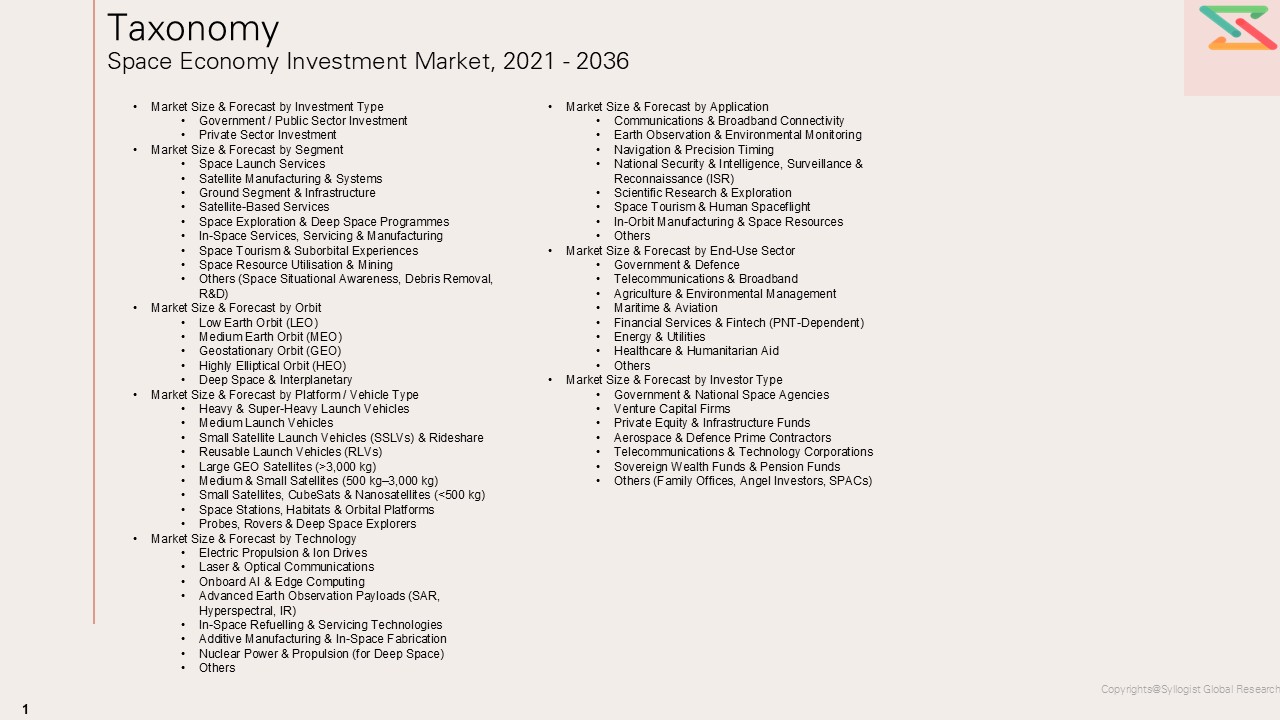
- Global Space Economy Investment Market Outlook
- Market Size & Forecast by Value (USD Billion, 2021–2036)
- Market Size & Forecast by Investment Type
- Government / Public Sector Investment
- – Civil Space Agency Budgets (NASA, ESA, ISRO, JAXA, CNSA, Roscosmos, etc.)
- – National Defence & Military Space Programmes
- – Government-Backed Development Finance & Grants
- Private Sector Investment
- – Venture Capital (Seed, Series A–D)
- – Private Equity & Growth Capital
- – Corporate Venture Capital (CVC)
- – IPOs, SPACs & Public Market Capital
- – Strategic M&A & Partnerships
- Market Size & Forecast by Segment
- Space Launch Services
- Satellite Manufacturing & Systems
- Ground Segment & Infrastructure
- Satellite-Based Services
- – Satellite Broadband & Connectivity
- – Earth Observation (EO) & Remote Sensing
- – Positioning, Navigation & Timing (PNT)
- – Satellite Communications (SATCOM)
- Space Exploration & Deep Space Programmes
- In-Space Services, Servicing & Manufacturing
- Space Tourism & Suborbital Experiences
- Space Resource Utilisation & Mining
- Others (Space Situational Awareness, Debris Removal, R&D)
- Market Size & Forecast by Orbit
- Low Earth Orbit (LEO)
- Medium Earth Orbit (MEO)
- Geostationary Orbit (GEO)
- Highly Elliptical Orbit (HEO)
- Deep Space & Interplanetary
- Market Size & Forecast by Platform / Vehicle Type
- Heavy & Super-Heavy Launch Vehicles
- Medium Launch Vehicles
- Small Satellite Launch Vehicles (SSLVs) & Rideshare
- Reusable Launch Vehicles (RLVs)
- Large GEO Satellites (>3,000 kg)
- Medium & Small Satellites (500 kg–3,000 kg)
- Small Satellites, CubeSats & Nanosatellites (<500 kg)
- Space Stations, Habitats & Orbital Platforms
- Probes, Rovers & Deep Space Explorers
- Market Size & Forecast by Technology
- Electric Propulsion & Ion Drives
- Laser & Optical Communications
- Onboard AI & Edge Computing
- Advanced Earth Observation Payloads (SAR, Hyperspectral, IR)
- In-Space Refuelling & Servicing Technologies
- Additive Manufacturing & In-Space Fabrication
- Nuclear Power & Propulsion (for Deep Space)
- Others
- Market Size & Forecast by Application
- Communications & Broadband Connectivity
- Earth Observation & Environmental Monitoring
- Navigation & Precision Timing
- National Security & Intelligence, Surveillance & Reconnaissance (ISR)
- Scientific Research & Exploration
- Space Tourism & Human Spaceflight
- In-Orbit Manufacturing & Space Resources
- Others
- Market Size & Forecast by End-Use Sector
- Government & Defence
- Telecommunications & Broadband
- Agriculture & Environmental Management
- Maritime & Aviation
- Financial Services & Fintech (PNT-Dependent)
- Energy & Utilities
- Healthcare & Humanitarian Aid
- Others
- Market Size & Forecast by Investor Type
- Government & National Space Agencies
- Venture Capital Firms
- Private Equity & Infrastructure Funds
- Aerospace & Defence Prime Contractors
- Telecommunications & Technology Corporations
- Sovereign Wealth Funds & Pension Funds
- Others (Family Offices, Angel Investors, SPACs)
- Asia-Pacific Space Economy Investment Market Outlook
- Market Size & Forecast
- By Value (2020–2035)
- By Investment Type
- By Segment
- By Orbit
- By Platform / Vehicle Type
- By Technology
- By Application
- By End-Use Sector
- By Investor Type
- Key Demand Drivers (APAC-Specific)
- Competitive Landscape (APAC)
- Market Size & Forecast
- Europe Space Economy Investment Market Outlook
- Market Size & Forecast
- By Value (2020–2035)
- By Investment Type
- By Segment
- By Orbit
- By Platform / Vehicle Type
- By Technology
- By Application
- By End-Use Sector
- By Investor Type
- Key Demand Drivers (Europe-Specific)
- Competitive Landscape (Europe)
- Market Size & Forecast
- North America Space Economy Investment Market Outlook
- Market Overview & Strategic Importance
- Market Size & Forecast
- By Value (2020–2035)
- By Investment Type
- By Segment
- By Orbit
- By Platform / Vehicle Type
- By Technology
- By Application
- By End-Use Sector
- By Investor Type
- Key Demand Drivers (North America-Specific)
- Competitive Landscape (North America)
- Latin America Space Economy Investment Market Outlook
- Market Size & Forecast
- By Value (2020–2035)
- By Investment Type
- By Segment
- By Orbit
- By Platform / Vehicle Type
- By Technology
- By Application
- By End-Use Sector
- By Investor Type
- Key Demand Drivers (LATAM-Specific)
- Competitive Landscape (Latin America)
- Market Size & Forecast
- Middle East & Africa Space Economy Investment Market Outlook
- Market Size & Forecast
- By Value (2020–2035)
- By Investment Type
- By Segment
- By Orbit
- By Platform / Vehicle Type
- By Technology
- By Application
- By End-Use Sector
- By Investor Type
- Key Demand Drivers (MEA-Specific)
- Competitive Landscape (MEA)
- Market Size & Forecast
- Country-Wise Space Economy Investment Market Outlook
- Market Size & Forecast by Country
- By Value
- By Investment Type
- By Segment
- By Orbit
- By Platform / Vehicle Type
- By Technology
- By Application
- By End-Use Sector
- By Investor Type
- Market Size & Forecast by Country
- Countries Covered: United States, Canada, Brazil, United Kingdom, France, Germany, Italy, Luxembourg, Spain, Russia, China, India, Japan, South Korea, Australia, Israel, UAE, Saudi Arabia, South Africa, New Zealand
- Technology Landscape & Innovation Analysis
- Space Economy Technology Maturity Assessment
- Emerging & Disruptive Technologies in Launch, Satellite & In-Space Services
- Reusable Launch Vehicle (RLV) Technology Advances & Cost Disruption Impact
- Mega-Constellation LEO Broadband Technology & Infrastructure Build-Out
- AI, Machine Learning & Autonomy in Satellite Operations & Earth Observation Analytics
- In-Space Manufacturing, Servicing & On-Orbit Assembly Technology Readiness
- Space Nuclear Power & Advanced Propulsion for Exploration & Deep Space
- Technology Readiness & Commercialisation Matrix – Key Space Economy Technologies
- Patent Landscape Analysis
- R&D Investment Benchmarking
- Value Chain & Supply Chain Analysis
- Space Economy Investment Value Chain Mapping
- Supply Chain Concentration & Dependency Analysis
- Key Supplier Mapping by Segment & Technology Programme
- Supplier Risk Heat Map (Semiconductors, Radiation-Hardened Components, Rare Earth Materials)
- Make vs Buy Strategy Trends Among Launch Providers, Satellite OEMs & Service Operators
- Pricing Analysis
- Space Economy Pricing Dynamics & Mechanisms
- Launch Pricing by Vehicle Class, Orbit & Payload Mass (USD/kg to Orbit Benchmarks)
- Satellite Manufacturing & Systems Pricing by Platform Size & Mission Type
- Satellite Service Subscription & Data Monetisation Pricing Models
- Government vs Commercial Procurement Pricing & Contract Structures
- New Space Disruptive Pricing vs Legacy Space Incumbent Benchmarks
- Sustainability & Environmental Stewardship
- Environmental & Sustainability Landscape in the Space Economy
- Carbon Footprint & Atmospheric Impact Benchmarking Across Launch Vehicle Types
- Space Debris Mitigation, Active Debris Removal (ADR) & Orbital Sustainability Roadmap
- Responsible Use of Spectrum, Orbital Slots & Dark Sky Preservation
- Green Propellant & Low-Toxicity Fuel Adoption Roadmap
- ESG Reporting & Lifecycle Assessment (LCA) in Space Programme Operations
- Competitive Landscape
- Market Structure & Concentration
- Market Consolidation Level: Government Primes vs New Space Disruptors vs Private Equity-Backed Players
- Top 5 Space Economy Investment Recipients Market Revenue & Funding Share
- HHI (Herfindahl-Hirschman Index) Concentration Analysis by Segment & Region
- Competitive Intensity Map by Investment Type & Programme Segment
- Player Classification
- Tier-1 Global Integrated Aerospace, Defence & Space Prime Contractors
- Tier-2 New Space Ventures & Growth-Stage Commercial Operators
- Space-Tech Investors, VCs, Government Agencies & Sovereign Programmes
- Emerging & Disruptive Players
- Competitive Analysis Frameworks
- Market Share Analysis by Segment, Investment Type & Geography
- R&D Intensity Benchmarking
- Launch Cadence, Satellite Fleet Size & Programme Backlog Comparison
- Geographic Revenue Exposure Comparison
- Company Profiles
- Company Overview, HQ & Organisational Structure
- Space Products, Programmes & Services Portfolio
- Revenue Breakdown
- Key Missions, Contracts, Constellations & Programme Milestones
- Manufacturing Footprint & Key Facilities
- Recent Developments (M&A, Partnerships, Launch Successes, Financial Results)
- SWOT Analysis
- Strategic Focus: Reusability, Constellation Build-Out, In-Space Services & New Market Entry
- Market Structure & Concentration
- Strategic Output
- Market Opportunity Matrix
- High-Value Opportunity Quadrant Analysis
- Addressable Market by Segment, Technology & Region
- Time-to-Revenue Assessment by Opportunity
- White Space Opportunity Analysis
- Underserved Application & End-Use Sector Gaps
- Geographic Markets with Low Space Economy Participation
- Technology Gaps with High Commercialisation Potential
- Investor Segment Unmet Needs
- Market Opportunity Matrix
- Strategic Recommendations
- Product Portfolio & Innovation Strategy
- Technology & Digitalisation Strategy
- Manufacturing Footprint & Launch Capacity Expansion Strategy
- Downstream Services, Data Monetisation & Platform Ecosystem Strategy
- Pricing & Commercial Strategy
- Sustainability, Debris Mitigation & Regulatory Compliance Strategy
- Supply Chain & Critical Component Sourcing Strategy
- Partnership, M&A & Expansion Strategy
- Regional Growth & National Space Programme Engagement Strategy
- Risk Mitigation & Future Roadmap
- Strategic Priority Matrix & Roadmap
- Near-Term (2025–2028)
- Mid-Term (2029–2032)
- Long-Term (2033–2036)