
Market Definition
The Global Urban Air Mobility (UAM) eVTOL Infrastructure & Aircraft Market encompasses the complete commercial ecosystem involved in the design, development, certification, manufacturing, and operation of electric vertical take-off and landing (eVTOL) aircraft, as well as the ground-based and digital infrastructure systems required to enable safe, scalable, and commercially viable urban and regional air mobility services. eVTOL aircraft are a class of electrically propelled rotorcraft or fixed-wing hybrid vehicles that achieve vertical lift without conventional runways, operating at low altitudes typically between 300 and 1,500 metres above ground level across urban, suburban, and inter-city corridors. They are designed to be significantly quieter, cleaner, and more energy-efficient than legacy helicopters and conventional light aircraft, leveraging distributed electric propulsion (DEP), advanced composite airframes, fly-by-wire flight control systems, and increasingly autonomous avionics to deliver on-demand passenger and cargo transport at commercially competitive per-seat-mile costs.
The aircraft segment of this market covers all principal eVTOL configurations, including multicopter designs, vectored-thrust platforms, lift-plus-cruise architectures, and tilt-rotor and tilt-wing vehicles, across fully electric, hybrid-electric, and hydrogen-electric propulsion technologies. The infrastructure segment encompasses vertiports, purpose-built ground facilities providing passenger boarding, battery charging and swapping, aircraft maintenance, and airside operations, as well as Urban Air Traffic Management (U-ATM) and Unmanned Traffic Management (UTM) software platforms, communication and navigation systems (CNS), Advanced Air Mobility (AAM) operations centres, charging and power grid integration infrastructure, and digital booking and fleet management platforms. Support services including pilot training, simulation, MRO (maintenance, repair, and overhaul), and insurance products specifically developed for eVTOL operations are also included within scope.
From a use-case standpoint, the market spans urban air taxi services (point-to-point intra-city passenger transport), airport-to-city express shuttle operations, inter-city regional air mobility, aerial cargo and last-mile logistics delivery, air ambulance and emergency medical services (EMS), law enforcement and surveillance, and defence and military logistics applications. The commercial passenger air taxi segment, anchored by the air taxi-as-a-service model analogous to ridesharing, represents the primary revenue driver over the 2026–2036 forecast horizon. The market definition encompasses all commercially active regions, with a particular focus on North America (the regulatory pace-setter under FAA powered-lift rules), Europe (governed by EASA’s SC-VTOL framework), Asia-Pacific (led by China’s low-altitude economy policy and Japan’s eVTOL commercialisation roadmap), and the Middle East (a first-mover commercial launch region through partnerships with Joby Aviation in Dubai and Archer Aviation in Abu Dhabi).
Market Insights
As of early 2026, the global UAM eVTOL market is transitioning decisively from a development-stage industry into an early-commercial one, with first revenue-generating passenger operations expected to launch before year-end.
The central commercial catalyst of early 2026 is the imminent launch of the world’s first commercial eVTOL air taxi services. Joby Aviation, the industry’s certification front-runner, entered Stage 4 of the FAA’s five-stage Type Certification process in November 2025 after receiving Type Inspection Authorization (TIA), the first such milestone in the eVTOL industry. The company has completed over 850 test flights in 2025 and is targeting a commercial launch in Dubai in Q3 2026, supported by a four-vertiport network anchored at Dubai International Airport, developed in partnership with Dubai’s Roads and Transport Authority. Archer Aviation, Joby’s closest competitor, is simultaneously building out a ten-vertiport initial network in Abu Dhabi for commercial operations targeting 2026, backed by a multi-hundred-million-dollar framework agreement with the Abu Dhabi Investment Office. The United States eVTOL Integration Pilot Program (eIPP), established by executive order in 2025 and launched with eight approved projects in March 2026, enables pre-certified eVTOL operations in controlled real-world settings, creating the first commercial revenue pathway in US airspace ahead of full FAA Type Certification.
The vertiport infrastructure segment has emerged as the market’s most critical near-term bottleneck and simultaneously its most significant investment opportunity. By mid-2025, more than 350 vertiport projects were contracted globally, with over 1,000 installations forecast by 2028. The vertiport business is projected to grow into a USD 10 billion annual market driven by city governments, airport authorities, and real estate developers, with 42% of new premium commercial developments in major cities now incorporating vertiport facilities into planning. Los Angeles has approved 50+ vertiport sites in preparation for the 2028 Olympic Games, while Joby has partnered with Metropolis Technologies to develop 25 US vertiports, and UrbanV and Signature Aviation signed a joint venture in June 2025 targeting networks across Florida, New York, California, and Texas. EHang’s automated vertiport in Shenzhen is already capable of supporting over 500 daily flights, and Shenzhen’s ambitious low-altitude economy roadmap targets 1,200 vertiports and 10,000 communication base stations as part of a CNY 130 billion output target by 2026.
Regionally, North America commands the largest market share at 41–44% of global eVTOL revenue in 2024, underpinned by the FAA’s powered-lift regulatory framework, strong venture capital deployment exceeding USD 10 billion from 2020–2025, the presence of leading OEMs, and explicit government support through the US Advanced Air Mobility National Strategy and eIPP. Archer Aviation’s cash position exceeded USD 2 billion after a USD 650 million capital raise in 2025. Asia-Pacific is the fastest-growing region at a CAGR of 28%+ through 2030, driven predominantly by China’s low-altitude economy policy, which targets CNY 1.5 trillion (USD 210 billion) of GDP contribution, and by Japan’s eVTOL integration roadmap showcased at the 2025 World Expo in Osaka. EHang became the world’s first eVTOL company to receive a mass-production type certificate for a passenger aircraft. The Middle East, anchored by the UAE, has moved fastest toward commercial launch infrastructure, positioning itself as a global first-mover market supported by government-backed aviation development frameworks and significant inbound OEM investment.
The competitive landscape has consolidated sharply from over 800 active eVTOL programs in 2022 to approximately a dozen credible commercial contenders in early 2026, defined by those that have advanced into FAA or EASA certification stages, secured anchor customers, and established manufacturing footprints. Joby Aviation (backed by Toyota with approximately USD 1 billion committed), Archer Aviation, Beta Technologies, Wisk Aero (Boeing-backed), Vertical Aerospace, EHang, SkyDrive, and Volocopter represent the leading commercial programs. A five-nation certification harmonisation alliance between the United States, the United Kingdom, Australia, Canada, and New Zealand, announced in June 2025, is accelerating mutual recognition of type certificates across key commercial markets, reducing the per-jurisdiction regulatory burden for leading OEMs and simplifying multi-market commercial launches.
Key Drivers
Escalating Urban Congestion and the Demand for Time-Efficient Point-to-Point Transport
The primary structural demand driver for urban air mobility is the compounding cost of urban road congestion in major global metropolitan areas. The global urban population is forecast to reach 5 billion by 2030 and 6.7 billion by 2050, concentrating demand for rapid, reliable intra-city transport in corridors where road infrastructure has reached effective capacity limits. In the United States alone, commuters lost an average of 51 hours per year to traffic congestion in 2024, with productivity losses estimated at USD 87 billion annually. eVTOL air taxis, operating at cruise speeds of 150–200 mph across direct point-to-point routes at altitudes that bypass surface-level constraints, are projected to reduce travel times on key urban corridors by 60–80%, creating a compelling time-value proposition for premium commuters, business travellers, and time-sensitive logistics operators. Demand modelling for cities such as Chicago, Los Angeles, and Dallas projects that 85% of day-to-day air taxi trips will be concentrated within metropolitan areas, reinforcing the business case for dense, hub-and-spoke vertiport networks in high-income urban markets.
Maturing Regulatory Frameworks and Accelerating Certification Milestones
A decisive regulatory inflection point has been reached across major aviation jurisdictions, removing the primary commercial deployment uncertainty that defined the eVTOL market through 2021–2024. The FAA’s October 2024 Special Federal Aviation Regulation (SFAR) for powered-lift aircraft established a clear, structured certification pathway for eVTOL aircraft, while the FAA Reauthorisation Act of 2024 provided USD 105 billion in appropriations through fiscal year 2028, including up to USD 35 million annually for a dedicated Centre for Advanced Aviation Technologies. In Europe, EASA’s SC-VTOL regulatory package, approved in 2024, sets unified rules across the EU for air operations, licensing, and U-space air traffic management. The June 2025 five-nation certification alliance between the US, UK, Australia, Canada, and New Zealand further streamlines multi-market type certificate recognition. Joby Aviation’s entry into Stage 4 of the FAA’s five-stage certification process in November 2025, the industry’s first TIA milestone, signals that commercial US certification is within an 18–24-month horizon, crystallising investor confidence and accelerating downstream infrastructure and operator investment.
Battery Technology Advances and Declining Electric Propulsion Costs
The commercial viability of eVTOL operations is fundamentally coupled to the energy density and cost trajectory of electric propulsion systems. Battery costs have declined from USD 156/kWh in 2019 to approximately USD 110–120/kWh in 2025, with new lithium-sulphur battery formulations achieving energy densities of 400 Wh/kg, a 60% improvement over standard lithium-ion systems, directly extending the operational range of fully electric eVTOL platforms beyond the 100 km threshold that unlocks the majority of commercially relevant urban and regional corridors. Hydrogen-electric propulsion, which offers zero-emission operation with significantly extended range potential, is being actively developed by Joby (whose hybrid-electric variant completed its maiden flight in November 2025 on a 523-mile sortie), Beta Technologies, and Pipistrel. eVTOL production costs are forecast to decline by 40–60% by 2030 as manufacturers scale production, Joby’s Dayton, Ohio facility is being built to support up to 500 aircraft per year, creating the unit economics required for commercially sustainable per-seat pricing at or below premium ground transportation rates.
Government Policy Support and Smart City Infrastructure Integration
National and subnational governments across major economies are actively embedding eVTOL and advanced air mobility into transportation master plans, smart city strategies, and economic development frameworks, creating durable policy-backed demand for aircraft, vertiports, and air traffic management systems. China’s low-altitude economy policy, enshrined as a national strategic priority, targets a CNY 1.5 trillion GDP contribution from the sector, with Shenzhen alone recording over 780,000 commercial drone sorties by 2025. The US Advanced Air Mobility National Strategy and Comprehensive Plan, released in December 2025, provides a ten-year roadmap for airspace integration, infrastructure investment, and workforce development. New Jersey’s state-level AAM roadmap projects 26,000 jobs and USD 152 million in annual state tax revenue over 15 years. Los Angeles’ planning for 50+ vertiports ahead of the 2028 Olympic Games creates a time-bound public infrastructure commitment that will catalyse private investment across Southern California’s high-density urban corridors. Saudi Arabia’s Vision 2030 smart city programme, South Korea’s K-UAM roadmap, and Japan’s Society 5.0 framework each embed eVTOL infrastructure into national competitiveness strategies, broadening the geographic distribution of market development capital.
Strategic Airline and Automotive Partnerships Accelerating Commercialisation
The eVTOL sector’s commercialisation trajectory has been materially accelerated by the entry of major airlines, automotive original equipment manufacturers, and aerospace primes as strategic investors, manufacturing partners, and launch customers. Toyota’s commitment of approximately USD 1 billion to Joby Aviation, including manufacturing expertise, supply chain relationships, and corporate governance support, provides a structural advantage in scaling production at commercially viable unit costs. United Airlines has partnered with Archer Aviation to launch the first UAM route in Chicago, targeting operations between O’Hare International Airport and Vertiport Chicago. American Airlines, United Airlines, and Delta Air Lines collectively hold conditional pre-orders for hundreds of eVTOL aircraft, providing the long-term offtake commitments required for OEMs to justify capital-intensive manufacturing scale-up. Stellantis’ manufacturing partnership with Archer and Hyundai’s development of the S-A2 eVTOL platform (unveiled at CES 2024) bring automotive-scale production expertise, capital, and brand distribution channels to the commercialisation race. These multi-sector partnerships de-risk individual company execution risk and create integrated air taxi ecosystem value chains that span aircraft, operations, passenger booking, and airport integration.
Key Challenges
Certification Delays, Regulatory Fragmentation, and Timeline Uncertainty
Despite significant regulatory progress in 2024–2025, achieving full type certification for eVTOL aircraft in major jurisdictions remains a formidable and timeline-uncertain undertaking. Even the industry’s furthest-advanced programme, Joby Aviation in FAA Stage 4 as of November 2025, faces at least 12–18 additional months of ‘for-credit’ flight testing with FAA test pilots before a type certificate can be awarded, and industry analysts characterise 2028–2030 as the more realistic window for full commercial-scale US certification. Regulatory frameworks across different jurisdictions vary materially in their approach, timeline, and mutual recognition, creating multi-jurisdiction certification complexity for OEMs seeking simultaneous market entry in North America, Europe, and Asia-Pacific. The anticipated Aviation Innovation and Global Competitiveness Act, introduced in February 2026 to set 270-day FAA response targets, has not yet become law. Volocopter’s insolvency filing in 2024 and Lilium’s restructuring demonstrated that even well-funded, technically advanced programmes can fail before reaching commercial service, underscoring the capital intensity and execution risk of certification campaigns.
Vertiport Infrastructure Development Bottleneck and Capital Requirements
Aircraft certification and manufacturing readiness are advancing faster than the ground infrastructure ecosystem required to make commercial eVTOL services operationally viable at scale. Vertiport development faces a compound set of challenges: high construction costs, site selection complexity in dense urban environments, permitting and zoning hurdles, noise and visual impact objections from surrounding communities, grid capacity constraints for high-power battery charging, and the need for FAA or national civil aviation authority approval of each vertiport facility as an official landing site. Despite over 350 contracted projects globally, only approximately 45–156 vertiports (across varying operational status definitions) were operational as of early 2025, a fraction of the network density required for commercially viable frequency and route coverage.
Battery Energy Density Constraints and Range Limitations
Despite meaningful advances in battery technology, current commercially deployable lithium-ion battery systems constrain eVTOL operational range to a ceiling of approximately 50–150 km per charge under full passenger load, limiting the commercially addressable route network relative to the full potential of urban and regional air mobility. The intracity segment (20–100 km range) accounted for 49.21% of the market in 2024 and captures the majority of near-term commercial use cases, but longer regional corridors, which unlock substantially higher revenue per flight hour and per aircraft, require either next-generation battery chemistry at 400+ Wh/kg or hybrid and hydrogen-electric propulsion systems not yet available for mass commercial deployment. Aircraft weight budgets are acutely sensitive to battery mass, creating engineering trade-offs between payload capacity, range, safety reserves, and operational flexibility. Thermal management, charge cycle degradation, and safe battery disposal at end-of-life represent additional operational and environmental challenges that must be systematically resolved at commercial scale.
Public Acceptance, Noise Concerns, and Urban Integration Resistance
Sustained commercial demand for eVTOL services requires a level of public trust in the safety, noise profile, and urban integration of air taxi operations that has not yet been fully established in most target markets. While public acceptance rates improved from 35% in 2023 to 62% by early 2025 following successful public demonstration flights in cities including Dubai, Osaka, and various US locations, sustained community opposition to vertiport siting, driven by NIMBY concerns over rooftop construction, low-altitude flight paths over residential neighbourhoods, and acoustic disturbance. represents a persistent regulatory and commercial risk. eVTOL aircraft are significantly quieter than conventional helicopters, operating at noise levels comparable to an air conditioning unit at 100 metres, but acoustic perception in residential and mixed-use urban contexts remains a politically charged planning issue. Building the public trust necessary for high-frequency commercial operations requires extensive community engagement, transparent safety communication, and demonstrable noise performance over extended commercial trial periods.
Capital Intensity, Pre-Revenue Cash Burn, and Financial Sustainability
The eVTOL industry’s path to commercialisation is characterised by exceptionally high capital requirements, extended pre-revenue development phases, and structural cash burn that has already claimed several technically credible programmes. The capital required to achieve full FAA or EASA type certification, establish a commercial manufacturing facility, build out an initial vertiport network, and fund the first years of operational ramp-up is estimated at USD 1–2 billion per company, a threshold that only a small number of well-capitalised programmes can reach. Leading pre-commercial OEMs are burning USD 100–175 million or more per quarter with no commercial revenue to offset expenditure, making them acutely dependent on continued access to equity capital markets, strategic partner investment, and government support. Post-SPAC market scepticism in 2022–2023 created significant share price pressure across the sector, and the insolvency of Volocopter and restructuring of Lilium demonstrated that even landmark programmes are not immune to capital exhaustion. As the industry enters commercial operations from 2026 onward, the transition from development-stage funding to revenue-based and asset-backed financing models will be one of the defining determinants of which companies survive and scale.
Market Segmentation
- Segmentation By Component / Market Layer
- eVTOL Aircraft (Hardware: Airframe, Propulsion, Avionics, Systems)
- Vertiport Infrastructure (Construction, Equipment, Passenger Terminal)
- Air Traffic Management & UTM Software Platforms
- Charging & Energy Infrastructure (Grid Integration, Battery Swap Systems)
- MRO: Maintenance, Repair & Overhaul Services
- Pilot Training & Simulation Systems
- Digital Booking, Fleet Management & Operations Software
- Insurance & Risk Products for eVTOL Operations
- Others
- Segmentation By Aircraft Configuration / Lift Architecture
- Multicopter (Fixed Multi-Rotor, Fully Electric)
- Vectored Thrust
- Lift-Plus-Cruise (Separate Vertical Lift & Forward Flight Systems)
- Tilt-Rotor
- Tilt-Wing
- Winged / Fixed-Wing eVTOL Hybrid
- Others
- Segmentation By Propulsion Type
- Fully Electric (Battery-Powered)
- Hybrid-Electric (Battery + Combustion / Turbine Range Extender)
- Hydrogen-Electric (Fuel Cell Propulsion)
- Hydrogen Combustion
- Others
- Segmentation By Mode of Operation
- Piloted (Human Pilot On-Board)
- Remotely Piloted / Remote Operations
- Optionally Piloted (Dual-Mode)
- Fully Autonomous (No On-Board Pilot)
- Segmentation By Range
- Short-Range: Below 50 km
- Mid-Range: 50–150 km
- Long-Range: Above 150 km
- Segmentation By Passenger Capacity
- 1–2 Seats
- 3–6 Seats
- 7–12 Seats
- Cargo-Only / Unmanned Freight eVTOL
- Segmentation By Application / Use Case
- Urban Air Taxi Services
- Airport-to-City Express Shuttle
- Inter-City / Regional Air Mobility
- Aerial Cargo & Last-Mile Logistics Delivery
- Air Ambulance & Emergency Medical Services (EMS)
- Law Enforcement, Surveillance & Monitoring
- Search & Rescue Operations
- Tourism & Scenic Flights
- Military & Defence Logistics
- Infrastructure Inspection (Power Lines, Bridges, Pipelines)
- Others
- Segmentation By Vertiport Type
- Skyport
- Ground-Level Standalone Vertiport
- Airport-Integrated Vertiport
- Waterfront / Floating Vertiport
- Intermodal Hub-Integrated Vertiport
- Micro-Vertiport / Remote Pad
- Segmentation By Technology
- Avionics & Flight Control Systems
- Electric Motors & Power Electronics
- Battery Management Systems (BMS)
- Composite Airframe & Lightweighting Materials
- Sense-and-Avoid / Collision Avoidance Systems
- Autonomous Flight & AI Navigation Software
- Urban Air Traffic Management (U-ATM) & UTM Platforms
- Charging Technology (Conductive / Wireless / Battery Swap)
- Communication, Navigation & Surveillance (CNS) Systems
- Segmentation By End-User
- Urban Commuters & Business Travellers (Passenger Air Taxi)
- Airlines & Air Taxi Operators
- Logistics & E-Commerce Companies (Cargo eVTOL)
- Hospitals, EMS Agencies & Healthcare Systems
- Military & Government Defence Agencies
- Tourism & Hospitality Operators
- Municipal Governments & Smart City Planners
- Airport Authorities & Ground Handlers
- Real Estate & Infrastructure Developers (Vertiport Owners)
- Law Enforcement & Emergency Services
- Segmentation By Service / Business Model
- Air Taxi-as-a-Service (Rideshare / On-Demand)
- Scheduled Fixed-Route Air Shuttle
- Charter & Private Air Taxi
- Subscription / Membership Air Mobility
- Cargo Delivery-as-a-Service
- Vertiport-as-a-Service (Infrastructure Leasing)
- UTM / ATM Software-as-a-Service
- Segmentation By Region
- North America (United States, Canada, Mexico)
- Europe (Germany, France, United Kingdom, Italy, Rest of Europe)
- Asia-Pacific (China, Japan, South Korea, India, Australia, Rest of APAC)
- Middle East & Africa (UAE, Saudi Arabia, Rest of MEA)
- Latin America (Brazil, Chile, Rest of Latin America)
All market revenues are presented in USD
Historical Year: 2021–2024 | Base Year: 2025 | Estimated Year: 2026 | Forecast Period: 2027–2036
Key Questions this Study Will Answer
- What is the projected global market valuation (USD billion) and unit volume (aircraft deliveries and vertiport installations) for the UAM eVTOL Infrastructure & Aircraft Market through 2036, disaggregated by component layer, aircraft configuration, application, and region? This quantitative baseline provides the essential foundation for capital allocation decisions, technology investment prioritisation, and competitive benchmarking across OEMs, infrastructure developers, airlines, and institutional investors.
- What are the precise certification timelines, regulatory pathways, and mutual recognition frameworks across FAA, EASA, CAAC, and other key aviation authorities through 2036, and how will the pace of type certification awards for leading programmes, including Joby Aviation, Archer Aviation, Beta Technologies, Wisk Aero, EHang, and Vertical Aerospace, determine the commercial market launch schedule and first-mover advantage distribution across regional markets?
- How will vertiport network density, site selection economics, construction costs, permitting timelines, and grid integration requirements evolve across North America, Europe, the Middle East, and Asia-Pacific through 2036, and which vertiport business models, developer-owned, airline-operated, airport authority-managed, or real estate developer-integrated, offer the most commercially sustainable returns across different market contexts?
- At what per-seat-mile price point will eVTOL air taxi services reach mass-market commercial viability beyond premium early adopters, and what are the key cost reduction levers, including battery cost trajectories, manufacturing scale efficiencies, autonomy-enabled crew cost reduction, and infrastructure amortisation, that will determine whether per-trip pricing converges with premium ground transport rates by 2030–2033?
- How is the competitive landscape among leading eVTOL OEMs, including Joby Aviation (Toyota-backed), Archer Aviation (Stellantis-backed), Beta Technologies, Wisk Aero (Boeing-backed), EHang, SkyDrive, and Volocopter, evolving across certification progress, manufacturing capacity, strategic airline partnerships, vertiport ownership stakes, and regional market access, and which competitive configurations are best positioned to capture dominant share through 2036?
- What are the technology evolution trajectories for battery energy density, hydrogen-electric propulsion, autonomous flight systems, and AI-driven air traffic management through 2036, and how will next-generation propulsion technologies, including lithium-sulphur batteries at 400 Wh/kg and hydrogen fuel cells, expand the commercially addressable route network from the current 50–150 km intracity window to longer regional corridors?
- How will China’s low-altitude economy policy, targeting CNY 1.5 trillion in GDP contribution, reshape the global competitive dynamics of the eVTOL sector, and what does the faster commercialisation trajectory of Chinese OEMs including EHang and the broader low-altitude economy industrial ecosystem mean for market share distribution, technology transfer risk, and geopolitical supply chain considerations for Western eVTOL programmes?
- What are the critical infrastructure investment requirements, public-private partnership models, and policy frameworks needed to enable the 1,000+ vertiport installations projected by 2028, and how will major urban centres, including Los Angeles (2028 Olympics), Dubai, Singapore, Tokyo, and London, structure the regulatory, financial, and operational frameworks for integrating eVTOL services into their existing multimodal transport systems through the forecast period?
- Product Definition
- Research Methodology
- Research Design & Framework
- Overall Research Approach: Descriptive, Exploratory & Quantitative Mixed-Method Design
- Market Definition & Scope Boundaries: What is Included and Excluded
- Segmentation Framework
- Key Research Assumptions & Limitations
- Secondary Research
- Primary Research Design & Execution
- Data Triangulation & Validation
- Market Sizing & Forecasting Methodology
- Competitive Intelligence Methodology
- Quality Assurance & Peer Review
- Definitions, Abbreviations & Data Notes
- Research Design & Framework
- Executive Summary
- Market Snapshot & Headline Numbers
- Key Findings & Research Highlights
- Market Dynamics
- Regional Market Summary
- Competitive Landscape Snapshot
- Technology & Innovation Highlights
- Market Dynamics
- Drivers
- Restraints
- Opportunities
- Challenges
- Porter’s Five Forces Analysis
- PESTLE Analysis
- Market Trends & Developments
- Emerging Trends
- Technological Developments
- Regulatory & Policy Changes
- Infrastructure & Vertiport Development Trends
- Investment & Funding Activity
- Sustainability & ESG Trends
- Urban Planning & Smart City Integration Trends
- Geographic & Regional Trends
- Risk Assessment Framework
- Geopolitical & Political Risk
- Airspace & Regulatory Certification Risk
- Technology & Safety Risk
- Financial / Market Risk
- Public Acceptance & Social Risk
- Infrastructure & Interoperability Risk
- Regulatory Framework & Standards
- Global Urban Air Mobility (eVTOL) Market Outlook
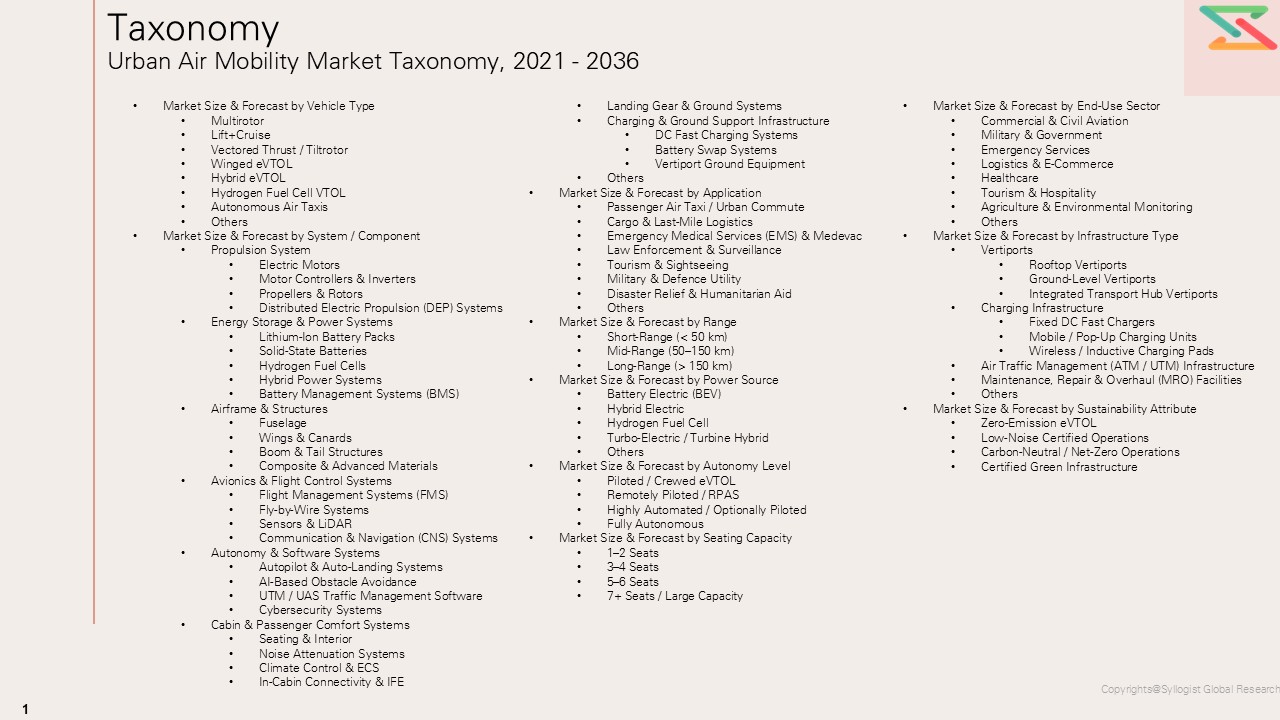
- Market Size & Forecast by Value
- Market Size & Forecast by Vehicle Type
- Multirotor
- Lift+Cruise
- Vectored Thrust / Tiltrotor
- Winged eVTOL
- Hybrid eVTOL
- Hydrogen Fuel Cell VTOL
- Autonomous Air Taxis
- Others
- Market Size & Forecast by System / Component
- Propulsion System
- Electric Motors
- Motor Controllers & Inverters
- Propellers & Rotors
- Distributed Electric Propulsion (DEP) Systems
- Energy Storage & Power Systems
- Lithium-Ion Battery Packs
- Solid-State Batteries
- Hydrogen Fuel Cells
- Hybrid Power Systems
- Battery Management Systems (BMS)
- Airframe & Structures
- Fuselage
- Wings & Canards
- Boom & Tail Structures
- Composite & Advanced Materials
- Avionics & Flight Control Systems
- Flight Management Systems (FMS)
- Fly-by-Wire Systems
- Sensors & LiDAR
- Communication & Navigation (CNS) Systems
- Autonomy & Software Systems
- Autopilot & Auto-Landing Systems
- AI-Based Obstacle Avoidance
- UTM / UAS Traffic Management Software
- Cybersecurity Systems
- Cabin & Passenger Comfort Systems
- Seating & Interior
- Noise Attenuation Systems
- Climate Control & ECS
- In-Cabin Connectivity & IFE
- Landing Gear & Ground Systems
- Charging & Ground Support Infrastructure
- DC Fast Charging Systems
- Battery Swap Systems
- Vertiport Ground Equipment
- Others
- Propulsion System
- Market Size & Forecast by Application
- Passenger Air Taxi / Urban Commute
- Cargo & Last-Mile Logistics
- Emergency Medical Services (EMS) & Medevac
- Law Enforcement & Surveillance
- Tourism & Sightseeing
- Military & Defence Utility
- Disaster Relief & Humanitarian Aid
- Others
- Market Size & Forecast by Range
- Short-Range (< 50 km)
- Mid-Range (50–150 km)
- Long-Range (> 150 km)
- Market Size & Forecast by Power Source
- Battery Electric (BEV)
- Hybrid Electric
- Hydrogen Fuel Cell
- Turbo-Electric / Turbine Hybrid
- Others
- Market Size & Forecast by Autonomy Level
- Piloted / Crewed eVTOL
- Remotely Piloted / RPAS
- Highly Automated / Optionally Piloted
- Fully Autonomous
- Market Size & Forecast by Seating Capacity
- 1–2 Seats
- 3–4 Seats
- 5–6 Seats
- 7+ Seats / Large Capacity
- Market Size & Forecast by End-Use Sector
- Commercial & Civil Aviation
- Military & Government
- Emergency Services
- Logistics & E-Commerce
- Healthcare
- Tourism & Hospitality
- Agriculture & Environmental Monitoring
- Others
- Market Size & Forecast by Infrastructure Type
- Vertiports
- Rooftop Vertiports
- Ground-Level Vertiports
- Integrated Transport Hub Vertiports
- Charging Infrastructure
- Fixed DC Fast Chargers
- Mobile / Pop-Up Charging Units
- Wireless / Inductive Charging Pads
- Air Traffic Management (ATM / UTM) Infrastructure
- Maintenance, Repair & Overhaul (MRO) Facilities
- Others
- Vertiports
- Market Size & Forecast by Sustainability Attribute
- Zero-Emission eVTOL
- Low-Noise Certified Operations
- Carbon-Neutral / Net-Zero Operations
- Certified Green Infrastructure
- Asia-Pacific Urban Air Mobility (eVTOL) Market Outlook
- Market Size & Forecast
- By Value
- By Vehicle Type
- By System / Component
- By Application
- By Range
- By Power Source
- By Autonomy Level
- By Seating Capacity
- By End-Use Sector
- By Infrastructure Type
- By Sustainability Attribute
- Market Size & Forecast
- Europe Urban Air Mobility (eVTOL) Market Outlook
- Market Size & Forecast
- By Value
- By Vehicle Type
- By System / Component
- By Application
- By Range
- By Power Source
- By Autonomy Level
- By Seating Capacity
- By End-Use Sector
- By Infrastructure Type
- By Sustainability Attribute
- Market Size & Forecast
- North America Urban Air Mobility (eVTOL) Market Outlook
- Market Size & Forecast
- By Value
- By Vehicle Type
- By System / Component
- By Application
- By Range
- By Power Source
- By Autonomy Level
- By Seating Capacity
- By End-Use Sector
- By Infrastructure Type
- By Sustainability Attribute
- Market Size & Forecast
- Latin America Urban Air Mobility (eVTOL) Market Outlook
- Market Size & Forecast
- By Value
- By Vehicle Type
- By System / Component
- By Application
- By Range
- By Power Source
- By Autonomy Level
- By Seating Capacity
- By End-Use Sector
- By Infrastructure Type
- By Sustainability Attribute
- Market Size & Forecast
- Middle East & Africa Urban Air Mobility (eVTOL) Market Outlook
- Market Size & Forecast
- By Value
- By Vehicle Type
- By System / Component
- By Application
- By Range
- By Power Source
- By Autonomy Level
- By Seating Capacity
- By End-Use Sector
- By Infrastructure Type
- By Sustainability Attribute
- Market Size & Forecast
- Country Wise* Urban Air Mobility (eVTOL) Market Outlook
- Market Size & Forecast
- By Value
- By Vehicle Type
- By System / Component
- By Application
- By Range
- By Power Source
- By Autonomy Level
- By Seating Capacity
- By End-Use Sector
- By Infrastructure Type
- By Sustainability Attribute
- Market Size & Forecast
*Countries Analyzed in the Syllogist Global Research Portfolio: United States, Canada, Germany, United Kingdom, France, Italy, Netherlands, Switzerland, China, Japan, India, South Korea, Australia, Singapore, UAE, Saudi Arabia, Brazil, Mexico, South Africa
- Technology Landscape & Innovation Analysis
- Value Chain & Supply Chain Analysis
- Pricing Analysis
- Sustainability & Energy Efficiency
- Competitive Landscape
- Market Structure & Concentration
- Market Consolidation Level (Fragmented Vs Consolidated)
- Top 5 Players Market Share
- HHI (Herfindahl–Hirschman Index) Concentration Analysis
- Competitive Intensity Map
- Player Classification
- Market Leaders
- Strong Challengers
- Specialist / Niche Players
- Emerging Players
- Regional Players
- Competitive Analysis Frameworks
- Market Share Analysis
- Company Profile
- Company Overview & HQ
- Products & Solutions Portfolio
- Overall Revenue & Segmental Revenue
- Geographic Presence
- Recent Developments (M&A, Launches, Partnerships)
- SWOT Analysis
- Strategic Focus Areas
- Competitive Positioning Map
- Market Structure & Concentration
- Strategic Output
- Market Opportunity Matrix
- White Space Opportunity Analysis
- Strategic Recommendations
- Vehicle Design & Platform Development Strategy
- Technology & Propulsion Innovation Strategy
- Certification & Regulatory Compliance Strategy
- Infrastructure & Vertiport Deployment Strategy
- Pricing & Business Model Strategy
- Sustainability & Zero-Emission Operations Strategy
- Supply Chain & Component Sourcing Strategy
- Partnership, M&A & Ecosystem Expansion Strategy
- Regional Growth & Market Entry Strategy
- Risk Mitigation & Future Roadmap
- Strategic Priority Matrix & Roadmap
- Near-term (2025–2028)
- Mid-term (2029–2032)
- Long-term (2033–2036)