Market Definition
The India Seed Market encompasses the full commercial value chain involved in the breeding, production, certification, processing, distribution, and retail sale of seeds across all agricultural and horticultural crops cultivated within India. This market spans an extensive spectrum of seed categories, including proprietary hybrid seeds, open-pollinated varieties (OPVs), genetically modified (GM) seeds, currently limited in commercial cultivation to Bt cotton, gene-edited varieties under progressive regulatory delineation, and certified organic seeds. India’s seed sector is uniquely characterised by the coexistence of a mature private-sector hybrid industry, a historically dominant public-sector breeding ecosystem anchored by the Indian Council of Agricultural Research (ICAR) and State Agricultural Universities (SAUs), and a resilient informal farm-saved seed economy that continues to serve a significant proportion of smallholder farmers across rain-fed geographies.
The market definition encompasses seeds for all principal crop systems relevant to India’s agricultural economy: cereals and grains (rice, wheat, maize, sorghum, pearl millet, barley), oilseeds and pulses (soybean, groundnut, mustard, sunflower, tur, masoor, chickpea), cash crops (cotton, sugarcane, jute), fruits and vegetables (tomato, chilli, onion, brinjal, cucumber, bitter gourd, leafy vegetables, watermelon), and forage and turf crops. The market further includes seed treatment technologies, encompassing chemical fungicide and insecticide coatings, biological inoculants, and polymer film coatings, as well as seed production services, foundation and breeder seed programs managed under national missions, and the distribution infrastructure linking seed companies to the nation’s estimated 120+ million farm households.
From a policy standpoint, the Indian seed market is governed by the Seeds Act of 1966, the Seeds Control Order of 1983, and the Protection of Plant Varieties and Farmers’ Rights (PPV&FR) Act of 2001, with a draft Seeds Bill 2025 currently under parliamentary consideration. Regulatory oversight for GM events is exercised by the Genetic Engineering Appraisal Committee (GEAC) under the Ministry of Environment, Forest and Climate Change. The market’s commercial scope, for the purposes of this study, covers formally traded certified and truthfully labelled (TL) seed, while farm-saved seed volumes are referenced for context but excluded from commercial revenue calculations.
Market Insights
As of early 2026, India’s seed market stands as one of the most dynamic and strategically significant agricultural input sectors in the Asia-Pacific region. Valued in the range of USD5.8 billion in 2024 across varying scope definitions, with the wider estimate inclusive of seed treatment, processing services, and the informal seed economy, the formal commercial seed market is projected to grow at a CAGR of 5.6% to 10.5% through 2030–2033, contingent on scope and segmentation methodology. India currently ranks as the world’s fifth-largest seed market, accounting for approximately 4.4% of global commercial seed trade, a share expected to expand as hybrid penetration deepens in under-served crop categories and as food security-driven government missions catalyze new certified seed demand.
Hybrid seed technology dominates India’s commercial seed landscape, commanding a 70.1% revenue share in 2024, supported by yield premiums of 15–35% over OPVs and demonstrable advantages in pest and drought tolerance. Hybrid dominance is most pronounced in cotton (Bt hybrids), maize (single-cross hybrids with high starch content for ethanol), sunflower, sorghum, and the vegetable seed segment. Key crops such as rice and wheat, which together cover nearly 25.8% and 17.0% of India’s total row crop cultivation area respectively, continue to exhibit hybrid penetration below 5% in most geographies, representing the single largest untapped commercial opportunity in the Indian seed sector. National programs including the National Mission on High Yielding Seeds (Budget 2025, INR 100 Crore allocation) and the Mission for Atmanirbharta in pulses are creating structured pull demand for certified hybrid seed in precisely these under-penetrated crop segments.
India made a landmark breakthrough in May 2025 with the launch of its first two genome-edited rice varieties, DRR Rice 100 (Kamala) and Pusa DST Rice 1, making the country the world’s first to release CRISPR-edited rice for commercial cultivation. This milestone signals a new regulatory and commercial frontier, as gene-edited crops developed through site-directed mutagenesis have been differentiated from transgenics under India’s regulatory framework, enabling faster approval timelines and opening a new pipeline of climate-adaptive, non-GM biotech traits. Companies that have built gene-editing pipelines are positioned to benefit disproportionately from this regulatory opening over the 2027–2036 forecast horizon.
The GM seed landscape in India remains anchored by Bt cotton, which underpins the livelihoods of an estimated 6 million cotton farmers across Maharashtra, Telangana, Andhra Pradesh, Gujarat, and Punjab. The Supreme Court litigation surrounding GM mustard (DMH-11) and a continuing moratorium on new food-crop transgenic approvals create significant commercial uncertainty for biotech-focused seed companies seeking to expand GM trait portfolios beyond cotton. Meanwhile, the Draft Seeds Bill 2025, released in November 2025 and under parliamentary consideration as of early 2026, is expected to modernize compulsory seed registration, curb the counterfeit seed trade, which affected 43,001 non-standard seed samples between 2022 and 2025, with West Bengal, Tamil Nadu, and Madhya Pradesh accounting for the highest volumes, and streamline seed import protocols.
Regionally, Maharashtra holds the largest seed market revenue share at 13.6% in 2024, driven by the scale of Bt cotton cultivation and a diversified vegetable seed industry. Haryana is forecast to log the fastest state-level CAGR at 6.7% through 2030, underpinned by wheat intensification, protected cultivation expansion, and the highest per-hectare input spending among Indian states. Uttar Pradesh leads in absolute seed production volume, particularly for paddy, while Bihar and Tamil Nadu are emerging as high-growth vegetable seed markets, with state-level programs such as Tamil Nadu’s Uzhavan app, serving over two million registered farmers, accelerating precision agriculture-aligned seed adoption. The PM Dhan-Dhaanya Krishi Yojana, launched in October 2025 and targeting agricultural development across 100 low-productivity districts, is expected to generate significant incremental seed demand across cereals, pulses, and vegetables through the forecast period.
The private sector’s share of Indian seed production has grown from 57.28% in 2018–19 to 64.46% in 2020–21, and this trajectory is expected to continue as domestic companies such as Kaveri Seed Company (net sales of INR 808 crore in June 2024, up 5.32% year-on-year), Nuziveedu Seeds, Mahyco, and VNR Seeds intensify R&D investment and expand geographic reach, while multinational players including Bayer, Syngenta, Corteva, and BASF deepen their India-specific germplasm programs and distribution partnerships.
Key Drivers
Government-Led Food Security Missions and National Seed Programs
India’s Union Budget 2025–26 marked a pivotal acceleration in the government’s investment in the seed sector, establishing the National Mission on High Yielding Seeds with an initial allocation of INR 100 Crore (approximately USD 12.1 million) to strengthen research ecosystems, develop climate-resilient and pest-resistant varieties, and ensure commercial availability of over 100 seed varieties released since July 2024. The parallel PM Dhan-Dhaanya Krishi Yojana, targeting 100 low-productivity agricultural districts with integrated investments in irrigation, seed quality, credit, and storage, is expected to unlock structured certified seed demand across previously underserved smallholder geographies. The six-year Mission for Atmanirbharta in pulses, channelling subsidised foundation seed into tur and masoor production clusters, further expands the commercial seed addressable market by reducing dependence on farm-saved pulse seed. These concurrent national programs create a sustained policy-backed demand floor that de-risks long-term investment in certified seed multiplication and distribution infrastructure.
Rising Hybrid Penetration in Under-Served Crop Categories
The most powerful organic growth driver within India’s seed market is the structural expansion of hybrid adoption into crop categories historically dominated by farm-saved or public-bred OPVs. Rice, wheat, and several pulse crops, which together constitute the majority of India’s net sown area, exhibit commercial hybrid penetration below 5%, in stark contrast to cotton (near 100% Bt hybrid), maize (approximately 60%), and vegetables (79.4% hybrid share in 2024). Public-private breeding consortia, supported by molecular breeding and doubled haploid technologies that have shortened hybrid development cycles from eleven to seven years, are expanding the commercially viable hybrid portfolio for these large-area staple crops. Each percentage point of hybrid adoption gained in rice and wheat translates directly into hundreds of millions of dollars of incremental certified seed revenue, making this the highest-priority commercial frontier for both domestic and multinational seed companies operating in India.
Gene Editing Regulatory Breakthrough and Biotechnology Pipeline Expansion
India’s May 2025 commercial release of CRISPR-edited rice varieties, the world’s first such regulatory approval for rice, represents a transformative catalyst for India’s seed innovation landscape. The government’s differentiation of site-directed mutagenesis-based gene-edited crops from transgenic GMOs under a streamlined regulatory pathway significantly reduces approval timelines and R&D risk for a new generation of climate-adaptive, yield-optimised seed varieties. Public sector research has already developed gene-edited lines for rice carrying drought tolerance and salinity resistance traits, and confined field trials for additional edited varieties are scheduled for 2026. This regulatory opening is expected to catalyse a wave of private sector gene editing investment by domestic companies and multinational breeders, progressively expanding the commercial biotech seed pipeline well beyond the current Bt cotton boundary over the 2027–2036 forecast horizon.
Population Growth, Dietary Diversification, and Expanding Vegetable Seed Demand
India’s population of approximately 1.44 billion, projected to remain the world’s largest through the 2036 forecast horizon, exerts persistent structural demand pressure on the agricultural system to increase caloric output, improve nutritional quality, and diversify food supply. Rising per-capita incomes, rapid urbanisation, and the expansion of organised food retail and food processing are significantly shifting consumer diets toward proteins, vegetables, fruits, and processed foods, creating outsized demand growth for vegetable and specialty crop seeds. The India vegetable seed market, valued at USD 740.7 million in 2025, is projected to reach USD 970 million by 2030 at a 5.54% CAGR, with hybrids maintaining a 79.4% technology share. Protected cultivation, growing at an 11.1% CAGR, is generating premium demand for greenhouse-adapted hybrid varieties with compact architecture, extended shelf-life, and heat tolerance, traits that command significantly higher seed prices than open-field commodity varieties.
Ethanol Blending Policy and Maize Seed Demand Acceleration
India’s National Biofuel Policy and its ethanol blending mandate, targeting a 20% blend ratio in petrol by 2025–26, has established maize as a strategic industrial crop in addition to its traditional food and feed roles. The policy creates sustained demand pull for high-starch maize hybrids optimised for industrial fermentation, directly expanding the commercial maize seed market across new geographies including eastern India and the southern states. With crop production having increased 44% over the past decade driven by improved seed varieties, maize seed demand is expected to benefit disproportionately from the intersection of biofuel policy support, ethanol pricing incentives, and the continued expansion of double-cropping under irrigated conditions, creating a structurally reinforced growth runway for the premium hybrid maize seed segment through 2036.
Key Challenges
Counterfeit and Spurious Seed Proliferation
The proliferation of counterfeit, sub-standard, and mislabelled seeds constitutes one of the most acute structural challenges confronting India’s commercial seed market. Between 2022 and 2025, government testing identified 43,001 non-standard seed samples across states, with West Bengal alone accounting for 62% of total failures, followed by Tamil Nadu and Madhya Pradesh. High-profile crop failure incidents, including widespread maize and chilli crop failures in Telangana, vegetable failures in Rajasthan, and Bt cotton failures in Andhra Pradesh, have eroded farmer confidence in branded seeds, created reputational risk for legitimate commercial seed companies, and generated significant political pressure on regulatory institutions. Combating counterfeit seeds requires multi-layered investments in tamper-proof packaging, QR-code-enabled traceability, blockchain-backed provenance systems, and enforcement capacity that many seed companies, particularly smaller domestic players, find difficult to sustain at scale.
Prolonged and Uncertain GM and Gene-Edited Crop Approval Pathways
Despite the landmark CRISPR rice approvals of 2025, the broader GM crop regulatory environment in India remains characterised by protracted timelines, judicial interventions, and policy inconsistency that significantly constrain commercial biotech seed investment. Supreme Court litigation over biosafety assessments has maintained an effective moratorium on the commercial cultivation of new food-crop transgenics, leaving GM mustard (DMH-11), Bt brinjal, and a range of other advanced trait events in legal and regulatory limbo for extended periods. This policy uncertainty deflects R&D investment toward non-transgenic trait strategies, narrows the technology menu available to breeders, and creates commercial asymmetries that favour companies in less-regulated markets. The Draft Seeds Bill 2025, while positively received by the seed industry federation, faces continued opposition from farmer organizations and civil society groups, adding further uncertainty to the legislative timeline for regulatory modernisation.
Fragmented Landholdings and Smallholder Seed Affordability Constraints
India’s agricultural structure is defined by extreme landholding fragmentation, with the average operational holding estimated at below 1.1 hectares and the majority of India’s approximately 120 million farm households operating as marginal or smallholder farmers. This structural fragmentation creates persistent barriers to the adoption of premium certified hybrid seeds, as the higher per-unit cost of commercial varieties, particularly proprietary hybrids and imported vegetable seed lines, represents a disproportionately large share of input budgets for small operators with limited credit access. The high cost of Bt cotton seed has historically been a significant source of farmer distress in cotton belt states. Without scalable input financing mechanisms, farmer producer organisation (FPO) aggregation models, and smallholder-adapted packaging and pricing strategies, the commercial seed market’s total accessible farmer base remains artificially constrained relative to India’s theoretical agricultural scale.
Climate Vulnerability, Monsoon Dependence, and Supply Chain Fragility
India’s agricultural system, and therefore its seed demand cycle, is acutely exposed to monsoon variability and climate-driven growing season disruption. Approximately 55% of India’s net sown area remains rain-fed, making seed purchasing decisions, kharif planting windows, and farmer cash flows highly sensitive to pre-monsoon forecasts, in-season rainfall distribution, and post-harvest price outcomes. Delayed or deficient monsoon years directly suppress certified seed sales volumes, compress seed company working capital cycles, and create excess seed inventory that can destabilise pricing in subsequent seasons. Simultaneously, rising incidences of unseasonal rainfall, heat stress events during critical crop reproductive phases, and expanded pest ranges driven by warming temperatures are shortening the useful commercial lifespan of existing elite varieties, accelerating the pace at which breeders must develop and register replacement varieties with updated stress tolerance profiles.
Intellectual Property Disputes and Trait Fee Governance
India’s seed market has been periodically disrupted by disputes over trait fee pricing, compulsory licensing provisions, and the applicability of patent protection to seed technologies under the PPV&FR Act of 2001 and Indian patent law. The Bt cotton trait fee dispute between the government and Monsanto India, involving state-mandated price reductions on Bollgard II technology licensing fees, established a precedent that has created sustained investor uncertainty around the commercial viability of introducing new proprietary biotech seed technologies into the Indian market. Multinational seed companies considering commercialisation of next-generation traits weigh the risk of post-commercialisation trait fee regulation as a primary market entry deterrent, dampening the flow of global seed technology investment into India and slowing the availability of advanced trait portfolios for Indian farmers.
Market Segmentation
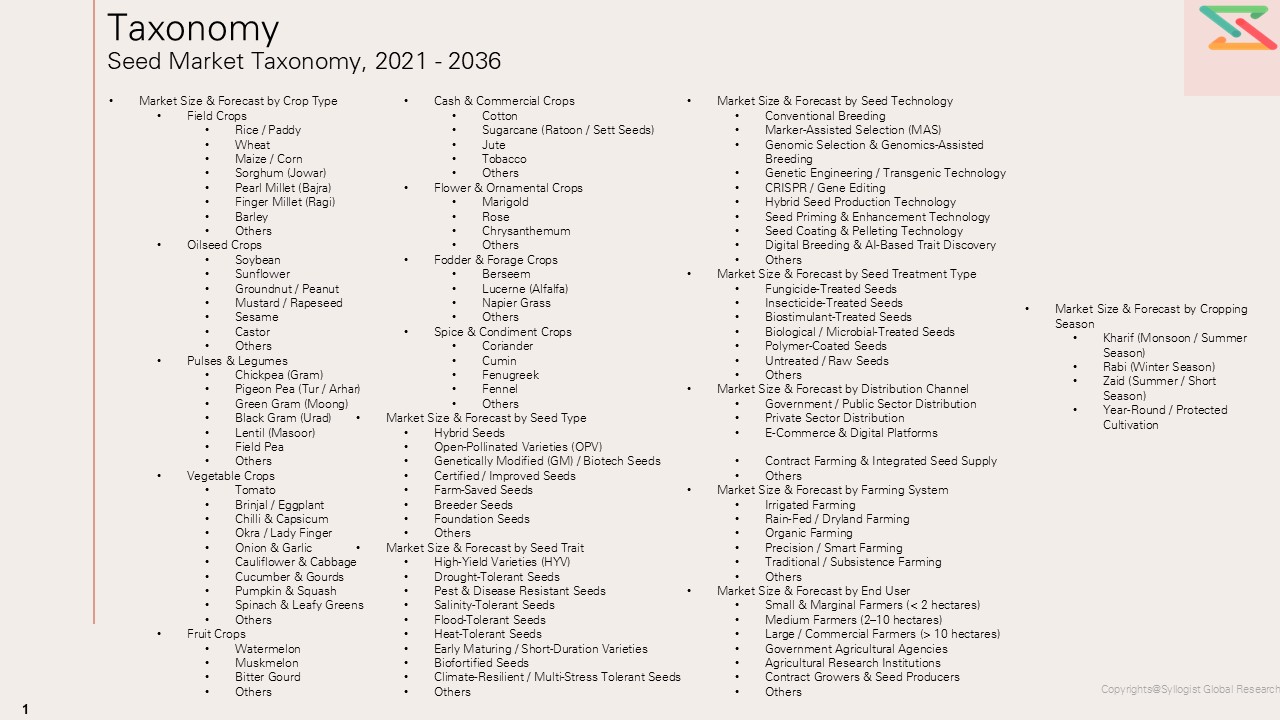
- Segmentation by Crop Type
- Field Crops
- Rice / Paddy
- Wheat
- Maize / Corn
- Sorghum (Jowar)
- Pearl Millet (Bajra)
- Finger Millet (Ragi)
- Barley
- Others
- Oilseed Crops
- Soybean
- Sunflower
- Groundnut / Peanut
- Mustard / Rapeseed
- Sesame
- Castor
- Others
- Pulses & Legumes
- Chickpea (Gram)
- Pigeon Pea (Tur / Arhar)
- Green Gram (Moong)
- Black Gram (Urad)
- Lentil (Masoor)
- Field Pea
- Others
- Vegetable Crops
- Tomato
- Brinjal / Eggplant
- Chilli & Capsicum
- Okra / Lady Finger
- Onion & Garlic
- Cauliflower & Cabbage
- Cucumber & Gourds
- Pumpkin & Squash
- Spinach & Leafy Greens
- Others
- Fruit Crops
- Watermelon
- Muskmelon
- Bitter Gourd
- Others
- Cash & Commercial Crops
- Cotton
- Sugarcane (Ratoon / Sett Seeds)
- Jute
- Tobacco
- Others
- Flower & Ornamental Crops
- Marigold
- Rose
- Chrysanthemum
- Others
- Fodder & Forage Crops
- Berseem
- Lucerne (Alfalfa)
- Napier Grass
- Others
- Spice & Condiment Crops
- Coriander
- Cumin
- Fenugreek
- Fennel
- Others
- Field Crops
- Segmentation by Seed Type
- Hybrid Seeds
- Single Cross Hybrids
- Double Cross Hybrids
- Three-Way Cross Hybrids
- Open-Pollinated Varieties (OPV)
- Genetically Modified (GM) / Biotech Seeds
- Bt Seeds
- HT (Herbicide-Tolerant) Seeds
- Stacked Trait Seeds
- Certified / Improved Seeds
- Farm-Saved Seeds
- Breeder Seeds
- Foundation Seeds
- Others
- Hybrid Seeds
- Segmentation by Seed Trait
- High-Yield Varieties (HYV)
- Drought-Tolerant Seeds
- Pest & Disease Resistant Seeds
- Salinity-Tolerant Seeds
- Flood-Tolerant Seeds
- Heat-Tolerant Seeds
- Early Maturing / Short-Duration Varieties
- Biofortified Seeds
- Climate-Resilient / Multi-Stress Tolerant Seeds
- Others
- Segmentation by Seed Technology
- Conventional Breeding
- Marker-Assisted Selection (MAS)
- Genomic Selection & Genomics-Assisted Breeding
- Genetic Engineering / Transgenic Technology
- CRISPR / Gene Editing
- Hybrid Seed Production Technology
- Seed Priming & Enhancement Technology
- Hydropriming
- Osmopriming
- Chemical Priming
- Bio-priming
- Seed Coating & Pelleting Technology
- Digital Breeding & AI-Based Trait Discovery
- Others
- Segmentation by Seed Treatment Type
- Fungicide-Treated Seeds
- Insecticide-Treated Seeds
- Biostimulant-Treated Seeds
- Biological / Microbial-Treated Seeds
- Rhizobium Inoculated
- Mycorrhizal Treated
- Bacillus-Based Treatment
- Polymer-Coated Seeds
- Untreated / Raw Seeds
- Others
- Segmentation by Distribution Channel
- Government / Public Sector Distribution
- National Seeds Corporation (NSC)
- State Seeds Corporations (SSCs)
- Krishi Vigyan Kendras (KVKs) & Extension Services
- Private Sector Distribution
- Agro-Input Dealers & Retailers
- Seed Company Direct Distribution
- Cooperative Societies
- E-Commerce & Digital Platforms
- Agri-Tech Marketplaces
- Direct-to-Farmer Online Channels
- Contract Farming & Integrated Seed Supply
- Others
- Government / Public Sector Distribution
- Segmentation by Farming System
- Irrigated Farming
- Rain-Fed / Dryland Farming
- Organic Farming
- Precision / Smart Farming
- Traditional / Subsistence Farming
- Others
- Segmentation by End User
- Small & Marginal Farmers (< 2 hectares)
- Medium Farmers (2–10 hectares)
- Large / Commercial Farmers (> 10 hectares)
- Government Agricultural Agencies
- Agricultural Research Institutions
- Contract Growers & Seed Producers
- Others
- Segmentation by Cropping Season
- Kharif (Monsoon / Summer Season)
- Rabi (Winter Season)
- Zaid (Summer / Short Season)
- Year-Round / Protected Cultivation
- Segmentation by Crop Type
All market revenues are presented in USD
Historical Year: 2021–2024 | Base Year: 2025 | Estimated Year: 2026 | Forecast Period: 2027–2036
Key Questions this Study Will Answer
- What is the projected market valuation (USD billion) and volume (metric tonnes) for India’s commercial seed market across all crop categories through 2036, disaggregated by seed type, crop, state, and distribution channel? This provides the quantitative foundation required for strategic capital allocation, portfolio prioritisation, and competitive benchmarking for both domestic and multinational seed companies operating in India.
- How will the National Mission on High Yielding Seeds, the PM Dhan-Dhaanya Krishi Yojana, the Mission for Atmanirbharta in pulses, and other government agricultural missions shape certified seed demand volumes across low-productivity districts and underserved crop-region combinations through the forecast period, and which seed categories and geographies stand to benefit most?
- What is the commercial trajectory for hybrid seed penetration in rice, wheat, and key pulse crops, currently below 5% in most geographies, and what breeding technology investments, government policy catalysts, and distribution model innovations are most critical to unlocking large-scale adoption in these high-acreage staple crop segments?
- How will India’s landmark CRISPR rice variety approvals (May 2025) and the broader regulatory differentiation of gene-edited crops from GM transgenics reshape the seed innovation pipeline, R&D investment strategies of private seed companies, and the competitive positioning of domestic breeders relative to multinational players through 2036?
- What is the current scale and commercial impact of counterfeit and spurious seed proliferation in India, and how effective are traceability technologies, including QR codes, blockchain provenance systems, and tamper-proof packaging, in curbing quality failures that have compromised farmer confidence and eroded brand equity for commercial seed companies?
- How will the pending Seeds Bill 2025, currently under parliamentary consideration, alter the seed registration and certification framework, reshape competitive dynamics between multinational and domestic seed companies, and affect the rights and purchasing behaviour of India’s smallholder farming majority?
- What role will India’s ethanol blending mandate and biofuel policy play in driving incremental demand for high-starch maize hybrids, and how are leading seed companies repositioning their maize portfolios to capture the growing industrial-use market alongside food and feed demand segments through 2036?
- Who are the dominant companies in the Indian seed market, including Kaveri Seed Company, Nuziveedu Seeds, Mahyco, VNR Seeds, Bayer Crop Science, Syngenta, Corteva, BASF, and UPL Advanta, and what are the key determinants of competitive advantage including germplasm breadth, state-level distribution density, pricing strategy, and digital agronomy service integration?
- Product Definition
- Research Methodology
- Research Design & Framework
- Overall Research Approach: Descriptive, Exploratory & Quantitative Mixed-Method Design
- Market Definition & Scope Boundaries: What is Included and Excluded
- Segmentation Framework
- Key Research Assumptions & Limitations
- Secondary Research
- Primary Research Design & Execution
- Data Triangulation & Validation
- Market Sizing & Forecasting Methodology
- Competitive Intelligence Methodology
- Quality Assurance & Peer Review
- Definitions, Abbreviations & Data Notes
- Research Design & Framework
- Executive Summary
- Market Snapshot & Headline Numbers
- Key Findings & Research Highlights
- Market Dynamics
- Regional Market Summary
- Competitive Landscape Snapshot
- Technology & Innovation Highlights
- Market Dynamics
- Drivers
- Restraints
- Opportunities
- Challenges
- Porter’s Five Forces Analysis
- PESTLE Analysis
- Market Trends & Developments
- Emerging Trends
- Technological Developments
- Regulatory & Policy Changes
- Supply Chain & Sourcing Trends
- Farmer Adoption & Demand Trends
- Investment & Funding Activity
- Sustainability & ESG Trends
- Geographic & Regional Trends
- Risk Assessment Framework
- Geopolitical & Political Risk
- Climate & Agronomic Risk
- Regulatory & IP Risk
- Financial / Market Risk
- Supply Chain & Seed Quality Risk
- Biosafety & Environmental Risk
- Regulatory Framework & Standards
- India Seed Market Outlook
- Market Size & Forecast by Value
- Market Size & Forecast by Volume
- Market Size & Forecast by Crop Type
- Field Crops
- Rice / Paddy
- Wheat
- Maize / Corn
- Sorghum (Jowar)
- Pearl Millet (Bajra)
- Finger Millet (Ragi)
- Barley
- Others
- Oilseed Crops
- Soybean
- Sunflower
- Groundnut / Peanut
- Mustard / Rapeseed
- Sesame
- Castor
- Others
- Pulses & Legumes
- Chickpea (Gram)
- Pigeon Pea (Tur / Arhar)
- Green Gram (Moong)
- Black Gram (Urad)
- Lentil (Masoor)
- Field Pea
- Others
- Vegetable Crops
- Tomato
- Brinjal / Eggplant
- Chilli & Capsicum
- Okra / Lady Finger
- Onion & Garlic
- Cauliflower & Cabbage
- Cucumber & Gourds
- Pumpkin & Squash
- Spinach & Leafy Greens
- Others
- Fruit Crops
- Watermelon
- Muskmelon
- Bitter Gourd
- Others
- Cash & Commercial Crops
- Cotton
- Jute
- Tobacco
- Others
- Flower & Ornamental Crops
- Marigold
- Zinnia
- Cosmos
- Petunia
- Others
- Fodder & Forage Crops
- Berseem
- Lucerne (Alfalfa)
- Napier Grass
- Others
- Spice & Condiment Crops
- Coriander
- Cumin
- Fenugreek
- Fennel
- Others
- Market Size & Forecast by Seed Type
- Hybrid Seeds
- Single Cross Hybrids
- Double Cross Hybrids
- Three-Way Cross Hybrids
- Open-Pollinated Varieties (OPV)
- Genetically Modified (GM) / Biotech Seeds
- Hybrid Seeds
- Market Size & Forecast by Seed Trait
- Yield Enhancement Traits (High-Yield Varieties -HYV, Improved Harvest Index)
- Abiotic Stress Tolerance Traits
- Drought-Tolerant Seeds
- Heat-Tolerant Seeds
- Flood-Tolerant Seeds/ Waterlogging Tolerant
- Salinity-Tolerant Seeds
- Climate-Resilient / Multi-Stress Tolerant Seeds
- Biotic Stress Resistance Traits
- Pest Resistant Seeds
- Disease Resistant Seeds
- Agronomic Efficiency Traits
- Early Maturing / Short-Duration Varieties
- Lodging Resistant
- Nutritional / Quality Traits
- Biofortified Seeds
- Protein / Quality Enhanced
- Others
- Market Size & Forecast by Source of Supply
- Government / Public Sector Distribution
- National Seeds Corporation (NSC)
- State Farms Corporation of India (SFCI)
- State Seed Development Corporations (SSDCs)
- Private Sector Distribution
- Multinational Companies
- Indian Private Companies
- Startups & AgriTech Seed Companies
- Cooperative Sector
- Government / Public Sector Distribution
- Market Size & Forecast by Seed Class
- Certified Seeds
- Truthful Label (TL) Seeds
- Market Size & Forecast by Sales Channel
- Organized / Formal Channel
- Company-Owned Retail Outlets / Agri-Input Stores
- Registered Seed Dealers & Distributors
- Agrochemical + Seed Combo Retailers
- Cooperative Societies & PACs
- Government Distribution
- E-Commerce / Digital Channel
- Company Direct
- AgriTech Platforms
- General E-Commerce
- Market Size & Forecast by Farming System
- Conventional / Mainstream Farming Seeds
- Organic & Natural Farming Seeds
- Protected Cultivation Seeds
- Others
- Market Size & Forecast by Cropping Season
- Kharif (Monsoon / Summer Season)
- Rabi (Winter Season)
- Zaid (Summer / Short Season)
- Year-Round / Protected Cultivation
- North India Seed Market Outlook
- Market Size & Forecast
- By Value
- By Volume
- By Crop Type
- By Seed Type
- By Seed Trait
- By Source of Supply
- By Seed Class
- By Sales Channel
- By Farming System
- By Cropping Season
- East India Seed Market Outlook
- Market Size & Forecast
- By Value
- By Volume
- By Crop Type
- By Seed Type
- By Seed Trait
- By Source of Supply
- By Seed Class
- By Sales Channel
- By Farming System
- By Cropping Season
- West India Seed Market Outlook
- Market Size & Forecast
- By Value
- By Volume
- By Crop Type
- By Seed Type
- By Seed Trait
- By Source of Supply
- By Seed Class
- By Sales Channel
- By Farming System
- By Cropping Season
- South India Seed Market Outlook
- Market Size & Forecast
- By Value
- By Volume
- By Crop Type
- By Seed Type
- By Seed Trait
- By Source of Supply
- By Seed Class
- By Sales Channel
- By Farming System
- By Cropping Season
- State Wise* Seed Market Outlook
- Market Size & Forecast
- By Value
- By Volume
- By Crop Type
- By Seed Type
- By Seed Trait
- By Source of Supply
- By Seed Class
- By Sales Channel
- By Farming System
- By Cropping Season
- Market Size & Forecast
- Market Size & Forecast
- Market Size & Forecast
- Market Size & Forecast
- Market Size & Forecast
- Organized / Formal Channel
- Field Crops
*States Analyzed in the Syllogist India Research Portfolio: Uttar Pradesh, Maharashtra, Madhya Pradesh, Rajasthan, Telangana, Gujarat, Karnataka, Andhra Pradesh, Punjab, West Bengal, Haryana, Bihar, Tamil Nadu, Odisha, Chhattisgarh, Assam, Jharkhand, Uttarakhand, Himachal Pradesh, Kerala, Jammu & Kashmir, Manipur, Tripura, Meghalaya, Nagaland
- India Seed Treatment Market Outlook
- Market Size & Forecast by Value
- Market Size & Forecast by Treatment Type
- Chemical Seed Treatment
- Fungicide-Based Treatment
- Insecticide-Based Treatment
- Combined Fungicide + Insecticide Treatment
- Nematicide-Based Treatment
- Herbicide Safener Treatment
- Biological Seed Treatment
- Microbial Inoculants (Rhizobium, Azospirillum, Azotobacter, Phosphate Solubilizing Bacteria (PSB), Mycorrhizal Fungi (VAM))
- Biocontrol Agents (Trichoderma spp., Pseudomonas fluorescens, Bacillus subtilis, Beauveria bassiana)
- Biostimulant-Based Treatment (Seaweed Extract-Based, Humic Acid-Based, Amino Acid-Based)
- Physical / Thermal Seed Treatment
- Hot Water Treatment (Thermotherapy)
- Solar Treatment
- UV / Radiation Treatment
- Dry Heat Treatment
- Combination / Integrated Seed Treatment (Chemical + Biological combined on same seed)
- Others
- Chemical Seed Treatment
- Market Size & Forecast by Application Technology
- Seed Dressing
- Dry Dressing
- Wet Dressing
- Seed Priming
- Hydropriming
- Osmopriming
- Halopriming
- Chemical Priming
- Bio-priming
- Thermopriming
- Solid Matrix Priming
- Nano-priming
- Seed Coating
- Film Coating
- Pelleting
- Encrusting
- Seed Dipping / Soaking
- Others
- Seed Dressing
- Market Size & Forecast by Active Ingredient
- By Fungicide Chemistry
- Triazoles
- Tebuconazole
- Propiconazole
- Ipconazole
- Difenoconazole
- Others
- Benzimidazoles
- Carbendazim
- Thiabendazole
- Others
- Phenylpyrroles
- SDHI (Succinate Dehydrogenase Inhibitors)
- Sedaxane
- Penflufen
- Isopyrazam
- Others
- Strobilurins
- Azoxystrobin
- Thiram
- Others
- Multi-site Contact Fungicides
- Thiram
- Captan
- Mancozeb
- Others
- Combination Fungicide Products
- Triazoles
- By Insecticide Chemistry
- Neonicotinoids
- Imidacloprid
- Thiamethoxam
- Clothianidin
- Organophosphates
- Pyrethroids
- Diamides
- Combination Insecticide Products
- Neonicotinoids
- Combination (Fungicide + Insecticide) Products
- By Fungicide Chemistry
- Market Size & Forecast by Crop Type
- Cereals
- Rice / Paddy
- Wheat
- Maize
- Sorghum & Millets
- Barley
- Other Cereals
- Oilseeds
- Soybean
- Groundnut
- Mustard / Rapeseed
- Sunflower
- Other Oilseeds
- Pulses
- Chickpea
- Pigeon Pea
- Lentil
- Green Gram / Black Gram
- Other Pulses
- Cotton
- Vegetables
- Fruits & Plantation Crops
- Spices
- Forage Crops
- Cereals
- Market Size & Forecast by Formulation Type
- Suspension Concentrate for Seed Treatment
- Water-Dispersible Powder for Seed Treatment (WS)
- Emulsion for Seed Treatment (ES)
- Wettable Powder (WP)
- Flowable Concentrate for Seed Treatment (CF)
- Dustable Powder (DS)
- Granule (GR)
- Liquid Inoculant Formulations
- Polymer-Based Formulations
- Market Size & Forecast by End Use
- Commercial Seed Companies
- Contract Seed Treatment Service Providers
- Farmers / On-Farm Treatment
- Government / Public Sector
- Research Institutions
- Market Size & Forecast by Distribution Chennel
- Direct Sales to Seed Companies
- Agri-Input Distributors & Dealers
- Cooperative Societies
- Government Procurement & Distribution
- E-Commerce / AgriTech Platforms
- North India Seed Market Outlook
- Market Size & Forecast
- By Value
- By Treatment Type
- By Application Technology
- By Active Ingredients
- By Crop Type
- By Formulation Type
- By End Use
- By Distribution Channel
- East India Seed Market Outlook
- Market Size & Forecast
- By Value
- By Treatment Type
- By Application Technology
- By Active Ingredients
- By Crop Type
- By Formulation Type
- By End Use
- By Distribution Channel
- West India Seed Market Outlook
- Market Size & Forecast
- By Value
- By Treatment Type
- By Application Technology
- By Active Ingredients
- By Crop Type
- By Formulation Type
- By End Use
- By Distribution Channel
- South India Seed Market Outlook
- Market Size & Forecast
- By Value
- By Treatment Type
- By Application Technology
- By Active Ingredients
- By Crop Type
- By Formulation Type
- By End Use
- By Distribution Channel
- State Wise* Seed Market Outlook
- Market Size & Forecast
- By Value
- By Treatment Type
- By Application Technology
- By Active Ingredients
- By Crop Type
- By Formulation Type
- By End Use
- By Distribution Channel
- Market Size & Forecast
- Market Size & Forecast
- Market Size & Forecast
- Market Size & Forecast
- Market Size & Forecast
- Technology Landscape & Innovation Analysis
- Value Chain & Supply Chain Analysis
- Pricing Analysis
- Sustainability & Environmental Impact
- Competitive Landscape
- Market Structure & Concentration
- Market Consolidation Level (Fragmented Vs Consolidated)
- Top 5 Players Market Share
- HHI (Herfindahl–Hirschman Index) Concentration Analysis
- Competitive Intensity Map
- Player Classification
- Market Leaders
- Strong Challengers
- Specialist / Niche Players
- Emerging Players
- Regional Players
- Competitive Analysis Frameworks
- Market Share Analysis
- Company Profile
- Company Overview & HQ
- Products & Solutions Portfolio
- Overall Revenue & Segmental Revenue
- Geographic Presence
- Recent Developments (M&A, Launches, Partnerships)
- SWOT Analysis
- Strategic Focus Areas
- Competitive Positioning Map
- Market Structure & Concentration
- Strategic Output
- Market Opportunity Matrix
- White Space Opportunity Analysis
- Strategic Recommendations
- Seed Portfolio & Crop Expansion Strategy
- Hybrid & Biotech Seed Development Strategy
- Seed Treatment & Enhancement Strategy
- Distribution Network & Channel Penetration Strategy
- Pricing & Commercial Strategy
- Regulatory Compliance & IP Protection Strategy
- Sustainability & Climate-Resilient Seed Strategy
- Farmer Outreach, Education & Extension Strategy
- Partnership, M&A & Expansion Strategy
- Regional & State-Level Growth Strategy
- Risk Mitigation & Future Roadmap
- Strategic Priority Matrix & Roadmap
- Near-term (2025–2028)
- Mid-term (2029–2032)
- Long-term (2033–2036)