Market Definition
The Global Seed Market encompasses the entire commercial ecosystem involved in the research, development, production, processing, treatment, distribution, and sale of seeds intended for agricultural, horticultural, and specialty crop production worldwide. This market includes a wide spectrum of seed types, ranging from conventional open-pollinated varieties (OPVs) and proprietary hybrid seeds to advanced genetically modified (GM) and gene-edited varieties developed through precision breeding technologies such as CRISPR-Cas9 and marker-assisted selection (MAS). Seeds serve as the foundational input of the global food supply chain, directly influencing crop yield, quality, disease resistance, and resource efficiency across field crops, fruits and vegetables, and other specialty categories.
The market further incorporates seed treatment technologies, including biological, chemical, and polymer coatings designed to enhance germination rates and protect seedlings from early-stage pests, pathogens, and abiotic stressors. From a commercial standpoint, the market is bifurcated between commercial seeds, formally bred, certified, and sold through organized trade channels, and farm-saved seeds, though the latter are progressively being displaced in many regions by the superior performance attributes and regulatory support afforded to commercially certified varieties. The market spans diverse end-users, including large-scale commodity farmers, smallholder growers, greenhouse operators, and vertical farming enterprises, each with distinct seed performance requirements and purchasing behaviors.
Market Insights
As of early 2026, the global seed market is experiencing a structural transformation driven by the convergence of biotechnology, digital agriculture, and intensifying food security imperatives. The market was valued at approximately USD65 billion in 2024 and is projected to reach USD 148 billion by 2036. This robust expansion is underpinned by the imperative to feed a global population projected to surpass 9.6 billion by 2050, requiring an estimated 70% increase in overall food production relative to the 2005–2007 baseline, according to FAO projections.
A defining trend shaping the 2025–2026 market landscape is the accelerated adoption of hybrid seed technology, which captured a 72.65% share of global seed revenue in 2025. Hybrid seeds, characterized by heterosis-driven yield advantages, uniformity, and stacked-trait capabilities, have become the commercial standard in high-value row crops including corn, rice, and sunflower. The hybrid segment is forecast to grow at a 5.47% CAGR through 2031, with penetration deepening in emerging markets where key crops such as paddy and wheat have historically maintained hybrid penetration below 5%. Multinational seed companies are intensifying their investment in expanding hybrid portfolios for these underserved crop-region combinations, representing a significant untapped commercial opportunity.
The GM seed segment continues to expand, anchored by herbicide-tolerant (HT) and insect-resistant (Bt) trait stacks predominantly deployed in commodity crops including corn, soybean, cotton, and canola. In 2024, HT seeds accounted for 41.6% of all biotech seed hectares planted globally. Simultaneously, gene-edited seed varieties, developed through non-transgenic technologies such as CRISPR-Cas9, are gaining regulatory acceptance in key jurisdictions including the United States, Japan, Brazil, and increasingly in the European Union under a differentiated regulatory framework. This regulatory evolution is shortening innovation-to-market cycles and enabling the commercialization of novel trait portfolios addressing heat tolerance, drought resistance, nitrogen use efficiency, and improved nutritional profiles.
Geographically, North America retained the largest market share at 34.6–34.9% in 2024–2025, driven by the extensive adoption of biotech seeds in large-scale commodity agriculture and the strong R&D infrastructure of leading agribusiness firms. However, the Asia-Pacific region is emerging as the primary growth engine, propelled by rising food demand in India and China, the expansion of protected cultivation in urban farming corridors, and government-driven agricultural modernization programs. Latin America, led by Brazil and Argentina, represents a key growth market supported by large-scale soy and corn production and high commercial seed adoption rates. Africa and the Middle East remain nascent but increasingly strategic markets, as rising agricultural value-added and international development investments unlock demand for improved seed varieties.
The integration of digital agriculture tools, including AI-driven phenotyping, satellite-based field monitoring, and precision planting technologies, is creating new commercial linkages between seed development pipelines and farm-level decision-making. Seed companies are increasingly packaging proprietary seed genetics with agronomic data services and crop management platforms, creating value-added ecosystems that deepen farmer dependency on commercial seed programs and generate recurring revenue streams beyond the seed transaction itself.
Key Drivers
Population Growth and Global Food Security Imperatives
The foremost structural driver of the global seed market is the relentless increase in global population and the consequent pressure on agricultural systems to deliver more calories per unit of arable land. With global population projected to reach 9.66 billion by 2050 and the FAO estimating that food production must increase by approximately 70% from the 2005–2007 baseline, the seed industry is positioned as the central vehicle for productivity enhancement. This imperative translates directly into sustained investment in high-yield hybrid and biotech seed varieties, as farmers at all scales seek certified, performance-verified genetics to maximize output and mitigate the risk of crop failure.
Accelerated Biotechnology Innovation and Precision Breeding
Advances in agricultural biotechnology, most notably CRISPR-Cas9 gene editing, genomic selection, and high-throughput phenotyping, are fundamentally compressing the seed development pipeline, reducing the time to commercialize new trait innovations from over a decade to as few as four to six years. Leading seed companies including Bayer (Crop Science), Corteva Agriscience, Syngenta, and BASF are channeling 9–10% of their agricultural division revenues into R&D, focused on delivering multi-stress tolerance stacks, enhanced nutritional profiles, and climate-adaptive germplasm. The progressive regulatory acceptance of gene-edited varieties in major agricultural economies is further amplifying the commercial pipeline available to breeders, substantially expanding the total addressable market for premium seed technology.
Climate Change and Rising Demand for Stress-Tolerant Varieties
Increasing climate variability, manifesting as prolonged droughts, erratic rainfall, rising ambient temperatures, and accelerated shifts in pest and disease pressure, is creating urgent demand for seed varieties engineered for resilience and adaptive performance. Farmers across major production geographies are transitioning away from traditional landraces and heritage OPVs toward certified hybrid and biotech varieties that offer demonstrable yield stability under adverse growing conditions. This demand signal is directing significant R&D capital toward drought tolerance, heat resistance, and soil salinity adaptation programs, and is elevating the strategic importance of seed genetics as a primary tool for climate risk management across global food supply chains.
Expansion of Precision Agriculture and Digital Farming Ecosystems
The rapid proliferation of precision agriculture technologies, encompassing variable-rate seed placement systems, AI-enabled crop monitoring, and agronomic decision-support platforms, is amplifying the value proposition of high-performance commercial seeds by enabling growers to precisely optimize genetic potential against specific soil and climate conditions. Seed companies are increasingly commercializing integrated solutions that bundle seed genetics with digital service layers, creating agri-data ecosystems that strengthen farmer loyalty and enable targeted upselling of seed treatment, crop protection, and fertilization programs aligned with specific seed varieties.
Key Challenges
Regulatory Complexity and Prolonged GM Approval Timelines
The global seed market remains fragmented by significant regulatory heterogeneity across jurisdictions, particularly for genetically modified and gene-edited varieties. In the European Union, stringent biosafety regulations continue to restrict the commercial cultivation of many GM seed varieties, limiting market penetration for biotech-focused companies and creating commercial asymmetries relative to the Americas. Approval timelines for new GM traits can span five to twelve years and involve multi-jurisdictional regulatory filings, imposing high compliance costs and delaying revenue realization on R&D investments. Divergent national approaches to the regulation of gene-edited crops, distinguishing them from conventional GMOs in some jurisdictions but not others, add further complexity to international seed trade and portfolio management.
Intellectual Property Conflicts and Seed Sovereignty Concerns
Increasing consolidation in the seed industry, dominated by a small number of multinational agribusiness firms following landmark mergers including Bayer-Monsanto, ChemChina-Syngenta, and Dow-DuPont, has intensified public and policy scrutiny around corporate control of agricultural intellectual property and biodiversity. Concerns regarding seed patent enforcement, the erosion of traditional farm-saving practices, and the concentration of germplasm ownership are generating regulatory pushback in several jurisdictions and fueling demand for public sector breeding programs and open-source seed initiatives. These dynamics complicate market access strategies for large commercial players and create reputational risks that require active stakeholder management.
Smallholder Market Access and Technology Affordability Gaps
Despite strong aggregate demand growth, the global seed market faces persistent structural challenges in penetrating smallholder farming segments in Sub-Saharan Africa, South Asia, and Southeast Asia, which collectively represent hundreds of millions of potential end-users. The high cost differential between certified commercial seeds and farm-saved alternatives, combined with limited access to credit, inadequate rural distribution infrastructure, and low agronomy extension support, creates significant barriers to adoption in these markets. Without targeted distribution innovations, input financing mechanisms, and smallholder-adapted seed varieties, the commercial seed market will remain concentrated in higher-income farming segments, constraining long-term volume growth.
Biodiversity Erosion and Long-Term Germplasm Sustainability Risks
The commercial prioritization of a narrow set of high-performing hybrid and biotech varieties poses systemic risks to global agricultural biodiversity over the long term. The progressive displacement of traditional landraces and heritage OPVs narrows the genetic base available to breeders for future trait development and climate adaptation programs. As pathogen and pest populations evolve in response to widely deployed trait stacks, genetic uniformity across major crops creates systemic vulnerability to novel biotic stressors. Regulatory bodies and multilateral agricultural organizations are increasingly mandating biodiversity impact assessments as a condition of seed approval, adding compliance costs and creating medium-term headwinds for the continued commercialization of narrow-spectrum elite varieties.
Market Segmentation
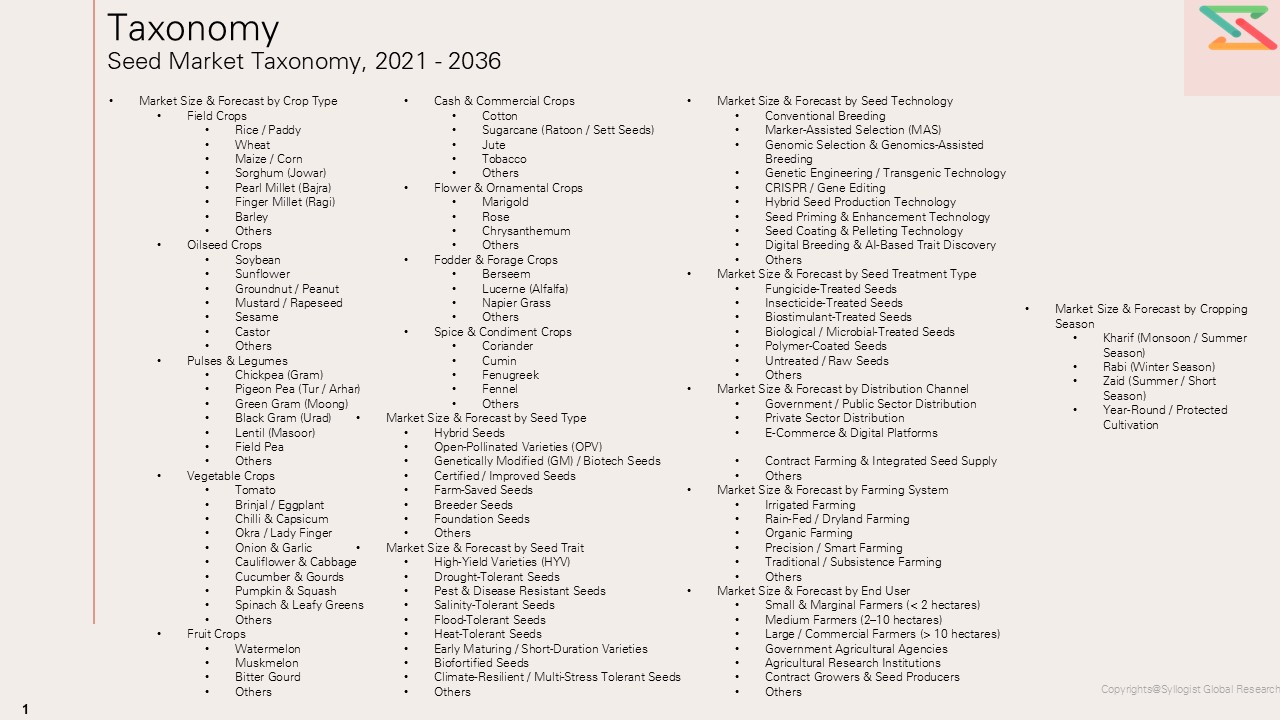
- Segmentation By Seed Type
- Hybrid Seeds
- Open-Pollinated Varieties (OPVs)
- Genetically Modified (GM) Seeds
- Gene-Edited Seeds (CRISPR / Precision Breeding)
- Organic Seeds
- Heirloom / Heritage Varieties
- Others
- Segmentation By Crop Type
- Cereals & Grains
- Corn / Maize
- Wheat
- Rice
- Barley
- Sorghum
- Oilseeds & Pulses
- Soybean
- Canola / Rapeseed
- Sunflower
- Groundnut
- Fruits & Vegetables
- Tomato
- Pepper
- Cucumber
- Leafy Vegetables
- Melons
- Cotton
- Sugarcane & Sugar Beet
- Forage & Turf Crops
- Specialty & Niche Crops
- Others
- Segmentation By Trait
- Herbicide-Tolerant (HT)
- Insect-Resistant (Bt)
- Drought-Tolerant
- Disease-Resistant
- Stacked Traits (Multiple Attributes)
- Nutritionally Enhanced
- Yield-Optimized Conventional
- Others
- Segmentation By Technology / Breeding Method
- Conventional Breeding
- Marker-Assisted Selection (MAS)
- Transgenic / Recombinant DNA Technology
- Gene Editing (CRISPR-Cas9)
- Genomic Selection
- Doubled Haploid Technology
- Somaclonal Variation / Tissue Culture
- Segmentation By Seed Treatment
- Chemical Treatment (Fungicides / Insecticides)
- Biological Treatment (Microbial Inoculants)
- Polymer Coating & Film Coating
- Pelleting
- Untreated / Raw Seeds
- Segmentation By Availability
- Commercial Seeds
- Farm-Saved Seeds
- Segmentation By Cultivation Mechanism
- Open Field Production
- Protected Cultivation (Greenhouse / Polyhouse)
- Vertical Farming / Controlled Environment Agriculture (CEA)
- Hydroponic / Aeroponic Systems
- Segmentation By Application
- Food Production
- Animal Feed
- Industrial / Non-Food Use (Biofuels, Fiber)
- Ornamental / Floriculture
- Research & Breeding Programs
- Segmentation By End-User
- Large-Scale Commercial Farmers
- Smallholder Farmers
- Government / Public Sector Agricultural Programs
- Research Institutions & Universities
- Greenhouse & Controlled Environment Operators
- Seed Distributors & Cooperatives
- Segmentation By Distribution Channel
- Direct Sales (Manufacturer to Farmer)
- Agrodealer / Retail Seed Stores
- Agricultural Cooperatives
- E-Commerce / Digital Platforms
- Government Distribution Programs
- NGO / Development Organization Channels
All market revenues are presented in USD
Historical Year: 2021–2024 | Base Year: 2025 | Estimated Year: 2026 | Forecast Period: 2027–2036
Key Questions this Study Will Answer
- What is the projected global market valuation (USD billion) and volume (metric tons) for commercial seeds across all crop categories through 2036? This provides the quantitative baseline essential for long-term capital allocation, portfolio prioritization, and competitive benchmarking across the global seed value chain.
- How are advances in gene editing technologies, particularly CRISPR-Cas9 and genomic selection, reshaping seed development timelines, trait commercialization pipelines, and the competitive dynamics between large multinational seed companies and emerging biotech challengers?
- Which crop segments (e.g., corn/maize, soybean, vegetable seeds, wheat) and regional markets offer the highest growth potential and return on seed technology investment through 2036, and what structural factors, including regulatory environments, hybrid adoption rates, and farm consolidation trends, are driving this differentiation?
- To what extent will climate change-driven demand for drought-tolerant, heat-resistant, and salinity-adapted seed varieties reshape R&D investment priorities among major seed companies, and which trait categories are expected to command premium pricing and strongest farmer adoption rates?
- How are consolidation dynamics in the global seed and agribusiness sector, including post-merger integration trajectories of Bayer-Monsanto, ChemChina-Syngenta, and Corteva, affecting competitive intensity, seed pricing power, and the relative positioning of regional and independent seed companies?
- What is the commercial and regulatory trajectory for gene-edited and non-transgenic precision breeding technologies in key markets including the EU, United States, Brazil, China, and India, and how will regulatory divergence affect multinational product launch strategies and international seed trade flows through 2036?
- How are digital agriculture platforms, AI-driven phenotyping, and precision planting technologies transforming the farmer purchasing journey and seed company go-to-market models, and what commercial implications do integrated seed-plus-data service ecosystems have for customer loyalty, pricing, and market share?
- What are the critical success factors and structural barriers for commercial seed market penetration in smallholder-dominated agricultural economies across Sub-Saharan Africa and South Asia, and which distribution, financing, and agronomic service models are best positioned to unlock volume growth in these regions through 2036?
- Product Definition
- Research Methodology
- Research Design & Framework
- Overall Research Approach: Descriptive, Exploratory & Quantitative Mixed-Method Design
- Market Definition & Scope Boundaries: What is Included and Excluded
- Segmentation Framework
- Key Research Assumptions & Limitations
- Secondary Research
- Primary Research Design & Execution
- Data Triangulation & Validation
- Market Sizing & Forecasting Methodology
- Competitive Intelligence Methodology
- Quality Assurance & Peer Review
- Definitions, Abbreviations & Data Notes
- Research Design & Framework
- Executive Summary
- Market Snapshot & Headline Numbers
- Key Findings & Research Highlights
- Market Dynamics
- Regional Market Summary
- Competitive Landscape Snapshot
- Technology & Innovation Highlights
- Market Dynamics
- Drivers
- Restraints
- Opportunities
- Challenges
- Porter’s Five Forces Analysis
- PESTLE Analysis
- Market Trends & Developments
- Emerging Trends
- Technological Developments
- Regulatory & Policy Changes
- Supply Chain & Sourcing Trends
- Farmer Adoption & Demand Trends
- Investment & Funding Activity
- Sustainability & ESG Trends
- Geographic & Regional Trends
- Risk Assessment Framework
- Geopolitical & Political Risk
- Climate Change & Agronomic Risk
- Regulatory, Biosafety & IP Risk
- Financial / Market Risk
- Supply Chain & Seed Quality Risk
- Technology & Biotech Adoption Risk
- Regulatory Framework & Standards
- Global Seed Market Outlook
- Market Size & Forecast by Value
- Market Size & Forecast by Volume
- Market Size & Forecast by Crop Type
- Field Crops / Cereals & Grains
- Maize / Corn
- Wheat
- Rice / Paddy
- Sorghum
- Barley
- Oats
- Rye
- Triticale
- Others
- Oilseed Crops
- Soybean
- Canola / Rapeseed
- Sunflower
- Cotton (Cottonseed)
- Groundnut / Peanut
- Palm
- Sesame
- Flaxseed / Linseed
- Others
- Pulses & Legumes
- Common Bean
- Chickpea
- Pea
- Lentil
- Cowpea
- Faba Bean
- Soybean (Edible / Vegetable Type)
- Others
- Vegetable Crops
- Tomato
- Pepper & Chilli
- Cucumber & Gherkin
- Lettuce & Leafy Greens
- Onion & Alliums
- Carrot & Root Vegetables
- Broccoli & Brassica
- Squash, Pumpkin & Gourds
- Eggplant / Aubergine
- Spinach & Herbs
- Others
- Fruit Crops
- Watermelon
- Melon
- Strawberry
- Others
- Forage & Turf Crops
- Alfalfa / Lucerne
- Clover
- Ryegrass
- Fescue
- Bermudagrass & Turf Grass
- Others
- Root & Tuber Crops
- Potato (True Potato Seed)
- Cassava
- Sweet Potato
- Sugar Beet
- Others
- Cash & Fiber Crops
- Cotton
- Sugarcane (True Seed)
- Tobacco
- Jute & Kenaf
- Others
- Flower & Ornamental Crops
- Petunia
- Impatiens
- Marigold
- Begonia
- Pansy
- Others
- Tree, Nut & Plantation Crops
- Forestry Seeds
- Nut Crop Seeds
- Coffee & Cocoa
- Others
- Spice & Condiment Crops
- Coriander
- Cumin
- Fenugreek
- Mustard
- Others
- Market Size & Forecast by Seed Type
- Hybrid Seeds
- Single Cross Hybrids (F1)
- Double Cross Hybrids
- Three-Way Cross Hybrids
- Open-Pollinated Varieties (OPV)
- Genetically Modified (GM) / Biotech Seeds
- Bt (Bacillus thuringiensis) Seeds
- Herbicide-Tolerant (HT) Seeds
- Stacked Trait / Combined GM Seeds
- Certified & Improved Conventional Seeds
- Breeder Seeds
- Foundation Seeds
- Farm-Saved Seeds
- Treated Seeds
- Others
- Hybrid Seeds
- Market Size & Forecast by Seed Trait
- High-Yield Varieties (HYV)
- Drought-Tolerant Seeds
- Pest & Insect Resistant Seeds
- Disease Resistant Seeds
- Herbicide-Tolerant Seeds
- Salinity-Tolerant Seeds
- Heat & Temperature-Tolerant Seeds
- Flood & Waterlogging Tolerant Seeds
- Early Maturing / Short-Duration Varieties
- Biofortified Seeds (Nutrient-Enhanced)
- Nitrogen Use Efficient (NUE) Seeds
- Climate-Resilient / Multi-Stress Tolerant Seeds
- Others
- Market Size & Forecast by Seed Technology
- Conventional / Classical Plant Breeding
- Hybrid Seed Production Technology
- Marker-Assisted Selection (MAS)
- Quantitative Trait Loci (QTL) Mapping
- Genomic Selection & Genomics-Assisted Breeding
- Genetic Engineering / Transgenic Technology
- CRISPR / Gene Editing & Mutagenesis
- Speed Breeding Technology
- Double Haploid (DH) Technology
- Seed Priming & Enhancement Technology
- Hydropriming
- Osmopriming
- Chemical Priming
- Bio-priming
- Solid Matrix Priming
- Seed Coating & Pelleting Technology
- Digital Breeding & AI-Based Trait Discovery
- High-Throughput Phenotyping Technology
- Others
- Market Size & Forecast by Seed Treatment Type
- Fungicide-Treated Seeds
- Insecticide-Treated Seeds
- Nematicide-Treated Seeds
- Biostimulant-Treated Seeds
- Biological / Microbial-Treated Seeds
- Rhizobium Inoculated
- Mycorrhizal Treated
- Bacillus-Based Biological Treatment
- Trichoderma-Based Treatment
- Polymer-Coated Seeds
- Multi-Layer / Stack-Treated Seeds
- Untreated / Raw Seeds
- Others
- Market Size & Forecast by Distribution Channel
- Direct Sales by Seed Companies
- Agro-Input Dealers & Retailers
- Distributors & Wholesalers
- Cooperative Societies & Farmer Groups
- Government & Public Sector Distribution
- National / State Seed Corporations
- Agricultural Extension Services
- Government Subsidy Programs
- E-Commerce & Digital Agri Platforms
- Online Seed Marketplaces
- Direct-to-Farmer Digital Channels
- Contract Farming & Integrated Supply Programs
- NGO & Development Program Distribution
- Others
- Market Size & Forecast by Farming System
- Irrigated Farming
- Rain-Fed / Dryland Farming
- Organic Farming
- Precision / Smart Farming
- Greenhouse & Protected Cultivation
- Hydroponic & Vertical Farming
- Traditional / Subsistence Farming
- Conservation / Regenerative Agriculture
- Others
- Market Size & Forecast by End User
- Commercial / Large-Scale Farmers
- Small & Marginal Farmers
- Contract Growers & Seed Multipliers
- Government Agricultural Agencies
- Agricultural Research Institutions
- Greenhouse & Nursery Operators
- Landscaping & Turf Management Companies
- Others
- Market Size & Forecast by Sustainability Attribute
- Conventional Seeds
- Certified Organic Seeds
- Non-GMO / IP-Protected Seeds
- Climate-Smart / Low-Input Seeds
- Sustainably Sourced & Certified Seeds
- Biodiversity-Supporting / Heirloom Seeds
- Field Crops / Cereals & Grains
- Asia-Pacific Seed Market Outlook
- Market Size & Forecast
- By Value
- By Volume
- By Crop Type
- By Seed Type
- By Seed Trait
- By Seed Technology
- By Seed Treatment Type
- By Distribution Channel
- By Farming System
- By End User
- By Sustainability Attribute
- Market Size & Forecast
- Europe Seed Market Outlook
- Market Size & Forecast
- By Value
- By Volume
- By Crop Type
- By Seed Type
- By Seed Trait
- By Seed Technology
- By Seed Treatment Type
- By Distribution Channel
- By Farming System
- By End User
- By Sustainability Attribute
- Market Size & Forecast
- North America Seed Market Outlook
- Market Size & Forecast
- By Value
- By Volume
- By Crop Type
- By Seed Type
- By Seed Trait
- By Seed Technology
- By Seed Treatment Type
- By Distribution Channel
- By Farming System
- By End User
- By Sustainability Attribute
- Market Size & Forecast
- Latin America Seed Market Outlook
- Market Size & Forecast
- By Value
- By Volume
- By Crop Type
- By Seed Type
- By Seed Trait
- By Seed Technology
- By Seed Treatment Type
- By Distribution Channel
- By Farming System
- By End User
- By Sustainability Attribute
- Market Size & Forecast
- Middle East & Africa Seed Market Outlook
- Market Size & Forecast
- By Value
- By Volume
- By Crop Type
- By Seed Type
- By Seed Trait
- By Seed Technology
- By Seed Treatment Type
- By Distribution Channel
- By Farming System
- By End User
- By Sustainability Attribute
- Market Size & Forecast
- Country Wise* Seed Market Outlook
- Market Size & Forecast
- By Value
- By Volume
- By Crop Type
- By Seed Type
- By Seed Trait
- By Seed Technology
- By Seed Treatment Type
- By Distribution Channel
- By Farming System
- By End User
- By Sustainability Attribute
- Market Size & Forecast
*Countries Analyzed in the Syllogist Global Research Portfolio: United States, Canada, Germany, United Kingdom, France, Italy, Spain, Netherlands, Denmark, Poland, China, Japan, India, Australia, Brazil, Argentina, Mexico, Colombia, Saudi Arabia, UAE, South Africa, Kenya, Nigeria
- Technology Landscape & Innovation Analysis
- Value Chain & Supply Chain Analysis
- Pricing Analysis
- Sustainability & Environmental Impact
- Competitive Landscape
- Market Structure & Concentration
- Market Consolidation Level (Fragmented Vs Consolidated)
- Top 5 Players Market Share
- HHI (Herfindahl–Hirschman Index) Concentration Analysis
- Competitive Intensity Map
- Player Classification
- Market Leaders
- Strong Challengers
- Specialist / Niche Players
- Emerging Players
- Regional Players
- Competitive Analysis Frameworks
- Market Share Analysis
- Company Profile
- Company Overview & HQ
- Products & Solutions Portfolio
- Overall Revenue & Segmental Revenue
- Geographic Presence
- Recent Developments (M&A, Launches, Partnerships)
- SWOT Analysis
- Strategic Focus Areas
- Competitive Positioning Map
- Market Structure & Concentration
- Strategic Output
- Market Opportunity Matrix
- White Space Opportunity Analysis
- Strategic Recommendations
- Seed Portfolio & Crop Diversification Strategy
- Hybrid & Biotech Seed Development Strategy
- Seed Treatment & Enhancement Strategy
- Distribution Network & Channel Penetration Strategy
- Pricing & Commercial Strategy
- Regulatory Compliance, Biosafety & IP Protection Strategy
- Sustainability & Climate-Resilient Seed Strategy
- Farmer Outreach, Education & Extension Strategy
- Partnership, M&A & Global Expansion Strategy
- Regional & Country-Level Market Entry Strategy
- Risk Mitigation & Future Roadmap
- Strategic Priority Matrix & Roadmap
- Near-term (2025–2028)
- Mid-term (2029–2032)
- Long-term (2033–2036)