
Market Definition
The Perovskite Solar Chemicals market refers to the global specialty chemicals and advanced materials sector involved in the synthesis, purification, formulation, and supply of the chemical precursors, functional layers, encapsulants, and processing solvents that constitute the active and auxiliary material stack of perovskite photovoltaic devices, spanning single-junction perovskite cells, perovskite-silicon tandem architectures, all-perovskite multi-junction devices, and perovskite-integrated building and flexible form factor products. The market is structurally organized across four principal chemical categories: perovskite absorber precursor chemicals, encompassing lead iodide, lead bromide, formamidinium iodide, methylammonium iodide, methylammonium bromide, cesium iodide, rubidium iodide, and the mixed-halide and multi-cation precursor salt blends whose stoichiometric composition determines the bandgap, crystallographic stability, and photovoltaic conversion efficiency of the deposited perovskite absorber layer; charge transport layer chemicals, including hole transport materials such as spiro-OMeTAD, poly(triarylamine), and nickel oxide nanoparticle inks, and electron transport materials including titanium dioxide compact and mesoporous layers, tin oxide nanoparticle dispersions, and fullerene derivatives such as PCBM and its analogues, which govern charge extraction efficiency and recombination losses at the perovskite heterointerface; passivation and interfacial treatment chemicals, comprising phenethylammonium iodide, butylammonium iodide, and a range of Lewis acid and base molecular passivators applied at perovskite grain boundaries and interfaces to suppress non-radiative recombination and improve operational stability under thermal and illumination stress; and encapsulant and barrier materials, including ionomer films, ethylene vinyl acetate formulations adapted for lead containment, polyisobutylene edge sealants, and atomic layer deposition precursor chemicals deposited as ultra-thin inorganic moisture barrier layers protecting the perovskite absorber from ambient humidity degradation. As the foundational material inputs determining the efficiency ceiling, operational lifetime, and manufacturing yield of perovskite photovoltaic products, these specialty chemicals are indispensable across the entire perovskite solar development and commercialization landscape. The market dynamics are profoundly shaped by the accelerating transition of perovskite photovoltaic technology from laboratory record efficiencies toward pilot line and commercial production scale, the regulatory imperative to develop lead-free and reduced-lead perovskite formulations for markets with restrictions on hazardous substance deployment in consumer and building-integrated products, and the competitive pressure on perovskite cell producers to achieve certified module efficiency and operational lifetime benchmarks that close the remaining performance gap with established silicon photovoltaic technology while delivering a manufacturing cost structure that justifies commercial deployment.
Global Perovskite Solar Chemicals Market Insights
As of early 2026, the global perovskite solar chemicals market is valued at approximately USD 680 million, operating through a period of rapid expansion and intensifying commercial investment with a projected compound annual growth rate of 31 percent through 2033. The market structure remains highly fragmented at the specialty precursor and functional material level, with no single producer controlling a dominant share of global supply across all chemical categories, though a cohort of leading specialty chemical companies including Tokyo Chemical Industry, Sigma-Aldrich Advanced Materials, GreatCell Solar Materials, Ossila, Dyenamo, and several vertically integrated Chinese perovskite precursor manufacturers have established recognized positions in the research and early commercial supply chain. Lead halide perovskite precursor chemicals currently constitute the largest product segment by consumption value, reflecting the continued dominance of lead-based ABX3 perovskite absorber compositions in the highest-efficiency certified devices and the most commercially advanced manufacturing programs, while the hole and electron transport layer chemical segment is growing at the fastest rate within the commercial module production supply chain as production scale-up by perovskite module manufacturers dramatically increases the consumption volume of charge transport materials relative to the milligram-to-gram quantities characteristic of laboratory research procurement. While the market operated primarily in research institution, university laboratory, and corporate research and development supply channels through 2024, the entry of multiple perovskite module producers into pilot production and the announcement of initial commercial deployments in 2025 and 2026 is shifting a growing proportion of market volume and value toward production-scale chemical procurement contracts with stringent batch consistency, purity certification, and supply continuity requirements that are substantively different from the research-grade chemical supply model that previously dominated the market.
Current Producing Countries and Regional Concentration
China has emerged as the dominant producing country for perovskite absorber precursor chemicals by production volume and export activity, with Chinese chemical manufacturers supplying the majority of globally traded lead iodide, formamidinium iodide, methylammonium iodide, and cesium iodide consumed by research institutions and perovskite module development programs worldwide, leveraging established positions in the broader iodine chemistry and halide salt manufacturing sectors to rapidly scale perovskite precursor production at competitive cost points. The United Kingdom, Germany, Sweden, and Switzerland host the most significant concentrations of specialty hole transport material and passivation chemical development capability, with European research-commercialization spinouts and specialty chemical companies holding a disproportionate share of the intellectual property underlying commercially deployed spiro-OMeTAD alternatives, dopant-free hole transport material platforms, and molecular passivation chemistries whose performance advantages at the device level are creating premium commercial supply opportunities independent of the commodity precursor salt volume market. Japan maintains significant positions in high-purity iodine chemistry, specialty encapsulant material formulation, and atomic layer deposition precursor supply, reflecting the integration of perovskite solar chemical development within Japan’s established strength in display and advanced materials chemistry. South Korea and Taiwan are advancing rapidly in perovskite absorber ink and solution formulation technology, driven by the active perovskite commercialization programs of their domestic solar and display panel manufacturers who are applying thin-film deposition and roll-to-roll coating expertise from organic light-emitting diode manufacturing to perovskite layer deposition process development. The United States perovskite chemical supply landscape is characterized by strong academic and national laboratory research activity generating novel material chemistries whose commercial transition is being accelerated by Department of Energy perovskite photovoltaic manufacturing program funding, with domestic specialty chemical producers beginning to establish production capacity for research and early commercial supply ahead of anticipated domestic perovskite module manufacturing scale-up supported by Inflation Reduction Act domestic content incentives.
Current and Emerging Production Technologies
The current standard for perovskite absorber precursor salt synthesis is based on acid-base reaction chemistry between lead oxide or lead acetate and hydroiodic or hydrobromic acid for lead halide production, and between formamidine acetate or methylamine and hydroiodic acid for organic ammonium iodide salt synthesis, followed by recrystallization, filtration, and vacuum drying to achieve the purity levels required for reproducible perovskite film formation, with the most demanding production-scale specifications requiring sub-10 parts per million metallic impurity profiles and strictly controlled residual solvent and moisture content that necessitate controlled atmosphere packaging in anhydrous conditions. Charge transport material synthesis, particularly for spiro-OMeTAD and its dopant-free successor chemistries, requires multi-step organic synthesis routes involving palladium-catalyzed cross-coupling reactions, chromatographic purification, and rigorous batch-to-batch molecular weight and optical purity characterization whose cumulative manufacturing complexity and yield loss are primary contributors to the high per-gram cost of premium hole transport materials relative to absorber precursor salts. Emerging production and formulation technologies advancing rapidly in 2026 include continuous flow chemistry platforms enabling the synthesis of perovskite precursor salts and organic semiconductor charge transport materials under precisely controlled reaction conditions that reduce batch variability, improve yield, and eliminate the manual handling steps introducing contamination in batch synthesis processes; nanoparticle-formulated charge transport layer inks optimized for industrial slot-die coating and blade coating deposition at speeds and film uniformity levels compatible with high-throughput module production; and atomic layer deposition precursor chemistries specifically engineered for conformal ultra-thin tin oxide and aluminum oxide electron transport and moisture barrier layer deposition at temperatures compatible with flexible substrate processing. Artificial intelligence-assisted high-throughput experimental platforms are being extensively deployed by both academic and industrial chemical developers to accelerate the compositional optimization of multi-cation multi-halide perovskite formulations and passivation additive combinations, compressing what previously required years of sequential experimentation into months of parallel screening across combinatorial precursor mixture libraries.
Market Hotspots and Opportunity Analysis
The most commercially compelling near-term hotspot for perovskite solar chemical investment is the perovskite-silicon tandem module supply chain, where the commercial deployment of tandem architectures achieving certified power conversion efficiencies substantially above the practical silicon single-junction limit is creating first-mover premium pricing opportunities for perovskite absorber precursor formulations, interfacial recombination junction chemicals, and passivation materials specifically engineered for the two-terminal and four-terminal tandem device architectures being advanced toward commercial production by leading integrated photovoltaic manufacturers in China, Germany, the United States, and South Korea. The building-integrated photovoltaics segment represents a structurally distinct and high-value growth hotspot for perovskite solar chemicals, as the color tunability and architectural form factor flexibility enabled by halide composition engineering of perovskite absorbers is creating design-differentiated photovoltaic products for facade, roof, and glazing integration that command price premiums unavailable to commodity silicon module producers and whose specialty chemical requirements for semi-transparent absorber formulations, UV-stable encapsulants, and aesthetically consistent large-area coating processes are generating demand for novel chemical solutions with no direct equivalent in the silicon photovoltaic supply chain. The lead-free perovskite chemical segment, encompassing tin-based, bismuth-based, and antimony-based perovskite and perovskite-inspired absorber precursor chemistries, is attracting accelerating research and early commercial investment driven by the anticipated extension of European Union Restriction of Hazardous Substances directive coverage to photovoltaic modules and the proactive sustainability positioning of module manufacturers whose commercial targets include product categories in consumer electronics and indoor photovoltaics where lead content restrictions are already operative or imminent. For strategic investors, the convergence of perovskite photovoltaic commercialization with the broader energy transition capital deployment cycle represents a material specialty chemical investment opportunity whose risk-return profile is maturing rapidly as certified module lifetime and efficiency data from first commercial deployments begins to validate the performance projections underlying the commercial investment theses of leading perovskite technology developers.
Certified Efficiency and Operational Lifetime Advances in Perovskite-Silicon Tandem Devices Driving Commercial Adoption and Displacing Single-Junction Silicon in High-Performance Module Applications
The primary structural demand driver creating a credible and near-term commercial market for perovskite solar chemicals at production scale is the sustained and accelerating advance in the certified power conversion efficiency and outdoor operational stability of perovskite-silicon tandem photovoltaic devices, which have progressed from laboratory curiosities to commercially differentiated products achieving certified module efficiencies that exceed the practical efficiency ceiling of single-junction crystalline silicon and that are beginning to demonstrate the outdoor stability lifetimes under International Electrotechnical Commission standardized stress testing conditions required for bankable commercial project deployment in utility-scale and commercial and industrial photovoltaic applications. The certified tandem module efficiency record trajectory has advanced from below 25 percent in 2020 to above 33 percent at the cell level and above 28 percent at the module level by early 2026, a progression rate that substantially exceeds the historical silicon efficiency improvement curve and that is translating into commercially deployable efficiency advantages of several absolute percentage points relative to premium monocrystalline silicon modules, a performance differential whose economic value at the project level is sufficient to justify the material cost premium of perovskite-containing tandem modules and to establish a commercially viable market entry point for perovskite technology that does not require cost parity with commodity silicon before generating positive commercial return. The translation of these efficiency advances into commercial production demand for perovskite solar chemicals is being catalyzed by the announced and active scale-up programs of multiple perovskite module manufacturers who are transitioning from pilot-scale to initial commercial production in 2025 and 2026, generating first commercial-scale purchase orders for perovskite precursor salts, charge transport materials, and passivation chemicals in quantities and at batch consistency specifications that are substantively different from the research-scale procurement that previously constituted the totality of commercial market demand. The competitive dynamic among silicon wafer, cell, and module manufacturers whose market position is threatened by perovskite tandem performance advantages is simultaneously accelerating their own perovskite integration programs, broadening the perovskite commercial supply chain development beyond dedicated perovskite startups to include established photovoltaic manufacturers whose production scale and commercial relationships will amplify the chemical consumption volumes generated by initial commercial perovskite deployments.
Global Solar Energy Capacity Expansion Targets and the Structural Demand for Higher-Efficiency Photovoltaic Technologies That Reduce the Land, Balance-of-System, and Levelized Cost Constraints of Solar Deployment
The second major structural demand driver establishing the long-term commercial foundation for perovskite solar chemical market growth is the global solar energy capacity expansion imperative arising from national and international net-zero carbon commitments whose required solar installation volumes are generating an efficiency-driven demand pull for photovoltaic technologies that can generate more electricity per unit of installed area, reduce the balance-of-system cost per watt peak, and extend the economic deployment of solar into land-constrained, shading-affected, and built environment contexts where conventional silicon module efficiency and physical form factor constraints limit addressable deployment capacity. The aggregate global solar photovoltaic installation target commitments of major economies including the United States, European Union, China, India, Japan, and Australia collectively imply cumulative capacity additions through 2035 whose scale requires not merely the expansion of existing silicon photovoltaic production but the development and commercial deployment of next-generation photovoltaic technologies capable of generating electricity at levelized costs and land use footprints that make solar economically competitive in an expanding range of grid and off-grid application contexts beyond those currently served by utility-scale silicon installations. Perovskite technology’s ability to achieve higher module efficiencies than single-junction silicon directly addresses the land use and balance-of-system cost drivers that constrain solar deployment in high-value real estate contexts including commercial rooftops, urban facades, and co-located agrivoltaic installations, and whose efficiency advantage translates at the project level into fewer modules, smaller racking and mounting hardware quantities, reduced wiring and inverter requirements, and lower installation labor per megawatt of generating capacity, collectively generating a balance-of-system cost reduction that improves project economics independently of the module cost differential between perovskite tandem and premium silicon products. The policy incentive architecture of the Inflation Reduction Act in the United States, whose domestic content requirements for investment tax credit eligibility are creating powerful incentives for United States-based perovskite module manufacturing, is providing the demand visibility and commercial revenue floor that perovskite module manufacturers require to justify the capital investment in domestic production facilities and the associated domestic specialty chemical supply chain development programs that will drive United States-based perovskite solar chemical procurement growth across the forecast period.
Operational Stability and Certified Lifetime Validation Deficit Creating Commercial Adoption Risk and Financing Barriers for Early Perovskite Module Deployments
The most consequential commercial challenge constraining the pace of perovskite solar chemical market expansion from research and pilot supply toward the large-volume production procurement that commercial module deployment would generate is the persistent gap between the operational stability and certified outdoor lifetime demonstrated by perovskite photovoltaic modules in accelerated stress testing and actual field deployment studies and the 25-year to 30-year performance warranty standards that are required by project financiers, insurance underwriters, and large commercial and utility-scale solar procurement organizations as preconditions for project bankability and investment-grade asset classification. The degradation mechanisms affecting perovskite absorber materials under prolonged combined illumination, thermal cycling, and humidity exposure, including ionic migration and halide phase segregation under sustained illumination that reduce open-circuit voltage and fill factor over time, methylammonium cation volatilization under elevated temperature conditions that irreversibly degrades film stoichiometry, and moisture ingress through encapsulant and barrier material defects that initiates hydrate phase formation and absorber decomposition, are sufficiently distinct from the well-characterized degradation modes of established silicon photovoltaic technology that the accelerated aging protocols developed for silicon lifetime prediction cannot be directly applied to perovskite devices, requiring the development and industry-wide adoption of perovskite-specific stress test protocols whose correlation with real-world outdoor performance over decade-scale timeframes can only be established through the accumulation of extended outdoor performance data that is by definition a multi-year endeavor. The chemical solution to the stability challenge, which encompasses the development of thermally stable inorganic and hybrid perovskite compositions that eliminate the volatile methylammonium cation, the engineering of passivation chemical treatments that suppress ionic migration at grain boundaries and interfaces, the formulation of encapsulant and barrier chemical systems that maintain adhesion and moisture barrier function across thermal cycling extremes, and the development of self-healing additive chemistries that repair electrochemically induced defects during the dark recovery periods of the operational cycle, is advancing rapidly but requires validation through the same multi-year outdoor exposure programs whose results lag the commercial deployment timeline being pursued by perovskite technology developers and their investors, creating a fundamental tension between commercial urgency and scientific validation thoroughness that is the primary source of bankability risk in the perovskite solar investment landscape.
Lead Content Regulatory Risk and the Unresolved Commercial and Technical Pathway for Lead-Free Perovskite Absorber Chemistries at Commercially Viable Efficiency Levels
A structurally significant and commercially consequential challenge confronting the long-term market development trajectory of perovskite solar chemicals is the unresolved regulatory and technical status of lead content in perovskite photovoltaic products, whose current best-performing absorber compositions are based on lead halide perovskite crystal structures containing lead concentrations that place them within or near the threshold of applicability of existing hazardous substance regulations including the European Union Restriction of Hazardous Substances directive, the Waste Electrical and Electronic Equipment directive, and the Registration, Evaluation, Authorisation and Restriction of Chemicals regulation, whose potential extension to photovoltaic modules is a subject of active regulatory discussion and whose implementation would either require the reformulation of perovskite absorber chemistries to lead-free alternatives or impose product registration, end-of-life collection, and disposal infrastructure requirements that would add cost and logistical complexity to perovskite module commercialization across European and other markets with equivalent regulatory frameworks. The technical challenge of replacing lead in the perovskite absorber with non-toxic divalent metal cations while maintaining the combination of bandgap tunability, high defect tolerance, long charge carrier diffusion length, and solution processability that makes lead halide perovskites uniquely suited for high-efficiency photovoltaic application has proven substantially more difficult than initial research optimism suggested, with the most extensively investigated lead-free alternatives based on tin, bismuth, antimony, and copper demonstrating power conversion efficiencies and operational stability levels that remain materially below those of their lead-containing counterparts despite years of intensive research investment, leaving a performance gap whose closure requires fundamental advances in the crystal chemistry and defect physics of lead-free perovskite compositions that cannot be guaranteed on any specific timeline. The commercial consequence of this regulatory and technical uncertainty is that perovskite solar chemical producers developing lead-free precursor and functional material chemistries must invest in product development programs whose commercial payoff timeline is contingent on both regulatory trigger events whose timing and scope are uncertain and on materials science breakthroughs whose occurrence cannot be predicted with confidence, creating a resource allocation challenge for specialty chemical companies whose development investment capacity is finite and whose lead-containing product lines are simultaneously generating the commercial traction that short-term business performance requires.
Market Segmentation
- Segmentation By Chemical Category
- Perovskite Absorber Precursor Salts (Lead Halides, Organic Ammonium Halides, Cesium and Rubidium Halides)
- Hole Transport Materials (Spiro-OMeTAD, PTAA, NiOx Inks, Dopant-Free HTMs)
- Electron Transport Materials (TiO2, SnO2 Nanoparticle Inks, PCBM, Fullerene Derivatives)
- Passivation and Interfacial Treatment Chemicals
- Perovskite Solvent and Antisolvent Systems
- Encapsulant and Edge Sealant Materials
- ALD Barrier Precursor Chemicals
- Lead-Free Perovskite Precursor Chemicals (Tin, Bismuth, Antimony-Based)
- Others
- Segmentation By Device Architecture
- Single-Junction Perovskite Cells and Modules
- Perovskite-Silicon Two-Terminal Tandem
- Perovskite-Silicon Four-Terminal Tandem
- All-Perovskite Multi-Junction Tandem
- Perovskite-CIGS Tandem
- Flexible and Substrate-Conformable Perovskite Devices
- Building-Integrated and Semi-Transparent Perovskite Modules
- Others
- Segmentation By Application
- Utility-Scale Solar Photovoltaic Modules
- Commercial and Industrial Rooftop Modules
- Building-Integrated Photovoltaics (BIPV)
- Consumer Electronics and Indoor Photovoltaics
- Agrivoltaic and Dual-Use Installations
- Space and Aerospace Photovoltaics
- Research and Development Laboratories
- Others
- Segmentation By Perovskite Composition
- Methylammonium Lead Iodide (MAPbI3) Based
- Formamidinium Lead Iodide (FAPbI3) Based
- Cesium-Formamidinium Mixed Cation
- Triple Cation (Cs/MA/FA) Mixed Halide
- All-Inorganic Cesium Lead Halide
- Tin-Based Lead-Free Perovskite
- Bismuth and Antimony Halide Perovskite-Inspired
- Others
- Segmentation By Deposition Process
- Spin Coating (Laboratory and Small Area)
- Blade and Bar Coating
- Slot-Die Coating
- Inkjet Printing
- Vacuum Thermal Evaporation
- Chemical Vapor Deposition
- Roll-to-Roll Coating
- Others
- Segmentation By End User
- Perovskite Module Manufacturers
- Perovskite-Silicon Tandem Cell Producers
- University and Academic Research Institutions
- National Laboratory and Government Research Programs
- Corporate Research and Development Centers
- Photovoltaic Equipment and Tool Manufacturers
- Others
- Segmentation By Sales Channel
- Direct Supply Agreements with Module Manufacturers
- Specialty Chemical Distributors and Research Suppliers
- Online Scientific Supply Platforms
- Collaborative Development and Joint Supply Programs
- Others
- Segmentation By Region
- Asia-Pacific (China, South Korea, Japan, Taiwan)
- Europe (Germany, United Kingdom, Switzerland, Sweden)
- North America (United States)
- Rest of World (India, Australia, Middle East)
All market revenues are presented in USD
Historical Year: 2021-2024 | Base Year: 2025 | Estimated Year: 2026 | Forecast Period: 2027-2036
Key Questions this Study Will Answer
- What is the projected global market valuation for perovskite solar chemicals through 2036, segmented by chemical category, device architecture, application, perovskite composition, deposition process, and region, and which chemical categories and geographic markets are expected to generate the highest incremental revenue and volume growth as perovskite photovoltaic technology transitions from pilot production to commercial deployment scale?
- How are the certified efficiency and accelerated stress test lifetime results emerging from the first commercial perovskite-silicon tandem module deployments influencing the bankability assessment frameworks of project finance institutions, insurance underwriters, and large-scale photovoltaic procurement organizations, and what certified performance milestones will most effectively unlock the utility-scale and commercial and industrial segment adoption that represents the largest volume opportunity for perovskite solar chemical consumption?
- What is the current regulatory status and anticipated trajectory of lead content restrictions applicable to perovskite photovoltaic modules under the European Union Restriction of Hazardous Substances directive, REACH regulation, and equivalent frameworks in other major markets, and what technical performance benchmarks must lead-free perovskite absorber chemistries achieve to represent a commercially viable regulatory compliance pathway for perovskite module manufacturers serving regulated markets across the forecast period?
- How are the chemical supply chain requirements, batch consistency specifications, purity certification standards, and production scale economics of perovskite solar chemicals evolving as the market transitions from milligram and gram-scale research procurement toward kilogram and tonne-scale production supply, and which chemical categories and supplier capability profiles are most exposed to supply chain qualification bottlenecks as perovskite module production volumes scale?
- What is the competitive positioning and commercial development trajectory of dopant-free hole transport materials, inorganic charge transport layer nanoparticle inks, and next-generation passivation chemistry platforms relative to the legacy spiro-OMeTAD and titanium dioxide charge transport layer chemistries that dominate current device architectures, and which performance, cost, and processability improvements in emerging charge transport and passivation chemistries are expected to drive material substitution in commercial perovskite module production during the forecast period?
- Who are the leading perovskite absorber precursor manufacturers, hole and electron transport material developers, passivation chemistry innovators, encapsulant and barrier material producers, and specialty perovskite chemical distributors currently defining the competitive landscape of the global perovskite solar chemicals market, and what are their respective product portfolio strategies, purity grade advancement roadmaps, lead-free development programs, production scale-up investment plans, and geographic market development priorities for serving the commercial perovskite photovoltaic manufacturing supply chain through the forecast horizon?
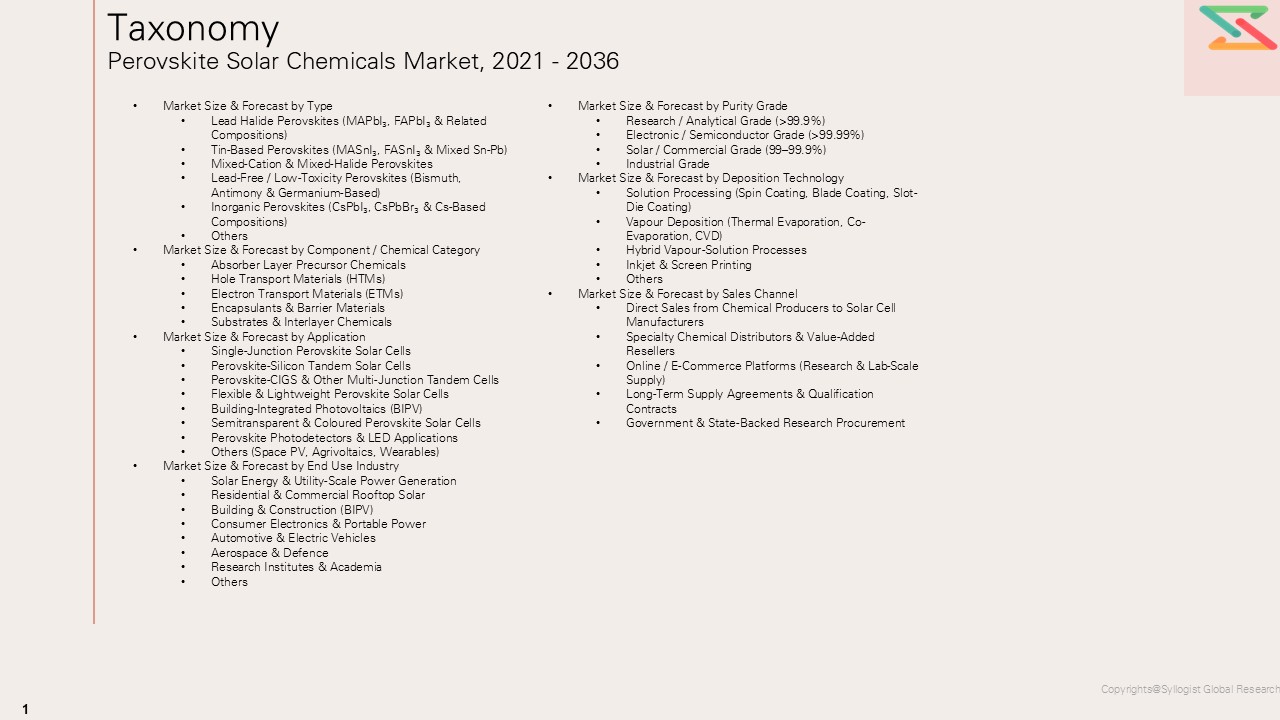
- Introduction (Product Definition, Taxonomy and Research Methodology)
- Executive Summary
- Global Perovskite Solar Chemicals Demand Supply Analysis
- Global Perovskite Solar Chemicals Market Assessment, 2021-2036
- Market Size & Forecast by Value
- Market Size & Forecast by Volume
- Market Size & Forecast by Type
- Lead Halide Perovskites (MAPbI₃, FAPbI₃ & Related Compositions)
- Tin-Based Perovskites (MASnI₃, FASnI₃ & Mixed Sn-Pb)
- Mixed-Cation & Mixed-Halide Perovskites
- Lead-Free / Low-Toxicity Perovskites (Bismuth, Antimony & Germanium-Based)
- Inorganic Perovskites (CsPbI₃, CsPbBr₃ & Cs-Based Compositions)
- Others
- Market Size & Forecast by Component / Chemical Category
- Absorber Layer Precursor Chemicals
- Lead Iodide (PbI₂)
- Lead Bromide (PbBr₂)
- Methylammonium Iodide (MAI / CH₃NH₃I)
- Formamidinium Iodide (FAI / HC(NH₂)₂I)
- Caesium Iodide (CsI) & Caesium Bromide (CsBr)
- Tin Iodide (SnI₂) & Tin Bromide (SnBr₂)
- Dimethyl Sulphoxide (DMSO) & Dimethylformamide (DMF) Process Solvents
- Other Halide Salts & Co-Dopant Additives
- Hole Transport Materials (HTMs)
- Spiro-OMeTAD (2,2′,7,7′-Tetrakis-(N,N-di-4-methoxyphenylamino)-9,9′-spirobifluorene)
- PTAA (Poly[bis(4-phenyl)(2,4,6-trimethylphenyl)amine])
- P3HT & Poly(3-hexylthiophene) Derivatives
- Inorganic HTMs (NiOx, CuSCN, CuI)
- Dopants (Li-TFSI, FK209, tBP) for HTM Optimisation
- Emerging Small-Molecule & Polymer HTMs
- Electron Transport Materials (ETMs)
- Titanium Dioxide (TiO₂) Nanoparticles & Paste
- Tin Oxide (SnO₂) Nanoparticles & Colloidal Dispersions
- Zinc Oxide (ZnO) Nanostructures
- C₆₀ Fullerene & PCBM Derivatives
- Other Inorganic & Organic ETMs
- Encapsulants & Barrier Materials
- Ethylene Vinyl Acetate (EVA) Films
- Polyolefin Encapsulants (POE)
- Butyl Rubber & Edge Sealants
- Atomic Layer Deposition (ALD) Barrier Coatings (Al₂O₃, SiO₂)
- Transparent Conducting Oxides (TCOs) & Electrode Materials
- Indium Tin Oxide (ITO) Pastes & Films
- Fluorine-Doped Tin Oxide (FTO) Coatings
- Silver (Ag) Nanowire & Paste Electrode Inks
- Carbon-Based Electrode Materials (Carbon Paste, Graphene)
- Substrates & Interlayer Chemicals
- Anti-Solvent & Crystallisation Control Agents (Chlorobenzene, Diethyl Ether, Toluene)
- Self-Assembled Monolayers (SAMs) for Interface Passivation
- Mesoporous Scaffold Materials (TiO₂ Paste, Al₂O₃ Scaffold)
- Others (Dopants, Additives, Passivation Agents & Specialty Solvents)
- Absorber Layer Precursor Chemicals
- Market Size & Forecast by Application
- Single-Junction Perovskite Solar Cells
- Perovskite-Silicon Tandem Solar Cells
- Perovskite-CIGS & Other Multi-Junction Tandem Cells
- Flexible & Lightweight Perovskite Solar Cells
- Building-Integrated Photovoltaics (BIPV)
- Semitransparent & Coloured Perovskite Solar Cells
- Perovskite Photodetectors & LED Applications
- Others (Space PV, Agrivoltaics, Wearables)
- Market Size & Forecast by End Use Industry
- Solar Energy & Utility-Scale Power Generation
- Residential & Commercial Rooftop Solar
- Building & Construction (BIPV)
- Consumer Electronics & Portable Power
- Automotive & Electric Vehicles
- Aerospace & Defence
- Research Institutes & Academia
- Others
- Market Size & Forecast by Purity Grade
- Research / Analytical Grade (>99.9%)
- Electronic / Semiconductor Grade (>99.99%)
- Solar / Commercial Grade (99–99.9%)
- Industrial Grade
- Market Size & Forecast by Deposition Technology
- Solution Processing (Spin Coating, Blade Coating, Slot-Die Coating)
- Vapour Deposition (Thermal Evaporation, Co-Evaporation, CVD)
- Hybrid Vapour-Solution Processes
- Inkjet & Screen Printing
- Others
- Market Size & Forecast by Sales Channel
- Direct Sales from Chemical Producers to Solar Cell Manufacturers
- Specialty Chemical Distributors & Value-Added Resellers
- Online / E-Commerce Platforms (Research & Lab-Scale Supply)
- Long-Term Supply Agreements & Qualification Contracts
- Government & State-Backed Research Procurement
- Asia-Pacific Perovskite Solar Chemicals Market Assessment, 2021-2036
- Market Size & Forecast
- By Value
By Volume - By Type
- By Component / Chemical Category
- By Application
- By End Use Industry
- By Purity Grade
- By Sales Channel
- By Country (Market Share of Leading 5-6 Countries)
- By Value
- Market Size & Forecast
- North America Perovskite Solar Chemicals Market Assessment, 2021-2036
- Market Size & Forecast
- By Value
By Volume - By Type
- By Component / Chemical Category
- By Application
- By End Use Industry
- By Purity Grade
- By Sales Channel
- By Country (Market Share of Leading 5-6 Countries)
- By Value
- Market Size & Forecast
- Europe Perovskite Solar Chemicals Market Assessment, 2021-2036
- Market Size & Forecast
- By Value
By Volume - By Type
- By Component / Chemical Category
- By Application
- By End Use Industry
- By Purity Grade
- By Sales Channel
- By Country (Market Share of Leading 5-6 Countries)
- By Value
- Market Size & Forecast
- South America Perovskite Solar Chemicals Market Assessment, 2021-2036
- Market Size & Forecast
- By Value
By Volume - By Type
- By Component / Chemical Category
- By Application
- By End Use Industry
- By Purity Grade
- By Sales Channel
- By Country (Market Share of Leading 5-6 Countries)
- By Value
- Market Size & Forecast
- Middle East & Africa Perovskite Solar Chemicals Market Assessment, 2021-2036
- Market Size & Forecast
- By Value
By Volume - By Type
- By Component / Chemical Category
- By Application
- By End Use Industry
- By Purity Grade
- By Sales Channel
- By Country (Market Share of Leading 5-6 Countries)
- By Value
- Market Size & Forecast
- White Space & Emerging Investment Hotspot
- Market White Space Opportunities
- Underserved Chemical Categories & Component Gaps (Lead-Free HTMs, Stable ETMs)
- Geographic Markets with Nascent Perovskite Manufacturing & High Import Dependency
- Technology Gaps in Scalable Deposition & Long-Term Stability Chemicals
- Unmet Demand in Tandem Cell & BIPV Chemical Supply Chains
- Mergers & Acquisitions (M&A)
- Joint Ventures & Strategic Alliances
- Technology & Innovation Hotspots
- Lead-Free & Low-Toxicity Perovskite Chemistry Development Hubs
- Scalable Slot-Die & Roll-to-Roll Coating Chemical Innovation Centres
- Encapsulation & Long-Term Stability Solution Hotspots
- AI-Driven High-Throughput Perovskite Composition Discovery Platforms
- Regional Investment Attractiveness
- Barriers & Risks in Investment
- Lead Toxicity & Environmental Regulation Barriers
- Long-Term Stability & Outdoor Durability Certification Challenges
- Scaling from Laboratory to Commercial Fab: Process Chemistry Risks
- IP Fragmentation & Licensing Complexity in Perovskite Chemical Compositions
- Market White Space Opportunities
- Value Chain Analysis
- Raw Material Sourcing & Suppliers
- Key Raw Materials & Inputs
- Lead Iodide, Lead Bromide & Halide Salt Upstream Producers
- Organic Ammonium Salt Synthesisers (MAI, FAI, CsI)
- High-Purity Solvent & Process Chemical Suppliers (DMSO, DMF, GBL)
- HTM & ETM Specialty Chemical Synthesisers (Spiro-OMeTAD, TiO₂, SnO₂)
- Encapsulant Film, Sealant & Barrier Coating Suppliers
- Supplier Landscape & Concentration
- Pricing Trends & Volatility
- Dependence on Imports vs Domestic Availability
- Manufacturing & Purification
- Chemical Synthesis & Purification Process Steps
- Quality Control, Purity Testing & Batch Certification
- Packaging: Sealed Vials, Inert Atmosphere & Cold-Chain Requirements
- Distribution & Logistics
- Specialty Chemical Distributor & Reseller Networks
- Cold-Chain, Hazardous Goods & Lead-Regulated Shipping Compliance
- Online & Catalogue Supply for Research & Pilot-Scale Demand
- Marketing & Sales Channels
- Value Addition & Profitability across Chain
- Emerging Trends & Disruptions
- Circular Economy, Lead Recovery & Recycling in Perovskite Manufacturing
- On-Site Chemical Synthesis & Just-in-Time Supply Models for Fabs
- Digital Platforms & AI-Assisted Formulation Services
- Raw Material Sourcing & Suppliers
- Pricing Analysis
- Historical Vs Projected Pricing Analysis
- Demand-Supply Impact on Prices
- Application-wise Pricing Differences
- Research / Lab-Scale vs Commercial Solar Grade Pricing
- HTM Pricing (Spiro-OMeTAD Premium vs Emerging Alternatives)
- Lead-Free vs Lead-Based Perovskite Precursor Pricing
- Impact of Tariffs, Taxes, and Trade Policies
- Lead Import Restrictions & Environmental Tax Impact on Precursor Costs
- Export Controls on High-Purity Halide Salts & Specialty Solvents
- Key Player Pricing Strategies
- Technology Landscape
- Key Existing Technologies
- Solution-Processed Perovskite Absorber Layer Chemistry
- Spiro-OMeTAD & PTAA Hole Transport Layer Technology
- TiO₂ & SnO₂ Electron Transport Layer Technology
- EVA & Butyl Rubber Encapsulation Technology
- Standard n-i-p & Inverted p-i-n Device Architecture Chemistries
- Emerging & Next-gen Technologies
- Lead-Free & Low-Toxicity Perovskite Compositions (Sn, Bi, Sb-Based)
- All-Inorganic Perovskites for Enhanced Thermal Stability (CsPbI₃)
- Self-Assembled Monolayer (SAM) Passivation & Interface Engineering Chemicals
- Scalable Vapour Deposition (Co-Evaporation & CVD) Process Chemistries
- High-Efficiency Perovskite-Silicon & Perovskite-Perovskite Tandem Cell Chemicals
- Advanced Encapsulant & ALD Barrier Coating Solutions for 25+ Year Stability
- AI & High-Throughput Experimental (HTE) Approaches to Perovskite Composition Optimisation
- Strategic Insights
- Future Technology Roadmap
- Opportunities for Differentiation via Technology
- Risks of Obsolescence & Barriers to Adoption
- Lead Regulation & Phase-Out Risk for Pb-Based Perovskite Chemistries
- Long-Term Outdoor Stability Gap vs Crystalline Silicon: Chemical Solutions
- Scale-Up Yield Loss & Coating Uniformity Challenges for Commercial Fabs
- Key Existing Technologies
- Policy & Regulatory Landscape
- Competition Outlook (Leading 10 Companies)
- Competition Benchmarking
- Market Share Analysis by Product Type, Purity Grade & Geography
- R&D Intensity & Patent Portfolio Benchmarking
- Pricing Strategy & Customer Qualification Status Comparison
- Product Portfolio Breadth: Full-Stack Chemical Supply vs Specialist Suppliers
- Market Leaders Vs New Entrants
- Established Specialty Chemical Giants Entering Perovskite Solar Supply Chains
- Start-ups & Spin-Outs Commercialising Novel HTMs, ETMs & Lead-Free Compositions
- Academic-Industry Licensing & Technology Transfer Models
- Competition Benchmarking
- Strategic Recommendations