Market Definition
The Global Autonomous Delivery Infrastructure Market encompasses the physical assets, digital systems, connectivity platforms, operational management software, and supporting services specifically engineered and deployed to enable the reliable, scalable, and commercially viable movement of goods from origin to destination through autonomous and semi-autonomous delivery vehicles and systems operating across ground, aerial, and sidewalk environments without continuous direct human operation during the delivery execution phase. This market includes the full spectrum of hardware and software infrastructure that autonomous delivery operations require beyond the delivery vehicle itself, spanning autonomous delivery locker networks and unattended parcel reception units installed at residential complexes, commercial premises, transit hubs, and curbside urban locations that receive and securely store deliveries from autonomous ground robots and uncrewed aerial vehicles, smart micro-fulfillment and dark store facilities specifically designed with autonomous ground robot and drone ingress, loading, and dispatch interfaces that enable seamless handoff between warehouse automation systems and last-mile autonomous delivery vehicles, dedicated sidewalk robot charging and docking infrastructure including embedded inductive charging pads, curbside docking stations, and building-integrated robot access ports that enable sustained autonomous ground robot operational uptime across urban delivery territories, drone landing and takeoff infrastructure comprising rooftop vertiports, ground-level drone depots, urban drone corridors with certified flight path infrastructure, drone-in-box automated launch and recovery systems, and secure weather-protected battery swap and cargo loading stations enabling high-frequency drone delivery operations at scale, vehicle-to-infrastructure communication systems including roadside dedicated short-range communication units, cellular vehicle-to-everything base station infrastructure, and edge computing nodes that provide real-time localization reference, hazard warning, and traffic management data to autonomous delivery robots and vehicles operating on public roads and footpaths, centralized fleet management and route optimization software platforms coordinating simultaneous deployments of hundreds or thousands of autonomous delivery units across urban and suburban delivery zones with dynamic rerouting, load balancing, and exception management capability, digital identity and secure access infrastructure enabling autonomous delivery robots to interact with building access control systems, smart lockboxes, parcel lockers, and recipient authentication platforms without human courier intermediation, geofencing and operational domain management systems defining the authorized operating boundaries, speed limits, and behavioral constraints of autonomous delivery vehicles within specific urban zones and regulatory jurisdictions, and the physical road and footpath marking, sensor reference marker, and reflective target infrastructure deployed at the municipal level to improve the localization accuracy and navigational reliability of autonomous delivery robots operating in complex urban environments. The technology landscape of this market spans ground-based sidewalk delivery robots operating at pedestrian speeds with payloads suited to grocery, pharmacy, and small parcel delivery, mid-sized autonomous ground delivery vehicles operating in mixed traffic environments for larger payload and longer range last-mile delivery, uncrewed aerial vehicles ranging from multi-rotor drones serving sub-five-kilometer delivery radii to fixed-wing hybrid drones extending delivery range to suburban and rural coverage zones, and the integrated hardware and software systems that connect these vehicle platforms to the physical and digital infrastructure required for scalable commercial operation. The value chain of this market extends from semiconductor and sensor component manufacturers supplying lidar, radar, camera, ultrasonic sensor, and positioning module hardware through autonomous vehicle system integrators, infrastructure hardware manufacturers producing lockers, docking stations, vertiports, and charging infrastructure, connectivity technology providers, cloud platform and fleet management software developers, real estate and urban infrastructure operators hosting autonomous delivery assets, logistics operators and e-commerce companies deploying autonomous delivery networks, municipal governments and regulatory bodies defining the operational frameworks within which autonomous delivery infrastructure is permitted and governed, and the residential, commercial, and institutional end users whose adoption behavior and satisfaction with autonomous delivery experiences ultimately determines the commercial viability and growth trajectory of the entire market ecosystem.
Market Insights
The global autonomous delivery infrastructure market is advancing through a critical commercial inflection point in 2026, transitioning from a phase dominated by isolated technology pilots and proof-of-concept deployments toward a phase of measured commercial scaling in defined urban markets, driven by the convergence of maturing vehicle autonomy technology that has achieved the reliability thresholds required for commercial operation in structured environments, the progressive development of regulatory frameworks in the United States, United Kingdom, European Union, Japan, China, and Australia that are providing legal operating permissions for sidewalk robots and delivery drones in defined operational domains, and the intensifying strategic and financial pressure on e-commerce operators and logistics companies to reduce last-mile delivery costs in a competitive market environment where consumer expectations for same-day and two-hour delivery are expanding faster than the capacity of conventional courier labor models to satisfy them at commercially sustainable cost per delivery. The global autonomous delivery infrastructure market was valued at approximately USD 6.3 billion in 2025 and is projected to expand at a compound annual growth rate of 28 percent through 2036, reaching approximately USD 72 billion by the end of the forecast period, a trajectory underpinned by the structural necessity of infrastructure investment as the enabling precondition for autonomous delivery scaling, the growing capital commitment of e-commerce platform operators, logistics conglomerates, and dedicated autonomous delivery technology companies to deploying the physical and digital infrastructure required for fleet operations at commercially meaningful density, and the emerging contribution of municipal government and real estate sector investment in autonomous delivery-compatible infrastructure as urban planners begin to incorporate autonomous delivery operational requirements into city design, building code, and mobility infrastructure standards. The competitive landscape of the market encompasses dedicated autonomous delivery technology companies that have developed integrated vehicle and infrastructure platforms, major e-commerce and logistics operators investing in proprietary autonomous delivery infrastructure as a competitive differentiation and cost reduction strategy, urban real estate developers and property technology companies integrating autonomous delivery reception and docking infrastructure into new commercial and residential developments, telecommunications infrastructure companies providing the connectivity platforms essential for fleet-scale autonomous delivery coordination, and the growing ecosystem of specialized infrastructure hardware manufacturers serving the locker, vertiport, charging station, and fleet management software segments of the market.
A defining commercial and technological development reshaping the structure of the autonomous delivery infrastructure market is the progressive maturation of the unattended reception and secure handoff infrastructure category, which addresses the fundamental operational challenge that autonomous delivery systems face in completing the final stage of a delivery without a human courier present to hand goods directly to a recipient, requiring instead a network of physical reception points, secure storage units, and digital identity verification systems that collectively replicate and in many operational respects exceed the reliability and convenience of human courier delivery completion for the residential and commercial recipients who are the ultimate customers of autonomous delivery services. The deployment of smart autonomous delivery locker networks at apartment building lobbies, office complexes, university campuses, retail car parks, and transit station facilities is emerging as the highest-priority infrastructure investment category for autonomous delivery operators seeking to convert pilot-scale robot deployments into commercially scalable operations that can serve large populations without requiring every individual recipient to be physically present at the delivery address during the narrow delivery window that autonomous ground robot and drone delivery systems are operationally designed to serve. The technical sophistication of second-generation autonomous delivery reception infrastructure, which incorporates mobile device-based recipient notification and access authentication, real-time locker availability and temperature zone monitoring, integrated robot and drone docking interfaces enabling fully automated cargo transfer from vehicle to locker without human assistance, and condition monitoring sensors tracking package integrity and perishable item temperature throughout the storage period, is substantially improving the end-to-end delivery experience reliability and creating a commercially differentiated alternative to traditional courier delivery that is generating measurable consumer adoption and repeat usage metrics across the university, residential, and healthcare campus deployment contexts where autonomous delivery infrastructure density is sufficient to deliver genuine convenience advantages over conventional logistics alternatives.
The drone delivery infrastructure segment of the autonomous delivery market is advancing most rapidly in the last-mile delivery of healthcare products, pharmacy prescriptions, and diagnostics specimens, application contexts where the speed advantage of aerial delivery relative to ground-based alternatives delivers clinically significant benefits that justify the infrastructure investment in vertiports, drone-in-box systems, and digital airspace management platforms and that provide the high per-delivery value proposition required to sustain commercial drone delivery operations at the relatively low delivery volumes that characterize early-stage network deployments before the fixed infrastructure cost can be amortized across high daily delivery frequencies. Drone delivery networks operating in healthcare, pharmacy, and urgent goods delivery contexts are generating the operational data, regulatory approval precedents, and infrastructure design standards that will inform the subsequent scaling of drone delivery infrastructure to the much larger volume consumer e-commerce and grocery delivery applications that represent the long-term commercial opportunity for aerial autonomous delivery, establishing the vertiport siting, airspace coordination, weather management, battery logistics, and urban air traffic management protocols that will underpin the infrastructure architecture of mature drone delivery networks. The development of urban air mobility infrastructure standards, including the physical design specifications for rooftop vertiports compatible with both passenger air taxi and cargo drone operations, the digital communication protocols for vehicle-to-vehicle and vehicle-to-infrastructure coordination in low-altitude urban airspace, and the regulatory frameworks for unmanned traffic management system certification and operation, is creating a convergent infrastructure investment opportunity in which the capital deployed in urban air mobility vertiport and airspace management systems serves both passenger and cargo autonomous aerial vehicle operations, improving the economics of infrastructure investment by distributing fixed costs across a broader range of revenue-generating use cases.
From a regional perspective, North America and specifically the United States represents the most commercially advanced market for ground-based autonomous delivery robot infrastructure deployment, with multiple sidewalk delivery robot operators having achieved city-scale commercial operations in university towns, suburban residential communities, and urban mixed-use districts across California, Texas, and the Pacific Northwest, supported by a relatively accommodating regulatory environment in which sidewalk robot operation permits have been issued by a growing number of municipalities and state governments following the passage of enabling legislation in more than twenty states. Europe represents the most significant market for the regulatory framework development that is establishing the policy and legal architecture for autonomous delivery infrastructure at scale, with the European Union’s drone regulatory framework under the U-space urban airspace management system providing a progressively detailed operational framework for commercial drone delivery, the United Kingdom’s advanced air mobility program creating the regulatory pathway for drone delivery network certification, and several northern European municipalities including Helsinki, Hamburg, and Milton Keynes having invested in purpose-built autonomous delivery infrastructure pilot programs that are generating the operational evidence base for municipal infrastructure planning and investment standards. Asia-Pacific, led by China and Japan, represents the largest near-term growth market for autonomous delivery infrastructure investment by capital deployment volume, with Chinese e-commerce platform operators having invested heavily in autonomous delivery robot and drone infrastructure across tier-one and tier-two cities as an element of competitive logistics capability differentiation, and with the Japanese government’s active support for drone delivery infrastructure development in rural and mountainous regions where conventional last-mile logistics are costly and operationally challenging creating a government-backed demand driver for rural autonomous delivery infrastructure distinct from the urban commercial economics driving investment in North America and Europe.
Key Drivers
Structural Growth of E-Commerce and On-Demand Delivery Volumes Creating Unsustainable Last-Mile Logistics Labor and Cost Pressures That Autonomous Delivery Infrastructure Directly Addresses
The most structurally consequential and commercially immediate demand driver for autonomous delivery infrastructure investment is the sustained and accelerating growth of e-commerce order volumes and on-demand quick commerce delivery demand that is generating last-mile delivery cost and labor availability pressures that conventional courier-based logistics models are increasingly unable to address at the service level and unit economics required for commercial viability across the growing population of consumers who have incorporated frequent online shopping and same-day delivery into their regular purchasing behavior. The structural economics of conventional last-mile delivery are being progressively eroded by the combination of rising urban delivery labor costs driven by minimum wage legislation, labor market tightness in the logistics sector, and the high cost of vehicle operation in congested urban environments, the growing consumer expectation of free or low-cost delivery that compresses the revenue available per delivery below the cost of human courier execution in many market contexts, the challenge of completing deliveries to recipients who are not present at the delivery address during business hours in the growing proportion of households where all adults are employed full-time, and the regulatory and reputational pressure on logistics operators to reduce the carbon emissions and traffic congestion impact of the large fleets of diesel and petrol delivery vans that conventional last-mile logistics require at the delivery density of mature e-commerce markets. Autonomous delivery infrastructure directly addresses each dimension of this last-mile economics challenge by enabling delivery completion at a cost per delivery that is fundamentally decoupled from human labor cost through the substitution of autonomous vehicles for human couriers in the terminal delivery stage, by providing unattended reception infrastructure that eliminates the failed delivery and re-attempt cost that accounts for a significant fraction of total last-mile delivery operating cost in conventional courier networks, and by enabling electric autonomous delivery vehicles that operate at near-zero marginal fuel cost and zero direct emissions to substitute for fossil-fueled courier vans in the most emission-intensive component of the logistics supply chain. The strategic and financial imperative created by this structural cost and labor challenge is driving major e-commerce platform operators, grocery delivery companies, pharmaceutical distributors, and third-party logistics providers to treat autonomous delivery infrastructure not as an experimental technology investment but as a commercial necessity whose deployment timeline is determined by competitive market dynamics and financial sustainability requirements rather than by technology curiosity or regulatory permission alone.
Urban Density Growth, Sustainability Regulation, and Smart City Infrastructure Investment Creating Municipal Demand for Autonomous Delivery Network Integration into Urban Planning and Built Environment Design
The accelerating urbanization of global populations and the intensifying commitment of municipal governments in major cities across North America, Europe, and Asia-Pacific to sustainability, liveability, and logistics efficiency objectives is creating an institutional demand driver for autonomous delivery infrastructure that is distinct from and additive to the commercial logistics economics driver, operating through the incorporation of autonomous delivery operational requirements into urban planning standards, building codes, and smart city infrastructure investment programs that collectively establish the physical and regulatory preconditions for autonomous delivery network deployment at city scale. Municipal governments in leading autonomous delivery markets are increasingly recognizing that the traffic congestion, carbon emissions, footpath obstruction, and road safety impacts of conventional delivery van operations in dense urban environments represent a public policy problem whose solution requires the active facilitation of less impactful delivery modalities, including autonomous sidewalk robots and delivery drones that operate at much lower traffic impact per delivery than conventional courier vehicles and whose deployment requires the development of dedicated physical infrastructure and regulatory frameworks that municipal authorities are uniquely positioned to enable through planning policy, public right-of-way management, and urban infrastructure investment. The smart city investment programs being advanced by urban governments in Singapore, Tokyo, Amsterdam, Seoul, and several major North American cities are allocating capital to the connectivity, sensor, and data infrastructure that autonomous delivery systems require to operate safely and efficiently in complex urban environments, including the deployment of cellular vehicle-to-everything base station networks, urban lidar mapping and high-definition mapping update infrastructure, traffic management system interfaces, and standardized robot-accessible building infrastructure provisions whose benefits extend across multiple autonomous mobility applications beyond delivery alone. New commercial and residential building developments in cities with progressive sustainable building codes are increasingly required or commercially incentivized to incorporate autonomous delivery reception lockers, robot-accessible ground floor delivery bays with appropriate dimensional specifications and power provisions, and connectivity infrastructure supporting autonomous delivery system interfaces as standard building amenity components, creating a recurring infrastructure investment demand embedded in the construction economics of new urban real estate development that generates a persistent and growing capital flow into the autonomous delivery infrastructure market independent of the investment decisions of logistics operators and autonomous delivery technology companies.
Key Challenges
Regulatory Fragmentation and the Absence of Harmonized Operational Standards for Autonomous Delivery Vehicles and Infrastructure Across Jurisdictions Creating Deployment Complexity and Investment Uncertainty
The most consequential near-term commercial challenge limiting the pace and geographic scope of autonomous delivery infrastructure investment is the profound fragmentation of the regulatory landscape governing autonomous delivery vehicle operation and associated infrastructure deployment across national, regional, and municipal jurisdictions, which creates a complex and unpredictable operating environment in which the permissions, technical standards, liability frameworks, and infrastructure requirements applicable to sidewalk robots and delivery drones differ materially between adjacent cities and states in the same national market, imposing multi-market regulatory compliance costs on autonomous delivery operators and infrastructure developers whose business models require geographic scaling to achieve the delivery density and operational efficiency required for commercial viability. Sidewalk delivery robots face a regulatory environment in which the legal classification of autonomous ground robots as pedestrians, vehicles, or a novel category requiring specific enabling legislation varies between jurisdictions, determining the applicability of traffic law, liability frameworks, operational domain restrictions, and technical certification requirements in ways that create legal uncertainty for operators deploying robots across multiple municipal boundaries and that impose stop-start deployment timelines as operators navigate bespoke permitting processes in each new city market independently rather than relying on a consistent national regulatory framework that would enable efficient geographic expansion. Drone delivery infrastructure faces an even more complex multi-layer regulatory environment, in which the national civil aviation authority framework defines the operational category, certification requirements, and airspace access permissions for delivery drones, the urban air traffic management system under development or already operational in the deployment market defines the communication protocols and flight coordination requirements for drone fleet operations, the municipal government regulates the siting, height, and visual impact of vertiport and drone-in-box infrastructure, and private property owners whose airspace is traversed by delivery drone flight paths have legal rights whose extent varies between jurisdictions and whose commercial resolution requires either regulatory clarification or individual negotiation with property owners along each delivery corridor. The commercial consequence of this regulatory fragmentation is that autonomous delivery infrastructure investment must be preceded by lengthy and expensive regulatory engagement processes in each new market, compressing the number of cities in which any individual operator can simultaneously advance deployment programs and slowing the accumulation of the operational scale required to achieve the unit economics of infrastructure utilization and fleet management that make autonomous delivery commercially sustainable at the city level.
High Capital Intensity of Autonomous Delivery Infrastructure Networks and the Extended Timeline to Achieving the Delivery Density Required for Commercially Viable Unit Economics
A structurally significant commercial challenge constraining the financial sustainability and investment scalability of autonomous delivery infrastructure deployment programs is the high capital expenditure required to establish the minimum viable infrastructure density across a city delivery zone at which autonomous delivery operations generate sufficient delivery volume per unit of infrastructure asset to achieve commercially sustainable cost per delivery economics, a capital intensity challenge that is creating a pronounced valley of death between the initial infrastructure deployment investment and the revenue generation trajectory that requires multi-year funding commitments from investors who must sustain significant operating losses during the infrastructure build-out and market adoption phase before delivery density and utilization rates reach the levels at which the inherent cost efficiency advantages of autonomous delivery over conventional courier logistics are realized in the financial performance of deployed networks. The capital cost structure of autonomous delivery infrastructure networks is dominated by the acquisition and installation cost of locker networks and unattended reception units, the construction and certification cost of vertiport and drone-in-box systems for aerial delivery, the deployment and maintenance cost of roadside communication and localization infrastructure, and the software development and integration cost of fleet management, building access, and recipient notification platforms, none of which generates revenue independently of the autonomous delivery vehicles they support and all of which must be deployed ahead of commercial operations to create the operational capability that delivery volume then monetizes. The utilization economics of autonomous delivery infrastructure are particularly sensitive to geographic delivery density, as a locker network or vertiport whose capital cost is fixed per unit generates a favorable cost per delivery only when the delivery volume routed through each infrastructure asset is high enough to amortize that fixed cost across a sufficient number of daily deliveries, a utilization threshold that requires either a large resident or commercial population within the catchment area of each infrastructure asset, a high per-capita delivery frequency from the consumer base served, or both conditions simultaneously, requirements that limit the initial viable deployment geography to the highest-density urban environments and delay the extension of autonomous delivery infrastructure to the lower-density suburban and rural markets that ultimately represent the larger addressable opportunity. Investors and autonomous delivery infrastructure operators are managing the capital intensity challenge through a combination of asset-light infrastructure partnership models in which real estate operators, telecommunications companies, and municipal governments co-invest in or provide the physical hosting locations for autonomous delivery infrastructure at below-market cost in exchange for service access rights, technology sharing arrangements between autonomous delivery operators that allow competing vehicle platforms to utilize shared locker and charging infrastructure to improve utilization economics, and phased deployment strategies that concentrate initial infrastructure investment in the highest-utilization environments before extending coverage to progressively lower-density markets as operating revenues from mature deployment zones fund infrastructure expansion.
Market Segmentation
- Segmentation By Infrastructure Type
- Autonomous Delivery Locker and Unattended Reception Networks
- Sidewalk Robot Charging and Docking Stations
- Drone Vertiports and Rooftop Landing Pads
- Drone-in-Box Automated Launch and Recovery Systems
- Autonomous Vehicle-Compatible Micro-Fulfillment Centers
- Vehicle-to-Infrastructure Communication Units
- Edge Computing and Real-Time Localization Nodes
- Building-Integrated Robot Access and Reception Ports
- Urban Drone Corridor and Airspace Management Infrastructure
- Battery Swap and Fast-Charging Stations for Delivery Robots
- Others
- Segmentation By Autonomous Delivery Vehicle Type Served
- Sidewalk Delivery Robots (Pedestrian Speed Ground Units)
- Mid-Size Autonomous Ground Delivery Vehicles
- Multi-Rotor Delivery Drones (Short Range)
- Fixed-Wing Hybrid Delivery Drones (Extended Range)
- Autonomous Delivery Vans and Light Commercial Vehicles
- Autonomous Cargo Bicycles and Micro-Mobility Units
- Multi-Modal Integrated Platforms
- Others
- Segmentation By Deployment Environment
- Dense Urban Core and City Centre
- Urban Residential Neighbourhoods
- Suburban Residential Zones
- University and Campus Environments
- Healthcare and Hospital Campuses
- Commercial and Business Parks
- Mixed-Use Transit Hub Precincts
- Rural and Remote Communities
- Others
- Segmentation By Component
- Physical Locker and Reception Hardware
- Vertiport and Drone Docking Hardware
- Charging and Power Management Equipment
- Vehicle-to-Infrastructure Communication Hardware
- Fleet Management and Route Optimization Software
- Digital Identity and Recipient Authentication Platforms
- Geofencing and Operational Domain Management Systems
- Unmanned Traffic Management (UTM) Software
- Data Analytics and Delivery Performance Platforms
- Building Access Control Integration Systems
- Others
- Segmentation By Delivery Goods Category
- Grocery and Fresh Food Delivery
- Pharmacy and Healthcare Products
- Small Parcel and E-Commerce Orders
- Restaurant and Prepared Meal Delivery
- Documents and Diagnostic Specimens
- Industrial and B2B Supplies
- Returns and Reverse Logistics
- Others
- Segmentation By End User
- E-Commerce Platform Operators
- Third-Party Logistics and Courier Companies
- Grocery and Quick Commerce Platforms
- Healthcare and Pharmaceutical Distributors
- Restaurant and Food Delivery Networks
- Real Estate Developers and Property Managers
- Municipal Governments and Urban Planning Authorities
- University and Campus Facility Managers
- Others
- Segmentation By Business Model
- Proprietary Operator-Owned Infrastructure
- Infrastructure-as-a-Service (IaaS) Platform Models
- Public-Private Partnership Deployments
- Real Estate-Integrated Infrastructure Provision
- Shared Multi-Operator Infrastructure Networks
- Municipal Government-Owned Public Infrastructure
- Others
- Segmentation By Connectivity Technology
- Cellular Vehicle-to-Everything (C-V2X) Networks
- Dedicated Short-Range Communication (DSRC) Units
- 5G and Advanced 4G LTE Infrastructure
- Wi-Fi 6 and Private Wireless Networks
- Satellite Connectivity for Remote Operations
- Others
- Segmentation By Region
- North America
- Europe
- Asia-Pacific
- Latin America
- Middle East and Africa
All market revenues are presented in USD
Historical Year: 2021-2024 | Base Year: 2025 | Estimated Year: 2026 | Forecast Period: 2027-2036
Key Questions this Study Will Answer
- What is the projected global market valuation for autonomous delivery infrastructure through 2036, segmented by infrastructure type, autonomous vehicle type served, deployment environment, component, delivery goods category, and region, and which infrastructure categories and geographic markets are expected to generate the highest incremental revenue and deployment scale growth across the forecast period?
- How are the regulatory frameworks governing sidewalk delivery robot operation and drone delivery airspace access evolving across the United States, European Union, United Kingdom, China, Japan, and Australia, and at what milestones of regulatory framework harmonization and permitting process streamlining are autonomous delivery infrastructure operators projected to achieve the multi-city deployment scalability that commercial network economics require for viable long-term investment returns?
- What are the minimum delivery density and infrastructure utilization thresholds at which autonomous delivery locker networks, drone vertiports, and sidewalk robot docking infrastructure achieve commercially sustainable cost per delivery economics relative to conventional courier delivery in major urban market contexts, and how are leading operators structuring asset-light infrastructure partnership models, shared infrastructure arrangements, and phased deployment strategies to manage the capital intensity challenge of building toward these utilization thresholds?
- How is the deployment of autonomous delivery infrastructure in healthcare, pharmacy, and medical diagnostics transport applications generating the operational performance data, regulatory approval precedents, and infrastructure design standards that are expected to inform the subsequent scaling of autonomous delivery networks to the larger-volume consumer e-commerce and grocery delivery markets, and what infrastructure capability developments are most critical to enabling the transition from specialty high-value delivery to mass-market consumer delivery operations?
- What is the role of municipal government investment, smart city program funding, building code integration requirements, and public-private partnership models in accelerating the deployment of autonomous delivery infrastructure in leading city markets, and how are urban planners in cities at the forefront of autonomous mobility adoption incorporating autonomous delivery operational requirements into zoning regulations, building standards, public right-of-way management frameworks, and urban mobility infrastructure investment priorities?
- Who are the leading autonomous delivery locker and reception infrastructure manufacturers, drone vertiport and drone-in-box system developers, fleet management software platform providers, vehicle-to-infrastructure communication technology companies, and integrated autonomous delivery network operators currently defining the competitive landscape of the global autonomous delivery infrastructure market, and what are their respective technology platform strategies, geographic deployment priorities, partnership structures with logistics operators and real estate companies, and capital investment roadmaps for scaling autonomous delivery infrastructure from current pilot and early commercial deployments toward the city-scale network density required for commercially self-sustaining operations through the forecast horizon?
- Product Definition
- Scope of the Study
- Research Methodology
- Research Design & Framework
- Overall Research Approach: Descriptive, Exploratory & Quantitative Mixed-Method Design
- Market Definition & Scope Boundaries: What is Included and Excluded
- Segmentation Framework
- Key Research Assumptions & Limitations
- Secondary Research
- Industry Publications, Logistics & Robotics Association Reports & Press Releases
- Government Transportation, Smart City & Last-Mile Delivery Policy Data (USDOT, EC, NITI Aayog, etc.)
- Autonomous Vehicle, Drone & Delivery Robot Deployment & Fleet Statistics
- Infrastructure Investment, Permitting & Regulatory Approval Databases
- Primary Research Design & Execution
- In-depth Interviews with ADI Solution Providers, Fleet Operators, Urban Planners & Logistics OEMs
- Surveys with E-Commerce Platforms, Retailers, Third-Party Logistics (3PL) Providers & Municipal Bodies
- Expert Panel Validation
- Data Triangulation & Validation
- Market Sizing & Forecasting Methodology
- Bottom-Up & Top-Down Reconciliation
- Deployment Fleet, Route Coverage & Infrastructure Utilisation-Based Market Sizing Model
- Last-Mile Cost Reduction & Automation Adoption Rate-Driven Demand Model
- Competitive Intelligence Methodology
- Quality Assurance & Peer Review
- Definitions, Abbreviations & Data Notes
- Executive Summary
- Market Snapshot & Headline Numbers
- Key Findings & Research Highlights
- Technology & Innovation Highlights
- Infrastructure Economics & Unit Economics Summary
- Average Deployment CAPEX & OPEX Benchmarks
- Operator vs OEM Margin & Profitability Analysis
- Autonomous Ground Vehicle & Aerial Drone Infrastructure Revenue Model Summary
- Market Dynamics
- Drivers
- Restraints
- Opportunities
- Challenges
- Porter’s Five Forces Analysis
- PESTLE Analysis
- Market Trends & Developments
- Emerging Trends
- Technological Developments
- Regulatory & Policy Changes
- Supply Chain & Sourcing Trends
- Investment & Funding Activity
- Sustainability & ESG Trends
- Geographic & Regional Trends
- Risk Assessment Framework
- Geopolitical & Trade Policy Risk
- Hardware Component & Semiconductor Supply Chain Volatility Risk
- Environmental & Regulatory Risk (Airspace, Road Use & Data Privacy Compliance)
- Financial / Market Risk
- Cybersecurity & Infrastructure Vulnerability Risk
- Public Acceptance, Liability & Insurance Framework Risk
- Workforce Displacement & Last-Mile Labour Relations Risk
- Regulatory Framework & Policy Standards
- Global Autonomous Delivery Infrastructure Market Economics
- Infrastructure Economics & Unit Economics Framework
- Capital Expenditure (CAPEX) Structure
- Operating Expenditure (OPEX) Structure
- Revenue Model & Monetisation Levers
- Capacity Utilisation & Throughput Economics
- Payback Period & Return on Investment (ROI) Analysis
- Total Cost of Ownership (TCO) vs Conventional Last-Mile Delivery Economics
- Hardware & Component Cost Analysis
- Autonomous Ground Vehicle (AGV / Robot) Hardware Cost Trends (USD/unit, 2021–2035)
- Delivery Drone (UAV) Hardware & Propulsion Cost Dynamics
- Sensor Suite (LiDAR, Radar, Camera, GPS) Cost Benchmarks
- Communication & Connectivity Infrastructure (5G, V2X, IoT) Cost Analysis
- Charging, Docking & Maintenance Station Infrastructure Cost Structure
- Software Platform, AI & Fleet Management System Cost Analysis
- Impact of Scale & Fleet Density on Per-Delivery Infrastructure Economics
- Operational & Service Economics
- Cost Per Delivery Analysis by Vehicle Type & Route Density
- Fleet Maintenance, Battery Replacement & Refurbishment Economics
- Hub, Micro-Fulfilment Centre & Locker Network Infrastructure Economics
- Insurance, Liability & Regulatory Compliance Cost Structure
- Platform-as-a-Service (PaaS) vs Owned-Fleet Commercial Model Comparison
- Regulatory & Standards Compliance Economics
- Autonomous Vehicle Certification & Type Approval Cost Benchmarks
- Airspace Authorisation, UTM Integration & Drone Corridor Compliance Costs
- Data Protection, Cybersecurity & Privacy Compliance Costs
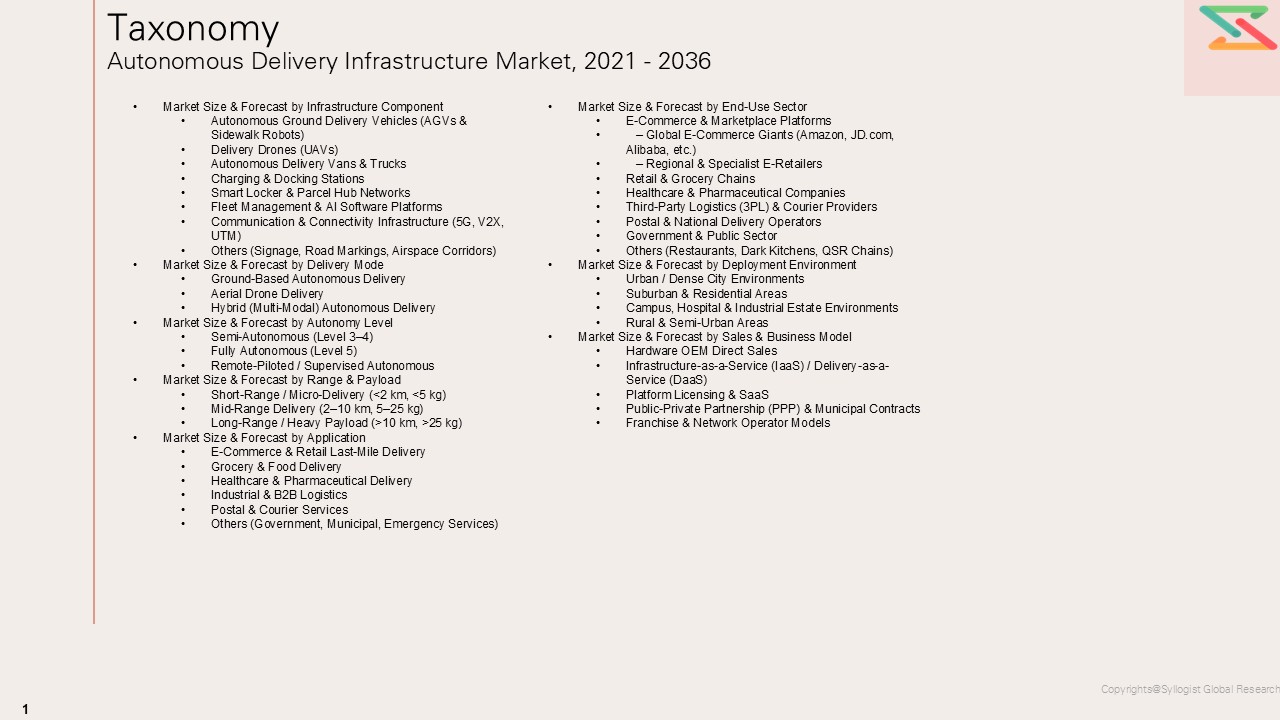
- Global Autonomous Delivery Infrastructure Market Outlook
- Market Size & Forecast by Value (USD Billion, 2021–2036)
- Market Size & Forecast by Infrastructure Component
- Autonomous Ground Delivery Vehicles (AGVs & Sidewalk Robots)
- Delivery Drones (UAVs)
- Autonomous Delivery Vans & Trucks
- Charging & Docking Stations
- Smart Locker & Parcel Hub Networks
- Fleet Management & AI Software Platforms
- Communication & Connectivity Infrastructure (5G, V2X, UTM)
- Others (Signage, Road Markings, Airspace Corridors)
- Market Size & Forecast by Delivery Mode
- Ground-Based Autonomous Delivery
- Aerial Drone Delivery
- Hybrid (Multi-Modal) Autonomous Delivery
- Market Size & Forecast by Autonomy Level
- Semi-Autonomous (Level 3–4)
- Fully Autonomous (Level 5)
- Remote-Piloted / Supervised Autonomous
- Market Size & Forecast by Range & Payload
- Short-Range / Micro-Delivery (<2 km, <5 kg)
- Mid-Range Delivery (2–10 km, 5–25 kg)
- Long-Range / Heavy Payload (>10 km, >25 kg)
- Market Size & Forecast by Application
- E-Commerce & Retail Last-Mile Delivery
- Grocery & Food Delivery
- Healthcare & Pharmaceutical Delivery
- Industrial & B2B Logistics
- Postal & Courier Services
- Others (Government, Municipal, Emergency Services)
- Market Size & Forecast by End-Use Sector
- E-Commerce & Marketplace Platforms
- – Global E-Commerce Giants (Amazon, JD.com, Alibaba, etc.)
- – Regional & Specialist E-Retailers
- Retail & Grocery Chains
- Healthcare & Pharmaceutical Companies
- Third-Party Logistics (3PL) & Courier Providers
- Postal & National Delivery Operators
- Government & Public Sector
- Others (Restaurants, Dark Kitchens, QSR Chains)
- Market Size & Forecast by Deployment Environment
- Urban / Dense City Environments
- Suburban & Residential Areas
- Campus, Hospital & Industrial Estate Environments
- Rural & Semi-Urban Areas
- Market Size & Forecast by Sales & Business Model
- Hardware OEM Direct Sales
- Infrastructure-as-a-Service (IaaS) / Delivery-as-a-Service (DaaS)
- Platform Licensing & SaaS
- Public-Private Partnership (PPP) & Municipal Contracts
- Franchise & Network Operator Models
- Asia-Pacific Autonomous Delivery Infrastructure Market Outlook
- Market Size & Forecast
- By Value (2020–2035)
- By Infrastructure Component
- By Delivery Mode
- By Autonomy Level
- By Range & Payload
- By Application
- By End-Use Sector
- By Deployment Environment
- By Sales & Business Model
- Key Demand Drivers (APAC-Specific)
- Competitive Landscape (APAC)
- Europe Autonomous Delivery Infrastructure Market Outlook
- Market Size & Forecast
- By Value (2020–2035)
- By Infrastructure Component
- By Delivery Mode
- By Autonomy Level
- By Range & Payload
- By Application
- By End-Use Sector
- By Deployment Environment
- By Sales & Business Model
- Key Demand Drivers (Europe-Specific)
- Competitive Landscape (Europe)
- North America Autonomous Delivery Infrastructure Market Outlook
- Market Overview & Strategic Importance
- Market Size & Forecast
- By Value (2020–2035)
- By Infrastructure Component
- By Delivery Mode
- By Autonomy Level
- By Range & Payload
- By Application
- By End-Use Sector
- By Deployment Environment
- By Sales & Business Model
- Key Demand Drivers (North America-Specific)
- Competitive Landscape (North America)
- Latin America Autonomous Delivery Infrastructure Market Outlook
- Market Size & Forecast
- By Value (2020–2035)
- By Infrastructure Component
- By Delivery Mode
- By Autonomy Level
- By Range & Payload
- By Application
- By End-Use Sector
- By Deployment Environment
- By Sales & Business Model
- Key Demand Drivers (LATAM-Specific)
- Competitive Landscape (Latin America)
- Middle East & Africa Autonomous Delivery Infrastructure Market Outlook
- Market Size & Forecast
- By Value (2020–2035)
- By Infrastructure Component
- By Delivery Mode
- By Autonomy Level
- By Range & Payload
- By Application
- By End-Use Sector
- By Deployment Environment
- By Sales & Business Model
- Key Demand Drivers (MEA-Specific)
- Competitive Landscape (MEA)
- Country-Wise Autonomous Delivery Infrastructure Market Outlook
- Market Size & Forecast by Country
- By Value
- By Infrastructure Component
- By Delivery Mode
- By Autonomy Level
- By Range & Payload
- By Application
- By End-Use Sector
- By Deployment Environment
- By Sales & Business Model
- Countries Covered: United States, Canada, Brazil, Mexico, Germany, United Kingdom, France, Netherlands, Sweden, China, Japan, South Korea, India, Australia, Singapore, UAE, Saudi Arabia, Israel, South Africa, Nigeria
- Technology Landscape & Innovation Analysis
- Autonomous Delivery Infrastructure Technology Maturity Assessment
- Emerging & Disruptive Technologies in Ground & Aerial Autonomous Delivery
- AI, Computer Vision & Edge Computing in Autonomous Navigation & Obstacle Avoidance
- 5G, V2X & Low-Latency Connectivity Infrastructure for Autonomous Delivery
- Urban Air Mobility (UAM), Drone Corridors & UTM Infrastructure Development
- Swarm Robotics & Multi-Agent Coordination in Last-Mile Delivery Networks
- Technology Readiness & Commercialisation Matrix – Key ADI Technologies
- Patent Landscape Analysis
- R&D Investment Benchmarking
- Value Chain & Supply Chain Analysis
- Autonomous Delivery Infrastructure Value Chain Mapping
- Supply Chain Concentration & Dependency Analysis
- Key Supplier Mapping by Component Category & Technology Programme
- Supplier Risk Heat Map
- Make vs Buy Strategy Trends Among ADI Providers, Fleet Operators & Logistics Companies
- Pricing Analysis
- Autonomous Delivery Infrastructure Pricing Dynamics & Mechanisms
- Pricing by Infrastructure Component, Deployment Environment & Autonomy Level
- Total Cost of Ownership (TCO) Analysis – Including Hardware, Software & Operations
- Operator vs OEM Pricing Trends & Benchmarks
- IaaS / DaaS vs Owned-Fleet Pricing & Value Proposition
- Per-Delivery Cost Benchmarking Across Vehicle Types & Geographies
- Sustainability & Environmental Stewardship
- Environmental & Sustainability Landscape in Autonomous Delivery Infrastructure
- Carbon Footprint Benchmarking Across Ground & Aerial Autonomous Delivery vs Conventional Vans
- Electric Propulsion, Battery Technology & Charging Infrastructure Sustainability Roadmap
- Noise Pollution & Urban Environment Impact Assessment for Drones & Sidewalk Robots
- Circular Economy & End-of-Life Hardware Recycling for Autonomous Delivery Fleets
- ESG Reporting & Lifecycle Assessment (LCA) in ADI Operations
- Competitive Landscape
- Market Structure & Concentration
- Market Consolidation Level: Global Leaders vs Regional Players
- Top 5 ADI Providers Market Revenue Share
- HHI (Herfindahl-Hirschman Index) Concentration Analysis by Component & Application Segment
- Competitive Intensity Map by Delivery Mode & Region
- Player Classification
- Tier-1 Global Integrated ADI & Logistics Technology Companies
- Tier-2 Regional & Specialist Autonomous Delivery Hardware & Software Providers
- Drone & Robot OEMs, Infrastructure Developers & Platform Operators
- Emerging & Disruptive Players
- Competitive Analysis Frameworks
- Market Share Analysis by Component, Application & Geography
- R&D Intensity Benchmarking
- Fleet Deployment Scale & Route Coverage Comparison
- Geographic Revenue Exposure Comparison
- Company Profiles
- Company Overview, HQ & Organisational Structure
- ADI Products, Platforms & Services Portfolio
- Revenue Breakdown
- Key Fleet Deployments, Pilot Programmes & Commercial Contracts
- Manufacturing Footprint & Key Facilities
- Recent Developments (M&A, Partnerships, New Products, Financial Results)
- SWOT Analysis
- Strategic Focus: Autonomy Levels, Route Expansion, Platform Ecosystem & Regulatory Wins
- Strategic Output
- Market Opportunity Matrix
- High-Value Opportunity Quadrant Analysis
- Addressable Market by Component, Application & Region
- Time-to-Revenue Assessment by Opportunity
- White Space Opportunity Analysis
- Underserved Delivery Application & Deployment Environment Gaps
- Geographic Markets with Low ADI Penetration
- Technology Gaps with High Commercialisation Potential
- Customer Segment Unmet Needs
- Strategic Recommendations
- Product Portfolio & Innovation Strategy
- Technology & Digitalisation Strategy
- Manufacturing Footprint & Fleet Deployment Capacity Expansion Strategy
- Delivery-as-a-Service (DaaS) & Platform Ecosystem Growth Strategy
- Pricing & Commercial Strategy
- Sustainability & Regulatory Compliance Strategy
- Supply Chain & Hardware Sourcing Strategy
- Partnership, M&A & Expansion Strategy
- Regional Growth Strategy
- Risk Mitigation & Future Roadmap
- Strategic Priority Matrix & Roadmap
- Near-Term (2025–2028)
- Mid-Term (2029–2032)
- Long-Term (2033–2036)
- Market Opportunity Matrix
- Market Structure & Concentration
- Market Size & Forecast by Country
- Market Size & Forecast
- Market Size & Forecast
- Market Size & Forecast
- Market Size & Forecast
- Infrastructure Economics & Unit Economics Framework