
Market Definition
The Global Gallium Nitride Power Devices Market encompasses the design, fabrication, packaging, and commercialization of power semiconductor devices built on gallium nitride epitaxial structures, engineered to convert, switch, and control electrical energy across a broad continuum of voltage, current, and frequency requirements in power electronics applications spanning consumer electronics, data center infrastructure, electric mobility, renewable energy generation and storage, industrial motor drives, telecommunications base stations, aerospace and defense power systems, and wireless charging platforms. Gallium nitride is a wide-bandgap semiconductor material whose fundamental physical properties, including a bandgap of 3.4 electron volts, a critical electric field strength approximately ten times that of silicon, and an electron mobility enabling switching frequencies in the megahertz range, collectively enable the construction of power transistors and rectifiers that operate at higher voltages, higher temperatures, and higher switching frequencies than silicon-based equivalents of comparable die area, translating into power conversion systems of substantially reduced size, weight, and passive component count with materially superior energy conversion efficiency. The product scope of this market includes enhancement-mode gallium nitride field-effect transistors, depletion-mode high-electron-mobility transistors, gallium nitride-on-silicon epitaxial wafer platforms for lateral device architectures, gallium nitride-on-silicon carbide substrates for radio frequency and high-power density applications, vertical gallium nitride device structures targeting high-voltage utility and industrial power applications, integrated gallium nitride power stages combining gate driver and protection circuitry with the switching element, and multi-chip module and system-in-package assemblies that leverage gallium nitride switching performance within thermally optimized packaging configurations. The technology landscape spans device voltage classes from sub-100 volt consumer charging applications through 650 volt platforms dominant in switched-mode power supplies and onboard electric vehicle chargers to emerging 1,200 volt and higher vertical device architectures targeting motor drive and grid interface applications currently served by silicon carbide and silicon insulated-gate bipolar transistor solutions. The value chain of this market extends from gallium and nitrogen source material producers and metalorganic chemical vapor deposition epitaxy service providers through substrate wafer suppliers, integrated device manufacturers operating proprietary gallium nitride fabrication lines, fabless device design companies utilizing foundry services, power module and integrated circuit packaging specialists, reference design and application engineering service providers, and the distribution channels and original equipment manufacturer procurement organizations that deliver gallium nitride power components into end-system power electronics designs across global industrial and consumer markets.
Market Insights
The global gallium nitride power devices market is demonstrating a distinctly accelerating commercial trajectory in 2026, driven by the convergence of sustained cost reduction in gallium nitride-on-silicon device manufacturing, a broadening base of qualified and commercially shipping product families across voltage and current classes, and the intensifying design-in activity at major power supply, electric vehicle onboard charger, and data center voltage regulation module manufacturers who are progressively standardizing on gallium nitride switching elements as the performance-enabling technology of choice for next-generation power conversion density and efficiency targets. The market surpassed a valuation of USD 2.1 billion in 2025 and is projected to expand at a compound annual growth rate exceeding 20 percent through 2036, reaching approximately USD 16 billion by the end of the forecast period, a trajectory underpinned by the structural shift in power electronics design philosophy from silicon-optimized topologies operating at tens of kilohertz toward gallium nitride-optimized resonant and soft-switching topologies that operate at hundreds of kilohertz to multiple megahertz and that require the near-zero reverse recovery charge and low gate charge characteristics that gallium nitride devices uniquely provide among commercially available power semiconductor technologies at the 650 volt class. The competitive landscape of the market is structured around a core group of vertically integrated device manufacturers with proprietary gallium nitride-on-silicon epitaxy and fabrication capabilities, a growing ecosystem of fabless design companies accessing independent foundry capacity, and the emerging entry of established silicon power semiconductor leaders who are deploying gallium nitride product lines to protect their franchise positions in power supply, motor control, and automotive power electronics markets as the technology transitions from early adopter to mainstream qualification status.
A defining commercial and technical trend reshaping the competitive structure of the gallium nitride power device market is the rapid proliferation of integrated gate driver and power stage products that co-package gallium nitride switching transistors with complementary metal-oxide-semiconductor gate driver circuitry, protection logic, and in some configurations analog controller functions within a single package or monolithic die, fundamentally simplifying the printed circuit board design task and reducing the engineering barriers that previously limited gallium nitride adoption to power electronics design teams with deep expertise in high-frequency switching circuit techniques. The integration trend is commercially significant because the performance advantages of gallium nitride switching at megahertz frequencies are fully realizable only when the gate drive signal path is engineered with sub-nanosecond timing precision and the layout parasitics of the power loop are minimized to the sub-hundred picohenry range, requirements that are substantially easier to meet within a co-packaged integrated circuit than in a discrete component printed circuit board implementation. Leading device suppliers are differentiating their integrated product platforms through proprietary gate drive architectures optimized for gallium nitride threshold voltage characteristics, on-chip overcurrent and over-temperature protection systems calibrated to gallium nitride device failure mode physics, and application-specific configurations targeting the LLC resonant converter topology dominant in data center power supplies and the totem-pole power factor correction and phase-shifted full bridge topologies prevalent in electric vehicle onboard charger and industrial power supply applications. The growing availability of integrated gallium nitride power stage products at competitive price points relative to silicon gate-driver and metal-oxide-semiconductor field-effect transistor combinations is accelerating design-in conversion rates among tier-one power supply manufacturers and is expanding the addressable market for gallium nitride beyond the high-performance frontier applications where discrete devices first established commercial traction.
The electric vehicle onboard charger and DC-DC converter segment has emerged as the largest single application driver of gallium nitride power device revenue growth, with the transition of global automotive original equipment manufacturers toward battery electric vehicle platforms creating a structurally significant and rapidly scaling demand pool for high-frequency power conversion components that enable the compact, lightweight, and thermally manageable power electronics architectures demanded by electric vehicle platform integration constraints. Gallium nitride devices are enabling onboard charger designs achieving power densities exceeding 5 kilowatts per liter and conversion efficiencies above 97 percent, performance parameters that are not achievable with silicon superjunction transistors in equivalent form factor envelopes and that translate directly into vehicle-level benefits including reduced weight, freed installation volume, and lower thermal management system requirements that are commercially valued by automotive platform engineers. The automotive qualification pathway for gallium nitride devices has matured significantly over the preceding three years, with leading device suppliers having completed AEC-Q101 qualification programs for their 650 volt automotive-grade product families and having established the production volume, supply chain redundancy, and quality system documentation required for tier-one automotive supplier approval processes. The simultaneous growth of DC fast charging infrastructure, which increasingly incorporates gallium nitride power conversion stages in the AC-DC rectifier and DC-DC isolation stages to achieve the combination of high power density, wide input voltage range operation, and high partial-load efficiency that modern charging station designs demand, is adding a parallel infrastructure demand stream that complements the vehicle-level application pull and extends gallium nitride revenue exposure across the complete electric vehicle charging ecosystem.
From a geographic perspective, Asia-Pacific dominates the global gallium nitride power device market by both consumption volume and manufacturing investment, driven by the concentration of consumer electronics original equipment manufacturers, power adapter and charger manufacturers, and electric vehicle production in China, South Korea, Japan, and Taiwan, all of which are at the forefront of gallium nitride design adoption and are generating the highest volumes of qualified design wins converting to commercial production. China represents the single largest national market for gallium nitride power device consumption and is simultaneously the most significant geography for domestic gallium nitride device manufacturing investment, with multiple Chinese semiconductor companies having established gallium nitride-on-silicon epitaxy and device fabrication capabilities in pursuit of domestic supply chain independence for a technology identified as strategically important within national semiconductor self-sufficiency policy frameworks. North America constitutes the most significant market for gallium nitride device intellectual property development, venture and corporate research investment, and premium application adoption in data center power infrastructure and defense electronics, with the concentration of hyperscale data center operators in the United States creating a high-value and technically demanding demand pull for the most advanced gallium nitride integrated power stage solutions targeting 48 volt to point-of-load voltage regulation module applications at the rack and server level. Europe represents a market characterized by strong adoption of gallium nitride in industrial motor drives, renewable energy inverter applications, and the onboard power electronics of European-branded electric vehicles, supported by energy efficiency regulatory frameworks that are progressively tightening the minimum energy performance standards applied to external power supplies, server power units, and variable-speed motor drives in ways that create compliance-driven demand for the efficiency advantages that gallium nitride power conversion delivers relative to silicon-based alternatives.
Key Drivers
Surging Demand for High-Efficiency, High-Density Power Conversion in Data Center Infrastructure and the Transition to 48 Volt Power Distribution Architectures
The most structurally significant and commercially immediate demand driver for gallium nitride power devices in the near-term market outlook is the accelerating expansion of hyperscale and AI-optimized data center infrastructure, which is generating unprecedented demand for power conversion components capable of meeting the combination of extreme power density, high conversion efficiency at all load levels, and low acoustic noise requirements that modern high-performance computing rack designs impose on their power delivery systems. The explosive growth of artificial intelligence training and inference workloads is driving a rapid escalation in per-rack power consumption at leading hyperscale operators from conventional levels of 10 to 15 kilowatts per rack toward 50 to 100 kilowatts per rack in GPU-dense AI compute configurations, a power density escalation that is forcing fundamental architectural changes in data center power distribution toward 48 volt bus architectures and high-density bus converters whose technical requirements align precisely with the switching frequency, output ripple, and conversion efficiency capabilities that gallium nitride devices provide. The transition from traditional 12 volt server power delivery architectures to 48 volt intermediate bus distribution with point-of-load gallium nitride DC-DC converters reduces resistive distribution losses, enables smaller cable and busbar cross-sections, and allows the placement of power conversion closer to the processor load, all of which are engineering priorities that data center operators and server platform designers are actively pursuing as they scale AI compute density within constrained facility power and cooling envelopes. Major hyperscale operators including those with the largest AI infrastructure deployment programs have publicly disclosed efficiency and power density targets for their next-generation server power architectures that are achievable only with gallium nitride-based power conversion stages, effectively establishing technology pull specifications that their power supply and voltage regulation module suppliers are responding to with gallium nitride product development investments that are accelerating the technology’s transition from premium option to baseline specification in data center power electronics.
Rapid Electrification of Consumer and Industrial Applications Driving Adoption of Compact, High-Frequency Gallium Nitride Charging and Power Supply Platforms
The broad-based electrification of consumer electronics, personal mobility devices, and industrial equipment, combined with the proliferation of multi-device wireless and wired charging ecosystems and the regulatory tightening of energy efficiency standards for external power supplies and battery chargers across major markets, is generating a sustained and expanding demand driver for gallium nitride power devices that is distinct from and complementary to the data center and automotive application pull. The consumer electronics charging market has served as the volume commercialization pathway for 65 volt to 100 watt gallium nitride power adapter products, with the adoption of gallium nitride charging technology by major smartphone, laptop, and tablet original equipment manufacturers driving the rapid commoditization of gallium nitride-based USB Power Delivery charger platforms at retail price points that are now competitive with silicon-based alternatives of equivalent power rating at substantially smaller physical dimensions. The commercial success of compact gallium nitride consumer chargers has created a self-reinforcing adoption dynamic in which consumer awareness of gallium nitride’s size and weight advantages is generating retail demand pull that incentivizes brand-name consumer electronics accessories manufacturers to expand their gallium nitride charger portfolios, increasing production volumes that drive further die cost reductions and making the economic case for gallium nitride adoption increasingly compelling across a widening range of power ratings and application categories. In the industrial domain, the combination of tightening energy efficiency regulations for variable-speed motor drives, uninterruptible power supplies, and photovoltaic inverters in Europe, North America, and China is creating compliance-driven demand for power conversion technologies capable of delivering the fractional percentage improvements in full-load and partial-load efficiency that gallium nitride switching enables relative to silicon insulated-gate bipolar transistor designs, and which are increasingly necessary to meet the next tier of mandatory minimum efficiency requirements without the size and cost penalties associated with alternative efficiency improvement approaches such as increased passive component dimensions or advanced magnetics.
Key Challenges
High Manufacturing Cost and Epitaxial Yield Constraints Limiting the Addressable Price-Performance Window for Gallium Nitride Devices Relative to Mature Silicon Competitors
A persistent structural challenge constraining the pace of gallium nitride power device market penetration beyond its current strongholds in premium power density and efficiency-sensitive applications is the materially higher manufacturing cost per ampere of current handling capability that gallium nitride devices carry relative to mature silicon superjunction transistors and silicon carbide devices at overlapping voltage classes, a cost disadvantage rooted in the higher complexity and lower volume of gallium nitride-on-silicon epitaxial wafer production, the tighter process control requirements of gallium nitride device fabrication, and the currently limited number of high-volume manufacturing facilities operating at the wafer size and throughput levels required for cost-competitive production. The epitaxial growth of gallium nitride device layers on large-diameter silicon substrates, while substantially more cost-effective than growth on native gallium nitride or silicon carbide substrates, introduces wafer bow and thermal mismatch challenges that increase epitaxial defect density and reduce device yield relative to silicon processes at equivalent wafer diameters, and the management of these yield loss mechanisms requires proprietary process knowledge and equipment optimization that represents a significant barrier to rapid manufacturing capacity expansion by new entrants. The consequence of this cost structure is that gallium nitride devices remain priced at a premium relative to silicon superjunction alternatives in the 600 volt class that constrains adoption in cost-sensitive application segments including commodity power supplies, low-end motor drives, and consumer appliance power electronics where the efficiency and density advantages of gallium nitride are technically valued but cannot be monetized through product pricing premiums sufficient to recover the higher component cost. Overcoming this challenge requires sustained progress on multiple fronts simultaneously, including transition to 200 millimeter gallium nitride-on-silicon epitaxial wafer processing at commercial volume, improvement in epitaxial uniformity and device yield through enhanced metalorganic chemical vapor deposition reactor design and process control, and the design optimization of device architectures that maximize current handling capability per unit die area to drive down the cost per ampere that is the fundamental commercial competitiveness metric in power electronics procurement.
Reliability Qualification Complexity and the Long Design-In Cycles Required to Establish Gallium Nitride Device Confidence in High-Criticality Industrial and Automotive Applications
A structurally significant commercial challenge limiting the pace of gallium nitride power device penetration in high-criticality application segments including automotive power electronics, industrial motor drives for safety-relevant machinery, aerospace power systems, and grid-connected renewable energy inverters is the complexity, duration, and cost of the reliability qualification programs that original equipment manufacturers and system integrators in these sectors require before approving new semiconductor technologies for use in designs where device failure carries safety, warranty, or system downtime consequences of material financial or regulatory significance. Gallium nitride device reliability qualification in automotive applications requires completion of AEC-Q101 stress test protocols including high-temperature reverse bias, high-temperature gate bias, temperature cycling, humidity and bias testing, and electrostatic discharge characterization, followed by extended application-specific reliability demonstration programs at automotive tier-one supplier level that can require 12 to 24 months of accelerated life testing and field data accumulation before design approval is granted. The qualification timeline challenge is compounded by the relative immaturity of established failure physics models for gallium nitride device degradation mechanisms including dynamic on-resistance dispersion, threshold voltage instability under repetitive gate stress, and buffer trapping phenomena that are specific to the gallium nitride-on-silicon heterostructure and that do not have direct analogues in the silicon device reliability literature from which automotive and industrial qualification engineers typically draw their stress test methodology and acceptance criteria frameworks. Device suppliers are addressing this challenge through the publication of application-specific reliability data packages, the development of physics-of-failure models for gallium nitride degradation mechanisms that provide qualification engineers with the scientific basis for relating accelerated stress test results to field lifetime predictions, and the establishment of application engineering partnerships with tier-one automotive and industrial system integrators that provide the collaborative technical environment in which qualification program design and acceptance criterion definition can proceed more efficiently than in a purely transactional supplier-customer relationship.
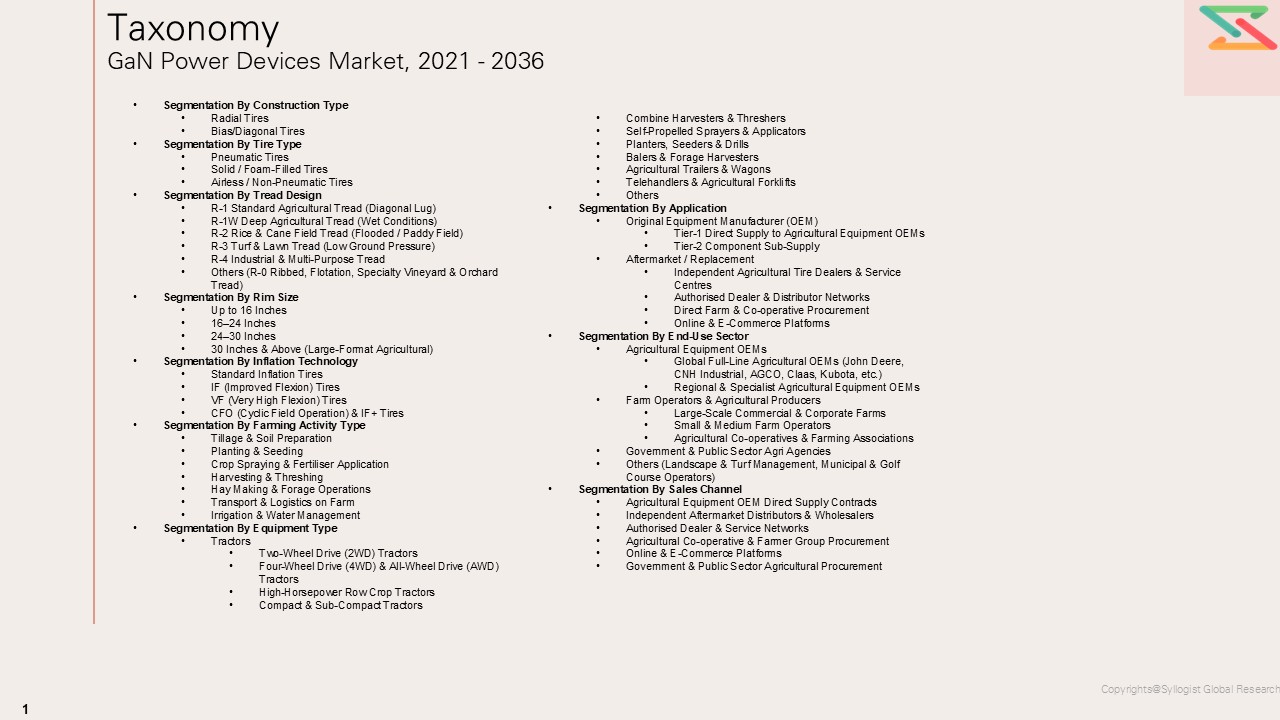
Market Segmentation
- Segmentation By Device Type
- Enhancement-Mode Gallium Nitride Field-Effect Transistors (eGaN FET)
- Depletion-Mode High-Electron-Mobility Transistors (HEMT)
- Cascode Gallium Nitride Transistors
- Integrated Gallium Nitride Power Stages
- Gallium Nitride Schottky Barrier Diodes
- Vertical Gallium Nitride Transistors
- Gallium Nitride Power Modules
- Others
- Segmentation By Voltage Class
- Below 100 Volts
- 100 to 200 Volts
- 201 to 650 Volts
- 651 to 900 Volts
- Above 900 Volts
- Segmentation By Substrate Technology
- Gallium Nitride on Silicon (GaN-on-Si)
- Gallium Nitride on Silicon Carbide (GaN-on-SiC)
- Gallium Nitride on Gallium Nitride (Native Substrate)
- Gallium Nitride on Sapphire
- Others
- Segmentation By Application
- Consumer Electronics Chargers and Adapters
- Data Center Power Supplies and Voltage Regulation Modules
- Electric Vehicle Onboard Chargers
- Electric Vehicle DC-DC Converters
- Photovoltaic and Energy Storage Inverters
- Industrial Motor Drives and Variable Frequency Drives
- Telecommunications and 5G Base Station Power
- Wireless Charging Systems
- Aerospace and Defense Power Systems
- Uninterruptible Power Supplies
- Others
- Segmentation By Wafer Size
- 100 Millimeter Wafers
- 150 Millimeter Wafers
- 200 Millimeter Wafers
- Others
- Segmentation By Integration Level
- Discrete Power Transistors
- Integrated Gate Driver and Power Stage
- Power Management Integrated Circuits with Gallium Nitride Switch
- Multi-Chip Power Modules
- System-in-Package (SiP) Assemblies
- Others
- Segmentation By End-Use Industry
- Consumer Electronics
- Information Technology and Data Centers
- Automotive and Electric Vehicles
- Renewable Energy and Energy Storage
- Industrial Automation and Motor Drives
- Telecommunications
- Aerospace and Defense
- Healthcare and Medical Equipment
- Others
- Segmentation By Sales Channel
- Direct Original Equipment Manufacturer Sales
- Authorized Distributor Channel
- Electronics Component Brokers
- Online Procurement Platforms
- Others
- Segmentation By Region
- North America
- Europe
- Asia-Pacific
- Latin America
- Middle East and Africa
All market revenues are presented in USD
Historical Year: 2021-2024 | Base Year: 2025 | Estimated Year: 2026 | Forecast Period: 2027-2036
Key Questions this Study Will Answer
- What is the projected global market valuation and volume for gallium nitride power devices through 2036, segmented by device type, voltage class, substrate technology, application, and region, and which product categories and geographic markets are expected to generate the highest incremental revenue growth across the forecast period?
- How is the ongoing cost reduction trajectory in gallium nitride-on-silicon epitaxial wafer production and device fabrication expected to close the price-performance gap with silicon superjunction transistors across the 600 volt device class, and at what cost crossover points are gallium nitride devices projected to displace silicon as the default switching technology in mainstream power supply, motor drive, and industrial converter applications?
- What is the current state of automotive qualification for gallium nitride 650 volt power devices among leading device suppliers, which electric vehicle platforms and onboard charger architectures are generating the most active design-in pipelines, and how are automotive original equipment manufacturer procurement strategies expected to evolve as gallium nitride transitions from premium to standard specification in electric vehicle power electronics through the forecast period?
- How is the transition to 48 volt power distribution architectures and the scaling of artificial intelligence compute power density in hyperscale data centers reshaping the performance specifications and integration requirements applied to gallium nitride power conversion components, and which integrated gate driver and power stage product platforms are best positioned to capture the resulting design-win opportunity among major server platform and power supply manufacturers?
- What is the competitive and intellectual property landscape among leading gallium nitride power device manufacturers, foundry service providers, and epitaxial wafer suppliers, and how are technology licensing strategies, manufacturing capacity investment plans, and product portfolio roadmaps across the 100 volt to 1,200 volt device voltage spectrum expected to reshape competitive positioning among established players and emerging domestic manufacturers in China and other Asia-Pacific markets over the forecast horizon?
- How are tightening energy efficiency regulations for external power supplies, variable-speed motor drives, and renewable energy inverters in the European Union, United States, and China expected to influence the adoption pace of gallium nitride power conversion technology in compliance-driven application segments, and what incremental efficiency thresholds in next-generation regulatory frameworks are projected to create step-change demand inflections for gallium nitride devices relative to incumbent silicon insulated-gate bipolar transistor and superjunction transistor technologies?
- Product Definition
- Scope of the Study
- Research Methodology
- Research Design & Framework
- Overall Research Approach: Descriptive, Exploratory & Quantitative Mixed-Method Design
- Market Definition & Scope Boundaries: What is Included and Excluded
- Segmentation Framework
- Key Research Assumptions & Limitations
- Secondary Research
- Industry Publications, Semiconductor & Power Electronics Manufacturer Reports & Press Releases
- Government Technology, Energy & Trade Authority Data (IEA, DOE, SEMI, JEITA, etc.)
- GaN Power Device Production, Trade & Shipment Market Statistics
- OEM Procurement & Power Electronics Supply Chain Databases
- Primary Research Design & Execution
- In-depth Interviews with GaN Power Device Manufacturers, OEM Procurement Heads & Distribution Channel Partners
- Surveys with Power Electronics OEMs, Independent Distributors & End-Use Industry Buyers
- Expert Panel Validation
- Data Triangulation & Validation
- Market Sizing & Forecasting Methodology
- Bottom-Up & Top-Down Reconciliation
- Wafer Shipment & Device Conversion Model for OEM & Aftermarket Demand
- End-Use Application Adoption Rate & Technology Substitution-Driven Market Sizing Model
- Competitive Intelligence Methodology
- Quality Assurance & Peer Review
- Definitions, Abbreviations & Data Notes
- Executive Summary
- Market Snapshot & Headline Numbers
- Key Findings & Research Highlights
- Technology & Innovation Highlights
- Manufacturing Economics & Unit Economics Summary
- Average Fab CAPEX & OPEX Benchmarks
- IDM vs Fabless vs Foundry Model Margin & Profitability Analysis
- GaN-on-Si & GaN-on-SiC Device Revenue Model Summary
- Market Dynamics
- Drivers
- Restraints
- Opportunities
- Challenges
- Porter’s Five Forces Analysis
- PESTLE Analysis
- Market Trends & Developments
- Emerging Trends
- Technological Developments
- Regulatory & Policy Changes
- Supply Chain & Sourcing Trends
- Investment & Funding Activity
- Sustainability & ESG Trends
- Geographic & Regional Trends
- Risk Assessment Framework
- Geopolitical & Trade Policy Risk
- Raw Material Price Volatility (Gallium, SiC Substrate, Epitaxial Wafer) Risk
- Environmental & Regulatory Risk
- Financial / Market Risk
- End-Market Cyclicality & Technology Adoption Rate Risk
- Competing Technologies (SiC MOSFET, Si IGBT, Si MOSFET) Substitution Risk
- Intellectual Property Litigation & Patent Concentration Risk
- Regulatory Framework & Policy Standards
- Global Gallium Nitride Power Devices Market Economics
- Manufacturing Economics & Unit Economics Framework
- Capital Expenditure (CAPEX) Structure
- Operating Expenditure (OPEX) Structure
- Revenue Model & Monetisation Levers
- Capacity Utilisation & Throughput Economics
- Payback Period & Return on Investment (ROI) Analysis
- Total Cost of Production vs Alternative Power Semiconductor Technologies (SiC MOSFET, Si IGBT)
- Raw Material & Input Cost Analysis
- Gallium Metal & Gallium Compounds Price Trends (USD/tonne, 2021–2035)
- Silicon Carbide (SiC) Substrate & GaN Epitaxial Wafer Cost Dynamics
- Silicon (Si) Substrate Cost Analysis for GaN-on-Si Devices
- Chemical Vapour Deposition (CVD) & MOCVD Process Input Cost Structure
- Energy Cost Structure in GaN Wafer Fabrication & Device Manufacturing
- Advanced Packaging & Assembly Material Cost Economics
- Impact of Large-Diameter Wafer (6-inch & 8-inch) Transition on Product Economics
- Distribution & Aftermarket Channel Economics
- Distribution Cost Structure by Application Segment & Geography
- Inventory Carrying Costs & Lead Time Economics by Channel Type
- Value-Added Reseller (VAR) & Design-In Support Service Economics
- Warranty & Returns Economics in Direct vs Distribution Channel
- Regulatory & Standards Compliance Economics
- GaN Power Device Safety & Reliability Standards Compliance Cost Benchmarks (IEC, UL, AEC-Q101, MIL-STD, etc.)
- EMC, Energy Efficiency & Thermal Performance Testing Compliance Costs
- End-of-Life & RoHS / WEEE Environmental Regulation Compliance Costs
- Global Gallium Nitride Power Devices Market Outlook
- Market Size & Forecast by Value (USD Billion, 2021–2036)
- Market Size & Forecast by Substrate Type
- GaN-on-Silicon (GaN-on-Si)
- GaN-on-Silicon Carbide (GaN-on-SiC)
- GaN-on-Diamond
- Others (Native GaN Substrates, Sapphire)
- Market Size & Forecast by Device Type
- High Electron Mobility Transistors (HEMTs)
- Schottky Barrier Diodes (SBDs)
- GaN Gate Injection Transistors (GITs)
- Monolithic Microwave Integrated Circuits (MMICs)
- Others (Enhancement Mode GaN, Cascode Configurations)
- Market Size & Forecast by Voltage Rating
- Below 100V
- 100V–600V
- 600V–1,200V
- Above 1,200V (High-Voltage GaN)
- Market Size & Forecast by Power Range
- Below 10W
- 10W–100W
- 100W–1kW
- Above 1kW
- Market Size & Forecast by Wafer Size
- 2-inch & Below
- 4-inch
- 6-inch
- 8-inch & Above
- Market Size & Forecast by Frequency Range
- Low Frequency (Below 100 kHz)
- Medium Frequency (100 kHz–1 MHz)
- High Frequency (1 MHz–6 GHz)
- Very High Frequency (Above 6 GHz – RF & Microwave)
- Market Size & Forecast by Application
- Power Conversion & Switched-Mode Power Supplies (SMPS)
- Motor Drives & Industrial Automation
- Electric Vehicle (EV) On-Board Chargers (OBC)
- EV Traction Inverters & DC-DC Converters
- Renewable Energy (Solar PV & Wind) Inverters
- Data Centre & Server Power Supplies
- Wireless Charging & Fast-Charging Adapters (Consumer Electronics)
- RF & Microwave Power Amplifiers
- Others (Aerospace, Medical, Defence, Rail)
- Market Size & Forecast by End-Use Industry
- Automotive & Electric Vehicles
- Global Automotive OEMs (Toyota, Volkswagen, General Motors, BYD, Tesla, etc.)
- EV Charging Infrastructure Operators & EVSE Manufacturers
- Consumer Electronics
- Smartphones, Laptops & Fast-Charging Adapter OEMs
- Home Appliances & White Goods Manufacturers
- Industrial
- Industrial Motor Drive & Automation System OEMs
- Industrial Power Supply & UPS Manufacturers
- Telecommunications & Data Centres
- 5G Base Station & Telecom Infrastructure OEMs
- Data Centre Server & Power Supply Manufacturers
- Renewable Energy & Grid Infrastructure
- Solar PV Inverter OEMs
- Wind Turbine Converter & Grid Energy Storage System Manufacturers
- Defence & Aerospace
- Others (Medical, Rail, Marine, Space)
- Automotive & Electric Vehicles
- Market Size & Forecast by Sales Channel
- Direct OEM Sales & Long-Term Supply Agreements
- Independent Semiconductor Distributors & Wholesalers
- Authorised Distribution & Value-Added Reseller (VAR) Networks
- Online & E-Commerce Platforms
- Government & Defence Procurement
- Asia-Pacific Gallium Nitride Power Devices Market Outlook
- Market Size & Forecast
- By Value (2020–2035)
- By Substrate Type
- By Device Type
- By Voltage Rating
- By Power Range
- By Wafer Size
- By Frequency Range
- By Application
- By End-Use Industry
- By Sales Channel
- Key Demand Drivers (Asia-Pacific-Specific)
- Competitive Landscape (Asia-Pacific)
- Europe Gallium Nitride Power Devices Market Outlook
- Market Size & Forecast
- By Value (2020–2035)
- By Substrate Type
- By Device Type
- By Voltage Rating
- By Power Range
- By Wafer Size
- By Frequency Range
- By Application
- By End-Use Industry
- By Sales Channel
- Key Demand Drivers (Europe-Specific)
- Competitive Landscape (Europe)
- North America Gallium Nitride Power Devices Market Outlook
- Market Overview & Strategic Importance
- Market Size & Forecast
- By Value (2020–2035)
- By Substrate Type
- By Device Type
- By Voltage Rating
- By Power Range
- By Wafer Size
- By Frequency Range
- By Application
- By End-Use Industry
- By Sales Channel
- Key Demand Drivers (North-Specific)
- Competitive Landscape (North)
- Latin America Gallium Nitride Power Devices Market Outlook
- Market Size & Forecast
- By Value (2020–2035)
- By Substrate Type
- By Device Type
- By Voltage Rating
- By Power Range
- By Wafer Size
- By Frequency Range
- By Application
- By End-Use Industry
- By Sales Channel
- Key Demand Drivers (Latin-Specific)
- Competitive Landscape (Latin)
- Middle East & Africa Gallium Nitride Power Devices Market Outlook
- Market Size & Forecast
- By Value (2020–2035)
- By Substrate Type
- By Device Type
- By Voltage Rating
- By Power Range
- By Wafer Size
- By Frequency Range
- By Application
- By End-Use Industry
- By Sales Channel
- Key Demand Drivers (Middle-Specific)
- Competitive Landscape (Middle)
- Country-Wise Gallium Nitride Power Devices Market Outlook
- Market Size & Forecast by Country
- By Value
- By Substrate Type
- By Device Type
- By Voltage Rating
- By Power Range
- By Wafer Size
- By Frequency Range
- By Application
- By End-Use Industry
- By Sales Channel
- Market Size & Forecast by Country
- Market Size & Forecast
- Market Size & Forecast
- Market Size & Forecast
- Market Size & Forecast
- Manufacturing Economics & Unit Economics Framework
Countries Covered: United States, Canada, Japan, China, South Korea, Taiwan, Germany, France, United Kingdom, Netherlands, Italy, India, Australia, Israel, Singapore, Brazil, South Africa, Saudi Arabia, UAE
- Technology Landscape & Innovation Analysis
- GaN Power Device Technology Maturity Assessment
- Emerging & Disruptive Technologies in GaN Power Electronics
- GaN-on-Si vs GaN-on-SiC: Cost-Performance Trade-off & Technology Roadmap
- Epitaxial Growth (MOCVD), Wafer Fabrication & Back-End Process Technology Innovations
- Gate Dielectric, Threshold Voltage Control & Dynamic On-Resistance Mitigation Advances
- Integrated Gate Driver, Protection Circuit & Advanced Packaging Technology Developments
- Technology Readiness & Commercialisation Matrix – Key GaN Power Device Technologies
- Patent Landscape Analysis
- R&D Investment Benchmarking
- Value Chain & Supply Chain Analysis
- GaN Power Device Value Chain Mapping
- Supply Chain Concentration & Dependency Analysis
- Key Supplier Mapping by Product & Technology Programme
- Gallium Metal & Gallium Compound Suppliers
- MOCVD Equipment & Epitaxial Wafer (Epi-Wafer) Suppliers
- SiC & Si Substrate Suppliers
- Advanced Packaging, Testing & Assembly Equipment Suppliers
- Supplier Risk Heat Map
- Make vs Buy Strategy Trends Among GaN Power Device Manufacturers
- Pricing Analysis
- GaN Power Device Pricing Dynamics & Mechanisms
- Pricing by Device Type, Voltage Rating & Power Range
- Total Cost of Ownership (TCO) Analysis – Including Efficiency Gains, Thermal Management & System-Level Savings
- IDM vs Fabless vs Foundry Model Pricing Trends & Benchmarks
- GaN vs SiC MOSFET vs Si IGBT Pricing & Value Proposition
- Sustainability & Environmental Stewardship
- Environmental & Sustainability Landscape in GaN Power Device Manufacturing
- Carbon Footprint Benchmarking Across GaN Device Production Technologies
- Recycled & Sustainable Material Integration Roadmap for GaN Device Manufacturers
- GaN Device Recyclability & End-of-Life Circular Economy Assessment
- Energy Efficiency Contribution of GaN Devices to System-Level & Grid-Level Carbon Reduction
- ESG Reporting & Lifecycle Assessment (LCA) in GaN Power Device Operations
- Competitive Landscape
- Market Structure & Concentration
- Market Consolidation Level: Global IDMs vs Fabless Players vs Foundry Partners
- Top 5 GaN Power Device Manufacturers Market Revenue Share
- HHI (Herfindahl-Hirschman Index) Concentration Analysis by Device Type & Application Segment
- Competitive Intensity Map by Segment & Region
- Player Classification
- Tier-1 Global Integrated GaN Power Device Manufacturers (IDMs)
- Tier-2 Fabless GaN Device Design Houses & Foundry-Based Players
- Epitaxial Wafer, Substrate & MOCVD Equipment Suppliers
- Emerging & Disruptive Players
- Competitive Analysis Frameworks
- Market Share Analysis by Device Type & Geography
- R&D Intensity Benchmarking
- OEM Design-In Programme & Long-Term Supply Contract Portfolio Comparison
- Geographic Revenue Exposure Comparison
- Company Profiles
- Company Overview, HQ & Organisational Structure
- GaN Power Device Products & Technology Portfolio
- Revenue Breakdown
- Key OEM Design-In Programmes & Customer Deployment References
- Manufacturing Footprint & Key Facilities
- Recent Developments (M&A, Partnerships, New Products, Financial Results)
- SWOT Analysis
- Strategic Focus: GaN-on-Si vs GaN-on-SiC Technology Roadmap, OEM Platform Wins, Distribution Channel Expansion
- Strategic Output
- Market Opportunity Matrix
- High-Value Opportunity Quadrant Analysis
- Addressable Market by Segment & Region
- Time-to-Revenue Assessment by Opportunity
- White Space Opportunity Analysis
- Underserved Application Segment & End-Use Industry Gaps
- Geographic Markets with Low GaN Penetration
- Technology Gaps with High Commercialisation Potential
- Customer Segment Unmet Needs
- Strategic Recommendations
- Product Portfolio & Innovation Strategy
- Technology & Digitalization Strategy
- Manufacturing Footprint & Capacity Expansion Strategy
- Distribution & Channel Partner Network Growth Strategy
- Pricing & Commercial Strategy
- Sustainability & Regulatory Compliance Strategy
- Supply Chain & Raw Material Sourcing Strategy
- Partnership, M&A & Expansion Strategy
- Regional Growth Strategy
- Risk Mitigation & Future Roadmap
- Strategic Priority Matrix & Roadmap
- Near-Term (2025–2028)
- Mid-Term (2029–2032)
- Long-Term (2033–2036)
- Market Opportunity Matrix
- Market Structure & Concentration