
Market Definition
The Global Aircraft Maintenance, Repair, and Overhaul (MRO) Market encompasses the complete commercial ecosystem of technical services, processes, materials, tooling, facilities, and regulatory frameworks required to maintain the airworthiness, operational safety, and performance compliance of commercial, military, and general aviation aircraft throughout their operational service lives. MRO constitutes the critical post-delivery aftermarket backbone of the global aviation industry, ensuring that every aircraft in operation conforms continuously to the airworthiness standards mandated by national and international civil aviation authorities, principally the US Federal Aviation Administration (FAA), the European Union Aviation Safety Agency (EASA), the International Civil Aviation Organization (ICAO), and their national counterparts, across every phase of its lifecycle from initial entry into service through scheduled and unscheduled maintenance events to end-of-life teardown and parts reclamation.
The market is structurally organised around four principal service categories: Engine MRO (overhaul, repair, and testing of aircraft powerplants including turbofan, turboprop, and turboshaft engines, as well as APUs, auxiliary power units, and associated hot-section components); Airframe Heavy Maintenance (scheduled base maintenance checks, structural inspections, corrosion control, and major modifications requiring full aircraft access in dedicated hangar facilities); Component MRO (the repair, overhaul, and certification of avionics, landing gear, flight control systems, hydraulic systems, electrical and mechanical systems, and cabin interior components); and Line Maintenance (routine pre-flight, transit, and light scheduled checks performed at airports to maintain day-to-day operational airworthiness with minimal aircraft downtime). A fifth and growing category encompasses Modifications and Upgrades, covering cabin reconfiguration, avionics upgrades, structural Supplemental Type Certificate (STC) installations, and retrofit programmes that extend aircraft commercial viability.
The market scope further includes the supporting technology and digital service layers that are progressively transforming MRO delivery models: predictive and condition-based maintenance analytics platforms, digital twin maintenance simulation systems, drone-based and AI-enhanced non-destructive testing (NDT) inspection tools, additive manufacturing for component repair and spare-part production, extended reality (XR) and augmented reality maintenance guidance systems, and cloud-based maintenance record management and compliance documentation systems. From a business model standpoint, the market is served by three organisational types: Original Equipment Manufacturer (OEM) captive MRO networks, which leverage proprietary engine and airframe data and tooling to deliver branded maintenance under long-term power-by-the-hour (PBH) and flight-hour agreements; independent third-party MRO providers (also known as independent MROs), which offer multi-type and multi-OEM service flexibility often at competitive cost; and airline in-house MRO divisions (also known as airline-affiliated MROs), which perform self-maintenance and often offer third-party capacity. The market serves commercial passenger airlines, cargo carriers, aircraft lessors, military operators, business aviation operators, regional carriers, and governmental and emergency services aviation fleets across all geographic regions.
Market Insights
As of early 2026, the global aircraft MRO market is operating in a period of structural supercycle demand driven by an unprecedented convergence of fleet ageing, aircraft production shortfalls, record air travel volumes, and accelerating digital transformation. The commercial aircraft MRO market was valued at approximately USD 90.85 billion in 2024 across principal analyst scope definitions, and is projected to reach USD 165 billion by 2035, reflecting CAGRs of 2.7–5.2% depending on scope boundaries and market definition. The Oliver Wyman Global Fleet and MRO Market Forecast 2025–2035, the industry’s most widely cited independent baseline, projects the MRO market to reach USD 119 billion in 2025 (surpassing the pre-COVID peak of 2019 by 12%) and USD 156 billion by 2035, at a CAGR of 2.7%.
The defining structural dynamic of the 2025–2026 market is the MRO supercycle created by simultaneous fleet ageing and production constrained fleet renewal. The average age of the global commercial fleet rose to 13.4 years in 2025, up from 12.1 years in 2024, as severe production shortfalls at both Airbus and Boeing prevent airlines from retiring ageing mid-generation aircraft on schedule. The global commercial airliner fleet, comprising approximately 29,000 aircraft in 2025, is forecast to grow to 38,300 by 2035 (a 32% increase), but is expected to fall materially short of the 39,000-aircraft forecast made before COVID-19, representing approximately six years of lost fleet growth absorbed entirely by existing assets flying more hours and requiring more intensive maintenance. Annual flight hours are projected to exceed 112 million globally by 2035. Each additional year of fleet age, combined with higher aircraft utilisation, directly translates into deeper and more frequent maintenance visits, heavier structural inspections, increased component replacement, and greater engine shop-visit rates, all of which structurally expand MRO addressable revenue.
The engine MRO segment is the market’s largest and highest-growth category, accounting for approximately 41–46% of total commercial MRO revenue. A historically unprecedented concentration of next-generation turbofan engine introductions, including the CFM International LEAP, Pratt & Whitney Geared Turbofan (GTF), and Rolls-Royce Trent XWB, has created exceptional engine shop capacity demand as durability issues, higher-than-anticipated shop-visit rates, and parts shortages have converged across multiple platforms simultaneously. Pratt & Whitney’s GTF engine issues, which required grounding and inspection of multiple Airbus A320 fleets across 2023–2025, are emblematic of a broader industry pattern in which next-generation engines are requiring unplanned maintenance visits at rates and scopes significantly above initial design assumptions. Engine MRO is forecast to grow at a 10-year CAGR of 2.3%, the highest among all MRO service categories, as global engine shop capacity runs near full utilisation and carriers book overhaul slots more than a year in advance.
The digital transformation of MRO service delivery represents the most commercially consequential structural shift within the market. By 2025, more than 60% of leading MRO firms had integrated digital twin or remote inspection capabilities, and approximately 57% of providers had adopted predictive maintenance analytics. Gecko Robotics and L3Harris deployed XR-based digital twin technology in April 2025, enabling remote real-time evaluation of aircraft components without physical disassembly, dramatically cutting turnaround times. Finnair deployed 3D-printed EASA Part 21G-certified blanking panels for its A320 fleet in May 2024, representing one of the first regulatory-certified additive manufacturing applications in commercial line maintenance. Additive manufacturing is estimated to reduce engine component repair turnaround times by over 60% in applicable use cases. OEMs invested more than USD 2 billion in service-network additions across the United States, Europe, and Asia-Pacific in the 2024–2025 period, leveraging proprietary data and tooling advantages to capture long-term power-by-the-hour contracts.
Regionally, North America retains the largest market share at approximately 25–40% of global MRO revenue (varying by scope), underpinned by the world’s largest commercial and military aviation fleet, a mature MRO industrial base anchored by Delta TechOps, AAR Corp, StandardAero, and major OEM service centres, and the highest concentration of aircraft requiring deep structural heavy maintenance. However, Asia-Pacific is the unambiguous growth leader, projected to advance at a 5.01% CAGR through 2031 and commanding a 25%+ revenue share in 2024, driven by the fastest-growing commercial fleet globally, aggressive government investment in domestic MRO capacity (particularly in China, India, Singapore, and Malaysia), and the strategic expansion of third-party MRO hubs serving the region’s diverse multi-type fleet. China’s MRO market is growing at a 4.5% CAGR, India at 4.1%, supported by airport infrastructure expansion and cost-base advantages. The Middle East, led by Dubai’s MRO ecosystem serving as a hub for transit fleet maintenance, continues to attract significant MRO investment from carriers and independent providers seeking regional coverage across the high-traffic Gulf aviation corridor.
Key Drivers
Fleet Ageing Supercycle and Delivery-Constrained Aircraft Replacement
The most powerful structural driver of the global aircraft MRO market through 2036 is the simultaneous ageing of the world’s commercial fleet and the inability of Airbus and Boeing to deliver new aircraft at rates sufficient to enable timely retirement of older assets. The global fleet’s average age has risen to 13.4 years, its highest in decades, and airlines that would typically retire mid-generation aircraft at 15–20 years are extending service lives well beyond original design assumptions, as new-aircraft delivery slots remain constrained by production shortfalls driven by supply chain fragility, manufacturing quality issues, and labour capacity limitations. Older aircraft require progressively deeper maintenance visits: D-checks (the heaviest structural overhaul event, requiring full aircraft disassembly and inspection) occur at intervals of 10–12 years and escalate dramatically in scope and cost with each successive cycle. Component replacement rates accelerate as aircraft age beyond 15 years, landing gear overhaul intervals compress, and structural corrosion repair requirements increase. This fleet ageing dynamic underpins a durable, multi-year structural demand floor for all MRO service categories, independent of short-term air traffic volatility, and is projected to sustain elevated MRO market growth through at least 2030.
Sustained Post-Pandemic Air Travel Recovery and Rising Fleet Utilisation
The sustained post-pandemic recovery of global air travel demand is the second foundational MRO market driver, as rising passenger traffic directly translates into higher aircraft utilisation rates, faster accumulation of flight cycles and flight hours that trigger maintenance intervals, and greater urgency around minimising aircraft ground time. Global air passenger demand rebounded sharply after 2021, with worldwide passenger numbers exceeding 2019 pre-pandemic levels in 2024 and continuing to grow. Annual global commercial flight hours are projected to exceed 112 million by 2035. Airlines operating at maximum capacity utilisation face compressed maintenance windows and heightened time-sensitivity around MRO turnaround times, increasing the premium placed on MRO providers capable of delivering guaranteed rapid-turn line maintenance, predictive engine health monitoring, and component repair exchange programmes that minimise AOG (aircraft-on-ground) time. The Asia-Pacific region in particular is seeing commercial aviation demand expand fastest, as rising middle-class populations across China, India, Indonesia, Vietnam, and the Philippines drive structural increases in domestic and intra-regional air travel that are not matched by fleet deliveries, creating conditions of acute fleet utilisation pressure.
Next-Generation Engine Complexity and Elevated Shop-Visit Rates
The accelerating introduction of next-generation narrow-body and wide-body aircraft powered by new-technology turbofan engines, including the CFM LEAP, Pratt & Whitney GTF, and Rolls-Royce Trent XWB, has created an unprecedented engine MRO demand surge that is structurally distinct from historical patterns. These advanced powerplants deliver 15–20% fuel burn improvements over their predecessors through engineering innovations including higher overall pressure ratios, ceramic matrix composite hot-section components, and geared fan architectures, but have experienced significantly higher-than-forecast shop-visit rates, extended maintenance scope, and parts supply constraints in their early operational years. Pratt & Whitney’s GTF engine situation, requiring the inspection and maintenance of hundreds of A320neo family aircraft across 2023–2025 due to powdered metal contamination in compressor disk manufacturing, placed global engine shop capacity under exceptional stress and drove shop-visit lead times to record highs of 12–18 months in some regions. This engine MRO demand surge has prompted OEMs including GE Aerospace, Safran, MTU Aero Engines, and Rolls-Royce to invest heavily in expanding dedicated engine MRO shop capacity, while independent engine MRO providers are securing multi-year slot bookings from airlines seeking capacity certainty.
Digital Transformation, Predictive Maintenance, and Data-Driven MRO
The integration of advanced digital technologies into MRO operations represents the most transformative commercial and operational development in the industry since the introduction of computerised maintenance management systems in the 1980s. Artificial intelligence, machine learning, digital twin simulation, IoT sensor-based structural health monitoring, drone-based automated inspection, and augmented reality maintenance guidance are collectively enabling the shift from fixed-interval, schedule-based maintenance to condition-based and predictive maintenance regimes that align maintenance interventions with actual component condition rather than elapsed flight hours. This transition reduces unscheduled maintenance events, extends component useful life, compresses turnaround times, and improves fleet availability, creating significant airline operating cost savings. OEMs are leveraging proprietary engine and airframe operational data to offer analytics-enhanced power-by-the-hour contract structures that lock in long-term MRO relationships based on demonstrated efficiency advantages. More than 60% of leading MRO firms had integrated digital twin or remote inspection capabilities by 2025, and approximately 57% had adopted predictive maintenance analytics platforms. The digital MRO market is becoming a critical competitive differentiator, with airlines increasingly weighting technology capability alongside price and geographic proximity in MRO partner selection.
Rising Defence Budgets and Military Aircraft Fleet Modernisation
Growing geopolitical instability across Eastern Europe, the Middle East, and the Indo-Pacific has catalysed a multi-year global defence spending expansion that directly amplifies demand for military aircraft MRO services. NATO member states are collectively increasing defence spending toward and beyond the 2% GDP threshold, with the US Department of Defense, Germany, Poland, and several other alliance members committing to historic increases in defence procurement and fleet modernisation. Military aircraft are subject to significantly more intensive maintenance requirements than commercial counterparts, driven by high-g manoeuvring loads, combat-related stress, frequent deployments, and the national security imperative for sustained operational readiness, and defence fleets often remain in service for three to five decades, requiring multiple complete avionics, structural, and propulsion overhaul cycles across their lifetimes. The procurement of next-generation combat aircraft including the US F-47 NGAD, the European FCAS and Tempest programmes, and multiple UAV and unmanned combat aerial vehicle platforms creates long-term MRO demand streams alongside existing legacy fleet support obligations for F-16, F-18, Eurofighter, and Tornado fleets undergoing life extension programmes across allied nations.
Key Challenges
Acute Skilled Technician Shortage and Workforce Pipeline Constraints
The global MRO industry’s most operationally critical and structurally intractable challenge is the severe shortage of licensed aircraft maintenance engineers, engine technicians, and avionics specialists required to deliver expanding MRO volumes within the stringent regulatory compliance frameworks that govern every maintenance act. In the United States alone, the skilled technician gap reached an estimated 18,500 positions in 2025, with retirement attrition significantly outpacing new entrant training enrolments. Approximately 30% of global MRO capacity is constrained by technician shortages, and 48% of operators cite high labour costs, driven directly by this scarcity, as a primary operational constraint. Certified aircraft maintenance personnel require two to four years of structured training, an extended supervised apprenticeship under regulatory oversight, and the accumulation of type-specific authorisations for each aircraft class and maintenance category they service, making human capital pipeline development a fundamentally slow process that cannot be rapidly accelerated in response to demand signals. Airlines and MRO providers have responded with premium overtime rates, accelerated apprenticeship programmes, and international workforce recruitment, but these measures provide only partial relief against a structural imbalance that will persist through at least the late 2020s and constrain industry capacity expansion despite robust demand.
Aerospace Supply Chain Fragility, Parts Shortages, and OEM Delivery Backlogs
The global aerospace supply chain, severely disrupted by COVID-19 pandemic shutdowns in 2020–2021 and still recovering its structural resilience, continues to create acute operational challenges for MRO providers through persistent shortages of serviceable components, rotable parts, expendables, and consumables. Single-source supplier dependencies for critical aerospace components, a structural characteristic of the highly certified, low-volume aerospace supply chain, mean that capacity constraints or quality holds at individual suppliers can propagate into extended MRO visit durations and AOG situations across entire aircraft types. The Boeing 787 titanium fastener shortage, Pratt & Whitney GTF powered metal parts recall, and continuing LEAP engine parts lead-time extensions are representative of a broader pattern in which supply chain fragility is lengthening MRO work scopes and extending aircraft out-of-service periods well beyond initial estimates. Airline lessors managing diversified multi-type fleets are particularly exposed to parts availability risk, while independent MRO providers without deep OEM supply relationships face competitive disadvantages in securing priority access to constrained serviceable components during periods of peak demand.
OEM Encroachment on Aftermarket Revenue and Independent MRO Margin Pressure
The progressive expansion of OEM-controlled long-term service agreements, including GE Aerospace’s TrueChoice, Rolls-Royce’s TotalCare, Safran’s Enginelife, and Pratt & Whitney’s EngineWise programmes, is structurally reducing the addressable market available to independent MRO providers for new-generation engine platforms. OEMs increasingly attach proprietary data exclusivity, specialised tooling requirements, and warranty conditions that effectively mandate or strongly incentivise airline operators to enter into OEM-affiliated service contracts as a condition of their aircraft and engine purchase agreements. For new-generation engine types including the LEAP and GTF, independent MRO access is constrained by OEM intellectual property over performance monitoring algorithms, non-standard proprietary tooling, and the gatekeeping of technical data required for independent repair development. This dynamic progressively compresses the independent MRO market share in the highest-value engine segment, shifting competitive battleground toward legacy engine types, narrow-body airframe checks, and component MRO, while requiring independent providers to invest heavily in technology capability and OEM partnership agreements to maintain relevance in next-generation fleet MRO.
High Technology Adoption Costs and Digital Infrastructure Barriers
While predictive maintenance, digital twin technology, additive manufacturing, and drone inspection systems are transforming MRO operational efficiency at leading providers, the substantial investment requirements associated with these technologies create a structural two-tier market in which large MRO providers with sufficient scale to justify the capital expenditure and technical integration costs can access the full efficiency and competitive differentiation benefits, while smaller regional providers and airline in-house divisions face meaningful barriers to adoption. Digital twin implementation for a single aircraft type requires significant investment in sensor infrastructure, data architecture, software development, and integration with existing maintenance management and compliance systems. Regulatory approval processes for novel maintenance technologies, including additive manufactured replacement parts and AI-assisted inspection, add further cost and timeline overhead. Operators in developing regions, where digital infrastructure quality is inconsistent and regulatory approval capacity for novel technologies is limited, face compounded barriers that risk perpetuating a capability gap between mature and emerging market MRO ecosystems through the forecast period.
Market Segmentation
- Segmentation By Service Type
- Engine MRO
- Engine Overhaul (Full Shop Visit)
- Engine Repair (On-Wing / Off-Wing)
- Hot Section Inspection (HSI)
- Auxiliary Power Unit (APU) Maintenance
- Engine Test Cell Services
- Airframe Heavy Maintenance
- A-Check (Light Scheduled Maintenance)
- B-Check (Intermediate Scheduled Maintenance)
- C-Check (Heavy Maintenance Visit)
- D-Check / Structural Overhaul (Major Scheduled Maintenance)
- Structural Repair & Corrosion Control
- Component MRO
- Avionics & Instruments
- Landing Gear Overhaul
- Flight Control Actuation Systems
- Hydraulic & Pneumatic Systems
- Electrical Systems & Wiring
- Cabin Interior Components
- Wheels, Brakes & Tyres
- Line Maintenance
- Pre-Flight & Post-Flight Checks
- Transit & Turnaround Checks
- Overnight & Weekly Checks
- Modifications & Upgrades
- Cabin Reconfiguration
- Avionics / Cockpit Upgrades (RNAV, ADS-B, EFB)
- Structural STC Installations
- Winglet Retrofits & Aerodynamic Modifications
- WiFi & In-Flight Entertainment (IFE) Upgrades
- Segmentation By Aircraft Type
- Narrowbody Aircraft (A320 Family, Boeing 737 Family)
- Widebody Aircraft (A350, A380, Boeing 777, 787)
- Regional Jets (Embraer E-Jets, Bombardier CRJ, ARJ21)
- Turboprops & Regional Transports
- Business Jets & VIP Aircraft
- Military Aircraft
- Fighter & Multi-Role Combat Aircraft
- Military Transport & Tanker Aircraft
- Military Helicopters & Rotorcraft
- Military UAVs / UCAVs
- Civil Helicopters & Rotorcraft
- Unmanned Aerial Vehicles (Commercial UAVs)
- General Aviation Aircraft
- Segmentation By Aircraft Generation
- Legacy / Classic Generation (Pre-1990s Introduction)
- Mid-Generation (1990s–2000s Introduction, e.g., A320ceo, 737NG, 777-200)
- New Generation (2010s Introduction, e.g., A320neo, 737 MAX, A350, 787)
- Next Generation (2020s Onwards Introduction)
- Segmentation By Organisation Type
- OEM Captive MRO Networks (GE Aerospace, Rolls-Royce, Safran, Pratt & Whitney, Airbus, Boeing)
- Independent Third-Party MRO Providers
- Airline-Affiliated In-House MRO Divisions
- Segmentation By Business / Contract Model
- Time & Materials (T&M) Transactional Services
- Power-by-the-Hour (PBH) / Flight-Hour Agreement (FHA)
- Fixed-Price Long-Term Service Agreements
- Total Care / Comprehensive Lifecycle Management Programmes
- Component Exchange / Rotable Pool Programmes
- MRO-on-Demand / Digital Marketplace Models
- Segmentation By Technology Integration
- Traditional / Scheduled Interval-Based Maintenance
- Condition-Based Maintenance (CBM) with IoT Sensor Monitoring
- Predictive Maintenance with AI & Machine Learning Analytics
- Digital Twin-Enabled Maintenance Simulation
- Drone-Assisted Automated NDT Inspection
- Augmented Reality (AR) / Extended Reality (XR) Maintenance Guidance
- Additive Manufacturing for Component Repair & Spares Production
- Blockchain-Enabled Maintenance Records & Parts Traceability
- Segmentation By End-User / Operator Type
- Commercial Passenger Airlines (Full-Service Carriers)
- Low-Cost Carriers (LCCs) & Ultra-Low-Cost Carriers (ULCCs)
- Cargo & Freight Airlines
- Aircraft Lessors & Asset Management Companies
- Military & Defence Operators
- Government & Governmental Aviation Fleets
- Business Aviation & Charter Operators
- Regional Airlines & Commuter Carriers
- Helicopter & Rotorcraft Operators
- General Aviation Operators
- Segmentation By Facility Type
- Dedicated MRO Hangars & Maintenance Bases
- Airport-Integrated Line Maintenance Stations
- Engine Test Cell & Shop Facilities
- Component Overhaul Workshops
- Mobile / On-Wing Maintenance Units
- Virtual MRO Centres (Remote Diagnostics & Digital Services)
- Segmentation By Region
- North America (United States, Canada, Mexico)
- Europe (Germany, France, United Kingdom, Netherlands, Spain, Rest of Europe)
- Asia-Pacific (China, India, Japan, Singapore, Malaysia, South Korea, Australia, Rest of APAC)
- Middle East & Africa (UAE, Saudi Arabia, Turkey, Rest of MEA)
- Latin America (Brazil, Chile, Colombia, Rest of Latin America)
All market revenues are presented in USD
Historical Year: 2021–2024 | Base Year: 2025 | Estimated Year: 2026 | Forecast Period: 2027–2036
Key Questions this Study Will Answer
- What is the projected global aircraft MRO market valuation (USD billion) across all service categories, aircraft types, operator segments, and regions through 2036, and what is the cumulative market expenditure opportunity across the full 2027–2036 forecast period? This quantitative baseline is essential for strategic capital allocation, investment prioritisation, and competitive benchmarking across MRO providers, OEMs, airlines, lessors, and institutional investors.
- How will the fleet ageing supercycle, driven by production constrained aircraft delivery shortfalls at Airbus and Boeing and an average global fleet age rising to 13.4 years in 2025, shape MRO demand intensity by service category, aircraft type, and generation through 2036, and which specific maintenance check categories, component overhaul types, and engine platforms will capture the largest incremental demand volumes as fleet age continues to escalate?
- How are next-generation engine platform MRO dynamics, including the elevated shop-visit rates and extended work scopes of the Pratt & Whitney GTF, CFM LEAP, and Rolls-Royce Trent XWB, reshaping global engine MRO capacity requirements, OEM versus independent provider market share distribution, and shop-slot lead times through 2030, and which engine types and service categories offer the highest revenue growth opportunity for capacity-investing providers?
- What are the quantified commercial and operational benefits of predictive maintenance, digital twin technology, additive manufacturing, and AI-driven inspection systems in reducing aircraft turnaround times, unscheduled maintenance events, and MRO cost per flight hour, and how rapidly are these technologies achieving commercial scale adoption across MRO provider tiers, regions, and aircraft type categories through 2036?
- How is the progressive encroachment of OEM long-term service agreement programmes, including GE Aerospace TrueChoice, Rolls-Royce TotalCare, Safran Enginelife, and Pratt & Whitney EngineWise, altering the addressable market available to independent MRO providers on new-generation engine and airframe types, and what strategic responses, including OEM partnership structures, capability investment, digital differentiation, and regional expansion, are most effective for independent providers maintaining competitive relevance?
- Which geographic markets, particularly across Asia-Pacific (China, India, Southeast Asia), the Middle East (UAE, Saudi Arabia, Turkey), and Latin America, offer the highest near-term and long-term MRO capacity investment returns, and what are the specific policy environments, fleet composition characteristics, infrastructure gaps, workforce availability profiles, and competitive dynamics that determine MRO market attractiveness across these high-growth regions through 2036?
- How is the global skilled aviation technician shortage, with a gap of 18,500 licensed positions in the United States alone in 2025 and approximately 30% of global MRO capacity constrained by technician scarcity, being addressed through workforce training programmes, apprenticeship reforms, international recruitment strategies, and technology-enabled maintenance productivity tools, and what realistic trajectory does the labour supply-demand balance follow through 2036 in different regional MRO markets?
- Who are the leading companies in the global aircraft MRO market, including Lufthansa Technik, GE Aerospace, Safran, AFI KLM E&M, ST Engineering, AAR Corp, Delta TechOps, MTU Aero Engines, Turkish Technic, StandardAero, Rolls-Royce, Pratt & Whitney, and Honeywell Aerospace, and what are the decisive competitive differentiators across service breadth, OEM authorisation portfolios, regional facility networks, digital technology capability, long-term contract coverage, and capital investment that will determine market share trajectories through 2036?
- Product Definition
- Research Methodology
- Research Design & Framework
- Overall Research Approach: Descriptive, Exploratory & Quantitative Mixed-Method Design
- Market Definition & Scope Boundaries: What is Included and Excluded
- Segmentation Framework
- Key Research Assumptions & Limitations
- Secondary Research
- Primary Research Design & Execution
- Data Triangulation & Validation
- Market Sizing & Forecasting Methodology
- Competitive Intelligence Methodology
- Quality Assurance & Peer Review
- Definitions, Abbreviations & Data Notes
- Research Design & Framework
- Executive Summary
- Market Snapshot & Headline Numbers
- Key Findings & Research Highlights
- Market Dynamics
- Regional Market Summary
- Competitive Landscape Snapshot
- Technology & Innovation Highlights
- Market Dynamics
- Drivers
- Restraints
- Opportunities
- Challenges
- Porter’s Five Forces Analysis
- PESTLE Analysis
- Market Trends & Developments
- Emerging Trends
- Technological Developments
- Regulatory & Policy Changes
- Supply Chain & Sourcing Trends
- Workforce & Skills Trends
- Investment & Funding Activity
- Sustainability & ESG Trends
- Geographic & Regional Trends
- Risk Assessment Framework
- Geopolitical & Political Risk
- Parts & Component Supply Chain Risk
- Environmental & Regulatory Risk
- Financial / Market Risk
- Workforce & Talent Risk
- Regulatory Framework & Standards
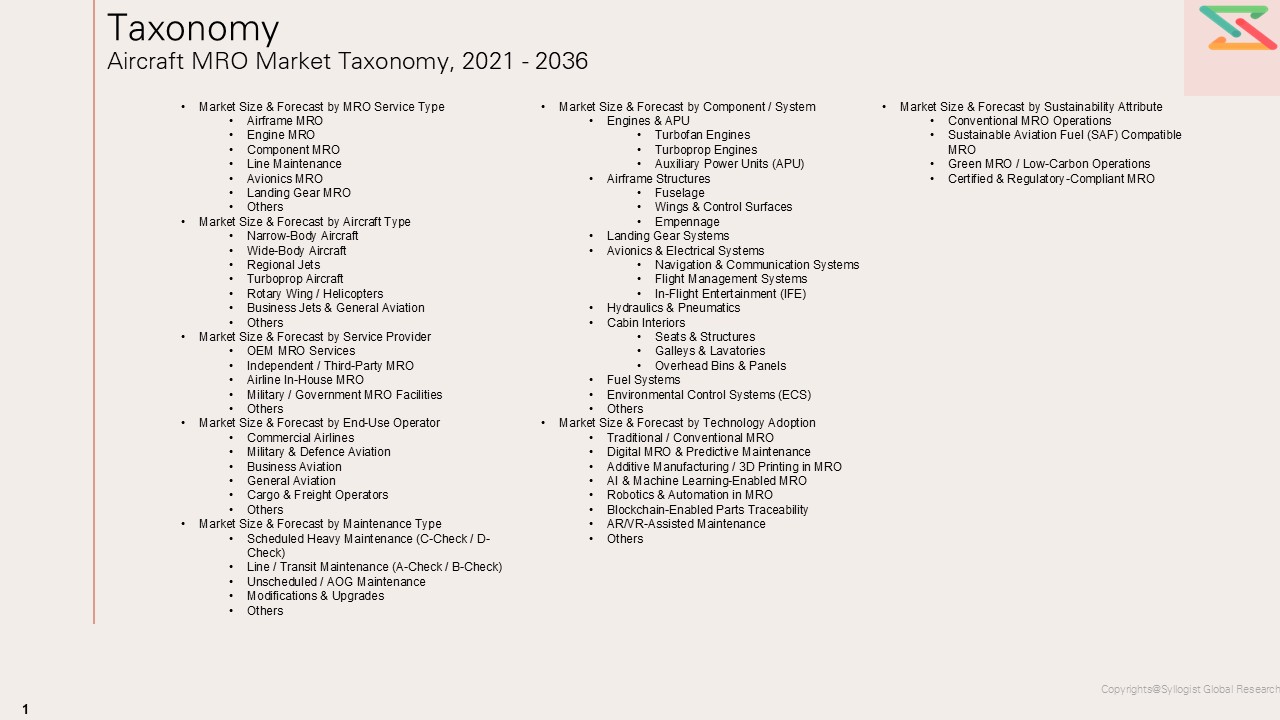
- Global Aircraft MRO Market Outlook
- Market Size & Forecast by Value
- Market Size & Forecast by MRO Service Type
- Airframe MRO
- Engine MRO
- Component MRO
- Line Maintenance
- Avionics MRO
- Landing Gear MRO
- Others
- Market Size & Forecast by Aircraft Type
- Narrow-Body Aircraft
- Wide-Body Aircraft
- Regional Jets
- Turboprop Aircraft
- Rotary Wing / Helicopters
- Business Jets & General Aviation
- Others
- Market Size & Forecast by Service Provider
- OEM MRO Services
- Independent / Third-Party MRO
- Airline In-House MRO
- Military / Government MRO Facilities
- Others
- Market Size & Forecast by End-Use Operator
- Commercial Airlines
- Military & Defence Aviation
- Business Aviation
- General Aviation
- Cargo & Freight Operators
- Others
- Market Size & Forecast by Maintenance Type
- Scheduled Heavy Maintenance (C-Check / D-Check)
- Line / Transit Maintenance (A-Check / B-Check)
- Unscheduled / AOG Maintenance
- Modifications & Upgrades
- Others
- Market Size & Forecast by Component / System
- Engines & APU
- Turbofan Engines
- Turboprop Engines
- Auxiliary Power Units (APU)
- Airframe Structures
- Fuselage
- Wings & Control Surfaces
- Empennage
- Landing Gear Systems
- Avionics & Electrical Systems
- Navigation & Communication Systems
- Flight Management Systems
- In-Flight Entertainment (IFE)
- Hydraulics & Pneumatics
- Cabin Interiors
- Seats & Structures
- Galleys & Lavatories
- Overhead Bins & Panels
- Fuel Systems
- Environmental Control Systems (ECS)
- Others
- Engines & APU
- Market Size & Forecast by Technology Adoption
- Traditional / Conventional MRO
- Digital MRO & Predictive Maintenance
- Additive Manufacturing / 3D Printing in MRO
- AI & Machine Learning-Enabled MRO
- Robotics & Automation in MRO
- Blockchain-Enabled Parts Traceability
- AR/VR-Assisted Maintenance
- Others
- Market Size & Forecast by Sustainability Attribute
- Conventional MRO Operations
- Sustainable Aviation Fuel (SAF) Compatible MRO
- Green MRO / Low-Carbon Operations
- Certified & Regulatory-Compliant MRO
- Asia-Pacific Aircraft MRO Market Outlook
- Market Size & Forecast
- By Value
- By MRO Service Type
- By Aircraft Type
- By Service Provider
- By End-Use Operator
- By Maintenance Type
- By Component / System
- By Technology Adoption
- By Sustainability Attribute
- Market Size & Forecast
- Europe Aircraft MRO Market Outlook
- Market Size & Forecast
- By Value
- By MRO Service Type
- By Aircraft Type
- By Service Provider
- By End-Use Operator
- By Maintenance Type
- By Component / System
- By Technology Adoption
- By Sustainability Attribute
- Market Size & Forecast
- North America Aircraft MRO Market Outlook
- Market Size & Forecast
- By Value
- By MRO Service Type
- By Aircraft Type
- By Service Provider
- By End-Use Operator
- By Maintenance Type
- By Component / System
- By Technology Adoption
- By Sustainability Attribute
- Market Size & Forecast
- Latin America Aircraft MRO Market Outlook
- Market Size & Forecast
- By Value
- By MRO Service Type
- By Aircraft Type
- By Service Provider
- By End-Use Operator
- By Maintenance Type
- By Component / System
- By Technology Adoption
- By Sustainability Attribute
- Market Size & Forecast
- Middle East & Africa Aircraft MRO Market Outlook
- Market Size & Forecast
- By Value
- By MRO Service Type
- By Aircraft Type
- By Service Provider
- By End-Use Operator
- By Maintenance Type
- By Component / System
- By Technology Adoption
- By Sustainability Attribute
- Market Size & Forecast
- Country Wise* Aircraft MRO Market Outlook
- Market Size & Forecast
- By Value
- By MRO Service Type
- By Aircraft Type
- By Service Provider
- By End-Use Operator
- By Maintenance Type
- By Component / System
- By Technology Adoption
- By Sustainability Attribute
- Market Size & Forecast
*Countries Analyzed in the Syllogist Global Research Portfolio: United States, Canada, Germany, United Kingdom, France, Italy, Spain, Netherlands, Switzerland, China, Japan, India, South Korea, Australia, Singapore, Brazil, Mexico, Saudi Arabia, UAE, South Africa
- Technology Landscape & Innovation Analysis
- Value Chain & Supply Chain Analysis
- Pricing Analysis
- Sustainability & Energy Efficiency
- Competitive Landscape
- Market Structure & Concentration
- Market Consolidation Level (Fragmented Vs Consolidated)
- Top 5 Players Market Share
- HHI (Herfindahl–Hirschman Index) Concentration Analysis
- Competitive Intensity Map
- Player Classification
- Market Leaders
- Strong Challengers
- Specialist / Niche Players
- Emerging Players
- Regional Players
- Competitive Analysis Frameworks
- Market Share Analysis
- Company Profile
- Company Overview & HQ
- Products & Services Portfolio
- Overall Revenue & Segmental Revenue
- Geographic Presence
- Recent Developments (M&A, Launches, Partnerships)
- SWOT Analysis
- Strategic Focus Areas
- Competitive Positioning Map
- Market Structure & Concentration
- Strategic Output
- Market Opportunity Matrix
- White Space Opportunity Analysis
- Strategic Recommendations
- MRO Capability Expansion Strategy
- Technology & Digitalization Strategy
- Fleet Management & Lifecycle Optimization Strategy
- Product Portfolio & Service Offering Strategy
- Pricing & Commercial Strategy
- Sustainability & Regulatory Compliance Strategy
- Supply Chain & Parts Sourcing Strategy
- Partnership, M&A & Expansion Strategy
- Regional Growth Strategy
- Risk Mitigation & Future Roadmap
- Strategic Priority Matrix & Roadmap
- Near-term (2025–2028)
- Mid-term (2029–2032)
- Long-term (2033–2036)