Market Overview
The global aircraft tire market is expanding steadily due to rising global air traffic, increasing aircraft fleet sizes, and continuous growth in commercial aviation operations. Aircraft tires are critical safety components designed to withstand extreme operating conditions, including high landing speeds, heavy loads, and intense friction during takeoff and landing.
Aircraft tires are specifically engineered using high-strength rubber compounds, reinforced carcass structures, and specialized tread designs that allow them to absorb heavy impact loads and perform under high pressure conditions. These tires must support aircraft weights during landing, provide traction on runways, and endure rapid acceleration and braking forces. Unlike conventional vehicle tires, aircraft tires undergo frequent maintenance cycles and retreading to maximize operational life and reduce operating costs for airlines and aviation operators.
Growing investments in airline fleet expansion, increasing aircraft deliveries, rising passenger traffic, and the expansion of global airport infrastructure are expected to sustain strong demand for aircraft tires across both developed and emerging aviation markets.
Key Market Drivers
Growth in Global Air Passenger Traffic
One of the primary drivers of the aircraft tire market is the continuous growth in global air travel. Increasing disposable incomes, expanding middle-class populations, and rising demand for international travel have led to significant growth in passenger traffic worldwide.
Airlines are expanding their fleets to meet growing passenger demand, which directly increases the requirement for aircraft tires for both original equipment and replacement cycles. Each aircraft undergoes multiple tire replacements during its operational life, making aftermarket demand a major revenue contributor for the aircraft tire industry.
Expansion of Commercial Aircraft Fleets
The expansion of global aircraft fleets is another key factor driving demand for aircraft tires. Major aircraft manufacturers are increasing production of narrow-body and wide-body aircraft to support airline fleet modernization and route expansion.
As airlines add new aircraft and retire older models, the need for high-performance aircraft tires continues to rise. Additionally, the growing popularity of low-cost carriers and regional aviation networks is increasing the frequency of short-haul flights, which accelerates tire wear and increases replacement demand.
Rising Military Aviation and Defense Spending
Military aviation also contributes significantly to aircraft tire demand. Fighter jets, military transport aircraft, surveillance aircraft, and helicopters all require specialized high-performance tires capable of handling extreme landing speeds and heavy loads.
Increasing defense budgets in major economies are driving procurement of new military aircraft and modernization of existing fleets. These developments are expected to generate steady demand for military aircraft tires, particularly those designed for high-impact landings and operations in challenging environments.
Expansion of Aircraft Maintenance, Repair, and Overhaul (MRO) Services
Aircraft tires have a relatively short operational life compared to many other aircraft components, making the replacement market a major contributor to industry revenue. Airlines rely heavily on maintenance, repair, and overhaul (MRO) providers to inspect, replace, and retread aircraft tires.
As global airline fleets expand and flight frequencies increase, the demand for aircraft tire maintenance and retreading services continues to grow. Retreading allows airlines to extend tire life cycles and significantly reduce operating costs while maintaining safety and performance standards.
Technological Advancements in Aircraft Tire Design
Technological innovation in tire design and materials is playing an important role in shaping the aircraft tire market. Manufacturers are developing advanced rubber compounds, stronger carcass materials, and improved tread patterns that enhance durability, heat resistance, and load-bearing capacity.
Aircraft tire manufacturers are also investing in digital monitoring technologies such as tire pressure monitoring systems and predictive maintenance tools. These technologies help airlines monitor tire health in real time, improving operational efficiency and reducing the risk of unexpected failures.
Increasing Focus on Sustainability
Sustainability has become an important focus area in the aviation industry, including aircraft tire manufacturing. Tire manufacturers are developing more sustainable production processes and exploring environmentally friendly materials to reduce the environmental impact of tire manufacturing.
Aircraft tire retreading programs are also becoming more widely adopted. Retreading allows airlines to reuse tire casings multiple times, reducing waste and lowering overall lifecycle costs. This approach aligns with the aviation industry’s broader efforts to adopt circular economy practices and improve sustainability.
Key Market Challenges
Aviation Industry Cyclicality
The aircraft tire market is closely tied to the overall performance of the aviation industry. Economic downturns, travel restrictions, or disruptions in air travel can significantly reduce flight activity and aircraft utilization rates.
When flight operations decline, the wear and replacement cycle for aircraft tires slows, which directly impacts aftermarket demand. As a result, the aircraft tire market can experience fluctuations linked to broader aviation industry cycles.
Volatility in Raw Material Costs
Aircraft tires are manufactured using high-performance materials such as natural rubber, synthetic rubber, carbon black, steel cords, and specialty reinforcing fabrics. Price volatility in these raw materials can significantly impact production costs.
Supply chain disruptions, geopolitical tensions, and fluctuations in global commodity markets can lead to unpredictable price increases, which may affect profit margins for tire manufacturers.
Increasing Product Complexity and Safety Requirements
Aircraft tires must meet extremely stringent safety standards and certification requirements set by aviation authorities. Designing tires capable of handling high landing speeds, extreme temperatures, and heavy loads while maintaining structural integrity presents significant engineering challenges.
As aircraft become larger and more technologically advanced, tire manufacturers must continuously innovate to meet evolving performance and safety requirements.
Key Market Trends
Smart Tire Monitoring Technologies
One of the emerging trends in the aircraft tire market is the integration of digital monitoring technologies. Sensors embedded within tires allow airlines to monitor pressure, temperature, and wear patterns in real time.
These systems enable predictive maintenance and improve operational safety by identifying potential tire issues before they lead to failures.
Growth of Retreaded Aircraft Tires
Aircraft tire retreading is gaining widespread adoption across the aviation industry. A single aircraft tire casing can often be retreaded multiple times, significantly reducing lifecycle costs for airlines.
Retreading also supports sustainability objectives by reducing material consumption and minimizing tire waste.
Customization for Aircraft Platforms
Aircraft tire manufacturers are increasingly developing tires tailored for specific aircraft models and operational conditions. Different aircraft types require tires designed for specific weight classes, landing speeds, and runway conditions.
Customization ensures optimal performance and durability across various aircraft platforms, including commercial airliners, military aircraft, and business jets.
Rising Demand in Emerging Aviation Markets
Emerging aviation markets across Asia-Pacific, the Middle East, and Latin America are becoming important growth centers for aircraft tires. Rapid economic growth, expansion of airline networks, and increasing passenger traffic are driving aircraft fleet expansion in these regions.
Countries such as China, India, Indonesia, and the United Arab Emirates are witnessing rapid aviation infrastructure development and increased aircraft deliveries, which is boosting demand for aircraft tires.
Regional Insights
North America represents a major aircraft tire market due to its large commercial aviation sector, strong defense aviation presence, and extensive MRO infrastructure.
Europe remains a technologically advanced aviation market with strong aircraft manufacturing capabilities and high demand for premium aircraft tires.
Asia-Pacific is emerging as the fastest-growing regional market due to increasing airline fleets, rising passenger traffic, and expanding airport infrastructure.
Recent Developments
Several strategic developments have taken place in the aircraft tire industry:
- Manufacturers are introducing advanced radial aircraft tires designed for improved durability and fuel efficiency.
- Tire companies are expanding retreading facilities to support airline maintenance operations.
- Strategic partnerships between aircraft manufacturers and tire suppliers are strengthening OEM supply agreements.
- Increased investment in digital tire monitoring systems is improving fleet safety and operational efficiency.
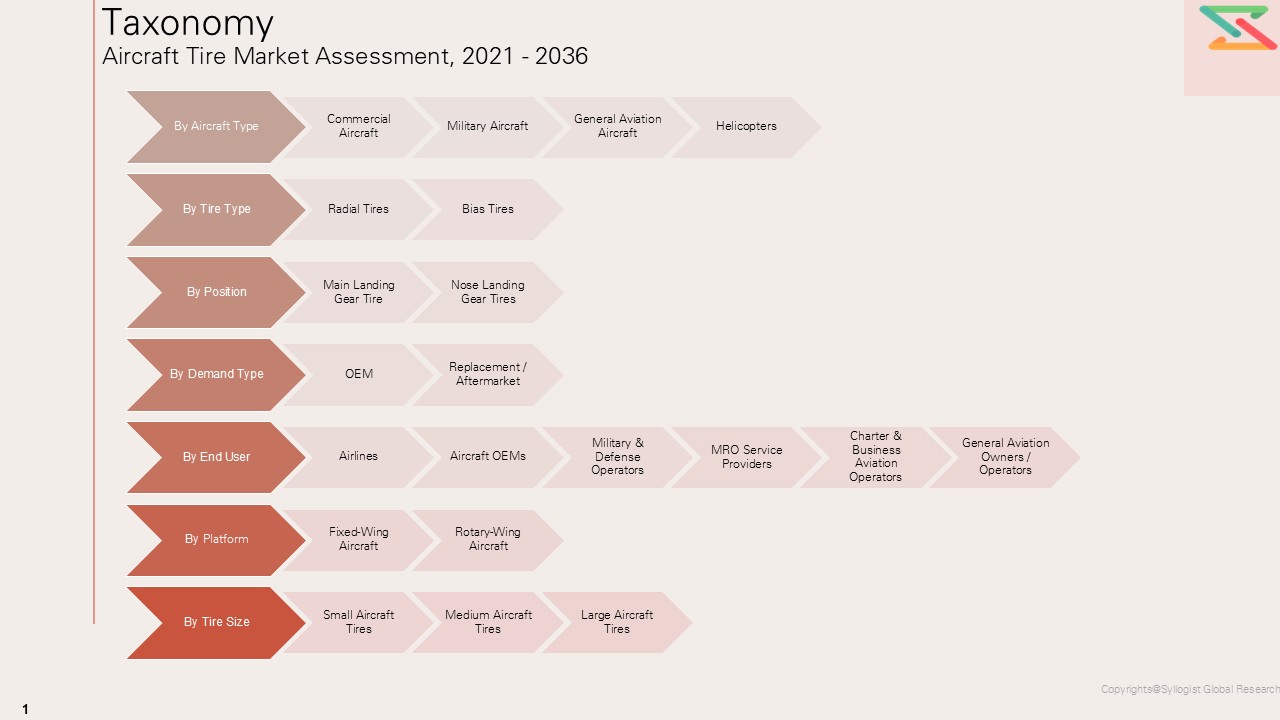
Market Segmentation
- Segmentation by Aircraft Type
- Commercial Aircraft
- Military Aircraft
- General Aviation Aircraft
- Helicopters
- Segmentation by Tire Type
- Radial Tires
- Bias Tires
- Segmentation by Position
- Main Landing Gear Tires
- Nose Landing Gear Tires
- Segmentation by Demand Type
- OEM
- Replacement
- Segmentation by End Use
- Airlines
- Aircraft OEMs
- Military & Defense Operators
- MRO Service Providers
- Charter & Business Aviation Operators
- General Aviation Owners / Operators
- Segmentation by Platform
- Fixed-Wing Aircraft
- Rotary-Wing Aircraft
- Segmentation by Tire Size
- Small Aircraft Tires
- Medium Aircraft Tires
- Large Aircraft Tires
- Market Foundations & Dynamics
- Product Overview
- Research Methodology
- Executive Summary
- Market Dynamics (Drivers, Restraints, Opportunities, Challenges, Porter’s Five Forces Analysis, PESTLE Analysis)
- Market Ecosystem & Value Chain
- Overview of Value Chain Participants
- Flow of Value and Material Through the Chain
- Value Addition and Margins at Each Stage
- Market Trends & Developments
- Emerging Raw Material Trends
- Raw Material Availability
- Technological Advancements
- Demand–Supply Gaps
- Investment Hotspots
- Unmet Needs and White Market Spaces
- Risk Assessment Framework
- Political / Geopolitical Risk
- Raw Material Supply Risk
- Environmental and Regulatory Risk
- Financial / Market Risk
- Regulatory Framework & Standards
- Global Policy and Mandate Overview
- Transportation and Storage Regulations
- Sustainability and GHG Reduction Standards
- Environmental & Liability Considerations
- Technology Landscape
- Overview of Technologies
- Cost Optimization Technologies
- Future Outlook
- Global Aircraft Tire Market Outlook
- Market Size & Forecast by Value
- Market Size & Forecast by Volume
- Market Size & Forecast by Aircraft Type
- Commercial Aircraft
- Military Aircraft
- General Aviation Aircraft
- Helicopters
- Market Size & Forecast by Tire Type
- Radial Tires
- Bias Tires
- Market Size & Forecast by Position
- Main Landing Gear Tires
- Nose Landing Gear Tires
- Market Size & Forecast by Demand Type
- OEM
- Replacement
- Market Size & Forecast by End Use
- Airlines
- Aircraft OEMs
- Military & Defense Operators
- MRO Service Providers
- Charter & Business Aviation Operators
- General Aviation Owners / Operators
- Market Size & Forecast by Platform
- Fixed-Wing Aircraft
- Rotary-Wing Aircraft
- Market Size & Forecast by Tire Size
- Small Aircraft Tires
- Medium Aircraft Tires
- Large Aircraft Tires
- Market Size & Forecast by Region
- North America
- Europe
- Asia-Pacific
- Middle East & Africa
- South America
- Asia-Pacific Aircraft Tire Market Outlook
- Market Size & Forecast by Value & Volume
- Market Size & Forecast by Aircraft Type
- Market Size & Forecast by Tire Type
- Market Size & Forecast by Position
- Market Size & Forecast by Demand Type
- Market Size & Forecast by End User
- Market Size & Forecast by Platform
- Market Size & Forecast by Tire Size
- Europe Aircraft Tire Market Outlook
- Market Size & Forecast by Value & Volume
- Market Size & Forecast by Aircraft Type
- Market Size & Forecast by Tire Type
- Market Size & Forecast by Position
- Market Size & Forecast by Demand Type
- Market Size & Forecast by End User
- Market Size & Forecast by Platform
- Market Size & Forecast by Tire Size
- North America Aircraft Tire Market Outlook
- Market Size & Forecast by Value & Volume
- Market Size & Forecast by Aircraft Type
- Market Size & Forecast by Tire Type
- Market Size & Forecast by Position
- Market Size & Forecast by Demand Type
- Market Size & Forecast by End User
- Market Size & Forecast by Platform
- Market Size & Forecast by Tire Size
- Latin America Aircraft Tire Market Outlook
- Market Size & Forecast by Value & Volume
- Market Size & Forecast by Aircraft Type
- Market Size & Forecast by Tire Type
- Market Size & Forecast by Position
- Market Size & Forecast by Demand Type
- Market Size & Forecast by End User
- Market Size & Forecast by Platform
- Market Size & Forecast by Tire Size
- Middle East & Africa Aircraft Tire Market Outlook
- Market Size & Forecast by Value & Volume
- Market Size & Forecast by Aircraft Type
- Market Size & Forecast by Tire Type
- Market Size & Forecast by Position
- Market Size & Forecast by Demand Type
- Market Size & Forecast by End User
- Market Size & Forecast by Platform
- Market Size & Forecast by Tire Size
- Country wise Aircraft Tire Market Outlook
- Market Size & Forecast by Value & Volume
- Market Size & Forecast by Aircraft Type
- Market Size & Forecast by Tire Type
- Market Size & Forecast by Position
- Market Size & Forecast by Demand Type
- Market Size & Forecast by End User
- Market Size & Forecast by Platform
- Market Size & Forecast by Tire Size
Countries Analyzed in the Syllogist Global Research Portfolio: China, India, Japan, Indonesia, South Korea, Thailand, Taiwan, Vietnam, Australia, Malaysia, Pakistan, Philippines, Bangladesh, United States, Canada, Mexico, Germany, France, Italy, United Kingdom, Spain, Poland, Czech Republic, Netherlands, Belgium, Russia, Sweden, Finland, Austria, Romania, Hungary, Portugal, Slovakia, Kazakhstan, Brazil, Argentina, Colombia, Chile, Turkey, Iran, Saudi Arabia, UAE, Oman, Qatar, South Africa, Egypt, Algeria, Kenya, Ethiopia, Angola, Zimbabwe
- Pricing Analysis
- Global Average Selling Price Trend
- Pricing Analysis by Tire Type
- Pricing Analysis by Application
- Pricing Analysis by Demand Type
- Raw Material Price Impact Analysis
- Competition Outlook
- Market Concentration and Fragmentation Level
- Company Market Shares (Top 10 Producers)
- Competitive Strategies
- Benchmarking Matrix
- Recent Developments: Partnerships, M&A, and Policy-Driven Expansions
- Sales & Distribution Channel Analysis
- Overview of Go-to-Market Channels
- Channel Share by Region
- Distribution Strategies by Leading Players
- Strategic Recommendations & Roadmap
- Competitors’ Strategic Initiatives
- Future Outlook (Next 5–10 Years, Emerging Players, Success Factors)
- Strategic Recommendations
- Market Acceleration Roadmap
- Short-Term
- Mid-Term
- Long-Term
- Tailored Recommendations for:
- Producers
- Raw Material Suppliers
- Policymakers / Regulators
- Recommendations on Key Success Factors
- Raw Material Security
- Policy Alignment
- Supply Chain Integration
- Market Acceleration Roadmap