
Market Definition
The Global Battery Swapping Infrastructure Economics Market encompasses the end-to-end financial, operational, and technological ecosystem associated with the deployment, management, monetization, and scaling of battery swapping networks for electric vehicles and related electrified mobility platforms. Unlike conventional plug-in charging infrastructure, battery swapping involves the automated or semi-automated exchange of a discharged battery pack for a pre-charged unit at a dedicated station, effectively decoupling the battery asset from the vehicle and enabling refueling times comparable to those of conventional internal combustion engine vehicles. The economics of this market extend across a multi-layered value chain that includes station development and real estate economics, battery pack procurement and ownership models, energy procurement and storage cost structures, software-enabled fleet and battery management systems, asset financing and leasing frameworks, and the revenue models underpinning commercial station operation. The market is relevant across a spectrum of vehicle segments including two-wheelers, three-wheelers, light commercial vehicles, passenger cars, heavy commercial vehicles, and electric buses, with the economic viability and infrastructure investment thesis varying substantially by vehicle class, duty cycle intensity, battery standardization level, and regulatory environment. Participants operating across this ecosystem include electric vehicle original equipment manufacturers, battery manufacturers, independent station network operators, energy utilities, fleet operators, financial institutions, insurance providers, and government entities with mandates for transport electrification and energy transition.
Market Insights
The global battery swapping infrastructure economics market is undergoing a critical transition from early-stage pilot deployment toward structured commercial scaling, with the economic viability thesis for swapping networks gaining significant traction across several high-density urban mobility markets in Asia, Europe, and emerging economies. As of 2026, the market is defined by a growing body of operational data from mature swapping networks in China, India, and select Southeast Asian markets, which is enabling station operators and investors to move beyond conceptual financial modeling toward evidence-based infrastructure investment frameworks. The economics of battery swapping are increasingly being evaluated against the total cost of ownership benchmarks of plug-in charging infrastructure, with swapping demonstrating superior economics in high-utilization commercial fleet contexts where minimizing vehicle downtime is a primary operational requirement. The progressive standardization of battery pack form factors within specific vehicle segments is emerging as the central enabling condition for the market to achieve the network density and interoperability necessary to support commercially viable open-network swapping operations.
A defining characteristic of the current market landscape is the bifurcation between closed proprietary swapping ecosystems, in which a single OEM or operator controls the battery standard, station network, and vehicle fleet, and open interoperable network models designed to serve multiple vehicle brands and fleet operators through a standardized battery interface. The closed ecosystem model, most prominently established in the two-wheeler and passenger electric vehicle segments in China, has demonstrated strong unit economics and high station utilization rates by concentrating demand within a captive customer base and maintaining full control over battery chemistry, state-of-health management, and energy procurement. The open network model, while presenting significantly greater commercial opportunity at scale, requires coordination across OEMs, regulators, and financiers to establish and enforce battery standardization protocols, which represents a substantially higher institutional complexity. Investors and infrastructure developers are navigating this bifurcation with increasing sophistication, with capital allocation strategies increasingly differentiating between the risk-return profiles of proprietary closed networks and the longer-dated but more scalable economics of open interoperable platforms.
The integration of battery swapping infrastructure economics with broader energy system dynamics is emerging as a strategically significant dimension of market evolution. Swapping station operators are increasingly positioning their battery inventories as distributed energy storage assets capable of participating in grid balancing, demand response, and ancillary services markets, thereby unlocking secondary revenue streams that meaningfully improve station-level economics and shorten payback periods. The co-location of swapping infrastructure with renewable energy generation assets, including solar carports and wind-integrated charging parks, is being actively pursued by network operators seeking to reduce operational energy procurement costs and improve the carbon intensity credentials of their service offerings. Battery-as-a-service financing structures, in which the battery asset is owned by the station operator or a financial intermediary rather than the vehicle owner, are restructuring the upfront capital requirements for electric vehicle adoption and redefining the financial relationship between the vehicle owner, the mobility service provider, and the energy infrastructure operator.
From a regional perspective, the Asia-Pacific region, and China in particular, constitutes the most advanced and commercially mature market for battery swapping infrastructure, accounting for the overwhelming majority of operational stations, standardization initiatives, and cumulative capital invested globally as of 2026. India represents the most dynamic growth opportunity within the near-term forecast, driven by the combination of a large two-wheeler and three-wheeler electrification opportunity, favorable economics for fleet-based swapping in last-mile delivery and ride-hailing applications, and progressive government support for swapping-friendly regulatory frameworks. Europe is emerging as a secondary growth market, with infrastructure investment increasingly focused on commercial vehicle and bus fleet applications where duty-cycle economics strongly favor swapping over opportunity charging. The Middle East and African markets are at early stages of infrastructure development, with pilot programs and regulatory framework development constituting the primary activities, while Latin America presents a long-term opportunity contingent on accelerating fleet electrification and improving financing conditions for infrastructure deployment.
Key Drivers
Total Cost of Ownership Advantages in High-Utilization Commercial Fleet and Shared Mobility Applications
The most compelling economic driver for battery swapping infrastructure investment is the demonstrable total cost of ownership advantage that swapping networks deliver relative to plug-in charging in high-utilization commercial fleet, ride-hailing, logistics, and public transit applications. In these operational contexts, vehicle uptime is a direct determinant of revenue generation capacity, and the operational economics of plug-in charging, which require vehicles to be immobilized for charging durations ranging from twenty minutes to several hours, impose a structural productivity cost that materially reduces fleet profitability. Battery swapping enables refueling in under five minutes for most commercial vehicle segments, effectively eliminating charging-related downtime as an operational constraint and allowing fleet operators to achieve utilization rates comparable to those of conventional vehicle fleets. Furthermore, the decoupling of battery ownership from vehicle ownership through battery-as-a-service models enables fleet operators to reduce initial vehicle acquisition costs, convert battery costs from capital expenditure to operational expenditure, and transfer battery degradation risk to the station network operator, collectively producing a total cost of ownership profile that is increasingly competitive with internal combustion engine alternatives across multiple high-utilization use cases.
Government Policy Support, Electrification Mandates, and Infrastructure Subsidy Frameworks
A powerful institutional driver shaping the market is the alignment of battery swapping infrastructure investment with national and subnational electrification mandates, clean transport policies, and energy security objectives across the major growth markets. Several leading economies have implemented or are actively developing regulatory and subsidy frameworks that explicitly recognize battery swapping as a qualifying electric vehicle infrastructure technology eligible for public investment support, capital subsidies, land allocation preferences, and utility interconnection prioritization. In China, the inclusion of battery swapping in national new energy vehicle policy frameworks has directly catalyzed large-scale commercial network deployment. In India, the government has incorporated battery swapping policy guidelines into its national electric mobility programs, providing a regulatory foundation for standardization initiatives and public-private co-investment in swapping infrastructure. These policy tailwinds are reducing the effective cost of capital for station network development, accelerating the pace of commercial deployment, and creating a more predictable regulatory environment that supports the long-term infrastructure investment horizons required by institutional capital providers considering battery swapping network financing.
Battery Standardization Progress and the Emergence of Open-Network Interoperability Frameworks
The progressive convergence of battery pack form factor standards within specific vehicle segments is constituting an increasingly significant commercial driver by expanding the addressable market for individual station networks beyond captive OEM ecosystems toward open multi-brand service environments. Standardization initiatives progressed through industry consortia, government-mandated technical committees, and bilateral OEM cooperation agreements are creating the technical preconditions for interoperable swapping networks in which a single station can serve vehicles from multiple manufacturers, fundamentally improving station utilization economics and the investment case for network densification. The economic implications of standardization are substantial: higher station utilization directly reduces the per-swap cost and shortens station-level payback periods, enabling network operators to price services more competitively while maintaining acceptable returns on infrastructure investment. As standardization milestones are reached across the two-wheeler, three-wheeler, and light commercial vehicle segments in key markets, the addressable investment universe for battery swapping infrastructure is expected to expand materially, attracting a broader range of infrastructure funds, development finance institutions, and strategic investors into the sector.
Key Challenges
Capital Intensity of Station Network Development and the Challenge of Achieving Economic Network Density
The most significant economic challenge confronting the battery swapping infrastructure market is the high upfront capital intensity of station development, battery inventory procurement, and network management system deployment, combined with the inherent difficulty of achieving the station density required to generate commercially viable utilization rates before accumulated capital costs erode investor returns. Each swapping station requires investment in physical civil works, automated exchange equipment, battery management systems, energy storage and grid connection infrastructure, and an inventory of battery packs that must be maintained at sufficient charge levels to meet demand at all times. The capital required per station is substantially higher than equivalent-capacity plug-in charging infrastructure, and the per-station economics are highly sensitive to utilization rates, battery procurement costs, energy tariff structures, and land or lease costs that vary significantly across geographies. Achieving the minimum network density required for commercially meaningful utilization rates necessitates coordinated multi-station rollout programs that require large aggregate capital commitments before the network reaches a self-sustaining economic operating point, creating a significant financing gap that constrains the pace of commercial scaling particularly in emerging market contexts with limited access to patient infrastructure capital.
Battery Standardization Fragmentation and the Risk of Stranded Infrastructure Investment
A structural challenge that directly threatens the long-term economics of open-network battery swapping infrastructure is the persistence of battery pack form factor fragmentation across vehicle OEMs, which creates the risk of stranded infrastructure investment if stations are built to support battery standards that fail to achieve broad OEM adoption or are superseded by competing technical specifications. The absence of universally adopted battery interface standards means that station operators face a binary strategic choice between investing in proprietary closed-ecosystem networks with limited addressable markets or committing to emerging open standards that carry execution and adoption risk. Investors and infrastructure developers financing long-duration infrastructure assets with depreciation horizons of ten to fifteen years are acutely sensitive to the technology obsolescence risk inherent in a market where battery chemistry, pack architecture, and thermal management standards are still evolving. This uncertainty is contributing to a cautious capital allocation posture among institutional infrastructure investors and delaying the transition from government-supported pilot programs to fully commercial privately financed network development in markets where standardization frameworks have not yet achieved regulatory codification.
Battery State-of-Health Management, Degradation Economics, and Liability Attribution Complexity
The operational economics of battery swapping networks are subject to a distinctive and technically complex challenge arising from the pooled nature of battery inventory management, in which individual battery packs are cycled across multiple vehicles and users over their operational lifetime, creating compound difficulties in state-of-health monitoring, degradation attribution, warranty liability management, and end-of-life asset value recovery. Unlike a dedicated vehicle battery whose degradation history is attributable to a single owner and a known usage pattern, a pooled swapping network battery is exposed to heterogeneous charging and discharging profiles, temperature environments, and mechanical handling conditions across its operational life, making it significantly more difficult to accurately predict remaining useful life, apportion degradation liability between the station operator and vehicle users, and structure financially equitable battery-as-a-service pricing that adequately compensates for measured capacity fade. The development of commercially robust battery health management software platforms capable of continuously monitoring individual cell performance, dynamically adjusting swap eligibility thresholds, and generating auditable degradation records is a prerequisite for the sound financial management of large battery pool inventories, and the current technological and commercial maturity of these platforms continues to represent a meaningful operational and financial risk factor for station network operators and their financing counterparties.
Market Segmentation
- Segmentation By Vehicle Type
- Two-Wheelers (Electric Motorcycles and Scooters)
- Three-Wheelers (Electric Auto-Rickshaws and Cargo Trikes)
- Light Passenger Vehicles
- Light Commercial Vehicles and Delivery Vans
- Heavy Commercial Vehicles and Trucks
- Electric Buses and Mass Transit Vehicles
- Others
- Segmentation By Station Type
- Fully Automated Swapping Stations
- Semi-Automated Swapping Stations
- Manual Assisted Swapping Stations
- Mobile and Portable Swapping Units
- Integrated Swapping and Charging Hub Stations
- Others
- Segmentation By Network Model
- Proprietary Closed-Network (Single OEM or Operator)
- Open Interoperable Multi-Brand Network
- Franchise and Licensed Station Network
- Utility-Integrated Swapping Network
- Cooperative Fleet Operator Network
- Others
- Segmentation By Battery Ownership and Financing Model
- Battery-as-a-Service (BaaS) Model
- Vehicle-Integrated Battery Ownership
- Station Operator Battery Ownership
- Third-Party Battery Leasing and Financing
- Battery Asset Pooling and Securitization
- Others
- Segmentation By Revenue Model
- Per-Swap Transaction Fee
- Subscription-Based Access Plan
- Fleet Management and Enterprise Contract
- Energy-as-a-Service and Grid Ancillary Revenue
- Battery Lifecycle Management Fee
- Carbon Credit and Renewable Energy Certificate Revenue
- Others
- Segmentation By End User
- Individual Electric Vehicle Owners
- Ride-Hailing and Taxi Fleet Operators
- Last-Mile Delivery and Logistics Fleet Operators
- Public Transit Authorities
- Corporate and Enterprise Fleet Operators
- Agricultural and Off-Road Vehicle Operators
- Others
- Segmentation By Component
- Battery Packs and Cell Systems
- Automated Swap Mechanism and Robotics
- Battery Management System (BMS) Hardware and Software
- Energy Storage and Grid Interface Equipment
- Station Civil Infrastructure and Enclosures
- Network Management and Billing Software Platform
- Thermal Management Systems
- Others
- Segmentation By Battery Chemistry
- Lithium Iron Phosphate (LFP)
- Nickel Manganese Cobalt (NMC)
- Lithium Titanate Oxide (LTO)
- Solid-State Battery
- Sodium-Ion Battery
- Others
- Segmentation By Application
- Urban Passenger Mobility
- Last-Mile and Middle-Mile Logistics
- Public Transit and Bus Rapid Transit
- Agricultural and Rural Electrification
- Construction and Industrial Fleet Electrification
- Tourism and Shared Micro-Mobility
- Others
- Segmentation By Infrastructure Investment Type
- Greenfield Station Development
- Brownfield Retrofit and Conversion
- Network Expansion Capital
- Battery Inventory Replenishment Capital
- Technology Upgrade and Digitalization Investment
- Others
- Segmentation By Region
- North America
- Europe
- Asia-Pacific
- Middle East and Africa
- Latin America
All market revenues are presented in USD
Historical Year: 2021–2024 | Base Year: 2025 | Estimated Year: 2026 | Forecast Period: 2027–2036
Key Questions this Study Will Answer
- What is the projected global market valuation for battery swapping infrastructure economics through 2036, segmented by vehicle type, network model, revenue model, and region? This analysis provides the quantitative foundation required for capital allocation decisions, infrastructure investment thesis development, and competitive positioning strategies across the swapping network value chain.
- Which battery ownership and financing models, including battery-as-a-service frameworks, station operator ownership, and third-party asset securitization structures, are expected to achieve the most favorable unit economics and attract the broadest range of infrastructure capital across the major vehicle segments and geographies within the forecast period?
- How will the pace and depth of battery pack standardization across key vehicle segments determine the commercial viability of open interoperable swapping networks relative to proprietary closed ecosystems, and what regulatory, commercial, and technical milestones will serve as the most consequential inflection points for institutional investment in open-network infrastructure?
- To what extent can grid services revenue streams, including demand response participation, frequency regulation, and renewable energy integration, improve station-level economics and shorten infrastructure payback periods, and which market structures and regulatory frameworks are most conducive to the commercial realization of these secondary revenue opportunities for station network operators?
- Who are the leading station network operators, electric vehicle OEMs, battery manufacturers, technology platform providers, and infrastructure financiers currently defining the competitive landscape of the global battery swapping infrastructure economics market, and what are their respective strategic priorities, geographic expansion trajectories, and partnership and investment strategies through the forecast horizon?
- Product Definition
- Scope of the Study
- Research Methodology
- Research Design & Framework
- Overall Research Approach: Descriptive, Exploratory & Quantitative Mixed-Method Design
- Market Definition & Scope Boundaries: What is Included and Excluded
- Segmentation Framework
- Key Research Assumptions & Limitations
- Secondary Research
- Industry Publications, EV Association Reports & Press Releases
- Government Transport & Energy Authority Data (IEA, NITI Aayog, DOE, EU DG MOVE, etc.)
- International Energy Agency (IEA) & IRENA EV & Battery Market Statistics
- Infrastructure Investment & Finance Databases
- Primary Research Design & Execution
- In-depth Interviews with Network Operators, OEM Executives & Infrastructure Investors
- Surveys with Fleet Operators, Ride-Hailing Platforms & Municipal Transport Authorities
- Expert Panel Validation
- Data Triangulation & Validation
- Market Sizing & Forecasting Methodology
- Bottom-Up & Top-Down Reconciliation
- EV Fleet Penetration & Swap Demand Model
- Station Economics & Utilisation Rate Model
- Competitive Intelligence Methodology
- Quality Assurance & Peer Review
- Definitions, Abbreviations & Data Notes
- Executive Summary
- Market Snapshot & Headline Numbers
- Key Findings & Research Highlights
- Technology & Innovation Highlights
- Infrastructure Economics & Unit Economics Summary
- Average Station CAPEX & OPEX Benchmarks
- Breakeven Utilisation Rate & Payback Period Analysis
- Battery-as-a-Service (BaaS) Revenue Model Summary
- Market Dynamics
- Drivers
- Restraints
- Opportunities
- Challenges
- Porter’s Five Forces Analysis
- PESTLE Analysis
- Market Trends & Developments
- Emerging Trends
- Technological Developments
- Regulatory & Policy Changes
- Supply Chain & Sourcing Trends
- Investment & Funding Activity
- Sustainability & ESG Trends
- Geographic & Regional Trends
- Risk Assessment Framework
- Geopolitical & Political Risk
- Battery Supply Chain & Critical Mineral Risk
- Environmental & Regulatory Risk
- Financial / Market Risk
- Technology Obsolescence & Standardisation Risk
- Regulatory Framework & Policy Standards
- Battery Swapping Infrastructure Economics
- Station Economics & Unit Economics Framework
- Capital Expenditure (CAPEX) Structure
- Operating Expenditure (OPEX) Structure
- Revenue Model & Monetisation Levers
- Utilisation Rate & Throughput Economics
- Payback Period & Return on Investment (ROI) Analysis
- Total Cost of Ownership (TCO) vs Conventional Charging
- Battery Economics & Lifecycle Cost Analysis
- Battery Pack Procurement Cost Trends (USD/kWh, 2021–2035)
- Battery Degradation Rate & State-of-Health (SoH) Economics
- Battery Reconditioning, Second-Life & Recycling Value Chain Economics
- Battery Inventory Optimisation Models
- Battery Insurance & Warranty Economics
- Impact of Solid-State & Next-Gen Chemistries on Swap Economics
- Network Infrastructure & Grid Integration Economics
- Grid Connection Costs by Geography & Voltage Level
- Renewable Energy Integration Economics (Solar + Storage Co-location)
- Vehicle-to-Grid (V2G) & Grid Balancing Revenue Potential
- Smart Charging & Load Management Cost Savings
- Network Scalability Economics: Hub-and-Spoke vs Distributed Models
- Financing Structures & Capital Markets
- Equity Financing: VC, PE & Strategic Corporate Investment
- Debt Financing: Green Bonds, Project Finance & Infrastructure Loans
- Government Grants, Subsidies & Viability Gap Funding (VGF)
- Public-Private Partnership (PPP) Structures & Risk Allocation
- Asset-Backed Financing & Battery Leasing Securitisation
- Carbon Credit & ESG-Linked Financing
- Standardisation & Interoperability Economics
- Cost Implications of Proprietary vs Open Battery Standards
- Economic Impact of Cross-Brand Battery Compatibility
- Standardisation Initiatives: CATL EVOGO, Gogoro, SWAP, NIO BaaS, Aulton
- Network Effect Economics in Standardised Ecosystems
- Global Battery Swapping Infrastructure Economics Market Outlook
- Market Size & Forecast by Value (USD Billion, 2021–2036)
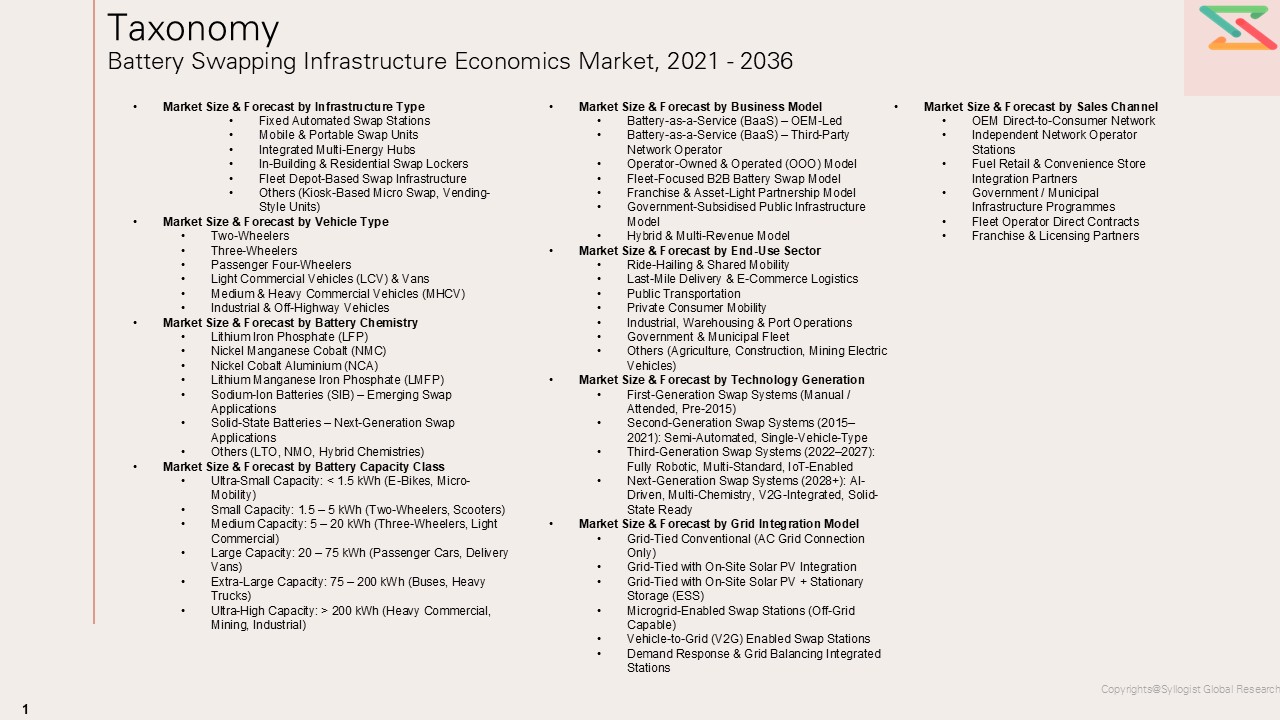
- Market Size & Forecast by Infrastructure Type
- Fixed Automated Swap Stations
- Robotic Fully Automated Swap Stations
- Semi-Automated Swap Stations
- Attended / Manned Swap Points
- Mobile & Portable Swap Units
- Mobile Swap Vans & Trucks
- Containerised Portable Swap Units
- Integrated Multi-Energy Hubs
- Swap + Fast Charging + Fuel Station Hybrid Hubs
- Swap Stations Integrated with Petrol / CNG Retail Outlets
- Highway Corridor Super Swap Stations
- In-Building & Residential Swap Lockers
- Apartment Complex & Gated Community Swap Lockers
- Office Park & Commercial Complex Installations
- Fleet Depot-Based Swap Infrastructure
- Logistics & Last-Mile Delivery Depot Swap Systems
- Public Transit Depot-Integrated Swap Systems
- Ride-Hailing & Shared Mobility Depot Swap Systems
- Others (Kiosk-Based Micro Swap, Vending-Style Units)
- Fixed Automated Swap Stations
- Market Size & Forecast by Vehicle Type
- Two-Wheelers
- Electric Motorcycles (>125cc)
- Electric Scooters (50–125cc Equivalent)
- Electric Mopeds & Light Scooters (<50cc Equivalent)
- Electric Bicycles & Speed Pedelecs (E-Bikes)
- Three-Wheelers
- Electric Auto-Rickshaws / E-Tuk-Tuks
- Electric Cargo Three-Wheelers
- Electric Passenger Vans / Maxicabs
- Passenger Four-Wheelers
- Battery Electric Vehicles (BEV)
- Battery Electric Vehicles (BEV)
- Battery Electric Vehicles (BEV)
- Ride-Hailing & Taxi EV Fleet
- Light Commercial Vehicles (LCV) & Vans
- Electric Delivery Vans (< 3.5 Tonnes GVW)
- Electric Refrigerated Vans
- Electric Minibus & Shuttle Vans
- Medium & Heavy Commercial Vehicles (MHCV)
- Electric Trucks (3.5–12 Tonnes GVW)
- Electric Heavy-Duty Trucks (> 12 Tonnes GVW)
- Electric City & Intercity Buses
- Electric School Buses
- Industrial & Off-Highway Vehicles
- Electric Forklifts & Warehouse Equipment
- Electric Port Handling & Airport GSE Equipment
- Electric Mining Vehicles & Construction Equipment
- Others (Electric Agricultural Vehicles, Micro-Mobility, Marine)
- Market Size & Forecast by Battery Chemistry
- Lithium Iron Phosphate (LFP)
- Standard LFP (Energy Density 120–160 Wh/kg)
- Advanced LFP (Cell-to-Pack / Blade / M3P Variants)
- Nickel Manganese Cobalt (NMC)
- NMC 622 & NMC 811
- High-Nickel NMC (NCMA) Variants
- Nickel Cobalt Aluminium (NCA)
- Lithium Manganese Iron Phosphate (LMFP)
- Sodium-Ion Batteries (SIB) – Emerging Swap Applications
- Solid-State Batteries – Next-Generation Swap Applications
- Others (LTO, NMO, Hybrid Chemistries)
- Lithium Iron Phosphate (LFP)
- Market Size & Forecast by Battery Capacity Class
- Ultra-Small Capacity: < 1.5 kWh (E-Bikes, Micro-Mobility)
- Small Capacity: 1.5 – 5 kWh (Two-Wheelers, Scooters)
- Medium Capacity: 5 – 20 kWh (Three-Wheelers, Light Commercial)
- Large Capacity: 20 – 75 kWh (Passenger Cars, Delivery Vans)
- Extra-Large Capacity: 75 – 200 kWh (Buses, Heavy Trucks)
- Ultra-High Capacity: > 200 kWh (Heavy Commercial, Mining, Industrial)
- Market Size & Forecast by Business Model
- Battery-as-a-Service (BaaS) – OEM-Led
- Battery-as-a-Service (BaaS) – Third-Party Network Operator
- Independent Network Operator Subscription Model
- Aggregator-Led Multi-OEM BaaS Platforms
- Operator-Owned & Operated (OOO) Model
- Vertically Integrated Network Operator Model
- White-Label Station Operator Model
- Fleet-Focused B2B Battery Swap Model
- Dedicated Logistics & Last-Mile Fleet Swap Contracts
- Public Transit Authority Long-Term Service Agreements
- Ride-Hailing Platform Fleet Swap Agreements
- Franchise & Asset-Light Partnership Model
- Station Franchise Partner Network
- Fuel Retail Partner Integration Model
- Government-Subsidised Public Infrastructure Model
- State-Mandated Battery Swap Network (China MIIT Model)
- National EV Mission-Backed Swap Infrastructure Schemes
- Hybrid & Multi-Revenue Model
- Swap + Charging + Grid Services Integrated Model
- Swap + Battery Recycling & Second-Life Revenue Model
- Market Size & Forecast by End-Use Sector
- Ride-Hailing & Shared Mobility
- On-Demand Ride-Hailing
- Shared Electric Scooter & Moped Platforms
- Shared Electric Bicycle & Micro-Mobility Platforms
- Last-Mile Delivery & E-Commerce Logistics
- E-Commerce Fulfilment Last-Mile
- Quick Commerce & Hyperlocal Delivery
- Third-Party Logistics (3PL) & Courier Networks
- Public Transportation
- City Bus & BRT (Bus Rapid Transit) Electrification
- School Bus Fleet Electrification
- Intercity & Suburban Electric Bus Networks
- Private Consumer Mobility
- Personal EV Owners (Urban & Peri-Urban Users)
- EV Taxi & Black Car Service Operators
- Industrial, Warehousing & Port Operations
- E-Forklift & Material Handling Fleet Operators
- Port Terminal Electrification
- Airport Ground Support Equipment (GSE) Electrification
- Government & Municipal Fleet
- Police, Ambulance & Emergency Services Fleet
- Municipal Solid Waste (MSW) Collection Fleet
- Government Administrative & Official Vehicle Fleet
- Others (Agriculture, Construction, Mining Electric Vehicles)
- Ride-Hailing & Shared Mobility
- Market Size & Forecast by Technology Generation
- First-Generation Swap Systems (Manual / Attended, Pre-2015)
- Second-Generation Swap Systems (2015–2021): Semi-Automated, Single-Vehicle-Type
- Third-Generation Swap Systems (2022–2027): Fully Robotic, Multi-Standard, IoT-Enabled
- Next-Generation Swap Systems (2028+): AI-Driven, Multi-Chemistry, V2G-Integrated, Solid-State Ready
- Market Size & Forecast by Grid Integration Model
- Grid-Tied Conventional (AC Grid Connection Only)
- Grid-Tied with On-Site Solar PV Integration
- Grid-Tied with On-Site Solar PV + Stationary Storage (ESS)
- Microgrid-Enabled Swap Stations (Off-Grid Capable)
- Vehicle-to-Grid (V2G) Enabled Swap Stations
- Demand Response & Grid Balancing Integrated Stations
- Market Size & Forecast by Sales Channel
- OEM Direct-to-Consumer Network (Captive Swap Network)
- Independent Network Operator Stations
- Fuel Retail & Convenience Store Integration Partners
- Government / Municipal Infrastructure Programmes
- Fleet Operator Direct Contracts
- Franchise & Licensing Partners
- Asia-Pacific Battery Swapping Infrastructure Economics Market Outlook
- Market Size & Forecast
- By Value (2020–2035)
- By Infrastructure Type
- By Vehicle Type
- By Battery Chemistry
- By Business Model
- By End-Use Sector
- By Technology Generation
- By Grid Integration Model
- Key Demand Drivers (APAC-Specific)
- Competitive Landscape (APAC)
- Europe Battery Swapping Infrastructure Economics Market Outlook
- Market Size & Forecast
- By Value (2020–2035)
- By Infrastructure Type
- By Vehicle Type
- By Battery Chemistry
- By Business Model
- By End-Use Sector
- By Technology Generation
- By Grid Integration Model
- Key Demand Drivers (Europe-Specific)
- Competitive Landscape (Europe)
- North America Battery Swapping Infrastructure Economics Market Outlook
- Market Overview & Strategic Importance
- Market Size & Forecast
- By Value (2020–2035)
- By Infrastructure Type
- By Vehicle Type
- By Battery Chemistry
- By Business Model
- By End-Use Sector
- By Technology Generation
- By Grid Integration Model
- Key Demand Drivers (North America-Specific)
- Competitive Landscape (North America)
- Latin America Battery Swapping Infrastructure Economics Market Outlook
- Market Size & Forecast
- By Value (2020–2035)
- By Infrastructure Type
- By Vehicle Type
- By Battery Chemistry
- By Business Model
- By End-Use Sector
- By Technology Generation
- By Grid Integration Model
- Key Demand Drivers (LATAM-Specific)
- Competitive Landscape (Latin America)
- Middle East & Africa Battery Swapping Infrastructure Economics Market Outlook
- Market Size & Forecast
- By Value (2020–2035)
- By Infrastructure Type
- By Vehicle Type
- By Battery Chemistry
- By Business Model
- By End-Use Sector
- By Technology Generation
- By Grid Integration Model
- Key Demand Drivers (MEA-Specific)
- Competitive Landscape (MEA)
- Country-Wise Battery Swapping Infrastructure Economics Market Outlook
- Market Size & Forecast by Country
- By Value
- By Infrastructure Type
- By Vehicle Type
- By Battery Chemistry
- By Business Model
- By End-Use Sector
- By Technology Generation
- By Grid Integration Model
- Market Size & Forecast by Country
- Market Size & Forecast
- Market Size & Forecast
- Market Overview & Strategic Importance
- Market Size & Forecast
- Market Size & Forecast
- Two-Wheelers
- Station Economics & Unit Economics Framework
Countries Covered: United States, Canada, Germany, United Kingdom, France, Italy, Spain, Netherlands, Switzerland, China, Japan, India, South Korea, Australia, Singapore, Brazil, Mexico, Saudi Arabia, United Arab Emirates, South Africa
- Technology Landscape & Innovation Analysis
- Swap Station Technology Maturity Assessment
- Emerging & Disruptive Technologies in Battery Swapping
- Digital Technologies in Station Operations & Fleet Management
- Technology Readiness Level (TRL) Matrix – Key Battery Swap Technologies
- Patent Landscape Analysis
- R&D Investment Benchmarking
- Value Chain & Supply Chain Analysis
- Battery Swapping Infrastructure Value Chain Mapping
- Supply Chain Concentration & Dependency Analysis
- Key Supplier Mapping by Technology Programme
- Supplier Risk Heat Map
- Make vs Buy Strategy Trends Among Battery Swap Network Operators
- Pricing Analysis
- Swap Service Pricing Dynamics & Mechanisms
- Pricing by Vehicle Type & Battery Capacity Class
- Total Cost of Ownership (TCO) Analysis
- BaaS Subscription Pricing Trends & Benchmarks
- Sustainability & Energy Efficiency
- Energy & Environmental Sustainability Landscape
- Carbon Footprint Benchmarking of Swap vs Conventional Charging
- Renewable Energy Integration Roadmap for Swap Networks
- Battery Second-Life & Circular Economy Impact Assessment
- Green Hydrogen & Future Energy Carrier Compatibility
- ESG Reporting & Lifecycle Assessment (LCA) in Swap Operations
- Competitive Landscape
- Market Structure & Concentration
- Market Consolidation Level: Concentrated (OEM-Led China) vs Fragmented (Global Emerging Markets)
- Top 5 Battery Swap Network Operators Market Revenue Share
- HHI (Herfindahl-Hirschman Index) Concentration Analysis by Vehicle Segment
- Competitive Intensity Map by Segment & Region
- Player Classification
- Tier-1 OEM-Integrated Battery Swap Network Operators
- Tier-1 Independent Network Operators & Technology Providers
- Battery Pack Manufacturers for Swap Ecosystems
- Emerging & Disruptive Players
- Competitive Analysis Frameworks
- Market Share Analysis by Vehicle Segment & Geography
- R&D Intensity Benchmarking
- Fleet Partnership Revenue & Long-Term Contract Portfolio Comparison
- Geographic Revenue Exposure Comparison
- Company Profiles
- Company Overview, HQ & Organisational Structure
- Swap Technology Products & Services Portfolio
- Revenue Breakdown
- Key Network Programmes & Deployments
- Manufacturing Footprint & Key Facilities
- Recent Developments (M&A, Partnerships, New Programmes, Financial Results)
- SWOT Analysis
- Strategic Focus: Network Expansion, BaaS Monetisation, Grid Services Integration
- Strategic Output
- Market Opportunity Matrix
- High-Value Opportunity Quadrant Analysis
- Addressable Market by Segment & Region
- Time-to-Revenue Assessment by Opportunity
- White Space Opportunity Analysis
- Underserved Vehicle Segment & Business Model Gaps
- Geographic Markets with Low Penetration
- Technology Gaps with High Commercialisation Potential
- Customer Segment Unmet Needs
- Strategic Recommendations
- Network Expansion & Site Selection Strategy
- Technology & Digitalization Strategy
- Battery Lifecycle & Second-Life Management Strategy
- Product Portfolio & Service Offering Strategy
- Pricing & Commercial Strategy
- Sustainability & Regulatory Compliance Strategy
- Supply Chain & Battery Sourcing Strategy
- Partnership, M&A & Expansion Strategy
- Regional Growth Strategy
- Risk Mitigation & Future Roadmap
- Strategic Priority Matrix & Roadmap
- Near-Term (2025–2028)
- Mid-Term (2029–2032)
- Long-Term (2033–2036)
- Market Opportunity Matrix