
Market Overview
The global biodegradable polymers market is increasingly shaped by structural drivers such as tightening environmental regulations, growing concern over plastic pollution, increasing consumer preference for sustainable materials, and the rising adoption of circular economy practices. Biodegradable polymers are designed to break down naturally through microbial activity into water, carbon dioxide, and biomass, offering an environmentally friendly alternative to conventional petroleum-based plastics.
These polymers are used across a wide range of applications including packaging, agriculture, consumer goods, textiles, and medical devices. The market spans both high-volume materials such as polylactic acid (PLA), polybutylene adipate terephthalate (PBAT), and starch blends, as well as higher-value specialty biodegradable polymers used in advanced applications such as biomedical implants, controlled-release systems, and specialty coatings. Increasing investments in sustainable packaging solutions and compostable materials are supporting strong demand for biodegradable polymers globally. At the same time, growing regulatory pressure to reduce single-use plastics is accelerating the transition toward biodegradable and bio-based alternatives.
Key Market Drivers
Rising Plastic Waste Concerns and Sustainability Goals
Growing awareness of plastic pollution and its environmental impact is one of the primary drivers of the biodegradable polymers market. Conventional plastics persist in the environment for hundreds of years, contributing to landfill accumulation and marine pollution. Governments, corporations, and consumers are increasingly seeking sustainable alternatives that reduce long-term environmental damage.
Biodegradable polymers provide a promising solution by offering materials that can decompose under appropriate environmental conditions. As sustainability commitments become central to corporate strategies and national environmental policies, demand for biodegradable materials is increasing across packaging, food service, agriculture, and consumer goods industries.
Policy and Regulatory Landscape
Government regulations targeting plastic waste reduction are playing a critical role in shaping the biodegradable polymers market. Many countries have implemented restrictions or bans on certain single-use plastic products such as shopping bags, cutlery, and packaging materials. These regulations are encouraging manufacturers to adopt compostable and biodegradable materials as substitutes for conventional plastics.
In several regions, policies promoting compostable packaging, extended producer responsibility (EPR), and waste reduction targets are accelerating market adoption. Regulatory frameworks are also encouraging investments in industrial composting infrastructure and biodegradable material standards, which further support the commercialization of biodegradable polymers.
Shift Toward Green Materials and Sustainable Polymers
Environmental sustainability is becoming a major focus area within the global plastics industry. Manufacturers are increasingly investing in biodegradable and bio-based polymer technologies that reduce dependence on fossil-based materials and lower environmental impact.
The shift toward green materials includes the development of polymers derived from renewable feedstocks such as corn starch, sugarcane, cellulose, and vegetable oils. Advances in polymer chemistry are enabling improved mechanical properties, better processing performance, and enhanced biodegradability while maintaining compatibility with existing manufacturing technologies. As a result, biodegradable polymers are becoming increasingly competitive with traditional plastics in selected applications.
Growing Role of Specialty Biodegradable Polymers
Although commodity biodegradable polymers such as PLA and PBAT account for a large share of market volume, the value growth of the market is increasingly driven by specialty biodegradable polymers. These materials are designed for high-performance applications that require specific mechanical properties, controlled degradation rates, or enhanced barrier performance.
Specialty biodegradable polymers are increasingly used in applications such as medical implants, drug delivery systems, agricultural mulch films, 3D printing materials, and specialty packaging. These materials often command higher margins due to their technical complexity and application-specific functionality. As industries demand more sophisticated sustainable materials, the role of specialty biodegradable polymers is expected to expand significantly.
Technology Trends and Material Innovation
Continuous innovation in polymer science and processing technologies is reshaping the biodegradable polymers market. Advances in polymer blending, compounding, and copolymerization are enabling manufacturers to improve strength, flexibility, heat resistance, and processing performance.
In addition, new material formulations are being developed to enhance compostability under different environmental conditions, including industrial composting, soil degradation, and marine environments. Emerging technologies are also enabling biodegradable polymers to be used in applications that were previously dominated by conventional plastics, such as rigid packaging and durable consumer products.
Regional Market Insights
Market dynamics for biodegradable polymers vary across regions. Europe currently represents one of the most mature markets due to strong regulatory frameworks aimed at reducing plastic waste and promoting sustainable packaging solutions. Many European countries have implemented strict policies encouraging the use of compostable materials and biodegradable plastics.
North America is also witnessing increasing adoption driven by sustainability initiatives, corporate commitments to reduce plastic waste, and growing consumer awareness. In contrast, Asia-Pacific is emerging as the fastest-growing market due to rapid industrialization, expanding packaging demand, and government initiatives to reduce plastic pollution. Countries such as China, India, Japan, and South Korea are investing in biodegradable polymer production and sustainable materials development.
Market Outlook
The long-term outlook for the global biodegradable polymers market remains highly positive as sustainability becomes a central priority for governments, industries, and consumers. Increasing environmental regulations, rising adoption of sustainable packaging solutions, and continuous advancements in polymer technology will continue to drive market growth.
While conventional plastics will continue to dominate many applications in the near term, biodegradable polymers are expected to capture an increasing share of the global materials market, particularly in packaging, agriculture, and specialty applications. Companies that can combine material performance, cost competitiveness, and scalable production technologies are likely to gain a strong competitive advantage in the rapidly evolving biodegradable polymers industry.
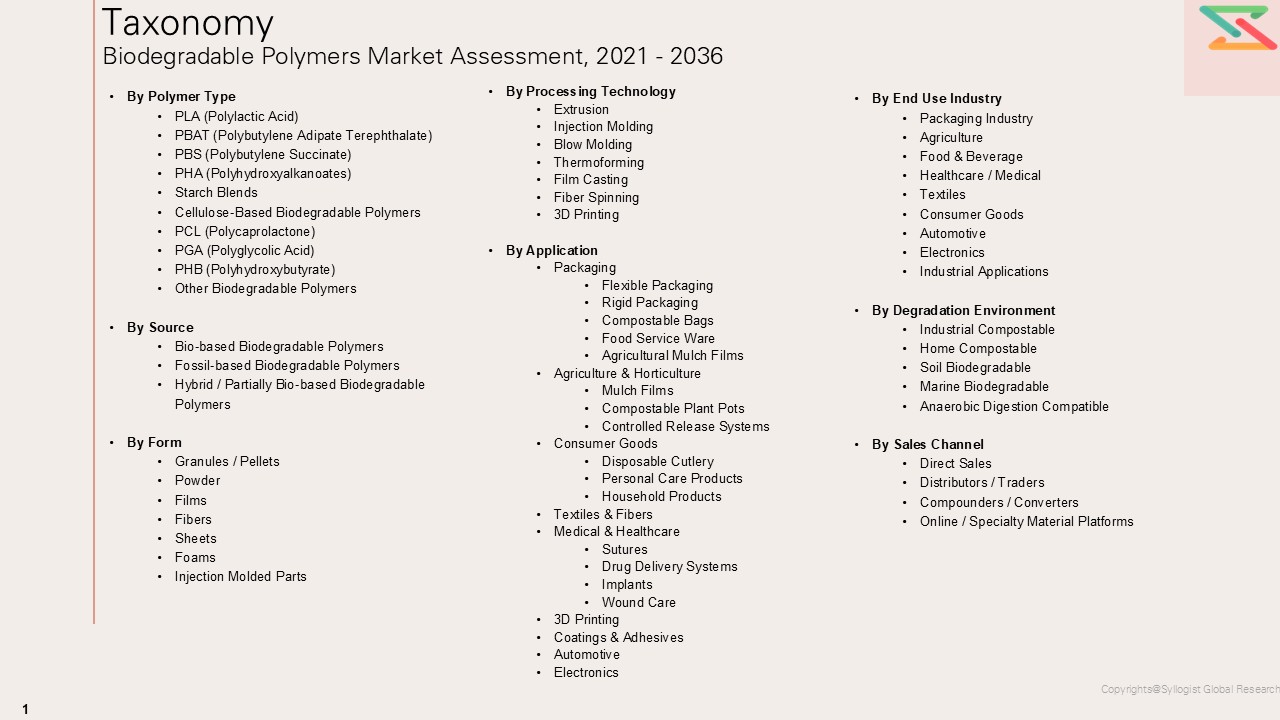
Market Segmentation
- Segmentation by Polymer Type
- PLA (Polylactic Acid)
- PBAT (Polybutylene Adipate Terephthalate)
- PBS (Polybutylene Succinate)
- PHA (Polyhydroxyalkanoates)
- Starch Blends
- Cellulose-Based Biodegradable Polymers
- PCL (Polycaprolactone)
- PGA (Polyglycolic Acid)
- PHB (Polyhydroxybutyrate)
- Other Biodegradable Polymers
- Segmentation by Source
- Bio-based Biodegradable Polymers
- Fossil-based Biodegradable Polymers
- Hybrid / Partially Bio-based Biodegradable Polymers
- Segmentation by Form
- Granules / Pellets
- Powder
- Films
- Fibers
- Sheets
- Foams
- Injection Molded Parts
- Segmentation by Processing Technology
- Extrusion
- Injection Molding
- Blow Molding
- Thermoforming
- Film Casting
- Fiber Spinning
- 3D Printing
- Segmentation by Application
- Packaging
- Flexible Packaging
- Rigid Packaging
- Compostable Bags
- Food Service Ware
- Agricultural Mulch Films
- Agriculture & Horticulture
- Mulch Films
- Compostable Plant Pots
- Controlled Release Systems
- Consumer Goods
- Disposable Cutlery
- Personal Care Products
- Household Products
- Textiles & Fibers
- Medical & Healthcare
- Sutures
- Drug Delivery Systems
- Implants
- Wound Care
- 3D Printing
- Coatings & Adhesives
- Automotive
- Electronics
- Packaging
- Segmentation by End Use Industry
- Packaging Industry
- Agriculture
- Food & Beverage
- Healthcare / Medical
- Textiles
- Consumer Goods
- Automotive
- Electronics
- Industrial Applications
- Segmentation by Degradation Environment
- Industrial Compostable
- Home Compostable
- Soil Biodegradable
- Marine Biodegradable
- Anaerobic Digestion Compatible
- Segmentation by Sales Channel
- Direct Sales
- Distributors / Traders
- Compounders / Converters
- Online / Specialty Material Platforms
- Market Foundations & Dynamics
- Product Overview
- Research Methodology
- Executive Summary
- Market Dynamics (Drivers, Restraints, Opportunities, Challenges, Porter’s Five Forces Analysis, PESTLE Analysis)
- Market Ecosystem & Value Chain
- Overview of Value Chain Participants
- Flow of Value and Material Through the Chain
- Value Addition and Margins at Each Stage
- Market Trends & Developments
- Emerging Raw Material Trends
- Raw Material Availability
- Technological Advancements
- Demand–Supply Gaps
- Investment Hotspots
- Unmet Needs and White Market Spaces
- Risk Assessment Framework
- Political / Geopolitical Risk
- Raw Material Supply Risk
- Environmental and Regulatory Risk
- Financial / Market Risk
- Regulatory Framework & Standards
- Global Policy and Mandate Overview
- Transportation and Storage Regulations
- Sustainability and GHG Reduction Standards
- Environmental & Liability Considerations
- Technology Landscape
- Overview of Technologies
- Cost Optimization Technologies
- Future Outlook
- Global Biodegradable Polymers Market Outlook
- Market Size & Forecast by Value
- Market Size & Forecast by Volume
- Market Size & Forecast by Polymer Type
- PLA (Polylactic Acid)
- PBAT (Polybutylene Adipate Terephthalate)
- PBS (Polybutylene Succinate)
- PHA (Polyhydroxyalkanoates)
- Starch Blends
- Cellulose-Based Biodegradable Polymers
- PCL (Polycaprolactone)
- PGA (Polyglycolic Acid)
- PHB (Polyhydroxybutyrate)
- Other Biodegradable Polymers
- Market Size & Forecast by Source
- Bio-based Biodegradable Polymers
- Fossil-based Biodegradable Polymers
- Hybrid / Partially Bio-based Biodegradable Polymers
- Market Size & Forecast by Form
- Granules / Pellets
- Powder
- Films
- Fibers
- Sheets
- Foams
- Injection Molded Parts
- Market Size & Forecast by Processing Technology
- Extrusion
- Injection Molding
- Blow Molding
- Thermoforming
- Film Casting
- Fiber Spinning
- 3D Printing
- Market Size & Forecast by Application
- Packaging
- Flexible Packaging
- Rigid Packaging
- Compostable Bags
- Food Service Ware
- Agricultural Mulch Films
- Agriculture & Horticulture
- Mulch Films
- Compostable Plant Pots
- Controlled Release Systems
- Consumer Goods
- Disposable Cutlery
- Personal Care Products
- Household Products
- Textiles & Fibers
- Medical & Healthcare
- Sutures
- Drug Delivery Systems
- Implants
- Wound Care
- 3D Printing
- Coatings & Adhesives
- Automotive
- Electronics
- Packaging
- Market Size & Forecast by End Use Industry
- Packaging Industry
- Agriculture
- Food & Beverage
- Healthcare / Medical
- Textiles
- Consumer Goods
- Automotive
- Electronics
- Industrial Applications
- Market Size & Forecast by Degradation Environment
- Industrial Compostable
- Home Compostable
- Soil Biodegradable
- Marine Biodegradable
- Anaerobic Digestion Compatible
- Market Size & Forecast by Sales Channel
- Direct Sales
- Distributors / Traders
- Compounders / Converters
- Online / Specialty Material Platforms
- Market Size & Forecast by Region
- North America
- Europe
- Asia-Pacific
- Middle East & Africa
- South America
- Asia-Pacific Biodegradable Polymers Market Outlook
- Market Size & Forecast by Value & Volume
- Market Size & Forecast by Polymer Type
- Market Size & Forecast by Source
- Market Size & Forecast by Form
- Market Size & Forecast by Processing Technology
- Market Size & Forecast by Application
- Market Size & Forecast by End Use Industry
- Market Size & Forecast by Degradation Environment
- Market Size & Forecast by Sales Channel
- Europe Biodegradable Polymers Market Outlook
- Market Size & Forecast by Value & Volume
- Market Size & Forecast by Polymer Type
- Market Size & Forecast by Source
- Market Size & Forecast by Form
- Market Size & Forecast by Processing Technology
- Market Size & Forecast by Application
- Market Size & Forecast by End Use Industry
- Market Size & Forecast by Degradation Environment
- Market Size & Forecast by Sales Channel
- North America Biodegradable Polymers Market Outlook
- Market Size & Forecast by Value & Volume
- Market Size & Forecast by Polymer Type
- Market Size & Forecast by Source
- Market Size & Forecast by Form
- Market Size & Forecast by Processing Technology
- Market Size & Forecast by Application
- Market Size & Forecast by End Use Industry
- Market Size & Forecast by Degradation Environment
- Market Size & Forecast by Sales Channel
- Latin America Biodegradable Polymers Market Outlook
- Market Size & Forecast by Value & Volume
- Market Size & Forecast by Polymer Type
- Market Size & Forecast by Source
- Market Size & Forecast by Form
- Market Size & Forecast by Processing Technology
- Market Size & Forecast by Application
- Market Size & Forecast by End Use Industry
- Market Size & Forecast by Degradation Environment
- Market Size & Forecast by Sales Channel
- Middle East & Africa Biodegradable Polymers Market Outlook
- Market Size & Forecast by Value & Volume
- Market Size & Forecast by Polymer Type
- Market Size & Forecast by Source
- Market Size & Forecast by Form
- Market Size & Forecast by Processing Technology
- Market Size & Forecast by Application
- Market Size & Forecast by End Use Industry
- Market Size & Forecast by Degradation Environment
- Market Size & Forecast by Sales Channel
- Country wise Biodegradable Polymers Market Outlook
- Market Size & Forecast by Value & Volume
- Market Size & Forecast by Polymer Type
- Market Size & Forecast by Source
- Market Size & Forecast by Form
- Market Size & Forecast by Processing Technology
- Market Size & Forecast by Application
- Market Size & Forecast by End Use Industry
- Market Size & Forecast by Degradation Environment
- Market Size & Forecast by Sales Channel
Countries Analyzed in the Syllogist Global Research Portfolio: China, United States, Germany, Italy, France, United Kingdom, The Netherlands, India, Japan, South Korea, Spain, Belgium, Poland, Switzerland, Austria, Canada, Mexico, Australia, Malaysia, Thailand, Indonesia, Taiwan, Singapore, Sweden, Denmark, Turkey, Brazil, Czech Republic, Ireland
- Pricing Analysis
- Global Average Selling Price Trend
- Pricing Analysis by Chemicals Type
- Pricing Analysis by Application
- Raw Material Price Impact Analysis
- Competition Outlook
- Market Concentration and Fragmentation Level
- Company Market Shares (Top 10 Producers)
- Competitive Strategies
- Benchmarking Matrix
- Recent Developments: Partnerships, M&A, and Policy-Driven Expansions
- Sales & Distribution Channel Analysis
- Overview of Go-to-Market Channels
- Channel Share by Region
- Distribution Strategies by Leading Players
- Strategic Recommendations & Roadmap
- Competitors’ Strategic Initiatives
- Future Outlook (Next 5–10 Years, Emerging Players, Success Factors)
- Strategic Recommendations
- Market Acceleration Roadmap
- Short-Term
- Mid-Term
- Long-Term
- Tailored Recommendations for:
- Producers
- Raw Material Suppliers
- Policymakers / Regulators
- Recommendations on Key Success Factors
- Raw Material Security
- Policy Alignment
- Supply Chain Integration
- Market Acceleration Roadmap