Global Brine Management and Disposal Market By Technology, By Brine Source, By Disposal Method, By Application, By End User, By Region, Competition, Forecast & Opportunities, 2021-2036F
Market Definition
The Global Brine Management and Disposal Market covers the engineering, supply, installation, operation, and outsourced service delivery of integrated brine treatment, concentration, crystallization, and disposal solutions used to handle high-salinity reject streams generated from seawater and brackish water desalination plants, industrial wastewater reverse osmosis operations, power plant cooling tower blowdown, oil and gas produced water, lithium and mineral extraction operations, food and beverage processing, pharmaceutical manufacturing, and emerging direct lithium extraction projects. The market encompasses brine concentration technologies including mechanical vapor recompression evaporators, multi-effect distillation, forward osmosis, membrane distillation, electrodialysis reversal, high-recovery reverse osmosis, and emerging humidification-dehumidification platforms, alongside crystallization and zero liquid discharge (ZLD) systems, deep well injection, surface water and ocean outfall disposal, evaporation ponds, and emerging brine valorization pathways covering salt recovery, lithium, magnesium, bromine, gypsum, and specialty mineral extraction. The supplier landscape is concentrated among integrated water technology providers including Veolia Environnement, SUEZ, Aquatech International, IDE Water Technologies, Doosan Enerbility, Acciona Agua, GEA Group, Saltworks Technologies, Gradiant Corporation, Memsys, Fluence Corporation, H2O Innovation, Veolia HPD, Aquatech, Hatch, and regional engineering, procurement, and construction firms. Market dynamics are governed by tightening environmental discharge regulations, zero liquid discharge mandates across India, China, and select US states, marine outfall restrictions in the European Union and Middle East, water reuse expansion, lithium extraction scaling under EV battery demand, oil and gas produced water volumes, and the structural transition toward circular brine valorization and resource recovery.
Market Insights
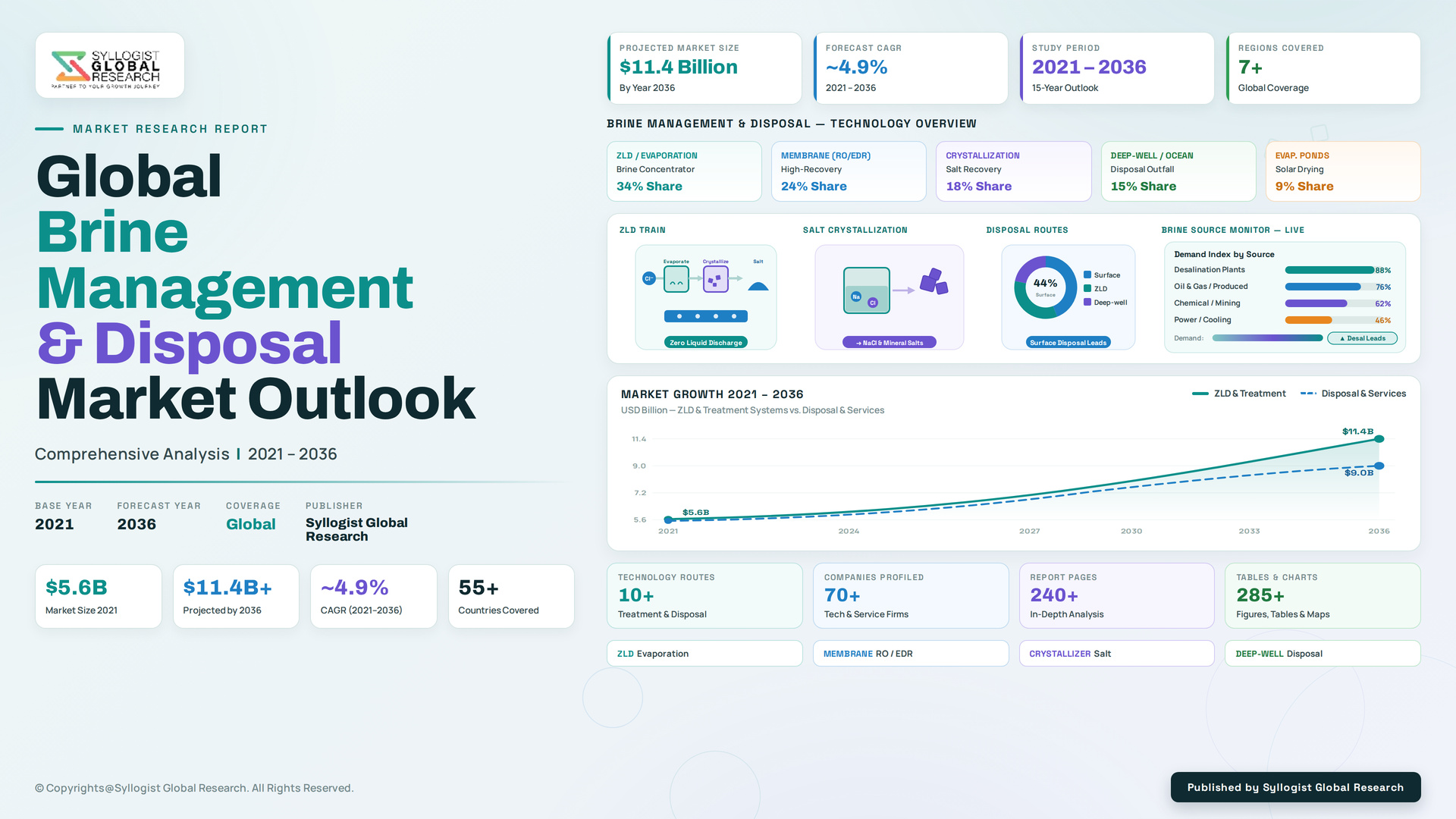
The global brine management and disposal market is entering a sustained high-growth phase driven by accelerating desalination capacity expansion across the Middle East, Asia-Pacific, and the Americas, tightening environmental discharge regulations restricting marine outfall and inland disposal, zero liquid discharge mandates across India, China, and select US states, the structural scaling of lithium extraction in support of EV battery demand, and the rising commercial importance of brine valorization and mineral recovery. The market was valued at USD 18.4 billion in 2025 and is projected to reach USD 38.6 billion by 2034, advancing at a compound annual growth rate of 8.6% through the forecast period, supported by greenfield desalination plant brine handling investments, industrial ZLD deployments, and emerging direct lithium extraction project commissioning across the global lithium triangle and broader resource-rich geographies.
Desalination brine accounts for nearly 52% of global brine management market value in 2025, with global desalination capacity exceeding 102 million cubic meters per day in 2025 and generating reject brine volumes of approximately 142 million cubic meters per day, requiring substantial outfall, mixing, and emerging valorization infrastructure. Saudi Arabia, the United Arab Emirates, Kuwait, Qatar, Oman, and Bahrain collectively account for over 38% of global desalination capacity, anchoring durable Middle East brine handling demand at SWCC, ACWA Power, Emirates Water and Electricity Company, Public Investment Fund-backed water projects, and emerging Saudi NEOM mega-project initiatives. NEOM alone is targeting over 2 million cubic meters per day of desalination capacity by 2030, generating reject brine flows requiring integrated mineral recovery and circular salt valorization infrastructure on an unprecedented scale.
Zero liquid discharge installations have emerged as one of the fastest growing brine management segments, advancing at over 11.4% CAGR through 2034, supported by binding ZLD mandates across Indian textile clusters in Tamil Nadu, Gujarat, and Maharashtra, Chinese coal-fired power and chemical industry effluent regulations, and emerging US Coal Combustion Residuals and ELG rule requirements. Aquatech International, Veolia HPD, GEA Group, Saltworks Technologies, Gradiant Corporation, and emerging Chinese suppliers are advancing commercial ZLD installations integrating mechanical vapor recompression evaporators, crystallizers, and high-recovery membrane systems, with full-scale ZLD project capital deployment typically ranging from USD 28 million to USD 145 million per facility. Direct lithium extraction from oil and gas produced water, geothermal brines, and salar deposits is simultaneously emerging as a high-value brine valorization pathway.
Asia-Pacific dominates the global brine management market with approximately 36% revenue share in 2025, anchored by India, China, and Southeast Asia where binding ZLD mandates, textile and chemical industry effluent regulations, and accelerating desalination capacity additions are driving structural equipment procurement. Middle East and North Africa represent the second largest regional market with nearly 32% share, driven by world-leading desalination capacity at SWCC, ACWA Power, Emirates Water and Electricity Company, Doosan Enerbility, IDE Water Technologies, and Acciona Agua project portfolios. North America is the fastest growing premium technology market advancing at over 10.2% CAGR through 2034, supported by California Pacific coast desalination expansion, Texas oil and gas produced water management, US lithium extraction at Salton Sea, Smackover, and Arkansas operations, and tightening EPA Effluent Limitation Guidelines across power generation, petrochemicals, and refining sectors.
Key Drivers
Desalination Capacity Expansion Across Middle East, Asia-Pacific, and Americas Driving Structural Reject Brine Handling Demand
Global desalination capacity exceeding 102 million cubic meters per day in 2025 is generating reject brine flows approaching 142 million cubic meters per day, anchoring durable brine handling infrastructure demand. Saudi Arabia NEOM targeting over 2 million cubic meters per day of desalination capacity by 2030, alongside aggressive Emirati, Qatari, Kuwaiti, Israeli, Indian, Chinese, Singaporean, and Californian expansion programs, is reinforcing brine management procurement at SWCC, ACWA Power, Emirates Water and Electricity Company, Veolia, SUEZ, IDE Water Technologies, Doosan Enerbility, and Acciona Agua portfolios through 2034.
Zero Liquid Discharge Mandates Across India, China, and US Industrial Sectors Driving High-Value ZLD Equipment Procurement
Binding ZLD mandates across Indian textile clusters in Tamil Nadu, Gujarat, and Maharashtra, Chinese coal-fired power plant and chemical industry effluent regulations, and emerging US EPA ELG and Coal Combustion Residuals rule requirements are driving sustained ZLD equipment procurement. Full-scale ZLD facilities typically requiring USD 28 million to USD 145 million of capital deployment per installation are anchoring durable revenue growth for Aquatech International, Veolia HPD, GEA Group, Saltworks Technologies, Gradiant Corporation, and emerging Chinese suppliers serving textile, power, chemicals, refining, and mining end users.
Direct Lithium Extraction, Mineral Recovery, and Brine Valorization Anchoring Circular Economy Investment Across Brine Streams
Direct lithium extraction at Salton Sea, Smackover, Arkansas, Argentine and Chilean salars, and emerging European geothermal projects is advancing rapidly under EV battery demand growth, anchoring brine valorization investment alongside salt, magnesium, bromine, gypsum, and specialty mineral recovery from desalination and industrial brine streams. Commercial DLE projects at EnergySource Minerals, Controlled Thermal Resources, Standard Lithium, Vulcan Energy Resources, ExxonMobil, and Occidental are reshaping brine valorization economics and creating new revenue streams across the brine management value chain through 2034.
Key Challenges
High Capital and Operating Costs, Energy Intensity, and Affordability Constraints Limiting ZLD and Brine Concentration Adoption
Brine management infrastructure is materially capital and energy intensive, with integrated ZLD installations typically requiring USD 28 million to USD 145 million of capital deployment per facility, alongside thermal evaporator energy consumption ranging from 22 to 65 kWh per cubic meter of brine processed. Operating cost burdens driven by electricity price volatility, anti-scalant chemical consumption, mechanical maintenance, and skilled labor inflation are compressing operator budgets, while affordability concerns at smaller industrial operators, project financing constraints, and competing capital priorities are slowing adoption across emerging markets through 2034.
Marine Outfall Restrictions, Regulatory Tightening, and Environmental Impact Concerns Reshaping Coastal Disposal Pathways
Tightening marine outfall regulations across the European Union under the Water Framework Directive and Marine Strategy Framework Directive, restrictions in the Red Sea, Persian Gulf, and Mediterranean basin, and emerging Californian, Australian, and Singaporean discharge frameworks are limiting traditional coastal disposal pathways. Concerns around localized seabed salinity elevation, marine biodiversity impacts, and cumulative coastal ecosystem stress are driving regulatory pressure on operators to invest in advanced diffuser design, mixing zone optimization, and emerging mineral recovery and brine valorization alternatives across coastal desalination geographies through 2034.
Scaling, Corrosion, and Operational Complexity in Crystallizers, Evaporators, and High-Recovery Membranes Constraining Reliability
High-salinity brine concentration, crystallization, and high-recovery membrane operations remain operationally complex, with scaling, corrosion, fouling, and crystal nucleation control introducing reliability risks that complicate plant availability targets. Skilled engineering workforce shortages, specialized maintenance expertise gaps, and aftermarket service capacity limitations across major brine management geographies are extending commissioning timelines, complicating qualification cycles, and introducing operational complexity that constrains both greenfield project deployment and brownfield equipment refurbishment programs across the brine management lifecycle through 2034.
Market Segmentation
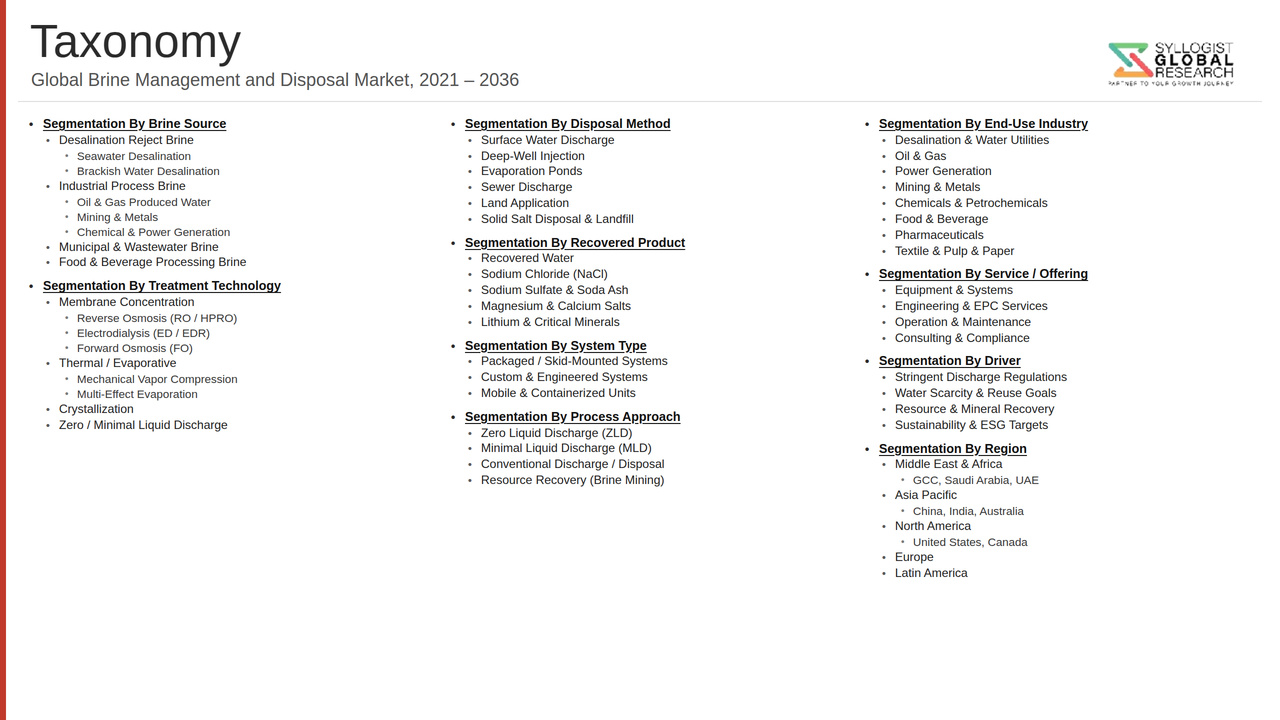
- Segmentation By Technology
- Mechanical Vapor Recompression (MVR) Evaporators
- Multi-Effect Distillation (MED)
- Crystallizers and Spray Dryers
- Forward Osmosis
- Membrane Distillation
- Electrodialysis Reversal (EDR)
- High-Recovery Reverse Osmosis
- Humidification-Dehumidification (HDH)
- Direct Lithium Extraction (DLE) Platforms
- Zero Liquid Discharge (ZLD) Integrated Systems
- Others
- Segmentation By Brine Source
- Seawater Desalination Reject
- Brackish Water Desalination Reject
- Industrial Wastewater RO Reject
- Power Plant Cooling Tower Blowdown
- Oil and Gas Produced Water
- Lithium and Mineral Extraction Brines
- Food and Beverage Processing Brines
- Pharmaceutical and Chemical Effluents
- Mining and Metallurgical Brines
- Others
- Segmentation By Disposal Method
- Surface Water and Ocean Outfall
- Deep Well Injection
- Evaporation Ponds
- Zero Liquid Discharge
- Brine Valorization and Mineral Recovery
- Sewer Discharge with Pre-Treatment
- Others
- Segmentation By Application
- Discharge Compliance
- Water Recovery and Reuse
- Salt and Mineral Recovery
- Lithium Extraction
- Magnesium, Bromine, and Specialty Mineral Recovery
- Cooling Tower Makeup Water Reuse
- Industrial Process Water Recycle
- Others
- Segmentation By End User
- Municipal Water Utilities and Desalination Operators
- Power Generation
- Oil and Gas Upstream and Midstream Operators
- Petrochemicals and Refining
- Chemicals and Pharmaceuticals
- Textiles and Apparel
- Mining and Metals
- Food and Beverage
- Lithium and Battery Materials Producers
- Others
- Segmentation By Region
- Asia-Pacific (China, India, Japan, South Korea, Southeast Asia, Australia)
- Middle East and North Africa
- North America
- Europe
- Latin America
- Sub-Saharan Africa
All market revenues are presented in USD
Historical Year: 2021-2024 | Base Year: 2025 | Estimated Year: 2026 | Forecast Period: 2027-2034
Key Questions this Study Will Answer
- What is the total market valuation of the Global Brine Management and Disposal Market in 2025, projected through 2034, disaggregated by technology, brine source, disposal method, application, and end user, enabling water technology suppliers, municipal desalination operators, industrial operators, lithium producers, and investors to identify the highest-growth opportunities and most durable revenue corridors across the brine management value chain?
- How is desalination capacity expansion across Saudi Arabia NEOM, the UAE, Qatar, Kuwait, Israel, India, China, Singapore, and California reshaping brine handling infrastructure procurement, and what reject brine flow management strategies are reshaping coastal disposal and mineral recovery economics through 2034?
- Which brine management technologies including MVR evaporators, multi-effect distillation, crystallizers, forward osmosis, membrane distillation, electrodialysis reversal, high-recovery reverse osmosis, direct lithium extraction, and integrated ZLD platforms are generating the highest growth rates, and how is the supply landscape evolving across Veolia Environnement, SUEZ, Aquatech International, IDE Water Technologies, Doosan Enerbility, Acciona Agua, GEA Group, Saltworks Technologies, Gradiant Corporation, Fluence Corporation, and H2O Innovation?
- How are binding zero liquid discharge mandates across Indian textile clusters in Tamil Nadu, Gujarat, and Maharashtra, Chinese coal-fired power and chemical industry regulations, and US EPA ELG and Coal Combustion Residuals frameworks reshaping ZLD equipment procurement and competitive positioning through 2034?
- How is direct lithium extraction at Salton Sea, Smackover, Arkansas, Argentine and Chilean salars, and emerging European geothermal projects reshaping brine valorization economics, and what scaling potential exists across EnergySource Minerals, Controlled Thermal Resources, Standard Lithium, Vulcan Energy Resources, ExxonMobil, and Occidental commercial deployments?
- How are tightening marine outfall regulations across the European Union, Red Sea, Persian Gulf, Mediterranean basin, California, Australia, and Singapore reshaping coastal brine disposal pathways, and what advanced diffuser design, mixing zone optimization, and brine valorization alternatives are emerging in response?
- How is the competitive landscape structured among integrated water technology providers Veolia Environnement, SUEZ, Aquatech International, IDE Water Technologies, Doosan Enerbility, Acciona Agua, and equipment specialists GEA Group, Saltworks Technologies, Gradiant Corporation, Fluence Corporation, H2O Innovation, Memsys, Veolia HPD, and Hatch, and what partnership, capacity expansion, and joint venture strategies are reshaping market share dynamics through 2034?
- Product Definition
- Research Methodology
- Research Design & Framework
- Overall Research Approach: Descriptive, Exploratory & Quantitative Mixed-Method Design
- Market Definition & Scope Boundaries: What is Included and Excluded
- Segmentation Framework
- Key Research Assumptions & Limitations
- Secondary Research
- Primary Research Design & Execution
- Data Triangulation & Validation
- Market Sizing & Forecasting Methodology
- Competitive Intelligence Methodology
- Quality Assurance & Peer Review
- Definitions, Abbreviations & Data Notes
- Research Design & Framework
- Executive Summary
- Market Snapshot & Headline Numbers
- Key Findings & Research Highlights
- Market Dynamics
- Regional Market Summary
- Competitive Landscape Snapshot
- Technology & Innovation Highlights
- Market Dynamics
- Drivers
- Restraints
- Opportunities
- Challenges
- Porter’s Five Forces Analysis
- PESTLE Analysis
- Market Trends & Developments
- Emerging Trends
- Technological Developments
- Regulatory & Policy Changes
- Supply Chain & Sourcing Trends
- Manufacturing & Process Trends
- Investment & Funding Activity
- Sustainability & ESG Trends
- Risk Assessment Framework
- Regulatory, Discharge Permit Restriction & Disposal Route Closure Risk
- Environmental, Marine & Groundwater Contamination Liability Risk
- Energy Cost, Power Consumption & ZLD Operating Cost Volatility Risk
- Technology Scale-Up, Scaling/Fouling & Process Reliability Risk
- Financing, Project Development & Stranded Asset Risk
- Regulatory Framework & Standards
- Brine Discharge, Marine Outfall & Surface Water Quality Regulatory Frameworks
- Deep-Well Injection, Groundwater Protection & Subsurface Disposal Regulations
- Zero Liquid Discharge (ZLD) Mandates & Industrial Effluent Standards
- Resource Recovery, Salt & Mineral Recovery Product Standards
- Green Finance, Carbon Accounting, ESG Disclosure & Sustainable Procurement Standards
- Global Brine Management and Disposal Market Outlook
- Market Size & Forecast by Value
- Market Size & Forecast by Volume (Brine Treated, Million Cubic Metres)
- Market Size & Forecast by Disposal Method
- Surface Water & Marine Discharge
- Deep-Well Injection
- Evaporation Ponds
- Sewer & Municipal Discharge
- Zero Liquid Discharge (ZLD)
- Minimal Liquid Discharge (MLD)
- Land Application & Spray Irrigation
- Brine Concentration & Crystallisation
- Other Disposal & Recovery Methods
- Market Size & Forecast by Technology
- Thermal Evaporation (Brine Concentrator) Technology
- Crystalliser & Spray Dryer Technology
- Reverse Osmosis & High-Pressure RO Technology
- Forward Osmosis Technology
- Membrane Distillation Technology
- Electrodialysis & Electrodialysis Reversal Technology
- Mechanical Vapor Compression (MVC) Technology
- Selective Salt & Mineral Recovery Technology
- Other Emerging & Hybrid Treatment Technologies
- Market Size & Forecast by System Type
- Zero Liquid Discharge (ZLD) Systems
- Minimal Liquid Discharge (MLD) Systems
- Brine Concentration Systems
- Brine Crystallisation & Solidification Systems
- Resource & Salt Recovery Systems
- Market Size & Forecast by Project Scale
- Large-Scale Centralised Brine Facilities (Above 5,000 Cubic Metres per Day)
- Medium-Scale Brine Facilities (500 to 5,000 Cubic Metres per Day)
- Small-Scale & Decentralised Brine Units (Below 500 Cubic Metres per Day)
- Market Size & Forecast by Application
- Desalination Plant Reject Brine
- Power Generation & Cooling Tower Blowdown
- Oil, Gas & Produced Water
- Mining & Metal Processing Effluent
- Chemical, Pharmaceutical & Industrial Process Brine
- Food, Beverage & Other Industrial Brine
- Market Size & Forecast by End-User
- Municipal & Desalination Utilities
- Power & Energy Companies
- Oil, Gas & Mining Operators
- Chemical, Pharmaceutical & Manufacturing Facilities
- Waste Management Contractors & Other End-Users
- Market Size & Forecast by Sales Channel
- EPC & Turnkey Project Contract (Engineering, Procurement & Construction)
- Direct Equipment & Technology Supply with System Integration
- Operations, Maintenance & Brine Handling Service Contract
- Public-Private Partnership (PPP) & Build-Operate Contract
- North America Brine Management and Disposal Market Outlook
- Market Size & Forecast
- By Value
- By Volume (Brine Treated, Million Cubic Metres)
- By Disposal Method
- By Technology
- By System Type
- By Project Scale
- By Application
- By End-User
- By Country
- By Sales Channel
- Europe Brine Management and Disposal Market Outlook
- Market Size & Forecast
- By Value
- By Volume (Brine Treated, Million Cubic Metres)
- By Disposal Method
- By Technology
- By System Type
- By Project Scale
- By Application
- By End-User
- By Country
- By Sales Channel
- Asia-Pacific Brine Management and Disposal Market Outlook
- Market Size & Forecast
- By Value
- By Volume (Brine Treated, Million Cubic Metres)
- By Disposal Method
- By Technology
- By System Type
- By Project Scale
- By Application
- By End-User
- By Country
- By Sales Channel
- Latin America Brine Management and Disposal Market Outlook
- Market Size & Forecast
- By Value
- By Volume (Brine Treated, Million Cubic Metres)
- By Disposal Method
- By Technology
- By System Type
- By Project Scale
- By Application
- By End-User
- By Country
- By Sales Channel
- Middle East & Africa Brine Management and Disposal Market Outlook
- Market Size & Forecast
- By Value
- By Volume (Brine Treated, Million Cubic Metres)
- By Disposal Method
- By Technology
- By System Type
- By Project Scale
- By Application
- By End-User
- By Country
- By Sales Channel
- Country-Wise* Brine Management and Disposal Market Outlook
- Market Size & Forecast
- By Value
- By Volume (Brine Treated, Million Cubic Metres)
- By Disposal Method
- By Technology
- By System Type
- By Project Scale
- By Application
- By End-User
- By Country
- By Sales Channel
- *Countries Analyzed in the Syllogist Global Research Portfolio: United States, Canada, Mexico, Germany, France, United Kingdom, Netherlands, Spain, Italy, Norway, Sweden, China, Japan, India, Australia, South Korea, Singapore, Brazil, Chile, Saudi Arabia, UAE, Egypt, South Africa, Israel
- Technology Landscape & Innovation Analysis
- Thermal Evaporation & Brine Concentrator Technology Deep-Dive
- Crystalliser & Spray Dryer Technology
- High-Pressure RO, Forward Osmosis & Membrane Distillation Technology
- Electrodialysis & Electrodialysis Reversal Technology
- Mechanical Vapor Compression & Energy Integration Technology
- Selective Salt, Mineral & Resource Recovery Technology
- Scaling, Fouling Control, Digitalisation & Smart Brine System Technology
- Patent & IP Landscape in Brine Management Technologies
- Value Chain & Supply Chain Analysis
- Evaporator, Crystalliser & Thermal Equipment Manufacturing Supply Chain
- Membrane, Module & High-Pressure Pump Component Supply Chain
- Chemical, Antiscalant & Pre-Treatment Reagent Supply Chain
- EPC Contractor, Project Developer & System Integrator Procurement Landscape
- Utility, Desalination, Power & Industrial Operator Channel
- Recovered Salt, Mineral Offtake & Disposal Partner Channel
- Resource Recovery, Mineral Valorisation & Circular Economy
- Pricing Analysis
- Thermal Evaporation & Brine Concentrator Capital and Operating Cost Analysis
- Crystalliser & ZLD System Capital and Operating Cost Analysis
- Membrane-Based (RO, FO & MD) Brine Treatment Cost Analysis
- Disposal Route (Deep-Well, Evaporation Pond & Discharge) Cost Analysis
- Brine Management Project Finance, PPP Tariff & Recovered-Product Revenue Structure Analysis
- Total Brine Management Economics: Cost-per-Cubic-Metre and ZLD-Cost Optimisation Analysis
- Sustainability & Environmental Analysis
- Lifecycle Assessment (LCA) of Brine Management: Energy Intensity, Carbon Footprint & Emissions Across Disposal Routes
- Carbon Neutrality & Net Zero Contribution: Pathway to Energy-Efficient and Renewable-Powered Brine Treatment
- Circular Economy & Resource Recovery: Salt, Mineral and Water Recovery Contribution
- Environmental Compliance, Marine, Groundwater & Ecosystem Impact Consideration in Disposal
- Regulatory-Driven Sustainability, SDG 6 (Clean Water) & SDG 12 (Responsible Consumption) Alignment & Green Finance Eligibility
- Competitive Landscape
- Market Structure & Concentration
- Market Consolidation Level (Fragmented vs. Consolidated by Technology & Geography)
- Top 10 Players Market Share
- HHI (Herfindahl-Hirschman Index) Concentration Analysis
- Competitive Intensity Map by Technology, Application & Geography
- Player Classification
- Integrated Water Treatment & Brine Management Technology Companies
- Specialist Thermal Evaporation & Crystalliser Providers
- Membrane-Based (RO, FO & MD) Brine Treatment Technology Providers
- Electrodialysis & Electrochemical Technology Providers
- Zero Liquid Discharge (ZLD) System Integrators
- Salt, Mineral & Resource Recovery Technology Specialists
- EPC Contractors & Project Developers Specialising in Brine Management
- Deep-Well Injection & Brine Disposal Service Providers
- Competitive Analysis Frameworks
- Market Share Analysis by Technology, Application & Region
- Company Profile
- Company Overview & Headquarters
- Brine Management Products & Technology Portfolio
- Key Customer Relationships & Reference Project Installations
- Manufacturing Footprint & Production Capacity
- Revenue (Brine Management Segment) & Backlog
- Technology Differentiators & IP
- Key Strategic Partnerships, JVs & M&A Activity
- Recent Developments (Contract Wins, Capacity Expansion, Product Launches)
- SWOT Analysis
- Strategic Focus Areas & Roadmap
- Competitive Positioning Map (Technology Capability vs. Market Penetration)
- Key Company Profiles
- Market Structure & Concentration
- Technology Landscape & Innovation Analysis
- Strategic Output
- Market Opportunity Matrix: By Technology, Disposal Method, Application, End-User & Geography
- White Space Opportunity Analysis
- Strategic Recommendations
- Product Portfolio & Technology Investment Strategy
- Manufacturing & Operational Excellence Strategy
- Geographic Expansion & Localisation Strategy
- Customer & End-User Engagement Strategy
- Partnership, M&A & Ecosystem Strategy
- Sustainability & Circular Economy Strategy
- Risk Mitigation & Future Roadmap
- Strategic Priority Matrix & Roadmap
- Near-term (2025-2028)
- Mid-term (2029-2032)
- Long-term (2033-2037)
- Strategic Output
- Market Size & Forecast
- Market Size & Forecast
- Market Size & Forecast
- Market Size & Forecast
- Market Size & Forecast
- Market Size & Forecast