Market Definition
The Global Gene Editing Technologies (CRISPR Crops) Market encompasses the research, development, commercialization, and deployment of clustered regularly interspaced short palindromic repeats and associated protein-based gene editing platforms applied specifically to the genetic improvement of food, feed, fiber, and bioenergy crops across the complete spectrum of agricultural production systems worldwide. This market includes the discovery and optimization of CRISPR-Cas9, CRISPR-Cas12, base editing, prime editing, and multiplexed gene editing systems as applied to crop improvement objectives including yield enhancement, abiotic stress tolerance, biotic resistance, nutritional quality improvement, input use efficiency, and post-harvest quality preservation across major staple crops such as wheat, rice, maize, soybean, and potato, as well as specialty crops including tomato, banana, citrus, cocoa, and a broad range of horticultural and oilseed species. The product and service scope of this market extends from intellectual property licensing of foundational CRISPR platform technologies and proprietary trait development tools, through contract research and gene editing service provision to seed companies and agricultural biotechnology organizations, to the development and commercial launch of CRISPR-edited crop varieties and the licensing of improved germplasm to seed producers operating across national and multinational markets. The technology landscape within this market encompasses both transgene-free small deletion and single nucleotide substitution editing applications that are increasingly regulated as equivalent to conventional breeding in multiple jurisdictions, and more complex editing applications involving the introduction of novel genetic sequences that remain subject to regulatory frameworks comparable to those applied to transgenic organisms in most major agricultural markets. The value chain of this market extends from university technology transfer offices and foundational intellectual property holders through dedicated agricultural biotechnology companies, major integrated seed and crop protection corporations, national and international agricultural research institutes, public breeding programs, and the commercial seed distribution networks that ultimately deliver gene-edited crop varieties to farming operations across both developed and developing agricultural economies.
Market Insights
The global gene editing technologies market applied to crop improvement is operating with substantial commercial and scientific momentum in 2026, supported by a broadening pipeline of CRISPR-edited crop varieties advancing toward or entering commercial cultivation in key agricultural markets, an expanding regulatory acceptance framework in major agricultural economies that is progressively distinguishing small-mutation gene editing from conventional transgenic modification, and the intensifying strategic investment by leading seed and agricultural biotechnology corporations in gene editing platform development and trait pipeline construction. The fundamental scientific premise underlying this market’s commercial trajectory is the demonstrated ability of CRISPR-based editing systems to introduce precise and predictable modifications to crop genomes at substantially lower cost, shorter development timelines, and greater multiplexing capability than conventional marker-assisted breeding or transgenic modification approaches, creating a productivity advantage in trait development that is translating into growing adoption across both commercial seed breeding programs and publicly funded crop improvement initiatives. The market is advancing along two structurally distinct commercial pathways, with trait licensing and technology platform provision generating early-stage revenue streams from seed company partnerships and government research agreements, and commercial seed product sales beginning to contribute growing revenue as the first generation of CRISPR-improved crop varieties achieves regulatory clearance and enters commercial cultivation in the United States, Argentina, Brazil, Japan, and a growing number of additional markets that have established gene editing-specific regulatory pathways distinct from transgenic frameworks.
A defining scientific and commercial development reshaping the competitive and intellectual property landscape of the CRISPR crops market is the progressive differentiation and specialization of gene editing platform technologies beyond the foundational CRISPR-Cas9 system, with base editing and prime editing technologies emerging as particularly significant commercial capabilities that expand the range of precise genomic modifications achievable without introducing double-strand breaks or requiring donor template DNA. Base editing systems, which enable the direct chemical conversion of one DNA base to another within a targeted genomic locus without creating double-strand breaks, are demonstrating particular commercial utility in the introduction of single nucleotide polymorphism variants associated with agronomically valuable traits including herbicide tolerance, disease resistance alleles, and quality characteristics identified through natural variation screening in crop germplasm collections. Prime editing, which combines a modified Cas9 nickase with an engineered reverse transcriptase to write new genetic information directly into a specified genomic location, is extending the precision editing toolkit to include small insertions, deletions, and all twelve types of point mutations at target sites, addressing editing scenarios that were not efficiently accessible through earlier generation CRISPR tools. The commercial deployment of these advanced editing platforms is generating substantial intellectual property activity, with multiple foundational technology licensors and platform development companies competing to establish proprietary positions in base editing and prime editing tool systems while simultaneously licensing these capabilities to seed company partners under trait development agreements that define the royalty and sublicensing terms for commercial crop product applications.
The regulatory environment governing CRISPR-edited crops has undergone substantial evolution across major agricultural markets over the preceding several years, creating a progressively more favorable commercialization landscape for the subset of gene editing applications that introduce modifications indistinguishable from those achievable through conventional breeding, natural mutation, or traditional mutagenesis techniques. The United States Department of Agriculture has established a regulatory interpretation under which CRISPR-edited plants that could have been developed through conventional breeding are not subject to the same regulatory review requirements as transgenic organisms, enabling commercial launch of a growing number of gene-edited crop varieties without the multi-year, high-cost regulatory submission processes that previously constrained the commercial economics of crop biotechnology innovation. Japan, Argentina, Brazil, and Australia have implemented comparable regulatory frameworks that provide conditional or full exemption from genetically modified organism regulatory review for CRISPR-edited plants meeting defined criteria related to the nature of the genomic modification introduced. The European Union regulatory environment represents a significant commercial variable, with ongoing legislative revision processes aimed at distinguishing new genomic techniques from transgenic modification for certain categories of applications, and the outcome of this legislative process is expected to materially influence the commercial deployment of CRISPR-edited varieties across European agricultural markets and the research investment strategies of agricultural biotechnology companies with significant European operations. China represents a market of substantial strategic importance whose regulatory pathway for gene-edited crops continues to develop and whose decisions on commercial authorization of CRISPR-improved varieties in staple crops including rice and wheat will have significant implications for the global adoption trajectory of this technology.
From a regional and crop category perspective, North America is the most commercially advanced market for CRISPR crop technology deployment, with the United States hosting the highest concentration of foundational intellectual property, commercial stage agricultural biotechnology companies, and venture and corporate investment in gene editing platform development and trait pipeline construction, supported by a regulatory environment that has provided early commercial clarity for qualifying editing applications and a seed industry structure well-suited to rapid technology integration into commercial breeding programs. Latin America, led by Argentina and Brazil, represents the most significant near-term commercial opportunity outside North America, with both countries having established favorable gene editing regulatory frameworks for modifications that fall within conventional breeding equivalence criteria, and with large-scale commercial agriculture sectors producing soybeans, maize, wheat, and sugarcane at global scale where gene-edited variety improvements in yield, stress tolerance, and input efficiency can generate economically significant returns on trait development investment. Asia-Pacific, and particularly Japan and China, represents a market of complex regulatory and commercial characteristics where national food security imperatives, large staple crop production systems, and significant public investment in agricultural genomics research are creating parallel pathways of CRISPR crop development within national research systems that are increasingly connected to commercial seed industry applications. Sub-Saharan Africa and South Asia represent the frontier commercial opportunity where the potential humanitarian and food security impact of gene-edited crop improvements in drought tolerance, pest resistance, and nutritional enhancement in smallholder farming systems is motivating substantial philanthropic and development institution investment in gene editing research programs targeting crops and traits of specific relevance to resource-limited farming contexts.
Key Drivers
Accelerating Regulatory Acceptance of Gene-Edited Crops in Major Agricultural Markets and the Commercial Clarity This Provides for Trait Development Investment
The single most transformative commercial development enabling the transition of CRISPR crop technology from a primarily research-stage capability to an active commercial market is the progressive establishment of regulatory frameworks in major agricultural economies that provide a clearly defined and commercially viable pathway for the authorization and market launch of gene-edited crop varieties whose modifications are equivalent in nature to those achievable through conventional breeding. Prior to the regulatory clarifications implemented by the United States, Argentina, Brazil, Japan, and Australia over the preceding several years, the commercial economics of CRISPR crop development were substantially constrained by the regulatory cost and timeline uncertainty associated with potential classification of all gene-edited products under full transgenic organism regulatory review frameworks, which carry multi-year development timelines and development costs that are prohibitive for all but the highest-value traits in the most commercially significant crop species. The removal or significant reduction of this regulatory barrier for qualifying gene editing applications has fundamentally restructured the commercial economics of the technology by enabling the development and launch of gene-edited crop varieties at cost structures and timelines that are competitive with advanced conventional breeding programs and that support positive return on investment across a substantially broader range of trait and crop category combinations than was previously commercially viable. The resulting expansion of the commercially addressable opportunity has triggered a significant increase in corporate research investment, partnership formation between gene editing technology developers and seed companies, and venture capital commitment to agricultural gene editing startups, all of which are accelerating the pace of commercial product development and the breadth of the crop variety pipeline expected to reach commercial availability across major markets over the forecast period.
Growing Urgency of Climate Adaptation in Agricultural Crop Systems and the Demonstrated Capability of CRISPR Editing to Accelerate Stress Tolerance Trait Development
The intensifying impact of climate variability on agricultural production systems across major crop-growing regions, manifesting in increased frequency and severity of drought episodes, heat stress events during critical crop developmental stages, flooding and waterlogging conditions in tropical and subtropical farming regions, and the geographic range expansion of existing and novel crop pathogens and insect pest species, is creating an urgent demand pull for crop varieties with enhanced resilience to abiotic and biotic stress conditions that conventional breeding programs are challenged to deliver within the timeframes that agricultural adaptation requirements demand. CRISPR gene editing is demonstrating significant practical utility in addressing these climate adaptation breeding challenges by enabling the rapid and precise introduction of stress tolerance alleles identified through comparative genomics and natural variation research into commercial elite crop backgrounds without the multi-generational backcrossing cycles required by conventional introgression breeding, compressing the time from trait discovery to commercial variety availability by a substantial margin relative to traditional breeding approaches. The specific editing applications generating the most active commercial development pipelines in the climate adaptation context include drought tolerance through modification of stomatal regulation genes and root architecture determinants, heat tolerance through introduction of thermostable protein variants and heat-responsive regulatory elements, flooding tolerance through editing of submergence response pathway genes, and broad-spectrum disease resistance through modification of susceptibility genes that pathogens exploit for host colonization and whose loss of function confers durable resistance without the yield penalties associated with resistance gene-based protection in many crop systems. The alignment between the urgency of agricultural climate adaptation requirements, the demonstrated speed advantage of CRISPR editing relative to conventional breeding, and the growing pipeline of climate-relevant trait editing targets identified through advances in crop functional genomics is creating a sustained and expanding driver for commercial investment in CRISPR crop development programs focused on stress tolerance improvement across major staple and specialty crop species.
Key Challenges
Consumer Acceptance Uncertainty and the Commercial Risk of Public Perception Barriers to Gene-Edited Food Crop Products in Key Consumer Markets
A fundamental commercial challenge facing the CRISPR crops market is the substantial uncertainty surrounding consumer acceptance of gene-edited food products in major consumer markets, particularly in Europe and parts of Asia where the historical controversy surrounding genetically modified organisms has created a precautionary public perception framework that may extend to gene-edited crops regardless of the technical distinctions between CRISPR editing and transgenic modification that underpin the more permissive regulatory approaches adopted in other jurisdictions. The commercial risk associated with consumer acceptance uncertainty is multidimensional, encompassing the potential for retailer and food manufacturer procurement policy restrictions that effectively create commercial market barriers for gene-edited crop ingredients even in jurisdictions where regulatory approval has been obtained, the risk of organized consumer advocacy campaigns against specific gene-edited crop products or traits that could damage broader market acceptance, and the challenge of communicating the nature, safety basis, and consumer benefit of gene editing technology to a general public whose understanding of agricultural biotechnology is limited and whose information environment on this topic is substantially shaped by advocacy communications from both proponent and opponent organizations. The commercial implications are particularly significant for the European market, where the ongoing legislative revision of the regulatory framework for new genomic techniques is creating a period of heightened public and political attention to gene-edited crops that may amplify consumer awareness and opinion formation at a critical juncture in the commercial development of the technology. Seed companies and agricultural biotechnology organizations developing CRISPR crop products are navigating this challenge through a combination of consumer benefit-focused trait prioritization strategies that favor gene-edited crop improvements with clear and direct consumer value such as enhanced nutritional content, reduced allergen levels, or extended shelf life, investment in transparent stakeholder communication programs, and engagement with food industry value chain partners to build the commercial infrastructure for responsible gene-edited product deployment.
Intellectual Property Complexity and the Constraining Effect of Fragmented Foundational Patent Landscapes on Commercial Access to Gene Editing Technologies
The intellectual property environment surrounding CRISPR gene editing technologies represents a structurally significant commercial challenge for the crops market, characterized by a complex and contested landscape of foundational patents covering core Cas protein systems, guide RNA design and delivery methodologies, and base and prime editing tools that is distributed across multiple academic institutions, technology transfer organizations, and commercial entities whose competing patent claims have generated extensive litigation and whose licensing terms and conditions substantially influence the economics of commercial agricultural application development. The foundational CRISPR-Cas9 patent dispute between major research universities established a precedent for the high-stakes nature of intellectual property competition in this technology domain and created a bifurcated licensing environment in which commercial agricultural biotechnology developers must navigate multiple overlapping patent estates to assemble the freedom-to-operate required for commercial product development, incurring transaction costs, legal uncertainty, and licensing royalty obligations that represent a meaningful constraint on the commercial economics of gene editing-based crop product development particularly for smaller companies and public sector breeding programs with limited resources to manage complex intellectual property negotiations. The intellectual property challenge is further complicated by the global nature of agricultural markets, as freedom-to-operate analysis and licensing obligations must be assessed jurisdiction by jurisdiction across the multiple national patent systems in which foundational gene editing patents have been granted or are pending, creating a geographic mosaic of intellectual property risk that adds complexity and cost to international commercial development and market access strategies for gene-edited crop products. Initiatives to establish more accessible and streamlined licensing mechanisms for agricultural applications of gene editing, including patent pool structures and humanitarian use licensing provisions for public sector crop improvement programs targeting food security objectives in developing countries, represent partial responses to this challenge but have achieved only limited adoption relative to the scope of the intellectual property access problem facing the broader commercial and public sector gene editing crop development community.
Market Segmentation
- Segmentation By Editing Technology Platform
- CRISPR-Cas9 Gene Disruption and Knockout
- CRISPR-Cas12 and Alternative Cas Protein Systems
- Adenine Base Editing (ABE)
- Cytosine Base Editing (CBE)
- Prime Editing
- Multiplexed Gene Editing
- Epigenome Editing and CRISPRa/CRISPRi
- Others
- Segmentation By Crop Category
- Cereals and Grains (Wheat, Rice, Maize, Barley)
- Oilseeds (Soybean, Canola, Sunflower)
- Pulses and Legumes
- Fruits and Vegetables
- Sugar Crops (Sugarcane, Sugar Beet)
- Fiber Crops (Cotton)
- Horticultural and Specialty Crops
- Bioenergy and Industrial Crops
- Others
- Segmentation By Trait Category
- Yield Enhancement and Biomass Improvement
- Drought and Abiotic Stress Tolerance
- Disease and Pathogen Resistance
- Insect and Pest Resistance
- Herbicide Tolerance
- Nutritional Quality and Composition Improvement
- Post-Harvest Quality and Shelf Life
- Input Use Efficiency (Nitrogen, Water, Phosphorus)
- Others
- Segmentation By Application
- Commercial Crop Variety Development
- Germplasm Improvement and Elite Line Development
- Trait Discovery and Functional Genomics Research
- Gene Editing Service Provision (Contract Research)
- Regulatory Dossier and Deregulation Support
- Others
- Segmentation By Delivery Mechanism
- Agrobacterium-Mediated Transformation
- Biolistic Particle Delivery (Gene Gun)
- Ribonucleoprotein (RNP) Delivery
- Nanoparticle and Lipid-Based Delivery
- Virus-Like Particle Delivery
- Others
- Segmentation By End User
- Multinational Seed and Crop Protection Corporations
- Independent Commercial Seed Companies
- Agricultural Biotechnology Startups
- Public and Government Research Institutions
- International Agricultural Research Centers
- Contract Research Organizations
- Others
- Segmentation By Regulatory Classification
- Transgene-Free Small Deletion Edits (Exempt Category)
- Single Nucleotide Substitution Edits (Exempt or Reduced Review)
- Small Insertion Edits Within Species Gene Pool
- Novel Sequence Introduction (Full Regulatory Review)
- Others
- Segmentation By Region
- North America
- Europe
- Asia-Pacific
- Latin America
- Middle East and Africa
All market revenues are presented in USD
Historical Year: 2021-2024 | Base Year: 2025 | Estimated Year: 2026 | Forecast Period: 2027-2036
Key Questions this Study Will Answer
- What is the projected global market valuation for gene editing technologies applied to crop improvement through 2036, segmented by editing platform, crop category, trait type, and region, and which technology categories and geographic markets are expected to generate the highest incremental revenue growth across the forecast period?
- How is the expanding regulatory acceptance of transgene-free CRISPR editing applications in the United States, Argentina, Brazil, Japan, and Australia reshaping the commercial development economics and market launch timelines for gene-edited crop varieties, and what is the expected regulatory trajectory in the European Union and China that will determine the scale of the addressable commercial opportunity in these critical markets?
- Which crop species and trait categories are generating the most active commercial development pipelines among leading agricultural biotechnology companies and seed corporations, and what is the projected timeline for commercial variety availability in priority trait categories including drought tolerance, disease resistance, yield enhancement, and nutritional quality improvement across major staple and specialty crop species?
- How is the intellectual property landscape governing foundational CRISPR platform technologies, base editing systems, and prime editing tools evolving, and what are the implications of patent licensing terms, freedom-to-operate complexity, and emerging patent pool initiatives for the commercial development strategies and competitive positioning of seed companies and agricultural biotechnology organizations operating in the gene editing crop market?
- What is the projected contribution of publicly funded international agricultural research programs, philanthropic investment, and development institution partnerships to CRISPR crop development targeting food security objectives in Sub-Saharan Africa and South Asia, and how are these public sector development pathways expected to interact with commercial market development in defining the global adoption trajectory of gene-edited crop varieties across smallholder and subsistence farming contexts?
- Who are the leading gene editing technology developers, agricultural biotechnology companies, seed corporations, and contract research organizations currently defining the competitive landscape of the global CRISPR crops market, and what are their respective technology platform strategies, trait pipeline priorities, regional expansion plans, and partnership structures for advancing gene-edited crop products through regulatory review and commercial deployment across the forecast horizon?
- Product Definition
- Scope of the Study
- Research Methodology
- Research Design & Framework
- Overall Research Approach: Descriptive, Exploratory & Quantitative Mixed-Method Design
- Market Definition & Scope Boundaries: What is Included and Excluded
- Segmentation Framework
- Key Research Assumptions & Limitations
- Secondary Research
- Industry Publications, Agri-Biotech Company Reports, Academic Journals & Press Releases
- Government Agriculture, Biosafety & Food Authority Data (USDA, FAO, EFSA, GEAC, FSANZ, etc.)
- Gene Editing Technology Licensing, Patent & Commercialisation Activity Statistics
- Seed Company Pipeline, Field Trial & Regulatory Approval Databases
- Primary Research Design & Execution
- In-depth Interviews with Gene Editing Technology Developers, Seed Company R&D Heads & Regulatory Affairs Specialists
- Surveys with Agricultural Biotech Companies, Contract Research Organisations (CROs), Growers & Food Processors
- Expert Panel Validation
- Data Triangulation & Validation
- Market Sizing & Forecasting Methodology
- Bottom-Up & Top-Down Reconciliation
- Crop Pipeline Advancement & Technology Adoption Rate-Driven Market Sizing Model
- Regulatory Approval Probability & Commercialisation Timeline Adjustment Framework
- Competitive Intelligence Methodology
- Quality Assurance & Peer Review
- Definitions, Abbreviations & Data Notes
- Executive Summary
- Market Snapshot & Headline Numbers
- Key Findings & Research Highlights
- Technology & Innovation Highlights
- Regulatory Landscape & Approval Pipeline Summary
- IP Licensing & Platform Economics Summary
- Trait Development & Crop Pipeline CAPEX & OPEX Benchmarks
- CRISPR-Cas9 vs Base Editing vs Prime Editing Revenue Model Summary
- Market Dynamics
- Drivers
- Restraints
- Opportunities
- Challenges
- Porter’s Five Forces Analysis
- PESTLE Analysis
- Market Trends & Developments
- Emerging Trends
- Technological Developments
- Regulatory & Policy Changes
- Supply Chain & Licensing Trends
- Investment & Funding Activity
- Sustainability & ESG Trends
- Geographic & Regional Trends
- Risk Assessment Framework
- Geopolitical & Trade Policy Risk
- Regulatory Fragmentation & Approval Uncertainty Risk (US, EU, China, Emerging Markets)
- Intellectual Property Litigation & Patent Landscape Concentration Risk
- Public Acceptance, Consumer Perception & Labelling Risk
- Off-Target Editing & Biosafety Risk
- Seed Market Consolidation & Competitive Displacement Risk
- Climate Variability Impact on Field Trial & Trait Performance Risk
- Regulatory Framework & Policy Standards
- Global Gene Editing Technologies (CRISPR Crops) Market Economics
- R&D & Platform Development Economics Framework
- Capital Expenditure (CAPEX) Structure
- Operating Expenditure (OPEX) Structure
- Revenue Model & Monetisation Levers (Licensing, Trait Fees, Seed Sales)
- Pipeline Advancement & Regulatory Approval Throughput Economics
- Payback Period & Return on Investment (ROI) Analysis
- Total Cost of Trait Development vs Conventional Breeding & Transgenic (GMO) Approaches
- Technology Platform & Input Cost Analysis
- CRISPR-Cas Reagent, Guide RNA & Delivery Vector Cost Trends (USD/programme, 2021–2035)
- Next-Generation Sequencing (NGS) & Genomic Screening Cost Dynamics
- Transformation, Tissue Culture & Regeneration Cost Structure
- Controlled Environment & Greenhouse Field Trial Cost Analysis
- Regulatory Dossier Preparation, Submission & Approval Cost Structure
- Seed Production Scale-Up & Quality Assurance Cost Economics
- Impact of Multiplexed Editing & High-Throughput Crop Transformation on Programme Economics
- Licensing & IP Commercialisation Economics
- Technology Licensing Fee & Royalty Rate Benchmarks by Crop & Trait Type
- Sub-Licensing & Stacked Trait Agreement Economics
- Out-Licensing vs In-Licensing vs Joint Development Cost-Benefit Analysis
- IP Freedom-to-Operate (FTO) Assessment & Freedom-to-Use Economics
- Regulatory & Standards Compliance Economics
- Biosafety, Environmental Risk Assessment & Regulatory Dossier Compliance Cost Benchmarks (USDA, EPA, FDA, EFSA, GEAC, etc.)
- Non-Regulated Status Determination vs Full Regulatory Review Cost Comparison
- Stewardship, Traceability & Labelling Compliance Cost Structure
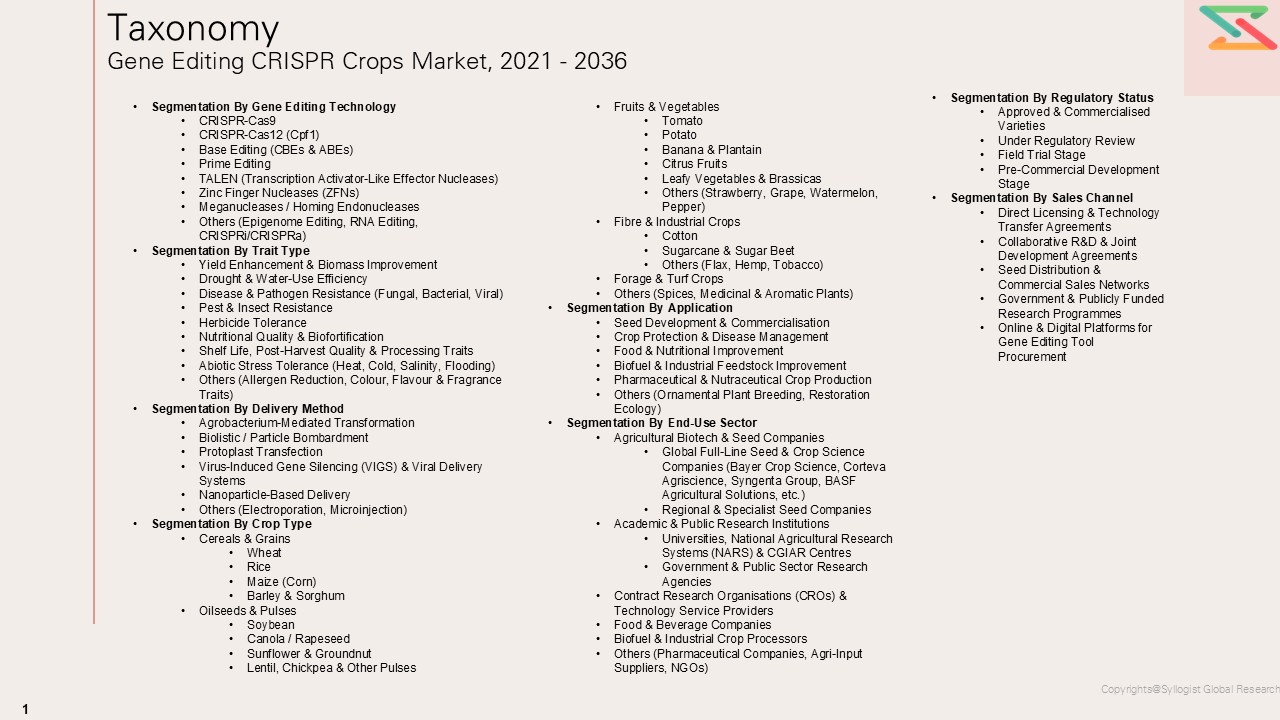
- Global Gene Editing Technologies (CRISPR Crops) Market Outlook
- Market Size & Forecast by Value (USD Billion, 2021–2036)
- Market Size & Forecast by Gene Editing Technology
- CRISPR-Cas9
- CRISPR-Cas12 (Cpf1)
- Base Editing (CBEs & ABEs)
- Prime Editing
- TALEN (Transcription Activator-Like Effector Nucleases)
- Zinc Finger Nucleases (ZFNs)
- Meganucleases / Homing Endonucleases
- Others (Epigenome Editing, RNA Editing, CRISPRi/CRISPRa)
- Market Size & Forecast by Trait Type
- Yield Enhancement & Biomass Improvement
- Drought & Water-Use Efficiency
- Disease & Pathogen Resistance (Fungal, Bacterial, Viral)
- Pest & Insect Resistance
- Herbicide Tolerance
- Nutritional Quality & Biofortification
- Shelf Life, Post-Harvest Quality & Processing Traits
- Abiotic Stress Tolerance (Heat, Cold, Salinity, Flooding)
- Others (Allergen Reduction, Colour, Flavour & Fragrance Traits)
- Market Size & Forecast by Delivery Method
- Agrobacterium-Mediated Transformation
- Biolistic / Particle Bombardment
- Protoplast Transfection
- Virus-Induced Gene Silencing (VIGS) & Viral Delivery Systems
- Nanoparticle-Based Delivery
- Others (Electroporation, Microinjection)
- Market Size & Forecast by Crop Type
- Cereals & Grains
- Wheat
- Rice
- Maize (Corn)
- Barley & Sorghum
- Oilseeds & Pulses
- Soybean
- Canola / Rapeseed
- Sunflower & Groundnut
- Lentil, Chickpea & Other Pulses
- Fruits & Vegetables
- Tomato
- Potato
- Banana & Plantain
- Citrus Fruits
- Leafy Vegetables & Brassicas
- Others (Strawberry, Grape, Watermelon, Pepper)
- Fibre & Industrial Crops
- Cotton
- Sugarcane & Sugar Beet
- Others (Flax, Hemp, Tobacco)
- Forage & Turf Crops
- Others (Spices, Medicinal & Aromatic Plants)
- Cereals & Grains
- Market Size & Forecast by Application
- Seed Development & Commercialisation
- Crop Protection & Disease Management
- Food & Nutritional Improvement
- Biofuel & Industrial Feedstock Improvement
- Pharmaceutical & Nutraceutical Crop Production
- Others (Ornamental Plant Breeding, Restoration Ecology)
- Market Size & Forecast by End-Use Sector
- Agricultural Biotech & Seed Companies
- Global Full-Line Seed & Crop Science Companies (Bayer Crop Science, Corteva Agriscience, Syngenta Group, BASF Agricultural Solutions, etc.)
- Regional & Specialist Seed Companies
- Academic & Public Research Institutions
- Universities, National Agricultural Research Systems (NARS) & CGIAR Centres
- Government & Public Sector Research Agencies
- Contract Research Organisations (CROs) & Technology Service Providers
- Food & Beverage Companies
- Biofuel & Industrial Crop Processors
- Others (Pharmaceutical Companies, Agri-Input Suppliers, NGOs)
- Agricultural Biotech & Seed Companies
- Market Size & Forecast by Regulatory Status
- Approved & Commercialised Varieties
- Under Regulatory Review
- Field Trial Stage
- Pre-Commercial Development Stage
- Market Size & Forecast by Sales Channel
- Direct Licensing & Technology Transfer Agreements
- Collaborative R&D & Joint Development Agreements
- Seed Distribution & Commercial Sales Networks
- Government & Publicly Funded Research Programmes
- Online & Digital Platforms for Gene Editing Tool Procurement
- Asia-Pacific Gene Editing Technologies (CRISPR Crops) Market Outlook
- Market Size & Forecast
- By Value (2020–2035)
- By Gene Editing Technology
- By Trait Type
- By Delivery Method
- By Crop Type
- By Application
- By End-Use Sector
- By Regulatory Status
- By Sales Channel
- Key Demand Drivers (APAC-Specific)
- Competitive Landscape (APAC)
- Europe Gene Editing Technologies (CRISPR Crops) Market Outlook
- Market Size & Forecast
- By Value (2020–2035)
- By Gene Editing Technology
- By Trait Type
- By Delivery Method
- By Crop Type
- By Application
- By End-Use Sector
- By Regulatory Status
- By Sales Channel
- Key Demand Drivers (Europe-Specific)
- Competitive Landscape (Europe)
- North America Gene Editing Technologies (CRISPR Crops) Market Outlook
- Market Overview & Strategic Importance
- Market Size & Forecast
- By Value (2020–2035)
- By Gene Editing Technology
- By Trait Type
- By Delivery Method
- By Crop Type
- By Application
- By End-Use Sector
- By Regulatory Status
- By Sales Channel
- Key Demand Drivers (North America-Specific)
- Competitive Landscape (North America)
- Latin America Gene Editing Technologies (CRISPR Crops) Market Outlook
- Market Size & Forecast
- By Value (2020–2035)
- By Gene Editing Technology
- By Trait Type
- By Delivery Method
- By Crop Type
- By Application
- By End-Use Sector
- By Regulatory Status
- By Sales Channel
- Key Demand Drivers (LATAM-Specific)
- Competitive Landscape (LATAM)
- Middle East & Africa Gene Editing Technologies (CRISPR Crops) Market Outlook
- Market Size & Forecast
- By Value (2020–2035)
- By Gene Editing Technology
- By Trait Type
- By Delivery Method
- By Crop Type
- By Application
- By End-Use Sector
- By Regulatory Status
- By Sales Channel
- Key Demand Drivers (MEA-Specific)
- Competitive Landscape (MEA)
- Country-Wise Gene Editing Technologies (CRISPR Crops) Market Outlook
- Market Size & Forecast by Country
- By Value
- By Gene Editing Technology
- By Trait Type
- By Delivery Method
- By Crop Type
- By Application
- By End-Use Sector
- By Regulatory Status
- By Sales Channel
- Market Size & Forecast by Country
- Market Size & Forecast
- Market Size & Forecast
- Market Size & Forecast
- Market Size & Forecast
- R&D & Platform Development Economics Framework
Countries Covered: United States, Canada, Brazil, Argentina, France, Germany, United Kingdom, Netherlands, Spain, Italy, China, India, Japan, Australia, South Korea, Israel, South Africa, Nigeria, Kenya, Indonesia
- Technology Landscape & Innovation Analysis
- Gene Editing Technology Maturity Assessment (CRISPR-Cas, Base Editing, Prime Editing)
- Emerging & Disruptive Technologies in Agricultural Gene Editing
- Next-Generation CRISPR Systems: Cas12, Cas13, Cas14 & Anti-CRISPR Proteins
- Epigenome Editing, CRISPRi & CRISPRa for Crop Trait Regulation
- High-Throughput Crop Transformation, Regeneration & Phenotyping Platform Innovations
- Artificial Intelligence (AI) & Machine Learning Integration in Target Identification & Guide RNA Design
- Technology Readiness & Commercialisation Matrix – Key Gene Editing Technologies for CRISPR Crops
- Patent Landscape Analysis
- R&D Investment Benchmarking
- Value Chain & Supply Chain Analysis
- Gene Editing Technologies (CRISPR Crops) Value Chain Mapping
- Supply Chain Concentration & Dependency Analysis
- Key Supplier Mapping by Technology Platform & Crop Programme
- CRISPR Enzyme, Guide RNA & Delivery Reagent Suppliers
- Next-Generation Sequencing & Bioinformatics Platform Suppliers
- Tissue Culture, Greenhouse & Controlled Environment Facility Providers
- Regulatory Consulting, CRO & Stewardship Service Providers
- Supplier Risk Heat Map
- Make vs Buy Strategy Trends Among Gene Editing Technology Developers & Seed Companies
- Pricing Analysis
- Gene Editing Technology Licensing & Royalty Pricing Dynamics
- Pricing by Technology Platform, Trait Type & Crop Category
- Total Cost of Trait Development (TCTD) Analysis – Including Editing, Regulatory, Seed Production & Commercial Launch Costs
- CRISPR vs TALEN vs ZFN Pricing Trends & Benchmarks
- Technology License vs Seed Trait Fee vs Royalty-Sharing Model Pricing & Value Proposition
- Sustainability & Environmental Stewardship
- Environmental & Sustainability Landscape in Gene Editing for Crop Improvement
- Carbon Footprint & Environmental Impact Benchmarking of Gene Editing vs Conventional & Transgenic Breeding
- Biodiversity, Ecological Risk & Non-Target Species Impact Assessment
- Contribution of Gene-Edited Crops to Climate-Resilient & Sustainable Food Systems
- Reduced Agrochemical Input & Water-Use Efficiency Pathway Through Trait Adoption
- ESG Reporting & Lifecycle Assessment (LCA) in CRISPR Crop Development Programmes
- Competitive Landscape
- Market Structure & Concentration
- Market Consolidation Level: Global Seed Giants vs Agri-Biotech Startups & Public Research Institutions
- Top 5 Gene Editing Technology Companies Market Revenue Share
- HHI (Herfindahl-Hirschman Index) Concentration Analysis by Technology Platform & Crop Segment
- Competitive Intensity Map by Technology, Trait & Region
- Player Classification
- Tier-1 Global Integrated Crop Science & Seed Companies with In-House Gene Editing Platforms
- Tier-2 Specialist Gene Editing Technology Developers & Agri-Biotech Startups
- Academic Spin-offs, CROs & Collaborative Research Platform Providers
- Emerging & Disruptive Players
- Competitive Analysis Frameworks
- Market Share Analysis by Technology Platform, Trait Type & Geography
- R&D Intensity & Crop Pipeline Breadth Benchmarking
- Licensing Portfolio, Patent Estate & Long-Term Commercialisation Agreement Comparison
- Geographic Revenue Exposure & Regulatory Approval Footprint Comparison
- Company Profiles
- Company Overview, HQ & Organisational Structure
- Gene Editing Technology & Crop Pipeline Portfolio
- Revenue Breakdown
- Key Licensing Agreements, Trait Commercialisation Programmes & Grower Deployment References
- R&D Facilities & Field Trial Network
- Recent Developments (M&A, Partnerships, Regulatory Approvals, New Products, Financial Results)
- SWOT Analysis
- Strategic Focus: CRISPR Platform Breadth, Regulatory Pathway Leadership, Crop Portfolio Expansion & Licensing Strategy
- Strategic Output
- Market Opportunity Matrix
- High-Value Opportunity Quadrant Analysis
- Addressable Market by Technology Platform, Trait Type & Region
- Time-to-Revenue Assessment by Opportunity
- White Space Opportunity Analysis
- Underserved Crop Type & Trait Category Gaps
- Geographic Markets with Low Gene Editing Penetration
- Technology & Delivery Method Gaps with High Commercialisation Potential
- Customer Segment Unmet Needs
- Strategic Recommendations
- Product Portfolio & Innovation Strategy
- Technology Platform & Digitalization Strategy
- Pipeline Development & Regulatory Navigation Strategy
- Licensing, IP Management & Commercial Partnerships Strategy
- Pricing & Commercial Strategy
- Sustainability & Regulatory Compliance Strategy
- Supply Chain & Reagent Sourcing Strategy
- Partnership, M&A & Expansion Strategy
- Regional Growth Strategy
- Risk Mitigation & Future Roadmap
- Strategic Priority Matrix & Roadmap
- Near-Term (2025–2028)
- Mid-Term (2029–2032)
- Long-Term (2033–2036)
- Market Opportunity Matrix
- Market Structure & Concentration