Market Definition
Data center cooling systems are specialized thermal management solutions designed to regulate the temperature, humidity, and airflow within a data center to prevent hardware failure and optimize energy efficiency. Unlike standard commercial HVAC, data center cooling must operate 24/7/365 with high precision to handle the concentrated heat loads generated by high-density compute clusters.
A typical cooling installation includes the primary cooling unit (CRAC/CRAH or Liquid Cooling Manifolds), heat rejection equipment (Chillers, Cooling Towers, or Dry Coolers), and distribution infrastructure (Coolant Distribution Units/CDUs, Piping, and Airflow Containment). Performance is increasingly defined by Power Usage Effectiveness (PUE), Water Usage Effectiveness (WUE), and the ability to handle extreme rack densities (often exceeding 100kW per rack in AI-focused facilities).
Market Insights
The global data center cooling market is entering a phase of rapid structural transformation, with its valuation reaching $12.13 billion in 2025. This growth, projected at a robust CAGR of 9.89%, is primarily underpinned by the explosive deployment of Generative AI and high-density compute clusters. As traditional air cooling reaches its physical thermal limits—typically around 20–30kW per rack—the industry is witnessing a mandatory shift toward liquid-based architectures. The integration of high-performance GPUs, such as NVIDIA’s Blackwell series, has necessitated a liquid-ready infrastructure mandate, driving massive investment in specialized hardware that can manage the unprecedented heat flux of modern AI silicon.
From a technological standpoint, the market is bifurcating into specialized niches designed to solve the last-inch thermal challenge. While legacy enterprise facilities continue to rely on precision air-handling units and advanced economizers, hyperscale and colocation giants are pivoting aggressively toward Direct-to-Chip (Cold Plate) and Immersion Cooling solutions. This shift has elevated the strategic importance of the Coolant Distribution Unit (CDU), which has emerged as a critical supply chain bottleneck in 2026. Because these high-density systems often capture up to 80% of total heat via liquid, the market is also seeing a surge in Hybrid architectures, where advanced airflow containment systems must work in perfect synchronization with fluid loops to manage the residual heat of non-liquid-cooled components like power supplies and networking gear.
Looking toward the end of the decade, the narrative of the market is increasingly defined by sustainability and operational intelligence. With global mandates for lower Power Usage Effectiveness (PUE) and Water Usage Effectiveness (WUE), cooling providers are no longer just equipment vendors but strategic partners in a Chemicals-as-a-Service (CaaS) model. This evolution involves the real-time monitoring of dielectric fluids, automated leak detection, and precision dosing of corrosion inhibitors to protect multi-billion dollar compute assets. As the industry scales, the primary challenge remains the retrofit gap, the complex mechanical task of bringing liquid infrastructure into aging, brownfield data centers that were never designed for wet-loop plumbing, creating a high-margin opportunity for specialized engineering and maintenance services.
Key Drivers
- AI-Driven Power Densities and Thermal Limits: High-density AI workloads generate heat that air alone cannot dissipate. Liquid cooling (Direct-to-Chip and Immersion) provides the thermal conductivity required to prevent thermal throttling, enabling chips to run at peak performance without risk of damage.
- Sustainability and PUE/WUE Mandates: Global regulations and sovereign ESG goals are forcing operators to lower their PUE. Liquid cooling is inherently more efficient than fans, drastically reducing the energy overhead required for cooling while minimizing water consumption through closed-loop systems.
- The Rise of Edge Computing: As AI processing moves closer to the end-user (Edge Data Centers), there is a surge in demand for compact, Modular Cooling Solutions and Direct Expansion (DX) systems that can operate in constrained, non-traditional environments without centralized chilled water.
- In-Rack and Near-Chip Cooling Innovation: To support 70kW+ racks, the market is moving toward Close-Coupled cooling. This places the cooling medium (Cold Plates or RDHx) within inches of the silicon, reducing the energy wasted on moving large volumes of air across the room.
- Chemicals-as-a-Service (CaaS) in Cooling: With the adoption of liquid loops, there is a new requirement for Coolant Monitoring and Treatment. Operators value the predictable, physics-based stability provided by specialized dielectric fluids and corrosion inhibitors.
Key Challenges
- High Upfront CAPEX and Retrofit Complexity: Transitioning to liquid cooling involves significant civil and mechanical work, including floor reinforcement, manifold piping, and specialized CDUs. The high initial cost is a barrier for smaller enterprise data centers still running legacy workloads.
- Supply Chain Bottlenecks for CDUs and Manifolds: The sudden pivot to AI has created severe lead-time constraints for critical liquid cooling components, particularly Coolant Distribution Units (CDUs) and specialized quick-connect valves.
- The Air-to-Liquid Trade-off and Hybrid Risk: While liquid is more efficient, it introduces the Risk of Leakage into the white space. Many operators struggle with the design complexity of Hybrid Architectures, managing the air-side load for power supplies while the chip is liquid-cooled.
- O&M Requirements and Fluid Lifecycles: Liquid systems require specialized maintenance, including fluid filtration, PH monitoring, and periodic dielectric fluid replacement. There is currently a talent gap in facility engineering for technicians trained in fluid dynamics versus traditional HVAC.
- Site Constraints and Plumbing Permitting: Retrofitting old facilities for liquid cooling often hits physical roadblocks, such as low ceiling heights or lack of wet infrastructure permitting, adding significant schedule risk to modernization programs.
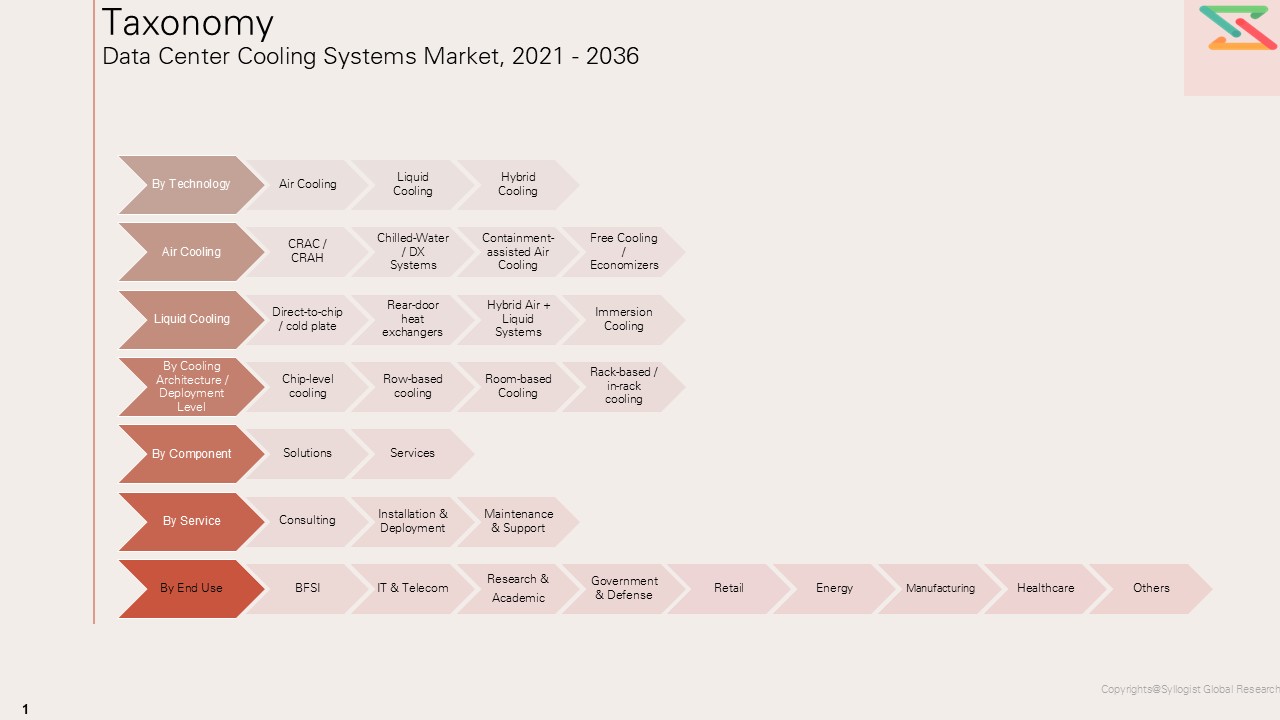
Market Segmentation
- Segmentation by Type
- Solutions
- Air Based Cooling
- Computer Room Air Conditioners (CRACs)
- Computer Room Air Handlers (CRAHs)
- In-Row Cooling Units
- Overhead / Ceiling-based Cooling
- Precision Air Conditioners
- Liquid Cooling
- Direct Liquid Cooling (DLC) / Direct-to-Chip
- Rear-Door Heat Exchangers (RDHx)
- Immersion Cooling (single-phase & two-phase)
- Coolant Distribution Units (CDUs)
- Free Cooling / Economizers
- Air-Side Economizers
- Water-Side Economizers
- Adiabatic Cooling Systems
- Chiller Systems
- Air-Cooled Chillers
- Water-Cooled Chillers
- Magnetic Bearing / Centrifugal Chillers
- Heat Rejection Systems
- Cooling Towers
- Dry Coolers / Fluid Coolers
- Condensers
- Airflow Management
- Hot Aisle / Cold Aisle Containment
- Blanking Panels
- Raised Floor Systems
- Chimney Cabinets
- Services
- Consulting & Design
- Installation & Deployment
- Maintenance & Support
- Segmentation by Components
- Chillers
- Cooling Towers & Dry Coolers
- Computer Room Air Units (CRAUs)
- CRACs
- CRAHs
- In-Row Cooling Units
- Overhead Units
- Air-Side Economizers
- Water-Side Economizers
- Adiabatic Coolers
- Heat Exchangers
- Coolant Distribution Units (CDUs)
- Cold Plates
- Immersion Cooling Systems
- Pumps, Valves & Piping
- Airflow Management
- Cooling Fluids
- Controls & Monitoring Systems
- Segmentation by Data Center Type
- Hyperscale
- Colocation
- Enterprise
- Edge
- HPC/AI-Optimized
- Segmentation by End Use
- BFSI
- IT & Telecom
- Government & Defense
- Healthcare & Life Sciences
- Retail & E-Commerce
- Media & Entertainment
- Energy & Utilities
- Manufacturing
- Education & Research
- Others
- Segmentation by Cooling Architecture
- Room-Based Cooling
- Row-Based Cooling
- Rack-Based / In-rack Cooling
- Chip/Component
- Segmentation by Power Density
- Low Density: < 10 kW/rack
- Medium Density: 10–30 kW/rack
- High Density: 30–100 kW/rack
- Ultra-High Density: > 100 kW/rack
- Segmentation by Deployment Type
- New Installations (Greenfield)
- Upgrades & Retrofits (Brownfield)
- Segmentation by Cooling Infrastructure
- Centralized Cooling
- Decentralized / Distributed Cooling
- Air Based Cooling
- Solutions
All market revenues are presented in USD
Historical Year: 2021–2024 | Base Year: 2025 | Estimated Year: 2026 | Forecast Period: 2027–2036
Key Questions this Study Will Answer
- What are the critical market metrics and forward-looking projections for the Global Data Center Cooling Market, including revenue size, unit shipments, and cooling capacity (kW/MW), with performance segmentation across Rack Density bands (≤20 kW, 20–50, 50–100, >100 kW per rack), Cooling Technique (Air-based, Direct-to-Chip, Immersion, RDHx), Configuration (Greenfield vs. Brownfield/Retrofit; Hybrid vs. Full Liquid), Cooling Medium (Chilled Water, Refrigerant/DX, Dielectric Fluid), and Critical Components (Coolant Distribution Units/CDUs, Chillers, Manifolds, Cooling Towers)?
- How do supply–demand fundamentals vary across key regions and Hyperscale/Colocation hubs, and what role do AI cluster deployments, sovereign PUE/WUE regulations, power availability constraints, and edge computing expansion play in shaping regional competitiveness, alongside local capability in high-precision thermal manufacturing, balance-of-plant integration (Piping, Pump Skids, Heat Exchangers, Leak Detection), and procurement structures (Hyperscaler direct-buy vs. Colocation-managed services vs. Enterprise CAPEX)?
- In what ways are raw material and component price volatility and lead-time constraints (High-grade aluminum and copper, Quick-disconnect valves, manifold forgings, specialized pumps, CDU power electronics, and PFAS-free dielectric fluids) influencing project CapEx, mechanical contractor pricing, delivery schedules, and supplier profitability, especially for high-density AI clusters and multi-megawatt campus installations?
- Who are the leading global and regional data center cooling suppliers and integrators, and how do they benchmark across Thermal Dissipation Efficiency, reliability/MTBF, leak-protection safety protocols, footprint/spatial density, installation complexity, and solution breadth across standalone hardware versus bundled thermal management packages (Cooling + Power Distribution + AI-driven DCIM monitoring + Maintenance Services)?
- What strategic insights emerge from primary discussions with Hyperscale operators (AWS/Microsoft/Google), Colocation providers (Equinix/Digital Realty), thermal consultants, and mechanical EPCs regarding chip-architecture-driven procurement triggers (NVIDIA Blackwell/AMD Instinct thermal envelopes), project pipelines (AI-specific data centers, Retrofit zones), specification evolution (higher kW density, zero-water cooling, cybersecurity-ready sensing), Air-to-Liquid transition decision criteria, lead times for long-cycle components (Chillers/CDUs), and key purchase criteria (TCO/Energy savings vs. total installed cost, delivery assurance, proven references, and fluid lifecycle management capability)?
- Market Overview
- Product Overview
- Research Methodology
- Executive Summary
- Market Dynamics
- Market Dynamics (Drivers, Restraints, Opportunities, Challenges, Porter’s Five Forces Analysis, PESTLE Analysis)
- Market Trends & Developments
- Risk Assessment Framework
- Political / Geopolitical Risk
- Feedstock Supply Risk
- Environmental and Regulatory Risk
- Financial / Market Risk
- Regulatory Framework & Standards
- Global Data Center Cooling Market Outlook
- Market Size & Forecast by Value
- Market Size & Forecast by Type
- Solutions
- Air Based Cooling
- Computer Room Air Conditioners (CRACs)
- Computer Room Air Handlers (CRAHs)
- In-Row Cooling Units
- Overhead / Ceiling-based Cooling
- Precision Air Conditioners
- Liquid Cooling
- Direct Liquid Cooling (DLC) / Direct-to-Chip
- Rear-Door Heat Exchangers (RDHx)
- Immersion Cooling (single-phase & two-phase)
- Coolant Distribution Units (CDUs)
- Free Cooling / Economizers
- Air-Side Economizers
- Water-Side Economizers
- Adiabatic Cooling Systems
- Chiller Systems
- Air-Cooled Chillers
- Water-Cooled Chillers
- Magnetic Bearing / Centrifugal Chillers
- Heat Rejection Systems
- Cooling Towers
- Dry Coolers / Fluid Coolers
- Condensers
- Airflow Management
- Hot Aisle / Cold Aisle Containment
- Blanking Panels
- Raised Floor Systems
- Chimney Cabinets
- Air Based Cooling
- Services
- Consulting & Design
- Installation & Deployment
- Maintenance & Support
- Solutions
- Market Size & Forecast by Components
- Chillers
- Cooling Towers & Dry Coolers
- Computer Room Air Units (CRAUs)
- CRACs
- CRAHs
- In-Row Cooling Units
- Overhead Units
- Air-Side Economizers
- Water-Side Economizers
- Adiabatic Coolers
- Heat Exchangers
- Coolant Distribution Units (CDUs)
- Cold Plates
- Immersion Cooling Systems
- Pumps, Valves & Piping
- Airflow Management
- Cooling Fluids
- Controls & Monitoring Systems
- Market Size & Forecast by Data Center Type
- Hyperscale
- Colocation
- Enterprise
- Edge
- HPC/AI-Optimized
- Market Size & Forecast by End Use
- BFSI
- IT & Telecom
- Government & Defense
- Healthcare & Life Sciences
- Retail & E-Commerce
- Media & Entertainment
- Energy & Utilities
- Manufacturing
- Education & Research
- Others
- Market Size & Forecast by Cooling Architecture
- Room-Based Cooling
- Row-Based Cooling
- Rack-Based / In-rack Cooling
- Chip/Component
- Market Size & Forecast by Power Density
- Low Density — < 10 kW/rack
- Medium Density — 10–30 kW/rack
- High Density — 30–100 kW/rack
- Ultra-High Density — > 100 kW/rack
- Market Size & Forecast by Deployment Type
- New Installations (Greenfield)
- Upgrades & Retrofits (Brownfield)
- Market Size & Forecast by Cooling Infrastructure
- Centralized Cooling
- Decentralized / Distributed Cooling
- Asia-Pacific Data Center Cooling Market Outlook
- Market Size & Forecast
- By Value
- By Type
- By Components
- By Data Center Type
- By End Use
- By Cooling Architecture
- By Power Density
- By Deployment Type
- By Cooling Infrastructure
- Market Size & Forecast
- Europe Data Center Cooling Market Outlook
- Market Size & Forecast
- By Value
- By Type
- By Components
- By Data Center Type
- By End Use
- By Cooling Architecture
- By Power Density
- By Deployment Type
- By Cooling Infrastructure
- Market Size & Forecast
- North America Data Center Cooling Market Outlook
- Market Size & Forecast
- By Value
- By Type
- By Components
- By Data Center Type
- By End Use
- By Cooling Architecture
- By Power Density
- By Deployment Type
- By Cooling Infrastructure
- Market Size & Forecast
- Latin America Data Center Cooling Market Outlook
- Market Size & Forecast
- By Value
- By Type
- By Components
- By Data Center Type
- By End Use
- By Cooling Architecture
- By Power Density
- By Deployment Type
- By Cooling Infrastructure
- Market Size & Forecast
- Middle East & Africa Data Center Cooling Market Outlook
- Market Size & Forecast
- By Value
- By Type
- By Components
- By Data Center Type
- By End Use
- By Cooling Architecture
- By Power Density
- By Deployment Type
- By Cooling Infrastructure
- Market Size & Forecast
- Country Wise* Data Center Cooling Market Outlook
- Market Size & Forecast
- By Value
- By Type
- By Components
- By Data Center Type
- By End Use
- By Cooling Architecture
- By Power Density
- By Deployment Type
- By Cooling Infrastructure
- Market Size & Forecast
*Countries Analyzed in the Syllogist Global Research Portfolio: United States, China, Germany, United Kingdom, Japan, Australia, France, The Netherlands, Singapore, India, Canada, Brazil, South Korea, UAE, Sweden, Ireland, Malaysia, Indonesia, Italy, Poland, Mexico, South Africa, Saudi Arabia, Finland, Thailand, Chile, Norway, Kenya, Vietnam, Qatar
- Technology Analysis
- Technology Readiness Levels (TRL) By Cooling Type
- Air Vs Liquid Vs Immersion: Comparative Analysis
- Emerging Technologies
- Technology Adoption Roadmap (2025–2036)
- Patent Analysis by Technology & Company
- Value Chain & Supply Chain Analysis
- Raw Material Suppliers
- Component Manufacturers
- System Integrators
- Cooling Solution Providers
- End Users
- Supply Chain Risk & Disruption Analysis
- Pricing Analysis
- Average Selling Price by Component
- Price Trends (2021–2036)
- Cost Structure Breakdown
- TCO (Total Cost of Ownership) Analysis
- Use Case Analysis
- AI/GPU Cluster Cooling
- HPC & Supercomputing
- Edge Data Center Cooling
- Telecom & 5G Cooling
- Sustainability & Energy Efficiency
- PUE Benchmarking by Region
- Carbon Footprint Analysis
- Water Usage Effectiveness (WUE)
- Heat Reuse & Waste Heat Recovery
- Green Cooling Certifications (LEED, BREEAM)
- Go-to-Market & Distribution
- Sales Channels (Direct Vs Indirect)
- Distribution Network Analysis
- OEM Vs Aftermarket
- Competitive Landscape
- Market Structure & Concentration
- Market Consolidation Level (Fragmented Vs Consolidated)
- Top 5 Players Market Share
- HHI (Herfindahl–Hirschman Index) Concentration Analysis
- Competitive Intensity Map
- Player Classification
- Market Leaders (N=10)
- Strong Challengers (N=5)
- Emerging & Specialist Players (N=5)
- Component Specific Players (N=20)
- Competitive Analysis Frameworks
- Market Share Analysis
- Company Profile
- Company Overview & HQ
- Products & Solutions Portfolio
- Revenue & Cooling Segment Revenue
- Geographic Presence
- Recent Developments (M&A, Launches, Partnerships)
- SWOT Analysis
- Strategic Focus Areas
- Competitive Positioning Map
- Market Structure & Concentration
- Strategic Recommendations
- For Solution Providers / Vendors
- Product & Technology Strategy
- Portfolio Strategy
- Go-to-Market Strategy
- Pricing & Commercial Strategy
- M&A & Partnership Strategy
- For Data Center Operators
- Cooling Infrastructure Planning
- AI & High-Density Readiness
- Energy & Sustainability Strategy
- Vendor & Procurement Strategy
- Operational Excellence
- For Investors & Private Equity
- High-Priority Investment Themes
- M&A Opportunity Map
- Geographic Investment Priorities
- Risk Considerations
- For Hyperscalers & Cloud Providers
- For Governments & Regulators
- White Space & Opportunity Analysis
- Unmet Market Needs
- Emerging Business Models
- Technology White Spaces
- Roadmap & Prioritization Matrix
- Strategic Priority Matrix
- Implementation Roadmap
- For Solution Providers / Vendors