China’s R-32 Supply-Demand Equilibrium & Trade Dynamics
China is the global “gravity center” for R-32 because it combines a large domestic refrigerant manufacturing base with one of the world’s biggest cooling markets. On the supply side, production is supported by an integrated fluorochemicals ecosystem (fluorspar/HF/intermediates) and a mature refrigerants manufacturing footprint. On the trade side, China typically functions as a net exporter of HFC molecules (including R-32) into multiple regions, but export flows are increasingly shaped by quota regimes, compliance documentation, and trade remedies in destination markets. As Kigali-linked controls tighten, the market behavior shifts from “capacity expansion” to “quota optimization,” making operating rates, allocation discipline, and product-mix decisions more important than nameplate capacity alone.
Demand Determinants & Growth Drivers in the Chinese Market
China’s R-32 demand is primarily a cooling-driven story anchored in the world’s largest room air-conditioner installed base and annual unit sales. Demand has two engines: OEM factory charge (linked to new AC production) and aftermarket servicing/top-up (linked to the installed base). Structurally, urbanization, rising disposable incomes, warmer summers, and improving comfort expectations keep the long-run cooling trajectory intact. Even in slower macro cycles, the aftermarket component tends to provide resilience because service demand is tied to installed units and seasonal usage intensity rather than only new construction.
Evolutionary Technology Landscape & Next-Gen System Architecture
R-32 sits in a pragmatic middle ground: materially lower GWP than R-410A while retaining strong thermodynamic performance for room AC and many light-commercial designs. The technology “unlock” is not the molecule itself but the A2L-ready system architecture, safe charge management, improved leak mitigation, better airflow and control logic, and standardized installation/service practices. The next wave of technology is focused on lowering total charge and improving safety margins (e.g., compact heat exchangers, optimized refrigerant circuits, and smarter fault detection). Over time, R-32 also competes with next-gen low-GWP blends and selective natural refrigerant deployments, so OEM platform strategy and standards compliance capability become critical differentiators.
End-to-End Supply Chain Economics & Distribution Logistics
The R-32 value chain in China is best viewed as two overlapping supply chains: bulk molecule supply to OEMs and large accounts versus packaged refrigerant distribution into servicing channels. Upstream economics are driven by feedstock and energy costs, integration advantages (especially around HF and intermediates), and environmental compliance overheads. Downstream, realized pricing is heavily influenced by packaging formats (bulk vs cylinder vs small packs), cylinder management/return logistics, distributor working capital, and seasonality (peak summer demand can tighten availability locally even when national supply is ample). Internationally, the “export chain” adds another layer, documentation, traceability, and compliance screening can become as important as production cost in determining who captures the highest-margin lanes
Competitive Strategy & Market Leadership Benchmarks
China’s competitive set includes large-scale fluorochemicals and refrigerant producers with diversified portfolios, integration advantages, and established domestic + export channels. Competitive leadership typically comes from five levers: (1) upstream integration and cost position, (2) quota/asset optimization under HFC controls, (3) OEM-grade quality consistency and supply reliability, (4) packaging + distribution reach into service markets, and (5) export-market agility (ability to pivot destinations and product mix when regulations or trade barriers change). As the market matures, “who has capacity” matters less than “who can consistently place volume into the best netback channels while staying compliant,” which tends to favor larger, better-integrated players and disciplined distributors.
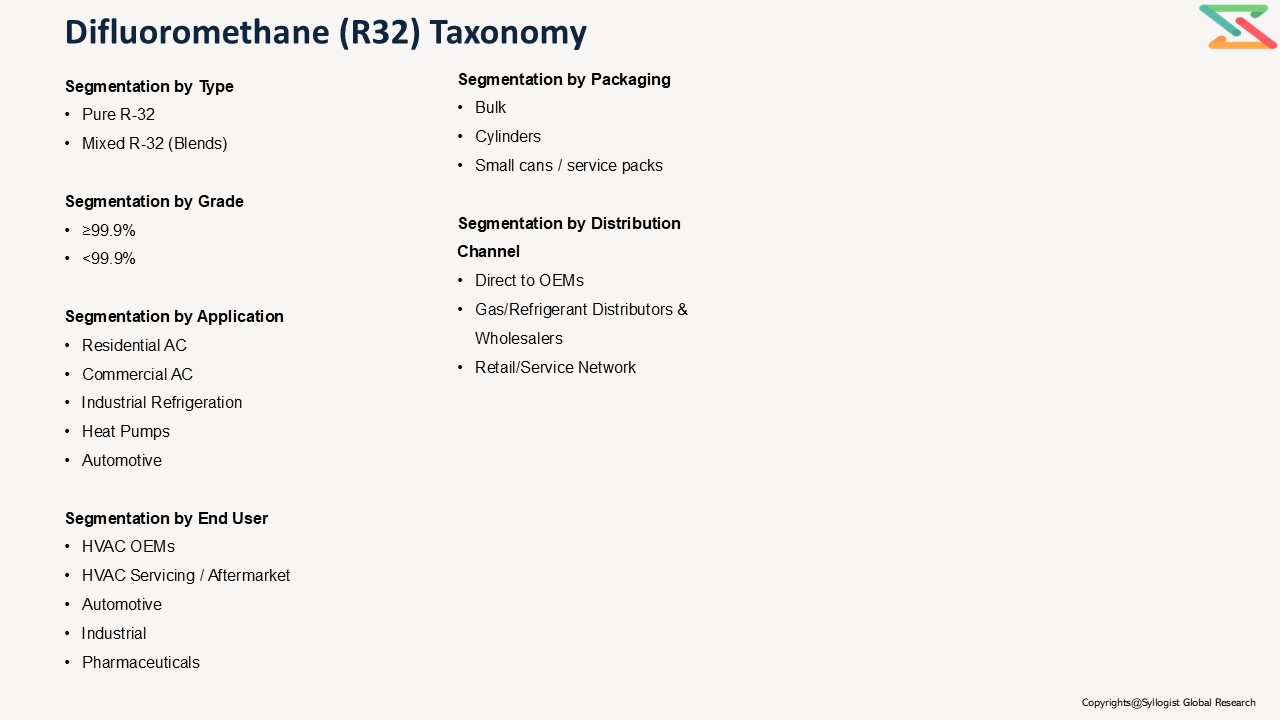
Market Segmentation:
- Segmentation by Type
- Pure R-32
- Mixed R-32 (Blends)
- Segmentation by Grade
- ≥99.9%
- <99.9%
- Segmentation by Application
- Residential AC
- Commercial AC
- Industrial Refrigeration
- Heat Pumps
- Automotive
- Segmentation by End User
- HVAC OEMs
- HVAC Servicing / Aftermarket
- Automotive
- Industrial
- Pharmaceuticals
- Segmentation by Packaging
- Bulk
- Cylinders
- Small Cans / Service Packs
- Segmentation by Distribution Channel
- Direct to OEMs
- Gas/Refrigerant Distributors & Wholesalers
- Retail/Service Network
- Introduction (Product Definition, Taxonomy and Research Methodology)
- Executive Summary
- Global Difluoromethane (R32) Demand Supply Analysis
- Global Difluoromethane (R32) Market Assessment, 2021-2036
- Global Market Outlook (Value, Volume and Segmental Analysis)
- China Difluoromethane (R32) Market Assessment, 2021-2036
- Market Size & Forecast by Value
- Market Size & Forecast by Volume
- Market Size & Forecast by Type
- Pure R-32
- Mixed R-32 (Blends)
- Market Size & Forecast by Grade
- ≥99.9%
- <99.9%
- Market Size & Forecast by Application
- Residential AC
- Commercial AC
- Industrial Refrigeration
- Heat Pumps
- Automotive
- Market Size & Forecast by End User
- HVAC OEMs
- HVAC Servicing / Aftermarket
- Automotive
- Industrial
- Pharmaceuticals
- Market Size & Forecast by Packaging
- Bulk
- Cylinders
- Small Cans / Service Packs
- Market Size & Forecast by Distribution Channel
- Direct to OEMs
- Gas/Refrigerant Distributors & Wholesalers
- Retail/Service Network
- White Space & Emerging Investment Hotspot
- Market White Space Opportunities
- Mergers & Acquisitions (M&A)
- Joint Ventures & Strategic Alliances
- Technology & Innovation Hotspots
- Regional Investment Attractiveness
- Barriers & Risks in Investment
- China Difluoromethane (R32) Market Value Chain Analysis
- Raw Material Sourcing & Suppliers
- Key Raw Materials & Inputs
- Supplier Landscape & Concentration
- Pricing Trends & Volatility
- Dependence on Imports vs Domestic Availability
- Distribution & Logistics
- Marketing & Sales Channels
- Value Addition & Profitability across Chain
- Emerging Trends & Disruptions
- Raw Material Sourcing & Suppliers
- China Difluoromethane (R32) Market Pricing Analysis
- Historical Vs Projected Pricing Analysis
- Demand-Supply Impact on Prices
- Application-wise Pricing Differences
- Impact of Tariffs, Taxes, and Trade Policies
- Key Player Pricing Strategies
- China Difluoromethane (R32) Technology Landscape
- Key Existing Technologies
- Emerging & Next-gen Technologies
- Strategic Insights
- Future Technology Roadmap
- Opportunities for Differentiation via Technology
- Risks of Obsolescence & Barriers to Adoption
- Policy & Regulatory landscape
- Competition Outlook (Leading 10 Companies)
- Competition Benchmarking
- Market Leaders Vs New Entrants
- Strategic Recommendations