Market Definition
The drone delivery market is defined as the specialized segment of the logistics and transportation industry focused on the use of unmanned aerial vehicles (UAVs) to transport lightweight goods directly from distribution hubs to end-users. This last-mile aerial solution primarily utilizes multi-rotor, fixed-wing, or hybrid vertical take-off and landing (VTOL) aircraft to deliver small parcels, medical supplies, and food orders. By operating in low-altitude airspace, delivery drones provide a high-velocity alternative to traditional ground-based courier services, effectively decoupling delivery times from urban road congestion and geographical barriers.
Market Insights
As of early 2026, the global drone delivery market has entered a phase of exponential expansion, with valuations for the equipment and services segments combined estimated to exceed USD 15 billion in 2026. This growth is sustained by an aggressive compound annual growth rate (CAGR) ranging from 28% to 44% across different sub-sectors. The market is transitioning from a period of isolated pilot programs to one of repeatable, commercialized operations, where major retail and logistics giants are integrating aerial routes as a standard layer within their broader distribution networks.
Geographically, North America remains the largest market by revenue, driven by the strong presence of technology-first players and extensive retail partnerships. However, the Asia-Pacific region is the fastest-growing hub, particularly in China and India, where high population density and government-led manufacturing incentives are accelerating the deployment of domestic drone fleets. In Europe, coordinated regional regulations through the EASA and the implementation of the U-Space framework are facilitating cross-border aerial logistics, with a specific focus on environmental sustainability and noise reduction.
From a sectoral perspective, Retail and E-commerce continue to dominate the market share, accounting for over 50% of current delivery missions. Consumer expectations for instant fulfillment, defined as delivery within 30 to 60 minutes, have made drones an essential tool for high-frequency, lightweight transactions. Simultaneously, the Healthcare vertical is emerging as a high-value application area, where drones are used for time-critical transport of blood products, vaccines, and diagnostic samples, often reducing delivery times by up to 70% in congested urban centers or remote, infrastructure-limited regions.
Technologically, the 2026 landscape is characterized by the widespread adoption of Beyond Visual Line of Sight (BVLOS) operations and the integration of Agentic AI for autonomous navigation. Modern delivery drones are increasingly utilizing multi-sensor fusion and IoT connectivity to make real-time decisions regarding obstacle avoidance and route optimization. Furthermore, the market is shifting toward hybrid drone designs that combine the maneuverability of rotors with the endurance of fixed-wing flight, allowing for extended ranges that significantly broaden the serviceable area of urban micro-fulfillment centers.
Key Drivers
Surge in E-Commerce and the Demand for Instant Fulfillment
The relentless growth of online retail remains the primary engine of the drone delivery market, as consumers increasingly prioritize speed and convenience over traditional shopping methods. With e-commerce giants aiming for ultra-fast fulfillment windows, drones offer a unique solution to bypass the ground bottleneck caused by urban traffic and complex street layouts. This ability to deliver small, high-frequency parcels directly to a consumer’s doorstep in minutes rather than hours is a significant competitive differentiator that is compelling retailers to invest heavily in aerial logistics infrastructure.
Technological Maturity and Regulatory Harmonization
Recent breakthroughs in battery density, autonomous flight systems, and sense-and-avoid technology have significantly improved the safety and reliability profiles of commercial drones. Simultaneously, aviation authorities such as the FAA and EASA have moved from restrictive, case-by-case approvals toward standardized regulatory frameworks for commercial drone corridors. This shift toward certified category operations and standardized air traffic management systems provides the legal certainty required for logistics providers to scale their fleets from experimental trials to full-scale operational deployment.
Key Challenges
Payload and Range Constraints
Despite advancements in propulsion and materials, the majority of current commercial delivery drones are restricted to payloads under 5 kilograms and operational ranges of less than 25 kilometers. These physical limitations exclude a significant portion of e-commerce inventory from aerial delivery consideration and necessitate a high density of micro-fulfillment centers to ensure effective coverage. The requirement for frequent battery swaps or charging cycles further complicates the unit economics of drone fleets, particularly when compared to the high-volume capacity of traditional delivery vans in dense urban environments.
Public Perception and Airspace Integration
Integrating thousands of unmanned aircraft into the shared low-altitude airspace of major cities presents a massive structural and social challenge. Persistent public concerns regarding noise pollution, visual privacy, and the safety of autonomous flights over populated areas can lead to local regulatory pushback and slow the pace of adoption. Furthermore, the technical complexity of managing high-density aerial traffic to prevent mid-air collisions requires a level of sophisticated, real-time coordination that is still being refined, making the seamless integration of drones into the urban fabric a long-term developmental barrier.
Market Segmentation
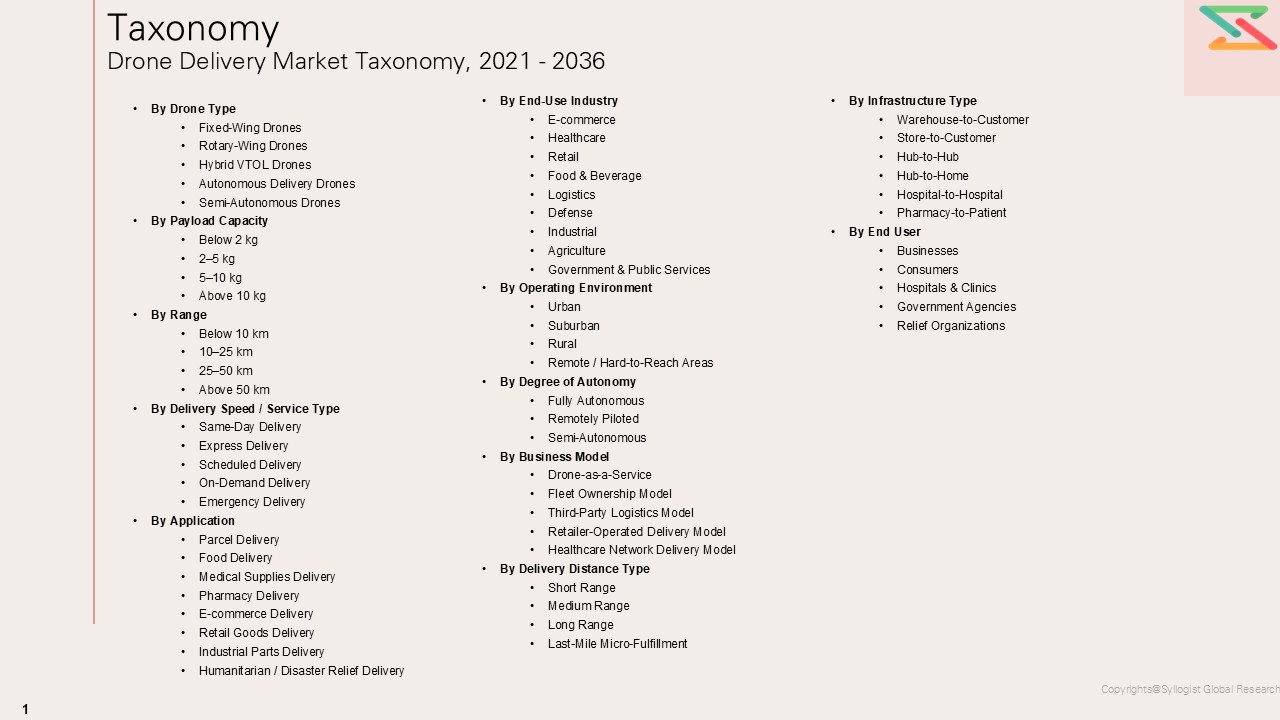
- Segmentation By Drone Type
- Fixed-Wing Drones
- Rotary-Wing Drones
- Hybrid VTOL Drones
- Autonomous Delivery Drones
- Semi-Autonomous Drones
- Segmentation By Payload Capacity
- Below 2 kg
- 2–5 kg
- 5–10 kg
- Above 10 kg
- Segmentation By Range
- Below 10 km
- 10–25 km
- 25–50 km
- Above 50 km
- Segmentation By Delivery Speed / Service Type
- Same-Day Delivery
- Express Delivery
- Scheduled Delivery
- On-Demand Delivery
- Emergency Delivery
- Segmentation By Application
- Parcel Delivery
- Food Delivery
- Medical Supplies Delivery
- Pharmacy Delivery
- E-commerce Delivery
- Retail Goods Delivery
- Industrial Parts Delivery
- Humanitarian / Disaster Relief Delivery
- Segmentation By End-Use Industry
- E-commerce
- Healthcare
- Retai
- Food & Beverage
- Logistics
- Defense
- Industrial
- Agriculture
- Government & Public Services
- Segmentation By Operating Environment
- Urban
- Suburban
- Rural
- Remote / Hard-to-Reach Areas
- Segmentation By Degree of Autonomy
- Fully Autonomous
- Remotely Piloted
- Semi-Autonomous
- Segmentation By Business Model
- Drone-as-a-Service
- Fleet Ownership Model
- Third-Party Logistics Model
- Retailer-Operated Delivery Model
- Healthcare Network Delivery Model
- Segmentation By Delivery Distance Type
- Short Range
- Medium Range
- Long Range
- Last-Mile Micro-Fulfillment
- Segmentation By Infrastructure Type
- Warehouse-to-Customer
- Store-to-Customer
- Hub-to-Hub
- Hub-to-Home
- Hospital-to-Hospital
- Pharmacy-to-Patient
- Segmentation By End User
- Businesses
- Consumers
- Hospitals & Clinics
- Government Agencies
- Relief Organizations
All market revenues are presented in USD
Historical Year: 2021–2024 | Base Year: 2025 | Estimated Year: 2026 | Forecast Period: 2027–2036
Key Questions this Study Will Answer
- What is the projected global market valuation and delivery volume through 2031? This provides the quantitative baseline required to understand the total addressable market (TAM) as aerial logistics moves from niche pilots to high-frequency commercial operations.
- Which specific segments, such as healthcare or food and retail, will offer the highest margins and fastest ROI? The study will analyze where the cost-per-delivery is most competitive compared to traditional ground-based last-mile solutions, helping firms prioritize their initial fleet deployments.
- To what extent will the normalization of Beyond Visual Line of Sight (BVLOS) regulations unlock regional growth? This question focuses on the regulatory landscape, evaluating how standardized air traffic management systems (like U-Space or the FAA’s Part 108) will allow for the scaling of autonomous corridors.
- How does the integration of drones into existing micro-fulfillment centers impact overall supply chain energy efficiency and carbon footprint? This analysis evaluates the sustainability benefits of replacing heavy delivery vans with lightweight, electrified aerial vehicles for small-parcel fulfillment.
- Who are the leading technology providers and logistics incumbents, and what are their strategic moats regarding intellectual property and safety systems? A detailed competitive analysis will reveal which players have the most robust sense-and-avoid technologies and the strongest partnerships with global retailers.
- Product Definition
- Research Methodology
- Research Design & Framework
- Overall Research Approach: Descriptive, Exploratory & Quantitative Mixed-Method Design
- Market Definition & Scope Boundaries: What is Included and Excluded
- Segmentation Framework
- Key Research Assumptions & Limitations
- Secondary Research
- Primary Research Design & Execution
- Data Triangulation & Validation
- Market Sizing & Forecasting Methodology
- Competitive Intelligence Methodology
- Quality Assurance & Peer Review
- Definitions, Abbreviations & Data Notes
- Research Design & Framework
- Executive Summary
- Market Snapshot & Headline Numbers
- Key Findings & Research Highlights
- Market Dynamics
- Regional Market Summary
- Competitive Landscape Snapshot
- Technology & Innovation Highlights
- Market Dynamics
- Drivers
- Restraints
- Opportunities
- Challenges
- Porter’s Five Forces Analysis
- PESTLE Analysis
- Market Trends & Developments
- Emerging Trends
- Technological Developments
- Regulatory & Policy Changes
- Supply Chain & Sourcing Trends
- Consumer & Demand Trends
- Investment & Funding Activity
- Sustainability & ESG Trends
- Geographic & Regional Trends
- Risk Assessment Framework
- Political / Geopolitical Risk
- Fuel & Component Supply Risk
- Environmental and Regulatory Risk
- Financial / Market Risk
- Regulatory Framework & Standards
- Global Drone Delivery Market Outlook
- Market Size & Forecast by Value
- Market Size & Forecast by Drone Type
- Fixed-Wing Drones
- Rotary-Wing Drones
- Hybrid VTOL Drones
- Autonomous Delivery Drones
- Semi-Autonomous Drones
- Market Size & Forecast by Payload Capacity
- Below 2 kg
- 2–5 kg
- 5–10 kg
- Above 10 kg
- Market Size & Forecast by Range
- Below 10 km
- 10–25 km
- 25–50 km
- Above 50 km
- Market Size & Forecast by Delivery Speed / Service Type
- Same-Day Delivery
- Express Delivery
- Scheduled Delivery
- On-Demand Delivery
- Emergency Delivery
- Market Size & Forecast by Application
- Parcel Delivery
- Food Delivery
- Medical Supplies Delivery
- Pharmacy Delivery
- E-commerce Delivery
- Retail Goods Delivery
- Industrial Parts Delivery
- Humanitarian / Disaster Relief Delivery
- Market Size & Forecast by End-Use Industry
- E-commerce
- Healthcare
- Retai
- Food & Beverage
- Logistics
- Defense
- Industrial
- Agriculture
- Government & Public Services
- Market Size & Forecast by Operating Environment
- Urban
- Suburban
- Rural
- Remote / Hard-to-Reach Areas
- Market Size & Forecast by Degree of Autonomy
- Fully Autonomous
- Remotely Piloted
- Semi-Autonomous
- Market Size & Forecast by Business Model
- Drone-as-a-Service
- Fleet Ownership Model
- Third-Party Logistics Model
- Retailer-Operated Delivery Model
- Healthcare Network Delivery Model
- Market Size & Forecast by Delivery Distance Type
- Short Range
- Medium Range
- Long Range
- Last-Mile Micro-Fulfillment
- Market Size & Forecast by Infrastructure Type
- Warehouse-to-Customer
- Store-to-Customer
- Hub-to-Hub
- Hub-to-Home
- Hospital-to-Hospital
- Pharmacy-to-Patient
- Market Size & Forecast by End User
- Businesses
- Consumers
- Hospitals & Clinics
- Government Agencies
- Relief Organizations
- Asia-Pacific Drone Delivery Market Outlook
- Market Size & Forecast
- By Value
- By Drone Type
- By Payload Capacity
- By Range
- By Delivery Speed / Service Type
- By Application
- By End Use Industry
- By Operating Environment
- By Degree of Autonomy
- By Business Model
- By Delivery Distance Type
- By Infrastructure Type
- By End User
- Market Size & Forecast
- Europe Drone Delivery Market Outlook
- Market Size & Forecast
- By Value
- By Drone Type
- By Payload Capacity
- By Range
- By Delivery Speed / Service Type
- By Application
- By End Use Industry
- By Operating Environment
- By Degree of Autonomy
- By Business Model
- By Delivery Distance Type
- By Infrastructure Type
- By End User
- Market Size & Forecast
- North America Drone Delivery Market Outlook
- Market Size & Forecast
- By Value
- By Drone Type
- By Payload Capacity
- By Range
- By Delivery Speed / Service Type
- By Application
- By End Use Industry
- By Operating Environment
- By Degree of Autonomy
- By Business Model
- By Delivery Distance Type
- By Infrastructure Type
- By End User
- Market Size & Forecast
- Latin America Drone Delivery Market Outlook
- Market Size & Forecast
- By Value
- By Drone Type
- By Payload Capacity
- By Range
- By Delivery Speed / Service Type
- By Application
- By End Use Industry
- By Operating Environment
- By Degree of Autonomy
- By Business Model
- By Delivery Distance Type
- By Infrastructure Type
- By End User
- Market Size & Forecast
- Middle East & Africa Drone Delivery Market Outlook
- Market Size & Forecast
- By Value
- By Drone Type
- By Payload Capacity
- By Range
- By Delivery Speed / Service Type
- By Application
- By End Use Industry
- By Operating Environment
- By Degree of Autonomy
- By Business Model
- By Delivery Distance Type
- By Infrastructure Type
- By End User
- Market Size & Forecast
- Country Wise* Drone Delivery Market Outlook
- Market Size & Forecast
- By Value
- By Drone Type
- By Payload Capacity
- By Range
- By Delivery Speed / Service Type
- By Application
- By End Use Industry
- By Operating Environment
- By Degree of Autonomy
- By Business Model
- By Delivery Distance Type
- By Infrastructure Type
- By End User
- Market Size & Forecast
*Countries Analyzed in the Syllogist Global Research Portfolio: United States, Canada, Germany, United Kingdom, France, Italy, Spain, Netherlands, Switzerland, China, Japan, India, South Korea, Australia, Brazil, Mexico, Saudi Arabia, South Africa, UAE
- Technology Landscape & Innovation Analysis
- Value Chain & Supply Chain Analysis
- Pricing Analysis
- Sustainability & Energy Efficiency
- Competitive Landscape
- Market Structure & Concentration
- Market Consolidation Level (Fragmented Vs Consolidated)
- Top 5 Players Market Share
- HHI (Herfindahl–Hirschman Index) Concentration Analysis
- Competitive Intensity Map
- Player Classification
- Market Leaders
- Strong Challengers
- Specialist / Niche Players
- Emerging Players
- Regional Players
- Competitive Analysis Frameworks
- Market Share Analysis
- Company Profile
- Company Overview & HQ
- Products & Solutions Portfolio
- Overall Revenue & Segmental Revenue
- Geographic Presence
- Recent Developments (M&A, Launches, Partnerships)
- SWOT Analysis
- Strategic Focus Areas
- Competitive Positioning Map
- Market Structure & Concentration
- Strategic Output
- Market Opportunity Matrix
- White Space Opportunity Analysis
- Strategic Recommendations
- Revenue Model Optimization
- Application Prioritization Recommendations
- Regulatory & Compliance Recommendations
- Fleet and Infrastructure Recommendations
- Technology & Automation Recommendations
- Partnership & Ecosystem Recommendations
- Geographic Expansion Recommendations
- Risk Management Recommendations
- Investment & Future Growth Recommendations
- Strategic Priority Matrix & Roadmap
- Near-term (2025–2028)
- Mid-term (2029–2032)
- Long-term (2033–2036)