Market Definition
The Global Ethylene Market encompasses the production, trade, and downstream consumption of ethylene, the world’s highest-volume petrochemical, produced predominantly through the steam cracking of naphtha, ethane, liquefied petroleum gas, and gasoil feedstocks, and increasingly through on-purpose routes such as methanol-to-olefins and oxidative coupling of methane. Ethylene serves as the primary building block for an extensive family of derivatives including polyethylene, ethylene oxide, ethylene dichloride, ethylbenzene, vinyl acetate monomer, and alpha-olefins, whose end-use applications span flexible and rigid packaging, construction materials, automotive components, agricultural films, textiles, personal care products, and industrial chemicals. The market is structurally segmented by feedstock type, cracking technology, derivative application, and geography, with naphtha cracking dominating in Europe and Asia while ethane cracking from shale gas defines competitive production economics in North America and the Middle East. Ethylene is predominantly consumed captively within integrated petrochemical complexes rather than traded as a commodity in open markets, though a significant merchant ethylene trade exists through pipeline networks in Europe and the United States Gulf Coast and through specialized ethylene carrier vessels for inter-regional shipments. The market’s dynamics are shaped by crackers’ feedstock flexibility, the capital intensity of world-scale steam cracker construction, the cyclical nature of ethylene and derivative margins, and the progressive integration of bio-based and circular feedstock pathways responding to sustainability imperatives across the global chemicals industry.
Market Insights
The global ethylene market is navigating a period of measured recovery in 2026 following two consecutive years of margin compression driven by the simultaneous accumulation of new capacity additions in China and the United States Gulf Coast and a cyclical softening of polyethylene and ethylene oxide demand across key consuming markets. Global ethylene production capacity has surpassed 240 million tonnes per annum, with China accounting for the single largest share of incremental capacity additions over the preceding five years as integrated coal-to-olefins and naphtha cracker expansions by state-owned and private chemical enterprises positioned the country to reduce dependence on polymer imports. Despite near-term margin headwinds, the structural demand trajectory for ethylene and its derivatives remains positive, underpinned by the durable growth of flexible packaging consumption in food and e-commerce applications, the expanding use of polyethylene in agricultural films and irrigation infrastructure in developing economies, and the sustained demand for ethylene oxide derivatives in personal care, surfactants, and pharmaceutical applications. The competitive dynamics of the market continue to favor producers with access to low-cost ethane feedstock in the United States, Saudi Arabia, and Qatar, whose cash cost of ethylene production provides a structural advantage over European and Northeast Asian naphtha crackers when oil prices are elevated.
A defining strategic development reshaping the ethylene value chain is the accelerating integration of circular and bio-based feedstock pathways alongside conventional fossil-derived cracker operations, as major producers respond to the sustainability commitments of their polymer and specialty chemical customers and to the growing regulatory pressure on the single-use plastics and carbon-intensive industrial processes that define large segments of ethylene’s downstream demand structure. Chemical recycling technologies including pyrolysis oil produced from mixed plastic waste are being co-processed in naphtha steam crackers at several European and North American facilities, generating certified recycled content polyethylene whose mass-balance attribution supports the sustainability claims of consumer goods brands committed to recycled plastic content targets. Bioethanol dehydration to bioethylene is advancing as a commercial production pathway in Brazil and Southeast Asia, where the combination of competitively priced sugarcane and cassava ethanol feedstocks and growing consumer brand demand for bio-attributed polyethylene packaging is supporting investment in dedicated bioethylene capacity. The methanol-to-olefins pathway, now operating at substantial commercial scale in China, is increasingly viewed as a strategic production route in coal-rich and natural gas-endowed economies seeking to develop domestic ethylene supply chains independent of crude oil import exposure, with technology improvements in catalyst selectivity and process energy integration progressively improving the cost competitiveness of methanol-derived ethylene relative to naphtha cracking.
The ethylene derivatives landscape is undergoing a structural shift in the relative growth rates of its primary product families, with the linear low-density and high-density polyethylene segments continuing to generate the largest absolute volume increments while the ethylene oxide and glycol chain is experiencing above-average growth driven by the expansion of polyester fiber and packaging production in Asia and the recovery of ethylene oxide-based surfactant and pharmaceutical intermediate demand. The alpha-olefins derivative chain, producing 1-butene, 1-hexene, and 1-octene comonomer grades consumed in the production of linear low-density polyethylene with enhanced mechanical performance, is attracting investment from integrated producers seeking to capture higher-margin derivative positions within the ethylene value chain rather than competing solely on commodity polyethylene volume. Ethylene dichloride and polyvinyl chloride, the second largest ethylene derivative chain by volume, are benefiting from sustained construction sector demand in Asia and the Middle East where polyvinyl chloride pipe, window profile, and flooring applications are growing in proportion to infrastructure investment, partially offsetting the demand substitution pressure from alternative materials in the European Union where polyvinyl chloride faces growing regulatory scrutiny over plasticizer and chlorine chemistry environmental profiles.
From a regional perspective, Asia-Pacific dominates global ethylene consumption by a substantial margin, with China alone accounting for the largest single-country share of both production and demand growth as its downstream polymer processing, packaging, and consumer goods manufacturing industries continue to expand in absolute volume terms despite the moderation of per-capita consumption growth rates as the market matures. The Middle East maintains its position as the most competitive export-oriented ethylene and polyethylene production hub by virtue of the lowest-cost ethane feedstock economics available globally, with Saudi Arabian, Qatari, and Emirati producers sustaining operating margins through crude oil price cycles that periodically eliminate profitability for naphtha-based crackers in Europe and Asia. North America is consolidating its position as the second major export hub following the generational wave of ethane cracker capacity additions enabled by Permian Basin and Appalachian shale gas production, with United States Gulf Coast polyethylene exports competing aggressively across Latin American, European, and Asian markets. Europe faces the most structurally challenging outlook among major regions, with high energy costs following the natural gas market disruptions of 2022, tightening carbon pricing under the European Emissions Trading System, and accelerating regulatory restrictions on certain polymer applications collectively compressing the competitiveness and long-term investment attractiveness of European naphtha steam cracking capacity relative to integrated Middle Eastern and North American competitors.
Key Drivers
Sustained Growth in Global Polyethylene Demand Driven by Packaging, Agriculture, and Emerging Economy Infrastructure Applications
The primary structural demand driver sustaining long-term ethylene market growth is the persistent expansion of polyethylene consumption across flexible and rigid packaging, agricultural films, and infrastructure applications in developing economies whose per-capita polymer consumption remains substantially below developed market levels and whose urbanization, modernization of food supply chains, and expansion of retail and e-commerce distribution infrastructure are generating durable incremental polyethylene demand independent of short-term economic cycles. Flexible packaging applications, consuming predominantly linear low-density and low-density polyethylene films, are benefiting from the global expansion of modern grocery retail formats, the growth of e-commerce fulfillment packaging, and the substitution of paper and glass packaging by polyethylene-based alternatives in price-sensitive emerging markets where the weight, cost, and barrier performance advantages of polymer packaging are compelling for food manufacturers and distributors. Agricultural polyethylene films for greenhouse covering, mulch, and silage applications are generating high-growth demand in water-scarce economies across the Middle East, North Africa, and South Asia where the adoption of covered cultivation is a national food security priority. High-density polyethylene for pressure pipe, conduit, and water distribution infrastructure is benefiting from large-scale government investment in urban water, sanitation, and gas distribution network development across Sub-Saharan Africa, South Asia, and Southeast Asia. The cumulative effect of these geographically diversified and economically uncorrelated demand streams provides the ethylene market with a resilient aggregate demand growth profile that sustains capacity investment through commodity price cycles and underpins the long-term capital commitment of major integrated producers to the refinery-to-chemicals and natural gas-to-chemicals integration investments that define the competitive structure of the modern ethylene industry.
Shale Gas Feedstock Advantage and Natural Gas-to-Chemicals Integration Reshaping Global Ethylene Cost Competitiveness and Trade Flows
The structural transformation of global ethylene production economics by shale gas-derived ethane feedstock in the United States and the complementary availability of competitively priced associated gas from oil production in the Middle East has created a sustained feedstock cost advantage for gas-based ethylene producers relative to oil-linked naphtha cracker operators that is reshaping long-term trade flows, investment patterns, and the competitive hierarchy of the global ethylene and polyethylene industries. United States Gulf Coast ethane crackers, whose variable production cost is anchored to the historically low natural gas price set by abundant Permian and Marcellus basin supply, have generated operating margins through crude oil price cycles that have enabled the rapid payback of the multi-billion USD cracker capital investments of the 2015 to 2022 construction wave and have created a durable export-oriented polyethylene supply surplus penetrating Latin American, European, and Asian markets at prices that structurally impair the economics of marginal naphtha cracker capacity in competing regions. In the Middle East, the combination of royalty-subsidized ethane feedstock, deep refinery integration capturing co-product value from cracker-adjacent operations, and access to low-cost engineering and construction labor has produced the lowest absolute cash cost ethylene production globally, providing Middle Eastern producers with the structural margin protection required to generate acceptable returns on integrated cracker and derivative investments across the full commodity price cycle. The progressive expansion of natural gas-to-chemicals integration in Central Asia, East Africa, and Australasia, where large natural gas resource endowments are being evaluated for conversion to ethylene and polyethylene as domestic chemical industry development instruments, will add further geographic diversification to the gas-advantaged ethylene production base over the forecast period.
Key Challenges
Cyclical Margin Compression and the Capital Intensity of World-Scale Cracker Investment Creating Periodic Profitability and Investment Risk
The most persistent structural challenge confronting the global ethylene industry is the inherent cyclicality of ethylene and derivative margins, whose periodically severe compression creates profitability crises for high-cost producers and complicates the investment economics of new steam cracker projects whose multi-billion USD capital costs require sustained favorable margin environments over 20-plus year operational lifespans to generate acceptable returns. The cycle dynamic arises from the combination of long cracker construction lead times of three to five years that prevent supply from responding rapidly to demand signals, the tendency of producers to commission new capacity simultaneously in response to common market signals, and the inelastic short-term demand for ethylene derivatives whose consumption does not respond strongly to price signals in either direction, creating periodic episodes of oversupply whose severity and duration are amplified by the geographic concentration of incremental capacity additions in China and the United States Gulf Coast. The most recent cycle trough of 2023 to 2025 demonstrated the particular vulnerability of naphtha-based European and Northeast Asian crackers to simultaneous high oil-linked feedstock costs and depressed polyethylene selling prices, with several producers announcing cracker rationalization and operational consolidation decisions that are expected to remove a portion of structurally uncompetitive high-cost capacity from the global production base. The capital intensity challenge is further compounded by the increasing engineering scope of world-scale crackers incorporating heat integration, co-product recovery, and carbon capture readiness features that are commercially necessary for long-term competitiveness and regulatory compliance but that escalate initial investment requirements and extend the capital payback timeline, requiring access to low-cost project finance and long-term offtake agreements whose availability is not uniformly accessible to producers across different geographies and ownership structures.
Regulatory Pressure on Single-Use Plastics and the Transition to Circular and Bio-Based Feedstocks Creating Strategic Uncertainty for Conventional Ethylene Producers
A structurally consequential and strategically complex challenge confronting conventional ethylene producers is the accelerating regulatory and consumer-driven transformation of the downstream polymer market toward circular economy and bio-based content requirements, whose implementation across the European Union, United Kingdom, and progressively across Asia-Pacific and North American jurisdictions is creating demand substitution risk for virgin fossil-derived polyethylene and imposing mandatory recycled content, extended producer responsibility, and end-of-life management obligations on the packaging and consumer goods applications that constitute the largest segment of ethylene derivative consumption. The European Union Single-Use Plastics Directive, packaging and packaging waste regulation revisions mandating minimum recycled content thresholds for packaging polymers, and the progressive extension of single-use plastic restrictions to additional product categories are creating structural demand headwinds for virgin polyethylene whose magnitude will grow in proportion to the adoption of these regulatory frameworks in major consuming markets over the forecast period. The strategic response required of integrated ethylene producers encompasses investment in chemical recycling plastic-to-feedstock infrastructure that enables the production of certified circular-attributed polyethylene from mixed plastic waste, development of bio-based ethylene production capability through bioethanol dehydration or bio-naphtha cracking to serve bio-attributed polymer demand, and supply chain traceability and mass-balance accounting systems that credibly substantiate the recycled or bio-based content claims of downstream polymer products. These investments impose substantial capital and operating cost obligations on producers whose core business is optimized for fossil feedstock conversion and whose returns on circular and bio-based investments are contingent on the premium pricing commanded by certified sustainable polymer grades remaining sufficient to justify the incremental production cost, a premium that is subject to competitive erosion as increasing volumes of recycled and bio-based polymer capacity enter commercial production during the forecast period.
Market Segmentation
- Segmentation By Feedstock
- Naphtha
- Ethane
- Liquefied Petroleum Gas (LPG) and Propane
- Gasoil and Condensate
- Methanol (MTO and MTP Routes)
- Bioethanol (Bioethylene Dehydration)
- Bio-Naphtha and Pyrolysis Oil
- Others
- Segmentation By Production Technology
- Steam Cracking
- Methanol-to-Olefins (MTO)
- Methanol-to-Propylene (MTP)
- Oxidative Coupling of Methane (OCM)
- Bioethanol Catalytic Dehydration
- Coal-to-Olefins (CTO)
- Others
- Segmentation By Derivative Application
- Polyethylene (HDPE, LDPE, LLDPE)
- Ethylene Oxide and Ethylene Glycol
- Ethylene Dichloride and Polyvinyl Chloride (PVC)
- Ethylbenzene and Styrene
- Vinyl Acetate Monomer (VAM)
- Alpha-Olefins (1-Butene, 1-Hexene, 1-Octene)
- Acetaldehyde and Acetic Acid
- Others
- Segmentation By End-Use Industry
- Packaging (Flexible and Rigid)
- Construction and Infrastructure
- Automotive and Transportation
- Agriculture (Films, Irrigation, Greenhouse)
- Textiles and Fibers
- Consumer Goods and Household Products
- Healthcare and Pharmaceuticals
- Electrical and Electronics
- Others
- Segmentation By Supply Chain Model
- Captive Integrated Production (Cracker to Derivatives)
- Merchant Ethylene Pipeline Supply
- Merchant Ethylene Seaborne Trade
- Tolling and Third-Party Cracker Operations
- Others
- Segmentation By Carbon Attribution
- Conventional Fossil-Derived Ethylene
- Bio-Based Ethylene (Mass Balance and Segregated)
- Circular Ethylene from Chemical Recycling Feedstocks
- Low-Carbon Ethylene with CCS Integration
- Others
- Segmentation By Region
- Asia-Pacific
- Middle East
- North America
- Europe
- Latin America
- Africa
All market revenues are presented in USD
Historical Year: 2021-2024 | Base Year: 2025 | Estimated Year: 2026 | Forecast Period: 2027-2036
Key Questions this Study Will Answer
- What is the projected global market valuation and production volume for ethylene through 2036, segmented by feedstock, production technology, derivative application, end-use industry, and region, and which derivative chains and geographic markets are expected to generate the highest incremental revenue and capacity growth across the forecast period?
- How are the feedstock cost differentials between ethane, naphtha, LPG, and methanol-based production routes expected to evolve through the forecast period under different crude oil and natural gas price scenarios, and what are the implications for the competitive positioning, capacity utilization rates, and investment economics of crackers across North America, the Middle East, Europe, and Asia-Pacific?
- What is the projected trajectory of circular and bio-based ethylene production capacity, and at what regulatory mandate stringency levels, polymer recycled content requirements, and bio-attributed price premiums does investment in chemical recycling feedstock integration and bioethanol dehydration capacity become commercially justified relative to continued investment in conventional fossil-derived cracker operations?
- How is the methanol-to-olefins and coal-to-olefins ethylene production base in China evolving in terms of cost competitiveness, capacity utilization, product mix sophistication, and carbon intensity management, and what are the implications for global ethylene and polyethylene trade balances, import dependencies, and the competitive economics of export-oriented cracker investments in the Middle East and United States?
- What are the projected capital investment requirements, commissioning timelines, and regional distribution of new steam cracker and on-purpose olefin facility announcements through 2036, and how are project finance availability, engineering procurement and construction contractor capacity, feedstock security requirements, and carbon regulatory risk affecting final investment decision timelines and project scope for the most commercially advanced greenfield cracker projects in Asia, Africa, and Central Asia?
- Who are the leading ethylene producers, steam cracker technology licensors, derivative polymerization and processing companies, and chemical recycling and bio-feedstock integration specialists currently defining the competitive landscape of the global ethylene market, and what are their respective capacity expansion strategies, feedstock diversification investment programs, circular and bio-based product development roadmaps, and geographic market positioning approaches through the forecast horizon?
- Product Definition
- Scope of the Study
- Research Methodology
- Research Design & Framework
- Overall Research Approach: Descriptive, Exploratory & Quantitative Mixed-Method Design
- Market Definition & Scope Boundaries: What is Included and Excluded
- Segmentation Framework
- Key Research Assumptions & Limitations
- Secondary Research
- Industry Publications, Petrochemical Association Reports & Company Press Releases
- Government Energy & Chemical Industry Data (IEA, EIA, ICIS, CPCIF, EC DG Energy, etc.)
- Ethylene Production Capacity, Trade & Consumption Statistics
- Cracker & Downstream Derivative Plant Commissioning Databases
- Primary Research Design & Execution
- In-depth Interviews with Ethylene Producers, Cracker Plant Operators & Derivative Manufacturers
- Surveys with Petrochemical OEMs, EPC Contractors, Technology Licensors & Traders
- Expert Panel Validation
- Data Triangulation & Validation
- Market Sizing & Forecasting Methodology
- Bottom-Up & Top-Down Reconciliation
- Cracker Capacity, Utilisation Rate & Ethylene Output-Based Market Sizing Model
- Feedstock Cost Sensitivity & Crackers Economics Model (Naphtha, Ethane, Propane, LPG)
- Competitive Intelligence Methodology
- Quality Assurance & Peer Review
- Definitions, Abbreviations & Data Notes
- Executive Summary
- Market Snapshot & Headline Numbers
- Key Findings & Research Highlights
- Technology & Innovation Highlights
- Manufacturing Economics & Unit Economics Summary
- Average Cracker Plant CAPEX & OPEX Benchmarks
- Feedstock Economics & Cracker Margin Analysis
- Ethylene Derivative Revenue Model Summary
- Market Dynamics
- Drivers
- Restraints
- Opportunities
- Challenges
- Porter’s Five Forces Analysis
- PESTLE Analysis
- Market Trends & Developments
- Emerging Trends
- Technological Developments
- Regulatory & Policy Changes
- Supply Chain & Sourcing Trends
- Investment & Funding Activity
- Sustainability & ESG Trends
- Geographic & Regional Trends
- Risk Assessment Framework
- Geopolitical & Trade Policy Risk
- Feedstock Price Volatility (Naphtha, Ethane, Propane, Natural Gas) Risk
- Environmental & Carbon Regulation Risk
- Financial / Market Risk
- Oversupply & Capacity Glut Risk
- Energy Transition & Low-Carbon Ethylene Substitution Risk
- Downstream Demand Cyclicality & End-Market Disruption Risk
- Regulatory Framework & Policy Standards
- Global Ethylene Market Economics
- Manufacturing Economics & Unit Economics Framework
- Capital Expenditure (CAPEX) Structure
- Operating Expenditure (OPEX) Structure
- Revenue Model & Monetisation Levers
- Capacity Utilisation & Throughput Economics
- Payback Period & Return on Investment (ROI) Analysis
- Total Cost of Production vs Alternative Olefin & Chemical Feedstock Routes
- Feedstock & Raw Material Cost Analysis
- Naphtha Price Trends & Steam Cracker Margin Impact (USD/tonne, 2021–2035)
- Ethane & NGL Feedstock Cost Dynamics (US, Middle East, Asia)
- Propane & LPG Cracking Economics
- Coal-to-Ethylene (CTO/MTO Route) Cost Benchmarking
- Energy & Utilities Cost Structure in Steam Cracker Operations
- Catalyst & Chemical Additives Cost Analysis
- Carbon Capture & CCUS Integration Cost in Ethylene Production
- Cracker Plant Economics by Feedstock Route
- Naphtha Steam Cracker Plant Economics
- Ethane Steam Cracker Plant Economics
- Propane Dehydrogenation (PDH) & Mixed-Feed Cracker Economics
- On-Purpose Ethylene via MTO/CTO Economics
- Ethanol-to-Ethylene (Bio-Ethylene) Economics
- Downstream Derivative Economics
- Polyethylene (HDPE, LDPE, LLDPE) Production Economics
- Ethylene Oxide (EO) & Ethylene Glycol (MEG/DEG) Economics
- Polyvinyl Chloride (PVC) & Vinyl Chloride Monomer (VCM) Economics
- Ethylbenzene, Styrene & Polystyrene Economics
- Alpha-Olefins & Specialty Derivatives Economics
- Regulatory & Standards Compliance Economics
- Emissions Regulation & Carbon Pricing Compliance Cost Benchmarks
- Product Safety, Transportation & Handling Compliance Costs
- Environmental Permitting & HSE Standards Compliance Costs
- Manufacturing Economics & Unit Economics Framework
- Global Ethylene Market Outlook
- Market Size & Forecast by Value (USD Billion, 2021–2036)
- Market Size & Forecast by Volume (Million Tonnes, 2021–2036)
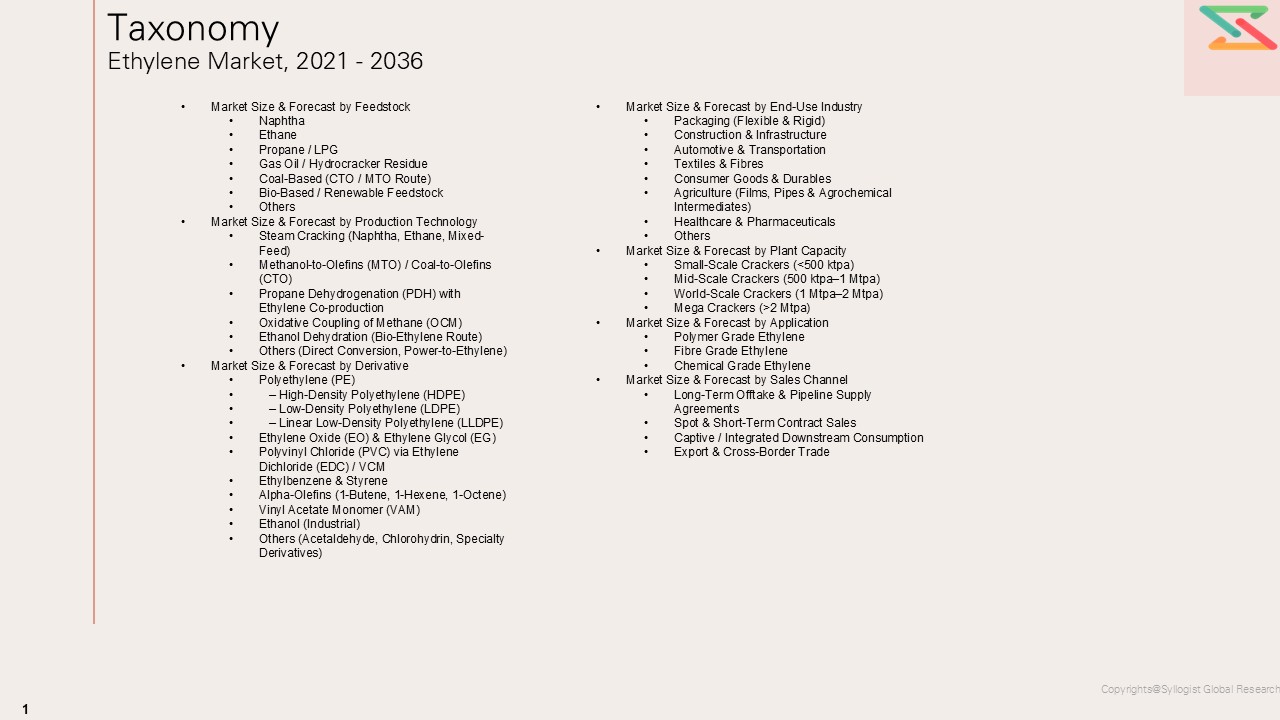
- Market Size & Forecast by Feedstock
- Naphtha
- Ethane
- Propane / LPG
- Gas Oil / Hydrocracker Residue
- Coal-Based (CTO / MTO Route)
- Bio-Based / Renewable Feedstock
- Others
- Market Size & Forecast by Production Technology
- Steam Cracking (Naphtha, Ethane, Mixed-Feed)
- Methanol-to-Olefins (MTO) / Coal-to-Olefins (CTO)
- Propane Dehydrogenation (PDH) with Ethylene Co-production
- Oxidative Coupling of Methane (OCM)
- Ethanol Dehydration (Bio-Ethylene Route)
- Others (Direct Conversion, Power-to-Ethylene)
- Market Size & Forecast by Derivative
- Polyethylene (PE)
- – High-Density Polyethylene (HDPE)
- – Low-Density Polyethylene (LDPE)
- – Linear Low-Density Polyethylene (LLDPE)
- Ethylene Oxide (EO) & Ethylene Glycol (EG)
- Polyvinyl Chloride (PVC) via Ethylene Dichloride (EDC) / VCM
- Ethylbenzene & Styrene
- Alpha-Olefins (1-Butene, 1-Hexene, 1-Octene)
- Vinyl Acetate Monomer (VAM)
- Ethanol (Industrial)
- Others (Acetaldehyde, Chlorohydrin, Specialty Derivatives)
- Market Size & Forecast by End-Use Industry
- Packaging (Flexible & Rigid)
- Construction & Infrastructure
- Automotive & Transportation
- Textiles & Fibres
- Consumer Goods & Durables
- Agriculture (Films, Pipes & Agrochemical Intermediates)
- Healthcare & Pharmaceuticals
- Others
- Market Size & Forecast by Plant Capacity
- Small-Scale Crackers (<500 ktpa)
- Mid-Scale Crackers (500 ktpa–1 Mtpa)
- World-Scale Crackers (1 Mtpa–2 Mtpa)
- Mega Crackers (>2 Mtpa)
- Market Size & Forecast by Application
- Polymer Grade Ethylene
- Fibre Grade Ethylene
- Chemical Grade Ethylene
- Market Size & Forecast by Sales Channel
- Long-Term Offtake & Pipeline Supply Agreements
- Spot & Short-Term Contract Sales
- Captive / Integrated Downstream Consumption
- Export & Cross-Border Trade
- Asia-Pacific Ethylene Market Outlook
- Market Size & Forecast
- By Value (2020–2035)
- By Volume
- By Feedstock
- By Production Technology
- By Derivative
- By End-Use Industry
- By Plant Capacity
- By Application
- By Sales Channel
- Key Demand Drivers (APAC-Specific)
- Competitive Landscape (APAC)
- Market Size & Forecast
- Europe Ethylene Market Outlook
- Market Size & Forecast
- By Value (2020–2035)
- By Volume
- By Feedstock
- By Production Technology
- By Derivative
- By End-Use Industry
- By Plant Capacity
- By Application
- By Sales Channel
- Key Demand Drivers (Europe-Specific)
- Competitive Landscape (Europe)
- Market Size & Forecast
- North America Ethylene Market Outlook
- Market Overview & Strategic Importance
- Market Size & Forecast
- By Value (2020–2035)
- By Volume
- By Feedstock
- By Production Technology
- By Derivative
- By End-Use Industry
- By Plant Capacity
- By Application
- By Sales Channel
- Key Demand Drivers (North America-Specific)
- Competitive Landscape (North America)
- Latin America Ethylene Market Outlook
- Market Size & Forecast
- By Value (2020–2035)
- By Volume
- By Feedstock
- By Production Technology
- By Derivative
- By End-Use Industry
- By Plant Capacity
- By Application
- By Sales Channel
- Key Demand Drivers (LATAM-Specific)
- Competitive Landscape (Latin America)
- Market Size & Forecast
- Middle East & Africa Ethylene Market Outlook
- Market Size & Forecast
- By Value (2020–2035)
- By Volume
- By Feedstock
- By Production Technology
- By Derivative
- By End-Use Industry
- By Plant Capacity
- By Application
- By Sales Channel
- Key Demand Drivers (MEA-Specific)
- Competitive Landscape (MEA)
- Market Size & Forecast
- Country-Wise Ethylene Market Outlook
- Market Size & Forecast by Country
- By Value
- By Volume
- By Feedstock
- By Production Technology
- By Derivative
- By End-Use Industry
- By Plant Capacity
- By Application
- By Sales Channel
- Market Size & Forecast by Country
- Countries Covered: United States, Canada, Brazil, Argentina, Germany, France, United Kingdom, Italy, Spain, Netherlands, Russia, China, India, Japan, South Korea, Saudi Arabia, Iran, UAE, Qatar, South Africa
- Technology Landscape & Innovation Analysis
- Ethylene Production Technology Maturity Assessment
- Emerging & Disruptive Technologies in Steam Cracking & On-Purpose Ethylene
- Advanced Process Control, Digitalisation & AI in Cracker Operations
- Green & Bio-Based Ethylene Production Pathways
- Oxidative Coupling of Methane (OCM) & Novel Catalytic Routes
- Technology Readiness & Commercialisation Matrix – Key Ethylene Production Technologies
- Patent Landscape Analysis
- R&D Investment Benchmarking
- Value Chain & Supply Chain Analysis
- Ethylene Value Chain Mapping
- Supply Chain Concentration & Dependency Analysis
- Key Supplier Mapping by Feedstock Type & Technology Programme
- Supplier Risk Heat Map
- Make vs Buy Strategy Trends Among Ethylene Producers & Downstream Converters
- Pricing Analysis
- Ethylene Pricing Dynamics & Mechanisms
- Pricing by Feedstock Route, Derivative & Region
- Total Cost of Production (TCOP) Analysis – Including Feedstock, Energy & Carbon Costs
- Cracker Margin Analysis by Feedstock & Geography
- Spot vs Contract Ethylene Pricing Trends & Benchmarks
- Derivative Premium Pricing & Value Proposition vs Commodity Ethylene
- Sustainability & Environmental Stewardship
- Environmental & Sustainability Landscape in Ethylene Production
- Carbon Footprint Benchmarking Across Steam Cracking & On-Purpose Technologies
- CCUS Integration Roadmap for Ethylene Producers
- Bio-Ethylene & Recycled Feedstock Integration Roadmap
- Circular Economy & End-of-Life Polymer Recycling Impact on Ethylene Demand
- ESG Reporting & Lifecycle Assessment (LCA) in Ethylene Operations
- Competitive Landscape
- Market Structure & Concentration
- Market Consolidation Level: Global Leaders vs Regional Players
- Top 5 Ethylene Producers Market Capacity & Revenue Share
- HHI (Herfindahl-Hirschman Index) Concentration Analysis by Region & Feedstock
- Competitive Intensity Map by Derivative Segment & Region
- Player Classification
- Tier-1 Global Integrated Ethylene & Petrochemical Producers
- Tier-2 Regional & Specialist Ethylene Producers
- Technology Licensors (Lummus, SABIC, LyondellBasell, KBR, etc.)
- Emerging & Disruptive Players
- Competitive Analysis Frameworks
- Market Share Analysis by Capacity, Volume & Revenue
- R&D Intensity Benchmarking
- Downstream Integration & Derivative Portfolio Comparison
- Geographic Revenue Exposure Comparison
- Company Profiles
- Company Overview, HQ & Organisational Structure
- Ethylene & Derivatives Products & Services Portfolio
- Revenue Breakdown
- Key Cracker Plants, Capacities & Expansion Projects
- Manufacturing Footprint & Key Facilities
- Recent Developments (M&A, Partnerships, New Plants, Financial Results)
- SWOT Analysis
- Strategic Focus: Feedstock Flexibility, Downstream Integration & Low-Carbon Roadmap
- Market Structure & Concentration
- Strategic Output
- Market Opportunity Matrix
- High-Value Opportunity Quadrant Analysis
- Addressable Market by Derivative, End-Use & Region
- Time-to-Revenue Assessment by Opportunity
- White Space Opportunity Analysis
- Underserved Derivative & End-Use Sector Gaps
- Geographic Markets with Low Ethylene Penetration or High Import Dependency
- Technology Gaps with High Commercialisation Potential
- Customer Segment Unmet Needs
- Market Opportunity Matrix
- Strategic Recommendations
- Product Portfolio & Innovation Strategy
- Technology & Digitalisation Strategy
- Cracker Capacity & Manufacturing Footprint Expansion Strategy
- Downstream Integration & Derivative Diversification Strategy
- Feedstock Flexibility & Procurement Strategy
- Pricing & Commercial Strategy
- Sustainability, Carbon Management & Regulatory Compliance Strategy
- Supply Chain & Raw Material Sourcing Strategy
- Partnership, M&A & Expansion Strategy
- Regional Growth Strategy
- Risk Mitigation & Future Roadmap
- Strategic Priority Matrix & Roadmap
- Near-Term (2025–2028)
- Mid-Term (2029–2032)
- Long-Term (2033–2036)