Market Definition
Gas-to-Liquid (GTL) technology refers to a chemical process that converts natural gas into high-quality liquid fuels such as diesel, naphtha, and lubricants. It involves transforming methane into syngas (a mixture of hydrogen and carbon monoxide) through partial oxidation or reforming, followed by Fischer–Tropsch synthesis to produce long-chain hydrocarbons. GTL fuels are ultra-clean, sulfur-free, and have high cetane numbers, making them ideal substitutes for conventional petroleum-derived fuels.
Market Insights
The Global Gas-to-Liquid Market has been witnessing renewed momentum driven by energy transition trends, increasing natural gas availability, and growing demand for cleaner liquid fuels. With the volatility of crude oil prices and the rising emphasis on energy security, countries with abundant natural gas reserves, such as Qatar, South Africa, and Malaysia, are prioritizing GTL investments to diversify their hydrocarbon value chains. However, the capital-intensive nature of GTL plants, coupled with fluctuating natural gas and crude oil differentials, has historically constrained widespread adoption. Recent technological advancements in micro-GTL and modular GTL systems have begun to address cost and scale limitations, making GTL viable even for smaller stranded gas fields and flare gas utilization.
In recent years, the GTL market has also benefited from global decarbonization initiatives. Governments and refiners are under increasing pressure to reduce emissions and adopt fuels that comply with Euro 6/VI and IMO 2020 sulfur standards. GTL diesel, known for its superior combustion efficiency and negligible sulfur and aromatics content, has emerged as a sustainable transition fuel for marine, aviation, and heavy-duty transport sectors. The aviation sector, in particular, is witnessing pilot-scale adoption of GTL-derived synthetic jet fuels as part of sustainable aviation fuel (SAF) programs, backed by the International Civil Aviation Organization’s (ICAO) carbon offsetting and reduction schemes.
Additionally, the market is witnessing growing research and pilot activities for integrating GTL with carbon capture, utilization, and storage (CCUS) systems to further lower the carbon intensity of GTL-derived products. The combination of natural gas reforming and CO₂ capture technologies offers a pathway toward low-carbon synthetic fuels. Key players such as Shell, Sasol, and Chevron are focusing on process optimization, catalyst innovations, and digital monitoring systems to enhance plant efficiency and lower operational costs.
Market Dynamics: Drivers
- Abundant Natural Gas Supply: With the global surge in unconventional gas production (shale gas, coal bed methane), GTL offers a monetization route for regions with stranded or flared gas reserves.
- Demand for Cleaner Fuels: Stringent emission norms and the phasing out of high-sulfur fuels are accelerating GTL fuel adoption in the transport and marine industries.
- Energy Diversification: GTL provides oil-importing nations with an alternative pathway to produce premium-quality fuels domestically, strengthening energy independence.
- Technological Advancements: The development of modular GTL units has lowered capital expenditure requirements and improved deployment flexibility, especially in remote or offshore fields.
Market Dynamics: Challenges
- High CAPEX and OPEX: GTL projects typically require multi-billion-dollar investments, with complex operations and long payback periods.
- Crude-Gas Price Differential: Profitability is sensitive to the relative prices of crude oil and natural gas; narrow differentials can make GTL production less competitive.
- Environmental Impact: Although cleaner than crude-based fuels, GTL processes still emit CO₂ during synthesis unless coupled with CCUS technologies.
- Technological Barriers: Catalyst deactivation, reactor fouling, and product upgrading remain key operational challenges in GTL process optimization.
Market Outlook
The Global Gas-to-Liquid Market is projected to grow steadily through 2030, supported by declining gas feedstock costs, advancements in modular GTL design, and the integration of renewable hydrogen into synthetic fuel pathways. Middle Eastern and African countries are expected to dominate the supply landscape due to abundant natural gas reserves and favorable government initiatives to reduce gas flaring. North America and Europe are likely to witness increasing interest in micro-GTL projects that target flare gas recovery and low-carbon synthetic fuel production.
Competitive Landscape
The GTL market is moderately consolidated, with global energy majors such as Shell, Sasol, Chevron, ExxonMobil, and Velocys holding significant technological and operational expertise. While Shell’s Pearl GTL plant in Qatar remains the largest globally, smaller-scale deployments are gaining traction in North America and Asia-Pacific. The growing participation of technology licensors, engineering firms, and renewable energy players in GTL-CCUS integration projects indicates a strategic shift toward sustainable production models.
Market Segmentation
- By Product Type:
- Diesel
- Naphtha
- Lubricants
- Waxes
- Others
- By Technology:
- Fischer–Tropsch Synthesis
- Methanol-to-Liquid (MTL)
- Syngas-to-Liquid (STL)
- By Application:
- Transportation
- Industrial
- Power Generation
- Marine
- Others
- By Plant Type:
- Large-scale GTL Plants
- Mini-GTL/Modular Units
- By Geography:
- North America
- Europe
- Asia-Pacific
- Latin America
- Middle East & Africa
All market revenues are expressed in USD Million.
Historical Year: 2021–2024 | Base Year: 2025 | Estimated Year: 2026 | Forecast Period: 2027–2031
Key Questions this Study Will Answer
- What is the global and regional market size of the Gas-to-Liquid industry by value?
- Which GTL technologies are most commercially viable and scalable?
- What are the emerging investment hotspots for modular GTL projects?
- How are carbon-neutral and CCUS-integrated GTL technologies shaping the future market outlook?
- Who are the leading players, and how do they benchmark in terms of technological capability, production scale, and financial performance?
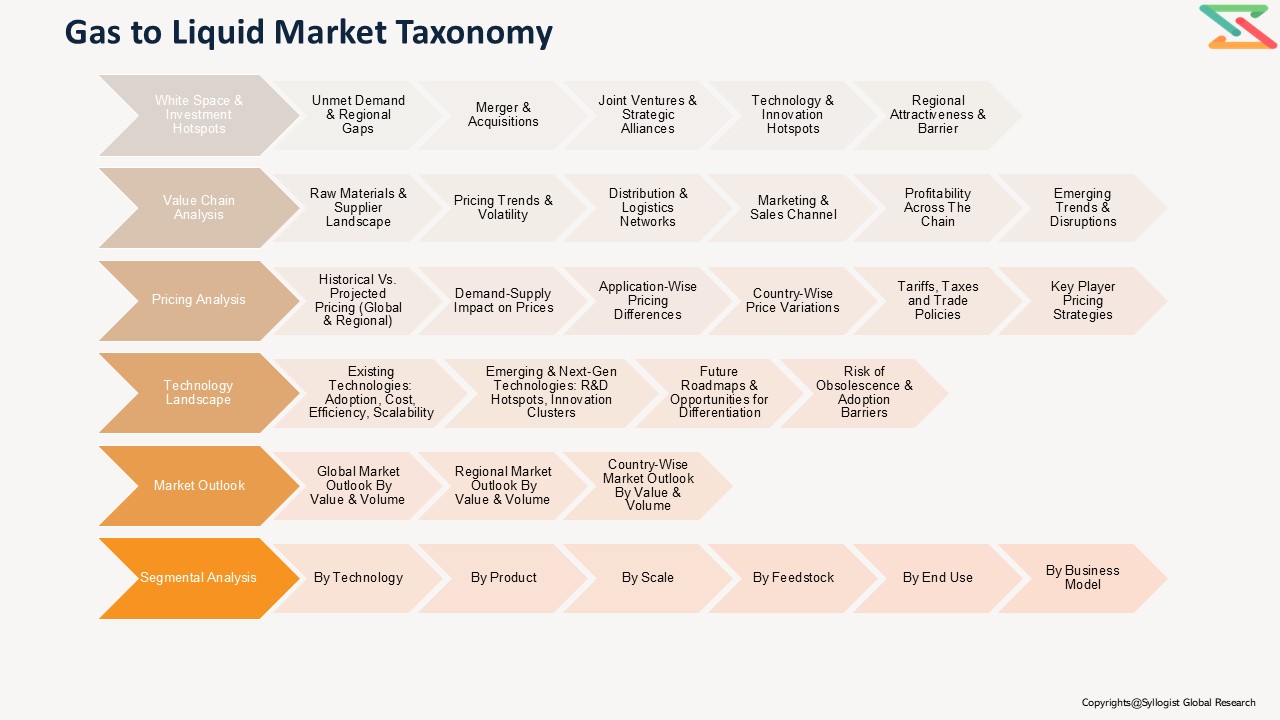
- Market Foundations & Dynamics
- Introduction
1.1. Product Overview (Definition & Scope of GTL — Fischer-Tropsch GTL, methanol-to-gasoline/diesel/olefins, indirect GTL routes, product slate: GTL diesel, naphtha, jet, base oils, waxes)
1.1.2. GTL Value-Chain Overview (Natural gas → Syngas → Synthesis (FT / MTO / MTG) → Upgrading & Hydroprocessing → Product Distribution → End-use)
1.1.3. Research Methodology
1.1.4. Executive Summary
1.1.5. Major Trends Shaping the Market (feedstock availability, LNG price dynamics, decarbonization pressure, downstream petrochem demand)
1.1.6. Short-Term vs. Long-Term Opportunities (mast projects, modular small-scale GTL, integration with LNG / hydrogen / CCUS)
1.1.7. Comparison of GTL Pathways vs. Conventional Refining & Alternative Routes (biofuels, green hydrogen + e-fuels)
1.1.8. Scenario Planning (Base, Optimistic, Conservative — oil/gas prices, carbon costs, policy support)
1.1.9. Sensitivity Analysis (natural gas price, carbon price, CAPEX, catalyst life)
1.1.10. Identification of Regional Investment Hotspots (gas resource basins, export hubs, low-carbon incentive regions) - Market Dynamics
- Introduction
- Drivers (abundant stranded gas monetization, demand for low-sulfur marine & aviation fuels, high-quality base oils)
- Restraints (high CAPEX, complex scale-up, feedstock logistics)
- Opportunities (small-scale modular GTL, integration with CCUS/blue hydrogen, chemicals production)
- Challenges (carbon intensity, project financing, catalyst & technology licensing)
- Porter’s Five Forces Analysis
- PESTLE Analysis
- Market Ecosystem & Value Chain
3.1. Overview of Value Chain Participants
1.3.1.1. Gas Producers & Suppliers (upstream operators, stranded gas monetization projects)
1.3.1.2. Technology & Catalyst Providers (FT licensors, MTO/MTG licensors)
1.3.1.3. EPC Contractors & Modular Plant Providers
1.3.1.4. Syngas Producers (steam methane reforming, autothermal reforming, partial oxidation)
1.3.1.5. Hydroprocessing & Refining / Upgrading Facilities
1.3.1.6. Distributors, Traders & Offtakers (fuel suppliers, petrochemical buyers)
1.3.2. Flow of Value and Material Through the Chain
1.3.3. Value Addition and Margins at Each Stage
1.3.3.1. Gas Feedstock Procurement & Conditioning
1.3.3.2. Syngas Production & Conditioning
1.3.3.3. Synthesis (FT / MTO / MTG) & Catalyst Costs
1.3.3.4. Upgrading, Hydrocracking & Blending
1.3.3.5. Distribution & Sales (marine fuel, jet, diesel, petrochemical feedstocks)
1.3.4. Integration Trends (integrated gas + GTL + export terminal vs. merchant GTL)
1.3.5. Impact of Vertical Integration (gas producer owning GTL plant, offtake security) - Mapping of Roles and Interdependencies
- Market Trends & Developments
5.1. White Market Space Analysis (modular small-scale GTL, niche specialty products, GTL lubricants)
1.5.2. Demand–Supply Gaps (clean marine & aviation fuel supply, chemical feedstock shortages)
1.5.3. Investment Hotspots (Middle East, North America shale hubs, Africa gas basins, Australia)
1.5.4. Unmet Needs (cost-effective small-scale solutions, low-carbon product certification) - Risk Assessment Framework
6.1. Political / Geopolitical Risk (export controls, resource nationalization, sanctions)
1.6.2. Operational Risk (project execution delays, catalyst deactivation, feedstock variability)
1.6.3. Environmental Risk (GHG footprint, flaring reduction, water usage)
1.6.4. Financial Risk (CAPEX overruns, commodity price swings, offtake contract risk)
- Market Ecosystem & Value Chain
- Regulatory Framework & Standards
- Global Regulatory Overview
1.1. Fuel Quality & Emissions Standards (IMO 2020/2025, aviation fuel specs, regional diesel/naphtha specs)
2.1.2. Environmental Regulations (carbon pricing, MRV – measurement, reporting & verification)
2.1.3. Local Content & Licensing (host country requirements for project development)
2.2. Compliance & Certification Requirements (fuel certification for aviation/marine, fuel blending regs)
2.3. Transportation and Storage Regulations (LNG/GTL terminals, shipping regs, tank storage)
2.4. Safety, Health & Environmental Standards (process safety management, HSE standards)
2.5. Environmental & Liability Considerations (CCUS permitting, emissions liability)
2.6. Incentives & Policy Mechanisms (tax credits, production subsidies, low-carbon fuel standards)
- Global Regulatory Overview
- Technology Landscape
- Syngas Production Technologies (SMR, ATR, POX, electrified reforming)
2. Synthesis Technologies
3.2.1. Fischer-Tropsch (fixed/microchannel/trickle bed reactors, slurry FT)
3.2.2. Methanol-to-Olefins / Methanol-to-Gasoline (MTO/MTG) pathways
3.3. Catalyst Technologies & Life (FT catalysts, methanol catalysts, regeneration strategies)
3.4. Upgrading & Hydroprocessing Technologies (hydrocracking, hydroisomerization, wax upgrading)
3.5. Modular & Small-Scale GTL Solutions (micro-FT, distributed GTL)
3.6. Integration with CCUS, Blue Hydrogen & Renewable Hydrogen (hybrid pathways)
3.7. Process Digitalization & Plant Optimization (digital twins, advanced process control)
3.8. Innovations to Reduce CAPEX/OPEX (intensified reactors, electrification, alternative syngas routes)
- Syngas Production Technologies (SMR, ATR, POX, electrified reforming)
- Global, Regional & Country Forecasts (2020–2035)
- Global GTL Market Outlook (value, volume; product split by diesel, naphtha, jet, base oils, chemicals)
- Market Share by:
2.1. By Technology Pathway (Fischer-Tropsch GTL, Methanol-to-Liquids, Hybrid routes)
4.2.2. By Product (GTL diesel, GTL naphtha, jet fuel, base oils, waxes, petrochemical feedstocks)
4.2.3. By Scale (mega-projects, brownfield integration, small-scale modular)
4.2.4. By Feedstock Source (associated gas, non-associated gas, stranded gas, pipeline gas, LNG)
4.2.5. By End-Use (transport fuels, aviation, marine, lubricant base stocks, petrochemicals)
4.2.6. By Business Model (producer-integrated, merchant GTL, tolling/contract manufacturing)
4.2.7. By Company / Project - Regional & Country Outlook (2020–2035)
3.1. Middle East (Qatar, UAE, Saudi Arabia)
4.3.2. North America (U.S., Canada)
4.3.3. Africa (Nigeria, Mozambique, Angola)
4.3.4. Asia-Pacific (Australia, China, Malaysia)
4.3.5. Latin America (Trinidad & Tobago, Argentina)
- Pricing Analysis
- Overview of Pricing Structures (per barrel equivalent, $/bbl FOB, $/ton for chemicals, $/kg for specialty products)
2. ASP Trends by Product and Region (GTL diesel premium vs. conventional diesel, aviation fuel pricing)
5.3. Cost Benchmark: GTL vs. Conventional Refining & Alternative Fuels (CAPEX/OPEX per bbl production)
5.4. Price Sensitivity by Application (marine/aviation low-sulfur demand, specialty base oil premiums)
5.5. Historical Price Evolution (2015–2025)
5.6. Forecast Pricing Curve (2025–2035)
5.7. Factors Influencing Price:
5.7.1. Natural Gas Feedstock Price & Transport Costs
5.7.2. Capital Intensity & Financing Costs
5.7.3. Catalyst & Operating Costs (hydrogen, utilities)
5.7.4. Carbon Pricing & Emission Compliance Costs
5.8. Regional Pricing Differentiation (landed costs, taxation, subsidies)
5.9. Impact of Low-Carbon Premiums & Fuel Standards on GTL Pricing
- Overview of Pricing Structures (per barrel equivalent, $/bbl FOB, $/ton for chemicals, $/kg for specialty products)
- Competition Outlook
- Market Concentration and Fragmentation Level
2. Company & Project Portfolios (major GTL licensors, EPCs, national oil companies with GTL assets)
6.3. Competitive Strategies (integration with LNG/Refining, offtake contracts, modularisation, green branding)
6.4. Benchmarking Matrix (Technology vs. Scale vs. Feedstock Access vs. Carbon Intensity)
6.5. Recent Developments (project announcements, joint ventures, capacity expansions, technology licensing)
- Market Concentration and Fragmentation Level
- Cost Structure & Margin Analysis
- Detailed Cost Breakdown (gas feedstock, syngas production, synthesis, upgrading, utilities, catalyst replacement)
2. Average Cost per Stage (CAPEX amortization, OPEX drivers per barrel equivalent)
7.3. Profitability and Margin Distribution Along Value Chain
7.3.1. Gas Supplier Margin / Opportunity Cost of Gas
7.3.2. GTL Producer Margin (product mix dependent)
7.3.3. Upgrader / Refinery Margin (integration benefits)
7.3.4. Distributor / Trader Margin
7.4. Sensitivity Analysis: How Gas Price, CAPEX & Carbon Price Impact Margin
7.5. Cost Reduction Opportunities (heat integration, modular construction, catalyst life extension)
- Detailed Cost Breakdown (gas feedstock, syngas production, synthesis, upgrading, utilities, catalyst replacement)
- Business Models & Strategic Insights
- Integrated Producer Models (NOC / IOC owning gas upstream + GTL plant + export terminals)
2. Merchant GTL & Tolling Models (third-party gas monetization)
8.3. Modular & Distributed GTL Service Models (small-scale units, remote monetization)
8.4. Low-Carbon GTL & Blue GTL Models (CCUS integration, blue hydrogen pathways)
8.5. Economic Viability Comparison of Models (CAPEX intensity vs. revenue certainty)
8.6. SWOT Analysis of Leading Models
- Integrated Producer Models (NOC / IOC owning gas upstream + GTL plant + export terminals)
- Investment & Financial Analysis
- CAPEX and OPEX Benchmarks for GTL Projects (FT plants, MTO/MTG, upgrading units)
2. Payback Period and IRR Sensitivity (by feedstock price, product slate, offtake contracts)
9.3. Financial Modeling Assumptions (plant utilization, catalyst life, transport & logistics costs)
9.4. Revenue Streams: Fuel sales, petrochemical co-products, lubricant base oil premiums, carbon credits/low-carbon premiums
9.5. Investment Case Studies (Qatar Shell GTL, small-scale projects, integrated hub examples)
9.6. Funding Landscape: Project finance, export credit agencies, strategic investors, green financing for low-carbon GTL
- CAPEX and OPEX Benchmarks for GTL Projects (FT plants, MTO/MTG, upgrading units)
- Sales & Distribution Channel Analysis
- Overview of Go-to-Market Channels (direct to refiners/traders, long-term contracts, spot markets, bunker suppliers)
2. Channel Share by Region & Product Type
10.3. Typical Channel Flow Diagram (producer → terminal → shipping / pipeline → offtaker)
10.4. Sales Process (specification, certification for aviation/marine, logistics planning)
10.5. Distribution Strategies by Leading Players (captive terminals, blending partnerships, trading desks)
10.6. Emerging Trends:
10.6.1. Blending & Co-marketing with conventional fuels (drop-in capability)
10.6.2. Low-carbon fuel certification & premium marketing
10.6.3. Integration with LNG / Hydrogen export value chains
- Overview of Go-to-Market Channels (direct to refiners/traders, long-term contracts, spot markets, bunker suppliers)
- Strategic Recommendations & Roadmap
- Competitors’ Strategic Initiatives (vertical integration, CCUS partnerships, modular tech adoption)
2. Future Outlook (next 5–10 years — role in low-sulfur fuel supply, niche specialty products, decarbonized GTL)
11.3. Strategic Recommendations
11.3.1. Technology & Operational Priorities to Watch (small-scale FT, electrified syngas, CCUS cost reductions)
11.3.2. GTL Commercialization Roadmap (2030–2035)
11.3.3. Strategic Recommendations for Stakeholders (NOCs, IOCs, EPCs, technology licensors, investors)
11.4. GTL Market Acceleration Roadmap
11.4.1. Short-term (2025–2027): de-risk pilot modular units, secure long-term offtakes, evaluate CCUS integration
11.4.2. Mid-term (2028–2030): scale modular fleets, strengthen export logistics, pursue low-carbon certification
11.4.3. Long-term (2031–2035): integrate with hydrogen & CCUS value chains, target specialty high-margin products
11.5. Tailored recommendations for:
11.5.1. Gas Producers & NOCs
11.5.2. Technology Licensors & EPCs
11.5.3. Offtakers & Traders (marine/aviation fuel suppliers, petrochemical buyers)
11.6. Recommendations on Key Success Factors
11.6.1. Partnerships & Alliances (offtake, finance, CCUS providers)
11.6.2. Digitalization & Plant Optimization (digital twins, predictive maintenance)
11.6.3. Policy Alignment & Low-Carbon Certification (GHG accounting, incentives)
11.6.4. Investor Confidence & Capital Availability
- Competitors’ Strategic Initiatives (vertical integration, CCUS partnerships, modular tech adoption)