Market Definition
The global hypersonic weapons and propulsion systems market encompasses the full spectrum of technologies, platforms, subsystems, and enabling infrastructure required to develop, test, produce, and operationally deploy weapons and vehicles capable of sustained flight at velocities exceeding Mach 5 (approximately 6,174 km/h at sea level) within or at the edges of the atmosphere. The market is defined by two principal technological architectures that represent fundamentally different engineering approaches to achieving hypersonic flight: hypersonic glide vehicles (HGVs), which are boost-glide systems released from ballistic or rocket boosters at high altitude and then glide unpowered or semi-powered along extended, manoeuvrable flight paths at speeds of Mach 5–20+, exploiting their aerodynamic lift-to-drag ratio to achieve ranges of 1,000–10,000+ km while executing terminal evasive manoeuvres that defeat conventional ballistic missile defence intercept geometries; and hypersonic cruise missiles (HCMs), which are air-breathing, powered throughout their flight by scramjet (supersonic combustion ramjet) or dual-mode ramjet/scramjet propulsion systems that enable sustained cruise at Mach 5–8 within the atmosphere at lower altitudes than HGVs, delivering high-precision strikes against time-sensitive, hardened, or mobile targets at ranges of 500–2,000+ km. Critical enabling subsystems span the full propulsion stack, solid rocket boosters, liquid-fuelled boost stages, ramjet transition stages, and scramjet combustor assemblies, as well as the advanced thermal protection systems (TPS) required to withstand aerodynamic heating to temperatures of 1,500–3,000°C at hypersonic velocities, the high-bandwidth seeker and guidance systems capable of terminal homing under extreme heat and plasma-induced electromagnetic interference, and the command, control, and communications architectures necessary for hypersonic strike integration. The market also encompasses the associated test and evaluation infrastructure, hypersonic wind tunnels, high-enthalpy ground test facilities, instrumented flight test ranges, and the broader hypersonic technology development ecosystem including high-temperature materials science (ultra-high-temperature ceramics, carbon-carbon composites, refractory metal alloys), computational aerothermodynamics, and advanced manufacturing for complex hypersonic airframe geometries.
Market Insights
The single most consequential strategic development reshaping the global hypersonic weapons market in 2026 is the transition of multiple nation-state programmes from extended research and development phases into initial operational capability (IOC) and limited production deployment, a transition that has fundamentally altered the strategic calculus of military planners, defence procurement agencies, and allied governments in ways that the programmes’ earlier demonstration flight tests alone could not. Russia’s operational deployment of the Avangard HGV system aboard SS-18 and SS-19 ICBMs, and the combat employment of the Kinzhal aeroballistic hypersonic missile in Ukraine beginning in 2022, provided the first real-world evidence that hypersonic weapons could be operationalised under combat conditions, even if both systems are technically distinct from the precision-manoeuvrable, scramjet-powered HCMs that represent the most strategically significant long-term threat. More critically, China’s demonstrated test of a Fractional Orbital Bombardment System-equipped HGV in August 2021, which achieved a trajectory that transited the South Pole before releasing a glide vehicle that flew thousands of kilometres and struck within tens of kilometres of its target, validated Chinese technical capability at a level that shocked Western intelligence communities and triggered the most significant acceleration of US, UK, Australian, and European hypersonic development funding since the Cold War. The convergence of Russian operational deployment, Chinese technical demonstration, and North Korean and Iranian expressed ambitions has created a threat perception environment in which hypersonic weapons have transitioned from a long-range R&D concern to a near-term operational imperative across the full tier of advanced defence establishments.
The competitive landscape for hypersonic weapons and propulsion development is evolving on three fundamentally different strategic trajectories that reflect each major actor’s technological starting position, industrial base capacity, and strategic intent. The United States, despite holding the foundational patents on scramjet technology and operating the most advanced hypersonic ground-test infrastructure globally, has experienced a series of high-profile test failures across its major programmes, the ARRW (AGM-183A Air-Launched Rapid Response Weapon), Conventional Prompt Strike (CPS), and LRHW (Long-Range Hypersonic Weapon), that have raised significant questions about programme management, scramjet combustor reliability at operational flight conditions, and the translation of wind tunnel performance data to free-flight results. Congressional scrutiny of cost escalation across these programmes, with the ARRW programme ultimately cancelled after repeated test failures, and CPS experiencing significant schedule delays, has redirected US strategy toward a portfolio approach emphasising nearer-term achievable capabilities such as the hypersonic air-breathing weapon concept (HAWC) programme, Mach 5+ glide weapons, and shared development under the AUKUS Optimal Pathway arrangements, while sustaining longer-term scramjet technology maturation. China, by contrast, has pursued a broader, more integrated hypersonic development programme that combines HGV development under the DF-17 and DF-ZF platforms, the Starry Sky-2 waverider demonstrator, and a sustained investment in scramjet propulsion that has produced a series of hypersonic wind tunnel facilities, including the JF-22 detonation-driven shock tunnel capable of simulating Mach 30 conditions, that now collectively represent the world’s most extensive hypersonic ground-test complex by test section size and operating pressure range.
The primary structural growth driver of the global hypersonic market is the breakdown of the post-Cold War strategic stability architecture that had suppressed large-scale development of advanced offensive weapons systems for three decades. The effective demise of the Intermediate-Range Nuclear Forces (INF) Treaty following the US withdrawal in 2019, the expiry of the New START nuclear arms limitation framework in 2026 without a successor agreement, Russia’s suspension of its New START participation in February 2023, and China’s sustained rejection of bilateral or multilateral arms limitation discussions have collectively removed the treaty-based constraints that previously bounded advanced strike weapons development. Into this unconstrained environment, the combination of Chinese DF-17 operational deployment, Russian Avangard integration, and the demonstrated inability of current US and allied ballistic missile defence (BMD) interceptors, the SM-3, THAAD, and GBI systems, to reliably engage manoeuvring hypersonic glide vehicles on non-ballistic trajectories has driven a procurement response across the Five Eyes alliance, Japan, South Korea, India, France, and Germany that collectively represents the largest acceleration of advanced strike investment since the Reagan-era Strategic Defense Initiative. The market is further shaped by two structural technology drivers: the maturation of additive manufacturing for refractory metal components enabling the production of complex scramjet combustor geometries previously impossible by conventional machining; and advances in ultra-high-temperature ceramic matrix composites (UHTCMCs) incorporating hafnium boride, zirconium boride, and silicon carbide reinforcement that are extending the thermal endurance of leading edges, nose caps, and control surfaces to the temperatures sustained hypersonic flight demands, progressively solving the materials science constraint that has historically been the most fundamental barrier to operationally reliable hypersonic cruise missile development.
Key Drivers
- The foundational demand accelerator for hypersonic weapons programmes across every major defence establishment in 2026 is the structurally altered threat environment created by the operational deployment of Chinese and Russian hypersonic systems, which has created a tripartite strategic imperative simultaneously: the need for offensive hypersonic capability to deny adversaries the belief that their own targets are protected by existing air defences; the need to develop and deploy defensive hypersonic intercept capabilities that can engage manoeuvring hypersonic threats; and the compounding recognition that the diplomatic and arms control frameworks that previously managed advanced strike competition are either defunct or inadequate to the current technological pace. The United States Fiscal Year 2025 National Defense Authorization Act authorised USD 4.7 billion for hypersonic weapons development and procurement across the Army, Navy, and Air Force, representing a 340% increase from FY2020 baseline funding levels and reflecting the bipartisan political consensus that hypersonic capability represents the most critical near-term strategic gap in US defence posture. The AUKUS Optimal Pathway announcement, which explicitly includes hypersonic strike weapons as a pillar-two advanced capability alongside autonomous undersea vehicles and advanced cyber, has created a trilateral development framework between the US, UK, and Australia with confirmed funding commitments exceeding USD 3 billion through 2030. Japan’s Stand-Off Defence Capability expansion, approved under the December 2022 National Security Strategy revision, allocates JPY 5 trillion over five years to hypersonic glide weapons, extended-range cruise missiles, and counterstrike capabilities, representing the largest reorientation of Japanese offensive strike doctrine since the post-war pacifist constitution’s constraints were formally reinterpreted. India’s HSTDV (Hypersonic Technology Demonstrator Vehicle) programme, following its 2020 and 2023 successful scramjet-powered flight demonstrations, has transitioned to a weaponisation development phase under DRDO’s DRDL laboratory, with operational integration timelines targeting the 2027–2029 window, adding a sixth independently capable hypersonic nation to the global competitive landscape and significantly complicating regional deterrence calculations across the Indo-Pacific.
- A second foundational growth driver is the rapid maturation of enabling technologies across propulsion, materials, and guidance that is progressively solving the engineering barriers that prevented earlier generations of hypersonic programmes from achieving operationally reliable performance. In propulsion, the most significant development is the demonstrated improvement in scramjet combustor ignition reliability and flame stability across the Mach 5–8 flight envelope by programmes including the US HAWC (Hypersonic Air-Breathing Weapon Concept), which achieved multiple successful powered flight tests between 2021 and 2024 using a hydrocarbon-fuelled dual-mode ramjet/scramjet propulsion system developed by Raytheon and Northrop Grumman, validating the transition ignition sequence from subsonic intake to supersonic combustion that has historically been the most technically challenging operational milestone in scramjet development. In materials, the qualification of fourth-generation ultra-high-temperature ceramic matrix composites (CMC) incorporating hafnium carbide and zirconium diboride secondary phases by US companies including Aerojet Rocketdyne, GE Aerospace, and COI Ceramics has extended leading-edge and nose-cap thermal endurance from approximately 1,600°C to demonstrated survivability above 2,400°C for sustained exposure periods of 300–600 seconds, the thermal envelope required for operationally meaningful hypersonic cruise missile flight profiles at sea-level-equivalent dynamic pressure altitudes. In guidance, the development of millimetre-wave (mmW) and dual-mode infrared/mmW terminal seekers that maintain acquisition lock through the plasma sheath surrounding a hypersonic vehicle at terminal approach velocities has addressed the communications blackout and seeker performance degradation that previously limited terminal guidance precision to levels insufficient for hardened or defended point targets, enabling circular error probable (CEP) performance below 1–2 metres for late-phase terminal guidance even at velocities exceeding Mach 5.
- The third critical driver is the transformative role of defence procurement reform and advanced manufacturing capability in enabling nations and industrial primes that previously lacked sovereign hypersonic capacity to rapidly close the technology gap with pioneering programmes. The US Department of Defense’s Other Transaction Authority (OTA) contracting mechanism and the subsequent Hypersonic and High-Cadence Airborne Testing Capabilities (HyCAT) programme have created a competitive development ecosystem that has brought new entrants including Leidos, L3Harris, Kratos Defense, and Hermeus Corporation into active hypersonic development contracts alongside traditional primes, dramatically expanding the industrial base and creating a competitive cost-reduction pressure that was absent when Lockheed Martin, Raytheon, and Boeing held effectively monopoly positions on advanced strike development. The application of additive manufacturing, specifically laser powder bed fusion (LPBF) and directed energy deposition (DED) processes using refractory alloys including C-103 niobium, molybdenum-rhenium, and tungsten-rhenium, to scramjet combustor liner fabrication has reduced component production lead times from 18–24 months to 6–8 weeks for complex geometry combustor and fuel-injection strut components, enabling iterative design-test-redesign cycles that compress the development timeline for new combustor configurations from years to months. Australia’s sovereign hypersonic development programme, anchored by the Southern Cross Integrated Flight Research Experiment (SCIFiRE) under the AUKUS framework and executed in partnership with DSTG, Boeing Defence Australia, and BAE Systems Australia, demonstrates how even mid-tier defence industrial nations can rapidly build sovereign hypersonic capability when provided with access to US scramjet intellectual property and test infrastructure, a development model likely to be replicated by South Korea, Japan, Germany, and France as their respective national programmes mature through the 2027–2032 period.
Key Challenges
- The most structurally significant technical challenge confronting every hypersonic weapons programme globally is the fundamental difficulty of achieving operationally reliable scramjet ignition, sustained combustion, and consistent propulsive efficiency across the full Mach 5–8 operational flight envelope under the combined stresses of extreme aerodynamic heating, airframe structural vibration, and fuel-air mixing instabilities within combustor residence times measured in milliseconds. Unlike conventional gas turbine or even ramjet combustion, where flame stabilisation and fuel-air mixing occur in subsonic flow fields at manageable temperatures and pressures, scramjet combustion occurs in supersonic internal flow where the residence time of fuel molecules in the combustion chamber is of the order of one millisecond, requiring complete fuel injection, atomisation, vapourisation, mixing, ignition, and heat release within a distance of approximately one metre of combustor length. The sensitivity of scramjet combustion to small perturbations in inlet conditions, fuel injection geometry, cavity flame-holder design, and thermal soakback creates a propulsion system that is fundamentally more difficult to reliably operate across a wide flight envelope than any predecessor air-breathing engine technology, and explains why the US ARRW programme, despite years of investment and the most advanced hypersonic test infrastructure in the world, experienced repeated ignition and transition failures before programme cancellation. The thermal management challenge is compounded by the requirement for active cooling of scramjet combustor walls using endothermic hydrocarbon fuel as the coolant, a dual-function role that imposes strict constraints on fuel thermal stability, coking propensity, and the heat sink capacity available per kilogram of fuel carried, directly limiting the powered range and cruise duration achievable within a weapon system mass budget. These propulsion reliability constraints are the primary reason why the most operationally deployed hypersonic weapons to date, Russia’s Avangard and Kinzhal, China’s DF-17, are HGV or aeroballistic systems that avoid the scramjet combustion problem entirely, rather than the manoeuvring, air-breathing HCMs that would offer the greatest operational flexibility and the highest threat to defended targets.
- A parallel and in some respects even more strategically consequential challenge is the near-complete absence of proven, deployable hypersonic defence intercept capability against operationally representative manoeuvring glide vehicles, which creates a strategic asymmetry in which nations that have successfully deployed or can credibly threaten to deploy hypersonic offensive systems enjoy a structural first-mover advantage that is independent of the absolute capability of their offensive weapon. The fundamental intercept challenge posed by manoeuvring HGVs derives from the combination of three factors that jointly defeat conventional BMD geometries: the non-ballistic, variable-altitude flight path of a gliding vehicle precludes the predictive intercept solution that underpins THAAD, SM-3, and GBI engagements against fixed-trajectory ballistic re-entry vehicles; the velocity of a Mach 15–20 HGV at engagement-relevant ranges requires an interceptor with sufficient divert velocity and lateral acceleration to close and intercept a manoeuvring target in a time window of seconds; and the radar horizon limitations of current ground-based and sea-based BMD sensor networks create a fundamental detection-to-intercept timeline that is physically insufficient for intercept of low-altitude gliders with current interceptor burnout velocities. The US Missile Defense Agency’s Glide Phase Interceptor (GPI) programme, awarded to RTX (Raytheon) and Northrop Grumman in 2023, is the primary US response and is targeting initial operational capability no earlier than 2030, leaving a minimum five-year window in which operational Chinese and Russian HGV systems face no credible intercept threat from US BMD. The economic asymmetry compounds the strategic problem: a single DF-17 or Avangard HGV represents an investment of tens of millions of dollars in offensive capability, while the Glide Phase Interceptor is expected to cost several hundred million dollars per interceptor at initial production rates, creating the same cost-exchange ratio problem that has historically undermined the economic sustainability of ballistic missile defence at scale, and which is significantly more acute for hypersonic threats given their higher velocity, lower-altitude flight profiles, and greater terminal manoeuvre capability.
Market Segmentation
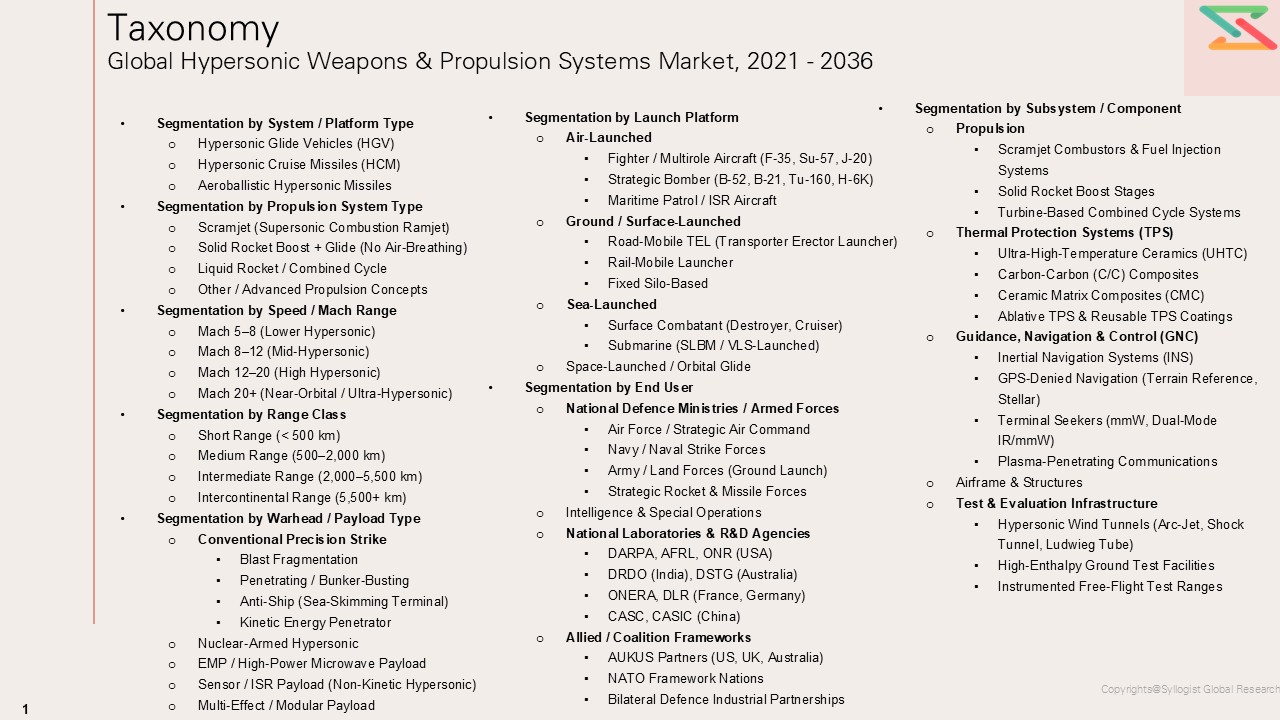
- Segmentation by System / Platform Type
- Hypersonic Glide Vehicles (HGV)
- Boost-Glide Systems (Ballistic Missile Launched)
- Fractional Orbital Bombardment System (FOBS)-HGV
- Air-Launched HGV
- Sea-Launched HGV
- Hypersonic Cruise Missiles (HCM)
- Air-Launched HCM (Scramjet-Powered)
- Ground / Mobile Launcher-Launched HCM
- Sea / Submarine-Launched HCM
- Aeroballistic Hypersonic Missiles
- Air-Launched Aeroballistic (Kinzhal-class)
- Ground-Launched Aeroballistic
- Hypersonic Demonstrators & Technology Vehicles
- Directed Energy & Hypersonic Integration Platforms
- Hypersonic Glide Vehicles (HGV)
- Segmentation by Propulsion System Type
- Scramjet (Supersonic Combustion Ramjet)
- Hydrocarbon-Fuelled Scramjet (JP-10, Ethylene)
- Hydrogen-Fuelled Scramjet
- Dual-Mode Ramjet / Scramjet (DMRJ)
- Rotating Detonation Engine (RDE)
- Solid Rocket Boost + Glide (No Air-Breathing)
- Single-Stage Solid Rocket Booster
- Multi-Stage Solid Rocket Boost
- Liquid Rocket / Combined Cycle
- Turbine-Based Combined Cycle (TBCC)
- Rocket-Based Combined Cycle (RBCC)
- Other / Advanced Propulsion Concepts
- Pulse Detonation Engine (PDE)
- Nuclear Thermal Propulsion (NTP)
- Segmentation by Speed / Mach Range
- Mach 5–8 (Lower Hypersonic)
- Mach 8–12 (Mid-Hypersonic)
- Mach 12–20 (High Hypersonic)
- Mach 20+ (Near-Orbital / Ultra-Hypersonic)
- Segmentation by Range Class
- Short Range (< 500 km)
- Medium Range (500–2,000 km)
- Intermediate Range (2,000–5,500 km)
- Intercontinental Range (5,500+ km)
- Segmentation by Warhead / Payload Type
- Conventional Precision Strike
- Blast Fragmentation
- Penetrating / Bunker-Busting
- Anti-Ship (Sea-Skimming Terminal)
- Kinetic Energy Penetrator
- Nuclear-Armed Hypersonic
- EMP / High-Power Microwave Payload
- Sensor / ISR Payload (Non-Kinetic Hypersonic)
- Multi-Effect / Modular Payload
- Conventional Precision Strike
- Segmentation by Launch Platform
- Air-Launched
- Fighter / Multirole Aircraft (F-35, Su-57, J-20)
- Strategic Bomber (B-52, B-21, Tu-160, H-6K)
- Maritime Patrol / ISR Aircraft
- Ground / Surface-Launched
- Road-Mobile TEL (Transporter Erector Launcher)
- Rail-Mobile Launcher
- Fixed Silo-Based
- Sea-Launched
- Surface Combatant (Destroyer, Cruiser)
- Submarine (SLBM / VLS-Launched)
- Space-Launched / Orbital Glide
- Air-Launched
- Segmentation by End User
- National Defence Ministries / Armed Forces
- Air Force / Strategic Air Command
- Navy / Naval Strike Forces
- Army / Land Forces (Ground Launch)
- Strategic Rocket & Missile Forces
- Intelligence & Special Operations
- National Laboratories & R&D Agencies
- DARPA, AFRL, ONR (USA)
- DRDO (India), DSTG (Australia)
- ONERA, DLR (France, Germany)
- CASC, CASIC (China)
- Allied / Coalition Frameworks
- AUKUS Partners (US, UK, Australia)
- NATO Framework Nations
- Bilateral Defence Industrial Partnerships
- Segmentation by Subsystem / Component
- Propulsion
- Scramjet Combustors & Fuel Injection Systems
- Solid Rocket Boost Stages
- Turbine-Based Combined Cycle Systems
- Thermal Protection Systems (TPS)
- Ultra-High-Temperature Ceramics (UHTC)
- Carbon-Carbon (C/C) Composites
- Ceramic Matrix Composites (CMC)
- Ablative TPS & Reusable TPS Coatings
- Guidance, Navigation & Control (GNC)
- Inertial Navigation Systems (INS)
- GPS-Denied Navigation (Terrain Reference, Stellar)
- Terminal Seekers (mmW, Dual-Mode IR/mmW)
- Plasma-Penetrating Communications
- Airframe & Structures
- Test & Evaluation Infrastructure
- Hypersonic Wind Tunnels (Arc-Jet, Shock Tunnel, Ludwieg Tube)
- High-Enthalpy Ground Test Facilities
- Instrumented Free-Flight Test Ranges
- Propulsion
- National Defence Ministries / Armed Forces
- Scramjet (Supersonic Combustion Ramjet)
All market revenues are presented in USD; classified or restricted programme values are estimated through open-source proxy modelling and defence budget analysis
Historical Year: 2021–2024 | Base Year: 2025 | Estimated Year: 2026 | Forecast Period: 2027–2036
Key Questions this Study Will Answer
- What are the critical market metrics and forward-looking projections for the Global Hypersonic Weapons & Propulsion Systems Market, including total addressable programme value (USD), active development and procurement contract value by nation, investment in propulsion and materials subsystems, and test infrastructure expenditure, segmented across System Type (HGV, HCM, Aeroballistic), Propulsion (Scramjet, DMRJ, Solid Boost-Glide, TBCC, RBCC), Speed Range (Mach 5–8, 8–12, 12–20, 20+), Range Class (Short, Medium, Intermediate, Intercontinental), Warhead Type (Conventional Precision, Nuclear, EMP, Kinetic), Launch Platform (Air, Ground, Sea, Orbital), End User (Armed Forces branch, National Lab, Allied Framework), and Subsystem / Component (Propulsion, TPS, GNC, Airframe, Test Infrastructure)?
- How do the strategic threat perceptions, technological starting positions, defence industrial base capacities, and procurement philosophies of the six principal hypersonic powers, the United States, China, Russia, India, France, and Australia, and secondarily Japan, South Korea, the United Kingdom, and Germany, shape their respective programme portfolios, technology development timelines, operational deployment priorities, allied co-development arrangements under frameworks including AUKUS, NATO Enhanced Forward Presence, and bilateral defence technology sharing agreements, and the competitive dynamics between HGV boost-glide and HCM scramjet-powered development strategies across each national programme?
- In what ways are propulsion maturation constraints, specifically scramjet ignition reliability across the Mach 5–8 operational envelope, dual-mode transition from ramjet to scramjet combustion, hydrocarbon fuel thermal stability and endothermic cooling capacity limitations, rotating detonation engine scalability for hypersonic applications, and the translational validity of ground-test hypersonic wind tunnel data to free-flight performance under real atmospheric conditions, influencing programme development timelines, test campaign architectures, contractor selection decisions, technology down-select choices between HGV and HCM approaches, and the pace at which programmes across the US, China, India, Australia, and Europe are achieving credible operational weapons capability versus sustained technology demonstrator status?
- Who are the leading global primes, subsystem specialists, and national laboratory developers across hypersonic weapons and propulsion, and how do they compare across key dimensions including propulsion system TRL (Technology Readiness Level) and demonstrated Mach range in free flight, thermal protection system material performance (sustained temperature tolerance, thermal cycling endurance, areal mass), terminal seeker technology (CEP demonstrated under plasma-sheath conditions), active programme portfolio value and government contract backlog, manufacturing capacity for refractory material components, hypersonic wind tunnel test access and in-house ground test infrastructure, and involvement in classified versus open-source development programmes across US, allied, and competitor national ecosystems?
- What strategic insights emerge from analysis of government budget submissions, declassified programme evaluations, congressional testimony, defence exhibition technical disclosures, and primary engagement with government programme offices, prime contractor engineering leadership, independent defence analysts, and allied nation procurement officials regarding the actual versus projected timeline for US Conventional Prompt Strike and Army LRHW fielding, the credibility of Chinese DF-ZF glide vehicle terminal manoeuvre performance claims, the strategic implications of Russia’s combat use of Kinzhal aeroballistic missiles in Ukraine as a proxy indicator of operational maturity, India’s HSTDV weaponisation transition timeline and programme funding continuity risks, the technology transfer, co-development scope, and intellectual property boundaries within the AUKUS hypersonic pillar, the viable intercept timeline for Glide Phase Interceptor initial operational capability, the impact of US export control (ITAR / EAR) restrictions on allied co-development efficiency, and the critical technology investment priorities that would most effectively compress the gap between current scramjet TRL levels and the operational reliability standards required for weapons certification?
- Market Overview
- Product Overview
- Research Methodology
- Executive Summary
- Market Dynamics
- Market Dynamics (Drivers, Restraints, Opportunities, Challenges, Porter’s Five Forces Analysis, PESTLE Analysis)
- Market Trends & Developments
- Risk Assessment Framework
- Geopolitical & Arms Race Escalation Risk
- Technology Maturity & Programme Failure Risk
- Supply Chain & Refractory Materials Risk
- Export Control, Treaty & Sanctions Risk
- Regulatory, Treaty & Strategic Framework
- Global Arms Control Architecture
- Key Treaties, Agreements & Frameworks by Status
- INF Treaty (Defunct 2019)
- New START Framework
- Outer Space Treaty
- Missile Technology Control Regime (MTCR)
- Wassenaar Arrangement
- Australia Group & Nuclear Suppliers Group
- National Export Control Frameworks
- US ITAR (International Traffic in Arms Regulations)
- US EAR (Export Administration Regulations)
- UK Export Control Act
- EU Dual-Use Regulation (2021/821)
- AUKUS Technology Transfer Framework
- Alliance & Co-Development Frameworks
- AUKUS Pillar 2
- NATO Enhanced Forward Presence
- US-Japan Extended Deterrence Dialogue
- US-South Korea Integrated Deterrence Framework
- QUAD Defence Technology Cooperation
- Safety, Test & Certification Standards
- MIL-STD-810
- MIL-HDBK-516
- Range Safety Standards for Hypersonic Flight Test (WSMR, PMRF)
- Hypersonic Test Vehicle Certification & Telemetry Standards
- Strategic Stability Implications & Arms Control Proposals
- Hypersonic Weapons & Crisis Stability
- Verification Challenges for Hypersonic Arms Limitation
- UN Group of Governmental Experts
- Regulatory Impact on Market
- Global Hypersonic Weapons & Propulsion Systems Market Outlook
- Market Size & Forecast by Value
- Open-Source Programme Value Estimation Methodology
- Market Size & Forecast by System / Platform Type
- Hypersonic Glide Vehicles (HGV)
- Boost-Glide Systems (Ballistic Missile Launched)
- Fractional Orbital Bombardment System-HGV (FOBS-HGV)
- Air-Launched HGV
- Sea-Launched HGV
- Hypersonic Cruise Missiles (HCM)
- Air-Launched HCM (Scramjet-Powered)
- Ground / Mobile Launcher-Launched HCM
- Sea / Submarine-Launched HCM
- Aeroballistic Hypersonic Missiles
- Air-Launched Aeroballistic (Kinzhal-Class)
- Ground-Launched Aeroballistic
- Hypersonic Demonstrators & Technology Vehicles
- Scramjet-Powered Demonstrators
- HGV Demonstrators & Waverider Test Vehicles
- Combined-Cycle & Advanced Concept Demonstrators
- Directed Energy & Hypersonic Integration Platforms
- Hypersonic Interceptors & Defence Systems
- Hypersonic Glide Vehicles (HGV)
- Market Size & Forecast by Propulsion System Type
- Scramjet (Supersonic Combustion Ramjet)
- Hydrocarbon-Fuelled Scramjet (JP-10, Ethylene, Endothermic)
- Hydrogen-Fuelled Scramjet
- Dual-Mode Ramjet / Scramjet (DMRJ)
- Rotating Detonation Engine (RDE)
- Solid Rocket Boost + Glide
- Single-Stage Solid Rocket Booster
- Multi-Stage Solid Rocket Boost
- Boost-Sustain Solid Motor Configurations
- Combined Cycle Propulsion
- Turbine-Based Combined Cycle (TBCC)
- Rocket-Based Combined Cycle (RBCC)
- Air-Turbo Ramjet (ATR)
- Liquid Rocket Propulsion
- Cryogenic Liquid Propellants (LOX/LH2)
- Storable Liquid Propellants (Hypergolic)
- Advanced / Emerging Propulsion
- Pulse Detonation Engine (PDE)
- Oblique Detonation Wave Engine (ODWE)
- Nuclear Thermal Propulsion (NTP)
- Scramjet (Supersonic Combustion Ramjet)
- Market Size & Forecast by Speed / Mach Range
- Mach 5–8 (Lower Hypersonic)
- Mach 8–12 (Mid-Hypersonic)
- Mach 12–20 (High Hypersonic)
- Mach 20+ (Near-Orbital / Ultra-Hypersonic)
- Market Size & Forecast by Range Class
- Short Range (< 500 km)
- Medium Range (500–2,000 km)
- Intermediate Range (2,000–5,500 km)
- Intercontinental Range (5,500+ km)
- Market Size & Forecast by Warhead / Payload Type
- Conventional Precision Strike
- Blast Fragmentation Warhead
- Penetrating / Bunker-Busting Warhead
- Anti-Ship Terminal Seeker Payload
- Kinetic Energy Penetrator
- Nuclear-Armed Hypersonic Vehicle
- EMP / High-Power Microwave (HPM) Payload
- ISR / Sensor Payload (Non-Kinetic Hypersonic)
- Multi-Effect / Modular Payload Architecture
- Conventional Precision Strike
- Market Size & Forecast by Launch Platform
- Air-Launched
- Fighter / Multirole Aircraft (F-35, Su-57, J-20, Rafale)
- Strategic Bomber (B-52, B-21 Raider, Tu-160, H-6K)
- Maritime Patrol / ISR Aircraft
- Ground / Surface-Launched
- Road-Mobile TEL (Transporter Erector Launcher)
- Rail-Mobile Launcher
- Fixed Silo-Based Launcher
- Static Ground Launch Platform
- Sea-Launched
- Surface Combatant (Destroyer, Cruiser)
- Submarine
- Unmanned Surface Vessel (USV) Launch
- Space-Launched / Orbital Glide Vehicle
- Air-Launched
- Market Size & Forecast by End User
- National Armed Forces
- Air Force / Strategic Air Command
- Navy / Naval Strike Forces
- Army / Land Forces
- Strategic Rocket & Missile Forces
- National Laboratories & Government R&D Agencies
- DARPA, AFRL, ONR, ARL (USA)
- DRDO / DRDL (India)
- DSTG / DST Group (Australia)
- ONERA, DGA (France)
- DLR, BWB (Germany)
- CASC, CASIC (China)
- JAXA, ATLA (Japan)
- Allied & Coalition Frameworks
- AUKUS Pillar 2 Partners (US, UK, Australia)
- NATO Framework Nations
- Bilateral Defence Industrial Partnerships
- Defence Prime Contractors
- National Armed Forces
- Market Size & Forecast by Subsystem / Component
- Propulsion Systems & Components
- Scramjet Combustors & Fuel Injection Struts
- Solid Rocket Boost Stages & Igniters
- Turbine-Based Combined Cycle Systems
- Fuel Tanks & Endothermic Fuel Management
- Thermal Protection Systems (TPS)
- Ultra-High-Temperature Ceramics (HfB2, ZrB2, HfC)
- Carbon-Carbon (C/C) Composite Structures
- Ceramic Matrix Composites (CMC)
- Ablative TPS
- Reusable Surface Insulation Tiles & Blankets
- Guidance, Navigation & Control (GNC)
- Inertial Navigation Systems (INS)
- GPS-Denied Navigation (Terrain Reference, Stellar Inertial)
- Terminal Seekers
- Plasma-Penetrating Communications & Data Links
- Autonomous Mission Management Systems
- Airframe & Structures
- Waverider Aeroshell Design & Fabrication
- Refractory Metal Structures (C-103, W-Re, Mo-Re)
- Additive-Manufactured Combustor & Airframe Components
- Test & Evaluation Infrastructure
- Hypersonic Wind Tunnels (Arc-Jet, Shock, Ludwieg Tube)
- High-Enthalpy Ground Test Facilities
- Instrumented Free-Flight Test Ranges (WSMR, PMRF, Woomera)
- Hypersonic Flight Test Vehicles & Telemetry Systems
- Propulsion Systems & Components
- Market Size & Forecast by Region
- North America
- Asia-Pacific
- Europe
- Middle East & Africa
- Rest of World
- Asia-Pacific Hypersonic Weapons & Propulsion Systems Market Outlook
- Market Size & Forecast
- By Value
- By System / Platform Type
- By Propulsion System Type
- By Speed / Mach Range
- By Range Class
- By Warhead / Payload Type
- By Launch Platform
- By End User
- By Subsystem / Component
- Market Size & Forecast
- North America Hypersonic Weapons & Propulsion Systems Market Outlook
- Market Size & Forecast
- By Value
- By System / Platform Type
- By Propulsion System Type
- By Speed / Mach Range
- By Range Class
- By Warhead / Payload Type
- By Launch Platform
- By End User
- By Subsystem / Component
- Market Size & Forecast
- Europe Hypersonic Weapons & Propulsion Systems Market Outlook
- Market Size & Forecast
- By Value
- By System / Platform Type
- By Propulsion System Type
- By Speed / Mach Range
- By Range Class
- By Warhead / Payload Type
- By Launch Platform
- By End User
- By Subsystem / Component
- Market Size & Forecast
- Middle East & Africa Hypersonic Weapons & Propulsion Systems Market Outlook
- Market Size & Forecast
- By Value
- By System / Platform Type
- By Propulsion System Type
- By Speed / Mach Range
- By Range Class
- By Warhead / Payload Type
- By Launch Platform
- By End User
- By Subsystem / Component
- Market Size & Forecast
- Rest of World Hypersonic Weapons & Propulsion Systems Market Outlook
- Market Size & Forecast
- By Value
- By System / Platform Type
- By Propulsion System Type
- By Speed / Mach Range
- By Range Class
- By Warhead / Payload Type
- By Launch Platform
- By End User
- By Subsystem / Component
- Market Size & Forecast
- Country & Programme-Wise* Hypersonic Weapons & Propulsion Systems Market Outlook
- Market Size & Forecast
- By Value
- By System / Platform Type
- By Propulsion System Type
- By Speed / Mach Range
- By Range Class
- By Warhead / Payload Type
- By Launch Platform
- By End User
- By Subsystem / Component
- Market Size & Forecast
- *Nations & Programmes Analyzed in the Syllogist Global Research Portfolio: United States (ARRW, CPS, LRHW, HAWC, HACM, GPI), China (DF-17, DF-ZF, FOBS-HGV, Starry Sky-2, JF-22), Russia (Avangard, Kinzhal, Zircon, Tsirkon), India (HSTDV, BrahMos-II), Australia (SCIFiRE, AUKUS Pillar 2), France (V-MAX, ASN4G), Germany (DLR HGV Research), Japan (HGV / Hyper Velocity Gliding Projectile), South Korea (Ballistic Missile-Launched Glide), United Kingdom (AUKUS Pillar 2, FC/ASW)
- Technology Analysis
- HGV vs HCM Technology Architecture Comparison
- Boost-Glide vs Scramjet-Powered
- Technology Readiness Level (TRL) Assessment by System & Nation
- Range-Speed-Altitude Performance Envelope Benchmarking
- Terminal Manoeuvre Capability
- Propulsion Technology Deep-Dives
- Scramjet Combustor Physics
- Dual-Mode Ramjet / Scramjet Transition
- Hydrocarbon Fuel Thermal Management
- Rotating Detonation Engine Scalability for Hypersonic Applications
- Turbine-Based Combined Cycle (TBCC)
- Solid Rocket Booster Design for HGV Boost-Glide Trajectories
- Nuclear Thermal Propulsion
- Thermal Protection Systems (TPS) Technology
- Ultra-High-Temperature Ceramics
- Carbon-Carbon (C/C) Composite Manufacturing & Oxidation Protection
- Ceramic Matrix Composite (CMC) Qualification for Hypersonic Structures
- Ablative TPS
- Active Cooling Systems
- TPS Areal Mass vs Thermal Performance Trade-Space Analysis
- Guidance, Navigation & Control (GNC) Technology
- Inertial Navigation Accuracy Over Extended Hypersonic Flight
- GPS-Denied Navigation
- Plasma Sheath Blackout
- Terminal Seeker Technology
- Autonomous Mission Management Under Comms Blackout
- Hypersonic Defence & Intercept Technology
- Glide Phase Interceptor (GPI)
- Directed Energy Intercept
- Space-Based Sensor Architecture
- Multi-Domain Kill Chain
- Advanced Manufacturing for Hypersonic Systems
- Laser Powder Bed Fusion (LPBF) for Refractory Combustor Components
- Directed Energy Deposition (DED)
- Hot Isostatic Pressing (HIP) for CMC Densification
- Additive Manufacturing Lead Time Compression vs Conventional Machining
- Computational Aerothermodynamics & Digital Engineering
- CFD Validation for Hypersonic Flow Fields
- Digital Twin Applications for Hypersonic Airframe & Propulsion
- AI/ML-Assisted Scramjet Combustion Stability Optimisation
- High-Performance Computing for Hypersonic Flight Simulation
- Emerging Technologies & Innovation Pipeline
- Oblique Detonation Wave Engine (ODWE) for Mach 8+ Applications
- Waverider Aeroshell Design Optimisation
- Plasma Actuator Flow Control for Hypersonic Manoeuvre
- Quantum-Enhanced Inertial Navigation for GPS-Denied Precision
- Non-Ablative Reusable TPS
- HGV vs HCM Technology Architecture Comparison
- Programme Landscape & Supply Chain Analysis
- Active Programme Inventory by Nation — Development, Test & Production
- United States Programme Portfolio
- Conventional Prompt Strike (CPS)
- Long-Range Hypersonic Weapon (LRHW)
- Hypersonic Air-Breathing Weapon Concept (HAWC)
- Hypersonic Attack Cruise Missile (HACM)
- Glide Phase Interceptor (GPI)
- AUKUS SCIFiRE
- Chinese Programme Portfolio
- DF-17 (DF-ZF HGV)
- Starry Sky-2 (Xingkong-2) Waverider Demonstrator
- FOBS-HGV
- JF-22 Shock Tunnel & Ground Test Infrastructure
- Russian Programme Portfolio
- Avangard HGV
- Kinzhal Aeroballistic Missile
- Tsirkon / Zircon Scramjet Cruise Missile
- Other Nation Programmes
- India
- Australia
- France
- Germany
- Japan
- South Korea
- United States Programme Portfolio
- Value Chain & Ecosystem Analysis
- Prime System Integrators
- Tier-1 Propulsion Suppliers
- Tier-1 Materials Suppliers
- Tier-2 GNC & Seeker Developers
- Test Infrastructure Operators
- Academic & National Laboratory Research Base
- Supply Chain Constraints & Risk Analysis
- Refractory Metal Supply
- Carbon Fibre Precursor Supply for C/C & CMC Structures
- Platinum Group Metal Dependency in High-Temperature Catalysts
- Skilled Workforce Gaps
- Ground Test Facility Bottlenecks
- ITAR-Constrained Supply Chain for Allied Co-Development Programmes
- Active Programme Inventory by Nation — Development, Test & Production
- Programme Cost & Procurement Economics
- Unit Production Cost Benchmarking by System Type
- HGV Unit Cost
- HCM (Scramjet) Unit Cost
- Aeroballistic Missile Unit Cost Comparison
- Hypersonic Interceptor Unit Cost
- Programme Development Cost Benchmarking
- Full-Scale EMD Phase Cost by Programme (USD, Where Disclosed)
- Cost Per Test Flight
- Ground Test Cost
- Cost Growth Analysis
- Cost Driver Analysis
- Refractory Material & TPS Component Cost Contribution
- Scramjet Combustor & Fuel System Cost Per Flight Vehicle
- GNC & Terminal Seeker Cost Under Low-Volume Production
- Test & Evaluation Cost as Percentage of Total Programme Value
- Cost-Exchange Ratio Analysis
- Offensive HGV / HCM Unit Cost vs GPI Interceptor Unit Cost
- Magazine Depth Economics
- Economic Sustainability of Hypersonic BMD at National Scale
- Allied Cost-Sharing & Co-Development Economics
- AUKUS Cost-Sharing Structure
- Bilateral R&D Cost-Sharing Models
- Technology Transfer Value Attribution for IP Contribution
- Unit Production Cost Benchmarking by System Type
- Strategic Stability, Arms Control & Ethical Considerations
- Hypersonic Weapons & Crisis Stability Analysis
- Decision Timeline Compression
- Nuclear Ambiguity Risk
- Early Warning System Response
- First-Strike Incentive Dynamics in Hypersonic-Armed Standoff
- Arms Control Verification Challenges
- Distinguishing HGV from ICBM
- On-Site Inspection Feasibility for Hypersonic Systems
- Remote Sensing & NTM Limits for Hypersonic Programme Monitoring
- FOBS-HGV & Outer Space Treaty Compliance Questions
- Strategic Stability Proposals & Diplomatic Initiatives
- UN Group of Governmental Experts
- Bilateral US-China Strategic Stability Dialogue
- NATO Deterrence & Defence Framework
- Dual-Use Technology & Proliferation Risk
- Scramjet Technology Proliferation
- HGV Technology Diffusion Risk
- Non-State Actor Access to Hypersonic-Related Materials & Components
- Hypersonic Weapons & Crisis Stability Analysis
- Defence Procurement & Go-to-Market Analysis
- Procurement Strategy Overview by Nation
- US DoD Procurement
- UK MOD Procurement
- Australian DOD Procurement
- French DGA Procurement
- Japanese ATLA Procurement
- Indian MoD Procurement
- Contract Mechanisms & Award Structures
- Other Transaction Authority (OTA)
- Cost-Plus Fixed-Fee (CPFF) vs Firm-Fixed-Price (FFP) for Development
- Indefinite Delivery / Indefinite Quantity (IDIQ) for Production
- International Cooperative Programme Agreements (ICAs)
- Prime vs Non-Traditional Contractor Competitive Dynamics
- Traditional Primes
- New Entrants
- Non-Traditional Contractors
- Technology Transition
- DARPA-to-Service Transition Framework for Hypersonic Programmes
- Technology Readiness Level (TRL) Gate Requirements for Production Entry
- Weaponisation vs Demonstrator Programme Structures
- Procurement Strategy Overview by Nation
- Competitive Landscape
- Market Structure & Concentration
- National Programme Concentration
- Industrial Base Concentration by Subsystem
- Prime vs Non-Traditional Entrant Programme Share
- Competitive Intensity Map
- Player Classification
- Tier-1 System Integrating Primes (US)
- Lockheed Martin Skunk Works
- Raytheon Technologies (RTX)
- Northrop Grumman
- Boeing Defense
- Aerojet Rocketdyne / L3Harris
- Tier-1 European Primes
- MBDA (France)
- ArianeGroup / ONERA (France)
- BAE Systems (UK)
- KNDS / Thales (France / Germany)
- State-Owned Enterprises
- CASC (China Aerospace Science & Technology Corp.)
- CASIC (China Aerospace Science & Industry Corp.)
- NPO Mashinostroyenia (Russia)
- Tactical Missiles Corporation (Russia)
- Non-Traditional & Emerging Players
- Hermeus Corporation
- Kratos Defense
- Venus Aerospace
- Leidos
- Reaction Engines (UK)
- National Laboratories Acting as Technical Lead
- Sandia National Laboratories
- Johns Hopkins APL
- AFRL
- DRDO DRDL (India)
- Tier-1 System Integrating Primes (US)
- Competitive Analysis Frameworks
- Market Share Analysis by Programme Value & Nation
- Company Profile
- Company / Organisation Overview
- Hypersonic Weapons & Propulsion Programme Portfolio
- Technology Specialisation
- Active Government Contracts & Backlog (Open-Source Estimate)
- Geographic Programme Presence
- Key Alliance & Partnership Relationships
- Ground Test Facility Access
- Recent Developments (Awards, Tests, Partnerships, CRAD)
- SWOT Analysis
- Technology Roadmap
- Competitive Positioning Map
- Patent Landscape Analysis
- Market Structure & Concentration
- Investment & Funding Landscape
- Strategic Recommendations
- For Defence Prime Contractors & System Integrators
- For Subsystem & Materials Suppliers
- For National Laboratories & Government R&D Agencies
- For Allied Governments & Procurement Agencies
- For Investors & Venture Capital
- For Policy Makers & Strategists
- White Space & Opportunity Analysis
- Strategic Priority Matrix & Roadmap
- Near-term (2025–2028)
- Mid-term (2029–2032)
- Long-term (2033–2036)