
Market Definition
The Long Duration Energy Storage (LDES) market comprises a diverse set of technologies designed to store electrical energy and discharge it over extended periods, typically defined as durations exceeding 8 to 10 hours, and extending to days or even weeks. Unlike traditional short-duration lithium-ion batteries that are optimized for 2-to-4-hour cycles, LDES systems utilize mechanical, thermal, electrochemical, and chemical energy forms to provide firm capacity to the grid. This market includes established solutions like Pumped Hydro Storage (PHS) alongside emerging innovations such as Compressed Air Energy Storage (CAES), flow batteries (vanadium or iron-air), liquid air storage, and hydrogen-based systems. By bridging the multi-day gap between energy supply and demand, LDES acts as the foundational infrastructure required to manage the inherent intermittency of high-penetration renewable grids.
Market Insights
As of early 2026, the global LDES market has reached a pivotal commercialization phase, with valuations estimated between USD 4.0 billion and USD 5.8 billion. The sector is exhibiting a robust compound annual growth rate (CAGR) of approximately 13.5% to 15%, driven by a shift from niche pilot projects to large-scale utility deployments. While mechanical storage currently accounts for the largest share of existing capacity (nearly 45%), there is significant momentum in non-lithium electrochemical technologies. Innovative iron-air and sodium-ion systems are beginning to reach scale as manufacturers diversify supply chains away from lithium to circumvent rising costs and geopolitical trade barriers.
North America remains the largest regional market in 2026, largely bolstered by the U.S. Inflation Reduction Act’s tax credits and aggressive state-level procurement targets, such as California’s requirement for 1GW of long-duration capacity. Simultaneously, the Asia-Pacific region is emerging as the fastest-growing hub, led by China’s massive Smart Factory and renewable integration initiatives. In Europe, the market is being structurally redefined by new regulatory mechanisms like the United Kingdom’s cap-and-floor scheme, which treats LDES as a regulated network asset rather than a speculative merchant bet, providing the revenue certainty needed to attract institutional capital.
A significant shift in end-user dynamics is the rise of the data center sector as the fastest-growing application segment for LDES. With global data center electricity consumption projected to double between 2025 and 2030 due to AI-optimized workloads, hyperscale operators are aggressively seeking 24/7 carbon-free energy solutions. These companies are increasingly utilizing LDES to buffer high-power charging loads and provide long-term backup security, ensuring that their operations remain resilient during prolonged renewable generation dips. This corporate demand for clean firming is creating a massive secondary market outside of traditional utility resource adequacy.
Technologically, the 2026 landscape is defined by the transition toward technology hybridization. Large-scale installations are increasingly combining different storage types, such as pairing high-power lithium-ion for frequency regulation with high-energy iron-air batteries for multi-day shifting, to optimize grid performance across multiple timescales. This stacking of services allows operators to generate multiple revenue streams from a single site, including arbitrage, capacity commitments, and grid-balancing instruments. As these systems move down the cost curve, the focus is shifting from basic energy storage to the holistic digitalization of storage assets, where AI-driven control systems predictively manage discharge cycles to maximize market value.
Key Drivers
Deep Decarbonization and Renewable Intermittency
The fundamental driver of the LDES market is the global hard math of net-zero power systems, where wind and solar are reaching 60% to 80% of total generation in many primary grids. Short-duration batteries are insufficient for managing the multi-day wind lulls or seasonal mismatches that occur as variable renewables replace traditional fossil-fuel baseload. LDES provides the essential clean firming capacity needed to maintain grid reliability during extended extreme-weather events, allowing regulators to retire coal and gas peaker plants without compromising the stability of the electricity supply.
Supportive Policy Frameworks and Sovereign Investment
Aggressive government mandates and strategic financial incentives are acting as powerful accelerators for LDES deployment in 2026. Programs such as the U.S. Department of Energy’s Long Duration Storage Shot, which aims for a 90% cost reduction by 2030, and the European Commission’s Innovation Fund are providing billions in grants and concessional finance. These policies, coupled with mandatory energy storage procurement targets in regions like New York and Australia, create a visible project pipeline that encourages technology competition and crowds in private sector investment for capital-intensive infrastructure.
Key Challenges
High Upfront Capital Costs and Bankability Gaps Despite strong demand, the LDES market faces significant financial hurdles due to its high upfront capital expenditure (CapEx) and long payback periods compared to conventional storage. Many advanced LDES technologies are still in early commercial stages, resulting in immature cost curves that make it difficult to secure standardized, bankable long-term offtake contracts. Without established cap-and-floor mechanisms or specific market rules that value multi-day capacity, early-stage projects often remain dependent on government subsidies rather than purely commercial project finance, limiting the pace of global scaling.
Grid Interconnection and Regulatory Complexity The deployment of large-scale LDES assets is increasingly hindered by congested grid interconnection queues and a lack of standardized regulatory frameworks across different jurisdictions. Integrating multi-day storage solutions requires substantial upgrades to existing grid infrastructure and sophisticated coordination with utility operators, which can lead to project delays of several years. Furthermore, many current electricity markets are not designed to remunerate the unique long-term resilience benefits of LDES, forcing developers to navigate complex, fragmented regulatory landscapes that often favor short-duration, high-power assets.
Market Segmentation
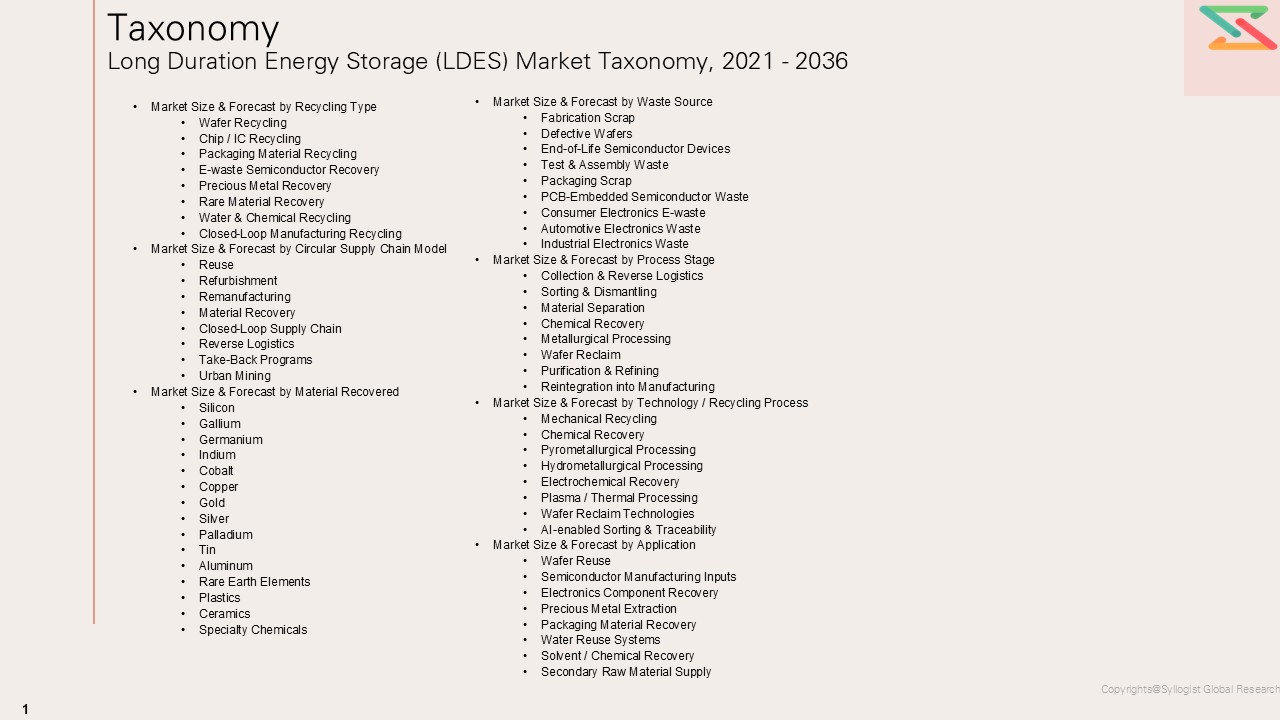
- Segmentation By Recycling Type
- Wafer Recycling
- Chip / IC Recycling
- Packaging Material Recycling
- E-waste Semiconductor Recovery
- Precious Metal Recovery
- Rare Material Recovery
- Water & Chemical Recycling
- Closed-Loop Manufacturing Recycling
- Segmentation By Circular Supply Chain Model
- Reuse
- Refurbishment
- Remanufacturing
- Material Recovery
- Closed-Loop Supply Chain
- Reverse Logistics
- Take-Back Programs
- Urban Mining
- Segmentation By Material Recovered
- Silicon
- Gallium
- Germanium
- Indium
- Cobalt
- Copper
- Gold
- Silver
- Palladium
- Tin
- Aluminum
- Rare Earth Elements
- Plastics
- Ceramics
- Specialty Chemicals
- Segmentation By Waste Source
- Fabrication Scrap
- Defective Wafers
- End-of-Life Semiconductor Devices
- Test & Assembly Waste
- Packaging Scrap
- PCB-Embedded Semiconductor Waste
- Consumer Electronics E-waste
- Automotive Electronics Waste
- Industrial Electronics Waste
- Segmentation By Process Stage
- Collection & Reverse Logistics
- Sorting & Dismantling
- Material Separation
- Chemical Recovery
- Metallurgical Processing
- Wafer Reclaim
- Purification & Refining
- Reintegration into Manufacturing
- Segmentation By Technology / Recycling Process
- Mechanical Recycling
- Chemical Recovery
- Pyrometallurgical Processing
- Hydrometallurgical Processing
- Electrochemical Recovery
- Plasma / Thermal Processing
- Wafer Reclaim Technologies
- AI-enabled Sorting & Traceability
- Segmentation By Application
- Wafer Reuse
- Semiconductor Manufacturing Inputs
- Electronics Component Recovery
- Precious Metal Extraction
- Packaging Material Recovery
- Water Reuse Systems
- Solvent / Chemical Recovery
- Secondary Raw Material Supply
All market revenues are presented in USD
Historical Year: 2021–2024 | Base Year: 2025 | Estimated Year: 2026 | Forecast Period: 2027–2036
Key Questions this Study Will Answer
- What is the projected global market valuation and capacity (GWh) through 2031? This provides the quantitative foundation for the study, establishing the expected growth rate and the total addressable market as LDES moves from pilot projects to utility-scale deployment.
- Which technology subsets, mechanical, thermal, or electrochemical, are most likely to achieve cost parity with traditional peaker plants? The study will analyze the levelized cost of storage (LCOS) across different LDES categories to identify the most commercially viable solutions for multi-day firming.
- How do regional regulatory frameworks, such as the U.S. Inflation Reduction Act and the UK’s cap-and-floor model, impact project bankability? This question explores how government incentives and market design shifts provide the revenue certainty required to attract institutional infrastructure investment.
- What is the total addressable opportunity within the Beyond-Utility segment, specifically for AI-driven data centers? The study will evaluate the rising demand from hyperscale operators who require long-duration storage to meet 24/7 carbon-free energy goals and ensure operational resilience.
- Who are the leading technology incumbents and emerging pure-play LDES startups, and what are their competitive moats? A detailed competitive landscape will reveal which players have the most scalable manufacturing processes, strategic partnerships, and robust intellectual property portfolios to dominate the next decade.
- Product Definition
- Research Methodology
- Research Design & Framework
- Overall Research Approach: Descriptive, Exploratory & Quantitative Mixed-Method Design
- Market Definition & Scope Boundaries: What is Included and Excluded
- Segmentation Framework
- Key Research Assumptions & Limitations
- Secondary Research
- Primary Research Design & Execution
- Data Triangulation & Validation
- Market Sizing & Forecasting Methodology
- Competitive Intelligence Methodology
- Quality Assurance & Peer Review
- Definitions, Abbreviations & Data Notes
- Research Design & Framework
- Executive Summary
- Market Snapshot & Headline Numbers
- Key Findings & Research Highlights
- Market Dynamics
- Regional Market Summary
- Competitive Landscape Snapshot
- Technology & Innovation Highlights
- Market Dynamics
- Drivers
- Restraints
- Opportunities
- Challenges
- Porter’s Five Forces Analysis
- PESTLE Analysis
- Market Trends & Developments
- Emerging Trends
- Technological Developments
- Regulatory & Policy Changes
- Supply Chain & Sourcing Trends
- Consumer & Demand Trends
- Investment & Funding Activity
- Sustainability & ESG Trends
- Geographic & Regional Trends
- Risk Assessment Framework
- Political / Geopolitical Risk
- Fuel & Component Supply Risk
- Environmental and Regulatory Risk
- Financial / Market Risk
- Regulatory Framework & Standards
- Global Long Duration Energy Storage (LDES) Market Outlook
- Market Size & Forecast by Value
- Market Size & Forecast by Recycling Type
- Wafer Recycling
- Chip / IC Recycling
- Packaging Material Recycling
- E-waste Semiconductor Recovery
- Precious Metal Recovery
- Rare Material Recovery
- Water & Chemical Recycling
- Closed-Loop Manufacturing Recycling
- Market Size & Forecast by Circular Supply Chain Model
- Reuse
- Refurbishment
- Remanufacturing
- Material Recovery
- Closed-Loop Supply Chain
- Reverse Logistics
- Take-Back Programs
- Urban Mining
- Market Size & Forecast by Material Recovered
- Silicon
- Gallium
- Germanium
- Indium
- Cobalt
- Copper
- Gold
- Silver
- Palladium
- Tin
- Aluminum
- Rare Earth Elements
- Plastics
- Ceramics
- Specialty Chemicals
- Market Size & Forecast by Waste Source
- Fabrication Scrap
- Defective Wafers
- End-of-Life Semiconductor Devices
- Test & Assembly Waste
- Packaging Scrap
- PCB-Embedded Semiconductor Waste
- Consumer Electronics E-waste
- Automotive Electronics Waste
- Industrial Electronics Waste
- Market Size & Forecast by Process Stage
- Collection & Reverse Logistics
- Sorting & Dismantling
- Material Separation
- Chemical Recovery
- Metallurgical Processing
- Wafer Reclaim
- Purification & Refining
- Reintegration into Manufacturing
- Market Size & Forecast by Technology / Recycling Process
- Mechanical Recycling
- Chemical Recovery
- Pyrometallurgical Processing
- Hydrometallurgical Processing
- Electrochemical Recovery
- Plasma / Thermal Processing
- Wafer Reclaim Technologies
- AI-enabled Sorting & Traceability
- Market Size & Forecast by Application
- Wafer Reuse
- Semiconductor Manufacturing Inputs
- Electronics Component Recovery
- Precious Metal Extraction
- Packaging Material Recovery
- Water Reuse Systems
- Solvent / Chemical Recovery
- Secondary Raw Material Supply
- Asia-Pacific Long Duration Energy Storage (LDES) Market Outlook
- Market Size & Forecast
- By Value
- By Recycling Type
- By Circular Supply Chain Model
- By Material Recovered
- By Waste Source
- By Process Stage
- By Technology / Recycling Process
- By Application
- Market Size & Forecast
- Europe Long Duration Energy Storage (LDES) Market Outlook
- Market Size & Forecast
- By Value
- By Recycling Type
- By Circular Supply Chain Model
- By Material Recovered
- By Waste Source
- By Process Stage
- By Technology / Recycling Process
- By Application
- Market Size & Forecast
- North America Long Duration Energy Storage (LDES) Market Outlook
- Market Size & Forecast
- By Value
- By Recycling Type
- By Circular Supply Chain Model
- By Material Recovered
- By Waste Source
- By Process Stage
- By Technology / Recycling Process
- By Application
- Market Size & Forecast
- Latin America Long Duration Energy Storage (LDES) Market Outlook
- Market Size & Forecast
- By Value
- By Recycling Type
- By Circular Supply Chain Model
- By Material Recovered
- By Waste Source
- By Process Stage
- By Technology / Recycling Process
- By Application
- Market Size & Forecast
- Middle East & Africa Long Duration Energy Storage (LDES) Market Outlook
- Market Size & Forecast
- By Value
- By Recycling Type
- By Circular Supply Chain Model
- By Material Recovered
- By Waste Source
- By Process Stage
- By Technology / Recycling Process
- By Application
- Market Size & Forecast
- Country Wise* Long Duration Energy Storage (LDES) Market Outlook
- Market Size & Forecast
- By Value
- By Recycling Type
- By Circular Supply Chain Model
- By Material Recovered
- By Waste Source
- By Process Stage
- By Technology / Recycling Process
- By Application
- Market Size & Forecast
*Countries Analyzed in the Syllogist Global Research Portfolio: United States, Canada, Germany, United Kingdom, France, Italy, Spain, Netherlands, Switzerland, China, Japan, India, South Korea, Australia, Brazil, Mexico, Saudi Arabia, South Africa, UAE
- Technology Landscape & Innovation Analysis
- Value Chain & Supply Chain Analysis
- Pricing Analysis
- Sustainability & Energy Efficiency
- Competitive Landscape
- Market Structure & Concentration
- Market Consolidation Level (Fragmented Vs Consolidated)
- Top 5 Players Market Share
- HHI (Herfindahl–Hirschman Index) Concentration Analysis
- Competitive Intensity Map
- Player Classification
- Market Leaders
- Strong Challengers
- Specialist / Niche Players
- Emerging Players
- Regional Players
- Competitive Analysis Frameworks
- Market Share Analysis
- Company Profile
- Company Overview & HQ
- Products & Solutions Portfolio
- Overall Revenue & Segmental Revenue
- Geographic Presence
- Recent Developments (M&A, Launches, Partnerships)
- SWOT Analysis
- Strategic Focus Areas
- Competitive Positioning Map
- Market Structure & Concentration
- Strategic Output
- Market Opportunity Matrix
- White Space Opportunity Analysis
- Strategic Recommendations
- Raw Material Recovery & Feedstock Strategy
- Closed-Loop Supply Chain Strategy
- Technology & Innovation Strategy
- Partnerships & Ecosystem Strategy
- Regional Expansion Strategy
- Cost & Commercial Strategy
- ESG & Regulatory Strategy
- Risk Management Strategy
- Investment & Long-Term Growth Strategy
- Strategic Priority Matrix & Roadmap
- Near-term (2025–2028)
- Mid-term (2029–2032)
- Long-term (2033–2036)