Phosgene as a Strategic Intermediate in Germany’s Isocyanates and Specialty Chemicals Value Chain
Phosgene is a highly reactive carbonyl chloride compound used primarily as an intermediate in the manufacture of isocyanates, polycarbonate intermediates, agrochemical intermediates, pharmaceutical intermediates, and other specialty chemicals. In Germany, phosgene is not a broad merchant commodity but a tightly controlled industrial intermediate used mainly within integrated chemical sites. Its usage pattern is dominated by downstream production of MDI, TDI, aliphatic isocyanates, and selected chloroformate- and carbamoyl chloride-based intermediates. As a result, the German phosgene market is best understood not as a standalone traded chemical market, but as a critical upstream building block embedded in the country’s advanced polyurethane, engineering plastics, and specialty chemicals ecosystem.
Demand, Supply, and Consumption: Germany’s Market Is Large, Integrated, and Primarily Captive in Nature
Germany represents one of Europe’s most important phosgene-consuming markets because of its strong base in isocyanates, polyurethanes, engineering plastics, and high-value intermediates. Domestic production is concentrated within large integrated chemical complexes, where phosgene is typically generated on-site and consumed captively due to its hazardous nature and limited transportability. This means Germany’s market size is substantial in functional terms, but visible import-export activity is far smaller than for more freely traded chemicals. Imports exist mainly in the form of downstream derivatives rather than large direct phosgene trade flows, while any direct cross-border movements are highly specialized and tightly regulated. Overall, Germany’s phosgene demand is mature but resilient, and the market is expected to post modest, steady growth over the medium term, supported by continued demand in polyurethane systems, specialty materials, and industrial manufacturing.
Downstream Polyurethane and Performance Materials Drive Demand, While Regulation and Safety Shape Market Constraints
The key growth driver for Germany’s phosgene market is sustained demand from downstream isocyanate chains, especially polyurethane systems used in building insulation, automotive interiors, appliances, coatings, adhesives, sealants, and industrial elastomers. Germany’s advanced manufacturing base also supports demand for phosgene-linked specialty intermediates in pharmaceuticals, agrochemicals, and engineered materials. However, the market is equally shaped by major constraints. Because phosgene is highly toxic and hazardous, production, handling, storage, and transfer are subject to stringent safety and environmental controls, raising operational complexity and limiting merchant trade. In addition, energy costs, feedstock price fluctuations, and industrial decarbonization pressure can affect the competitiveness of German chemical production. As a result, the market benefits from strong downstream linkages, but growth remains closely tied to operating efficiency, regulatory compliance, and the health of Germany’s broader industrial base.
Conventional Carbon Monoxide–Chlorine Chemistry Remains Standard, While Process Safety and Integration Are the Main Innovation Frontiers
Phosgene production in Germany continues to rely on the established reaction of carbon monoxide and chlorine under controlled catalytic conditions. The key raw materials therefore remain carbon monoxide, chlorine, and integrated utility infrastructure, supported by highly engineered containment and process-control systems. Because of phosgene’s hazardous nature, innovation in this market is less about changing the fundamental chemistry and more about improving closed-loop processing, plant integration, advanced monitoring, leak prevention, emergency containment, and downstream conversion efficiency. Future technology development is likely to focus on better process intensification, digital safety systems, lower-emission plant operations, and deeper integration with downstream isocyanate and specialty-intermediate units. In practical terms, Germany’s competitive advantage will depend on operating one of the safest and most efficient phosgene-based production systems in Europe rather than shifting away from conventional raw materials in the near term.
Integrated Chemical Clusters, Isocyanate Chains, and High-Purity Specialty Applications Offer the Strongest Opportunities
The main hotspots for phosgene demand in Germany are the country’s large chemical manufacturing clusters, especially those with strong polyurethane, engineering materials, and specialty chemicals infrastructure. These industrial hubs benefit from integrated feedstock access, established chemical logistics, skilled technical labor, and downstream conversion capacity. By application, isocyanates remain the dominant and most commercially important outlet, particularly MDI, TDI, and related polyurethane raw materials. By end use, the strongest growth pockets are linked to insulation materials, automotive systems, construction chemicals, performance coatings, and selected industrial manufacturing applications. In terms of product profile, the most attractive segment is not bulk merchant phosgene but high-integrity, tightly controlled phosgene use in integrated, high-value downstream manufacturing, where consistency, process reliability, and regulatory compliance matter more than volume alone.
Germany’s Phosgene Market Is Evolving Toward Safer, More Efficient, and More Integrated Production Models
Recent market direction suggests that Germany’s phosgene industry is becoming even more integration-driven, with greater emphasis on site safety, energy efficiency, environmental performance, and downstream value capture. Producers are increasingly focused on improving conversion efficiency into isocyanates and specialty intermediates rather than expanding visible merchant market activity. At the same time, tighter environmental expectations and industrial competitiveness pressures are encouraging chemical companies to optimize plant performance, modernize process-control systems, and strengthen resilience across feedstock and downstream chains. The overall conclusion is that Germany remains one of the most strategically important phosgene markets in Europe, not because of open-market trade volumes, but because of its role as a core production base for advanced polyurethane and specialty chemical value chains.
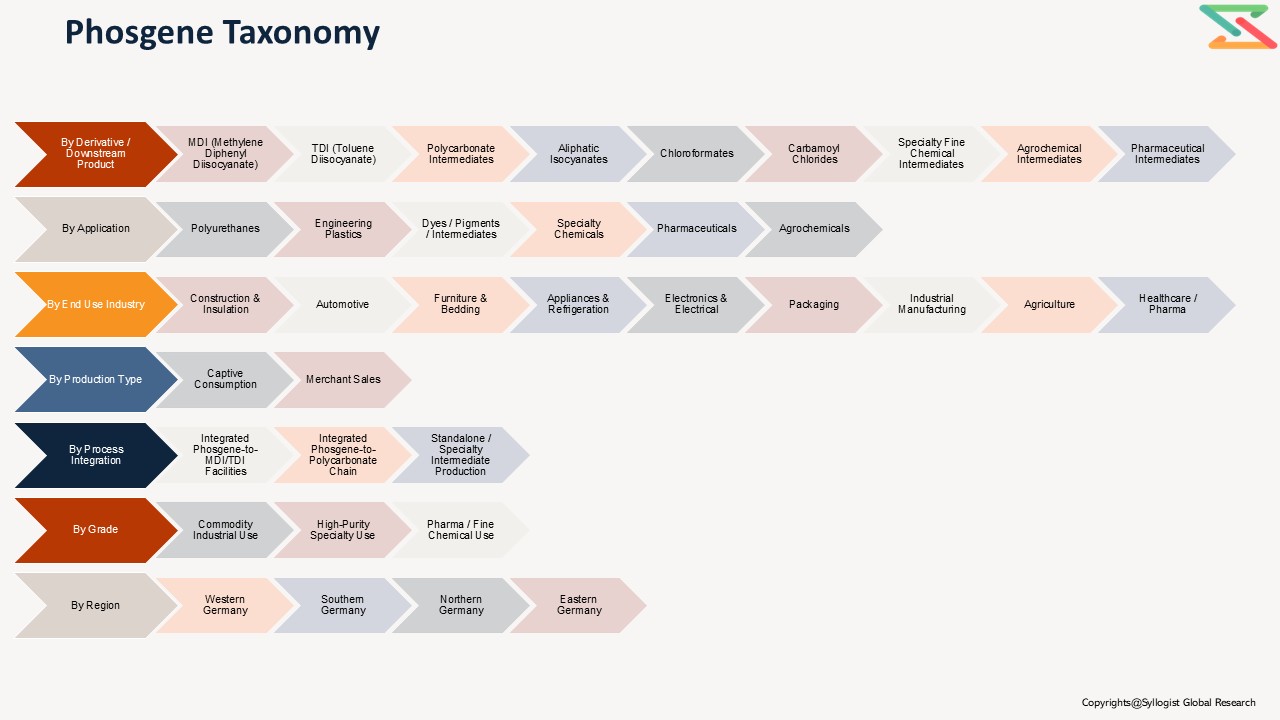
Market Segmentation:
- Segmentation by Derivative / Downstream Product
- MDI (Methylene Diphenyl Diisocyanate)
- TDI (Toluene Diisocyanate)
- Polycarbonate Intermediates
- Aliphatic Isocyanates
- Chloroformates
- Carbamoyl Chlorides
- Specialty Fine Chemical Intermediates
- Agrochemical Intermediates
- Pharmaceutical Intermediates
- Segmentation by Application
- Polyurethanes
- Rigid Foam
- Flexible Foam
- CASE (Coatings, Adhesives, Sealants, Elastomers)
- Engineering Plastics
- Polycarbonate
- Specialty Thermoplastics
- Agrochemicals
- Pharmaceuticals
- Specialty Chemicals
- Dyes / Pigments / Intermediates
- Polyurethanes
- Segmentation by End Use Industry
- Construction & Insulation
- Automotive
- Furniture & Bedding
- Appliances & Refrigeration
- Electronics & Electrical
- Packaging
- Industrial Manufacturing
- Agriculture
- Healthcare / Pharma
- Segmentation by Product Type
- Captive Consumption
- Merchant Sales
- Segmentation by Process Integration
- Integrated Phosgene-to-MDI/TDI Facilities
- Integrated Phosgene-to-Polycarbonate Chain
- Standalone / Specialty Intermediate Production
- Segmentation by Grade
- Commodity Industrial Use
- High-Purity Specialty Use
- Pharma / Fine Chemical Use
- Introduction (Product Definition, Taxonomy and Research Methodology)
- Executive Summary
- Global Phosgene Demand Supply Analysis
- Global Phosgene Market Assessment, 2021-2036
- Global Market Outlook (Value, Volume and Segmental Analysis)
- Germany Phosgene Market Assessment, 2021-2036
- Market Size & Forecast by Value
- Market Size & Forecast by Volume
- Market Size & Forecast by Derivative / Downstream Product
- MDI (Methylene Diphenyl Diisocyanate)
- TDI (Toluene Diisocyanate)
- Polycarbonate Intermediates
- Aliphatic Isocyanates
- Chloroformates
- Carbamoyl Chlorides
- Specialty Fine Chemical Intermediates
- Agrochemical Intermediates
- Pharmaceutical Intermediates
- Market Size & Forecast by Application
- Polyurethanes
- Rigid Foam
- Flexible Foam
- CASE (Coatings, Adhesives, Sealants, Elastomers)
- Engineering Plastics
- Polycarbonate
- Specialty Thermoplastics
- Agrochemicals
- Pharmaceuticals
- Specialty Chemicals
- Dyes / Pigments / Intermediates
- Polyurethanes
- Market Size & Forecast by End Use Industry
- Construction & Insulation
- Automotive
- Furniture & Bedding
- Appliances & Refrigeration
- Electronics & Electrical
- Packaging
- Industrial Manufacturing
- Agriculture
- Healthcare / Pharma
- Market Size & Forecast by Product Type
- Captive Consumption
- Merchant Sales
- Market Size & Forecast by Process Integration
- Integrated Phosgene-to-MDI/TDI Facilities
- Integrated Phosgene-to-Polycarbonate Chain
- Standalone / Specialty Intermediate Production
- Market Size & Forecast by Grade
- Commodity Industrial Use
- High-Purity Specialty Use
- Pharma / Fine Chemical Use
- White Space & Emerging Investment Hotspot
- Market White Space Opportunities
- Mergers & Acquisitions (M&A)
- Joint Ventures & Strategic Alliances
- Technology & Innovation Hotspots
- Regional Investment Attractiveness
- Barriers & Risks in Investment
- Germany Phosgene Market Value Chain Analysis
- Raw Material Sourcing & Suppliers
- Key Raw Materials & Inputs
- Supplier Landscape & Concentration
- Pricing Trends & Volatility
- Dependence on Imports vs Domestic Availability
- Distribution & Logistics
- Marketing & Sales Channels
- Value Addition & Profitability across Chain
- Emerging Trends & Disruptions
- Raw Material Sourcing & Suppliers
- Germany Phosgene Market Pricing Analysis
- Historical Vs Projected Pricing Analysis
- Demand-Supply Impact on Prices
- Application-wise Pricing Differences
- Impact of Tariffs, Taxes, and Trade Policies
- Key Player Pricing Strategies
- Germany Phosgene Technology Landscape
- Key Existing Technologies
- Emerging & Next-gen Technologies
- Strategic Insights
- Future Technology Roadmap
- Opportunities for Differentiation via Technology
- Risks of Obsolescence & Barriers to Adoption
- Policy & Regulatory landscape
- Competition Outlook (Leading 10 Companies)
- Competition Benchmarking
- Market Leaders Vs New Entrants
- Strategic Recommendations