
Market Definition
Photoresist chemicals are light-sensitive specialty materials used primarily in photolithography to transfer intricate circuit patterns onto semiconductor wafers, printed circuit boards (PCBs), and flat-panel displays. These chemicals are categorized into two functional types: positive photoresists, which become more soluble upon exposure to light and are prized for their high resolution in advanced chipmaking; and negative photoresists, which polymerize and become insoluble, often used in thicker-layer applications like MEMS and older-generation packaging. Beyond the resist itself, the market encompasses essential process chemicals and ancillaries, including developers, strippers, thinners, and anti-reflective coatings, all of which must meet extreme purity standards (often measured in parts per trillion) to ensure high wafer yields in the fabrication process.
Global Photoresist Chemicals Market Insights
As of early 2026, the global photoresist chemicals market is in a period of high-value expansion, valued at approximately USD 38.0 billion in 2025 and projected to reach USD 40.3 billion in 2026. The market is exhibiting a compound annual growth rate (CAGR) of roughly 5.9% to 7.1%, depending on the inclusion of ancillary process chemicals. Asia-Pacific dominates the global landscape, commanding a staggering 70% market share due to the concentration of major foundries like TSMC and Samsung in the region. While traditional DUV (Deep Ultraviolet) resists still account for nearly 75% of the total volume, the value of the market is increasingly shifting toward high-end materials used in advanced nodes for AI, 5G, and high-performance computing.
Leading and Emerging Producing Countries
The production of high-end photoresist chemicals is one of the most concentrated segments in the global chemical industry, with Japan maintaining an absolute leadership position, controlling approximately 75% of the global semiconductor photoresist market. Tier-1 players like Tokyo Ohka Kogyo (TOK), JSR Corporation, Shin-Etsu Chemical, and Fujifilm dominate the high-end ArF and EUV segments. The United States and Europe remain critical hubs for research and the production of specialty ancillaries, led by DuPont and Merck (AZ Electronic Materials). However, 2026 is seeing a rapid localization push; China is the fastest-growing emerging producer, with firms like Xuzhou B&C Chemical and Red Avenue aggressively scaling KrF and ArF capacity to achieve semiconductor self-sufficiency, while South Korea continues to expand its domestic supply chain through Dongjin Semichem to reduce reliance on Japanese imports.
Current and Emerging Production Technologies
The current technological workhorse of the industry is ArF (Argon Fluoride) immersion lithography, which remains essential for 28nm to 7nm nodes. However, the high-value frontier has moved to EUV (Extreme Ultraviolet) lithography at 13.5 nm, which requires entirely new chemically amplified resists (CARs) and metal-oxide-based formulations to achieve sub-5nm precision. Emerging in 2025–2026 is the pilot commercialization of High-NA (High Numerical Aperture) EUV photoresists, designed for the next generation of Angstrom-era chips. On the manufacturing side, AI-based photoresist simulators (such as the open-source TorchResist) are now being used to optimize chemical formulations in real-time, while non-phosgene green synthesis routes for monomers are gaining traction to meet tightening global sustainability mandates.
Key Market Drivers and Challenges
The primary driver of the market is the explosive demand for advanced logic and memory chips fueled by the global AI boom, 5G infrastructure, and the transition to electric vehicles. Furthermore, massive fab expansion projects under the U.S. CHIPS Act and the European Chips Act are creating a permanent demand floor for these chemicals. However, the industry faces severe challenges, most notably the extreme capital intensity and the lengthy, high-risk qualification cycles; it can take 12 to 36 months for a chipmaker to approve a new photoresist formulation. Additionally, manufacturers must navigate increasingly stringent environmental regulations, particularly regarding perfluorooctanoic acid (PFOA) and REACH compliance in Europe, which are forcing a costly redesign of many legacy chemical formulations.
Market Hotspots and Opportunity Analysis
The most significant market hotspot through 2031 is China, where the push for domestic semiconductor sovereignty is driving record investment in local photoresist production and zero-defect quality control. Another major opportunity lies in Advanced Packaging (3D Packaging), which requires specialized thick-film resists for Through-Silicon Vias (TSVs) and redistribution layers (RDLs). For specialty chemical players, the EUV Ancillaries segment, including extreme-purity solvents and high-performance developers, represents a high-margin growth area. Finally, as sustainability becomes a procurement priority, there is a burgeoning opportunity for Greener electronic chemicals, such as bio-derived solvents and recyclable resist stripping systems, which are increasingly becoming a differentiator for top-tier foundry suppliers.
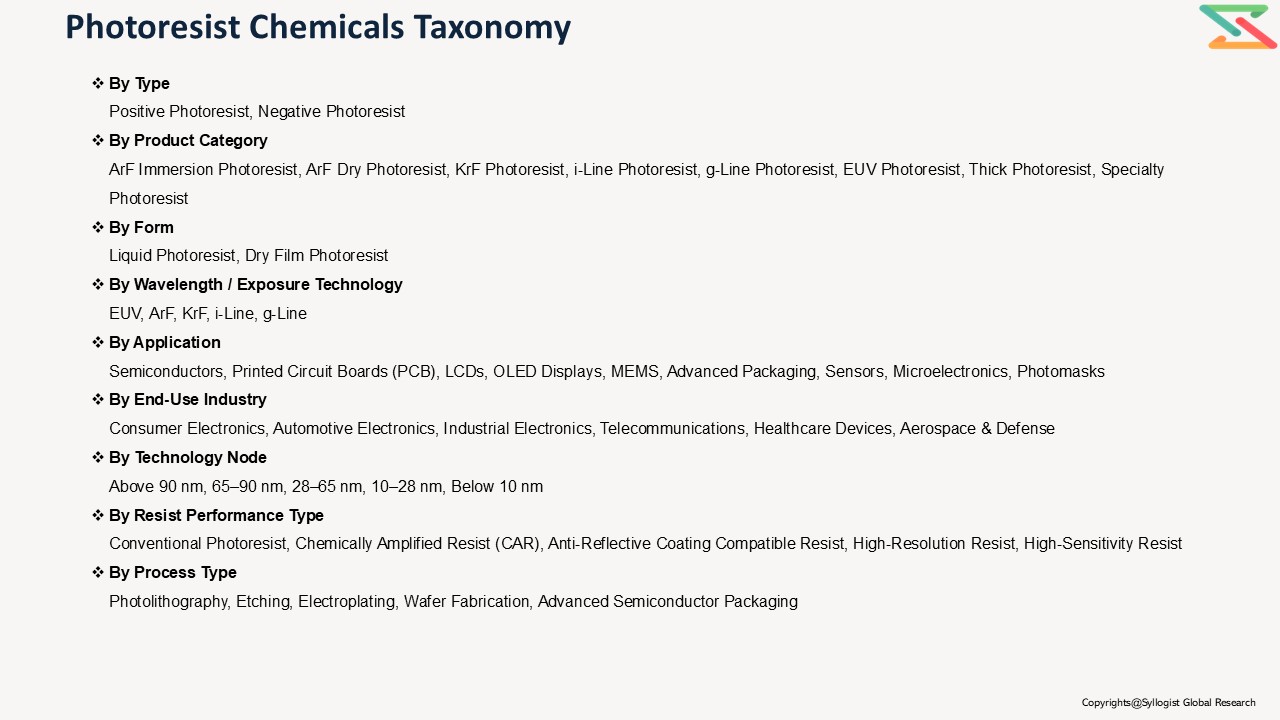
Market Segmentation
- Segmentation By Type
- Positive Photoresist
- Negative Photoresist
- Segmentation By Product Category
- ArF Immersion Photoresist
- ArF Dry Photoresist
- KrF Photoresist
- i-Line Photoresist
- g-Line Photoresist
- EUV Photoresist
- Thick Photoresist
- Specialty Photoresist
- Segmentation By Form
- Liquid Photoresist
- Dry Film Photoresist
- Segmentation By Wavelength / Exposure Technology
- EUV
- ArF
- KrF
- i-Line
- g-Line
- Segmentation By Application
- Semiconductors
- Printed Circuit Boards (PCB)
- LCDs
- OLED Displays
- MEMS
- Advanced Packaging
- Sensors
- Microelectronics
- Photomasks
- Segmentation By End Use Industry
- Consumer Electronics
- Automotive Electronics
- Industrial Electronics
- Telecommunications
- Healthcare Devices
- Aerospace & Defense
- Segmentation By Technology Node
- Above 90 nm
- 65–90 nm
- 28–65 nm
- 10–28 nm
- Below 10 nm
- Segmentation By Resist Performance Type
- Conventional Photoresist
- Chemically Amplified Resist (CAR)
- Anti-Reflective Coating Compatible Resist
- High-Resolution Resist
- High-Sensitivity Resist
- Segmentation By Process Type
- Photolithography
- Etching
- Electroplating
- Wafer Fabrication
- Advanced Semiconductor Packaging
- Introduction (Product Definition, Taxonomy and Research Methodology)
- Executive Summary
- Global Photoresist Chemicals Demand Supply Analysis
- Global Photoresist Chemicals Market Assessment, 2021-2036
- Market Size & Forecast by Value
- Market Size & Forecast by Volume
- Market Size & Forecast by Type
- Positive Photoresist
- Negative Photoresist
- Market Size & Forecast by Product Category
- ArF Immersion Photoresist
- ArF Dry Photoresist
- KrF Photoresist
- i-Line Photoresist
- g-Line Photoresist
- EUV Photoresist
- Thick Photoresist
- Specialty Photoresist
- Market Size & Forecast by Form
- Liquid Photoresist
- Dry Film Photoresist
- Market Size & Forecast by Wavelength / Exposure Technology
- EUV
- ArF
- KrF
- i-Line
- g-Line
- Market Size & Forecast by Application
- Semiconductors
- Printed Circuit Boards (PCB)
- LCDs
- OLED Displays
- MEMS
- Advanced Packaging
- Sensors
- Microelectronics
- Photomasks
- Market Size & Forecast by End Use Industry
- Consumer Electronics
- Automotive Electronics
- Industrial Electronics
- Telecommunications
- Healthcare Devices
- Aerospace & Defense
- Market Size & Forecast by Technology Node
- Above 90 nm
- 65–90 nm
- 28–65 nm
- 10–28 nm
- Below 10 nm
- Market Size & Forecast by Resist Performance Type
- Conventional Photoresist
- Chemically Amplified Resist (CAR)
- Anti-Reflective Coating Compatible Resist
- High-Resolution Resist
- High-Sensitivity Resist
- Market Size & Forecast by Process Type
- Photolithography
- Etching
- Electroplating
- Wafer Fabrication
- Advanced Semiconductor Packaging
- Asia-Pacific Photoresist Chemicals Market Assessment, 2021-2036
- Market Size & Forecast
- By Value
- By Volume
- By Type
- By Product Category
- By Form
- By Wavelength / Exposure Technology
- By Application
- By End Use Industry
- By Technology Node
- By Resist Performance Type
- By Process Type
- By Country (Market Share of Leading 5-6 Countries)
- Market Size & Forecast
- North America Photoresist Chemicals Market Assessment, 2021-2036
- Market Size & Forecast
- By Value
- By Volume
- By Type
- By Product Category
- By Form
- By Wavelength / Exposure Technology
- By Application
- By End Use Industry
- By Technology Node
- By Resist Performance Type
- By Process Type
- By Country (Market Share of Leading 5-6 Countries)
- Market Size & Forecast
- Europe Photoresist Chemicals Market Assessment, 2021-2036
- Market Size & Forecast
- By Value
- By Volume
- By Type
- By Product Category
- By Form
- By Wavelength / Exposure Technology
- By Application
- By End Use Industry
- By Technology Node
- By Resist Performance Type
- By Process Type
- By Country (Market Share of Leading 5-6 Countries)
- Market Size & Forecast
- Latin America Photoresist Chemicals Market Assessment, 2021-2036
- Market Size & Forecast
- By Value
- By Volume
- By Type
- By Product Category
- By Form
- By Wavelength / Exposure Technology
- By Application
- By End Use Industry
- By Technology Node
- By Resist Performance Type
- By Process Type
- By Country (Market Share of Leading 5-6 Countries)
- Market Size & Forecast
- Middle East & Africa Photoresist Chemicals Market Assessment, 2021-2036
- Market Size & Forecast
- By Value
- By Volume
- By Type
- By Product Category
- By Form
- By Wavelength / Exposure Technology
- By Application
- By End Use Industry
- By Technology Node
- By Resist Performance Type
- By Process Type
- By Country (Market Share of Leading 5-6 Countries)
- Market Size & Forecast
- White Space & Emerging Investment Hotspot
- Market White Space Opportunities
- Mergers & Acquisitions (M&A)
- Joint Ventures & Strategic Alliances
- Technology & Innovation Hotspots
- Regional Investment Attractiveness
- Barriers & Risks in Investment
- Value Chain Analysis
- Raw Material Sourcing & Suppliers
- Key Raw Materials & Inputs
- Supplier Landscape & Concentration
- Pricing Trends & Volatility
- Dependence on Imports vs Domestic Availability
- Distribution & Logistics
- Marketing & Sales Channels
- Value Addition & Profitability across Chain
- Emerging Trends & Disruptions
- Raw Material Sourcing & Suppliers
- Pricing Analysis
- Historical Vs Projected Pricing Analysis
- Demand-Supply Impact on Prices
- Application-wise Pricing Differences
- Impact of Tariffs, Taxes, and Trade Policies
- Key Player Pricing Strategies
- Technology Landscape
- Key Existing Technologies
- Emerging & Next-gen Technologies
- Strategic Insights
- Future Technology Roadmap
- Opportunities for Differentiation via Technology
- Risks of Obsolescence & Barriers to Adoption
- Policy & Regulatory landscape
- Competition Outlook (Leading 10 Companies)
- Competition Benchmarking
- Market Leaders Vs New Entrants
- Strategic Recommendations