Market Definition
Precision Farming (or Precision Agriculture) is a data-driven agricultural management strategy derived primarily from the integration of advanced digital technologies, most commonly GPS/GNSS, Internet of Things (IoT) sensors, drones (UAVs), satellite imagery, and autonomous robotics. Through processes such as real-time data collection, geospatial mapping, predictive analytics, and Variable Rate Technology (VRT), these technological inputs are converted into key farm management building blocks: yield monitors, automated steering systems, soil condition analytics, smart irrigation controls, and comprehensive Farm Management Software (FMS).
These hardware and software solutions are integral to a wide range of downstream agronomic applications, ,including crop scouting, targeted nutrient and agrochemical application, micro-climate forecasting, livestock monitoring, and automated harvesting. As global agricultural operations shift toward resource optimization, yield maximization, and climate-resilient practices, precision farming has emerged as an essential alternative to traditional, blanket-application agronomy.
The agricultural sector is undergoing a structural transformation driven by acute labor shortages, escalating input costs, rigorous environmental regulations, and the rising imperative of global food security. The rapid integration of Artificial Intelligence (AI), machine learning, edge computing, and regenerative agriculture models (such as carbon farming) is radically upgrading farm capabilities. This positions precision farming as a critical enabler in the global transition toward sustainable, traceable, and highly optimized agricultural production.
Market Insights
The precision farming industry represents a large, multi-billion-dollar global market anchored by North America’s early technological adoption and expanding aggressive deployment across Europe, Asia-Pacific, and Latin America. The market was valued at approximately USD 12 billion in 2024 and is expected to grow at a robust CAGR of 12% through 2035, supported by rising demand across crop monitoring, smart irrigation, automated harvesting, variable rate application (VRA), and livestock management.
Hardware (such as GPS/GNSS systems, drones, and IoT sensors) and Farm Management Software remain the largest product categories, driven by their extensive use in yield mapping, fleet routing, and real-time field analytics. Autonomous machinery continues to benefit from expanding artificial intelligence and computer vision applications, while predictive analytics and satellite imagery are gaining traction in micro-climate forecasting, carbon farming, and agronomic modeling.
Data-led agronomy is transforming the agricultural value chain. Global food processors, cooperatives, and agribusinesses are prioritizing traceable, tech-enabled sustainable practices, while equipment OEMs are investing in edge computing, machine learning platforms, and interoperable cloud ecosystems. As environmental regulations around water use and chemical runoff tighten, precision farming is shifting from a niche technological luxury to a strategic, compliance-linked, high-ROI operational necessity.
Market Dynamics: Drivers
Growing Need for Yield Optimization & Resource Efficiency Precision farming offers targeted, data-driven, and highly efficient alternatives to traditional “blanket-application” agronomy. Rising economic pressures to reduce the consumption of expensive inputs, such as fertilizers, pesticides, and fuel, are accelerating the shift toward Variable Rate Technology (VRA). Farm operators across the globe are redesigning their workflows to incorporate automated steering, smart sprayers, and soil moisture sensors to maximize output while drastically minimizing chemical waste and ecological impact.
Escalating Global Food Demand & Shrinking Arable Land Rapid urbanization, population growth, and erratic climate patterns are driving the urgent demand for significantly higher crop yields on a shrinking footprint of arable land. The global agricultural and food security sectors are increasingly relying on precision agriculture technologies due to their proven ability to mitigate weather risks, monitor real-time crop health, enhance soil preservation, and deliver consistent, resilient harvests season over season.
Technological Innovation Across AI, IoT & Autonomous Systems The industry is experiencing a profound shift toward AI-driven predictive analytics, advanced computer vision, autonomous robotics, and drone-based multispectral scouting that collectively improve farm efficiency and crop consistency. Innovations such as Low-Earth Orbit (LEO) satellite connectivity, 5G rural networks, and universal ISOBUS standards are broadening system integration. These advancements enhance machinery performance and unlock new specialty automation opportunities in broadacre, orchard, and vineyard management.
Market Dynamics: Challenges
High Initial Capital Expenditure (CAPEX) & The Digital Divide Implementing advanced technological frameworks, such as autonomous tractor fleets, real-time kinematics (RTK) networks, and comprehensive Farm Management Information Systems (FMIS), requires producers to make significant upfront investments and shoulder ongoing SaaS subscription fees. Meeting these financial requirements increases cost burdens and limits technological adoption, particularly for smallholder farmers and mid-sized operations in developing regions, thereby widening the digital divide in agriculture.
Data Integration, Connectivity Gaps & Cybersecurity Risks Precision farming success depends heavily on continuous, high-speed data transmission, which is frequently hindered by inadequate rural broadband infrastructure and cellular dead zones. Furthermore, the lack of standardized data protocols between competing OEM equipment (creating “walled gardens”) alongside rising concerns over data ownership, privacy, and farm-level cybersecurity directly impact operational efficiency, making long-term digital integration complex for farmers.
Market Segmentation
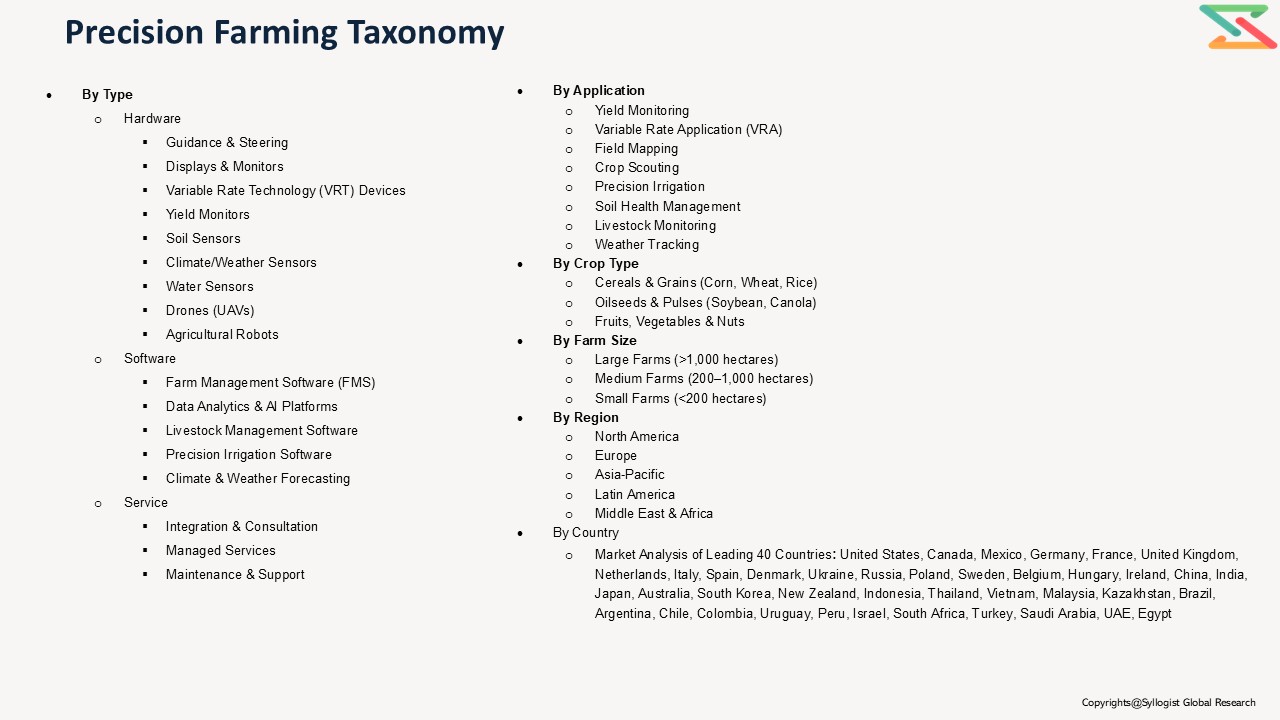
- By Type
- Hardware
- Guidance & Steering
- Displays & Monitors
- Variable Rate Technology (VRT) Devices
- Yield Monitors
- Soil Sensors
- Climate/Weather Sensors
- Water Sensors
- Drones (UAVs)
- Agricultural Robots
- Software
- Farm Management Software (FMS)
- Data Analytics & AI Platforms
- Livestock Management Software
- Precision Irrigation Software
- Climate & Weather Forecasting
- Service
- Integration & Consultation
- Managed Services
- Maintenance & Support
- By Application
- Yield Monitoring
- Variable Rate Application (VRA)
- Field Mapping
- Crop Scouting
- Precision Irrigation
- Soil Health Management
- Livestock Monitoring
- Weather Tracking
- By Crop Type
- Cereals & Grains (Corn, Wheat, Rice)
- Oilseeds & Pulses (Soybean, Canola)
- Fruits, Vegetables & Nuts
- By Farm Size
- Large Farms (>1,000 hectares)
- Medium Farms (200–1,000 hectares)
- Small Farms (<200 hectares)
- By Region
- North America
- Europe
- Asia-Pacific
- Latin America
- Middle East & Africa
- By Country
- Market Analysis of Leading 40 Countries
- United States, Canada, Mexico, Germany, France, United Kingdom, Netherlands, Italy, Spain, Denmark, Ukraine, Russia, Poland, Sweden, Belgium, Hungary, Ireland, China, India, Japan, Australia, South Korea, New Zealand, Indonesia, Thailand, Vietnam, Malaysia, Kazakhstan, Brazil, Argentina, Chile, Colombia, Uruguay, Peru, Israel, South Africa, Turkey, Saudi Arabia, UAE, Egypt
- Market Analysis of Leading 40 Countries
- Hardware
Revenue: USD Billion
Historical Years: 2020–2024
Base Year: 2025
Estimated: 2026
Forecast: 2027–2035
Key Questions this Study will Answer
- What are the key overall market statistics or market estimates (Market Overview, Market Size- By Value, Market Size-By Volume, Forecast Numbers, Market Segmentation, Market Shares) of Global Precision Farming Market?
- What is the region wise industry size, growth drivers and challenges key market trends?
- What are the key innovations, opportunities, current and future trends and regulations in the Global Precision Farming Market?
- Who are the key competitors, what are their key strength and weakness and how they perform in Global Precision Farming Market based on competitive benchmarking matrix?
- What are the key results derived from the market surveys conducted during Global Precision Farming Market study?
- Executive Summary
- Market Overview
- Key Findings
- Market Size & Forecast Snapshot
- Growth Drivers & Challenges
- Competitive Landscape Highlights
- Introduction
- Definition & Scope of Precision Farming
- Value Chain Overview
- Technology Evolution
- Stakeholder Ecosystem
- Market Overview
- Market Size & Forecast (Value & Volume)
- Market Size & Forecast by Type
- Hardware
- Guidance & Steering Systems
- Displays & Monitors
- Variable Rate Technology (VRT) Devices
- Yield Monitors
- Soil Sensors
- Climate & Weather Sensors
- Water Sensors
- Drones (UAVs)
- Agricultural Robots
- Software
- Farm Management Software (FMS)
- Data Analytics & AI Platforms
- Livestock Management Software
- Precision Irrigation Software
- Climate & Weather Forecasting Platforms
- Services
- Integration & Consultation
- Managed Services
- Maintenance & Support
- Market Size & Forecast by Application
- Yield Monitoring
- Variable Rate Application (VRA)
- Field Mapping
- Crop Scouting
- Precision Irrigation
- Soil Health Management
- Livestock Monitoring
- Weather Tracking
- Market Size & Forecast by Crop Type
- Cereals & Grains (Corn, Wheat, Rice)
- Oilseeds & Pulses (Soybean, Canola)
- Fruits, Vegetables & Nuts
- Market Size & Forecast by Farm Size
- Large Farms (>1,000 hectares)
- Medium Farms (200–1,000 hectares)
- Small Farms (<200 hectares)
- Market Size & Forecast by Competition
- Market Size & Forecast by Region
- North America
- Europe
- Asia-Pacific
- Latin America
- Middle East & Africa
- Hardware
- Similar level of detail will be provided for all 5 regions and 40 countries listed below:
- United States, Canada, Mexico, Germany, France, United Kingdom, Netherlands, Italy, Spain, Denmark, Ukraine, Russia, Poland, Sweden, Belgium, Hungary, Ireland, China, India, Japan, Australia, South Korea, New Zealand, Indonesia, Thailand, Vietnam, Malaysia, Kazakhstan, Brazil, Argentina, Chile, Colombia, Uruguay, Peru, Israel, South Africa, Turkey, Saudi Arabia, UAE, Egypt
- Market Dynamics
- Growth Drivers
- Restraints
- Opportunities
- Emerging Trends
- Regulatory & Policy Landscape
- Policy & Regulatory Landscape
- Technology Adoption Lifecycle
- Competitive Landscape
- Market Share Analysis
- Company Benchmarking
- Product Portfolio Comparison
- Strategic Developments
- Mergers & Acquisitions
- Innovation & R&D Trends
- Investment & Opportunity Analysis
- White Space Opportunities
- High-Growth Application Segments
- Regional Investment Hotspots
- Technology Adoption Outlook
- Strategic Recommendations
- Market Entry Strategy
- Technology Differentiation Strategy
- Channel & Partnership Strategy
- Pricing & Commercial Strategy
- Long-Term Growth Roadmap