
Market Definition
PropTech (Property Technology) comprises digital tools and software solutions derived primarily from emerging technologies, most commonly artificial intelligence (AI), the Internet of Things (IoT), big data, cloud computing, and increasingly blockchain. Through processes such as data analytics, workflow automation, machine learning, and sensor integration, these technological feedstocks are converted into key PropTech building blocks: property management software, smart building platforms, automated valuation models, digital transaction marketplaces, and tenant experience applications.
These digital building blocks are integral to a wide range of downstream applications including residential property management, commercial asset optimization, real estate financing (FinTech), construction and design (ConTech), space utilization, and facility management. As global real estate markets shift toward data-driven, automated, and user-centric operations, PropTech has emerged as an essential alternative to traditional, paper-based, and manual real estate practices.
The industry is undergoing a structural transformation driven by ESG (Environmental, Social, and Governance) reporting mandates, smart city integration, decentralized finance (real estate tokenization), and green building technologies (GreenTech) such as predictive energy management and climate risk analytics. This positions PropTech as a critical enabler in the global transition toward sustainable, transparent, and technologically advanced real estate ecosystems.
Market Insights
The PropTech sector is currently positioned at the edge of a $200 billion frontier, poised for aggressive expansion as it scales from an estimated $42 billion in 2025 to nearly $200 billion by 2035. This remarkable leap represents a ~5.6x valuation multiple generated within a single decade, highlighting a rapidly accelerating growth trajectory. Having moved past the initial adoption phase of 2020–2024, the market is now entering a period of robust, sustained momentum. The growth curve is progressively steepening, driven by year-over-year compounding value creation rather than mere incremental gains. A critical inflection point is anticipated between 2028 and 2030, during which the growth trajectory will steepen sharply. By 2030, the market is forecast to cross the $95 billion threshold, marking a definitive industry shift from “Early Adoption” to “Mass Market Maturity”.
Market Dynamics: Drivers
AI Integration and Predictive Operations
Artificial Intelligence has transitioned from a buzzword into a core operational necessity. The market is being driven by predictive analytics that can automatically forecast maintenance needs to reduce breakdowns, execute real-time property valuations, and optimize asset yields, thereby directly lowering operating expenses (OPEX) and boosting ROI.
Sustainability and ESG Mandates
Green building requirements are no longer just for optics; they are an operational constraint and a massive growth driver. Property owners are rapidly adopting IoT sensors, smart HVAC controls, and carbon reporting software because high ESG compliance is now directly tied to premium property valuations, better financing terms, and higher rental yields.
Demand for Integrated Platforms
Real estate portfolios are shifting away from fragmented, standalone tools. There is a surging demand for comprehensive, cloud-based software platforms that consolidate leasing, maintenance, finance, and tenant communications into a single dashboard, vastly improving operational efficiency and the end-user experience.
Market Dynamics: Challenges
Cybersecurity and Data Privacy Risks
As buildings become hyper-connected through IoT and property transactions move entirely online, the attack surface for cyber threats has drastically expanded. The fear of data breaches, coupled with the escalating costs of implementing zero-trust networks and strict data governance protocols, is making risk-averse property owners hesitant to adopt new technologies.
Legacy Systems and Fragmented Regulations
The real estate industry historically resists change, leaving many firms burdened with outdated legacy tech (like basic spreadsheets) and high technical debt. Furthermore, PropTech companies face immense difficulty scaling across borders due to highly fragmented zoning laws, inconsistent property rights, and complex local compliance standards.
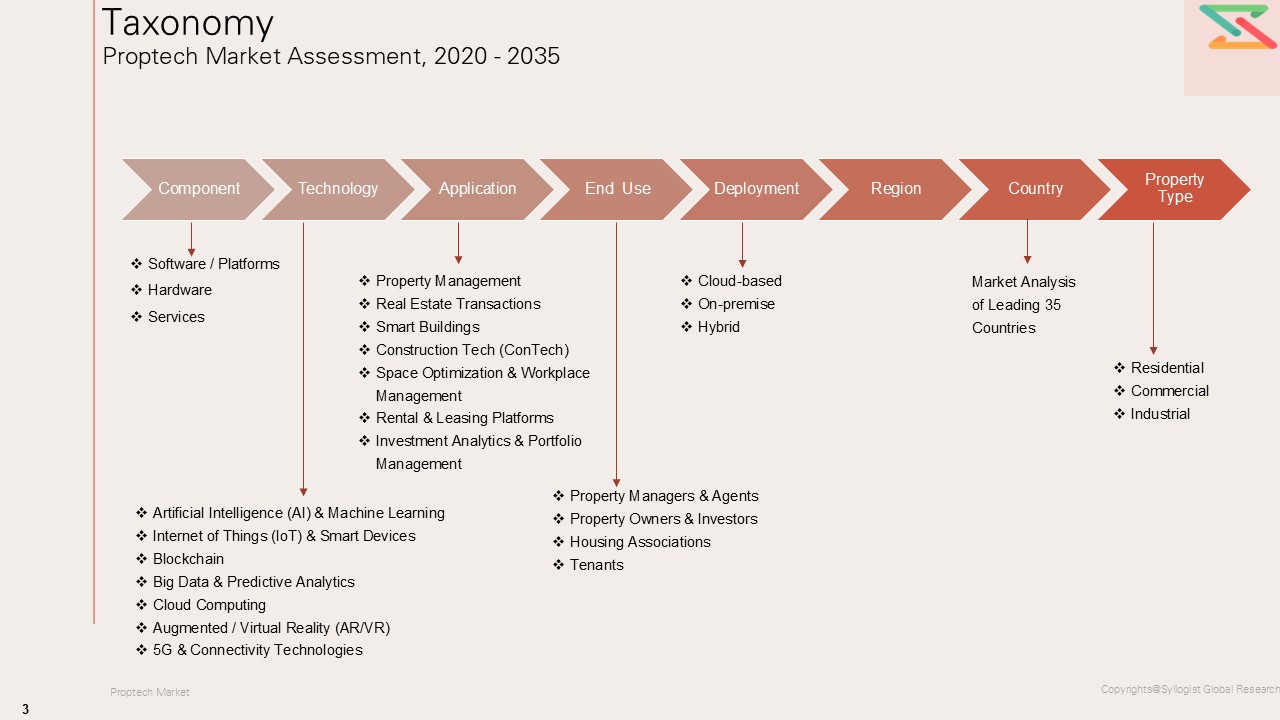
Market Segmentation
- By Component
- Software / Platforms
- Property management software
- Real estate analytics, transaction platforms
- Smart building & IoT solutions
- Virtual tour & visualization tools
- Hardware
- Smart sensors & IoT devices
- Security & access control
- Building automation controllers
- Services
- Consulting & implementation
- Data aggregation & licensing
- Integration & maintenance services
- By End Use
- Property Managers & Agents
- Property Owners & Investors
- Housing Associations
- Tenants
- By Technology
- Artificial Intelligence (AI) & Machine Learning
- Internet of Things (IoT) & Smart Devices
- Blockchain
- Big Data & Predictive Analytics
- Cloud Computing
- Augmented / Virtual Reality (AR/VR)
- 5G & Connectivity Technologies
- By Property Type
- Residential
- Single-family housing
- Multi-family properties
- Commercial
- Office & workspace
- Retail
- Hospitality
- Industrial
- Warehouses & logistics
- Manufacturing facilities
- By Deployment Mode
- Cloud-based
- On-premise
- Hybrid
- By Application
- Property Management
- Leasing & tenant engagement
- Facility management & maintenance
- Real Estate Transactions
- Brokerage platforms
- Digital contracts & payments
- Smart Buildings
- Energy management
- Occupancy tracking
- HVAC optimization
- Construction Tech (ConTech)
- Building information modeling
- Prefab & Lean construction tools
- Space Optimization & Workplace Management
- Flexible workspace platforms
- Coworking management solutions
- Rental & Leasing Platforms
- Short-term & long-term rentals
- Investment Analytics & Portfolio Management
- By Geography
- Asia-Pacific
- Europe
- North America
- Latin America
- Middle East & Africa
- Residential
- Software / Platforms
Revenue: USD Billion
Historical Years: 2020–2024
Base Year: 2025
Estimated: 2026
Forecast: 2027–2035
Key Questions this Study will Answer
- What are the key overall market statistics or market estimates (Market Overview, Market Size- By Value, Market Size-By Volume, Forecast Numbers, Market Segmentation, Market Shares) of Global Proptech Market?
- What is the region wise industry size, growth drivers and challenges key market trends?
- What are the key innovations, opportunities, current and future trends and regulations in the Global Proptech Market?
- Who are the key competitors, what are their key strength and weakness and how they perform in Global Proptech Market based on competitive benchmarking matrix?
- What are the key results derived from the market surveys conducted during Global Proptech Market study?
- Strategic Introduction
- Definition & Scope of the Global PropTech Market
- Market Architecture & Taxonomy (Component, Technology, Property Type, Deployment Mode, Application, End Use, Geography)
- Research Framework & Methodology
- Data Mining, Secondary & Primary Research
- Market Sizing & Validation (top-down, bottom-up, demand/supply analysis)
- Scenario Calibration (technology adoption rates, hybrid work trends, interest rate volatility, ESG regulatory shifts)
- Executive Insights
- Strategic snapshot of the Global PropTech market landscape, highlighting adoption drivers, smart city mandates, and technology scale-up readiness
- Key findings and actionable insights to guide boardroom decision-making, innovation strategy, and real estate portfolio expansion
- Future Outlook & Opportunity Mapping (2021–2031)
- Scenario Planning (Base, Optimistic, Conservative)
- Sensitivity Analysis (hardware/sensor pricing, data privacy requirements, cyber-regulatory tightening)
- Identification of regional investment hotspots and high-growth application/technology clusters
- PropTech’s Positioning in the Global Real Estate, Smart City, and ConTech Ecosystems
- Value Chain & Ecosystem Analysis
- PropTech’s Role Across Residential, Commercial, and Industrial Value Chains
- Digitalization in the Real Estate Value Chain (process automation, predictive maintenance, blockchain tokenization, & occupant analytics)
- Supply Chain & Deployment Logistics for IoT Hardware, Cloud Infrastructure, and Integration Services
- Stakeholder Mapping
- Technology Providers (Software developers, IoT/Hardware OEMs, Cloud providers)
- Real Estate Brokerages & Agencies
- Property Managers & Facility Operators
- Property Owners, REITs, & Institutional Investors
- Housing Associations & Government Urban Planning Bodies
- End Users (Tenants, Employees, Homebuyers)
- Ecosystem Interlinkages with FinTech, GreenTech, Smart City Initiatives, and Urban Mobility Programs
- Workforce and Skills Transformation Across Data Science, Cybersecurity, Facility Operations, and Digital Compliance
- Global Market Outlook & Segmentation (2021–2031)
- Market size and forecast by value (USD Billion)
- Market Segmentation by Component
- Software / Platforms
- Property management software
- Real estate analytics, transaction platforms
- Smart building & IoT solutions
- Virtual tour & visualization tools
- Hardware
- Smart sensors & IoT devices
- Security & access control
- Building automation controllers
- Services
- Consulting & implementation
- Data aggregation & licensing
- Integration & maintenance services
- Market Segmentation by Technology
- Artificial Intelligence (AI) & Machine Learning
- Internet of Things (IoT) & Smart Devices
- Blockchain
- Big Data & Predictive Analytics
- Cloud Computing
- Augmented / Virtual Reality (AR/VR)
- 5G & Connectivity Technologies
- Market Segmentation by Property Type
- Residential (Single-family housing, Multi-family properties)
- Commercial (Office & workspace, Retail, Hospitality)
- Industrial (Warehouses & logistics, Manufacturing facilities)
- Market Segmentation by Deployment Mode
- Cloud-based
- On-premise
- Hybrid
- Market Segmentation by Application
- Property Management (Leasing & tenant engagement, Facility management & maintenance)
- Real Estate Transactions (Brokerage platforms, Digital contracts & payments)
- Smart Buildings (Energy management, Occupancy tracking, HVAC optimization)
- Construction Tech / ConTech (Building information modeling, Prefab & Lean construction tools)
- Space Optimization & Workplace Management (Flexible workspace platforms, Coworking management solutions)
- Rental & Leasing Platforms (Short-term & long-term rentals)
- Investment Analytics & Portfolio Management
- Market Segmentation by End Use
- Property Managers & Agents
- Property Owners & Investors
- Housing Associations
- Tenants
- Regional Deep-Dive Analysis (2021–2031)
- Asia-Pacific (China, Japan, India, South Korea, Australia, Rest of APAC)
- Europe (UK, Germany, France, Nordics, Spain, Rest of Europe)
- North America (U.S., Canada)
- Latin America (Brazil, Mexico, Rest of LATAM)
- Middle East & Africa (UAE, Saudi Arabia, South Africa, Rest of MEA)
- Each region includes:
- Market size & forecast
- Adoption by Component, Technology, Property Type, Deployment Mode, Application, & End Use
- Key tech hubs, smart city initiatives, and domestic PropTech unicorns
- Country-specific data privacy, zoning, and ESG regulatory landscape
- Software / Platforms
- Policy & Regulatory Landscape
- Global & Regional Regulatory Frameworks for Data & Real Estate
- Data Privacy & Security Certifications (GDPR, CCPA, ISO 27001)
- Smart Building & ESG Regulations (LEED, BREEAM, carbon-reporting mandates)
- Digital Real Estate Transaction & Blockchain Legal Frameworks (e-signatures, smart contracts, tokenized asset regulations)
- Country-Specific Roadmaps for Smart Cities & Net-Zero Buildings
- Impact on Procurement by Institutional Investors, REITs, and Corporate Tenants
- Incentives for Green Buildings, Energy Efficiency & IoT Retrofitting
- Trade & Cross-Border Measures for Hardware/IoT Imports and Data Sovereignty
- Technology & Innovation Pathways
- Evolution of Legacy Real Estate Systems to Cloud-Native Platforms
- Advanced AI Pathways (Generative AI for property listings, Agentic AI for automated maintenance dispatch)
- Next-Generation Digital Twins & 3D Spatial Modeling
- Emerging Technologies: Blockchain for fractional ownership, 5G-enabled edge computing for smart buildings
- Cost, Performance, and Scalability Comparison Across Deployment Modes (Cloud vs. On-Premise vs. Hybrid)
- Commercial Readiness Levels (CRL/TRL) for Key PropTech Innovations
- Market Dynamics
- Growth drivers, restraints, challenges, opportunities
- Impact of ESG Mandates, Hybrid Work Shifts, Cybersecurity Risks, and High Interest Rates on PropTech Adoption
- White Space & Growth Frontiers (Emerging markets, underserved industrial assets, specialized affordable housing tech)
- Next-Generation Innovations & Platform Consolidation (End-to-end real estate operating systems)
- Pricing & Economics
- SaaS Pricing Models (Per-user, per-square-foot, freemium, tiered subscriptions)
- Hardware Installation & Integration Cost Benchmarking
- Regional Pricing Models Factoring Cloud Infrastructure Costs, Data Localization, and Implementation Labor
- Break-Even & ROI Analysis for Smart Building Upgrades, Energy Management IoT, and ConTech Integrations
- Competition & Benchmarking
- Competition Matrix: Global Software Giants vs Legacy Real Estate Firms vs Pure-Play PropTech Startups
- Market share analysis by Component (Software, Hardware) and by Application clusters
- Competitive edge in UI/UX, API ecosystem integration, AI capabilities, and data security
- Provider Strategies
- Data monetization and cross-platform integrations
- Investments in AI, Digital Twins, and advanced cybersecurity
- Case Comparisons of Early Adopters vs. Laggards in commercial real estate portfolios
- Competitive Benchmarking: Leaders, Challengers, Innovators
- Key Company Profiles and Strategies
- M&A activity in property management software, ConTech, and smart building hardware
- Strategic alliances with IoT hardware manufacturers and cloud infrastructure providers
- Startups and Disruptors in Next-Gen PropTech (Tokenization platforms, generative AI design tools)
- Role of VC funding, real estate corporate venture arms, and PropTech accelerators
- ESG & Sustainability Dimensions
- Carbon intensity reduction via smart HVAC optimization, IoT energy management, and predictive maintenance
- Space utilization efficiency and the reduction of real estate footprint carbon costs
- ESG compliance and access to sustainable financing via green bonds and sustainability-linked loans for smart retrofits
- Transparent environmental footprint accounting and automated ESG reporting platforms
- Investment & Financing Models
- CAPEX & OPEX Structures Across Legacy Systems vs. Next-Generation PropTech Platforms
- Risk-Return Models Under Tech Obsolescence, Interest Rate Volatility, and Regulatory Tightening
- Financing Incentives Linked to Smart Building Performance and ESG Certification Coverage
- Venture Capital, Private Equity, and SPAC Dynamics within the PropTech Ecosystem
- Talent, Skills & Workforce Transformation
- Human Capital Challenges in Scaling AI and IoT in Traditional Real Estate
- Reskilling Needs in Cybersecurity, Data Privacy Management, and Smart Facility Engineering
- Building Interdisciplinary Teams Bridging Real Estate Brokerage, Software Engineering, Data Science, and Tenant Experience
- Risk Assessment Framework
- Political/Regulatory Risk (Data sovereignty, zoning laws)
- Operational Risk (System downtime, integration failures with legacy tech)
- Cybersecurity & Data Privacy Risk (Breaches, ransomware in smart buildings)
- Financial Risk (VC funding winter, high upfront CAPEX for hardware)
- Market & Customer Risk (User adoption friction, subscription churn)
- Strategic Roadmap & Recommendations
- Short-term
- Mid-term
- Long-term
- Tailored recommendations for PropTech Developers, Hardware OEMs, Real Estate Investors, Property Managers, and Policymakers