Global Refinery Catalyst Market By Type, By Material, By Application, By Refinery Configuration, By End-Product, By Region, Competition, Forecast & Opportunities, 2021-2034F
Market Definition
The Global Refinery Catalyst Market encompasses the manufacture, distribution, and operational deployment of specialty catalytic materials engineered to accelerate, control, and optimize the chemical conversion reactions that transform crude oil into refined transportation fuels, heating products, lubricant base stocks, and petrochemical feedstocks across integrated and stand-alone refinery configurations globally. Refinery catalysts include functional product categories spanning zeolite-based fluid catalytic cracking (FCC) catalysts, hydroprocessing catalysts (covering hydrotreating, hydrocracking, and hydrodesulfurization formulations), catalytic reforming catalysts, alkylation catalysts, isomerization catalysts, polymerization catalysts, sulfur recovery catalysts, and renewable feedstock processing catalysts engineered for ultra-low sulfur diesel, premium gasoline, jet fuel, marine bunker fuel, and sustainable aviation fuel production. The market addresses critical operational requirements including selectivity optimization across distillate yield slates, sulfur and nitrogen removal to meet Euro 7, IMO 2020, and equivalent fuel quality regulations, octane and cetane number enhancement, residual oil upgrading, heavy crude conversion, contaminant tolerance under high-metal feedstocks, and progressive coke control to extend catalyst cycle life across operating campaigns. End users span integrated international oil companies, national oil companies, independent refiners, petrochemical-integrated complexes, biofuel producers, and renewable diesel facilities operating across topping, hydroskimming, conversion, and deep-conversion refinery architectures. Geographic deployment spans mature North American and European refining hubs, expanding Asia-Pacific and Middle Eastern complexes, and emerging African and Latin American downstream investments, with delivery models encompassing fresh catalyst supply, spent catalyst regeneration services, performance-based catalyst management contracts, and integrated process licensing relationships, establishing refinery catalysts as a foundational technology platform underpinning global fuel quality, refining margin economics, and downstream decarbonization pathways across both established and emerging hydrocarbon processing ecosystems worldwide.
Market Insights
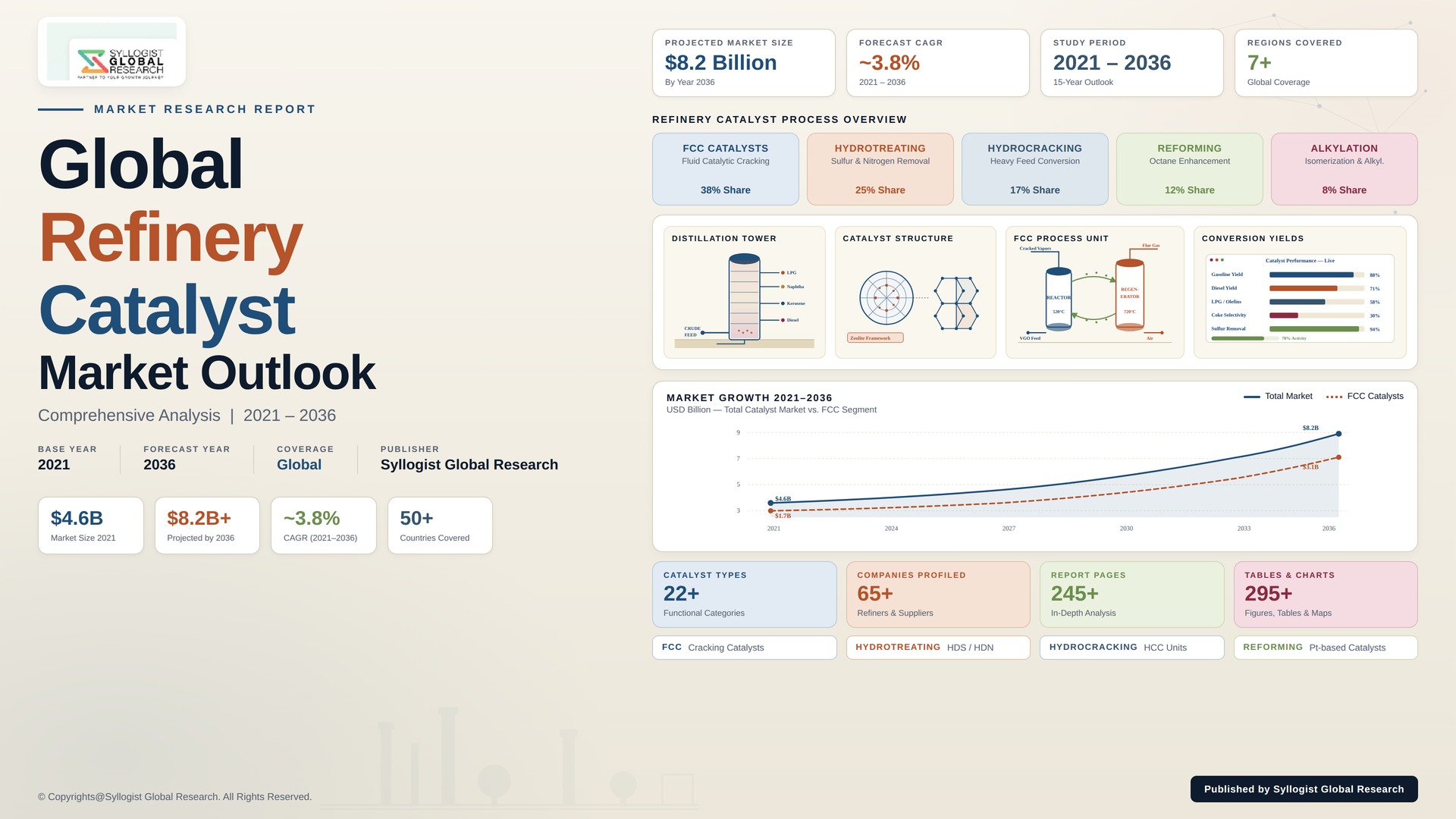
The global refinery catalyst market is moving through a structurally important growth cycle shaped by the dual forces of tightening clean fuel regulations and progressively heavier, more contaminant-laden crude oil slates entering the global refining system, both of which are systematically elevating catalyst intensity, technical performance thresholds, and reload frequency across operating refinery complexes worldwide. The market was valued at USD 9.5 billion in 2025 and is projected to reach USD 14.5 billion by 2034, advancing at a compound annual growth rate of 4.6% through the forecast window, supported by sustained refinery capacity additions across China, India, the Middle East, and Southeast Asia, accelerating uptake of advanced hydroprocessing catalysts in response to ultra-low sulfur diesel and IMO 2020 marine fuel rules, and expanding deployment of next-generation FCC catalyst formulations engineered to maximize gasoline, propylene, and middle distillate yields under shifting product demand patterns globally.
Crude slate evolution is the strongest secular force restructuring the demand profile for refinery catalysts, as refiners increasingly process heavier, sourer, and more metals-contaminated feedstocks alongside opportunity crudes, tight oil grades, and renewable lipid feedstocks that collectively place elevated performance demands on every catalyst loaded into hydrotreaters, hydrocrackers, and FCC units. The result is a measurable shift in revenue mix from commodity catalysts toward formulated specialty systems incorporating advanced zeolite chemistries, modified alumina supports, and tailored metal promoter combinations engineered to deliver improved sulfur removal efficiency, extended cycle length, and superior yield selectivity under demanding operating conditions. Refiners are simultaneously consolidating catalyst supply under integrated technology agreements that bundle catalyst, process licensing, technical service, and regeneration support, restructuring procurement economics in favor of suppliers offering measurable refinery margin uplift across multi-cycle operating campaigns.
Within the application taxonomy, fluid catalytic cracking catalysts continue to anchor the highest revenue concentration, capturing approximately 38% of total market revenue in 2025 owing to their indispensable role in converting heavy gas oils and resids into high-value gasoline, distillate, and propylene streams across virtually every conversion-configured refinery globally. Hydroprocessing catalysts represent the fastest-growing application category, expanding at a rate above 5% annually as global ultra-low sulfur diesel adoption, marine fuel desulfurization mandates, and renewable diesel co-processing requirements collectively elevate hydrotreating and hydrocracking catalyst consumption. Zeolite-based product chemistries dominate the material taxonomy with roughly 46% revenue share, while precious metal reforming and isomerization catalysts continue to anchor premium gasoline production economics. Sustainable aviation fuel, blue hydrogen, and renewable feedstock processing catalysts are emerging as a critical growth vertical reshaping competitive differentiation among integrated catalyst technology providers worldwide.
Asia-Pacific anchors the largest absolute revenue share of the global refinery catalyst market, driven by sustained refinery capacity expansion across China and India, large-scale petrochemical-integrated greenfield complexes in Southeast Asia, and progressive fuel quality upgrade programs aligning regional product specifications with international clean fuel benchmarks. North America represents a structurally critical share supported by complex deep-conversion refinery architectures, ultra-low sulfur diesel production, and growing renewable diesel and sustainable aviation fuel facility deployments across the United States. Europe holds a mature but evolving position underpinned by Euro 7 compliance investments, refinery decarbonization initiatives, and growing co-processing of renewable feedstocks within existing hydrotreating units. The Middle East is positioned to record the highest forecast period CAGR among regional markets, supported by Saudi Aramco, ADNOC, and Kuwait Petroleum-led refinery and petrochemical capacity additions, while Latin America and Africa contribute incremental demand through fuel quality modernization initiatives.
Key Drivers
Tightening Clean Fuel Regulations and Progressive Sulfur Reduction Mandates Driving Sustained Hydroprocessing Catalyst Demand
The progressive enforcement of ultra-low sulfur diesel rules, Euro 7 emission standards, IMO 2020 marine bunker fuel sulfur caps, and equivalent fuel quality benchmarks across China, India, and other emerging markets is generating durable demand for advanced hydrotreating, hydrodesulfurization, and hydrocracking catalysts engineered to deliver consistently lower sulfur and nitrogen levels in finished fuels while preserving operating cycle length. Refiners are progressively codifying catalyst performance commitments into multi-cycle technology agreements, anchoring long-cycle revenue visibility for hydroprocessing catalyst suppliers across global refinery operating fleets.
Refinery Capacity Expansion and Petrochemical Integration Investments Across Asia, the Middle East, and Africa Sustaining Long-Cycle Catalyst Consumption
Sustained greenfield and brownfield refinery capacity investment across China, India, Saudi Arabia, the United Arab Emirates, Kuwait, Nigeria, and Indonesia is reinforcing structural demand for fluid catalytic cracking, hydroprocessing, reforming, and alkylation catalysts across all major refining process units. The accelerating integration of refining and petrochemical operations into crude-to-chemicals complexes is further elevating catalyst intensity per barrel processed, anchoring multi-decade demand visibility for refinery catalyst suppliers serving capacity additions, debottlenecking projects, and unit revamps across major emerging refining hubs worldwide.
Heavy and Sour Crude Processing Requirements and Renewable Feedstock Co-Processing Elevating Specialty Catalyst Performance Premiums
The shift toward processing heavier, sourer, and more metals-contaminated crude oils, combined with rising volumes of vegetable oil, used cooking oil, and tallow co-processed in conventional hydrotreating units to produce renewable diesel and sustainable aviation fuel, is elevating the technical performance threshold required of every catalyst loaded into refinery process units. Specialty catalyst formulations engineered for high-metals tolerance, extended cycle length, and renewable feedstock compatibility are commanding sustained price premiums, supporting durable margin contribution for technology-leading catalyst suppliers across global refining markets.
Key Challenges
Long-Term Energy Transition and Declining Transportation Fuel Demand Reshaping Refinery Catalyst Demand Trajectories
Accelerating electric vehicle adoption across developed automotive markets, combined with progressive internal combustion engine phase-out timelines and refinery rationalization announcements across the European Union, United Kingdom, and parts of North America, is introducing structural uncertainty into long-term gasoline and diesel-linked refinery catalyst demand projections. Catalyst suppliers face a strategic imperative to reposition portfolios toward jet fuel, petrochemical-integrated, renewable diesel, sustainable aviation fuel, and blue hydrogen production catalyst categories less exposed to passenger vehicle electrification dynamics across mature regional refining markets globally.
Crude Oil Price Volatility and Refining Margin Compression Pressures Constraining Discretionary Catalyst Reload Decisions
Persistent volatility across global crude oil benchmarks, combined with periodic refining margin compression, is constraining flexibility in refinery capital and operating budgets and intensifying scrutiny of discretionary catalyst reload, cycle extension, and unit upgrade decisions. Refiners routinely defer non-essential catalyst replacements, extend operating cycles beyond optimal performance windows, and renegotiate supply contracts during downturn periods, exposing catalyst suppliers to revenue compression risk, inventory imbalance challenges, and margin erosion pressure across both commodity and specialty refinery catalyst portfolios globally during downcycle conditions.
Spent Catalyst Disposal Regulations, Critical Metal Recovery Complexity, and Tightening ESG Compliance Pressures Across Catalyst Lifecycle Management
Spent refinery catalysts containing molybdenum, nickel, cobalt, vanadium, and platinum group metals are subject to increasingly stringent hazardous waste classification, transboundary movement restrictions, and disposal regulations that elevate handling, regeneration, and metal recovery costs across catalyst lifecycle management. Critical metal supply concentration risks, geopolitical sourcing constraints, and rising ESG reporting expectations regarding spent catalyst disposition further complicate procurement and stewardship economics, pressuring suppliers to invest in closed-loop regeneration capacity, traceable metal recovery programs, and transparent end-of-life management protocols across global refinery customer bases.
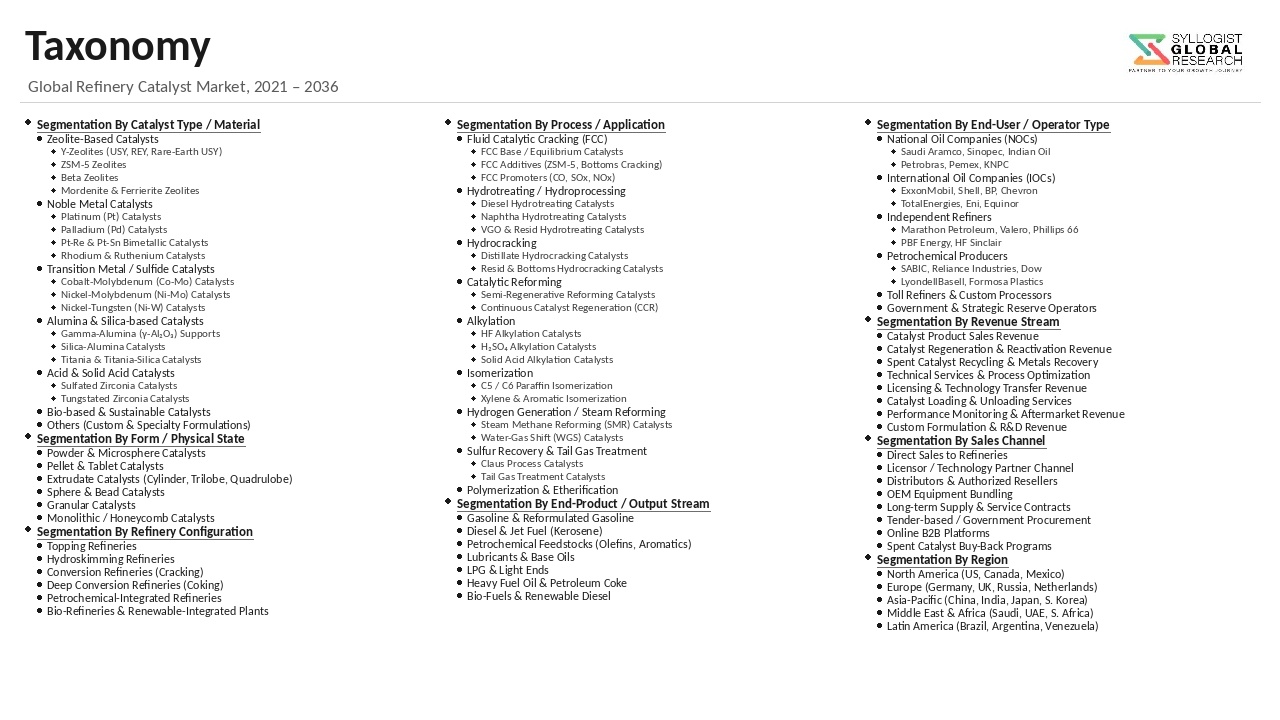
Market Segmentation
- Segmentation By Type
- Fluid Catalytic Cracking (FCC) Catalysts
- Hydroprocessing Catalysts (Hydrotreating, Hydrocracking, Hydrodesulfurization)
- Catalytic Reforming Catalysts
- Alkylation Catalysts
- Isomerization Catalysts
- Polymerization Catalysts
- Sulfur Recovery Catalysts
- Others
- Segmentation By Material
- Zeolites
- Metals (Platinum, Palladium, Nickel, Cobalt, Molybdenum, Vanadium)
- Chemical Compounds and Metal Oxides
- Others
- Segmentation By Application
- Fluid Catalytic Cracking
- Hydrotreating
- Hydrocracking
- Catalytic Reforming
- Alkylation
- Isomerization
- Sulfur Recovery
- Renewable Feedstock Processing
- Others
- Segmentation By Refinery Configuration
- Topping Refineries
- Hydroskimming Refineries
- Conversion Refineries
- Deep Conversion Refineries
- Petrochemical-Integrated Complexes
- Segmentation By End-Product
- Gasoline
- Diesel and Ultra-Low Sulfur Diesel
- Jet Fuel and Kerosene
- Liquefied Petroleum Gas (LPG)
- Petrochemical Feedstocks
- Renewable Diesel and Sustainable Aviation Fuel
- Others
- Segmentation By Region
- North America
- Europe
- Asia-Pacific
- Middle East and Africa
- Latin America
All market revenues are presented in USD
Historical Year: 2021-2024 | Base Year: 2025 | Estimated Year: 2026 | Forecast Period: 2027-2034
Key Questions this Study Will Answer
- What is the total global market valuation of the Refinery Catalyst Market in 2025, projected through 2034, disaggregated by catalyst type, application, and refinery configuration, enabling catalyst manufacturers, integrated oil companies, refiners, and investors to identify highest-growth segments and most durable revenue opportunities across the global downstream catalyst landscape?
- How are clean fuel regulations including Euro 7, IMO 2020, ultra-low sulfur diesel mandates, China 6, and Bharat Stage VI reshaping refinery catalyst consumption volumes across hydrotreating, hydrocracking, FCC, and reforming applications, and which national programs are setting the technical and procurement benchmarks defining global refinery catalyst demand architecture through 2034?
- Which refinery catalyst product categories, including FCC catalysts, hydroprocessing catalysts, reforming catalysts, alkylation catalysts, and isomerization catalysts, are recording the highest forecast period growth rates, and what crude slate, fuel quality, and refinery configuration factors are shaping demand intensity within each segment?
- How are major refinery capacity expansion programs across China, India, Saudi Arabia, the United Arab Emirates, Kuwait, Nigeria, and Indonesia, alongside crude-to-chemicals integration investments, reshaping global refinery catalyst demand distribution and supplier positioning through the forecast horizon?
- What partnership, technology licensing, vertical integration, and acquisition strategies are dominant refinery catalyst manufacturers using to consolidate market positions, secure critical metal supply continuity, and deepen long-cycle relationships with integrated oil companies, national oil companies, and independent refiners across global regions?
- Which renewable feedstock processing, sustainable aviation fuel, renewable diesel, and blue hydrogen catalyst opportunities are expected to generate the most substantial incremental refinery catalyst demand through 2034, and how are conventional hydrotreating and hydrocracking catalyst suppliers reformulating product portfolios to capture energy transition revenue streams?
- What spent catalyst regeneration, hazardous waste classification, critical metal recovery, and ESG-driven lifecycle stewardship dynamics are most critical to the operational performance and margin sustainability of refinery catalyst manufacturers serving global downstream customers across both commodity and specialty product categories?
- Product Definition
- Research Methodology
- Research Design & Framework
- Overall Research Approach: Descriptive, Exploratory & Quantitative Mixed-Method Design
- Market Definition & Scope Boundaries: What is Included and Excluded
- Segmentation Framework
- Key Research Assumptions & Limitations
- Secondary Research
- Primary Research Design & Execution
- Data Triangulation & Validation
- Market Sizing & Forecasting Methodology
- Competitive Intelligence Methodology
- Quality Assurance & Peer Review
- Definitions, Abbreviations & Data Notes
- Research Design & Framework
- Executive Summary
- Market Snapshot & Headline Numbers
- Key Findings & Research Highlights
- Market Dynamics
- Regional Market Summary
- Competitive Landscape Snapshot
- Technology & Innovation Highlights
- Market Dynamics
- Drivers
- Restraints
- Opportunities
- Challenges
- Porter’s Five Forces Analysis
- PESTLE Analysis
- Market Trends & Developments
- Emerging Trends
- Technological Developments
- Regulatory & Policy Changes
- Supply Chain & Sourcing Trends
- Manufacturing & Process Trends
- Investment & Funding Activity
- Sustainability & ESG Trends
- Risk Assessment Framework
- Crude Oil and Refined Product Price Volatility & Refining Margin Cycle Risk
- Precious Metal, Rare Earth & Base Metal Price Volatility and Critical Mineral Supply Risk
- Energy Transition, EV Adoption & Declining Transport Fuel Demand Risk
- Tightening Fuel Specifications, Sulfur Limit & Refinery Emission Regulation Risk
- Geopolitical, Sanctions & Critical Mineral Cross-Border Supply Risk
- Regulatory Framework & Standards
- National Refining, Fuel Quality & Catalyst Use Policy Frameworks
- Tier 3, Euro VI/VII, Bharat Stage VI & IMO 2020 Sulfur Specification Standards
- Spent Catalyst Disposal, RCRA Hazardous Waste, Heavy Metal Reclamation & Cross-Border Movement Standards
- Greenhouse Gas, Air Quality, Benzene & Emission Performance Regulations Applicable to Refineries
- REACH, TSCA, GHS Chemical Registration & ESG Disclosure Standards for Catalyst Manufacturers and Refiners
- Global Refinery Catalyst Market Outlook
- Market Size & Forecast by Value
- Market Size & Forecast by Volume (Kilo Tons)
- Market Size & Forecast by Catalyst Type
- Zeolite Catalysts (Faujasite/Y, ZSM-5, Mordenite & Beta)
- Precious Metal Catalysts (Platinum, Palladium, Rhodium & Ruthenium Based)
- Base Metal Catalysts (Nickel, Cobalt, Molybdenum, Tungsten & Iron Based)
- Alumina-Based & Silica-Alumina Catalysts
- Mixed Metal Oxide & Specialty Refinery Catalysts
- Market Size & Forecast by Process
- Fluid Catalytic Cracking (FCC) Catalysts & Additives
- Hydrotreating Catalysts (Hydrodesulfurization, Hydrodenitrogenation & Hydrodearomatization)
- Hydrocracking Catalysts (Distillate, Lube & Resid Hydrocracking)
- Catalytic Reforming Catalysts (Semi-Regenerative & Continuous Catalytic Regeneration)
- Alkylation Catalysts (Solid Acid, HF & Sulfuric Acid Based)
- Isomerization Catalysts (C5/C6 Paraffin & Xylene Isomerization)
- Sulfur Recovery (Claus) & Tail Gas Treatment Catalysts
- Renewable & Bio-Feedstock Coprocessing Catalysts (HVO, SAF & Renewable Diesel)
- Market Size & Forecast by Catalyst Form
- Powder & Microsphere
- Extrudates (Cylindrical, Trilobe & Quadrulobe)
- Spheres, Beads & Tablets
- Monolith & Structured Catalysts
- Market Size & Forecast by Catalyst Lifecycle
- Fresh Catalysts
- Regenerated & Reused Catalysts
- Spent Catalyst Recovery & Metal Reclamation
- Market Size & Forecast by End Product
- Gasoline & High-Octane Blendstock
- Ultra-Low Sulfur Diesel (ULSD) & Marine Gas Oil
- Jet Fuel & Sustainable Aviation Fuel (SAF)
- Petrochemical Feedstock (Propylene, BTX & Light Olefins)
- Lubricant Base Stock & Specialty Products
- Market Size & Forecast by Refinery Configuration
- Topping & Hydroskimming Refinery
- Cracking Refinery (FCC or Hydrocracking Based)
- Coking & Full Conversion Refinery
- Petrochemical-Integrated Refining Complex
- Market Size & Forecast by End-User
- Independent & Merchant Refiners
- Integrated Oil Majors (IOCs)
- National Oil Companies (NOCs)
- Petrochemical-Integrated Refining Complex Operators
- Market Size & Forecast by Sales Channel
- Direct Supply to Refiners (Long-Term Supply Contract & Frame Agreement)
- Catalyst Bundled Service & Performance Contract (Royalty and Pay-per-Yield Models)
- Distributor, Trading House & Regional Specialty Channel
- Tolling, Custom Manufacturing & Spent Catalyst Reclamation Channel
- North America Refinery Catalyst Market Outlook
- Market Size & Forecast
- By Value
- By Volume (Kilo Tons)
- By Catalyst Type
- By Process
- By Catalyst Form
- By Catalyst Lifecycle
- By End Product
- By End-User
- By Country
- By Sales Channel
- Market Size & Forecast
- Europe Refinery Catalyst Market Outlook
- Market Size & Forecast
- By Value
- By Volume (Kilo Tons)
- By Catalyst Type
- By Process
- By Catalyst Form
- By Catalyst Lifecycle
- By End Product
- By End-User
- By Country
- By Sales Channel
- Market Size & Forecast
- Asia-Pacific Refinery Catalyst Market Outlook
- Market Size & Forecast
- By Value
- By Volume (Kilo Tons)
- By Catalyst Type
- By Process
- By Catalyst Form
- By Catalyst Lifecycle
- By End Product
- By End-User
- By Country
- By Sales Channel
- Market Size & Forecast
- Latin America Refinery Catalyst Market Outlook
- Market Size & Forecast
- By Value
- By Volume (Kilo Tons)
- By Catalyst Type
- By Process
- By Catalyst Form
- By Catalyst Lifecycle
- By End Product
- By End-User
- By Country
- By Sales Channel
- Market Size & Forecast
- Middle East & Africa Refinery Catalyst Market Outlook
- Market Size & Forecast
- By Value
- By Volume (Kilo Tons)
- By Catalyst Type
- By Process
- By Catalyst Form
- By Catalyst Lifecycle
- By End Product
- By End-User
- By Country
- By Sales Channel
- Market Size & Forecast
- Country-Wise* Refinery Catalyst Market Outlook
- Market Size & Forecast
- By Value
- By Volume (Kilo Tons)
- By Catalyst Type
- By Process
- By Catalyst Form
- By Catalyst Lifecycle
- By End Product
- By End-User
- By Country
- By Sales Channel
- Market Size & Forecast
*Countries Analyzed in the Syllogist Global Research Portfolio: United States, Canada, Mexico, Germany, France, United Kingdom, Netherlands, Spain, Italy, Belgium, Russia, China, Japan, India, South Korea, Singapore, Thailand, Indonesia, Taiwan, Brazil, Argentina, Venezuela, Saudi Arabia, UAE, Kuwait, Iraq, Iran, Egypt, Algeria, Nigeria, South Africa
- Technology Landscape & Innovation Analysis
- FCC Catalyst, ZSM-5 Additive & Propylene Maximisation Technology Deep-Dive
- Hydroprocessing, Ultra-Deep HDS & High-Activity NiMo/CoMo Catalyst Technology
- Hydrocracking, Resid Conversion & Ebullated Bed Catalyst Technology
- Catalytic Reforming, Continuous Catalytic Regeneration (CCR) & Aromatic Maximisation Technology
- Renewable Diesel, Sustainable Aviation Fuel (SAF) & Biofeedstock Coprocessing Catalyst Technology
- Solid Acid Alkylation & Modern Paraffin Isomerization Catalyst Technology
- Catalyst Manufacturing, Spray Drying, Extrusion & Active Phase Loading Process Technology
- Patent & IP Landscape in Refinery Catalyst Technologies
- Value Chain & Supply Chain Analysis
- Rare Earth, Precious Metal & Base Metal Mining and Refining Supply Chain
- Zeolite, Alumina, Silica & Specialty Support Material Manufacturing Supply Chain
- Catalyst Manufacturing, Active Phase Loading & Shaping (Extrusion, Spray Drying) Supply Chain
- Catalyst Distribution, Logistics, Reactor Loading & Refinery Site Service Network
- Refiner Procurement, Catalyst Trial Programme & Long-Term Supply Agreement Landscape
- Distributor, Catalyst Service Provider & Field Engineer Channel
- Spent Catalyst Reclamation, Metal Recovery & Circular Economy
- Pricing Analysis
- FCC Catalyst Average Selling Price and Cost per Barrel of Cracked Feed Analysis
- Hydroprocessing Catalyst Cost per Barrel of Treated Feed & Cycle Length Analysis
- Hydrocracking Catalyst Pricing & Cost per Barrel of Conversion Analysis
- Reforming, Isomerization & Specialty Refinery Catalyst Pricing Analysis
- Long-Term Supply Contract, Performance Royalty & Pay-per-Yield Pricing Analysis
- Total Refinery Catalyst Programme Economics: Cost per Barrel and Yield Uplift Co-Optimisation Analysis
- Sustainability & Environmental Analysis
- Lifecycle Assessment (LCA) of Refinery Catalysts: Carbon Footprint, Energy Intensity & Critical Mineral Intensity Across Catalyst Routes
- Green Catalyst Manufacturing & Pathway to Low-Carbon, Rare Earth Lean & Circular Catalyst Portfolios
- Spent Catalyst Recovery, Metal Reclamation & Closed-Loop Material Management Contribution of Catalyst Programmes
- Environmental Compliance, Heavy Metal Leaching & Air Quality Consideration in Catalyst Manufacturing and Refinery Operations
- Regulatory-Driven Sustainability, Refinery Decarbonisation & Green Finance Eligibility of Operators
- Competitive Landscape
- Market Structure & Concentration
- Market Consolidation Level (Fragmented vs. Consolidated by Catalyst Type & Geography)
- Top 10 Players Market Share
- HHI (Herfindahl-Hirschman Index) Concentration Analysis
- Competitive Intensity Map by Catalyst Type, Process & Geography
- Player Classification
- Integrated Catalyst & Process Licensor Companies with Refinery Technology Portfolios
- Specialty Refinery Catalyst Manufacturers & Pure-Play Producers
- Diversified Specialty Chemical & Industrial Catalyst Companies
- Mining & Materials Majors Supplying Active Metals, Rare Earths & Support Materials
- Regional & Local Refinery Catalyst Formulators
- Spent Catalyst Reclamation & Metal Recovery Specialists
- Digital Catalyst Performance, AI Yield Optimisation & Refinery Analytics Platform Providers
- Distributors, Tolling Partners & Catalyst Service Specialists
- Competitive Analysis Frameworks
- Market Share Analysis by Catalyst Type, Process & Region
- Company Profile
- Company Overview & Headquarters
- Refinery Catalyst Products & Technology Portfolio
- Key Customer Relationships & Reference Refinery Installations
- Manufacturing Footprint & Production Capacity
- Revenue (Refinery Catalyst Segment) & Backlog
- Technology Differentiators & IP
- Key Strategic Partnerships, JVs & M&A Activity
- Recent Developments (Contract Wins, Capacity Expansion, Product Launches)
- SWOT Analysis
- Strategic Focus Areas & Roadmap
- Competitive Positioning Map (Catalyst Performance vs. Market Penetration)
- Key Company Profiles
- Market Structure & Concentration
- Technology Landscape & Innovation Analysis
- Strategic Output
- Market Opportunity Matrix: By Catalyst Type, Process, End Product, End-User & Geography
- White Space Opportunity Analysis
- Strategic Recommendations
- Product Portfolio & Technology Investment Strategy
- Manufacturing & Operational Excellence Strategy
- Geographic Expansion & Localisation Strategy
- Customer & End-User Engagement Strategy
- Partnership, M&A & Ecosystem Strategy
- Sustainability & Circular Economy Strategy
- Risk Mitigation & Future Roadmap
- Strategic Priority Matrix & Roadmap
- Near-term (2025-2028)
- Mid-term (2029-2032)
- Long-term (2033-2037)