Market Definition
The Robotics-as-a-Service (RaaS) market refers to a cloud-based, subscription-oriented business model in which organizations lease robotic hardware and integrated software rather than purchasing them as capital assets. This usership-over-ownership framework, modelled after Software-as-a-Service (SaaS), allows companies to deploy advanced automation through periodic fees or pay-per-use structures, shifting the financial burden from capital expenditure (Capex) to operating expense (OpEx). Under a typical RaaS contract, the provider retains ownership of the physical units and remains responsible for maintenance, technical support, and continuous software updates, thereby lowering the barrier to entry for enterprises that require scalable, high-tech solutions without the risks of technological obsolescence or high upfront investment.
Market Insights
As of early 2026, the global RaaS market has reached a pivotal valuation of approximately USD 32.1 billion, exhibiting a robust compound annual growth rate (CAGR) of over 20%. This exponential trajectory is driven by the rapid maturation of Agentic AI and cloud-native fleet management systems, which have transformed robots from static tools into intelligent, self-evolving assets. The market is currently seeing a massive influx of small and medium-sized enterprises (SMEs) that were previously priced out of the robotics sector but can now leverage modular automation to compete with larger incumbents.
The logistics and warehousing sector remain the dominant anchor of the RaaS ecosystem in 2026, accounting for nearly 40% of the total market share. The explosion of e-commerce fulfilment requirements has necessitated the mass deployment of Autonomous Mobile Robots (AMRs) for pick-and-pack operations and automated forklifts for material handling. Providers in this space are increasingly moving toward outcome-based pricing models, where customers pay based on successful deliveries or items sorted, directly aligning the cost of robotics with the operational throughput and revenue generation of the facility.
Technologically, the 2026 landscape is defined by the convergence of Information Technology (IT) and Operational Technology (OT), often referred to as Industrial IoT 5.0. RaaS platforms now come standard with predictive analytics modules that forecast maintenance needs and optimize energy consumption in real-time. This digital integration allows for lights-out warehouse shifts where fleets operate autonomously under remote supervision. Furthermore, the rise of 5G-enabled edge computing has significantly reduced latency, enabling RaaS units to perform high-precision tasks, such as surgical assistance or electronics assembly, with the reliability previously reserved for tethered, stationary systems.
Regionally, the Asia-Pacific region continues to lead in deployment volume, particularly in China and South Korea, where government-led Smart Factory initiatives have created a fertile environment for subscription-based automation. However, Europe is currently the fastest-growing market due to aggressive digital transformation mandates and a mature ecosystem of specialized system integrators. In North America, the market is characterized by a high concentration of venture-backed RaaS startups focusing on niche applications like vertical farming, commercial cleaning, and robotic last-mile delivery droids, reflecting a broad diversification of the service robotics landscape.
Key Drivers
Financial Democratization and the Capex-to-OpEx Shift
The foremost driver of the RaaS market is the fundamental restructuring of automation economics, which allows businesses to preserve capital while scaling their technological capabilities. By converting the multi-million-dollar upfront costs of traditional robotics into predictable, recurring operating expenses, RaaS enables companies to maintain liquidity and achieve a much faster return on investment (ROI). This financial flexibility is particularly critical in the volatile economic environment of 2026, as it allows firms to test and validate unproven robotic solutions without the balance-sheet risk of owning depreciating hardware.
Global Labor Shortages and Operational Resilience
Persistent structural labor gaps across the manufacturing, healthcare, and logistics sectors continue to push organizations toward robotic augmentation. As the global workforce ages and recruitment for repetitive or hazardous tasks becomes increasingly difficult, RaaS provides a plug-and-play solution to maintain productivity levels. The ability to scale robot fleets up or down in response to seasonal demand, such as peak holiday shopping or agricultural harvest cycles, ensures that businesses can remain resilient in the face of labor market fluctuations without the long-term commitment of a permanent workforce or owned machinery.
Key Challenges
Technical Integration and Legacy Interoperability
One of the most significant hurdles in the RaaS market is the complexity of integrating sophisticated robotic fleets with existing legacy IT and warehouse management systems (WMS). Most industrial environments operate on a patchwork of older protocols and siloed data architectures, making the seamless orchestration of heterogeneous robot brands a labour-intensive engineering challenge. While API standardization is improving in 2026, the need for extensive site-specific customization and safety validation often results in longer-than-expected deployment timelines, which can erode the perceived speed-to-market benefits for many potential adopters.
Cybersecurity Risks and Data Governance
The always-on connectivity required for cloud-based RaaS introduces substantial cybersecurity vulnerabilities, particularly regarding the collection of sensitive operational and environmental data. As robots navigate secure facilities and interact with proprietary production processes, they become potential entry points for industrial espionage or ransomware attacks. In 2026, data sovereignty regulations have become more stringent, forcing RaaS providers to invest heavily in encrypted edge-processing and robust identity management protocols. For many conservative industries, such as defense or high-end pharmaceuticals, the perceived risk of data breaches remains a primary barrier to fully embracing a third-party, subscription-based robotics model.
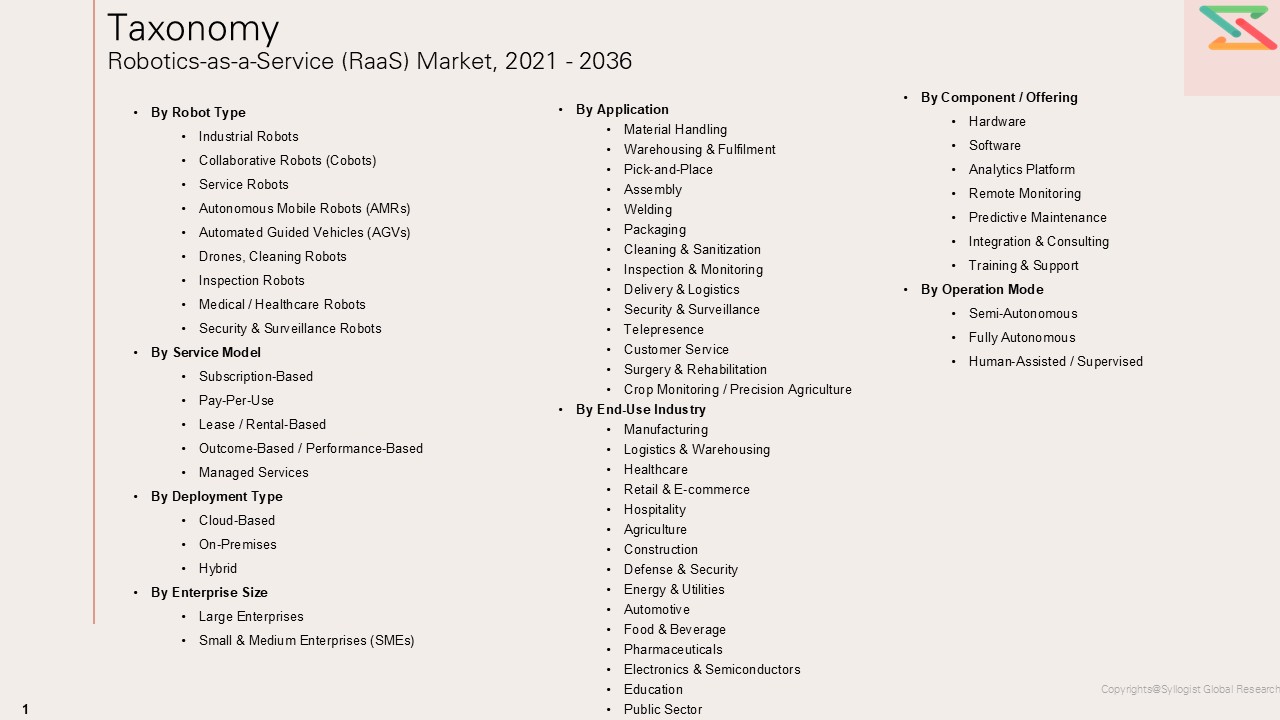
Market Segmentation
- Segmentation By Robot Type
- Industrial Robots
- Collaborative Robots (Cobots)
- Service Robots
- Autonomous Mobile Robots (AMRs)
- Automated Guided Vehicles (AGVs)
- Drones
- Cleaning Robots
- Inspection Robots
- Medical / Healthcare Robots
- Security & Surveillance Robots
- Segmentation By Service Model
- Subscription-Based
- Pay-Per-Use
- Lease / Rental-Based
- Outcome-Based / Performance-Based
- Managed Services
- Segmentation By Deployment Type
- Cloud-Based
- On-Permises
- Hybrid
- Segmentation By Enterprise Size
- Large Entreprises
- Small & Medium Entreprises (SMEs)
- Segmentation By Application
- Material Handling
- Warehousing & Fulfillment
- Pick-and-Place
- Assembly
- Welding
- Packaging
- Cleaning & Sanitization
- Inspection & Monitoring
- Delivery & Logistics
- Security & Surveillance
- Telepresence
- Customer Service
- Surgery & Rehabilitation
- Crop Monitoring / Precision Agriculture
- Segmentation By End Use Industry
- Manufacturing
- Logistics & Warehousing
- Healthcare
- Retail & E-commerce
- Hospitality
- Agriculture
- Construction
- Defense & Security
- Energy & Utilities
- Automotive
- Food & Beverage
- Pharmaceuticals
- Electronics & Semiconductors
- Education
- Public Sector
- Segmentation By Component / Offering
- Hardware
- Software
- Analytics Platform
- Remote Monitoring
- Predictive Maintenance
- Integration & Consulting
- Training & Support
- Segmentation By Operating Mode
- Semi-Autonomous
- Fully Autonomous
- Human-Assisted / Supervised
All market revenues are presented in USD
Historical Year: 2021–2024 | Base Year: 2025 | Estimated Year: 2026 | Forecast Period: 2027–2036
Key Questions this Study Will Answer
- What is the projected market valuation and growth rate (CAGR) for the RaaS model through 2031? This provides the quantitative baseline required for long-term strategic planning and capital allocation across various industrial sectors.
- How does the transition from CapEx to OpEx models specifically lower the entry barriers for Small and Medium Enterprises (SMEs)? The study will evaluate how subscription-based pricing democratizes access to advanced automation and accelerates adoption in previously underserved markets.
- Which industrial segments (e.g., logistics, healthcare, or agriculture) are poised for the highest RaaS adoption rates? Identifying these high-velocity sectors allows providers to tailor their hardware and software stacks to meet specific operational demands.
- What are the primary technological enablers, such as 5G, Edge Computing, and Agentic AI, that are making RaaS scalable in 2026? This question focuses on the infrastructure required to manage large-scale, cloud-connected robotic fleets with minimal latency.
- Who are the dominant market incumbents and emerging startups, and what are their unique value propositions? A detailed competitive analysis will reveal market share concentration and the service models (e.g., pay-per-pick vs. monthly subscription) that are currently winning.
- What are the most significant legal, cybersecurity, and data governance risks associated with third-party robotic management? This analysis provides a framework for mitigating risks related to data breaches, industrial espionage, and liability in autonomous environments.
- Product Definition
- Research Methodology
- Research Design & Framework
- Overall Research Approach: Descriptive, Exploratory & Quantitative Mixed-Method Design
- Market Definition & Scope Boundaries: What is Included and Excluded
- Segmentation Framework
- Key Research Assumptions & Limitations
- Secondary Research
- Primary Research Design & Execution
- Data Triangulation & Validation
- Market Sizing & Forecasting Methodology
- Competitive Intelligence Methodology
- Quality Assurance & Peer Review
- Definitions, Abbreviations & Data Notes
- Research Design & Framework
- Executive Summary
- Market Snapshot & Headline Numbers
- Key Findings & Research Highlights
- Market Dynamics
- Regional Market Summary
- Competitive Landscape Snapshot
- Technology & Innovation Highlights
- Market Dynamics
- Drivers
- Restraints
- Opportunities
- Challenges
- Porter’s Five Forces Analysis
- PESTLE Analysis
- Market Trends & Developments
- Emerging Trends
- Technological Developments
- Regulatory & Policy Changes
- Supply Chain & Sourcing Trends
- Consumer & Demand Trends
- Investment & Funding Activity
- Sustainability & ESG Trends
- Geographic & Regional Trends
- Risk Assessment Framework
- Political / Geopolitical Risk
- Fuel & Component Supply Risk
- Environmental and Regulatory Risk
- Financial / Market Risk
- Regulatory Framework & Standards
- Global Robotics-as-a-Service (RaaS) Market Outlook
- Market Size & Forecast by Value
- Market Size & Forecast by Robot Type
- Industrial Robots
- Collaborative Robots (Cobots)
- Service Robots
- Autonomous Mobile Robots (AMRs)
- Automated Guided Vehicles (AGVs)
- Drones
- Cleaning Robots
- Inspection Robots
- Medical / Healthcare Robots
- Security & Surveillance Robots
- Market Size & Forecast by Service Model
- Subscription-Based
- Pay-Per-Use
- Lease / Rental-Based
- Outcome-Based / Performance-Based
- Managed Services
- Market Size & Forecast by Deployment Type
- Cloud-Based
- On-Permises
- Hybrid
- Market Size & Forecast by Enterprise Size
- Large Entreprises
- Small & Medium Entreprises (SMEs)
- Market Size & Forecast by Application
- Material Handling
- Warehousing & Fulfillment
- Pick-and-Place
- Assembly
- Welding
- Packaging
- Cleaning & Sanitization
- Inspection & Monitoring
- Delivery & Logistics
- Security & Surveillance
- Telepresence
- Customer Service
- Surgery & Rehabilitation
- Crop Monitoring / Precision Agriculture
- Market Size & Forecast by End Use Industry
- Manufacturing
- Logistics & Warehousing
- Healthcare
- Retail & E-commerce
- Hospitality
- Agriculture
- Construction
- Defense & Security
- Energy & Utilities
- Automotive
- Food & Beverage
- Pharmaceuticals
- Electronics & Semiconductors
- Education
- Public Sector
- Market Size & Forecast by Component / Offering
- Hardware
- Software
- Analytics Platform
- Remote Monitoring
- Predictive Maintenance
- Integration & Consulting
- Training & Support
- Market Size & Forecast by Operating Mode
- Semi-Autonomous
- Fully Autonomous
- Human-Assisted / Supervised
- Asia-Pacific Robotics-as-a-Service (RaaS) Market Outlook
- Market Size & Forecast
- By Value
- By Robot Type
- By Service Model
- By Deployment Type
- By Enterprise Size
- By Application
- By End Use Industry
- By Component / Offering
- By Operating Mode
- Market Size & Forecast
- Europe Robotics-as-a-Service (RaaS) Market Outlook
- Market Size & Forecast
- By Value
- By Technology
- By Product Type
- By Delivery Method
- By Editing Approach
- By Application
- By End Use
- By Application Setting
- By Gene Target
- By Organism Type
- Market Size & Forecast
- North America Robotics-as-a-Service (RaaS) Market Outlook
- Market Size & Forecast
- By Value
- By Technology
- By Product Type
- By Delivery Method
- By Editing Approach
- By Application
- By End Use
- By Application Setting
- By Gene Target
- By Organism Type
- Market Size & Forecast
- Latin America Robotics-as-a-Service (RaaS) Market Outlook
- Market Size & Forecast
- By Value
- By Technology
- By Product Type
- By Delivery Method
- By Editing Approach
- By Application
- By End Use
- By Application Setting
- By Gene Target
- By Organism Type
- Market Size & Forecast
- Middle East & Africa Robotics-as-a-Service (RaaS) Market Outlook
- Market Size & Forecast
- By Value
- By Technology
- By Product Type
- By Delivery Method
- By Editing Approach
- By Application
- By End Use
- By Application Setting
- By Gene Target
- By Organism Type
- Market Size & Forecast
- Country Wise* Robotics-as-a-Service (RaaS) Market Outlook
- Market Size & Forecast
- By Value
- By Technology
- By Product Type
- By Delivery Method
- By Editing Approach
- By Application
- By End Use
- By Application Setting
- By Gene Target
- By Organism Type
- Market Size & Forecast
*Countries Analyzed in the Syllogist Global Research Portfolio: United States, Canada, Germany, United Kingdom, France, Italy, Spain, Netherlands, Switzerland, China, Japan, India, South Korea, Australia, Brazil, Mexico, Saudi Arabia, South Africa, UAE
- Technology Landscape & Innovation Analysis
- Value Chain & Supply Chain Analysis
- Pricing Analysis
- Sustainability & Energy Efficiency
- Competitive Landscape
- Market Structure & Concentration
- Market Consolidation Level (Fragmented Vs Consolidated)
- Top 5 Players Market Share
- HHI (Herfindahl–Hirschman Index) Concentration Analysis
- Competitive Intensity Map
- Player Classification
- Market Leaders
- Strong Challengers
- Specialist / Niche Players
- Emerging Players
- Regional Players
- Competitive Analysis Frameworks
- Market Share Analysis
- Company Profile
- Company Overview & HQ
- Products & Solutions Portfolio
- Overall Revenue & Segmental Revenue
- Geographic Presence
- Recent Developments (M&A, Launches, Partnerships)
- SWOT Analysis
- Strategic Focus Areas
- Competitive Positioning Map
- Market Structure & Concentration
- Strategic Output
- Market Opportunity Matrix
- White Space Opportunity Analysis
- Strategic Recommendations
- Strategic Imperatives for Market Participants
- Revenue Growth & Monetization Strategies
- Sector Prioritization Recommendations
- Product Innovation & Platform Development Recommendations
- Geographic Expansion Recommendations
- Partnership, M&A, and Ecosystem Recommendations
- Risk Management & Operational Excellence Recommendations
- Long-Term Market Positioning Recommendations
- Strategic Priority Matrix & Roadmap
- Near-term (2025–2028)
- Mid-term (2029–2032)
- Long-term (2033–2036)