India Salicylic Acid Market: Specialty Intermediate Strengthening Pharma & Personal Care Value Chains
Enabling Domestic API Leadership and Consumer Wellness Growth
The India salicylic acid market is evolving as a strategically important specialty chemical segment, driven by the country’s strong pharmaceutical manufacturing base and rapidly expanding personal care industry. As one of the world’s leading producers of generic medicines and active pharmaceutical ingredients (APIs), India represents both a major production hub and consumption center for salicylic acid. Derived primarily from phenol through the Kolbe–Schmitt process, salicylic acid serves as a key intermediate in aspirin (acetylsalicylic acid), topical dermatology treatments, anti-inflammatory formulations, and acne-care cosmetics. Beyond pharmaceuticals and personal care, it also finds use in dyes, preservatives, rubber chemicals, and specialty esters. Increasing regulatory oversight from CDSCO, USFDA, and EU authorities is driving demand for higher-purity, GMP-compliant pharmaceutical grades. Simultaneously, improvements in process efficiency, effluent treatment systems, and emission management are modernizing domestic production capabilities, reinforcing India’s position as a competitive and compliance-ready manufacturing base.
Mapping the Indian Value Chain: From Phenol to High-Value Derivatives
In India, the salicylic acid value chain is closely linked to phenol availability and pricing, with phenol serving as the primary feedstock alongside carbon dioxide. Production economics are highly sensitive to phenol price fluctuations, which are influenced by crude oil trends and domestic petrochemical supply. Efficiency in reaction yield, purification systems, crystallization control, and adherence to pharmacopeial standards (IP, USP, EP) determine competitive positioning.
Midstream, salicylic acid is converted into a range of derivatives including:
- Acetylsalicylic acid (aspirin)
- Sodium salicylate
- Methyl salicylate
- Salicylamide
- Specialty esters
These derivatives serve downstream industries such as pharmaceuticals, OTC analgesics, dermatology products, and cosmetics. India’s strong formulation industry supports forward integration into APIs and finished dosage forms, allowing manufacturers to capture greater value within the chain. Increasingly, companies are strengthening backward integration into phenol sourcing to mitigate raw material volatility and ensure supply security.
Balancing Domestic Demand and Supply Dynamics
India’s demand for salicylic acid is structurally supported by rising healthcare expenditure, expanding OTC penetration, and strong domestic consumption of dermatology and personal care products. Growth in acne-treatment formulations, anti-dandruff shampoos, and exfoliating skincare products is creating incremental demand for cosmetic-grade salicylic acid. Additionally, India’s role as a global exporter of aspirin and other salicylate derivatives reinforces stable industrial demand.
On the supply side, India benefits from cost-competitive manufacturing and established export linkages to regulated markets. However, the industry faces challenges including phenol price volatility, tightening environmental compliance norms under state pollution control boards, and regulatory scrutiny regarding cosmetic concentration limits. Any disruption in phenol availability or regulatory shifts can affect operating margins and export competitiveness. As a result, strategic raw material planning and compliance management are central to maintaining balanced growth.
Pricing Dynamics: Feedstock Sensitivity and Grade Premiums
Pricing in the Indian salicylic acid market is primarily influenced by phenol cost trends, plant utilization levels, export demand, and grade differentiation. Pharmaceutical-grade material commands premium pricing due to stringent GMP standards, regulatory documentation, and audit requirements for export markets. Cosmetic-grade material also achieves higher margins when supplied to established personal care brands requiring consistent particle size, purity, and stability. Industrial-grade salicylic acid remains more price-sensitive and linked to broader bulk chemical cycles.
India’s competitive advantage lies in relatively lower production costs and scale efficiencies; however, export-focused producers must continuously invest in compliance upgrades to maintain access to regulated markets. Increasingly, pricing power is shifting from pure feedstock cost pass-through to value-added factors such as certification strength, traceability, and consistent product performance.
Growth Opportunities & Strategic Outlook in India
Several structural growth avenues are shaping the India salicylic acid outlook. Rising dermatology awareness, premium skincare penetration, and e-commerce-led beauty product growth are expanding domestic cosmetic demand. In pharmaceuticals, sustained aspirin production and broader anti-inflammatory drug consumption provide a stable demand base. Export opportunities remain strong as global buyers seek diversified sourcing beyond China, positioning India as a reliable alternative supply hub.
Sustainability and process optimization are emerging as key differentiators, with investments in cleaner production technologies, improved effluent management, and waste reduction enhancing long-term competitiveness. For forward-looking producers, opportunities lie in deeper API integration, expansion into high-purity cosmetic grades, regulatory excellence for export markets, and selective downstream derivative development. In a specialty chemical segment closely aligned with healthcare and consumer wellness, competitive advantage in India will be driven by integration strength, compliance credibility, and value-added product differentiation rather than volume scale alone.
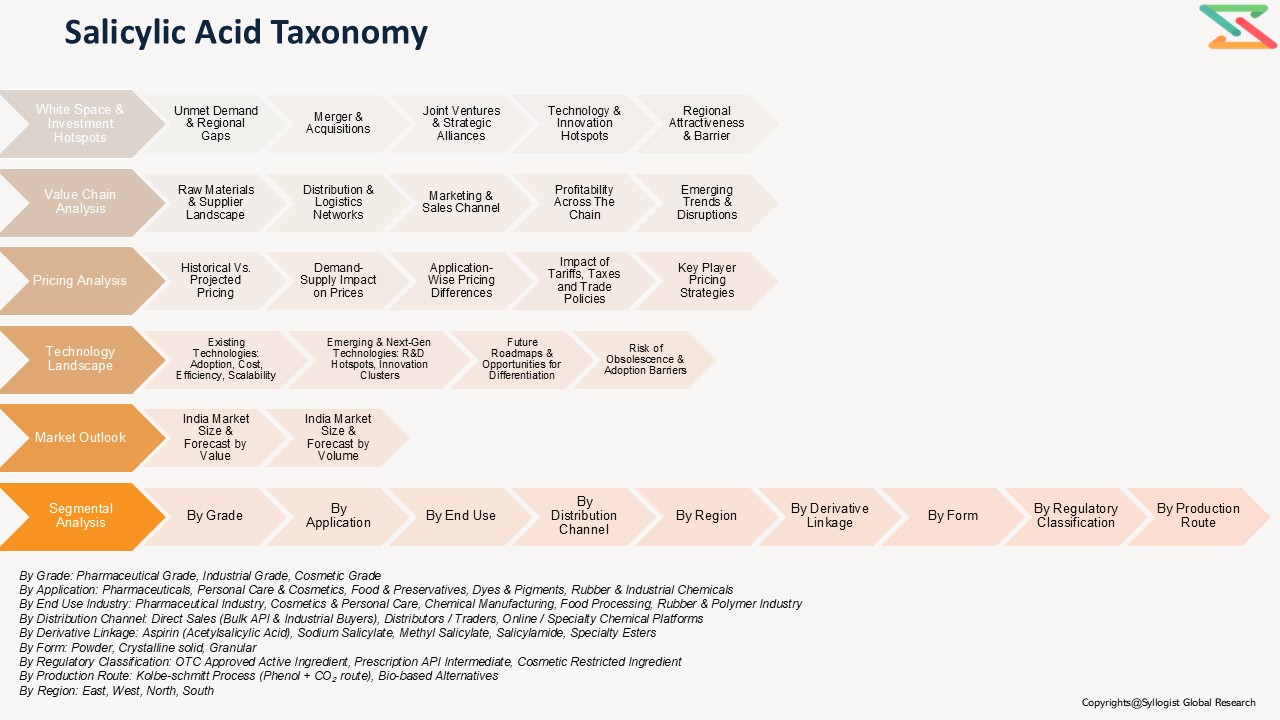
- Introduction (Product Definition, Taxonomy and Research Methodology)
- Executive Summary
- India Salicylic Acid Demand Supply Analysis
- Global Salicylic Acid Market Assessment, 2021-2031 Value, Volume and Segmental Analysis)
- India Market Outlook 2021-2031 (Value, Volume and Segmental Analysis)
- White Space & Emerging Investment Hotspot
- Market White Space Opportunities (Unmet demand, regional gaps, etc.)
- Mergers & Acquisitions (M&A)
- Joint Ventures & Strategic Alliances
- Technology & Innovation Hotspots
- Regional Investment Attractiveness
- Barriers & Risks in Investment
- Salicylic Acid Market Value Chain Analysis
- Raw Material Sourcing & Suppliers
- Key Raw Materials & Inputs
- Supplier Landscape & Concentration
- Pricing Trends & Volatility
- Dependence on Imports vs Domestic Availability
- Distribution & Logistics
- Marketing & Sales Channels
- Value Addition & Profitability Across Chain
- Emerging Trends & Disruptions
- Raw Material Sourcing & Suppliers
- Salicylic Acid Market Pricing Analysis
- Historical Vs Projected Pricing Analysis
- Demand-Supply Impact on Prices
- Application-wise Pricing Differences
- Impact of Tariffs, Taxes, and Trade Policies
- Key Player Pricing Strategies
- Salicylic Acid Technology Landscape
- Key Existing Technologies
- Technology Overview
- Advantages & Limitations
- Cost, Efficiency, and Scalability Aspects
- Emerging & Next-gen Technologies
- Pipeline & Under-development Technologies
- R&D Hotspots & Innovation Clusters
- Potential Disruption to Existing Methods
- Strategic Insights
- Future Technology Roadmap
- Opportunities for Differentiation via Technology
- Risks of Obsolescence & Barriers to Adoption
- Policy & Regulatory landscape
- Competition Outlook (Leading 10 Companies)
- Competition Benchmarking
- Market Leaders Vs New Entrants
- Strategic Recommendations
- Key Existing Technologies