Market Definition
The Global Subsea Electrification Technologies Market encompasses the engineering, manufacturing, qualification, installation, and life-cycle management of electrical power systems, power conversion equipment, distribution infrastructure, and control architectures specifically designed to deliver electrical energy to subsea production equipment, processing facilities, and transportation infrastructure located on the seabed at water depths ranging from shallow continental shelf environments to ultra-deepwater fields exceeding 3,000 meters, enabling the direct electric actuation, heating, pumping, compression, and separation of hydrocarbons and other seabed resources without the dependence on hydraulic fluid umbilicals, chemical injection lines, or surface-resident compression and processing infrastructure that characterizes conventional subsea production system architectures. The product and system scope of this market includes subsea power distribution units that step down and distribute electrical power from topside or floating production facilities through wet-mate and dry-mate electrical connectors to subsea loads across field architectures spanning single wellhead tiebacks to large multi-well subsea processing clusters, subsea variable speed drives and motor drive systems engineered to the pressure compensation, insulation coordination, and thermal management constraints of permanent seabed installation in electrically and mechanically hostile deepwater environments, subsea electric submersible pumps and their associated permanent magnet motor and variable speed drive systems replacing conventional hydraulic and surface-powered artificial lift methods in deepwater and ultra-deepwater production wells, subsea electric multiphase pumps delivering boosting capability for long-distance tieback developments where reservoir pressure is insufficient to transport wellstream fluids to processing facilities through extended subsea pipeline networks, subsea electric gas compressors enabling the compression and reinjection or export of associated gas at seabed locations without the need for surface or floating compression facilities, electrically trace-heated pipe-in-pipe and pipe bundle systems maintaining wellstream temperature above hydrate and wax appearance points across long subsea tiebacks where thermal insulation alone is insufficient to prevent flow assurance problems during production and shutdown conditions, subsea isolation and load switching equipment including subsea switchgear, fault current limiters, and protection relay systems adapted for seabed installation and remote electrical fault management, high-voltage subsea power cables and umbilicals incorporating power conductors, fiber optic communication elements, and chemical injection lines within a single integrated cross-section for efficient field infrastructure consolidation, subsea uninterruptible power supply and energy storage systems providing ride-through capability for subsea electrical systems during topside power disturbances, and the wet-mate electrical connector systems, penetrator assemblies, and subsea junction box infrastructure that constitute the interconnection architecture of distributed subsea electrical networks. The technology landscape within this market spans medium-voltage alternating current distribution systems operating at voltages up to 36 kilovolts for moderate tieback distance applications, high-voltage direct current power transmission architectures for ultra-long tieback distances exceeding 600 kilometers where alternating current reactive power compensation limitations make direct current transmission the technically preferred solution, and emerging wireless power transfer and resonant inductive coupling technologies targeting the elimination of physical electrical connectors in specific subsea instrumentation and sensor node applications. The value chain of this market extends from specialty insulation material, high-pressure electrical connector, and power semiconductor suppliers through subsea electrical equipment original equipment manufacturers, umbilical and subsea cable manufacturers, subsea installation and intervention vessel operators, subsea engineering and project management contractors, and the oil and gas operating companies, offshore wind developers, and emerging seabed mining and carbon capture and storage project proponents whose capital investment decisions determine the pace and geographic distribution of subsea electrification technology deployment globally.
Market Insights
The global subsea electrification technologies market is operating with strengthening commercial momentum in 2026, underpinned by the convergence of a sustained deepwater and ultra-deepwater exploration and production investment recovery, the progressive exhaustion of pressure support in mature subsea fields creating structural demand for electric boosting and compression to sustain production rates and extend field economic life, the intensifying commercial pressure on offshore operators to reduce topside facilities weight and complexity through subsea processing electrification, and the emerging demand from offshore wind developers for subsea electrical infrastructure supporting deepwater floating wind array inter-connection and power export systems. The global subsea electrification technologies market was valued at approximately USD 4.6 billion in 2025 and is projected to expand at a compound annual growth rate of 11 percent through 2036, reaching approximately USD 14 billion by the end of the forecast period, a trajectory supported by the long-duration capital investment cycles of deepwater oil and gas field development, the increasing technical necessity of subsea boosting and compression as a condition for the commercial viability of extended tieback and tail-end production optimization projects, and the broadening application base of subsea electrical technology beyond hydrocarbon production into offshore renewable energy, seabed mineral extraction, and carbon dioxide capture and geological storage infrastructure. The competitive structure of the market is shaped by a small number of large subsea systems and equipment corporations that have sustained multi-decade development programs for subsea electrical equipment qualification and that hold the engineering expertise, manufacturing infrastructure, and field reference track record necessary to bid for the large integrated subsea electrification contracts associated with major deepwater field development projects, alongside specialist component suppliers serving the wet-mate connector, subsea cable, power electronics module, and subsea instrumentation segments of the market with proprietary technology products that are integrated into complete subsea electrical systems by prime contractor system suppliers.
A defining technological and strategic development reshaping the commercial trajectory and competitive dynamics of the subsea electrification market is the accelerating industry transition toward all-electric subsea production systems that eliminate the hydraulic control and actuation infrastructure that has been the dominant subsea control architecture since the origins of deepwater production, replacing hydraulic actuators on subsea trees, manifolds, and pipeline end terminations with electric actuator systems powered and controlled through all-electric umbilicals that carry only electrical power and fiber optic communication conductors rather than the hydraulic fluid supply, chemical injection, and electrical power bundled within conventional hydraulic umbilicals. The all-electric subsea system architecture delivers operational and economic benefits that are generating strong operator interest and advancing commercial deployment, including the elimination of hydraulic fluid leakage risk and associated environmental liability, the ability to perform high-speed and independently timed valve actuation sequences that conventional hydraulic systems cannot achieve due to fluid compressibility and line length response time limitations, the enabling of condition-based maintenance through continuous monitoring of electric actuator torque, position, and health parameters that provide early warning of mechanical degradation before functional failure occurs, and the substantial reduction in chemical injection requirements and associated offshore chemical logistics that all-electric system designs achieve by replacing chemical hydrate inhibition during shutdown conditions with electrically powered thermal management systems. Several major deepwater operators have committed to all-electric subsea architecture as the standard for new field developments and brownfield expansion projects, and the qualification of all-electric subsea tree and manifold systems by leading subsea equipment suppliers in partnership with operator-led joint industry qualification programs is advancing the technology from pilot demonstration toward series production readiness, with the first commercial all-electric field developments expected to reach production during the forecast period and generating a significant commercial demand signal for all-electric umbilicals, electric actuators, subsea power distribution units, and associated electrical system integration services.
The subsea power from shore concept, in which electrical power is transmitted from onshore or near-shore power generation facilities through long high-voltage subsea cable systems to subsea loads located at distances of several hundred kilometers from shore, has advanced from conceptual engineering study to active front-end engineering design activity across multiple project applications, driven by the operational advantages of eliminating floating production facilities or manned offshore platforms as intermediate power generation hosts, the environmental benefit of enabling deepwater production with grid-connected renewable electricity rather than gas turbine-generated offshore power, and the technical feasibility demonstrated by the qualification and pilot operation of the first power-from-shore subsea compression systems in the Norwegian Continental Shelf. The commercial case for power from shore subsea electrification is strongest in geographic contexts where high-quality renewable electricity is available at competitive cost near the shore within cable transmission reach of deepwater fields, where the elimination of floating production infrastructure yields capital and operating cost savings that justify the investment in long high-voltage direct current or medium-voltage alternating current cable infrastructure, and where regulatory and fiscal frameworks provide incentives for the decarbonization of offshore production through grid-connected electrification of subsea systems. Norway represents the most commercially advanced national market for power from shore subsea electrification, with multiple operational installations and active project development pipelines supported by government electrification mandates, carbon tax frameworks that improve the economics of grid-connected subsea power relative to offshore gas turbine alternatives, and a mature subsea engineering supply chain with the competency and track record required to execute complex long-distance subsea power transmission projects. The broader application of power from shore electrification to subsea production assets across the North Sea, Gulf of Mexico, and deepwater Brazilian and West African fields is being evaluated in feasibility and front-end engineering studies whose outcomes will materially influence the capital expenditure pipeline for long-distance subsea power cable systems, offshore power conversion stations, and subsea distribution infrastructure across the forecast period.
From a regional investment and project development perspective, Europe and specifically the Norwegian Continental Shelf and the broader North Sea basin represent the most technically advanced and commercially active regional market for subsea electrification technology deployment, driven by the combination of Norway’s regulatory mandate for offshore electrification as a condition of field development approval in certain cases, the high carbon tax applied to offshore production emissions that significantly improves the economic case for grid-connected subsea power, the maturity of the Norwegian and British subsea engineering supply chain, and the active collaboration between major operators and equipment suppliers in joint industry qualification programs advancing next-generation subsea electrical system technologies. The Gulf of Mexico, particularly the ultra-deepwater Paleogene trend and the mature shelf and deepwater tieback development opportunities in the Mississippi Canyon and Garden Banks areas, represents the most significant near-term growth market for subsea electrification technology in North America, with major operators advancing feasibility studies for subsea boosting, compression, and all-electric system architectures as the mechanism for extending the productive life of existing deepwater infrastructure beyond the economic limits achievable through conventional production methods. Asia-Pacific, led by Australia’s deepwater gas production infrastructure and the emerging deepwater exploration and development programs in Southeast Asia, East Africa, and the eastern Mediterranean, represents a growing regional market for subsea electrification technology where the long tieback distances characteristic of remote deepwater gas field developments are creating technical requirements for subsea compression and boosting that conventional architectures cannot cost-effectively satisfy. The emerging application of subsea electrical infrastructure to floating offshore wind inter-array cable systems, seabed electrical hub and meshed offshore grid architectures for large floating wind clusters, and the electrification of remotely operated and autonomous underwater vehicle charging and docking infrastructure represents a structurally important and growing non-oil and gas demand stream that is broadening the addressable market for subsea electrification technology across the forecast period.
Key Drivers
Deepwater and Ultra-Deepwater Field Development Expansion and the Technical Necessity of Subsea Electrification for Extended Tieback and Tail-End Production Optimization
The most structurally durable and commercially consequential demand driver for subsea electrification technologies is the fundamental technical necessity of electric power delivery to seabed-resident boosting, compression, separation, and heating equipment as the enabling condition for the commercial development of the most significant categories of deepwater and ultra-deepwater hydrocarbon resources that constitute the primary growth frontier of global offshore oil and gas production investment. Extended tieback field developments, in which satellite wellheads and subsea manifolds are connected by long flowline systems to existing host production facilities rather than dedicated new surface infrastructure, are increasingly dependent on subsea boosting and compression to compensate for the friction and static head losses associated with long-distance multiphase flow transportation, with tieback distances in active development in the Gulf of Mexico, Norwegian Continental Shelf, and offshore Brazil routinely exceeding 100 kilometers and in some frontier cases approaching 200 kilometers, distances at which wellstream arrival pressure and temperature conditions cannot be maintained within acceptable process limits without active subsea intervention in the flow system through electrical boosting or compression. The tail-end production optimization imperative at mature deepwater fields, where natural reservoir pressure decline has reduced wellstream flowing pressures below the levels required to deliver oil and gas to surface processing facilities at commercially viable production rates, creates a second and equally compelling technical driver for subsea electric boosting and artificial lift investment that represents a brownfield capital expenditure category distinct from new field development and that is generating active subsea electrification project execution across the major deepwater producing regions as operators seek to extend field economic life beyond the production profiles achievable through conventional depletion drive recovery. The economic case for subsea electrification in these applications is supported by the oil and gas price environment prevailing in 2026, which provides sufficient revenue per barrel and per thousand cubic foot to justify the capital investment in subsea electrical systems when the alternative is either premature field abandonment or the installation of new surface production facilities at costs substantially exceeding subsea electrification investment requirements. The growing global oil and gas operator capital expenditure commitment to deepwater developments, driven by the superior reservoir quality, production longevity, and unit development cost profiles of deepwater accumulations relative to many onshore and shallow water alternatives, is providing the investment pipeline that sustains demand for the complete range of subsea electrification equipment and services required to bring technically complex deepwater projects to commercial production.
Offshore Decarbonization Mandates and the Commercial Incentive for Grid-Connected Electrification of Subsea Production Systems as an Emissions Reduction Strategy
The intensifying regulatory and commercial pressure on offshore oil and gas operators to reduce the greenhouse gas emissions intensity of their production operations is creating a powerful and structurally growing demand driver for subsea electrification technologies by establishing grid-connected electrification of offshore production systems, including subsea compression, boosting, and heating equipment, as the technically preferred and in some regulatory frameworks mandated pathway to eliminating the offshore gas turbine combustion that constitutes the dominant source of direct emissions from offshore production facilities. In Norway, the world’s most advanced regulatory environment for offshore emissions management, the carbon tax applied to offshore combustion emissions has reached a level that makes the net present value of grid-connected electrification investments positive relative to continued gas turbine operation across a growing range of field life extension and new development project economics, creating a market mechanism that generates organic commercial demand for subsea power from shore infrastructure independent of direct regulatory mandate. The Norwegian government’s electrification policy framework, which has established expectations for operator evaluation of electrification options as part of field development plan submissions and has in several cases made electrification a condition of development approval, is creating a project pipeline of power from shore and subsea electrification investments that is providing the demand volume necessary to drive continued cost reduction and technology maturation in the subsea electrical equipment supply chain. The United Kingdom North Sea Transition Deal and associated emissions reduction obligations accepted by offshore operators, combined with the Emissions Trading Scheme cost of offshore combustion allowances, is creating an analogous though less prescriptive commercial incentive for offshore electrification investment across the British Continental Shelf that is generating feasibility and front-end engineering study activity for power from shore and floating production facility electrification projects involving subsea electrical distribution to seabed-resident equipment. The global extension of carbon pricing and offshore emissions regulation to the Gulf of Mexico, Brazilian offshore, and Australian continental shelf production environments over the forecast period is expected to progressively replicate the commercially enabling framework that Norwegian carbon taxation has created for subsea electrification investment, broadening the geographic market for power from shore and subsea electrical system technologies beyond the current Northern European concentration and creating a global demand driver that reinforces the deepwater field development technical necessity driver across all major offshore producing regions.
Key Challenges
Extreme Technical Qualification Requirements and the Extended Development Timelines Associated with Certifying Novel Subsea Electrical Equipment for Permanent Deepwater Installation
The most consequential structural challenge limiting the pace of subsea electrification technology adoption and commercial deployment is the extraordinary rigor, duration, and cost of the equipment qualification programs required to demonstrate the fitness for purpose of novel subsea electrical components and systems for permanent installation on the seabed at water depths where intervention for repair or replacement requires specialized remotely operated vehicle operations costing in excess of USD 500,000 per day of vessel time and where the commercial consequences of equipment failure include production loss rates that can exceed USD 1,000,000 per day for a suspended deepwater production system. The qualification standard for subsea electrical equipment applies pressure testing at water depths substantially exceeding the target field installation depth to verify pressure housing and wet-mate connector integrity, thermal cycling across the full range of operating temperatures encountered from cold seawater ambient to equipment operating temperature under full electrical load, vibration and shock testing simulating installation handling and operational flow-induced excitation environments, insulation resistance and partial discharge testing at elevated voltage and pressure conditions replicating the combination of operating voltage and hydrostatic pressure that subsea power system components experience in service, salt water immersion and cathodic protection compatibility testing verifying long-term material corrosion resistance, and endurance testing of motorized components including variable speed drives, switchgear actuators, and wet-mate connector engagement mechanisms across the required operational cycle count for a 25 year or greater design life without maintenance access. The cumulative duration of a comprehensive subsea electrical equipment qualification program for a novel technology such as a subsea variable speed drive at a new voltage and power rating or a wet-mate electrical connector at a new current carrying capacity can span three to five years from the commencement of detailed engineering design to the issuance of a qualification certificate by a recognized classification society, a timeline that translates into an equivalent delay in the commercial availability of upgraded or higher-rated equipment and that requires project developers to initiate equipment qualification programs years in advance of anticipated project sanction to ensure certified equipment availability aligns with project execution schedules. The high cost of subsea qualification programs, which typically require the fabrication of multiple prototype units, the operation of specialist high-pressure test facilities, and the engagement of independent verification bodies across multi-year testing campaigns, creates a substantial barrier to technology innovation and new entrant participation in the subsea electrical equipment market and concentrates development investment in the largest incumbent suppliers who can amortize qualification costs across anticipated multi-project commercial volumes.
High System Integration Complexity and the Operational Risk of Subsea Electrical System Faults in Inaccessible Deepwater Environments Without Practical Intervention Capability
A structurally significant commercial challenge constraining operator confidence in the commitment of large capital expenditures to subsea electrification projects is the fundamental operational risk associated with the deployment of complex electrical systems in deepwater environments where the combination of extreme hydrostatic pressure, absence of human intervention capability, aggressive seawater corrosion conditions, and physical inaccessibility for inspection and maintenance creates a system reliability requirement that substantially exceeds the standards applied to equivalent surface-installed electrical equipment and where the failure of a single critical electrical component can result in complete loss of power to subsea production systems across entire field developments. The electrical fault management challenge in subsea power distribution systems is particularly acute because the high insulation resistance requirements of subsea electrical equipment operating at elevated voltage in a conductive seawater environment mean that conventional ground fault detection and protection schemes designed for surface power distribution cannot be directly applied to subsea systems, requiring the development of specialized subsea insulation monitoring and fault location technologies capable of distinguishing normal insulation degradation trends from incipient fault conditions and of providing sufficient fault location accuracy to guide remotely operated vehicle intervention to the specific section of the subsea electrical network requiring remediation. The interdependence of subsea electrical system components across complex deepwater field architectures, in which a single subsea switchgear unit or distribution junction box provides power to multiple downstream loads including subsea pumps, compressors, chemical injection systems, and control equipment, means that a failure of the upstream distribution component results in simultaneous loss of all dependent subsea systems, a single-point-of-failure risk that requires the incorporation of redundant power feed paths, subsea uninterruptible power supply systems, and load prioritization and shedding logic capable of maintaining critical subsea safety and well control functions during partial electrical system failure scenarios. The challenge of integrating subsea electrical systems from multiple suppliers, each with proprietary communication protocols, protection coordination philosophies, and equipment monitoring data formats, into a coherent subsea power management system that can be operated and diagnosed from a topside control room by operators without specialized electrical engineering expertise, represents a systems engineering challenge that has historically added cost and schedule risk to subsea electrification projects and that the industry is addressing through the development of subsea electrical system integration standards and the emergence of subsea power management system software platforms providing unified monitoring, protection coordination, and diagnostic capability across multi-vendor subsea electrical equipment installations.
Market Segmentation
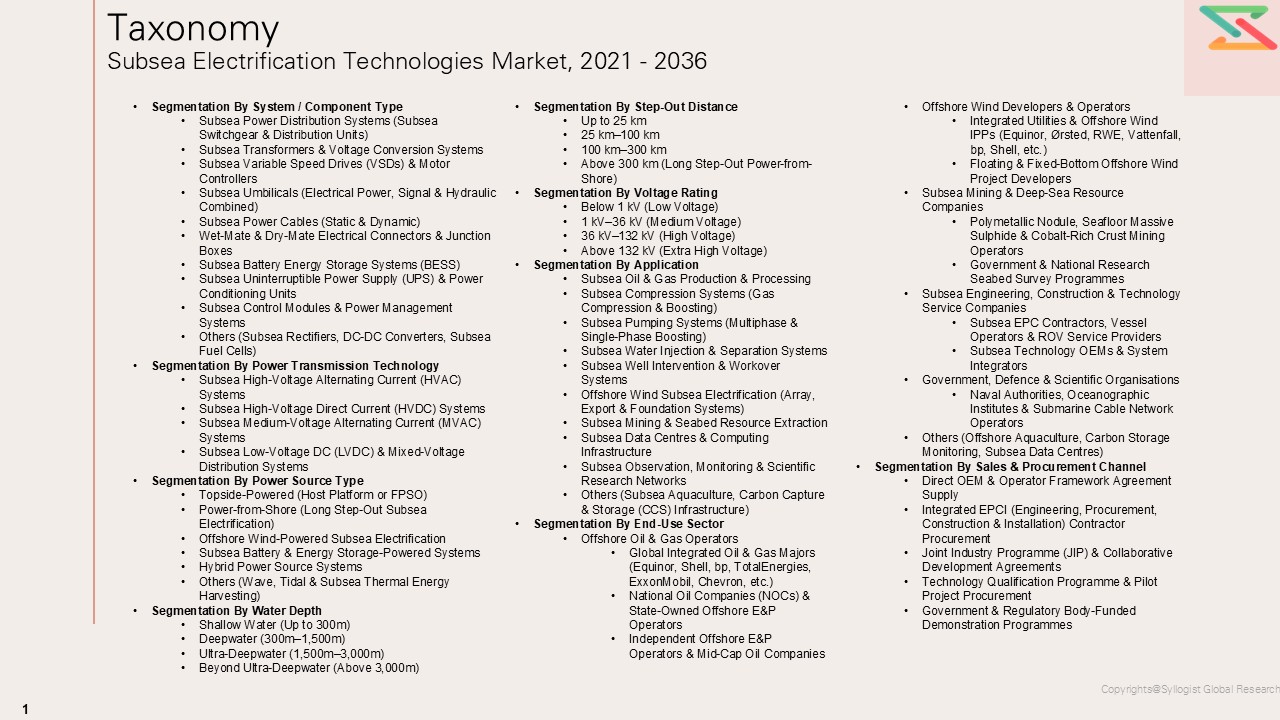
- Segmentation By Technology Type
- Subsea Power Distribution Units and Switchgear
- Subsea Variable Speed Drives and Motor Controllers
- Subsea Electric Submersible Pump Systems
- Subsea Electric Multiphase Pump Systems
- Subsea Electric Gas Compressors
- Electrically Trace-Heated Flowline and Pipe-in-Pipe Systems
- All-Electric Subsea Tree and Wellhead Actuation Systems
- Subsea Uninterruptible Power Supply and Energy Storage
- Subsea Power from Shore Cable and Conversion Systems
- Wet-Mate and Dry-Mate Electrical Connectors
- Subsea Electrical Umbilicals and Power Cables
- Others
- Segmentation By Power Transmission Architecture
- Medium-Voltage Alternating Current (MVAC) Distribution
- High-Voltage Alternating Current (HVAC) Transmission
- High-Voltage Direct Current (HVDC) Transmission
- Low-Voltage Direct Current (LVDC) Distribution
- Hybrid AC-DC Subsea Power Systems
- Others
- Segmentation By Application
- Subsea Production Boosting and Artificial Lift
- Subsea Gas Compression and Reinjection
- Subsea Separation and Processing
- Wellstream Thermal Management and Flow Assurance Heating
- Subsea Well Control and Safety Actuation
- Subsea Instrumentation and Sensor Power Supply
- Remotely Operated and Autonomous Underwater Vehicle Charging
- Floating Offshore Wind Inter-Array and Export Power
- Seabed Mining and Resource Extraction Equipment Power
- Subsea Carbon Dioxide Injection and Storage Infrastructure
- Others
- Segmentation By Water Depth
- Shallow Water (Below 300 Meters)
- Deepwater (300 to 1,500 Meters)
- Ultra-Deepwater (1,500 to 3,000 Meters)
- Hadal and Extreme Depth (Above 3,000 Meters)
- Segmentation By Tieback Distance
- Short Tieback (Below 30 Kilometers)
- Medium Tieback (30 to 100 Kilometers)
- Long Tieback (100 to 300 Kilometers)
- Ultra-Long Tieback (Above 300 Kilometers)
- Segmentation By Power Source
- Topside Facility-Resident Gas Turbine Generation
- Power from Shore via Grid-Connected Onshore Supply
- Floating Offshore Renewable Energy Generation
- Subsea Battery and Energy Storage Standalone Supply
- Hybrid Multi-Source Subsea Power Systems
- Others
- Segmentation By End-Use Industry
- Deepwater and Ultra-Deepwater Oil and Gas Production
- Offshore Gas Processing and LNG Infrastructure
- Floating Offshore Wind Energy
- Fixed Offshore Wind Energy
- Seabed Mineral and Polymetallic Nodule Extraction
- Offshore Carbon Capture and Geological Storage
- Subsea Scientific Research and Ocean Observatories
- Defense and Naval Subsea Infrastructure
- Others
- Segmentation By Component
- Subsea Power Electronics Hardware
- Subsea Electrical Connectors and Penetrators
- Subsea Power Cables and Umbilicals
- Subsea Junction Boxes and Manifold Electrical Systems
- Subsea Control and Power Management Software
- Subsea Insulation Monitoring and Fault Detection Systems
- Marine Installation and Commissioning Services
- Subsea Electrical Inspection and Intervention Services
- Qualification Testing and Certification Services
- Others
- Segmentation By Region
- Europe (North Sea and Norwegian Continental Shelf)
- North America (Gulf of Mexico)
- Latin America (Brazil Pre-Salt and Offshore West Africa)
- Asia-Pacific (Australia and Southeast Asia)
- Middle East and Africa
All market revenues are presented in USD
Historical Year: 2021-2024 | Base Year: 2025 | Estimated Year: 2026 | Forecast Period: 2027-2036
Key Questions this Study Will Answer
- What is the projected global market valuation for subsea electrification technologies through 2036, segmented by technology type, power transmission architecture, application, water depth, tieback distance, end-use industry, and region, and which technology categories and geographic markets are expected to generate the highest incremental revenue growth across the forecast period?
- What is the commercial development trajectory and operator adoption pipeline for all-electric subsea tree, manifold, and wellhead actuation systems, and how are the joint industry qualification programs led by major deepwater operators and subsea equipment suppliers expected to advance all-electric subsea architecture from the current pilot demonstration stage to series production readiness and mainstream field development specification across the forecast period?
- How are the competing medium-voltage alternating current, high-voltage alternating current, and high-voltage direct current power transmission architectures for subsea power from shore projects being evaluated in front-end engineering studies across the Norwegian Continental Shelf, British Continental Shelf, Gulf of Mexico, and offshore Brazil, and what tieback distance, water depth, and power demand thresholds are determining the selection of each transmission architecture in active project development pipelines?
- What is the scale and geographic distribution of the active capital expenditure pipeline for subsea electric boosting, compression, and trace heating projects targeting brownfield production optimization and tail-end life extension at mature deepwater fields, and how are oil and gas price scenarios, carbon tax frameworks, and emissions reduction obligations affecting the economic threshold at which operators are sanctioning subsea electrification investments relative to alternative field management strategies?
- How is the emerging demand for subsea electrical infrastructure from floating offshore wind inter-array cable systems, seabed electrical hub architectures for large-scale floating wind clusters, autonomous underwater vehicle charging infrastructure, and subsea carbon dioxide injection systems expected to develop as a proportion of total subsea electrification market revenue over the forecast period, and what are the technical specification differences between oil and gas and renewable energy application requirements that are shaping subsea electrical equipment product development priorities?
- Who are the leading subsea electrification system integrators, subsea variable speed drive manufacturers, wet-mate connector specialists, subsea cable and umbilical producers, and marine installation contractors currently defining the competitive landscape of the global subsea electrification technologies market, and what are their respective technology platform strategies, deepwater qualification program investment plans, regional market expansion priorities, and partnership structures with major deepwater operator clients for advancing subsea electrification from current commercial deployment levels toward the broader field development standard specification that increasing decarbonization and production optimization imperatives are expected to drive over the forecast horizon?
- Product Definition
- Scope of the Study
- Research Methodology
- Research Design & Framework
- Overall Research Approach: Descriptive, Exploratory & Quantitative Mixed-Method Design
- Market Definition & Scope Boundaries: What is Included and Excluded
- Segmentation Framework
- Key Research Assumptions & Limitations
- Secondary Research
- Industry Publications, Subsea Equipment OEM Reports, Offshore Energy Operator Technical Standards & Press Releases
- Government Offshore Energy, Maritime & Seabed Authority Data (IEA, NOPSEMA, BEIS, NOGEPA, Petroleumstilsynet, IMO, etc.)
- Subsea Electrification System Deployment, Project Award & CAPEX Investment Statistics
- Offshore Oil & Gas, Offshore Wind & Subsea Mining Operator Procurement & Field Development Databases
- Primary Research Design & Execution
- In-depth Interviews with Subsea Electrification System Manufacturers, Offshore Field Development Engineers, Subsea EPC Contractors & Asset Integrity Specialists
- Surveys with Offshore Oil & Gas Operators, Offshore Wind Developers, Subsea Technology Service Companies & Seabed Mining Operators
- Expert Panel Validation
- Data Triangulation & Validation
- Market Sizing & Forecasting Methodology
- Bottom-Up & Top-Down Reconciliation
- Offshore Field Development Pipeline, Tieback Activity & Subsea Processing Adoption-Driven Market Sizing Model
- Electrification Retrofit & Power-from-Shore Transition Rate Adjustment Framework
- Competitive Intelligence Methodology
- Quality Assurance & Peer Review
- Definitions, Abbreviations & Data Notes
- Executive Summary
- Market Snapshot & Headline Numbers
- Key Findings & Research Highlights
- Technology & Innovation Highlights
- Project Economics & Unit Economics Summary
- Average System CAPEX & OPEX Benchmarks
- Topside-Powered vs Power-from-Shore vs Subsea Battery Storage System Economics Comparison
- Subsea Power Distribution, Variable Speed Drive (VSD) & Transformer Revenue Model Summary
- Market Dynamics
- Drivers
- Restraints
- Opportunities
- Challenges
- Porter’s Five Forces Analysis
- PESTLE Analysis
- Market Trends & Developments
- Emerging Trends
- Technological Developments
- Regulatory & Policy Changes
- Supply Chain & Sourcing Trends
- Investment & Funding Activity
- Sustainability & ESG Trends
- Geographic & Regional Trends
- Risk Assessment Framework
- Geopolitical & Offshore Licensing, Permitting & Field Development Policy Risk
- Deepwater Technology Readiness, Qualification & First-of-a-Kind (FOAK) System Deployment Risk
- Subsea Asset Integrity, Corrosion, Pressure Rating & Long-Term Reliability Risk
- Supply Chain Bottleneck Risk (Subsea Umbilicals, Wet-Mate Connectors, Subsea Transformers & Pressure-Compensated Housings)
- Regulatory, Environmental & Seabed Impact Assessment Risk
- Oil & Gas Price Cyclicality & Operator Capital Expenditure Deferral Risk
- Offshore Wind Electrification & Energy Transition Disruption Risk to Conventional Subsea O&G Market
- Regulatory Framework & Policy Standards
- Global Subsea Electrification Technologies Market Economics
- System Development & Manufacturing Economics Framework
- Capital Expenditure (CAPEX) Structure
- Operating Expenditure (OPEX) Structure
- Revenue Model & Monetisation Levers (System Sales, Long-Term Service Agreements, Integrated Technology Packages, Software & Remote Monitoring)
- Capacity Utilisation & Throughput Economics
- Payback Period & Return on Investment (ROI) Analysis
- Total Cost of Ownership vs Conventional Topside Power & Umbilical-Fed Distribution Technologies
- Equipment & Component Input Cost Analysis
- Subsea Power Cable & Umbilical (Electrical, Fibre-Optic, Hydraulic) Cost Trends (USD/km, 2021–2035)
- Subsea Transformer, Switchgear & Power Distribution Unit Cost Dynamics
- Subsea Variable Speed Drive (VSD) & Motor Soft-Starter Cost Structure
- Wet-Mate & Dry-Mate Electrical Connector & Junction Box Cost Analysis
- Pressure-Compensated Housing, Syntactic Foam & Subsea Enclosure Material Cost Structure
- Subsea Battery Energy Storage Module & Power Management System Cost Economics
- Impact of Water Depth Rating Uplift (1,000m to 3,000m+) & Harsh Environment Qualification on System Economics
- Subsea Installation, Commissioning & Intervention Economics
- Vessel Day-Rate Economics: Dive Support Vessels (DSV), Construction Support Vessels (CSV) & ROV-Based Installation
- Subsea Tie-In, Energisation & Commissioning Cost Structure by Water Depth & Field Architecture
- Remotely Operated Vehicle (ROV) & Autonomous Underwater Vehicle (AUV) Intervention Cost Economics
- Integrity Management, Condition Monitoring & Long-Term Service Agreement Economics
- Regulatory & Standards Compliance Economics
- Subsea Electrical Equipment Design, Qualification & Certification Standards Compliance Cost Benchmarks (IEC 61892, DNVGL-ST-0238, API 17F, API 17H, etc.)
- Subsea High-Voltage AC/DC System Type Testing & Factory Acceptance Test (FAT) Cost Structure
- Environmental Impact Assessment (EIA), Seabed Survey & Marine Consenting Compliance Costs
- Global Subsea Electrification Technologies Market Outlook
- Market Size & Forecast by Value (USD Billion, 2021–2036)
- Market Size & Forecast by System / Component Type
- Subsea Power Distribution Systems (Subsea Switchgear & Distribution Units)
- Subsea Transformers & Voltage Conversion Systems
- Subsea Variable Speed Drives (VSDs) & Motor Controllers
- Subsea Umbilicals (Electrical Power, Signal & Hydraulic Combined)
- Subsea Power Cables (Static & Dynamic)
- Wet-Mate & Dry-Mate Electrical Connectors & Junction Boxes
- Subsea Battery Energy Storage Systems (BESS)
- Subsea Uninterruptible Power Supply (UPS) & Power Conditioning Units
- Subsea Control Modules & Power Management Systems
- Others (Subsea Rectifiers, DC-DC Converters, Subsea Fuel Cells)
- Market Size & Forecast by Power Transmission Technology
- Subsea High-Voltage Alternating Current (HVAC) Systems
- Subsea High-Voltage Direct Current (HVDC) Systems
- Subsea Medium-Voltage Alternating Current (MVAC) Systems
- Subsea Low-Voltage DC (LVDC) & Mixed-Voltage Distribution Systems
- Market Size & Forecast by Power Source Type
- Topside-Powered (Host Platform or FPSO)
- Power-from-Shore (Long Step-Out Subsea Electrification)
- Offshore Wind-Powered Subsea Electrification
- Subsea Battery & Energy Storage-Powered Systems
- Hybrid Power Source Systems
- Others (Wave, Tidal & Subsea Thermal Energy Harvesting)
- Market Size & Forecast by Water Depth
- Shallow Water (Up to 300m)
- Deepwater (300m–1,500m)
- Ultra-Deepwater (1,500m–3,000m)
- Beyond Ultra-Deepwater (Above 3,000m)
- Market Size & Forecast by Step-Out Distance
- Up to 25 km
- 25 km–100 km
- 100 km–300 km
- Above 300 km (Long Step-Out Power-from-Shore)
- Market Size & Forecast by Voltage Rating
- Below 1 kV (Low Voltage)
- 1 kV–36 kV (Medium Voltage)
- 36 kV–132 kV (High Voltage)
- Above 132 kV (Extra High Voltage)
- Market Size & Forecast by Application
- Subsea Oil & Gas Production & Processing
- Subsea Compression Systems (Gas Compression & Boosting)
- Subsea Pumping Systems (Multiphase & Single-Phase Boosting)
- Subsea Water Injection & Separation Systems
- Subsea Well Intervention & Workover Systems
- Offshore Wind Subsea Electrification (Array, Export & Foundation Systems)
- Subsea Mining & Seabed Resource Extraction
- Subsea Data Centres & Computing Infrastructure
- Subsea Observation, Monitoring & Scientific Research Networks
- Others (Subsea Aquaculture, Carbon Capture & Storage (CCS) Infrastructure)
- Market Size & Forecast by End-Use Sector
- Offshore Oil & Gas Operators
- Global Integrated Oil & Gas Majors (Equinor, Shell, bp, TotalEnergies, ExxonMobil, Chevron, etc.)
- National Oil Companies (NOCs) & State-Owned Offshore E&P Operators
- Independent Offshore E&P Operators & Mid-Cap Oil Companies
- Offshore Wind Developers & Operators
- Integrated Utilities & Offshore Wind IPPs (Equinor, Ørsted, RWE, Vattenfall, bp, Shell, etc.)
- Floating & Fixed-Bottom Offshore Wind Project Developers
- Subsea Mining & Deep-Sea Resource Companies
- Polymetallic Nodule, Seafloor Massive Sulphide & Cobalt-Rich Crust Mining Operators
- Government & National Research Seabed Survey Programmes
- Subsea Engineering, Construction & Technology Service Companies
- Subsea EPC Contractors, Vessel Operators & ROV Service Providers
- Subsea Technology OEMs & System Integrators
- Government, Defence & Scientific Organisations
- Naval Authorities, Oceanographic Institutes & Submarine Cable Network Operators
- Others (Offshore Aquaculture, Carbon Storage Monitoring, Subsea Data Centres)
- Offshore Oil & Gas Operators
- Market Size & Forecast by Sales & Procurement Channel
- Direct OEM & Operator Framework Agreement Supply
- Integrated EPCI (Engineering, Procurement, Construction & Installation) Contractor Procurement
- Joint Industry Programme (JIP) & Collaborative Development Agreements
- Technology Qualification Programme & Pilot Project Procurement
- Government & Regulatory Body-Funded Demonstration Programmes
- Asia-Pacific Subsea Electrification Technologies Market Outlook
- Market Size & Forecast
- By Value (2020–2035)
- By System / Component Type
- By Power Transmission Technology
- By Power Source Type
- By Water Depth
- By Step-Out Distance
- By Voltage Rating
- By Application
- By End-Use Sector
- By Sales & Procurement Channel
- Key Demand Drivers (APAC-Specific)
- Competitive Landscape (APAC)
- Europe Subsea Electrification Technologies Market Outlook
- Market Size & Forecast
- By Value (2020–2035)
- By System / Component Type
- By Power Transmission Technology
- By Power Source Type
- By Water Depth
- By Step-Out Distance
- By Voltage Rating
- By Application
- By End-Use Sector
- By Sales & Procurement Channel
- Key Demand Drivers (Europe-Specific)
- Competitive Landscape (Europe)
- North America Subsea Electrification Technologies Market Outlook
- Market Overview & Strategic Importance
- Market Size & Forecast
- By Value (2020–2035)
- By System / Component Type
- By Power Transmission Technology
- By Power Source Type
- By Water Depth
- By Step-Out Distance
- By Voltage Rating
- By Application
- By End-Use Sector
- By Sales & Procurement Channel
- Key Demand Drivers (North America-Specific)
- Competitive Landscape (North America)
- Latin America Subsea Electrification Technologies Market Outlook
- Market Size & Forecast
- By Value (2020–2035)
- By System / Component Type
- By Power Transmission Technology
- By Power Source Type
- By Water Depth
- By Step-Out Distance
- By Voltage Rating
- By Application
- By End-Use Sector
- By Sales & Procurement Channel
- Key Demand Drivers (LATAM-Specific)
- Competitive Landscape (LATAM)
- Middle East & Africa Subsea Electrification Technologies Market Outlook
- Market Size & Forecast
- By Value (2020–2035)
- By System / Component Type
- By Power Transmission Technology
- By Power Source Type
- By Water Depth
- By Step-Out Distance
- By Voltage Rating
- By Application
- By End-Use Sector
- By Sales & Procurement Channel
- Key Demand Drivers (MEA-Specific)
- Competitive Landscape (MEA)
- Country-Wise Subsea Electrification Technologies Market Outlook
- Market Size & Forecast by Country
- By Value
- By System / Component Type
- By Power Transmission Technology
- By Power Source Type
- By Water Depth
- By Step-Out Distance
- By Voltage Rating
- By Application
- By End-Use Sector
- By Sales & Procurement Channel
- Market Size & Forecast by Country
- Market Size & Forecast
- Market Size & Forecast
- Market Size & Forecast
- Market Size & Forecast
- System Development & Manufacturing Economics Framework
Countries Covered: Norway, United Kingdom, United States, Brazil, Australia, Netherlands, France, Angola, Nigeria, Saudi Arabia, UAE, Malaysia, Indonesia, India, China, Japan, South Korea, Mexico, Canada, South Africa
- Technology Landscape & Innovation Analysis
- Subsea Electrification Technology Maturity Assessment
- Emerging & Disruptive Technologies in Subsea Electrification
- Subsea High-Voltage DC (HVDC) Long Step-Out Power Transmission: Technology Roadmap & Qualification Status
- Subsea Variable Speed Drive (VSD) & Permanent Magnet Motor Technology Advances for High-Power Compression & Pumping
- Subsea Battery Energy Storage Systems: Pressure-Compensated Cell Technology, Pack Design & Qualification
- Wireless Power Transfer, Inductive Charging & Autonomous Underwater Vehicle (AUV) Docking & Recharging Technology
- Digital Twin, Fibre-Optic Sensing, Subsea IoT & AI-Driven Predictive Integrity Management Platforms
- Subsea Power Electronics Miniaturisation: Pressure-Tolerant, Fluid-Filled & Syntactic Foam-Encapsulated System Advances
- Technology Readiness & Commercialisation Matrix – Key Subsea Electrification Technologies
- Patent Landscape Analysis
- R&D Investment Benchmarking
- Value Chain & Supply Chain Analysis
- Subsea Electrification Technologies Value Chain Mapping
- Supply Chain Concentration & Dependency Analysis
- Key Supplier Mapping by Component & Technology Programme
- Subsea Umbilical, Cable & Flexible Pipe (SURF) Manufacturer Mapping
- Subsea Transformer, Switchgear & Power Distribution Unit Manufacturer Mapping
- Subsea VSD, Motor Controller & Power Electronics Module Supplier Mapping
- Wet-Mate Connector, Junction Box & Subsea Control Module Supplier Mapping
- Pressure-Compensated Housing, Syntactic Foam & Subsea Enclosure Material Supplier Mapping
- Supplier Risk Heat Map
- Make vs Buy Strategy Trends Among Subsea Electrification OEMs & Offshore EPCI Contractors
- Pricing Analysis
- Subsea Electrification System Pricing Dynamics & Mechanisms
- Pricing by System / Component Type, Water Depth, Voltage Rating & Step-Out Distance
- Total Cost of Ownership (TCO) Analysis – Including System CAPEX, Installation, Integrity Management, Intervention & Decommissioning
- Topside-Powered vs Power-from-Shore vs Battery-Backed Subsea Electrification System Pricing Trends & Benchmarks
- Hardware Sale vs Integrated EPCI Package vs Long-Term Service Agreement Pricing & Value Proposition
- Sustainability & Environmental Stewardship
- Environmental & Sustainability Landscape in Subsea Electrification Technology Development & Deployment
- Carbon Footprint Benchmarking: Subsea Electrification vs Conventional Topside-Diesel & Gas Turbine-Driven Offshore Power Systems
- Seabed Impact, Marine Ecology & Biodiversity Risk Assessment for Subsea Cable & Equipment Installation
- Subsea Electrification’s Role in Offshore Platform Decarbonisation, Emission Reduction & Energy Transition Targets
- Recyclability of Subsea Equipment, Cable Materials & Decommissioning Waste Stream Assessment
- ESG Reporting & Lifecycle Assessment (LCA) in Subsea Electrification Project Operations
- Competitive Landscape
- Market Structure & Concentration
- Market Consolidation Level: Global Subsea Technology Majors vs Specialist Niche Suppliers & Deep-Tech Startups
- Top 5 Subsea Electrification Technology Companies Market Revenue Share
- HHI (Herfindahl-Hirschman Index) Concentration Analysis by System Type, Application & Region
- Competitive Intensity Map by Segment & Region
- Player Classification
- Tier-1 Global Integrated Subsea Technology & Energy OEMs with Subsea Electrification Portfolios (Baker Hughes, Siemens Energy, ABB, TechnipFMC, Schlumberger / SLB, Subsea 7, etc.)
- Tier-2 Specialist Subsea Power Electronics, Cable & Connector Manufacturers & System Integrators
- Emerging Subsea Electrification Technology Startups, JIP Participants & University Spin-offs
- Emerging & Disruptive Players
- Competitive Analysis Frameworks
- Market Share Analysis by System Type, Application & Geography
- R&D Intensity & Technology Qualification Programme Breadth Benchmarking
- Operator Framework Agreement, Joint Industry Programme (JIP) Portfolio & Long-Term Service Contract Comparison
- Geographic Revenue Exposure & Offshore Basin Deployment Footprint Comparison
- Company Profiles
- Company Overview, HQ & Organisational Structure
- Subsea Electrification Products, System Architecture & Technology Qualification Portfolio
- Revenue Breakdown
- Key Operator Supply Programmes, Field Development Projects & EPCI Contract References
- Manufacturing Footprint, Subsea Test Facilities & Key Facilities
- Recent Developments (M&A, Partnerships, New Products, Technology Qualifications, Financial Results)
- SWOT Analysis
- Strategic Focus: Technology Qualification Leadership, Deepwater System Upscaling, Power-from-Shore Expansion & Offshore Wind Integration Strategy
- Strategic Output
- Market Opportunity Matrix
- High-Value Opportunity Quadrant Analysis
- Addressable Market by System Type, Application & Region
- Time-to-Revenue Assessment by Opportunity
- White Space Opportunity Analysis
- Underserved Water Depth, Step-Out Distance & Application Segment Gaps
- Geographic Offshore Basins with Low Subsea Electrification Penetration & High Development Pipeline
- Technology, Power Transmission & Voltage Rating Gaps with High Commercialisation Potential
- Customer Segment Unmet Needs
- Strategic Recommendations
- Product Portfolio & System Technology Innovation Strategy
- Technology Qualification, Deepwater Upscaling & Certification Strategy
- Manufacturing Footprint, Subsea Test Infrastructure & Capacity Expansion Strategy
- Operator Framework Agreement, EPCI Partnership & Channel Growth Strategy
- Pricing, Long-Term Service Agreement & Commercial Strategy
- Sustainability, Environmental Compliance & Offshore Decarbonisation Strategy
- Supply Chain Localisation, Resilience & Sourcing Strategy
- Partnership, M&A & Joint Industry Programme (JIP) Participation Strategy
- Regional Growth & Offshore Basin Expansion Strategy
- Risk Mitigation & Future Roadmap
- Strategic Priority Matrix & Roadmap
- Near-Term (2025–2028)
- Mid-Term (2029–2032)
- Long-Term (2033–2036)
- Market Opportunity Matrix
- Market Structure & Concentration