Market Overview
The global water & wastewater treatment chemicals market is increasingly shaped by structural drivers such as water scarcity, tightening environmental regulations, growing industrial water demand, and the rising need for wastewater reuse and recycling. Water treatment chemicals are used to improve water quality by removing suspended solids, controlling microbial growth, adjusting pH levels, and preventing corrosion and scale formation in water systems.
The market spans a wide spectrum of chemistries ranging from high-volume commodity products such as coagulants, disinfectants, and pH control agents to higher-value specialty formulations used in advanced treatment systems. Increasing investments in municipal water infrastructure, industrial wastewater treatment facilities, and desalination plants are supporting sustained demand for treatment chemicals. At the same time, the expansion of water reuse programs and stricter discharge standards are pushing utilities and industries toward more sophisticated chemical treatment solutions.
Key Market Drivers
Rising Global Water Stress and Infrastructure Expansion
Growing water scarcity and population growth are forcing governments and industries to invest heavily in water treatment and wastewater management infrastructure. Many regions are facing increasing pressure on freshwater resources due to climate change, urbanization, and industrialization. As a result, municipalities are expanding wastewater treatment capacity and implementing water recycling programs.
Industries such as power generation, oil & gas, chemicals, food processing, and semiconductors are also increasing their focus on water efficiency and recycling. These industries require complex treatment programs involving scale inhibitors, corrosion inhibitors, biocides, and specialty polymers to maintain system reliability and meet environmental discharge standards.
Policy and Regulatory Landscape
Regulation remains one of the most powerful forces shaping the water treatment chemicals market. Governments across the world are strengthening water quality standards for drinking water, wastewater discharge, and industrial effluent management. Regulations related to contaminants such as heavy metals, nutrients, pharmaceuticals, and emerging pollutants are becoming more stringent.
In many developed markets, regulatory focus is shifting from basic wastewater treatment toward advanced treatment capable of removing micropollutants and trace contaminants. Meanwhile, emerging economies are rapidly expanding wastewater treatment infrastructure to address environmental pollution and improve public health outcomes. These policy frameworks are driving steady demand for both conventional treatment chemicals and advanced specialty chemistries.
Shift Toward Green Chemistry and Sustainable Formulations
Environmental sustainability is becoming a major focus area within the water treatment chemicals industry. Chemical manufacturers and water utilities are increasingly seeking treatment solutions that reduce toxicity, improve biodegradability, and minimize environmental impact.
The industry is witnessing a gradual shift toward greener chemistries such as biodegradable polymers, phosphorus-free scale inhibitors, and low-toxicity biocides. Green chemistry approaches aim to reduce hazardous substances in water treatment processes while maintaining performance and regulatory compliance. In addition, chemical manufacturers are investing in process innovations that reduce energy consumption and waste generation during chemical production.
Growing Role of Specialty Chemicals
Although commodity chemicals continue to dominate overall consumption volumes, the value of the water treatment chemicals market is increasingly driven by specialty chemicals. Specialty formulations are designed to address complex treatment challenges such as membrane fouling, scaling in high-recovery desalination systems, corrosion in industrial cooling circuits, and contaminant-specific removal.
These chemicals often include advanced polymer dispersants, tailored corrosion inhibitors, high-performance antiscalants, multifunctional treatment blends, and specialty biocides. As treatment systems become more sophisticated, customers are demanding chemicals that offer improved performance, reduced dosing requirements, and better compatibility with automated monitoring and control systems. This shift is gradually increasing the share of specialty chemicals within the overall market.
Technology Trends and Advanced Treatment Systems
Advances in water treatment technologies are also reshaping the chemical demand landscape. Membrane-based filtration systems such as reverse osmosis, nanofiltration, and ultrafiltration are becoming more widely adopted for desalination, industrial recycling, and potable reuse applications. These technologies require specialized chemical support including membrane cleaners, antiscalants, and biofouling control agents.
At the same time, industries are implementing closed-loop water systems to reduce water consumption and discharge volumes. These systems require precise chemical treatment programs to maintain operational stability and prevent scaling, corrosion, and biological growth.
Regional Market Insights
The market dynamics for water treatment chemicals vary significantly by region. In North America and Europe, demand is largely driven by regulatory compliance, aging infrastructure upgrades, and advanced treatment requirements. Utilities in these regions are investing in modernizing treatment plants and addressing emerging contaminants.
In contrast, Asia-Pacific, the Middle East, and parts of Latin America are experiencing strong growth due to rapid industrialization, urban expansion, and water scarcity. Countries facing severe water stress are increasingly investing in desalination, wastewater reuse, and industrial recycling systems, all of which require advanced chemical treatment programs.
Market Outlook
The long-term outlook for the global water & wastewater treatment chemicals market remains positive as water management becomes a strategic priority for governments and industries. Rising environmental regulations, increasing water reuse initiatives, and the expansion of advanced treatment technologies will continue to drive demand.
While commodity chemicals will remain essential for municipal water treatment, the future growth of the market is expected to be increasingly influenced by specialty chemicals that enable higher treatment efficiency, regulatory compliance, and sustainable water management practices. Companies that can combine chemical performance with environmental compatibility and system optimization capabilities are likely to gain a competitive advantage in this evolving market.
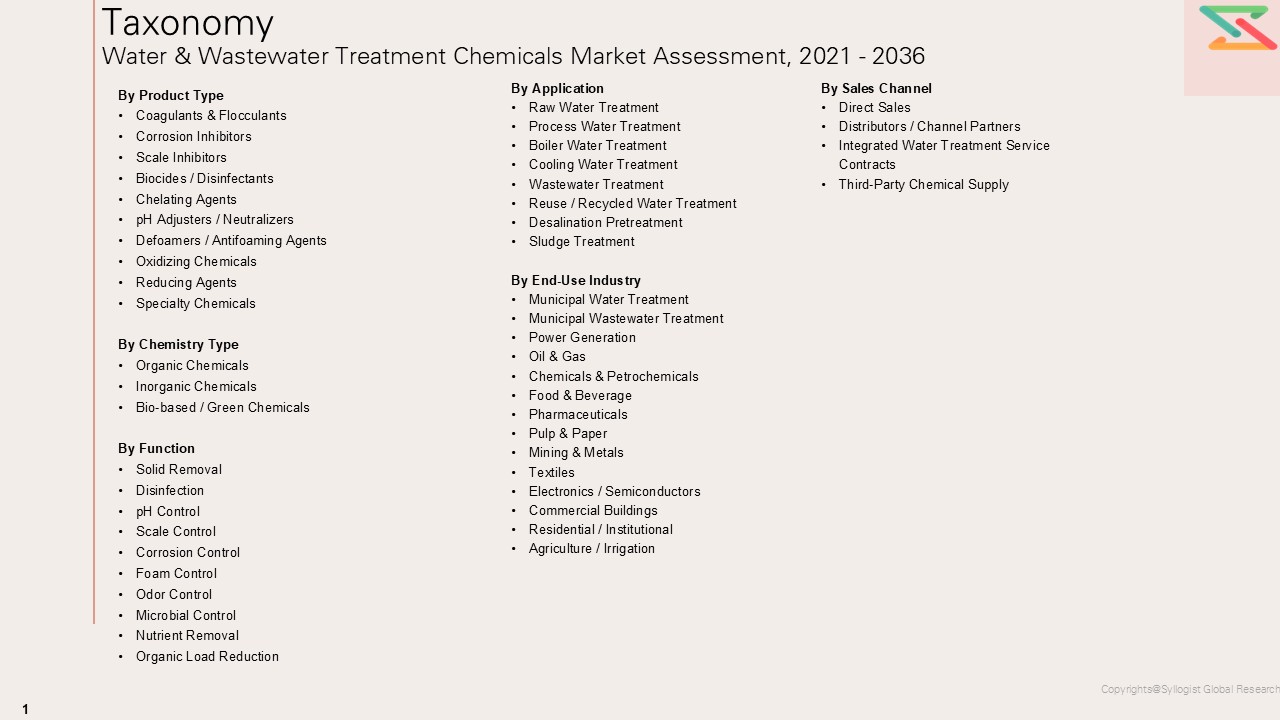
Market Segmentation
- Segmentation by Product Type
- Coagulants & Flocculants
- Corrosion Inhibitors
- Scale Inhibitors
- Biocides / Disinfectants
- Chelating Agents
- pH Adjusters / Neutralizers
- Defoamers / Antifoaming Agents
- Oxidizing Chemicals
- Reducing Agents
- Specialty Chemicals
- Segmentation by Chemical Type
- Coagulants & Flocculants
- Aluminum Sulfate (Alum)
- Polyaluminum Chloride (PAC)
- Ferric Chloride
- Ferric Sulfate
- Ferrous Sulfate
- Sodium Aluminate
- Anionic Polyacrylamide (APAM)
- Cationic Polyacrylamide (CPAM)
- PolyDADMAC (Polydiallyldimethylammonium chloride)
- Polyamine Coagulants
- Corrosion Inhibitors
- Orthophosphates
- Polyphosphates
- Zinc Phosphate
- Sodium Molybdate
- Sodium Nitrite
- Benzotriazole (BTA)
- Tolyltriazole (TTA)
- Sodium Silicate
- HEDP (1-Hydroxyethylidene-1,1-diphosphonic acid)
- ATMP (Aminotris(methylene phosphonic acid))
- Scale Inhibitors
- HEDP
- ATMP
- PBTC (2-Phosphonobutane-1,2,4-tricarboxylic acid)
- DTPMP (Diethylenetriamine pentakis phosphonic acid)
- Polyacrylic Acid (PAA)
- Polymaleic Acid (PMA)
- Acrylic Acid / Maleic Acid Copolymers
- Sodium Hexametaphosphate
- Polyaspartic Acid
- Organophosphonate Blends
- Biocides / Disinfectants
- Chlorine Gas
- Sodium Hypochlorite
- Calcium Hypochlorite
- Chlorine Dioxide
- Ozone
- Hydrogen Peroxide
- Peracetic Acid
- Glutaraldehyde
- Isothiazolinones
- Quaternary Ammonium Compounds (Quats)
- Chelating Agents
- EDTA (Ethylenediaminetetraacetic acid)
- DTPA (Diethylenetriaminepentaacetic acid)
- NTA (Nitrilotriacetic acid)
- GLDA (Tetrasodium glutamate diacetate)
- MGDA (Methylglycinediacetic acid)
- Citric Acid
- Sodium Gluconate
- Oxalic Acid
- HEDTA (Hydroxyethylethylenediaminetriacetic acid)
- IDS (Iminodisuccinic acid)
- pH Adjusters / Neutralizers
- Sulfuric Acid
- Hydrochloric Acid
- Nitric Acid
- Sodium Hydroxide (Caustic Soda)
- Potassium Hydroxide
- Lime (Calcium Oxide)
- Hydrated Lime (Calcium Hydroxide)
- Soda Ash (Sodium Carbonate)
- Sodium Bicarbonate
- Carbon Dioxide
- Defoamers / Antifoaming Agents
- Silicone-Based Defoamers
- Polydimethylsiloxane (PDMS)
- Mineral Oil-Based Defoamers
- Polyether Defoamers
- EO/PO Copolymer Defoamers
- Vegetable Oil-Based Defoamers
- Fatty Alcohol Defoamers
- Wax-Based Defoamers
- Amide-Based Antifoams
- Powder Defoamers
- Oxidizing Chemicals
- Chlorine
- Sodium Hypochlorite
- Calcium Hypochlorite
- Chlorine Dioxide
- Ozone
- Hydrogen Peroxide
- Potassium Permanganate
- Peracetic Acid
- Sodium Persulfate
- Monochloramine
- Reducing Agents
- Sodium Bisulfite
- Sodium Metabisulfite
- Sodium Sulfite
- Sulfur Dioxide
- Sodium Thiosulfate
- Ferrous Sulfate
- Hydrazine
- Carbohydrazide
- Ascorbic Acid
- Erythorbic Acid
- Specialty Chemicals
- Dispersants (Polyacrylate Dispersants)
- Oxygen Scavengers
- Passivators
- Metal Precipitants
- Anti-scalant Blends
- Odor Control Chemicals
- Biodispersants
- Sludge Conditioning Polymers
- Antifoam Specialty Blends
- Multifunctional Treatment Additives
- Segmentation by Chemistry Type
- Organic Chemicals
- Inorganic Chemicals
- Bio-based / Green Chemicals
- Segmentation by Function
- Solid Removal
- Disinfection
- pH Control
- Scale Control
- Corrosion Control
- Foam Control
- Odor Control
- Microbial Control
- Nutrient Removal
- Organic Load Reduction
- Segmentation by Application
- Raw Water Treatment
- Process Water Treatment
- Boiler Water Treatment
- Cooling Water Treatment
- Wastewater Treatment
- Reuse / Recycled Water Treatment
- Desalination Pretreatment
- Sludge Treatment
- Segmentation by End Use Industry
- Municipal Water Treatment
- Municipal Wastewater Treatment
- Power Generation
- Oil & Gas
- Chemicals & Petrochemicals
- Food & Beverage
- Pharmaceuticals
- Pulp & Paper
- Mining & Metals
- Textiles
- Electronics / Semiconductors
- Commercial Buildings
- Residential / Institutional
- Agriculture / Irrigation
- Segmentation by Sales Channel
- Direct Sales
- Distributors / Channel Partners
- Integrated Water Treatment Service Contracts
- Third-Party Chemical Supply
- Market Foundations & Dynamics
- Product Overview
- Research Methodology
- Executive Summary
- Market Dynamics (Drivers, Restraints, Opportunities, Challenges, Porter’s Five Forces Analysis, PESTLE Analysis)
- Market Ecosystem & Value Chain
- Overview of Value Chain Participants
- Flow of Value and Material Through the Chain
- Value Addition and Margins at Each Stage
- Market Trends & Developments
- Emerging Raw Material Trends
- Raw Material Availability
- Technological Advancements
- Demand–Supply Gaps
- Investment Hotspots
- Unmet Needs and White Market Spaces
- Risk Assessment Framework
- Political / Geopolitical Risk
- Raw Material Supply Risk
- Environmental and Regulatory Risk
- Financial / Market Risk
- Regulatory Framework & Standards
- Global Policy and Mandate Overview
- Transportation and Storage Regulations
- Sustainability and GHG Reduction Standards
- Environmental & Liability Considerations
- Technology Landscape
- Overview of Technologies
- Cost Optimization Technologies
- Future Outlook
- Global Water & Wastewater Treatment Chemicals Market Outlook
- Market Size & Forecast by Value
- Market Size & Forecast by Volume
- Market Size & Forecast by Product Type
- Coagulants & Flocculants
- Corrosion Inhibitors
- Scale Inhibitors
- Biocides / Disinfectants
- Chelating Agents
- pH Adjusters / Neutralizers
- Defoamers / Antifoaming Agents
- Oxidizing Chemicals
- Reducing Agents
- Specialty Chemicals
- Market Size & Forecast by Chemical Type
- Coagulants & Flocculants
- Aluminum Sulfate (Alum)
- Polyaluminum Chloride (PAC)
- Ferric Chloride
- Ferric Sulfate
- Ferrous Sulfate
- Sodium Aluminate
- Anionic Polyacrylamide (APAM)
- Cationic Polyacrylamide (CPAM)
- PolyDADMAC (Polydiallyldimethylammonium chloride)
- Polyamine Coagulants
- Corrosion Inhibitors
- Orthophosphates
- Polyphosphates
- Zinc Phosphate
- Sodium Molybdate
- Sodium Nitrite
- Benzotriazole (BTA)
- Tolyltriazole (TTA)
- Sodium Silicate
- HEDP (1-Hydroxyethylidene-1,1-diphosphonic acid)
- ATMP (Aminotris(methylene phosphonic acid))
- Scale Inhibitors
- HEDP
- ATMP
- PBTC (2-Phosphonobutane-1,2,4-tricarboxylic acid)
- DTPMP (Diethylenetriamine pentakis phosphonic acid)
- Polyacrylic Acid (PAA)
- Polymaleic Acid (PMA)
- Acrylic Acid / Maleic Acid Copolymers
- Sodium Hexametaphosphate
- Polyaspartic Acid
- Organophosphonate Blends
- Biocides / Disinfectants
- Chlorine Gas
- Sodium Hypochlorite
- Calcium Hypochlorite
- Chlorine Dioxide
- Ozone
- Hydrogen Peroxide
- Peracetic Acid
- Glutaraldehyde
- Isothiazolinones
- Quaternary Ammonium Compounds (Quats)
- Chelating Agents
- EDTA (Ethylenediaminetetraacetic acid)
- DTPA (Diethylenetriaminepentaacetic acid)
- NTA (Nitrilotriacetic acid)
- GLDA (Tetrasodium glutamate diacetate)
- MGDA (Methylglycinediacetic acid)
- Citric Acid
- Sodium Gluconate
- Oxalic Acid
- HEDTA (Hydroxyethylethylenediaminetriacetic acid)
- IDS (Iminodisuccinic acid)
- pH Adjusters / Neutralizers
- Sulfuric Acid
- Hydrochloric Acid
- Nitric Acid
- Sodium Hydroxide (Caustic Soda)
- Potassium Hydroxide
- Lime (Calcium Oxide)
- Hydrated Lime (Calcium Hydroxide)
- Soda Ash (Sodium Carbonate)
- Sodium Bicarbonate
- Carbon Dioxide
- Defoamers / Antifoaming Agents
- Silicone-Based Defoamers
- Polydimethylsiloxane (PDMS)
- Mineral Oil-Based Defoamers
- Polyether Defoamers
- EO/PO Copolymer Defoamers
- Vegetable Oil-Based Defoamers
- Fatty Alcohol Defoamers
- Wax-Based Defoamers
- Amide-Based Antifoams
- Powder Defoamers
- Oxidizing Chemicals
- Chlorine
- Sodium Hypochlorite
- Calcium Hypochlorite
- Chlorine Dioxide
- Ozone
- Hydrogen Peroxide
- Potassium Permanganate
- Peracetic Acid
- Sodium Persulfate
- Monochloramine
- Reducing Agents
- Sodium Bisulfite
- Sodium Metabisulfite
- Sodium Sulfite
- Sulfur Dioxide
- Sodium Thiosulfate
- Ferrous Sulfate
- Hydrazine
- Carbohydrazide
- Ascorbic Acid
- Erythorbic Acid
- Specialty Chemicals
- Dispersants (Polyacrylate Dispersants)
- Oxygen Scavengers
- Passivators
- Metal Precipitants
- Anti-scalant Blends
- Odor Control Chemicals
- Biodispersants
- Sludge Conditioning Polymers
- Antifoam Specialty Blends
- Multifunctional Treatment Additives
- Market Size & Forecast by Chemistry Type
- Organic Chemicals
- Inorganic Chemicals
- Bio-based / Green Chemicals
- Market Size & Forecast by Function
- Solid Removal
- Disinfection
- pH Control
- Scale Control
- Corrosion Control
- Foam Control
- Odor Control
- Microbial Control
- Nutrient Removal
- Organic Load Reduction
- Market Size & Forecast by Application
- Raw Water Treatment
- Process Water Treatment
- Boiler Water Treatment
- Cooling Water Treatment
- Wastewater Treatment
- Reuse / Recycled Water Treatment
- Desalination Pretreatment
- Sludge Treatment
- Market Size & Forecast by End Use Industry
- Municipal Water Treatment
- Municipal Wastewater Treatment
- Power Generation
- Oil & Gas
- Chemicals & Petrochemicals
- Food & Beverage
- Pharmaceuticals
- Pulp & Paper
- Mining & Metals
- Textiles
- Electronics / Semiconductors
- Commercial Buildings
- Residential / Institutional
- Agriculture / Irrigation
- Market Size & Forecast by Sales Channel
- Direct Sales
- Distributors / Channel Partners
- Integrated Water Treatment Service Contracts
- Third-Party Chemical Supply
- Market Size & Forecast by Region
- North America
- Europe
- Asia-Pacific
- Middle East & Africa
- South America
- Asia-Pacific Water & Wastewater Treatment Chemicals Market Outlook
- Market Size & Forecast by Value & Volume
- Market Size & Forecast by Product Type
- Market Size & Forecast by Chemical Type
- Market Size & Forecast by Chemistry Type
- Market Size & Forecast by Function
- Market Size & Forecast by Application
- Market Size & Forecast by End Use Industry
- Market Size & Forecast by Sales Channel
- Europe Water & Wastewater Treatment Chemicals Market Outlook
- Market Size & Forecast by Value & Volume
- Market Size & Forecast by Product Type
- Market Size & Forecast by Chemical Type
- Market Size & Forecast by Chemistry Type
- Market Size & Forecast by Function
- Market Size & Forecast by Application
- Market Size & Forecast by End Use Industry
- Market Size & Forecast by Sales Channel
- North America Water & Wastewater Treatment Chemicals Market Outlook
- Market Size & Forecast by Value & Volume
- Market Size & Forecast by Product Type
- Market Size & Forecast by Chemical Type
- Market Size & Forecast by Chemistry Type
- Market Size & Forecast by Function
- Market Size & Forecast by Application
- Market Size & Forecast by End Use Industry
- Market Size & Forecast by Sales Channel
- Latin America Water & Wastewater Treatment Chemicals Market Outlook
- Market Size & Forecast by Value & Volume
- Market Size & Forecast by Product Type
- Market Size & Forecast by Chemical Type
- Market Size & Forecast by Chemistry Type
- Market Size & Forecast by Function
- Market Size & Forecast by Application
- Market Size & Forecast by End Use Industry
- Market Size & Forecast by Sales Channel
- Middle East & Africa Water & Wastewater Treatment Chemicals Market Outlook
- Market Size & Forecast by Value & Volume
- Market Size & Forecast by Product Type
- Market Size & Forecast by Chemical Type
- Market Size & Forecast by Chemistry Type
- Market Size & Forecast by Function
- Market Size & Forecast by Application
- Market Size & Forecast by End Use Industry
- Market Size & Forecast by Sales Channel
- Country wise Water & Wastewater Treatment Chemicals Market Outlook
- Market Size & Forecast by Value & Volume
- Market Size & Forecast by Product Type
- Market Size & Forecast by Chemical Type
- Market Size & Forecast by Chemistry Type
- Market Size & Forecast by Function
- Market Size & Forecast by Application
- Market Size & Forecast by End Use Industry
- Market Size & Forecast by Sales Channel
Countries Analyzed in the Syllogist Global Research Portfolio: United States, China, India, Germany, Japan, Saudi Arabia, United Kingdom, France, Canada, Mexico, South Korea, Italy, Brazil, Australia, Spain, Netherlands, Russia, United Arab Emirates, Indonesia, Thailand, Belgium, Singapore, Poland, Vietnam, South Africa, Turkey, Israel, Malaysia, Taiwan, Oman, Qatar, Kuwait, Bahrain, Argentina, Chile, Colombia, Peru, Czech Republic, Sweden, Switzerland, Austria, Denmark, Norway, Finland, Ireland, Portugal, Romania, Hungary, Philippines, New Zealand, Egypt, Nigeria, Morocco, Algeria, Kazakhstan, Bangladesh, Pakistan, Jordan, Ecuador, Chile
- Pricing Analysis
- Global Average Selling Price Trend
- Pricing Analysis by Chemicals Type
- Pricing Analysis by Application
- Raw Material Price Impact Analysis
- Competition Outlook
- Market Concentration and Fragmentation Level
- Company Market Shares (Top 10 Producers)
- Competitive Strategies
- Benchmarking Matrix
- Recent Developments: Partnerships, M&A, and Policy-Driven Expansions
- Sales & Distribution Channel Analysis
- Overview of Go-to-Market Channels
- Channel Share by Region
- Distribution Strategies by Leading Players
- Strategic Recommendations & Roadmap
- Competitors’ Strategic Initiatives
- Future Outlook (Next 5–10 Years, Emerging Players, Success Factors)
- Strategic Recommendations
- Market Acceleration Roadmap
- Short-Term
- Mid-Term
- Long-Term
- Tailored Recommendations for:
- Producers
- Raw Material Suppliers
- Policymakers / Regulators
- Recommendations on Key Success Factors
- Raw Material Security
- Policy Alignment
- Supply Chain Integration
- Market Acceleration Roadmap