Market Definition
Synchronous condensers are spinning synchronous machines (similar to synchronous generators) operated without a prime mover to provide dynamic reactive power (MVAr), voltage support, and short-circuit strength to electrical grids. Unlike static compensation equipment that is purely power-electronic, a synchronous condenser contributes rotational inertia and can significantly improve system stability in weak grids by stabilizing voltage during disturbances and supporting fault ride-through performance.
A typical synchronous condenser installation includes the synchronous machine, excitation system/AVR, starting system (Static Frequency Converter/SFC or pony motor), step-up transformer, switchgear, protection & control, and auxiliary systems such as cooling, lubrication, and hydrogen systems (where applicable). Performance is defined by reactive capability curve (over/under excitation), dynamic MVAr response, fault current contribution, inertia (often enhanced via flywheels), and availability/maintainability over long lifecycles (often 25–40 years).
Synchronous condensers increasingly function as “grid strength assets,” enabling higher renewable penetration by delivering voltage stability + inertia + fault level, capabilities that are difficult to replicate with conventional capacitor banks alone and, in many grids, complementary to STATCOM-based solutions.
Market Insights
The global synchronous condenser market is being reshaped by a structural transition from synchronous generation-dominated grids (coal/gas/hydro) toward inverter-based resources (IBR) such as wind, solar, and battery systems. As conventional generators retire, many grids experience declining fault level, inertia, and voltage stiffness, triggering synchronous condenser procurement as a “stability infrastructure” requirement, especially in renewable corridors, remote interconnections, and weak-grid nodes.
Demand is concentrated in two engines: (1) transmission-led stability upgrades (TSO substation programs, interconnectors, offshore wind grid connections) and (2) renewable integration packages where synchronous condensers are deployed to meet grid code requirements for fault ride-through and voltage support. In parallel, generator conversion projects (repurposing retired units into condensers) can offer compelling economics where suitable assets exist, while new-built condensers dominate in greenfield substations and where space/performance constraints require optimized designs.
Competitive advantage is defined by proven references, delivery assurance for long-cycle components (large rotors/forgings, transformers, excitation, SFCs), system engineering strength, and the ability to provide a bankable grid-stability outcome (not just a machine). Increasingly, buyers assess synchronous condensers as part of an integrated solution, condenser + STATCOM + harmonic filters + digital monitoring, to optimize response speed and harmonics in IBR-heavy networks.
Key Drivers
Renewable Penetration and “Grid Strength” Requirements
High wind/solar penetration increases exposure to voltage instability, weak grid behavior, and reduced fault level. Synchronous condensers provide dynamic MVAr and short-circuit strength that improves system robustness, enabling higher renewable hosting capacity without curtailment or grid code non-compliance.
Retirement of Thermal Plants and Declining Inertia
As synchronous thermal units retire, many grids lose inertia and voltage stiffness, increasing the risk of fast frequency events and voltage dips. Synchronous condensers directly restore rotational inertia (especially with flywheels) while also supporting voltage control.
Grid Expansion, Long Tie-Lines, and Remote Interconnections
Transmission expansion into remote renewable regions and long tie-lines can create weak nodes and reactive power deficits. Synchronous condensers are deployed at strategic substations to improve voltage stability margins and transfer capability.
Offshore Wind and Subsea/Export System Stability
Offshore wind connections and long export cables require robust voltage control and fault level support onshore/offshore interfaces. Synchronous condensers are increasingly used in HV substations as part of stability packages for offshore integration.
Need for High Availability, Proven Physics-Based Stability
For critical transmission nodes, many TSOs value the predictable, physics-based behavior and high availability of rotating machines, often using synchronous condensers as a stability “anchor” alongside fast power-electronic devices.
Key Challenges
High Installed Cost and Complex Balance-of-Plant
Synchronous condenser projects are not just a machine purchase, they involve civil works, transformers, switchgear, protection & control, auxiliaries, and grid integration studies. The high upfront installed cost can be a barrier, especially where lower-cost alternatives (STATCOM/capacitor banks) are viewed as “good enough” for near-term compliance.
Long Lead Times for Critical Components
Schedules are often constrained by long-cycle items such as large forgings/rotors, step-up transformers, excitation systems, and SFCs, plus manufacturing and testing slots. This can create delivery bottlenecks in markets where multiple stability programs run in parallel.
Trade-off Versus STATCOM and Hybrid Architectures
STATCOMs offer very fast reactive response and smaller footprints, while synchronous condensers offer inertia and fault current. Many grids require a hybrid approach, but optimal sizing and architecture (SC-only vs STATCOM-only vs SC+STATCOM) depends on grid studies, creating design risk and procurement complexity.
O&M Requirements and Specialized Service Ecosystem
While mature technology, synchronous condensers require ongoing rotating equipment maintenance (bearings, cooling systems, vibration monitoring, hydrogen systems if used) and periodic overhauls. Some regions face capability gaps in specialized service infrastructure and spare part readiness.
Site Constraints, Grid Integration, and Permitting
Large rotating installations require sufficient footprint, foundation works, and careful integration with HV substations. Permitting timelines, noise constraints, and brownfield tie-ins can add schedule risk, particularly for retrofit programs in constrained substations.
Market Segmentation
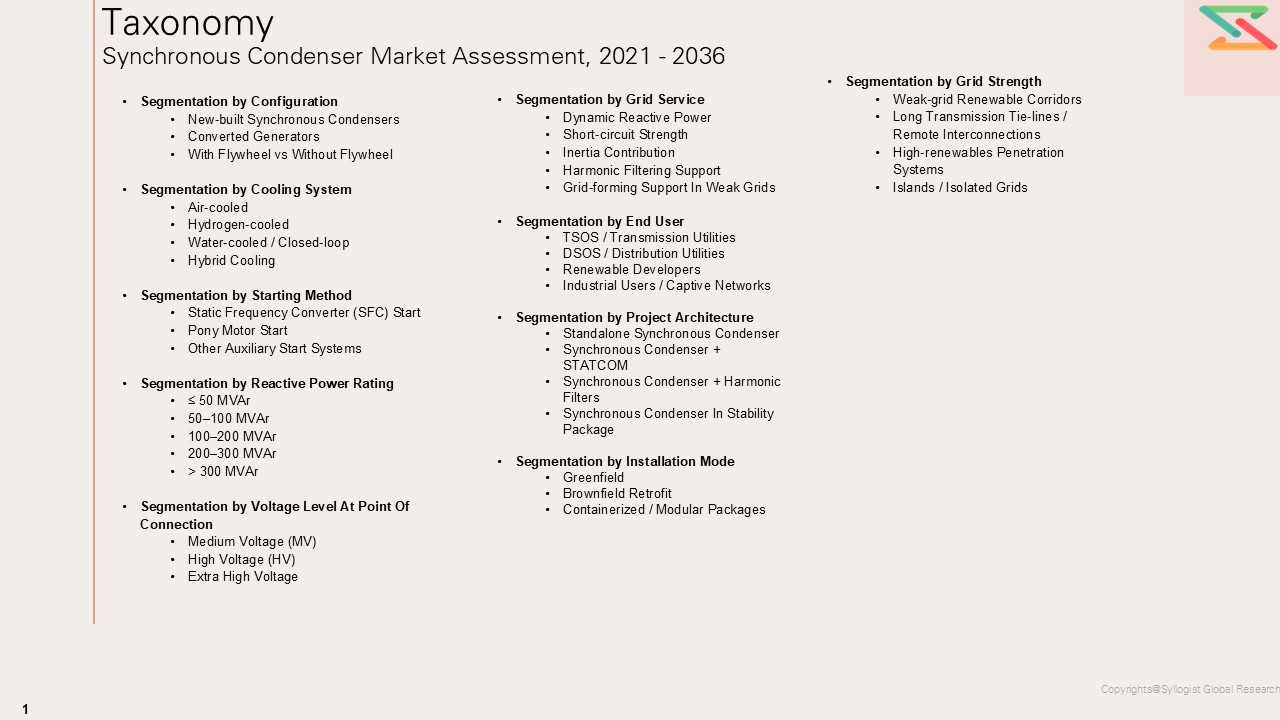
- Segmentation by Configuration
- New-built Synchronous Condensers
- Converted Generators
- With Flywheel vs Without Flywheel
- Segmentation by Cooling System
- Air-cooled
- Hydrogen-cooled
- Water-cooled / Closed-loop
- Hybrid Cooling
- Segmentation by Starting Method
- Static Frequency Converter (SFC) Start
- Pony Motor Start
- Other Auxiliary Start Systems
- Segmentation by Reactive Power Rating
- ≤ 50 MVAr
- 50–100 MVAr
- 100–200 MVAr
- 200–300 MVAr
- > 300 MVAr
- Segmentation by Voltage Level at Point of Connection
- Medium Voltage (MV)
- High Voltage (HV)
- Extra High Voltage
- Segmentation by Grid Service
- Dynamic Reactive Power
- Short-circuit Strength
- Inertia Contribution
- Harmonic Filtering Support
- Grid-forming Support In Weak Grids
- Segmentation by End User
- TSOS / Transmission Utilities
- DSOS / Distribution Utilities
- Renewable Developers
- Industrial Users / Captive Networks
- Segmentation by Project Architecture
- Standalone Synchronous Condenser
- Synchronous Condenser + STATCOM
- Synchronous Condenser + Harmonic Filters
- Synchronous Condenser in Stability Package
- Segmentation by Installation Mode
- Greenfield
- Brownfield Retrofit
- Containerized / Modular Packages
- Segmentation by Grid Strength
- Weak-grid Renewable Corridors
- Long Transmission Tie-lines / Remote Interconnections
- High-renewables Penetration Systems
- Islands / Isolated Grids
All market revenues are presented in USD, with production volumes expressed in units.
Historical Year: 2021–2024 | Base Year: 2025 | Estimated Year: 2026 | Forecast Period: 2027–2036
Key Questions this Study Will Answer
- What are the critical market metrics and forward-looking projections for the Global Synchronous Condenser Market, including revenue size, unit shipments, and commissioned MVAr capacity, with performance segmentation across reactive power rating bands (≤50 MVAr, 50–100, 100–200, 200–300, >300), grid connection voltage (MV/HV/EHV), configuration (new-built vs generator conversion/retrofit; with flywheel vs without), cooling technologies (air, hydrogen, water/closed-loop), and starting methods (Static Frequency Converter/SFC, pony motor, auxiliary start systems)?
- How do supply–demand fundamentals vary across key regions and grid-strength pockets, and what role do renewables penetration levels, weak-grid corridors, interconnector buildouts, and transmission expansion plans play in shaping regional competitiveness, alongside local capability in large rotating machine manufacturing/overhaul, balance-of-plant integration (step-up transformers, GIS/AIS, protection & control), and procurement structures (TSO-led tenders vs renewable developer grid-compliance packages vs industrial captive networks)?
- In what ways are raw material and component price volatility and lead-time constraints (electrical steel and copper, large forgings/shafts, bearings, excitation systems/AVR, SFC power electronics, step-up transformers, cooling skids and auxiliaries) influencing project CapEx, EPC pricing, delivery schedules, and supplier profitability, especially for high-MVAr and EHV-substation installations?
- Who are the leading global and regional synchronous condenser suppliers and integrators, and how do they benchmark across dynamic reactive performance (MVAr response speed), short-circuit strength contribution, inertia support (with/without flywheel), availability/MTBF, footprint and installation complexity, and solution breadth across standalone condensers versus bundled stability packages (synchronous condenser + STATCOM, harmonic filters, protection & control, digital monitoring)?
- What strategic insights emerge from primary discussions with TSOs/DSOs, renewable IPPs, grid consultants, and EPC/substation integrators regarding grid-code-driven procurement triggers (fault level, voltage stability, inertia requirements), project pipelines (renewable zones, offshore wind connections, interconnectors), specification evolution (higher MVAr density, faster response, remote monitoring, cybersecurity-ready SCADA interfaces), refurbishment vs new-build decision criteria, lead times for long-cycle components, and key purchase criteria (system stability impact vs total installed cost, delivery assurance, proven references, O&M ecosystem, spares and overhaul capability)?
- Market Foundations & Dynamics
- Product Overview
- Research Methodology
- Executive Summary
- Market Dynamics (Drivers, Restraints, Opportunities, Challenges, Porter’s Five Forces Analysis, PESTLE Analysis)
- Market Ecosystem & Value Chain
- Overview of Value Chain Participants
- Flow of Value and Material Through the Chain
- Value Addition and Margins at Each Stage
- Market Trends & Developments
- Emerging Feedstock Trends
- Feedstock Availability
- Technological Advancements
- Demand–Supply Gaps
- Investment Hotspots
- Unmet Needs and White Market Spaces
- Risk Assessment Framework
- Political / Geopolitical Risk
- Feedstock Supply Risk
- Environmental and Regulatory Risk
- Financial / Market Risk
- Regulatory Framework & Standards
- Global Policy and Mandate Overview
- Transportation and Storage Regulations
- Sustainability and GHG Reduction Standards
- Environmental & Liability Considerations
- Technology Landscape
- Overview of Technologies
- Cost Optimization Technologies
- Future Outlook
- Global Synchronous Condenser Market Outlook
- Market Size & Forecast by Value
- Market Size & Forecast by Volume
- Market Size & Forecast by Configuration
- New-built Synchronous Condensers
- Converted Generators
- With Flywheel vs Without Flywheel
- Market Size & Forecast by Cooling System
- Air-cooled
- Hydrogen-cooled
- Water-cooled / Closed Loop
- Hybrid Cooling
- Market Size & Forecast by Starting Method
- Static Frequency Converter (SFC) Start
- Pony Motor Start
- Other Auxiliary Start Systems
- Market Size & Forecast by Reactive Power Rating
- ≤ 50 MVAr
- 50–100 MVAr
- 100–200 MVAr
- 200–300 MVAr
- > 300 MVAr
- Market Size & Forecast by Voltage Level at Point of Connection
- Medium Voltage (MV)
- High Voltage (HV)
- Extra High Voltage
- Market Size & Forecast by Grid Service
- Dynamic Reactive Power
- Short-circuit Strength
- Inertia Contribution
- Harmonic Filtering Support
- Grid-forming Support in Weak Grids
- Market Size & Forecast by End User
- Conventional End-Use Industries
- Transmission Grid Infrastructure
- Distribution Grid Infrastructure
- Thermal Power & Conventional Generation Infrastructure
- Industrial Power Networks
- Rail & Traction Power Infrastructure
- High-Growth End-Use Industries
- Renewable Energy Integration Infrastructure
- Offshore Wind Transmission Systems
- Grid-Forming Renewable Hubs
- Battery Energy Storage-Integrated Grids
- Data Centers & Digital Infrastructure
- Islands, Remote Grids & Microgrid Infrastructure
- Emerging End-Use Industries
- Green Hydrogen Hubs
- HVDC Converter-Connected Grids
- Market Size & Forecast by Project Architecture
- Standalone Synchronous Condenser
- Synchronous Condenser + STATCOM
- Synchronous Condenser + Harmonic Filters
- Synchronous Condenser in Stability Package
- Market Size & Forecast by Installation Mode
- Greenfield
- Brownfield Retrofit
- Containerized / Modular Packages
- Market Size & Forecast by Application
- Weak-grid Renewable Corridors
- Long Transmission Tie-lines / Remote Interconnections
- High-renewables Penetration Systems
- Islands / Isolated Grids
- Asia-Pacific Synchronous Condenser Market Outlook
- Market Size & Forecast by Value & Volume
- Market Size & Forecast by Type
- Market Size & Forecast by Configuration
- Market Size & Forecast by Cooling System
- Market Size & Forecast by Starting Method
- Market Size & Forecast by Reactive Power Rating
- Market Size & Forecast by Voltage Level at Point of Connection
- Market Size & Forecast by Grid Service
- Market Size & Forecast by End User
- Market Size & Forecast by Project Architecture
- Market Size & Forecast by Installation Mode
- Market Size & Forecast by Grid Strength
- Europe Synchronous Condenser Market Outlook
- Market Size & Forecast by Value & Volume
- Market Size & Forecast by Type
- Market Size & Forecast by Configuration
- Market Size & Forecast by Cooling System
- Market Size & Forecast by Starting Method
- Market Size & Forecast by Reactive Power Rating
- Market Size & Forecast by Voltage Level at Point of Connection
- Market Size & Forecast by Grid Service
- Market Size & Forecast by End User
- Market Size & Forecast by Project Architecture
- Market Size & Forecast by Installation Mode
- Market Size & Forecast by Grid Strength
- North America Synchronous Condenser Market Outlook
- Market Size & Forecast by Value & Volume
- Market Size & Forecast by Type
- Market Size & Forecast by Configuration
- Market Size & Forecast by Cooling System
- Market Size & Forecast by Starting Method
- Market Size & Forecast by Reactive Power Rating
- Market Size & Forecast by Voltage Level at Point of Connection
- Market Size & Forecast by Grid Service
- Market Size & Forecast by End User
- Market Size & Forecast by Project Architecture
- Market Size & Forecast by Installation Mode
- Market Size & Forecast by Grid Strength
- Latin America Synchronous Condenser Market Outlook
- Market Size & Forecast by Value & Volume
- Market Size & Forecast by Type
- Market Size & Forecast by Configuration
- Market Size & Forecast by Cooling System
- Market Size & Forecast by Starting Method
- Market Size & Forecast by Reactive Power Rating
- Market Size & Forecast by Voltage Level at Point of Connection
- Market Size & Forecast by Grid Service
- Market Size & Forecast by End User
- Market Size & Forecast by Project Architecture
- Market Size & Forecast by Installation Mode
- Market Size & Forecast by Grid Strength
- Middle East & Africa Synchronous Condenser Market Outlook
- Market Size & Forecast by Value & Volume
- Market Size & Forecast by Type
- Market Size & Forecast by Configuration
- Market Size & Forecast by Cooling System
- Market Size & Forecast by Starting Method
- Market Size & Forecast by Reactive Power Rating
- Market Size & Forecast by Voltage Level at Point of Connection
- Market Size & Forecast by Grid Service
- Market Size & Forecast by End User
- Market Size & Forecast by Project Architecture
- Market Size & Forecast by Installation Mode
- Market Size & Forecast by Grid Strength
- Conventional End-Use Industries
Countries Analyzed in the Syllogist Global Research Portfolio: United States, Canada, Mexico, Brazil, Chile, Colombia, United Kingdom, Germany, France, Italy, Spain, Netherlands, Belgium, Sweden, Norway, Denmark, Finland, Poland, Czechia, Romania, Turkey, Russia, Ukraine, Saudi Arabia, United Arab Emirates, Qatar, Kuwait, Oman, South Africa, Egypt, Morocco, Israel, India, China, Japan, South Korea, Taiwan, Australia, Vietnam, Indonesia
- Pricing Analysis
- Overview of Pricing Structures
- Average Selling Price Trends Type and End Use
- Cost Benchmark
- Historical Price Evolution
- Forecast Pricing Curve
- Factors Influencing Price:
- Regional Pricing Differentiation
- Competition Outlook
- Market Concentration and Fragmentation Level
- Company Market Shares (Top 10 Producers)
- Competitive Strategies
- Benchmarking Matrix
- Recent Developments: Partnerships, M&A, and Policy-Driven Expansions
- Cost Structure & Margin Analysis
- Average Cost per Liter
- Profitability and Margin Distribution Along the Value Chain
- Sensitivity Analysis: How Feedstock Price and Policy Incentives Impact Margin
- Cost Reduction Opportunities through Process Optimization
- Business Models & Strategic Insights
- Sales & Distribution Channel Analysis
- Overview of Go-to-Market Channels
- Channel Share by Region
- Distribution Strategies by Leading Players
- Strategic Recommendations & Roadmap
- Competitors’ Strategic Initiatives
- Future Outlook (Next 5–10 Years, Emerging Players, Success Factors)
- Strategic Recommendations
- Technology Advancements to Watch
- Market Acceleration Roadmap
- Short-Term
- Mid-Term
- Long-Term
- Tailored Recommendations for:
- Producers
- Feedstock Suppliers
- Policymakers / Regulators
- Investors
- Recommendations on Key Success Factors
- Feedstock Security
- Technology Partnerships
- Policy Alignment
- Supply Chain Integration
- Investor Confidence