India Petrochemical Demand Market By Product Type, By Feedstock, By Application, By End-Use Industry, By Region, Competition, Forecast & Opportunities, 2021-2036F
Market Definition
The India Petrochemical Demand Market covers the consumption, procurement, downstream conversion, and end-use absorption of petrochemical products across the Indian subcontinent, including primary olefins such as ethylene and propylene, aromatics covering benzene, toluene, paraxylene, and orthoxylene, key intermediates including ethylene glycol, styrene monomer, vinyl chloride monomer, purified terephthalic acid, and acrylonitrile, alongside commodity polymers such as polyethylene, polypropylene, polyvinyl chloride, polystyrene, and polyethylene terephthalate, plus engineering thermoplastics, synthetic rubber, surfactants, and specialty chemicals. The market spans demand generated by polymer converters, packaging manufacturers, automotive component suppliers, construction material producers, textile and apparel mills, agricultural input formulators, electronics assemblers, healthcare device makers, and consumer goods companies operating across the Indian industrial base. The supply landscape includes integrated petrochemical producers such as Reliance Industries, Indian Oil Corporation, GAIL India, ONGC Petro additions, Haldia Petrochemicals, Brahmaputra Cracker and Polymer, alongside imports from Middle Eastern, South Korean, Singaporean, and North American suppliers serving structural demand gaps. The market structure is shaped by feedstock availability across naphtha, ethane, propane, refinery off-gas, coal-based methanol, and emerging bio-based pathways, alongside policy instruments including the Production Linked Incentive scheme for specialty chemicals, the National Petroleum, Chemical and Petrochemical Investment Region (PCPIR) policy, anti-dumping duties, extended producer responsibility mandates, and bilateral free trade frameworks. The market is geographically distributed across western India, southern India, eastern India, northern India, and northeastern India, with demand clusters concentrated around Mumbai, Dahej, Hazira, Jamnagar, Vadodara, Chennai, Visakhapatnam, Paradip, Haldia, and the National Capital Region.
Market Insights
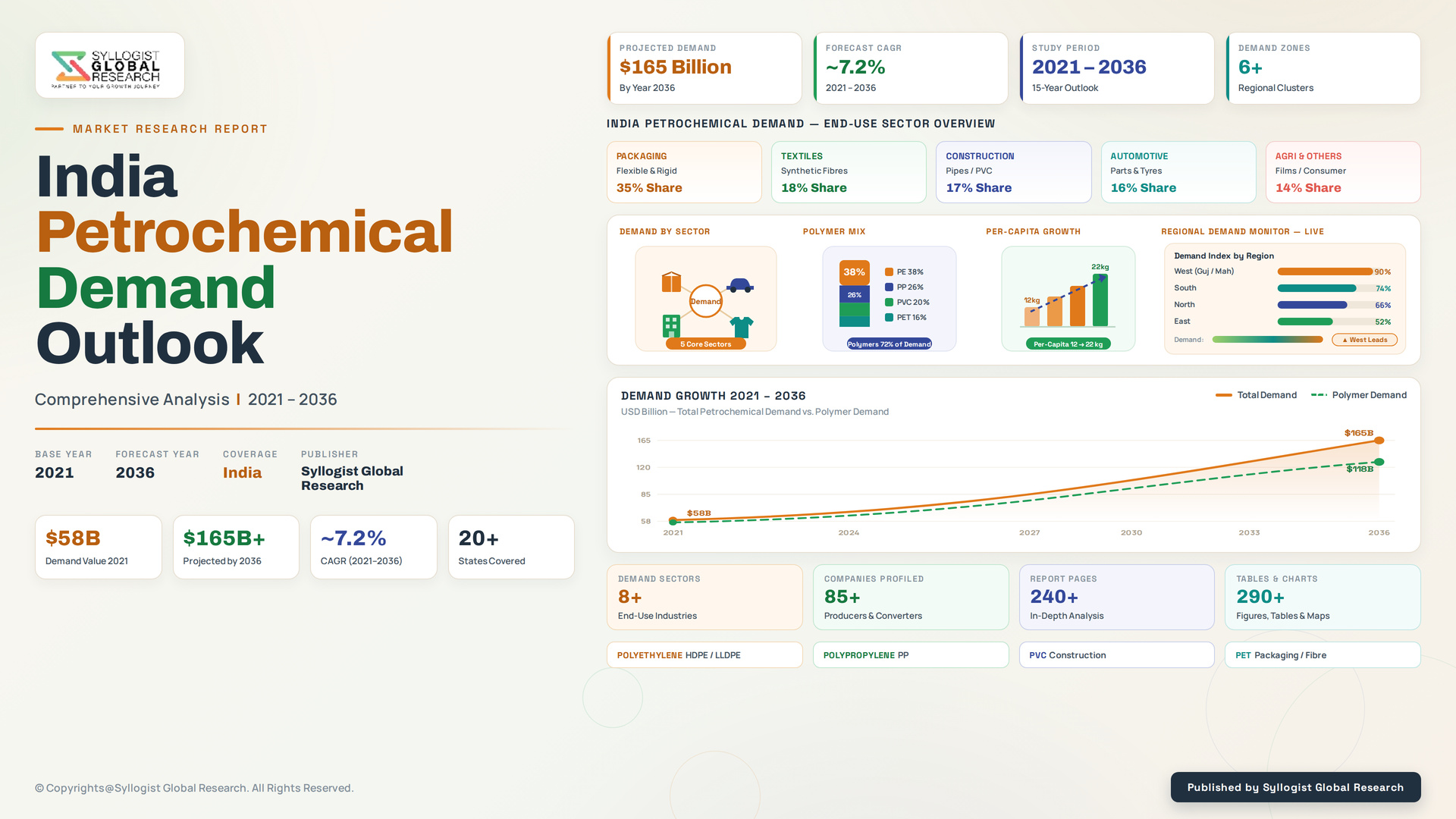
The India petrochemical demand market is entering a sustained high-growth phase, propelled by rapid urbanization, rising per capita plastics consumption, manufacturing expansion under the Production Linked Incentive scheme, and the structural emergence of India as a global manufacturing hub under the China Plus One supply chain realignment. The market was valued at USD 246.8 billion in 2025 and is projected to reach USD 528.4 billion by 2034, advancing at a compound annual growth rate of 8.9% through the forecast period, supported by polymer consumption growth, downstream conversion capacity expansion, and import-led supply augmentation that together position India as one of the most dynamic petrochemical demand markets globally.
Per capita plastics consumption in India remains structurally below the global average at approximately 14 kg in 2025, compared with the world average of 35 kg and Chinese consumption above 45 kg, creating substantial headroom for long-term polymer demand acceleration as incomes rise and packaging penetration deepens across Tier 2 and Tier 3 urban centers. Polyethylene demand is projected to grow at 7.8% CAGR through 2034, polypropylene at 8.6%, polyvinyl chloride at 9.2%, and polyethylene terephthalate at 7.4%, with the packaging sector absorbing nearly 45% of incremental polymer volumes, followed by construction at 18%, automotive at 9%, electricals at 8%, and agriculture, textiles, and consumer durables collectively accounting for the balance. Domestic ethylene capacity, currently at approximately 8.5 million tonnes, falls materially short of demand, leading to structural import dependence of nearly 50% for polyethylene and over 40% for polypropylene that will persist through the forecast horizon even after major capacity additions.
Reliance Industries operates the largest integrated petrochemical complex at Jamnagar, anchoring domestic supply across polyethylene, polypropylene, paraxylene, and purified terephthalic acid, while Indian Oil Corporation, GAIL India, Haldia Petrochemicals, ONGC Petro additions, and Brahmaputra Cracker are advancing significant capacity expansion programs targeting commissioning between 2026 and 2030. Hindustan Petroleum Corporation and Bharat Petroleum Corporation are pursuing refinery-integrated petrochemical projects at Barmer and Bina respectively, while ONGC and Adani Group are advancing greenfield petrochemical investments anchored at the Dahej and Mundra industrial corridors. Collectively, over USD 87 billion of announced petrochemical capital expenditure is targeted for India between 2025 and 2032, although project delays, feedstock sourcing complexity, and capital allocation discipline continue to introduce execution risk into capacity addition timelines and import dependency trajectories.
Western India dominates the petrochemical demand landscape, accounting for nearly 38% of national consumption in 2025, anchored by Gujarat, Maharashtra, and Rajasthan industrial corridors, dense petrochemical complex clustering at Dahej, Hazira, Jamnagar, and Vadodara, and proximity to major export terminals at Mundra, Kandla, and Nhava Sheva. Southern India represents the second largest demand region with approximately 26% share, driven by automotive manufacturing clusters in Chennai, Hosur, and Bengaluru, electronics manufacturing in Sriperumbudur, and packaging demand across Kerala and Andhra Pradesh. Eastern India and northeastern India are emerging as priority growth regions supported by the PCPIR policy, the Brahmaputra Cracker complex at Lepetkata, the upcoming Paradip refinery integration, and rising downstream conversion activity in West Bengal, Odisha, Assam, and Jharkhand, while northern India anchors demand for agricultural films, automotive components, and consumer packaging across the Delhi NCR, Haryana, Punjab, and Uttar Pradesh industrial clusters.
Key Drivers
Manufacturing Expansion Under Production Linked Incentive Scheme and China Plus One Supply Chain Realignment Anchoring Long-Term Polymer Demand Growth
The Production Linked Incentive scheme covering electronics, automotive components, textiles, pharmaceuticals, white goods, and specialty chemicals, alongside the broader Make in India and China Plus One strategy, is anchoring durable polymer and intermediates demand growth across the Indian industrial base. Approved PLI commitments exceed USD 26 billion across covered sectors, generating incremental demand for polypropylene, ABS, polycarbonate, engineering thermoplastics, and specialty polymers feeding electronics assembly, automotive component manufacturing, and pharmaceutical packaging value chains over the forecast horizon through 2034.
Rising Per Capita Plastics Consumption and Urban Packaging Penetration Sustaining Multi-Decade Polymer Demand Visibility
Indian per capita plastics consumption at 14 kg in 2025 remains substantially below the global average and provides structural headroom for sustained polymer demand growth as urbanization accelerates, e-commerce penetrates Tier 2 and Tier 3 cities, and packaged consumer goods expand across rural India. Flexible packaging demand alone is expected to grow at 9.4% CAGR through 2034, supported by food and beverage modernization, dairy and edible oil packaging expansion, and the rapid scaling of quick commerce platforms requiring lightweight polymer-based packaging solutions across India.
Infrastructure Investment, Affordable Housing, and Construction Sector Expansion Driving Sustained PVC and Polymer Demand Growth
Sustained government infrastructure investment under the National Infrastructure Pipeline targeting over USD 1.4 trillion of capital deployment, alongside affordable housing schemes under the Pradhan Mantri Awas Yojana and Smart Cities Mission, is driving durable demand growth for polyvinyl chloride pipes, fittings, profiles, and polymer-based construction materials. PVC pipe demand is projected to advance at 9.2% CAGR through 2034, supported by Jal Jeevan Mission water supply infrastructure, sanitation and sewerage expansion, and irrigation modernization programs across rural India.
Key Challenges
Persistent Capacity Gap, Import Dependence, and Feedstock Sourcing Constraints Limiting Domestic Supply Self-Sufficiency
India faces a structural petrochemical capacity gap with ethylene self-sufficiency at approximately 50% and projected to remain below 65% even after announced capacity additions through 2030, sustaining import dependence on Middle Eastern, South Korean, and Singaporean suppliers. Domestic naphtha availability constraints, limited ethane import infrastructure, and high refinery integration complexity are slowing capacity expansion timelines, while project execution challenges including land acquisition, environmental clearance, and capital allocation discipline at major operators are introducing further timeline uncertainty into supply augmentation programs.
Extended Producer Responsibility Mandates, Single-Use Plastics Restrictions, and Recycled Content Targets Reshaping Demand Architecture
Extended producer responsibility obligations under the Plastic Waste Management Rules covering rigid, flexible, multi-layered, and compostable packaging categories, alongside single-use plastics restrictions effective since 2022, are reshaping virgin polymer demand patterns and creating competitive pressure on selected high-volume polymer categories. Mandatory recycled content thresholds rising progressively from 30% in 2025 to 60% by 2030 across packaging applications are introducing material substitution pressure and accelerating investment in mechanical and chemical recycling infrastructure across western and southern India.
Anti-Dumping Investigations, Tariff Volatility, and Trade Policy Friction Constraining Import Optimization and Supply Diversification
Multiple anti-dumping investigations launched by India against polyethylene, polypropylene, PVC paste resin, PET resin, styrene-butadiene rubber, and select intermediate imports from China, South Korea, Saudi Arabia, Singapore, and Thailand are creating trade flow friction, with provisional duties ranging from 6% to 28% applied across product categories. Evolving tariff frameworks under RCEP non-participation, bilateral free trade agreement renegotiations, and the imposition of quality control orders on selected polymer categories are complicating import sourcing strategies for converters, distributors, and trading houses operating across the Indian market.
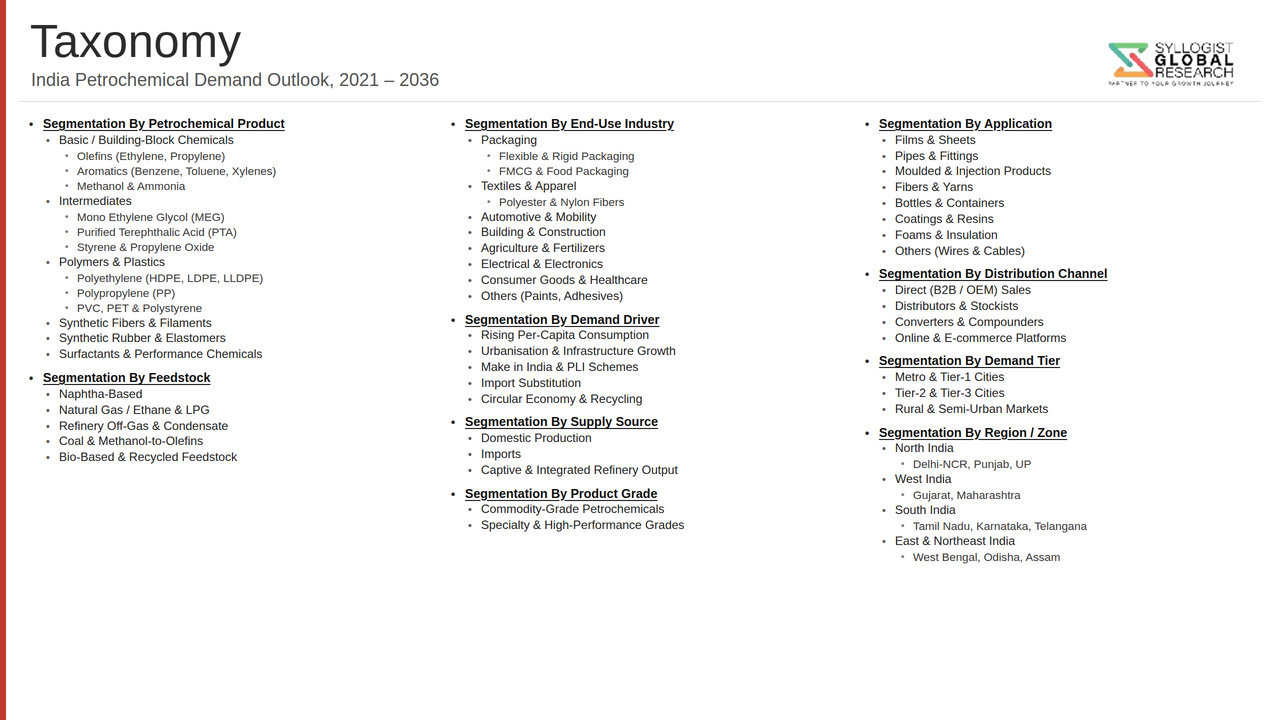
Market Segmentation
- Segmentation By Product Type
- Olefins (Ethylene, Propylene, Butadiene)
- Aromatics (Benzene, Toluene, Paraxylene, Orthoxylene)
- Intermediates (Ethylene Glycol, Styrene Monomer, VCM, PTA, Acrylonitrile)
- Commodity Polymers (PE, PP, PVC, PS, PET)
- Engineering Thermoplastics (ABS, Polycarbonate, Nylon, POM)
- Synthetic Rubber and Elastomers
- Surfactants and Specialty Chemicals
- Others
- Segmentation By Feedstock
- Naphtha
- Ethane and LPG
- Refinery Off-Gas
- Natural Gas Liquids
- Coal-Based Methanol (MTO)
- Bio-Based and Recycled Feedstock
- Others
- Segmentation By Application
- Packaging Films and Rigid Containers
- Construction Pipes, Fittings, and Profiles
- Automotive Components and Interiors
- Electronics and Electrical Goods
- Textiles and Synthetic Fibers
- Agricultural Films and Irrigation
- Consumer Durables and Appliances
- Healthcare and Medical Devices
- Others
- Segmentation By End-Use Industry
- Packaging
- Construction and Infrastructure
- Automotive and Transportation
- Electronics and Electricals
- Textiles and Apparel
- Agriculture
- Consumer Durables
- Healthcare and Pharmaceuticals
- Others
- Segmentation By Region
- Western India (Gujarat, Maharashtra, Rajasthan, Goa)
- Southern India (Tamil Nadu, Karnataka, Andhra Pradesh, Telangana, Kerala)
- Northern India (Delhi NCR, Haryana, Punjab, Uttar Pradesh, Uttarakhand)
- Eastern India (West Bengal, Odisha, Bihar, Jharkhand)
- Northeastern India (Assam and adjoining states)
- Central India (Madhya Pradesh, Chhattisgarh)
All market revenues are presented in USD
Historical Year: 2021-2024 | Base Year: 2025 | Estimated Year: 2026 | Forecast Period: 2027-2034
Key Questions this Study Will Answer
- What is the total market valuation of the India Petrochemical Demand Market in 2025, projected through 2034, disaggregated by product type, application, and end-use industry, enabling petrochemical producers, polymer converters, traders, and investors to identify the highest-growth demand segments and most durable revenue opportunities across the Indian value chain?
- How are the Production Linked Incentive scheme, Make in India, and China Plus One supply chain realignment reshaping polymer and specialty chemical demand patterns across electronics, automotive, textiles, pharmaceuticals, and white goods, and what incremental demand volumes are these policy frameworks generating through 2034?
- Which polymer categories including polyethylene, polypropylene, polyvinyl chloride, polyethylene terephthalate, and engineering thermoplastics are generating the highest demand growth rates across India, and how are application-level demand patterns evolving across packaging, construction, automotive, electronics, and agriculture sectors?
- How is the structural capacity gap between domestic petrochemical supply and Indian demand reshaping import dependence, supplier selection, and trade flow architecture, and which Middle Eastern, South Korean, Singaporean, and North American producers are positioned to capture incremental Indian polymer offtake through 2034?
- How are extended producer responsibility mandates, single-use plastics restrictions, and recycled content thresholds under the Plastic Waste Management Rules reshaping virgin polymer demand architecture, and what investment and partnership strategies are leading producers pursuing in mechanical and chemical recycling infrastructure across western and southern India?
- Which Indian regions including western India, southern India, eastern India, northeastern India, and northern India are generating the highest incremental petrochemical demand, and how are PCPIR policy execution, refinery integration projects, and downstream conversion cluster development reshaping regional demand and supply architectures?
- How is the competitive landscape structured among integrated petrochemical producers including Reliance Industries, Indian Oil Corporation, GAIL India, Haldia Petrochemicals, ONGC Petro additions, Brahmaputra Cracker, HPCL, BPCL, and Adani Group, and what partnership, joint venture, and capacity expansion strategies are reshaping domestic supply and market share dynamics through 2034?
- Product Definition
- Research Methodology
- Research Design & Framework
- Overall Research Approach: Descriptive, Exploratory & Quantitative Mixed-Method Design
- Market Definition & Scope Boundaries: What is Included and Excluded
- Segmentation Framework
- Key Research Assumptions & Limitations
- Secondary Research
- Primary Research Design & Execution
- Data Triangulation & Validation
- Market Sizing & Forecasting Methodology
- Competitive Intelligence Methodology
- Quality Assurance & Peer Review
- Definitions, Abbreviations & Data Notes
- Research Design & Framework
- Executive Summary
- Market Snapshot & Headline Numbers
- Key Findings & Research Highlights
- Demand Dynamics
- Zonal Market Summary
- Competitive Landscape Snapshot
- Technology & Innovation Highlights
- Market Dynamics
- Drivers
- Restraints
- Opportunities
- Challenges
- Porter’s Five Forces Analysis
- PESTLE Analysis
- Market Trends & Developments
- Emerging Trends
- Technological Developments
- Regulatory & Policy Changes
- Supply, Capacity Addition & Sourcing Trends
- Converter & Downstream Industry Trends
- Investment & Funding Activity
- Sustainability & ESG Trends
- Risk Assessment Framework
- Crude Oil & Naphtha Price Volatility, Feedstock Cost Pass-Through & Margin Compression Risk
- Import Dependence, Foreign Exchange Volatility & Trade Deficit Risk
- Regulatory, Plastic Waste Management Rules, EPR & Single-Use Plastic Ban Risk
- Demand Substitution by Bio-Based, Recycled & Alternative Materials Risk
- Infrastructure, Port Congestion, Inland Logistics & Last-Mile Distribution Risk
- Regulatory Framework & Standards
- Petrochemical & Chemicals Investment Region (PCPIR) Policy, Make in India & PLI Scheme Frameworks
- BIS, Food Safety & Standards Authority of India (FSSAI) & Packaging Material Compliance Standards
- Plastic Waste Management Rules, Extended Producer Responsibility (EPR) & Single-Use Plastic Ban
- Foreign Trade Policy (FTP), Customs Duty, Anti-Dumping & GST Framework Applicable to Petrochemicals
- Environmental, Hazardous Chemical, REACH Equivalence & Sustainability Disclosure Standards
- India Petrochemical Demand Outlook
- Demand Size & Forecast by Value
- Demand Size & Forecast by Volume (Million Tons)
- Demand Size & Forecast by Product Category
- Polyolefins (HDPE, LDPE, LLDPE & Polypropylene)
- Other Polymers (PVC, PS, EPS, PET, ABS, PC & Engineering Plastics)
- Polymer Intermediates (MEG, PTA, Caprolactam, VCM, EDC, Acrylonitrile & Phenol)
- Olefins (Ethylene, Propylene, Butadiene & C4 Streams)
- Aromatics (Benzene, Toluene, Xylenes & Styrene)
- Synthetic Fibres & Yarns (Polyester, Nylon & Acrylic Fibre Intermediates)
- Synthetic Rubber & Elastomers (SBR, BR, EPDM & Latex)
- Methanol & Derivatives (Formaldehyde, Acetic Acid & MTBE)
- Surfactants, Solvents & Specialty Chemicals
- Demand Size & Forecast by Application
- Flexible Packaging (Films, Pouches & Laminates)
- Rigid Packaging (Bottles, Containers, Caps & Closures)
- Pipes, Fittings & Water Infrastructure
- Construction Materials, Profiles & Insulation
- Automotive Components, Interiors & NVH
- Textile Fibres, Yarns & Apparel
- Electrical & Electronics Housing, Cables & Components
- Agricultural Films, Irrigation & Crop Protection Packaging
- Consumer Durables, Appliances & Houseware
- Healthcare, Pharmaceutical & Medical Device Packaging
- Personal Care, Cosmetic & FMCG Packaging
- Footwear, Furniture & Mattresses
- Demand Size & Forecast by End-Use Industry
- Packaging Industry (FMCG, Food & Beverage)
- Automotive & Transportation (ICE & EV)
- Construction & Infrastructure
- Textiles & Apparel
- Agriculture & Allied Sectors
- Electronics & Electricals
- Pharmaceuticals & Healthcare
- Consumer Durables & Appliances
- Footwear & Leather Goods
- Personal Care & Cosmetics
- Demand Size & Forecast by Demand Driver
- Urbanisation, Rising Middle Class & Per Capita Consumption Growth
- Government Infrastructure Spending (Gati Shakti & National Infrastructure Pipeline)
- Production-Linked Incentive (PLI) Scheme & Make in India Manufacturing Expansion
- Automotive Production, FAME II & EV Mission-Driven Demand
- E-Commerce, Quick Commerce & Packaging Demand Acceleration
- Healthcare, Pharmaceutical & Medical Device Sector Growth
- Agricultural Modernisation, Micro-Irrigation & Crop Protection Adoption
- Demand Size & Forecast by Supply Source
- Domestic Production
- Imports from the Middle East (Saudi Arabia, UAE, Qatar & Iran)
- Imports from Northeast Asia (South Korea, Japan & Taiwan)
- Imports from Southeast Asia (Singapore, Thailand & Malaysia)
- Imports from the United States & Other Regions
- Recycled & Circular Polymer Supply
- Demand Size & Forecast by Sales Channel
- Producer Direct Sales & Bilateral Contracts
- Distributors, Stockists & Channel Partners
- Trading Houses & Importers
- E-Commerce & Digital Trade Platforms
- Spot Market & Exchange-Traded Channels
- Western India (Maharashtra, Gujarat & Goa) Petrochemical Demand Outlook
- Demand Size & Forecast
- By Value
- By Volume (Million Tons)
- By Product Category
- By Application
- By End-Use Industry
- By Demand Driver
- By Supply Source
- By State
- By Sales Channel
- Northern India (Delhi NCR, Uttar Pradesh, Haryana, Punjab, Rajasthan & Uttarakhand) Petrochemical Demand Outlook
- Demand Size & Forecast
- By Value
- By Volume (Million Tons)
- By Product Category
- By Application
- By End-Use Industry
- By Demand Driver
- By Supply Source
- By State
- By Sales Channel
- Southern India (Tamil Nadu, Karnataka, Telangana, Andhra Pradesh & Kerala) Petrochemical Demand Outlook
- Demand Size & Forecast
- By Value
- By Volume (Million Tons)
- By Product Category
- By Application
- By End-Use Industry
- By Demand Driver
- By Supply Source
- By State
- By Sales Channel
- Eastern India (West Bengal, Odisha, Jharkhand, Bihar & Assam) Petrochemical Demand Outlook
- Demand Size & Forecast
- By Value
- By Volume (Million Tons)
- By Product Category
- By Application
- By End-Use Industry
- By Demand Driver
- By Supply Source
- By State
- By Sales Channel
- Central India (Madhya Pradesh & Chhattisgarh) Petrochemical Demand Outlook
- Demand Size & Forecast
- By Value
- By Volume (Million Tons)
- By Product Category
- By Application
- By End-Use Industry
- By Demand Driver
- By Supply Source
- By State
- By Sales Channel
- State-Wise* Petrochemical Demand Outlook
- Demand Size & Forecast
- By Value
- By Volume (Million Tons)
- By Product Category
- By Application
- By End-Use Industry
- By Demand Driver
- By Supply Source
- By State
- By Sales Channel
- *States Analysed in the Syllogist India Research Portfolio: Maharashtra, Gujarat, Tamil Nadu, Karnataka, Telangana, Andhra Pradesh, Kerala, Delhi NCR, Uttar Pradesh, Haryana, Punjab, Rajasthan, Uttarakhand, West Bengal, Odisha, Jharkhand, Bihar, Assam, Madhya Pradesh, Chhattisgarh, Goa
- Technology Landscape & Innovation Analysis
- Polymer Grade Evolution: High-Performance, Lightweighting & Multi-Layer Material Technology
- Bio-Based, Compostable & Renewable Carbon Polymer Technology Adoption
- Mechanical & Chemical Recycling Technology Integration in Domestic Supply
- Specialty Polymer & Engineering Plastics Localisation Technology
- Digital Demand Sensing, AI-Based Forecasting & Predictive Analytics Platforms
- Converter & Downstream Processing Technology Upgrade (Injection, Extrusion, Blow-Moulding)
- Smart Packaging, Active & Intelligent Packaging Technology
- Patent & IP Landscape in India Petrochemical Demand & Application Technologies
- Value Chain & Supply Chain Analysis
- Domestic Petrochemical Producer, Refinery & Cracker Capacity Landscape
- Import Sourcing, Port Handling & Inland Logistics Network
- Distributor, Stockist & Channel Partner Ecosystem Across Indian Zones
- Converter, Compounder & Master-Batch Manufacturer Landscape
- Brand Owner, OEM & Downstream End-User Procurement Channel
- Trade Finance, Marine Insurance & Cargo Risk Services for Petrochemical Imports
- Plastic Waste Collection, Recycling & Circular Polymer Supply Chain
- Pricing Analysis
- Polyolefin Price Trend Analysis (Domestic vs. CFR India Benchmarks)
- PVC, PET & Other Polymer Price Trend Analysis
- Polymer Intermediate (MEG, PTA, VCM, Caprolactam) Price & Margin Analysis
- Olefins, Aromatics & Naphtha Cracker Margin Analysis
- Converter Margin, Cost Pass-Through & Grade Premium Analysis
- Customs Duty, Anti-Dumping & GST Impact on Landed Cost Analysis
- Total Cost-to-Serve Analysis: Naphtha-to-Polymer-to-Converter Economics
- Sustainability & Environmental Analysis
- Lifecycle Carbon Footprint of Indian Petrochemical Demand: GHG Intensity Across Product Categories & Applications
- Plastic Waste Management Rules, EPR Compliance & Recycled Content Mandate Implementation Status
- Single-Use Plastic Ban, Substitution Materials & Demand Pattern Shift Analysis
- Circular Economy: Mechanical Recycling, Chemical Recycling & Recycled Polymer Demand Integration
- Net Zero, India 2070, SDG 12 (Responsible Consumption) Alignment & Green Procurement Standards
- Competitive Landscape
- Market Structure & Concentration
- Market Consolidation Level (Fragmented vs. Consolidated by Product Category & Zone)
- Top 10 Players Market Share
- HHI (Herfindahl-Hirschman Index) Concentration Analysis
- Competitive Intensity Map by Product Category, Application & Indian Zone
- Player Classification
- Integrated Domestic Petrochemical Majors (Reliance, Indian Oil, GAIL, ONGC Petro Additions)
- Joint Venture & State-Run Petrochemical Producers (HMEL, BCPL, Haldia Petrochemicals)
- Specialty Polymer & Engineering Plastics Producers
- Foreign Producers Serving the Indian Market via Imports & JVs (SABIC, ExxonMobil, LyondellBasell, Borouge, LG Chem)
- Polymer Importers, Traders & Channel Aggregators
- Compounders, Master-Batch & Specialty Additive Manufacturers
- Recyclers, Plastic Waste Processors & Circular Polymer Producers
- Distributor, Stockist & Channel Partner Networks
- Competitive Analysis Frameworks
- Market Share Analysis by Product Category, Application & Indian Zone
- Company Profile
- Company Overview & Headquarters
- Petrochemical Product Portfolio & Grade Coverage
- Key Customer Relationships & Reference Account Installations
- Domestic Manufacturing Footprint & Production Capacity
- Revenue (India Petrochemical Segment) & Order Book
- Technology Differentiators & IP
- Key Strategic Partnerships, JVs & M&A Activity
- Recent Developments (Contract Wins, Capacity Expansion, Product Launches)
- SWOT Analysis
- Strategic Focus Areas & Roadmap
- Competitive Positioning Map (Product Capability vs. Market Penetration)
- Key Company Profiles
- Market Structure & Concentration
- Technology Landscape & Innovation Analysis
- Strategic Output
- Market Opportunity Matrix: By Product Category, Application, End-Use Industry, Demand Driver & Indian Zone
- White Space Opportunity Analysis
- Strategic Recommendations
- Product Portfolio & Grade Investment Strategy
- Manufacturing, Localisation & Operational Excellence Strategy
- Zonal Expansion & Channel Penetration Strategy
- Customer, Converter & Brand Owner Engagement Strategy
- Partnership, M&A & Ecosystem Strategy
- Sustainability, EPR Compliance & Circular Economy Strategy
- Risk Mitigation & Future Roadmap
- Strategic Priority Matrix & Roadmap
- Near-term (2025-2028)
- Mid-term (2029-2032)
- Long-term (2033-2037)
- Demand Size & Forecast
- Demand Size & Forecast
- Demand Size & Forecast
- Demand Size & Forecast
- Demand Size & Forecast
- Demand Size & Forecast