Global Bio-Naphtha Market By Source, By Production Technology, By Application, By End User, By Region, Competition, Forecast & Opportunities, 2021-2036F
Market Definition
The Global Bio-Naphtha Market encompasses the production, commercial distribution, certification, and downstream conversion of light hydrocarbon liquid fractions derived from renewable biological feedstocks, including hydrotreated vegetable oils, used cooking oil, animal fats, tall oil distillates, lignocellulosic biomass pyrolysis oil, and waste-derived bio-oils, that function as drop-in chemical and fuel intermediates substituting for fossil-derived naphtha across steam cracker olefin production, gasoline blending, sustainable aviation fuel co-processing, and specialty chemical feedstock applications. The market includes paraffinic bio-naphtha produced as a co-product of renewable diesel and sustainable aviation fuel manufacturing through hydroprocessed esters and fatty acids routes, Fischer-Tropsch bio-naphtha synthesized from biomass-derived synthesis gas, fractionated bio-naphtha streams recovered from tall oil refining and pyrolysis oil upgrading, and emerging volumes from gasification and methanol-to-olefins integrated pathways. End users include integrated petrochemical producers operating steam crackers, polyolefin manufacturers serving brand owner commitments to bio-circular polyethylene and polypropylene, fuel refiners blending renewable gasoline pools to satisfy regulatory mandates, specialty chemical formulators sourcing renewable solvents and intermediates, and mass-balance certified plastic converters supplying consumer packaged goods, automotive, and construction value chains globally. The market additionally covers International Sustainability and Carbon Certification PLUS, REDcert, and Roundtable on Sustainable Biomaterials certification frameworks, traceability and chain-of-custody documentation systems, and bilateral offtake contracts between bio-naphtha producers and downstream petrochemical buyers establishing committed volume allocations across multi-year time horizons.
Market Insights
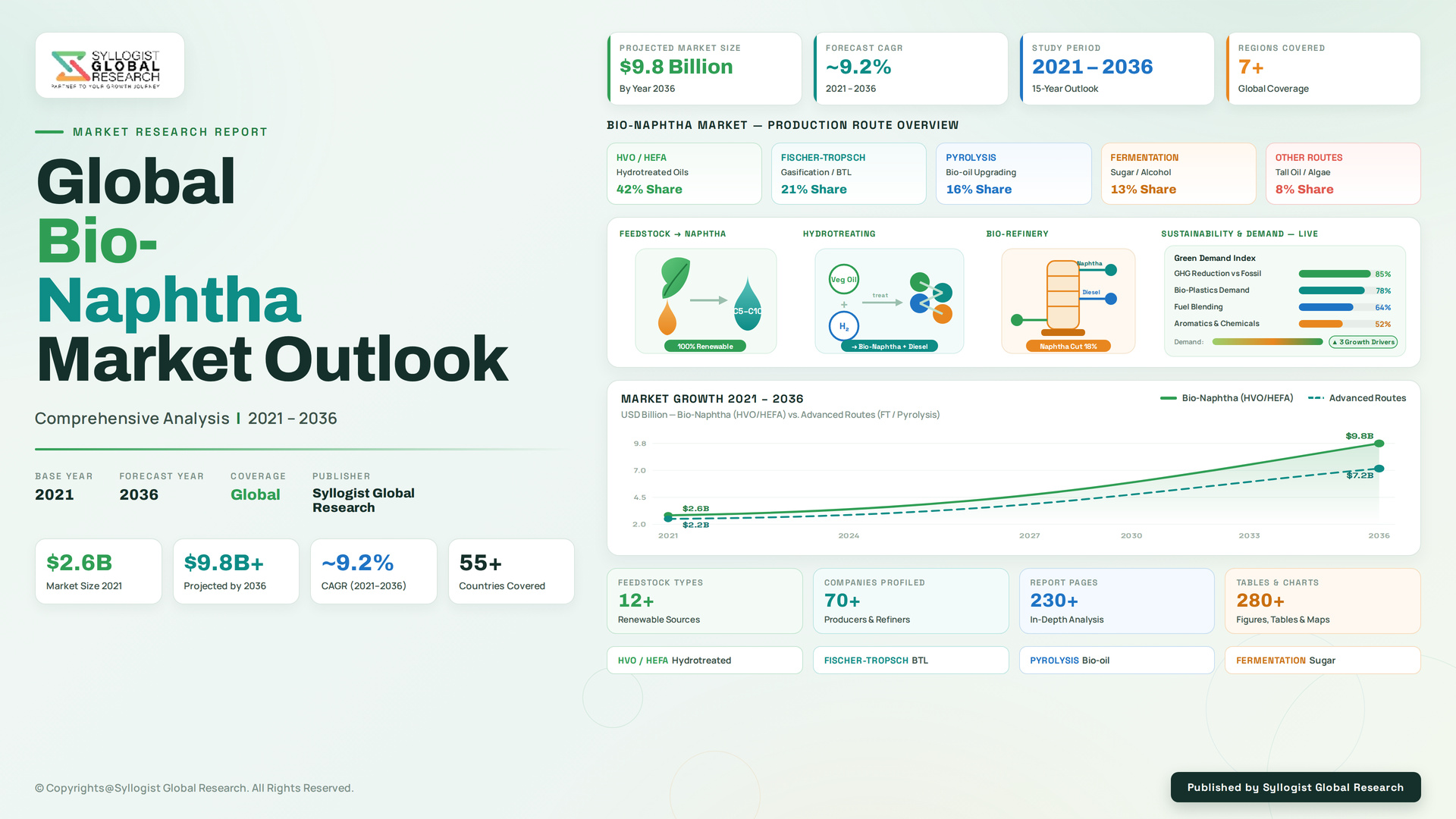
The global bio-naphtha market is entering an accelerated commercialization phase driven by binding renewable content mandates under the European Union Renewable Energy Directive III, brand owner commitments to deliver mass-balance certified bio-circular polymers in packaging applications, sustainable aviation fuel co-processing economics generating substantial bio-naphtha co-product volumes, and a structural petrochemical industry pivot toward feedstock decarbonization across steam cracker assets. The market was valued at approximately USD 1.9 billion in 2025 and is projected to reach USD 9.8 billion by 2036, advancing at a compound annual growth rate of 16.1% through the forecast period, as renewable diesel and sustainable aviation fuel capacity additions at Neste, Eni, TotalEnergies, Repsol, and Diamond Green Diesel generate co-product bio-naphtha volumes increasingly contracted to integrated petrochemical buyers under multi-year mass-balance certified offtake arrangements.
The structural integration of bio-naphtha into the European petrochemical value chain is reshaping olefin and polyolefin supply economics, with steam cracker operators in Antwerp, Rotterdam, Stenungsund, and Porvoo formally introducing bio-naphtha into feed slates and selling mass-balance certified bio-ethylene and bio-propylene at premium pricing to converters supplying Unilever, Procter and Gamble, Nestle, Coca-Cola, and PepsiCo brand commitments. Neste maintains the largest global bio-naphtha production position based on integrated renewable diesel capacity at Porvoo, Singapore, and Rotterdam, while UPM Biofuels supplies tall-oil derived bio-naphtha to Borealis under a long-standing contract. New entrants including Fulcrum BioEnergy, Velocys, Enerkem, and BTG Bioliquids are commercializing waste-to-naphtha gasification, Fischer-Tropsch, and pyrolysis pathways targeting non-food biomass and municipal solid waste feedstocks to mitigate feedstock competition risk relative to vegetable oil routes.
The petrochemical feedstock application segment is the fastest-expanding bio-naphtha demand category within the broader market, driven by mass-balance certified bio-circular polyolefin commercialization by Borealis, Dow, LyondellBasell, ExxonMobil, SABIC, and Braskem and rising brand owner specifications mandating verified renewable content in flexible packaging, rigid containers, and consumer durable applications. International Sustainability and Carbon Certification PLUS chain-of-custody systems have become the foundational accreditation framework enabling bio-naphtha attribute transfer through steam cracker, polymerization, and converter value chains without physical segregation, materially lowering implementation costs. Within the fuels segment, renewable gasoline blending applications are scaling more gradually due to favorable regulatory treatment of renewable diesel and sustainable aviation fuel under United States Inflation Reduction Act credits, although European RED III obligation tightening through 2030 is expected to redirect a growing share of bio-naphtha into transportation fuel pools.
Europe is the largest absolute revenue market by bio-naphtha consumption, anchored by the Antwerp-Rotterdam-Amsterdam petrochemical cluster, Stenungsund and Porvoo bio-naphtha cracking capacity, and RED III compulsory renewable content obligations across transportation fuel and chemical feedstock applications driving sustained demand growth across regulated end uses. North America is projected to record the highest regional compound annual growth rate through 2036, supported by United States Inflation Reduction Act Section 45Z clean fuel production credits, expanding renewable diesel capacity at Diamond Green Diesel, Marathon Petroleum, Phillips 66, and HollyFrontier facilities generating substantial bio-naphtha co-product volumes, and accelerating brand owner sourcing of bio-circular polymers from North American value chains. Asia-Pacific represents an emerging high-growth market, with Singapore-based Neste capacity, expanding Chinese sustainable aviation fuel investment, and Indian, South Korean, and Japanese petrochemical industry interest in feedstock decarbonization signaling structural demand acceleration through 2036.
Key Drivers
Brand Owner Commitments to Mass-Balance Certified Bio-Circular Polymers and Consumer Packaged Goods Sustainability Pledges Generating Durable Bio-Naphtha Demand Across Petrochemical Value Chains
Consumer packaged goods brand owners including Unilever, Procter and Gamble, Nestle, Coca-Cola, PepsiCo, and L’Oreal have issued public commitments to incorporate verified renewable and recycled content in plastic packaging at specified volume thresholds through 2030, creating durable downstream pull-through demand for mass-balance certified bio-circular polyethylene, polypropylene, and polyethylene terephthalate that requires bio-naphtha feedstock at the steam cracker level to support upstream attribute generation. International Sustainability and Carbon Certification PLUS accreditation has matured into the de facto chain-of-custody framework enabling bio-naphtha to flow through steam crackers, polymerization assets, and converter operations with attribute transfer to finished plastic products, materially reducing implementation cost relative to physically segregated bio-feedstock supply chains and accelerating petrochemical industry willingness to commit cracker capacity to bio-naphtha co-feeding. Borealis, Dow, LyondellBasell, ExxonMobil, SABIC, Braskem, and TotalEnergies are commercializing certified bio-circular polyolefin product lines marketed under Bornewables, Ecovera, and Circulen brand programs, with offtake terms increasingly extending to multi-year commitments that lock in bio-naphtha supply economics and underpin producer capacity investment decisions through 2036. Coca-Cola has committed to incorporating at least 50% recycled or renewable material across its PET portfolio by 2030, Unilever has pledged to halve virgin plastic use by 2025, and Procter and Gamble has targeted 100% recyclable or reusable packaging by 2030, with the residual fossil-derived plastic share increasingly drawn from mass-balance certified bio-circular pools, reinforcing dependence on upstream bio-naphtha feedstock availability.
Sustainable Aviation Fuel and Renewable Diesel Capacity Expansion Generating Structural Bio-Naphtha Co-Product Volumes Across HEFA and Fischer-Tropsch Production Pathways
The accelerated global build-out of sustainable aviation fuel and renewable diesel capacity, driven by European Union ReFuelEU Aviation blending mandates, United Kingdom Sustainable Aviation Fuel Mandate, United States Inflation Reduction Act Section 45Z clean fuel production credits, and corporate aviation decarbonization commitments by major airlines and freight integrators, is generating substantial bio-naphtha co-product volumes that emerge as a natural fraction of hydroprocessed esters and fatty acids and Fischer-Tropsch production processes. Approximately 15% of total HEFA process output emerges as bio-naphtha, creating large incremental supply volumes as renewable diesel and SAF capacity at Neste, Diamond Green Diesel, Phillips 66, Marathon Petroleum, TotalEnergies, Eni, and Repsol expands through 2036. This co-product economics dynamic creates a structural cost advantage for bio-naphtha buyers, since the primary economic driver of the parent facility is renewable diesel or SAF revenue, and bio-naphtha co-product pricing reflects available marginal value rather than full upstream production cost, supporting accelerating commercial uptake across petrochemical buyer segments. Neste Singapore expansion completed in 2023 added 1.3 million tons of annual renewable products capacity, generating proportional bio-naphtha output, while Marathon Petroleum Martinez and Phillips 66 Rodeo Renewed facilities contribute substantial North American volumes. European refiners are similarly converting fossil hydrocracking and hydrotreating capacity to HEFA service, with Eni Livorno, TotalEnergies La Mede, and Repsol Cartagena transitions illustrating the asset reconfiguration economics that unlock incremental bio-naphtha supply through 2036.
European Union Renewable Energy Directive III, ReFuelEU Aviation, and Chemicals Industry Decarbonization Obligations Creating Binding Regulatory Demand for Bio-Naphtha Across Transportation Fuel and Feedstock Applications
The European Union Renewable Energy Directive III establishes binding renewable content obligations across transportation fuel, aviation, and industry feedstock applications through 2030, with member state implementation requiring a 29% renewable energy share in transport by 2030 and specific advanced biofuel sub-targets that bio-naphtha qualifies to satisfy when produced from waste, residue, and non-food biomass feedstocks. The ReFuelEU Aviation Regulation mandates 2% sustainable aviation fuel blending in 2025 rising to 70% by 2050, with intermediate milestones at 6% in 2030 and 20% in 2035, generating direct demand for bio-naphtha as both a SAF co-product output and a renewable gasoline blending component. The European Chemicals Strategy for Sustainability and the circular economy action plan are simultaneously creating regulatory pressure on petrochemical producers to disclose and reduce fossil feedstock dependence, accelerating voluntary commitments by Borealis, BASF, Dow, INEOS, and SABIC to integrate bio-naphtha into European steam cracker feed slates ahead of any binding chemical industry renewable content mandate. Germany, the Netherlands, France, Sweden, Finland, and Belgium have implemented national transposition measures with varying stringency, including blending mandates, carbon intensity reduction targets, and feedstock eligibility criteria that materially shape regional bio-naphtha demand patterns. The Alliance to End Plastic Waste and individual producer initiatives are further accelerating voluntary investment in bio-naphtha sourcing infrastructure, certification capacity, and downstream attribute reconciliation systems preparing the petrochemical industry for compliance with anticipated chemical industry obligations expected during the second half of the forecast horizon.
Key Challenges
Feedstock Competition with Renewable Diesel, Sustainable Aviation Fuel, and Biodiesel Production Constraining Bio-Naphtha Supply Economics and Premium Pricing Versus Fossil Naphtha
Bio-naphtha producers operate within a feedstock economics environment where the primary value driver is renewable diesel and sustainable aviation fuel revenue, exposing bio-naphtha supply to direct competition with biodiesel, renewable diesel, and SAF for upstream feedstocks including used cooking oil, animal fats, tall oil, and lignocellulosic residues, the available volumes of which are constrained by collection infrastructure, regulatory eligibility under indirect land use change frameworks, and competing demand from established biofuel buyers. Bio-naphtha pricing structurally trades at a material premium to fossil naphtha, with delivered cost positions frequently exceeding 100% above fossil benchmarks depending on feedstock pathway, certification scheme, and regional incentive structure, requiring petrochemical buyers and brand owner end users to absorb the cost premium through downstream price pass-through that consumer packaged goods value chains have demonstrated limited capacity to absorb at scale. The persistent cost gap relative to fossil naphtha represents the central commercial constraint on bio-naphtha demand acceleration, and producer capacity investment economics remain sensitive to regulatory continuity, carbon credit valuation, and downstream willingness to maintain premium pricing through commodity cycle troughs. Used cooking oil prices, which serve as the marginal feedstock for many HEFA bio-naphtha producers, have ranged materially above historical norms as renewable diesel and SAF demand absorbs collected volumes, and the European Union restriction on palm oil and palm oil mill effluent derivatives further constrains the available eligible feedstock pool, prompting producers and buyers to respond through long-term offtake commitments and investment in alternative feedstock pathways.
Mass-Balance Certification Complexity, Indirect Land Use Change Compliance, and Cross-Border Chain-of-Custody Reconciliation Imposing Sustained Administrative and Verification Burdens
The International Sustainability and Carbon Certification PLUS, REDcert, and Roundtable on Sustainable Biomaterials certification frameworks underpinning bio-naphtha commercial transactions impose extensive documentation, third-party audit, and chain-of-custody reconciliation requirements across the entire value chain from feedstock collection through finished plastic product, with mass-balance accounting requiring synchronized credit and debit tracking across steam cracker, polymerization, and converter operations under externally verified bookkeeping protocols. Indirect land use change provisions under European Union RED III impose feedstock eligibility restrictions on palm oil derivatives and certain food-and-feed crops, requiring producers and buyers to maintain feedstock traceability documentation back to origin and creating compliance complexity for multi-feedstock production facilities operating across jurisdictions with divergent eligibility frameworks. Cross-border certification reconciliation between European Union, United States Renewable Fuel Standard, United Kingdom Renewable Transport Fuel Obligation, and emerging Asia-Pacific schemes introduces additional administrative friction, since attribute recognition rules and qualifying feedstock definitions vary materially across schemes, constraining the fungibility of certified bio-naphtha volumes across regional markets and limiting the price arbitrage mechanisms that would otherwise smooth regional supply-demand imbalances. Audit cycles typically extend over multiple months per facility, requiring dedicated sustainability and compliance staff at each value chain node and creating elevated cost barriers for smaller specialty chemical converters seeking to participate in bio-circular procurement programs. Recent European Commission scrutiny of certified used cooking oil import flows from China, allegations of feedstock substitution within the certification system, and emerging traceability technology requirements including blockchain-enabled chain-of-custody documentation are intensifying the compliance burden across the value chain.
Limited Production Capacity, Logistics Infrastructure Constraints, and Long Investment Lead Times Restricting Bio-Naphtha Supply Response to Accelerating Commercial Demand
The global bio-naphtha production base remains concentrated across a limited number of producers and facilities, with installed capacity insufficient to meet announced brand owner and petrochemical buyer commitments through 2030, creating supply-demand tightness that constrains commercial scale-up and exposes downstream buyers to volume allocation risk under multi-year offtake contracts. New bio-naphtha production capacity, whether from greenfield HEFA renewable diesel facilities, dedicated Fischer-Tropsch biomass-to-liquids investments, or pyrolysis oil upgrading routes, requires capital investment commitments often exceeding USD 1 billion per facility and project development timelines spanning multiple years from final investment decision to commercial operation, materially slowing the supply response to accelerating demand signals. Logistics infrastructure constraints further complicate market scale-up, since bio-naphtha requires segregated storage, dedicated transportation, and integrated terminal handling to preserve sustainability attributes through the value chain, while existing petrochemical and refining logistics infrastructure was engineered around commingled fossil hydrocarbon flows, requiring incremental capital investment in storage segregation, blending, and certified handling capacity across European, North American, and emerging Asia-Pacific bio-naphtha trade routes. Pipeline allocation challenges, vessel charter availability for cross-Atlantic and cross-Pacific bio-naphtha trade, and terminal qualification under ISCC PLUS chain-of-custody protocols are further extending project execution timelines. The concentration of bio-naphtha production in a small number of integrated renewable diesel hubs, combined with the geographic dispersion of petrochemical demand across Europe, North America, and Asia-Pacific, generates elevated transportation cost exposure relative to fossil naphtha trade flows that benefit from a mature, fungible global logistics network through 2036.
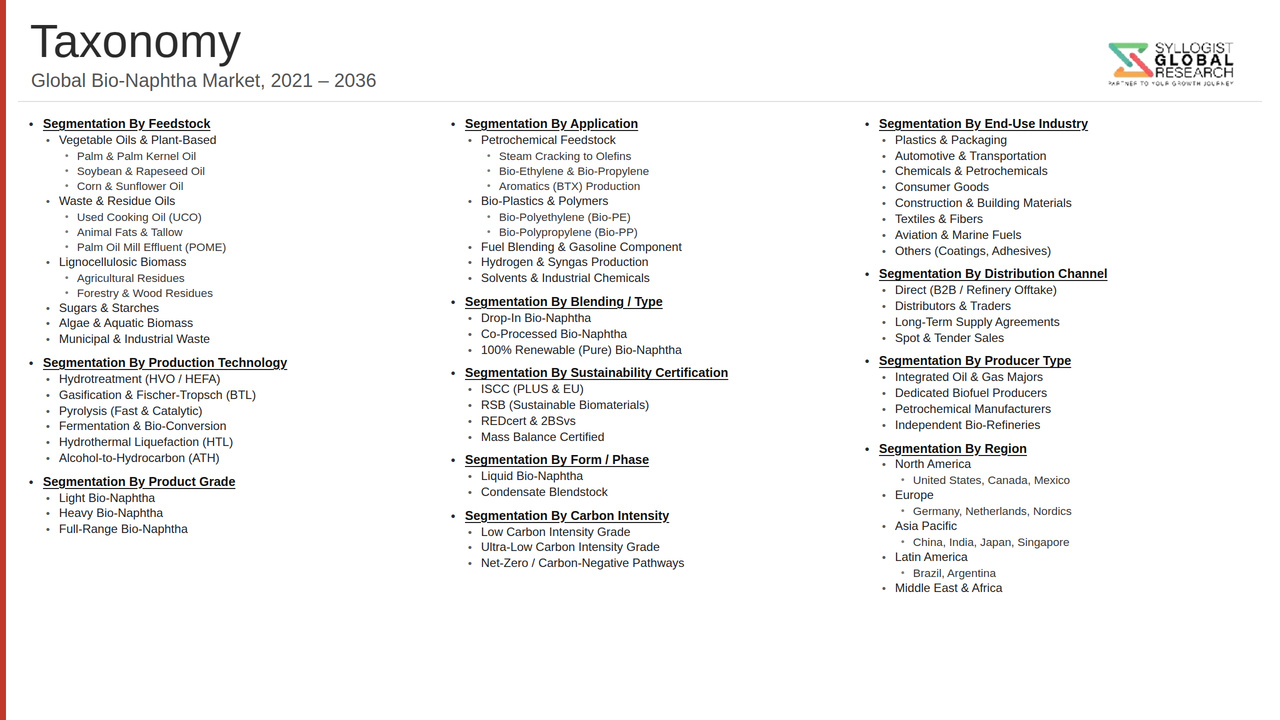
Market Segmentation
- Segmentation By Source
- Vegetable Oil (Used Cooking Oil, Tall Oil, Palm Oil Mill Effluent)
- Animal Fats and Tallow
- Lignocellulosic Biomass and Agricultural Residues
- Municipal Solid Waste
- Pyrolysis Oil from Plastic and Tire Waste
- Sugar and Starch Derivatives
- Others
- Segmentation By Production Technology
- Hydroprocessed Esters and Fatty Acids (HEFA)
- Fischer-Tropsch Synthesis
- Gasification and Pyrolysis Upgrading
- Methanol-to-Olefins (MTO) Integrated Routes
- Catalytic Hydrothermolysis
- Tall Oil Refining
- Others
- Segmentation By Application
- Petrochemical Feedstock for Steam Cracking
- Sustainable Aviation Fuel Blending and Co-Processing
- Renewable Gasoline Blending
- Specialty Chemicals and Solvents
- Hydrogen Production
- Others
- Segmentation By End User
- Petrochemical and Polyolefin Producers
- Fuel Refiners and Blenders
- Specialty Chemical Manufacturers
- Brand Owners and Consumer Packaged Goods Companies
- Automotive and Mobility Sector
- Others
- Segmentation By Region
- North America
- Europe
- Asia-Pacific
- Middle East and Africa
- Latin America
All market revenues are presented in USD
Historical Year: 2021-2024 | Base Year: 2025 | Estimated Year: 2026 | Forecast Period: 2027-2036
Key Questions this Study Will Answer
- What is the total global market valuation of the Bio-Naphtha Market in 2025, projected through 2036, disaggregated by source, production technology, and end-use application, enabling renewable fuel producers, petrochemical buyers, brand owners, and investors to identify highest-growth segments and most durable revenue opportunities across the bio-circular value chain?
- How are bio-naphtha producers including Neste, UPM Biofuels, Eni, TotalEnergies, Repsol, and Diamond Green Diesel allocating co-product output across petrochemical feedstock, sustainable aviation fuel blending, and renewable gasoline applications, and which capacity expansion programs are defining future global bio-naphtha supply geography across Europe, North America, and Asia-Pacific through 2036?
- What compliance pathways under the European Union Renewable Energy Directive III, ReFuelEU Aviation Regulation, United States Renewable Fuel Standard, and Section 45Z clean fuel production credits are reshaping bio-naphtha procurement economics, and how are producers and downstream buyers managing the regulatory eligibility, indirect land use change, and certification scheme reconciliation requirements across jurisdictions?
- Which bio-naphtha source and production technology pathways, including hydroprocessed esters and fatty acids, Fischer-Tropsch from biomass-to-liquids, pyrolysis oil upgrading, and waste gasification routes, are generating the highest growth rates through 2036, and what feedstock availability, capital cost, and certification capabilities are most critical to commercial scale-up in each pathway?
- How is the competitive landscape structured among integrated renewable fuel producers, dedicated waste-to-naphtha technology developers, tall-oil specialists, and emerging biomass gasification entrants pursuing petrochemical and refining offtake contracts, and what partnership, joint venture, and acquisition strategies are enabling new entrants to scale capacity against established producers in next-generation sustainable feedstock supply?
- What mass-balance certification, chain-of-custody, and indirect land use change compliance obligations under International Sustainability and Carbon Certification PLUS, REDcert, and Roundtable on Sustainable Biomaterials frameworks are reshaping bio-naphtha procurement specifications across steam cracker, polymerization, and brand owner value chains, and how are producers and buyers building the documentation infrastructure required for accreditation?
- Which regional bio-naphtha markets, specifically Europe, North America, and Asia-Pacific, are expected to generate the most substantial incremental demand through 2036, and what renewable content mandates, sustainable aviation fuel obligations, petrochemical decarbonization commitments, and brand owner sourcing strategies are driving bio-naphtha capacity investment and supplier selection decisions in each regional market?
- Product Definition
- Research Methodology
- Research Design & Framework
- Overall Research Approach: Descriptive, Exploratory & Quantitative Mixed-Method Design
- Market Definition & Scope Boundaries: What is Included and Excluded
- Segmentation Framework
- Key Research Assumptions & Limitations
- Secondary Research
- Primary Research Design & Execution
- Data Triangulation & Validation
- Market Sizing & Forecasting Methodology
- Competitive Intelligence Methodology
- Quality Assurance & Peer Review
- Definitions, Abbreviations & Data Notes
- Research Design & Framework
- Executive Summary
- Market Snapshot & Headline Numbers
- Key Findings & Research Highlights
- Market Dynamics
- Regional Market Summary
- Competitive Landscape Snapshot
- Technology & Innovation Highlights
- Market Dynamics
- Drivers
- Restraints
- Opportunities
- Challenges
- Porter’s Five Forces Analysis
- PESTLE Analysis
- Market Trends & Developments
- Emerging Trends
- Technological Developments
- Regulatory & Policy Changes
- Supply Chain & Sourcing Trends
- Manufacturing & Process Trends
- Investment & Funding Activity
- Sustainability & ESG Trends
- Risk Assessment Framework
- Feedstock Availability, Supply Competition & Price Volatility Risk
- Policy Dependence, Mandate Withdrawal & Incentive Continuity Risk
- Technology Scale-Up, Yield & Process Integration Risk
- Sustainability Certification, Indirect Land-Use Change (ILUC) & Feedstock Origin Risk
- Financing, Project Development & Stranded Asset Risk
- Regulatory Framework & Standards
- Renewable Fuel Mandates, Blending Obligations & Bio-Content Policy Frameworks
- Mass Balance, Chain-of-Custody & Sustainability Certification Standards (ISCC, RSB & Equivalent)
- Bio-Based Product, Drop-In Feedstock Specification & Petrochemical Quality Standards
- Environmental, Land-Use & Feedstock Sourcing (ILUC) Regulations
- Green Finance, Carbon Accounting, ESG Disclosure & Sustainable Procurement Standards
- Global Bio-Naphtha Market Outlook
- Market Size & Forecast by Value
- Market Size & Forecast by Volume (Production & Consumption, Kilo Tonnes)
- Market Size & Forecast by Feedstock Type
- Used Cooking Oil (UCO) & Waste Cooking Oils
- Animal Fats, Tallow & Rendered Fats
- Vegetable Oils (Rapeseed, Soybean, Palm & Others)
- Tall Oil & Forestry Residues
- Lignocellulosic & Agricultural Biomass Residues
- Municipal Solid Waste (MSW) & Mixed Organic Waste
- Sugars, Starches & Fermentable Carbohydrates
- Algae & Aquatic Biomass
- Other Advanced & Second-Generation Feedstocks
- Market Size & Forecast by Production Technology
- Hydrotreating of Esters & Fatty Acids (HEFA/HVO) Co-Production
- Gasification & Fischer-Tropsch (FT) Synthesis (Biomass-to-Liquid)
- Fast Pyrolysis & Bio-Oil Hydroprocessing
- Hydrothermal Liquefaction (HTL) & Catalytic Upgrading
- Alcohol-to-Hydrocarbon (Ethanol & Methanol-to-Naphtha) Routes
- Sugar Fermentation & Biochemical Conversion
- Co-Processing of Bio-Feedstocks in Conventional Refineries
- Catalytic Depolymerisation & Waste-Plastic-Derived Renewable Naphtha
- Other Emerging & Hybrid Conversion Technologies
- Market Size & Forecast by Derivative & Output Type
- Bio-Ethylene & Bio-Propylene (Olefins via Steam Cracking)
- Bio-Aromatics (Bio-BTX: Benzene, Toluene & Xylene)
- Bio-Based Polymers & Bioplastics (Bio-PE & Bio-PP)
- Renewable Gasoline & Fuel Blending Components
- Solvents & Specialty Chemical Intermediates
- Market Size & Forecast by Production Scale
- Large-Scale Integrated Biorefineries (Above 500 Kilo Tonnes per Annum)
- Medium-Scale Standalone Production Plants (100 to 500 Kilo Tonnes per Annum)
- Small-Scale & Decentralised Production Units (Below 100 Kilo Tonnes per Annum)
- Market Size & Forecast by Application
- Bio-Based Plastics & Polymer Production
- Petrochemical Feedstock for Olefins & Aromatics
- Transportation Fuel & Gasoline Blending
- Solvents & Industrial Chemicals
- Specialty & Performance Materials
- Other Emerging Applications
- Market Size & Forecast by End-Use Industry
- Packaging Industry
- Automotive & Transportation
- Consumer Goods & Electronics
- Building & Construction
- Chemicals & Other Industrial End-Users
- Market Size & Forecast by Sales Channel
- Direct Long-Term Offtake & Supply Agreement
- Mass-Balance & Book-and-Claim Contract
- Distributors & Traders
- Spot Market & Tolling Arrangement
- North America Bio-Naphtha Market Outlook
- Market Size & Forecast
- By Value
- By Volume (Production & Consumption, Kilo Tonnes)
- By Feedstock Type
- By Production Technology
- By Derivative & Output Type
- By Production Scale
- By Application
- By End-Use Industry
- By Country
- By Sales Channel
- Europe Bio-Naphtha Market Outlook
- Market Size & Forecast
- By Value
- By Volume (Production & Consumption, Kilo Tonnes)
- By Feedstock Type
- By Production Technology
- By Derivative & Output Type
- By Production Scale
- By Application
- By End-Use Industry
- By Country
- By Sales Channel
- Asia-Pacific Bio-Naphtha Market Outlook
- Market Size & Forecast
- By Value
- By Volume (Production & Consumption, Kilo Tonnes)
- By Feedstock Type
- By Production Technology
- By Derivative & Output Type
- By Production Scale
- By Application
- By End-Use Industry
- By Country
- By Sales Channel
- Latin America Bio-Naphtha Market Outlook
- Market Size & Forecast
- By Value
- By Volume (Production & Consumption, Kilo Tonnes)
- By Feedstock Type
- By Production Technology
- By Derivative & Output Type
- By Production Scale
- By Application
- By End-Use Industry
- By Country
- By Sales Channel
- Middle East & Africa Bio-Naphtha Market Outlook
- Market Size & Forecast
- By Value
- By Volume (Production & Consumption, Kilo Tonnes)
- By Feedstock Type
- By Production Technology
- By Derivative & Output Type
- By Production Scale
- By Application
- By End-Use Industry
- By Country
- By Sales Channel
- Country-Wise* Bio-Naphtha Market Outlook
- Market Size & Forecast
- By Value
- By Volume (Production & Consumption, Kilo Tonnes)
- By Feedstock Type
- By Production Technology
- By Derivative & Output Type
- By Production Scale
- By Application
- By End-Use Industry
- By Country
- By Sales Channel
- *Countries Analyzed in the Syllogist Global Research Portfolio: United States, Canada, Mexico, Germany, France, United Kingdom, Netherlands, Spain, Italy, Norway, Sweden, China, Japan, India, Australia, South Korea, Singapore, Brazil, Chile, Saudi Arabia, UAE, Egypt, South Africa, Israel
- Technology Landscape & Innovation Analysis
- Hydrotreating (HEFA/HVO) Bio-Naphtha Co-Production Technology Deep-Dive
- Gasification & Fischer-Tropsch (Biomass-to-Liquid) Bio-Naphtha Synthesis Technology
- Fast Pyrolysis & Bio-Oil Hydroprocessing Technology for Naphtha-Range Hydrocarbons
- Alcohol-to-Hydrocarbon, Fermentation & Sugar-Based Routes to Bio-Naphtha
- Hydrothermal Liquefaction & Catalytic Upgrading Technology
- Steam Cracking & Downstream Integration of Bio-Naphtha into Olefins & Polymers
- Co-Processing of Bio-Feedstocks in Conventional Refineries
- Patent & IP Landscape in Bio-Naphtha Production Technologies
- Value Chain & Supply Chain Analysis
- Feedstock Sourcing, Aggregation & Pre-Treatment Supply Chain
- Hydroprocessing, Catalyst & Reactor Equipment Supply Chain
- Gasification, Pyrolysis & Fischer-Tropsch Reactor Equipment Supply Chain
- Logistics, Storage & Drop-In Blending Infrastructure
- Refiner, Biorefinery Operator & Petrochemical Offtaker Procurement Landscape
- Polymer Producer, Brand Owner & Offtake Partner Channel
- Co-Product, Residue Valorisation & Circular Economy
- Pricing Analysis
- Hydrotreated (HEFA) Bio-Naphtha Capital and Operating Cost Analysis
- Gasification-Fischer-Tropsch Bio-Naphtha Levelised Production Cost Analysis
- Pyrolysis-Route Bio-Naphtha Capital and Payback Period Analysis
- Feedstock Cost, Green Premium & Price Parity vs. Fossil Naphtha Analysis
- Bio-Naphtha Offtake Contract, Mass-Balance Premium & Revenue Structure Analysis
- Total Bio-Naphtha Project Economics: Levelised Cost of Production and Carbon-Abatement Cost Analysis
- Sustainability & Environmental Analysis
- Lifecycle Assessment (LCA) of Bio-Naphtha: Carbon Footprint, Energy Intensity & GHG Savings Across Production Routes
- Carbon Neutrality & Net Zero Contribution: Pathway to Defossilised Petrochemicals and Plastics
- Circular Economy & Bio-Based Feedstock: Resource Efficiency and Waste Valorisation Contribution
- Environmental Compliance, Land-Use Change (ILUC) & Biodiversity Consideration in Feedstock Sourcing
- Regulatory-Driven Sustainability, SDG 12 (Responsible Consumption) & SDG 13 (Climate Action) Alignment & Green Finance Eligibility
- Competitive Landscape
- Market Structure & Concentration
- Market Consolidation Level (Fragmented vs. Consolidated by Feedstock & Geography)
- Top 10 Players Market Share
- HHI (Herfindahl-Hirschman Index) Concentration Analysis
- Competitive Intensity Map by Feedstock, Technology & Geography
- Player Classification
- Integrated Oil & Energy Majors Producing Renewable Naphtha
- Specialist Renewable Fuel & HVO/HEFA Producers
- Gasification & Fischer-Tropsch (Biomass-to-Liquid) Technology Companies
- Pyrolysis & Advanced Biofuel Technology Providers
- Petrochemical Producers Integrating Bio-Naphtha Feedstock
- Bio-Based Polymer & Bioplastic Producers
- Technology Licensors & Catalyst Providers
- Feedstock Aggregators & Pre-Treatment Specialists
- Competitive Analysis Frameworks
- Market Share Analysis by Feedstock, Technology & Region
- Company Profile
- Company Overview & Headquarters
- Bio-Naphtha Products & Technology Portfolio
- Key Customer Relationships & Reference Offtake Agreements
- Manufacturing Footprint & Production Capacity
- Revenue (Bio-Naphtha & Renewable Products Segment) & Backlog
- Technology Differentiators & IP
- Key Strategic Partnerships, JVs & M&A Activity
- Recent Developments (Capacity Expansion, Offtake Deals, Product Launches)
- SWOT Analysis
- Strategic Focus Areas & Roadmap
- Competitive Positioning Map (Technology Capability vs. Market Penetration)
- Key Company Profiles
- Market Structure & Concentration
- Technology Landscape & Innovation Analysis
- Strategic Output
- Market Opportunity Matrix: By Feedstock, Technology, Application, End-Use Industry & Geography
- White Space Opportunity Analysis
- Strategic Recommendations
- Product Portfolio & Technology Investment Strategy
- Manufacturing & Operational Excellence Strategy
- Geographic Expansion & Localisation Strategy
- Customer & End-User Engagement Strategy
- Partnership, M&A & Ecosystem Strategy
- Sustainability & Circular Economy Strategy
- Risk Mitigation & Future Roadmap
- Strategic Priority Matrix & Roadmap
- Near-term (2025-2028)
- Mid-term (2029-2032)
- Long-term (2033-2037)
- Strategic Output
- Market Size & Forecast
- Market Size & Forecast
- Market Size & Forecast
- Market Size & Forecast
- Market Size & Forecast
- Market Size & Forecast