Global Water Treatment Market By Treatment Type, By Technology, By Equipment, By Chemical Type, By Service, By Application, By End User, By Region, Competition, Forecast & Opportunities, 2021-2034F
Market Definition
Water treatment is the set of physical, chemical, and biological processes used to remove contaminants and improve water quality for drinking, industrial, agricultural, and environmental discharge across municipal and industrial systems worldwide. The Global Water Treatment Market covers the supply of treatment technologies, equipment, chemicals, and services spanning primary, secondary, tertiary, and advanced treatment, including coagulation, sedimentation, filtration, membrane separation such as reverse osmosis, ultrafiltration, and nanofiltration, disinfection through chlorination, ozonation, and ultraviolet systems, biological treatment such as activated sludge and membrane bioreactors, desalination, and sludge management. Within the Global Water Treatment Market, equipment includes filtration systems, disinfection units, pumps and valves, membrane systems, and sludge handling units; chemicals include coagulants, flocculants, biocides, corrosion and scale inhibitors, and pH adjusters; and services include design, installation, operation, and retrofitting. Applications span municipal drinking water and sewage, industrial process and effluent treatment across power, chemicals, pharmaceuticals, food and beverage, mining, and oil and gas, alongside commercial and residential purification. Participants in the Global Water Treatment Market include technology and equipment manufacturers, specialty chemical suppliers, engineering procurement and construction contractors, water utilities, and operation and maintenance service providers. End users span government and municipal bodies, private utilities, industrial enterprises, and commercial establishments. The Global Water Treatment Market excludes bulk water transport infrastructure, standalone irrigation networks, and bottled water production, focusing on the technologies, chemicals, equipment, and services that purify and reclaim water across municipal, industrial, and decentralized systems globally.
Market Insights
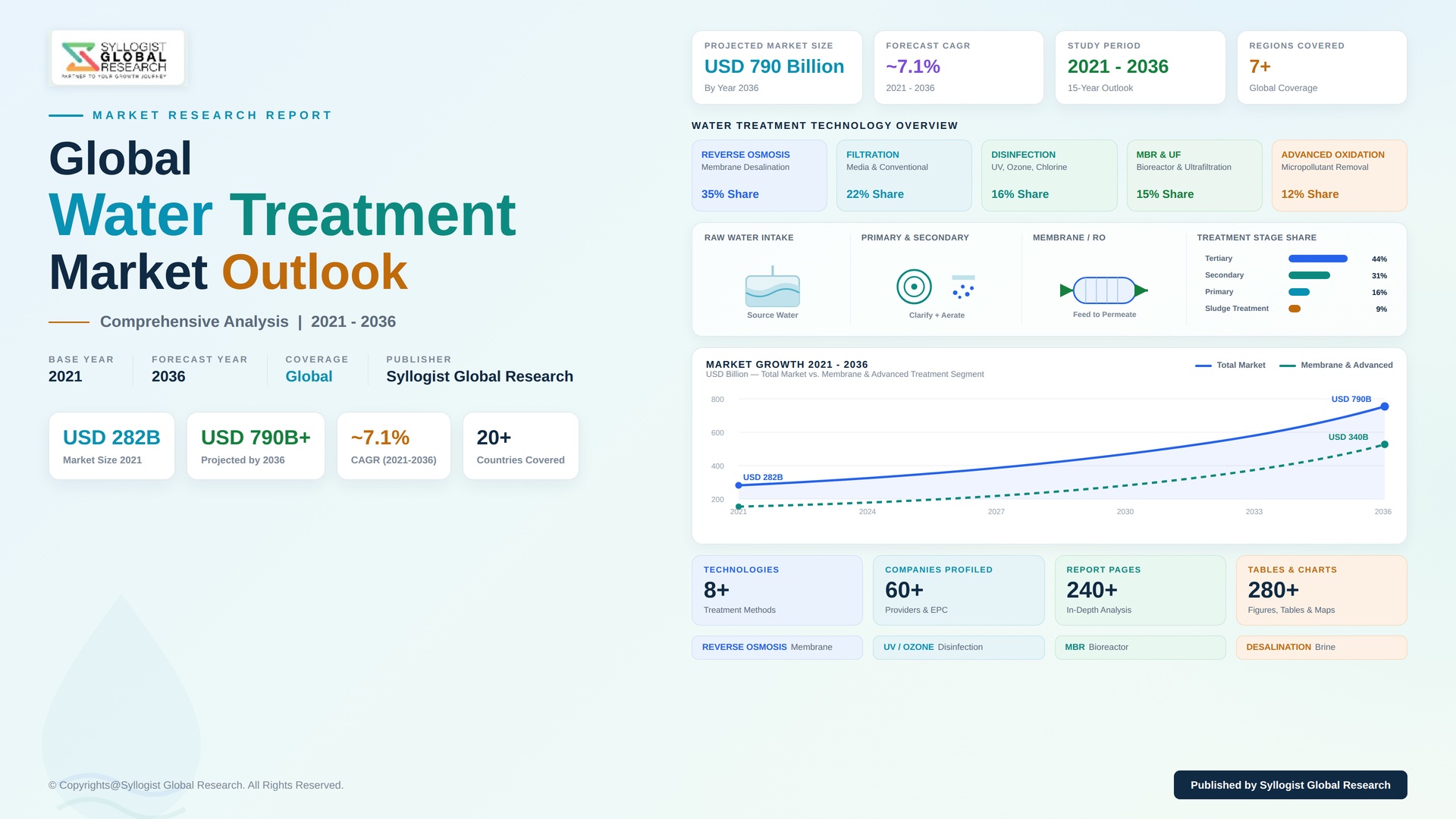
The Global Water Treatment Market is in a structural growth phase, propelled by intensifying freshwater scarcity, tightening discharge regulation, and rising demand for water reuse across municipal and industrial systems. The Global Water Treatment Market was valued at USD 372 billion in 2025 and is projected to reach USD 690 billion by 2034, advancing at a compound annual growth rate of 7.1% across the forecast period, as utilities and industries scale treatment capacity to meet clean water demand. Only 2.5% of the planet water is freshwater and less than 1% is directly accessible, while over 40% of the global population lives in water stressed regions, sustaining durable demand within the Global Water Treatment Market. Rapid urbanization is amplifying this pressure, with the urban share of global population reaching 56% in 2024 and projected to exceed 68% by 2050, raising municipal sewage volumes and treatment investment across the Global Water Treatment Market.
Tertiary treatment holds the largest revenue share within the Global Water Treatment Market, close to 44%, since advanced polishing is essential before treated effluent is reused or discharged to the environment. Reverse osmosis is the leading technology within the Global Water Treatment Market, accounting for close to 35% of technology revenue and close to 69% of installed desalination systems, supported by its high salt rejection and reliable contaminant removal. Membrane filtration now represents close to 42% of advanced treatment installations within the Global Water Treatment Market, with membrane bioreactors delivering up to 98% pathogen removal while cutting plant footprint. The municipal sector accounts for close to 61% of installations within the Global Water Treatment Market, while the industrial sector, at close to 39%, is the faster growing segment driven by reuse mandates and zero liquid discharge adoption.
The Global Water Treatment Market splits between treatment chemicals and treatment equipment, each with distinct dynamics. Water treatment chemicals were valued at close to USD 40 billion in 2025 within the Global Water Treatment Market, with coagulants and flocculants the largest chemical category and biocides and disinfectants the fastest growing. Treatment equipment was valued at close to USD 75 billion in 2025 within the Global Water Treatment Market, with filtration equipment the largest category and disinfection equipment the fastest growing. Digital water platforms, artificial intelligence analytics, and advanced oxidation are reshaping the Global Water Treatment Market, cutting water losses and removing over 95% of micropollutants. Reuse remains a major opportunity, since only close to 11% of treated wastewater is currently reused and close to 56% of wastewater generated worldwide remains untreated, anchoring long-term growth across the Global Water Treatment Market.
Asia-Pacific holds the largest share of the Global Water Treatment Market, close to 38%, driven by rapid industrialization, urbanization, and large municipal investment programs in China and India. The China market is projected to reach close to USD 100 billion and the India market close to USD 23 billion, keeping Asia at the centre of demand within the Global Water Treatment Market. North America and Europe remain advanced markets within the Global Water Treatment Market, supported by aging infrastructure renewal, emerging contaminant rules, and reuse programs, with the United States allocating USD 6.5 billion to water infrastructure projects targeting deteriorating systems and emerging contaminants. Global desalination capacity now exceeds 100 million cubic metres per day, reinforcing equipment demand within the Global Water Treatment Market, where participants including Veolia, Suez, Xylem, Ecolab, and Kurita compete through technology breadth, chemical formulation, and service depth.
Key Drivers
Freshwater Scarcity, Water Reuse Mandates, and Rising Clean Water Demand
Intensifying freshwater scarcity and expanding water reuse mandates are driving sustained demand across the Global Water Treatment Market. With less than 1% of global water directly accessible and over 40% of people living under water stress, utilities and industries are investing in advanced treatment, reuse, and desalination, sustaining strong growth within the Global Water Treatment Market through the forecast period.
Tightening Discharge Regulation and Zero Liquid Discharge Adoption Across Industry
Tightening effluent discharge regulation and accelerating zero liquid discharge adoption are widening the industrial base of the Global Water Treatment Market. Sectors such as power, chemicals, pharmaceuticals, textiles, and food and beverage are deploying membrane filtration, advanced oxidation, and reuse systems to meet stricter standards, driving high specification equipment and chemical demand across the Global Water Treatment Market.
Urbanization, Infrastructure Investment, and Government Funding Programs
Rapid urbanization, aging infrastructure renewal, and large government funding programs are widening the municipal base of the Global Water Treatment Market. Rising urban sewage volumes, public investment in treatment plants, and dedicated infrastructure funding are driving sustained installation of filtration, disinfection, and membrane systems across the Global Water Treatment Market in both developed and emerging economies.
Key Challenges
High Capital Cost, Energy Intensity, and Lifecycle Expense of Advanced Treatment
High capital cost and energy intensity constrain adoption across the Global Water Treatment Market, particularly for small municipalities and emerging economies. Capital investment can represent close to 48% of total lifecycle cost, while energy consumption accounts for close to 30% of operating expenditure, raising barriers for advanced membrane and oxidation systems and slowing technology replacement across the Global Water Treatment Market.
Aging Infrastructure, Skilled Workforce Shortages, and Maintenance Downtime
Aging infrastructure, skilled workforce shortages, and maintenance downtime challenge the Global Water Treatment Market. Skilled labour gaps affect close to 33% of treatment facilities, while maintenance downtime impacts close to 21% of ageing plants each year, reducing operational efficiency and complicating reliable service delivery across the Global Water Treatment Market, especially in cost-sensitive regions.
Emerging Contaminants and Rising Treatment Complexity
Emerging contaminants and rising treatment complexity are increasing cost and technical risk within the Global Water Treatment Market. Removing micropollutants, pharmaceuticals, and persistent compounds requires advanced oxidation, specialty membranes, and tighter monitoring, raising capital and operating cost and pressuring utilities and industrial operators across the Global Water Treatment Market to upgrade ahead of evolving regulation, often without proven low-cost treatment routes for the newest regulated compounds.
Market Segmentation
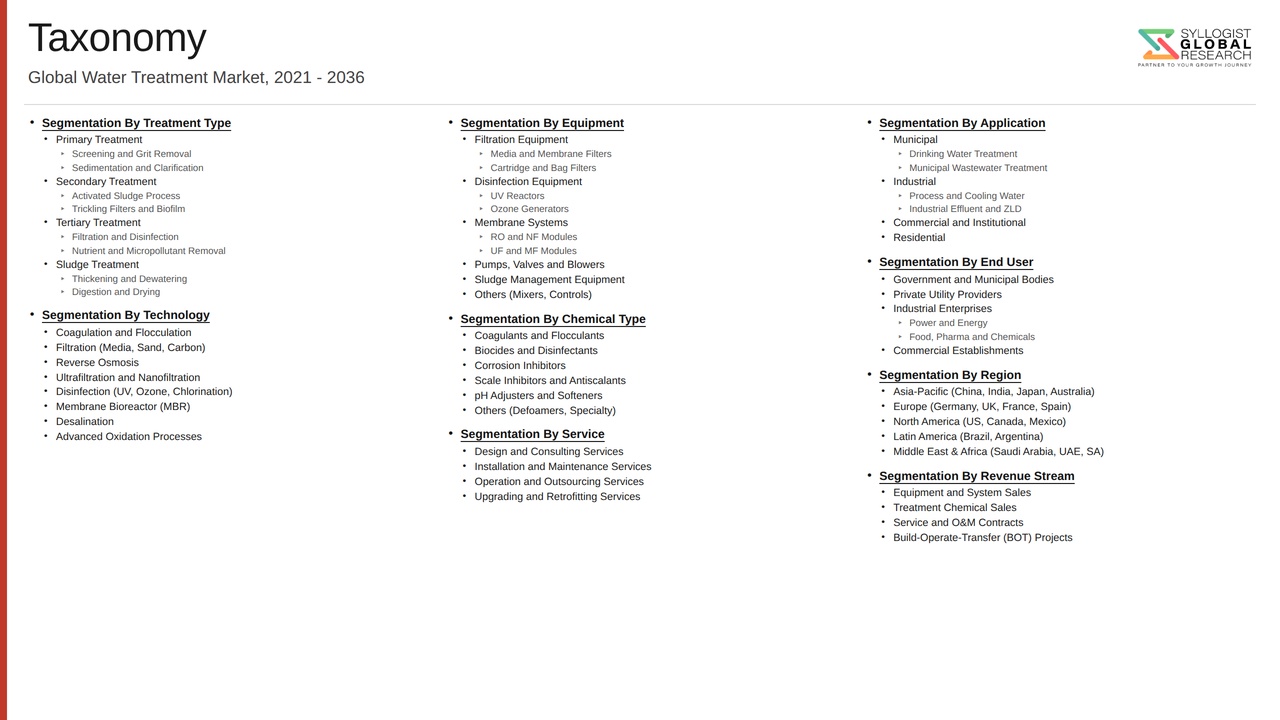
- Segmentation By Treatment Type
- Primary Treatment
- Secondary Treatment
- Tertiary Treatment
- Sludge Treatment
- Segmentation By Technology
- Coagulation and Flocculation
- Filtration
- Reverse Osmosis
- Ultrafiltration and Nanofiltration
- Disinfection (UV, Ozone, Chlorination)
- Membrane Bioreactor
- Desalination
- Advanced Oxidation
- Segmentation By Equipment
- Filtration Equipment
- Disinfection Equipment
- Membrane Systems
- Pumps and Valves
- Sludge Management Equipment
- Others
- Segmentation By Chemical Type
- Coagulants and Flocculants
- Biocides and Disinfectants
- Corrosion Inhibitors
- Scale Inhibitors
- pH Adjusters
- Others
- Segmentation By Service
- Design and Consulting Services
- Installation and Maintenance Services
- Operation and Outsourcing Services
- Upgrading and Retrofitting Services
- Segmentation By Application
- Municipal
- Industrial
- Commercial and Institutional
- Residential
- Segmentation By End User
- Government and Municipal Bodies
- Private Utility Providers
- Industrial Enterprises
- Commercial Establishments
- Segmentation By Region
- North America
- Europe
- Asia-Pacific
- Middle East and Africa
- Latin America
All market revenues are presented in USD
Historical Year: 2021-2024 | Base Year: 2025 | Estimated Year: 2026 | Forecast Period: 2027-2034
Key Questions this Study Will Answer
- What is the total valuation of the Global Water Treatment Market in 2025, projected through 2034, segmented by treatment type, technology, equipment, chemical type, and application, enabling technology manufacturers, chemical suppliers, utilities, and infrastructure investors to identify the highest growth segments and most durable revenue opportunities across the Global Water Treatment Market?
- How are freshwater scarcity, water reuse mandates, and zero liquid discharge adoption reshaping treatment technology selection and capital allocation across municipal and industrial operators within the Global Water Treatment Market through 2034?
- Which technologies, including reverse osmosis, membrane bioreactors, ultrafiltration, advanced oxidation, and disinfection systems, are gaining the strongest procurement traction across municipal, industrial, and reuse applications, and what removal efficiency, energy, and total cost of ownership metrics are shaping selection within the Global Water Treatment Market?
- How is demand splitting between treatment chemicals and treatment equipment within the Global Water Treatment Market, and which chemical and equipment categories are growing fastest as regulation and reuse intensify?
- What role do digital water platforms, artificial intelligence analytics, and emerging contaminant removal play in shaping the next phase of investment and modernization across the Global Water Treatment Market?
- How is the competitive landscape structured among technology and equipment manufacturers, specialty chemical suppliers, engineering contractors, and water service providers within the Global Water Treatment Market, and what technology, chemistry, and service strategies are shaping competitive position?
- Which regional markets, including Asia-Pacific, North America, Europe, the Middle East and Africa, and Latin America, are projected to generate the largest incremental water treatment opportunities through 2034, and what scarcity, regulation, urbanization, and infrastructure funding factors are shaping supplier selection in each regional Global Water Treatment Market?
- Product Definition
- Research Methodology
- Research Design & Framework
- Overall Research Approach: Descriptive, Exploratory & Quantitative Mixed-Method Design
- Market Definition & Scope Boundaries: What is Included and Excluded
- Segmentation Framework
- Key Research Assumptions & Limitations
- Secondary Research
- Primary Research Design & Execution
- Data Triangulation & Validation
- Market Sizing & Forecasting Methodology
- Competitive Intelligence Methodology
- Quality Assurance & Peer Review
- Definitions, Abbreviations & Data Notes
- Executive Summary
- Market Snapshot & Headline Numbers
- Key Findings & Research Highlights
- Market Dynamics
- Regional Market Summary
- Competitive Landscape Snapshot
- Technology & Innovation Highlights
- Market Dynamics
- Drivers
- Restraints
- Opportunities
- Challenges
- Porter’s Five Forces Analysis
- PESTLE Analysis
- Market Trends & Developments
- Emerging Trends
- Technological Developments
- Regulatory & Policy Changes
- Supply Chain & Sourcing Trends
- Manufacturing & Process Trends
- Investment & Funding Activity
- Sustainability & ESG Trends
- Risk Assessment Framework
- Discharge Compliance Complexity, Permitting & Water Quality Documentation Risk
- High Capital Cost, Energy Intensity & Lifecycle Expense Risk
- Aging Infrastructure, Skilled Workforce Shortage & Maintenance Downtime Risk
- Emerging Contaminant, Treatment Complexity & Technology Obsolescence Risk
- Water Scarcity, Reuse Mandate Pressure & Capacity Investment Risk
- Regulatory Framework & Standards
- Drinking Water Quality, Effluent Discharge & Environmental Compliance Frameworks
- Wastewater Reuse, Water Recycling & Decentralized Treatment Standards
- Zero Liquid Discharge (ZLD), Industrial Effluent & Emerging Contaminant Standards
- Desalination, Brine Management & Membrane Technology Standards
- Water Infrastructure Funding, Public-Private Partnership & Investment Frameworks
- Global Water Treatment Market Outlook
- Market Size & Forecast by Value
- Market Size & Forecast by Volume (Treatment Capacity in Million Cubic Metres per Day and Water Treated per Year)
- Market Size & Forecast by Treatment Type
- Primary Treatment
- Secondary Treatment
- Tertiary Treatment
- Sludge Treatment
- Market Size & Forecast by Technology
- Coagulation and Flocculation
- Filtration
- Reverse Osmosis
- Ultrafiltration and Nanofiltration
- Disinfection (UV, Ozone, Chlorination)
- Membrane Bioreactor
- Desalination
- Advanced Oxidation
- Market Size & Forecast by Equipment
- Filtration Equipment
- Disinfection Equipment
- Membrane Systems
- Pumps and Valves
- Sludge Management Equipment
- Others
- Market Size & Forecast by Chemical Type
- Coagulants and Flocculants
- Biocides and Disinfectants
- Corrosion Inhibitors
- Scale Inhibitors
- pH Adjusters
- Others
- Market Size & Forecast by Service
- Design and Consulting Services
- Installation and Maintenance Services
- Operation and Outsourcing Services
- Upgrading and Retrofitting Services
- Market Size & Forecast by Application
- Municipal
- Industrial
- Commercial and Institutional
- Residential
- Market Size & Forecast by End User
- Government and Municipal Bodies
- Private Utility Providers
- Industrial Enterprises
- Commercial Establishments
- North America Water Treatment Market Outlook
- Market Size & Forecast
- By Value
- By Volume (Treatment Capacity in Million Cubic Metres per Day and Water Treated per Year)
- By Treatment Type
- By Technology
- By Equipment
- By Chemical Type
- By Service
- By Application
- By End User
- By Country
- Market Size & Forecast
- Europe Water Treatment Market Outlook
- Market Size & Forecast
- By Value
- By Volume (Treatment Capacity in Million Cubic Metres per Day and Water Treated per Year)
- By Treatment Type
- By Technology
- By Equipment
- By Chemical Type
- By Service
- By Application
- By End User
- By Country
- Market Size & Forecast
- Asia-Pacific Water Treatment Market Outlook
- Market Size & Forecast
- By Value
- By Volume (Treatment Capacity in Million Cubic Metres per Day and Water Treated per Year)
- By Treatment Type
- By Technology
- By Equipment
- By Chemical Type
- By Service
- By Application
- By End User
- By Country
- Market Size & Forecast
- Latin America Water Treatment Market Outlook
- Market Size & Forecast
- By Value
- By Volume (Treatment Capacity in Million Cubic Metres per Day and Water Treated per Year)
- By Treatment Type
- By Technology
- By Equipment
- By Chemical Type
- By Service
- By Application
- By End User
- By Country
- Market Size & Forecast
- Middle East & Africa Water Treatment Market Outlook
- Market Size & Forecast
- By Value
- By Volume (Treatment Capacity in Million Cubic Metres per Day and Water Treated per Year)
- By Treatment Type
- By Technology
- By Equipment
- By Chemical Type
- By Service
- By Application
- By End User
- By Country
- Market Size & Forecast
- Country-Wise* Water Treatment Market Outlook
- Market Size & Forecast
- By Value
- By Volume (Treatment Capacity in Million Cubic Metres per Day and Water Treated per Year)
- By Treatment Type
- By Technology
- By Equipment
- By Chemical Type
- By Service
- By Application
- By End User
- By Country
- Market Size & Forecast
*Countries Analysed in the Global Research Portfolio: China, India, Japan, South Korea, Australia, United States, Canada, Mexico, Brazil, Germany, France, United Kingdom, Netherlands, Spain, Italy, Saudi Arabia, UAE, Israel, Egypt, South Africa, Singapore
- Technology Landscape & Innovation Analysis
- Reverse Osmosis, Membrane Separation & Desalination Technology Deep-Dive
- Membrane Bioreactor, Ultrafiltration & Advanced Filtration Technology
- Disinfection (UV, Ozone, Chlorination) & Pathogen Removal Technology
- Advanced Oxidation, Micropollutant & Emerging Contaminant Removal Technology
- Water Treatment Chemicals, Coagulation & Scale Control Technology
- Digital Water, AI Analytics & Smart Monitoring Technology
- Energy Recovery, Resource Recovery & Sustainable Treatment Technology
- Patent & IP Landscape in Water Treatment Technologies
- Value Chain & Supply Chain Analysis
- Membrane, Media & Treatment Component Supply Chain
- Treatment Chemical, Coagulant & Disinfectant Supply Chain
- Equipment OEM, System Integrator & EPC Contractor Supply Chain
- Utility, Municipal & Industrial Customer Channel
- Digital Water, Sensor & Connected Hardware Supply Chain
- Installation, Commissioning & Plant Delivery Network
- Aftermarket Service, Operation & Maintenance Network
- Pricing Analysis
- Treatment Equipment Pricing Across Filtration, Disinfection & Membrane Systems
- Water Treatment Chemical Pricing Across Coagulants, Biocides & Inhibitors
- Desalination & Reverse Osmosis Cost Economics Per Cubic Metre
- Energy & Operating Cost: Per Cubic Metre Treated & Utility Cost Analysis
- Capital Cost, Installation & Total Cost of Ownership Across Plant Scale
- Decentralized & Modular Treatment Cost Analysis
- Service, Operation & Outsourcing Contract Pricing
- Sustainability & Environmental Analysis
- Lifecycle Assessment (LCA) of Water Treatment Across Technologies & Applications
- Energy Consumption, Carbon Footprint & Net Climate Impact of Treatment
- Water Reuse, Resource Recovery & Circular Water Economy Performance
- Brine, Sludge & Treatment Byproduct Environmental Impact Management
- Regulatory-Driven Sustainability, SDG 6 (Clean Water and Sanitation) & SDG 12 (Responsible Consumption) Alignment
- Competitive Landscape
- Market Structure & Concentration
- Market Consolidation Level (Fragmented vs. Consolidated by Technology & Geography)
- Top 10 Players Market Share
- HHI (Herfindahl-Hirschman Index) Concentration Analysis
- Competitive Intensity Map by Technology, Application & Geography
- Player Classification
- Integrated Water Technology & Service Providers
- Treatment Equipment Manufacturers
- Specialty Water Treatment Chemical Suppliers
- Membrane & Filtration Technology Specialists
- Engineering, Procurement & Construction (EPC) Contractors
- Digital Water & Smart Monitoring Providers
- Operation, Maintenance & Service Providers
- Competitive Analysis Frameworks
- Market Share Analysis by Technology, Application & Region
- Company Profile
- Company Overview & Headquarters
- Water Treatment Product & Service Portfolio
- Key Customer Relationships & Reference Utility Accounts
- Operational Footprint & Project Network Coverage
- Revenue (Water Treatment Segment) & Project Backlog
- Technology Differentiators & IP
- Key Strategic Partnerships, JVs & M&A Activity
- Recent Developments (Project Wins, Capacity Expansion, Product Launches)
- SWOT Analysis
- Strategic Focus Areas & Roadmap
- Competitive Positioning Map (Technology Capability vs. Market Penetration)
- Key Company Profiles
- Market Structure & Concentration
- Technology Landscape & Innovation Analysis
- Strategic Output
- Market Opportunity Matrix: By Treatment Type, Technology, Application, End-User & Geography
- White Space Opportunity Analysis
- Strategic Recommendations
- Product Portfolio & Technology Investment Strategy
- Operational Excellence & Project Network Expansion Strategy
- Geographic Expansion & Localisation Strategy
- Customer & Utility Account Engagement Strategy
- Partnership, M&A & Ecosystem Strategy
- Sustainability & Circular Economy Strategy
- Risk Mitigation & Future Roadmap
- Strategic Priority Matrix & Roadmap
- Near-term (2025-2028)
- Mid-term (2029-2032)
- Long-term (2033-2037)