ASEAN Water Treatment Market By Treatment Type, By Technology, By Application, By End User, By Country, Competition, Forecast & Opportunities, 2021-2036F
Market Definition
The ASEAN Water Treatment Market covers the design, manufacture, supply, installation, operation, and outsourced service delivery of integrated water and wastewater treatment systems used across municipal drinking water plants, sewage treatment plants, industrial effluent treatment facilities, seawater and brackish water desalination plants, and emerging point-of-use applications across the ten member states of the Association of Southeast Asian Nations including Singapore, Malaysia, Thailand, Indonesia, the Philippines, Vietnam, Cambodia, Laos, Myanmar, and Brunei Darussalam. The market encompasses treatment technologies including conventional coagulation-flocculation, sedimentation, sand and multimedia filtration, activated sludge, sequencing batch reactors, moving bed biofilm reactors, membrane bioreactors (MBRs), reverse osmosis, nanofiltration, ultrafiltration, microfiltration, electrodialysis reversal, UV disinfection, ozone advanced oxidation, chlorination, chlorine dioxide, biological aerated filters, ion exchange, and emerging digital water platforms covering SCADA, GIS, hydraulic modeling, asset management, and AI-enabled non-revenue water analytics. The supplier landscape is led by integrated water technology providers including Veolia Environnement, SUEZ, Xylem, Grundfos, GE Water (BL Technologies), Pentair, Evoqua, Toray, Hyflux, Sembcorp Industries, Hitachi, Mitsubishi Chemical, Kurita Water Industries, Manila Water, Maynilad, alongside regional contractors and joint ventures with Chinese, Japanese, Korean, and European EPC firms. Market dynamics are governed by accelerating urbanization, rising urban sanitation coverage gaps, industrial wastewater discharge regulation tightening, manufacturing migration under the China Plus One strategy, Singapore PUB NEWater scaling, climate-driven water security pressures, ASEAN Strategic Plan for Water Resources Management commitments, and significant multilateral development bank co-financing from the Asian Development Bank, World Bank, JICA, and AIIB.
Market Insights
The ASEAN water treatment market is entering a sustained expansion phase driven by aggressive urbanization across Indonesia, the Philippines, Vietnam, and Thailand, accelerating industrial manufacturing migration under the China Plus One strategy, tightening discharge regulations across major river basins, climate-driven water security pressures, and substantial multilateral development bank co-financing through the Asian Development Bank, World Bank, JICA, and AIIB. The market was valued at USD 12.8 billion in 2025 and is projected to reach USD 28.6 billion by 2034, advancing at a compound annual growth rate of 9.3% through the forecast period, supported by greenfield municipal water and sewage treatment plant procurement, industrial effluent treatment scaling across electronics, textiles, semiconductors, pulp and paper, food and beverage, and petrochemicals, and emerging desalination capacity additions across coastal cities and islands.
Municipal sewage and sanitation infrastructure remains the most structurally underdeveloped segment, with ASEAN urban sewerage coverage averaging approximately 38% in 2025 compared with over 95% in developed Asian markets, creating substantial multi-decade investment requirements. Indonesia, the Philippines, and Vietnam together account for nearly 68% of ASEAN unserved urban populations and are advancing aggressive sanitation programs anchored by Jakarta Sewerage System Development Project under JICA financing, Manila Water and Maynilad concession area expansion, and Vietnamese urban environment improvement projects across Ho Chi Minh City, Hanoi, Da Nang, and Can Tho. Singapore represents the most advanced regulatory and technology market, with PUB NEWater advancing toward 55% of national water demand by 2060, alongside Deep Tunnel Sewerage System Phase 2 capital deployment exceeding USD 6.4 billion supporting Tuas Water Reclamation Plant commissioning.
Industrial wastewater treatment is the fastest growing segment, advancing at over 11.4% CAGR through 2034, supported by manufacturing migration from China to Vietnam, Thailand, Malaysia, Indonesia, and the Philippines, alongside tightening discharge standards across major industrial zones. Vietnam alone is hosting over USD 38 billion of foreign direct investment in electronics, semiconductors, textiles, and consumer goods manufacturing between 2023 and 2025, with Samsung Electronics, LG Display, Foxconn, Pegatron, Intel Vietnam, Nike, Adidas, and Inditex supply chain partners driving industrial effluent treatment procurement at Bac Ninh, Hai Phong, Binh Duong, Dong Nai, and Long An industrial parks. Malaysian semiconductor manufacturing at Penang, Kulim, and Johor, Thai EV and electronics manufacturing at Eastern Economic Corridor, Indonesian nickel processing for EV batteries at Morowali and Weda Bay, and Filipino electronics manufacturing are simultaneously driving substantial procurement growth.
Singapore dominates the ASEAN water treatment market on a per capita basis with approximately 18% regional revenue share in 2025 despite hosting only 1% of regional population, anchored by PUB integrated water management leadership and dense industrial demand. Indonesia represents the largest absolute market with approximately 24% share, supported by Jakarta, Surabaya, Bandung, Medan, and Makassar urban infrastructure programs, alongside the new capital Nusantara development. Vietnam is the fastest growing market advancing at over 13.8% CAGR through 2034, supported by FDI-driven industrial demand, urbanization, and the World Bank-supported VietWASH program. Thailand at 16%, the Philippines at 14%, and Malaysia at 12% represent the next layer of regional markets, while Cambodia, Laos, Myanmar, and Brunei collectively contribute the balance with emerging water infrastructure programs supported by ADB and JICA development finance.
Key Drivers
China Plus One Manufacturing Migration and Industrial Wastewater Treatment Demand Driving Greenfield Procurement Across ASEAN
China Plus One manufacturing migration to Vietnam, Thailand, Malaysia, Indonesia, and the Philippines, with Vietnam alone receiving over USD 38 billion of FDI between 2023 and 2025, is anchoring durable industrial wastewater treatment procurement growth. Samsung Electronics, LG Display, Foxconn, Pegatron, Intel Vietnam, Nike, Adidas, and Inditex expansion at Bac Ninh, Hai Phong, Binh Duong, Dong Nai, and Long An industrial parks, alongside Indonesian nickel processing at Morowali and Weda Bay, Malaysian semiconductor, Thai EV, and Filipino electronics, are driving industrial effluent procurement growth at 11.4% CAGR through 2034.
Urban Sanitation Coverage Gaps and Multilateral Development Bank Co-Financing Anchoring Municipal Treatment Investment
ASEAN urban sewerage coverage averaging approximately 38% in 2025 compared with over 95% in developed Asian markets is anchoring multi-decade municipal sanitation investment requirements. Multilateral development bank co-financing from ADB, World Bank, JICA, and AIIB exceeding USD 28 billion through 2030, alongside JICA-financed Jakarta Sewerage System Development, Manila Water and Maynilad concession expansion, and Vietnamese urban environment improvement across Ho Chi Minh City, Hanoi, Da Nang, and Can Tho, are anchoring greenfield municipal treatment procurement.
Singapore Water Reuse Leadership and Climate-Driven Water Security Pressures Reshaping Regional Treatment Technology Adoption
Singapore PUB NEWater advancing toward 55% of national water demand by 2060, Deep Tunnel Sewerage System Phase 2 capital deployment exceeding USD 6.4 billion, and Tuas Water Reclamation Plant commissioning are establishing the regional commercial template for advanced water reuse, MBR, RO, and ozone advanced oxidation. Climate-driven drought response programs across Indonesia, Thailand, Vietnam, and the Philippines, alongside El Nino impacts on water security and ASEAN Strategic Plan for Water Resources Management commitments, are reinforcing technology adoption across municipal and industrial operators through 2034.
Key Challenges
Tariff Affordability Constraints, Cost Recovery Gaps, and Public Sector Budget Pressures Limiting Municipal Capital Allocation
Water tariff affordability constraints across ASEAN, with average residential tariffs ranging from 0.18 USD per cubic meter in Indonesia and the Philippines to 0.86 USD per cubic meter in Singapore, are creating cost recovery gaps that limit municipal operator capital allocation toward treatment infrastructure upgrades. Public sector budget pressures, fiscal constraints across Indonesia, the Philippines, and Vietnam, alongside slow tariff escalation reforms, are constraining greenfield treatment procurement, while non-revenue water rates averaging 28% to 42% across major utilities are eroding operational revenues and slowing capital reinvestment cycles through 2034.
Skilled Workforce Shortages, Operator Capability Gaps, and Aftermarket Service Capacity Limitations Across Emerging Markets
Structural shortages of qualified process engineers, plant operators, instrumentation technicians, and skilled maintenance personnel across Indonesia, the Philippines, Vietnam, Cambodia, Laos, and Myanmar are extending project commissioning timelines, complicating qualification cycles, and constraining the operational ramp of new treatment facilities. Aftermarket service capacity, spare parts supply chain resilience, and digital operations expertise availability remain critical bottlenecks, introducing execution risk into both greenfield project deployment and brownfield refurbishment programs across municipal and industrial water operators through 2034.
Climate Risk, Sea-Level Rise, and Water Resource Vulnerability Pressuring Coastal Treatment Infrastructure
Climate change pressures including sea-level rise affecting Jakarta, Manila, Bangkok, Ho Chi Minh City, and coastal Vietnamese, Indonesian, and Filipino cities, alongside accelerating saltwater intrusion into coastal aquifers, increasing typhoon frequency, and El Nino-driven drought cycles, are pressuring treatment infrastructure across the ASEAN region. Jakarta’s land subsidence approaching 25 centimeters annually in some areas, alongside the relocation of the Indonesian capital to Nusantara, is reshaping infrastructure investment priorities and creating substantial climate adaptation premium requirements through 2034.
Market Segmentation
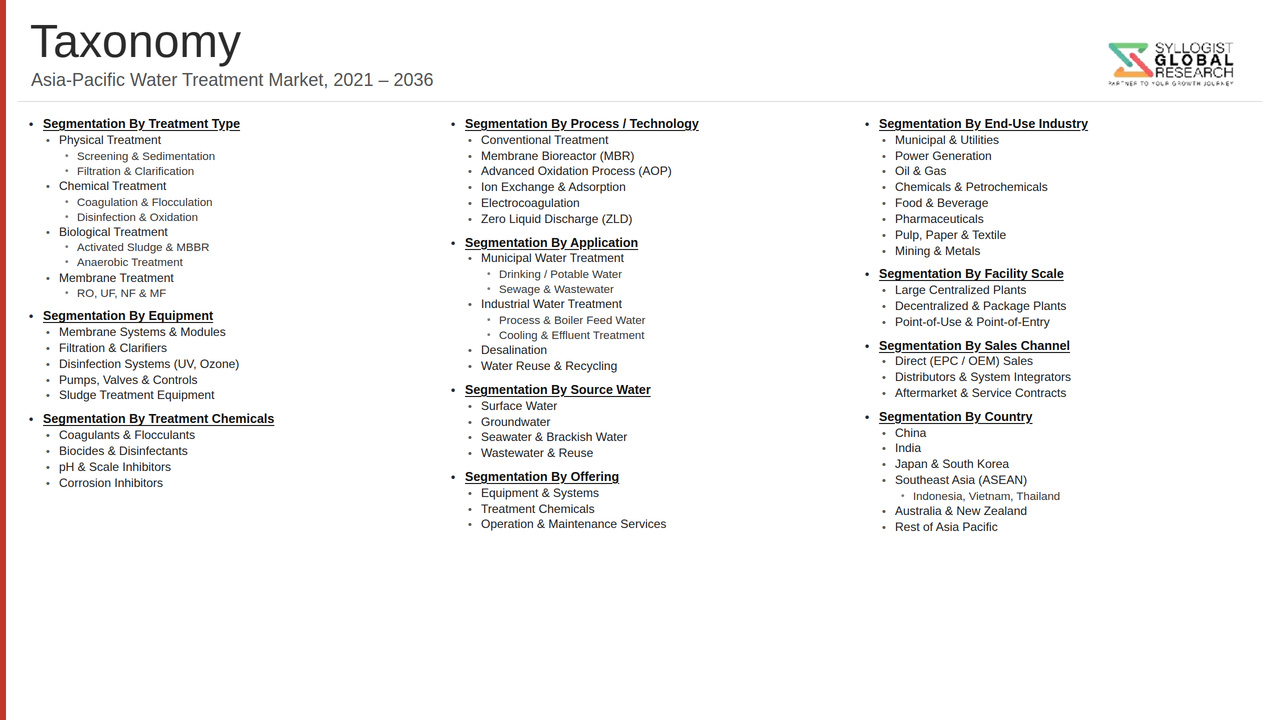
- Segmentation By Treatment Type
- Drinking Water Treatment
- Municipal Sewage Treatment
- Industrial Wastewater Treatment
- Seawater and Brackish Water Desalination
- Water Reuse and Recycling
- Point-of-Use and Decentralized Treatment
- Others
- Segmentation By Technology
- Coagulation-Flocculation and Sedimentation
- Sand and Multimedia Filtration
- Activated Sludge and Sequencing Batch Reactors (SBR)
- Moving Bed Biofilm Reactors (MBBR)
- Membrane Bioreactors (MBR)
- Reverse Osmosis (RO) and Nanofiltration
- Ultrafiltration and Microfiltration
- Electrodialysis Reversal (EDR)
- UV Disinfection
- Ozone Advanced Oxidation
- Chlorination and Chlorine Dioxide
- Biological Aerated Filters
- Ion Exchange and Adsorption
- Digital Water Platforms (SCADA, GIS, AI Analytics)
- Others
- Segmentation By Application
- Municipal Drinking Water Supply
- Municipal Sewage and Wastewater Collection
- Industrial Process Water
- Industrial Effluent Treatment
- Desalination and Brackish Water Recovery
- Water Reuse for Industrial and Non-Potable Applications
- Agriculture and Irrigation Water
- Others
- Segmentation By End User
- Municipal Water Utilities
- Electronics and Semiconductor Manufacturing
- Textiles and Apparel
- Food and Beverage
- Pharmaceuticals and Healthcare
- Petrochemicals and Refining
- Pulp and Paper
- Mining and Metals (including Nickel Processing)
- Power Generation
- Automotive and EV Battery Manufacturing
- Others
- Segmentation By Country
- Singapore
- Malaysia
- Thailand
- Indonesia
- Philippines
- Vietnam
- Cambodia
- Laos
- Myanmar
- Brunei Darussalam
All market revenues are presented in USD
Historical Year: 2021-2024 | Base Year: 2025 | Estimated Year: 2026 | Forecast Period: 2027-2034
Key Questions this Study Will Answer
- What is the total market valuation of the ASEAN Water Treatment Market in 2025, projected through 2034, disaggregated by treatment type, technology, application, end user, and country, enabling water technology suppliers, municipal utilities, industrial operators, EPC contractors, and investors to identify the highest-growth opportunities and most durable revenue corridors across the ASEAN water treatment value chain?
- How is China Plus One manufacturing migration to Vietnam, Thailand, Malaysia, Indonesia, and the Philippines, with Vietnam alone receiving over USD 38 billion of foreign direct investment between 2023 and 2025, reshaping industrial wastewater treatment procurement across Samsung Electronics, LG Display, Foxconn, Pegatron, Intel Vietnam, Nike, Adidas, and Inditex supply chain expansion through 2034?
- Which water treatment technologies including conventional coagulation-flocculation, sand and multimedia filtration, activated sludge, SBR, MBBR, MBR, RO, nanofiltration, ultrafiltration, electrodialysis reversal, UV disinfection, ozone advanced oxidation, and emerging digital water platforms are generating the highest growth rates, and how is the supply landscape evolving across Veolia Environnement, SUEZ, Xylem, Grundfos, GE Water, Pentair, Evoqua, Toray, Hyflux, Sembcorp Industries, Hitachi, Mitsubishi Chemical, and Kurita Water Industries?
- How are urban sanitation coverage gaps with ASEAN sewerage coverage averaging 38% in 2025 versus 95% in developed Asian markets, alongside multilateral development bank co-financing exceeding USD 28 billion through 2030 from ADB, World Bank, JICA, and AIIB, anchoring greenfield municipal treatment procurement across Indonesia, the Philippines, and Vietnam through 2034?
- How is Singapore PUB NEWater advancing toward 55% of national water demand by 2060, Deep Tunnel Sewerage System Phase 2 capital deployment exceeding USD 6.4 billion, and Tuas Water Reclamation Plant commissioning establishing the regional commercial template for advanced water reuse, MBR, RO, and ozone-based advanced oxidation adoption?
- How are water tariff affordability constraints, cost recovery gaps, public sector budget pressures, and non-revenue water rates averaging 28% to 42% across major utilities limiting municipal capital allocation toward treatment infrastructure upgrades across the ASEAN region through 2034?
- How is climate change pressure including sea-level rise affecting Jakarta, Manila, Bangkok, and Ho Chi Minh City, saltwater intrusion into coastal aquifers, increasing typhoon frequency, El Nino-driven drought, and the relocation of the Indonesian capital to Nusantara reshaping municipal and industrial water treatment investment priorities across coastal and island geographies?
- Product Definition
- Research Methodology
- Research Design & Framework
- Overall Research Approach: Descriptive, Exploratory & Quantitative Mixed-Method Design
- Market Definition & Scope Boundaries: What is Included and Excluded
- Segmentation Framework
- Key Research Assumptions & Limitations
- Secondary Research
- Primary Research Design & Execution
- Data Triangulation & Validation
- Market Sizing & Forecasting Methodology
- Competitive Intelligence Methodology
- Quality Assurance & Peer Review
- Definitions, Abbreviations & Data Notes
- Research Design & Framework
- Executive Summary
- Market Snapshot & Headline Numbers
- Key Findings & Research Highlights
- Market Dynamics
- Regional Market Summary
- Competitive Landscape Snapshot
- Technology & Innovation Highlights
- Market Dynamics
- Drivers
- Restraints
- Opportunities
- Challenges
- Porter’s Five Forces Analysis
- PESTLE Analysis
- Market Trends & Developments
- Emerging Trends
- Technological Developments
- Regulatory & Policy Changes
- Supply Chain & Sourcing Trends
- Manufacturing & Process Trends
- Investment & Funding Activity
- Sustainability & ESG Trends
- Risk Assessment Framework
- Water Scarcity, Demand Volatility & Resource Stress Risk
- Regulatory Compliance, Discharge Standard & Permit Risk
- Capital Intensity, Project Funding & Long Procurement-Cycle Risk
- Technology Performance, Membrane Fouling & Operational Reliability Risk
- Emerging Contaminant (PFAS & Microplastics) & Liability Risk
- Regulatory Framework & Standards
- Drinking Water Quality & Safe Water Regulatory Frameworks
- Wastewater Discharge, Effluent & Water Reuse Standards
- Equipment, Material & System Performance Standards (NSF, ISO & Equivalent)
- Emerging Contaminant Monitoring & Limit Regulations
- Green Finance, Carbon Accounting, ESG Disclosure & Sustainable Procurement Standards
- Asia-Pacific Water Treatment Market Outlook
- Market Size & Forecast by Value
- Market Size & Forecast by Volume (Installed Capacity, Million Litres per Day)
- Market Size & Forecast by Offering
- Membrane Systems (RO, UF, NF & MF)
- Filtration & Media Systems
- Disinfection Systems (UV, Ozone & Chlorination)
- Desalination Systems
- Coagulation, Flocculation & Clarification Systems
- Sludge Treatment & Dewatering Systems
- Ion Exchange, Softening & Demineralisation Systems
- Treatment Chemicals & Media
- Other Equipment, Components & Services
- Market Size & Forecast by Technology
- Reverse Osmosis (RO) & Nanofiltration Technology
- Ultrafiltration & Microfiltration Technology
- Membrane Bioreactor (MBR) Technology
- Ultraviolet (UV) Disinfection Technology
- Ozone & Advanced Oxidation Technology
- Electrodialysis & Electrochemical Technology
- Biological & Activated Sludge Treatment Technology
- Smart Water, IoT & Digital Monitoring Technology
- Other Emerging & Hybrid Treatment Technologies
- Market Size & Forecast by Process Stage
- Pre-Treatment & Screening
- Primary Treatment
- Secondary (Biological) Treatment
- Tertiary & Advanced Treatment
- Disinfection & Polishing
- Market Size & Forecast by Facility Scale
- Large-Scale Centralised Plants (Above 100 Million Litres per Day)
- Medium-Scale Plants (10 to 100 Million Litres per Day)
- Small-Scale & Decentralised Systems (Below 10 Million Litres per Day)
- Market Size & Forecast by Application
- Municipal Drinking Water Treatment
- Municipal Wastewater & Sewage Treatment
- Industrial Process Water Treatment
- Industrial Wastewater & Effluent Treatment
- Water Reuse & Recycling
- Desalination & Other Applications
- Market Size & Forecast by End-Use Industry
- Municipal Water & Wastewater Utilities
- Power & Energy Industry
- Oil, Gas & Petrochemical Industry
- Food, Beverage & Pharmaceutical Industry
- Other Industrial & Commercial End-Users
- Market Size & Forecast by Sales Channel
- Direct Sales & OEM Supply
- EPC, System Integrator & Engineering Contractor Channel
- Distributors & Authorised Resellers
- Aftermarket, Service & Subscription Channel
- China Water Treatment Market Outlook
- Market Size & Forecast
- By Value
- By Volume (Installed Capacity, Million Litres per Day)
- By Offering
- By Technology
- By Process Stage
- By Facility Scale
- By Application
- By End-Use Industry
- By Country
- By Sales Channel
- Japan Water Treatment Market Outlook
- Market Size & Forecast
- By Value
- By Volume (Installed Capacity, Million Litres per Day)
- By Offering
- By Technology
- By Process Stage
- By Facility Scale
- By Application
- By End-Use Industry
- By Country
- By Sales Channel
- India Water Treatment Market Outlook
- Market Size & Forecast
- By Value
- By Volume (Installed Capacity, Million Litres per Day)
- By Offering
- By Technology
- By Process Stage
- By Facility Scale
- By Application
- By End-Use Industry
- By Country
- By Sales Channel
- South Korea Water Treatment Market Outlook
- Market Size & Forecast
- By Value
- By Volume (Installed Capacity, Million Litres per Day)
- By Offering
- By Technology
- By Process Stage
- By Facility Scale
- By Application
- By End-Use Industry
- By Country
- By Sales Channel
- Australia Water Treatment Market Outlook
- Market Size & Forecast
- By Value
- By Volume (Installed Capacity, Million Litres per Day)
- By Offering
- By Technology
- By Process Stage
- By Facility Scale
- By Application
- By End-Use Industry
- By Country
- By Sales Channel
- Country-Wise* Water Treatment Market Outlook
- Market Size & Forecast
- By Value
- By Volume (Installed Capacity, Million Litres per Day)
- By Offering
- By Technology
- By Process Stage
- By Facility Scale
- By Application
- By End-Use Industry
- By Country
- By Sales Channel
- *Countries Analyzed in the Syllogist Asia-Pacific Research Portfolio: China, Japan, India, South Korea, Australia, Singapore, Indonesia, Thailand, Malaysia, Vietnam, Philippines, Taiwan, New Zealand
- Technology Landscape & Innovation Analysis
- Reverse Osmosis & Membrane Technology Deep-Dive
- Ultrafiltration, Microfiltration & MBR Technology
- UV, Ozone & Advanced Oxidation Disinfection Technology
- Desalination (Thermal & Membrane) Technology
- Biological & Activated Sludge Treatment Technology
- Sludge Treatment, Dewatering & Resource Recovery Technology
- Smart Water, IoT, AI & Digital Monitoring Technology
- Patent & IP Landscape in Water Treatment Technologies
- Value Chain & Supply Chain Analysis
- Membrane, Media & Equipment Component Manufacturing Supply Chain
- Pump, Valve & Mechanical Component Supply Chain
- Treatment Chemical & Reagent Supply Chain
- System Integration, Skid Assembly & Packaging Landscape
- EPC Contractor, Engineering Firm & Project Developer Procurement Landscape
- Utility, Municipality & Industrial Operator Channel
- Aftermarket, Service, Maintenance & Circular Economy
- Pricing Analysis
- Membrane-Based (RO & UF) System Capital and Operating Cost Analysis
- Conventional (Filtration & Clarification) System Cost Analysis
- Disinfection (UV & Ozone) System Cost Analysis
- Desalination System Cost and Cost-per-Cubic-Metre Analysis
- Treatment Chemical, Media & Service Contract Pricing Analysis
- Total Water Treatment Economics: Lifecycle Cost and Cost-per-Cubic-Metre Optimisation Analysis
- Sustainability & Environmental Analysis
- Lifecycle Assessment (LCA) of Water Treatment: Energy Intensity, Carbon Footprint & Chemical Use Across Technologies
- Carbon Neutrality & Net Zero Contribution: Pathway to Energy-Efficient and Renewable-Powered Water Treatment
- Circular Economy & Water Reuse: Water Recycling, Resource and Nutrient Recovery Contribution
- Environmental Compliance, Effluent Quality & Ecosystem Impact Consideration in Operations
- Regulatory-Driven Sustainability, SDG 6 (Clean Water) & SDG 12 (Responsible Consumption) Alignment & Green Finance Eligibility
- Competitive Landscape
- Market Structure & Concentration
- Market Consolidation Level (Fragmented vs. Consolidated by Offering & Geography)
- Top 10 Players Market Share
- HHI (Herfindahl-Hirschman Index) Concentration Analysis
- Competitive Intensity Map by Offering, Technology & Geography
- Player Classification
- Integrated Water Treatment Solution Companies
- Specialist Membrane & Filtration System Providers
- Disinfection (UV & Ozone) Technology Providers
- Desalination Technology & System Providers
- Treatment Chemical & Media Suppliers
- Smart Water & Digital Solution Providers
- EPC Contractors & System Integrators
- Aftermarket, Service & Managed-Service Providers
- Competitive Analysis Frameworks
- Market Share Analysis by Offering, Technology & Region
- Company Profile
- Company Overview & Headquarters
- Water Treatment Products & Technology Portfolio
- Key Customer Relationships & Reference Project Installations
- Manufacturing Footprint & Production Capacity
- Revenue (Water Treatment Segment) & Backlog
- Technology Differentiators & IP
- Key Strategic Partnerships, JVs & M&A Activity
- Recent Developments (Contract Wins, Capacity Expansion, Product Launches)
- SWOT Analysis
- Strategic Focus Areas & Roadmap
- Competitive Positioning Map (Technology Capability vs. Market Penetration)
- Key Company Profiles
- Market Structure & Concentration
- Technology Landscape & Innovation Analysis
- Strategic Output
- Market Opportunity Matrix: By Offering, Technology, Application, End-Use Industry & Geography
- White Space Opportunity Analysis
- Strategic Recommendations
- Product Portfolio & Technology Investment Strategy
- Manufacturing & Operational Excellence Strategy
- Geographic Expansion & Localisation Strategy
- Customer & End-User Engagement Strategy
- Partnership, M&A & Ecosystem Strategy
- Sustainability & Circular Economy Strategy
- Risk Mitigation & Future Roadmap
- Strategic Priority Matrix & Roadmap
- Near-term (2025-2028)
- Mid-term (2029-2032)
- Long-term (2033-2037)
- Strategic Output
- Market Size & Forecast
- Market Size & Forecast
- Market Size & Forecast
- Market Size & Forecast
- Market Size & Forecast
- Market Size & Forecast