Global Phosphorus Recovery Systems Market By Technology, By Recovery Stream, By Recovered Product, By Application, By End User, By Region, Competition, Forecast & Opportunities, 2021-2036F
Market Definition
The Global Phosphorus Recovery Systems Market covers the engineering, supply, installation, operation, and outsourced service delivery of integrated phosphorus recovery and nutrient circularity systems used to capture, concentrate, crystallize, and valorize phosphorus from municipal wastewater treatment plant side streams, biosolids, sewage sludge ash, livestock manure, dairy and food processing effluents, and emerging mining and metallurgical residual streams. The market encompasses struvite crystallization systems, calcium phosphate precipitation platforms, thermochemical sewage sludge ash recovery, wet chemical phosphorus extraction, biological enhanced phosphorus uptake, ion exchange and adsorption-based recovery, and emerging hybrid pathways combining anaerobic digestion with selective phosphorus crystallization. Recovered phosphorus is monetized as struvite (magnesium ammonium phosphate), calcium phosphate, phosphoric acid, phosphate rock substitutes, slow-release agricultural fertilizers, and specialty industrial chemicals serving food and beverage, animal feed, detergents, and battery cathode applications. The supplier landscape is concentrated among specialized phosphorus recovery technology vendors including Ostara Nutrient Recovery Technologies, NuReSys, Veolia Environnement (Phosphogreen), Multiform Harvest, Centrisys-CNP, Royal HaskoningDHV (Crystalactor), Glatt Ingenieurtechnik, EuPhoRe, ICL Group, Outotec Metso (ASH DEC), Easymining (Ash2Phos), Pyreg, and a growing ecosystem of municipal water utility partners, engineering procurement and construction firms, and circular economy joint ventures. Market dynamics are governed by tightening phosphorus discharge regulations, the inclusion of phosphate rock and white phosphorus on the European Union Critical Raw Materials list, Germany Sewage Sludge Ordinance phosphorus recovery mandates effective from 2029, Switzerland recovery mandates, rising phosphate fertilizer pricing, geopolitical phosphate rock supply concentration in Morocco, China, Russia, and the United States, and circular economy frameworks reshaping nutrient management across municipal and agricultural value chains.
Market Insights
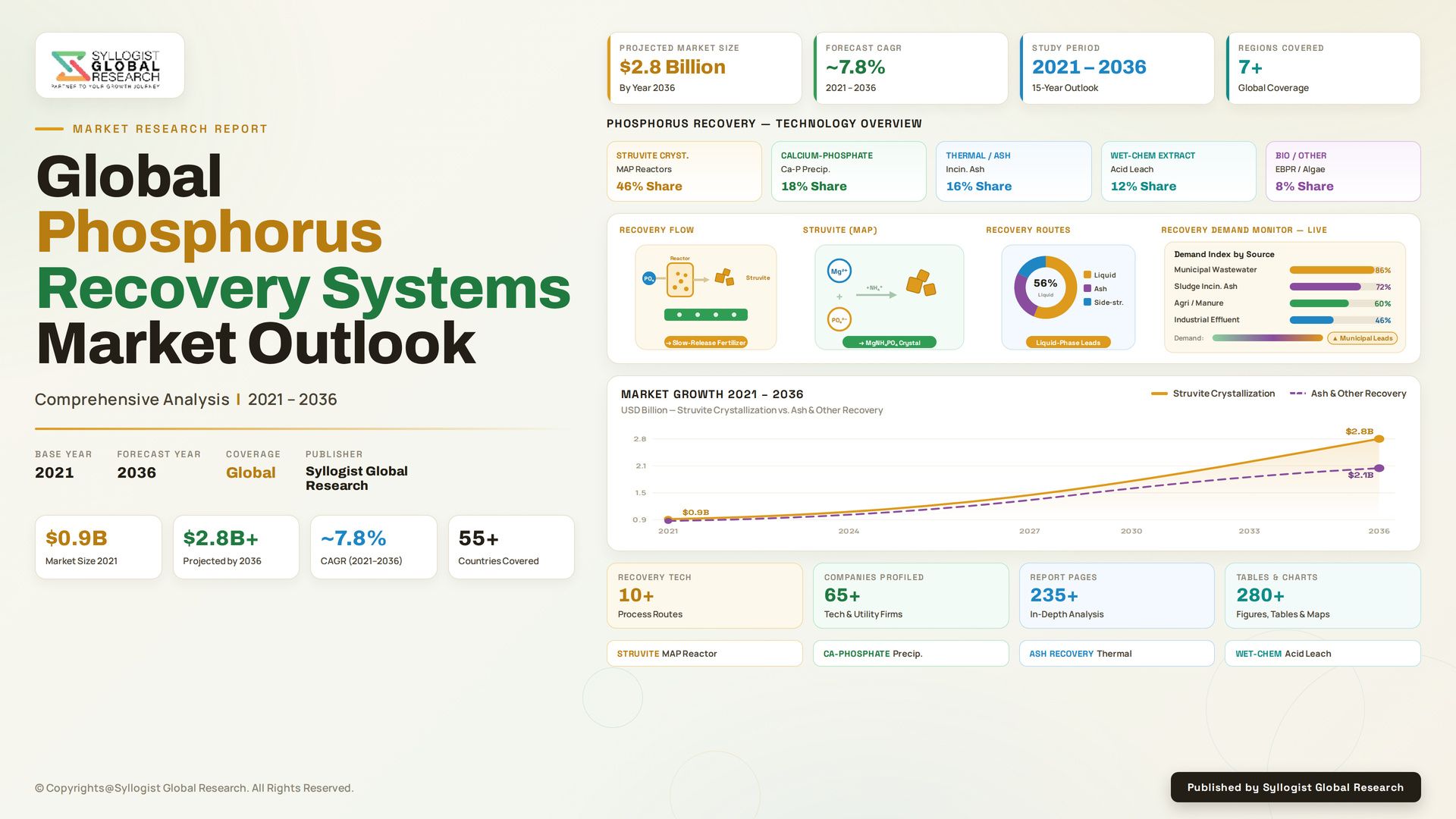
The global phosphorus recovery systems market is entering a structurally expansionary phase driven by tightening phosphorus discharge regulations, the inclusion of phosphate rock and white phosphorus on the EU Critical Raw Materials list, binding phosphorus recovery mandates under the German Sewage Sludge Ordinance and Swiss Waste Ordinance, persistent phosphate fertilizer price volatility, and the structural geopolitical concentration of phosphate rock reserves in Morocco, China, Russia, and the United States. The market was valued at USD 0.78 billion in 2025 and is projected to reach USD 2.34 billion by 2034, advancing at a compound annual growth rate of 13.0% through the forecast period, supported by greenfield phosphorus recovery system procurement across municipal wastewater plants, sewage sludge incineration ash valorization investments, and emerging livestock manure and food processing effluent recovery installations.
Municipal wastewater applications represent nearly 64% of global phosphorus recovery system revenue in 2025, driven by struvite crystallization deployments at over 230 municipal facilities worldwide that simultaneously address phosphorus discharge compliance, struvite scaling mitigation in anaerobic digesters, and revenue generation through fertilizer-grade phosphorus product sales. DC Water Blue Plains, Stickney Chicago, Stockholm Henriksdal, Slough Thames Water, Amersfoort, and Wassmannsdorf Berlin each operate flagship struvite recovery installations, anchoring the commercial template for integrated nutrient recovery. The German Sewage Sludge Ordinance, effective from 2029 for plants serving over 100,000 PE and from 2032 for plants above 50,000 PE, mandates phosphorus recovery exceeding 50% from sewage sludge or sewage sludge incineration ash, requiring infrastructure investment exceeding USD 4.8 billion across approximately 480 affected German wastewater operators.
Sewage sludge incineration ash valorization has emerged as the fastest growing recovery pathway, advancing at over 16.4% CAGR through 2034, supported by thermochemical and wet chemical extraction processes capable of recovering 75% to 92% of phosphorus from mono-incinerated sewage sludge ash. Easymining Ash2Phos, Outotec Metso ASH DEC, EuPhoRe, ICL Group, and Glatt Ingenieurtechnik are advancing commercial-scale ash recovery facilities at Schkopau, Helsingborg, Hamburg, and emerging Dutch and German sites, with Easymining commissioning the first full-scale Ash2Phos facility at Helsingborg in 2024 targeting 18,000 tonnes of phosphate product annually. Livestock manure phosphorus recovery is simultaneously gaining commercial traction across the Netherlands, Denmark, Germany, and the United States, supported by tightening manure nutrient management regulations and water quality compliance requirements across nitrate vulnerable zones.
Europe dominates the global phosphorus recovery systems market with approximately 52% revenue share in 2025, anchored by binding regulatory mandates in Germany and Switzerland, advanced municipal infrastructure across the Netherlands, Sweden, Denmark, and Belgium, and the strategic inclusion of phosphate rock on the EU Critical Raw Materials list. North America represents the second largest regional market with approximately 26% share, driven by Chesapeake Bay nutrient reduction mandates, Great Lakes nutrient management programs, struvite recovery investments at major US utilities, and EPA emerging contaminant frameworks. Asia-Pacific is the fastest growing regional market advancing at over 16.8% CAGR through 2034, supported by tightening Chinese Yangtze and Pearl River basin discharge standards, Japanese phosphorus recovery research and pilot deployments, South Korean nutrient circularity initiatives, and emerging Indian and Southeast Asian wastewater infrastructure programs incorporating phosphorus recovery requirements.
Key Drivers
German Sewage Sludge Ordinance, Swiss Recovery Mandates, and EU Critical Raw Materials Framework Driving Binding Phosphorus Recovery Investment
The German Sewage Sludge Ordinance effective from 2029 for plants serving over 100,000 PE and from 2032 for plants above 50,000 PE, mandating phosphorus recovery exceeding 50% from sewage sludge or sewage sludge incineration ash, is anchoring durable regulatory-driven equipment procurement across approximately 480 affected German wastewater operators with combined infrastructure investment exceeding USD 4.8 billion. Swiss Waste Ordinance phosphorus recovery mandates effective from 2026, alongside the EU Critical Raw Materials list inclusion of phosphate rock and white phosphorus, are reinforcing structural recovery investment across European municipal operators through 2034.
Phosphate Rock Supply Concentration, Fertilizer Price Volatility, and Geopolitical Risk Driving Circular Phosphorus Economics
Structural phosphate rock reserve concentration in Morocco holding approximately 71% of global reserves, alongside China, Russia, and the United States, combined with phosphate fertilizer price volatility of 40% to 110% across multiple cycles in 2022 and 2023, is materially reshaping the economic case for circular phosphorus recovery from wastewater and sewage sludge ash streams. Geopolitical phosphate rock supply risk, sanctions exposure following the 2022 Russian sanctions framework, and rising agricultural fertilizer security concerns are anchoring corporate, municipal, and government investment in domestic phosphorus recovery infrastructure across major markets.
Struvite Recovery and Anaerobic Digester Scaling Mitigation Driving Revenue-Positive Municipal Investment Across Major Wastewater Operators
Struvite recovery installations at over 230 municipal wastewater facilities worldwide simultaneously address phosphorus discharge compliance, mitigate struvite scaling that historically reduced anaerobic digester throughput by 12% to 28%, and generate revenue through fertilizer-grade phosphorus product sales. DC Water Blue Plains, Stickney Chicago, Stockholm Henriksdal, Slough Thames Water, Amersfoort, and Wassmannsdorf Berlin established the commercial template, with payback periods compressing toward 6 to 9 years and reinforcing capital allocation decisions across municipal operators.
Key Challenges
High Capital Intensity, Operating Cost Burdens, and Affordability Concerns Limiting Adoption Across Smaller Municipal Operators
Phosphorus recovery systems are materially capital intensive, with integrated struvite crystallization installations typically requiring USD 4 million to USD 22 million of capital deployment per facility, while sewage sludge ash thermochemical recovery facilities range from USD 38 million to USD 120 million per plant. Operating cost burdens driven by magnesium chloride reagent consumption, sodium hydroxide pH adjustment, electricity inputs, and skilled labor inflation are compressing operator budgets, while affordability concerns at smaller municipal utilities, project financing constraints, and ratepayer cost sensitivity are slowing capital allocation toward phosphorus recovery upgrades across emerging market jurisdictions through 2034.
Recovered Phosphorus Product Off-Take Market Development, Quality Certification, and Fertilizer Industry Acceptance Constraints
Recovered struvite, calcium phosphate, and phosphate product off-take markets remain structurally underdeveloped, with fertilizer industry acceptance, agronomic equivalence demonstration, slow-release nutrient release characterization, and quality certification under EU Fertilising Products Regulation and US AAPFCO frameworks introducing commercial complexity. Fertilizer distributor onboarding, farmer adoption cycles, and pricing power relative to virgin phosphate rock-derived diammonium phosphate and monoammonium phosphate fertilizers are constraining revenue realization across recovered phosphorus product portfolios, complicating project economics for both municipal operators and technology suppliers through 2034.
Technology Maturity Gaps, Sewage Sludge Ash Recovery Scaling Challenges, and Operational Complexity Constraints Limiting Deployment Pace
Sewage sludge ash thermochemical and wet chemical recovery technologies remain at relatively early commercial maturity, with only a handful of full-scale facilities operating globally including Helsingborg Ash2Phos, Schkopau EuPhoRe, and emerging Dutch and German projects. Technology maturity gaps, operator unfamiliarity, qualification cycle complexity, mono-incineration infrastructure prerequisites, and skilled engineering workforce shortages across European, North American, and Asian project deployments are constraining deployment pace, with commissioning timelines extending substantially beyond original schedules across several flagship projects.
Market Segmentation
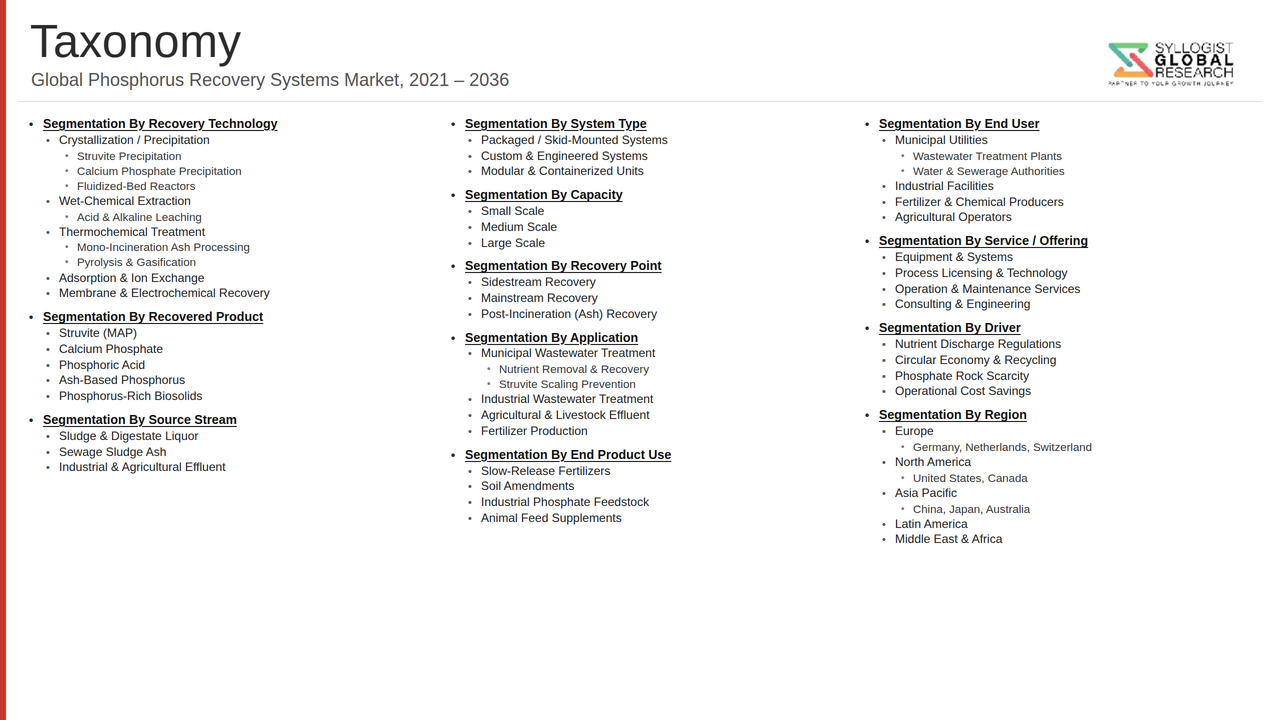
- Segmentation By Technology
- Struvite Crystallization
- Calcium Phosphate Precipitation
- Thermochemical Sewage Sludge Ash Recovery
- Wet Chemical Phosphorus Extraction
- Biological Enhanced Phosphorus Uptake
- Ion Exchange and Adsorption-Based Recovery
- Hybrid and Integrated Recovery Platforms
- Others
- Segmentation By Recovery Stream
- Municipal Wastewater Side Streams
- Sewage Sludge
- Sewage Sludge Incineration Ash
- Livestock Manure and Slurry
- Dairy and Food Processing Effluents
- Industrial Wastewater Streams
- Mining and Metallurgical Residuals
- Others
- Segmentation By Recovered Product
- Struvite (Magnesium Ammonium Phosphate)
- Calcium Phosphate
- Phosphoric Acid
- Phosphate Rock Substitutes
- Slow-Release Agricultural Fertilizer
- Specialty Industrial Phosphorus Products
- Battery Cathode Precursor Materials
- Others
- Segmentation By Application
- Phosphorus Discharge Compliance
- Struvite Scaling Mitigation
- Agricultural Fertilizer Production
- Specialty Chemicals and Food Phosphates
- Animal Feed Phosphates
- Battery Cathode Precursor Supply
- Industrial Process Phosphates
- Others
- Segmentation By End User
- Municipal Wastewater Utilities
- Industrial Wastewater Operators
- Agricultural and Livestock Operators
- Sewage Sludge Incineration Operators
- Fertilizer Manufacturers
- Food and Beverage Manufacturers
- Battery and Specialty Chemicals Producers
- Others
- Segmentation By Region
- Europe
- North America
- Asia-Pacific (China, India, Japan, South Korea, Southeast Asia, Australia)
- Middle East and Africa
- Latin America
All market revenues are presented in USD
Historical Year: 2021-2024 | Base Year: 2025 | Estimated Year: 2026 | Forecast Period: 2027-2034
Key Questions this Study Will Answer
- What is the total market valuation of the Global Phosphorus Recovery Systems Market in 2025, projected through 2034, disaggregated by technology, recovery stream, recovered product, application, and end user, enabling phosphorus recovery technology suppliers, municipal utilities, fertilizer manufacturers, and investors to identify the highest-growth opportunities and most durable revenue corridors across the phosphorus circularity value chain?
- How are the German Sewage Sludge Ordinance, Swiss Waste Ordinance phosphorus recovery mandates, and EU Critical Raw Materials list inclusion of phosphate rock and white phosphorus driving binding phosphorus recovery investment across approximately 480 affected German operators and parallel European jurisdictions through 2034?
- Which phosphorus recovery technologies including struvite crystallization, calcium phosphate precipitation, thermochemical sewage sludge ash recovery, wet chemical extraction, biological enhanced phosphorus uptake, and ion exchange platforms are generating the highest growth rates, and how is the supply landscape evolving across Ostara Nutrient Recovery Technologies, NuReSys, Veolia Phosphogreen, Multiform Harvest, Centrisys-CNP, Royal HaskoningDHV Crystalactor, Glatt Ingenieurtechnik, EuPhoRe, Outotec Metso ASH DEC, and Easymining Ash2Phos?
- How is sewage sludge incineration ash valorization at Helsingborg Ash2Phos, Schkopau EuPhoRe, and emerging Dutch and German projects reshaping phosphorus recovery economics, and what scaling potential exists across mono-incineration infrastructure investments through 2034?
- How are phosphate rock supply concentration in Morocco, China, Russia, and the United States, fertilizer price volatility, and geopolitical supply risk reshaping the economic case for circular phosphorus recovery across major agricultural and industrial markets?
- How are recovered struvite, calcium phosphate, and phosphate product off-take markets developing under EU Fertilising Products Regulation and US AAPFCO certification frameworks, and what fertilizer industry acceptance, agronomic equivalence, and farmer adoption dynamics are reshaping revenue realization across recovered phosphorus portfolios?
- How is the competitive landscape structured among specialized phosphorus recovery technology suppliers Ostara, NuReSys, Veolia Phosphogreen, Multiform Harvest, Centrisys-CNP, Royal HaskoningDHV, Glatt Ingenieurtechnik, EuPhoRe, Outotec Metso, Easymining, ICL Group, and Pyreg, and what partnership, capacity expansion, and joint venture strategies are reshaping market share dynamics through 2034?
- Product Definition
- Research Methodology
- Research Design & Framework
- Overall Research Approach: Descriptive, Exploratory & Quantitative Mixed-Method Design
- Market Definition & Scope Boundaries: What is Included and Excluded
- Segmentation Framework
- Key Research Assumptions & Limitations
- Secondary Research
- Primary Research Design & Execution
- Data Triangulation & Validation
- Market Sizing & Forecasting Methodology
- Competitive Intelligence Methodology
- Quality Assurance & Peer Review
- Definitions, Abbreviations & Data Notes
- Research Design & Framework
- Executive Summary
- Market Snapshot & Headline Numbers
- Key Findings & Research Highlights
- Market Dynamics
- Regional Market Summary
- Competitive Landscape Snapshot
- Technology & Innovation Highlights
- Market Dynamics
- Drivers
- Restraints
- Opportunities
- Challenges
- Porter’s Five Forces Analysis
- PESTLE Analysis
- Market Trends & Developments
- Emerging Trends
- Technological Developments
- Regulatory & Policy Changes
- Supply Chain & Sourcing Trends
- Manufacturing & Process Trends
- Investment & Funding Activity
- Sustainability & ESG Trends
- Risk Assessment Framework
- Recovered Phosphorus Price Competitiveness vs. Mined Phosphate Rock Risk
- Recovered Product Quality, Contaminant & Fertiliser Registration Risk
- Regulatory Mandate Dependence & Policy Continuity Risk
- Technology Scale-Up, Recovery Yield & Process Integration Risk
- Financing, Project Development & Stranded Asset Risk
- Regulatory Framework & Standards
- Phosphorus Recovery Mandates, Nutrient Recycling & Circular Economy Policy Frameworks
- Recovered Fertiliser Registration, End-of-Waste & Product Quality Standards
- Wastewater Discharge, Nutrient Limit & Effluent Quality Regulations
- Contaminant, Heavy Metal & Emerging Pollutant Limit Standards for Recovered Products
- Green Finance, Carbon Accounting, ESG Disclosure & Sustainable Procurement Standards
- Global Phosphorus Recovery Systems Market Outlook
- Market Size & Forecast by Value
- Market Size & Forecast by Volume (Phosphorus Recovered, Kilo Tonnes P)
- Market Size & Forecast by Recovery Route
- Struvite Precipitation & Crystallisation
- Calcium Phosphate Precipitation
- Chemical Extraction & Acid Leaching
- Wet Chemical Recovery from Sludge
- Thermochemical & Ash-Based Recovery
- Ion Exchange & Adsorption Recovery
- Biological & Enhanced Biological Phosphorus Recovery
- Electrochemical & Membrane-Based Recovery
- Other Emerging Recovery Routes
- Market Size & Forecast by Technology
- Fluidised Bed Struvite Reactor Technology
- Stirred Tank & Crystalliser Reactor Technology
- Acid & Alkaline Leaching Process Technology
- Sewage Sludge Ash (SSA) Thermochemical Technology
- Ion Exchange & Adsorbent Media Technology
- Membrane & Electrodialysis Recovery Technology
- Mono-Incineration & Ash Pre-Treatment Technology
- Crystallisation Control, Dosing & Monitoring Technology
- Other Emerging & Hybrid Recovery Technologies
- Market Size & Forecast by Recovered Product
- Struvite (Magnesium Ammonium Phosphate)
- Calcium Phosphate & Hydroxyapatite
- Phosphoric Acid & Phosphate Salts
- Recovered Phosphate Fertiliser & Soil Amendment
- Other Recovered Phosphorus Products
- Market Size & Forecast by Project Scale
- Large-Scale Centralised Recovery Facilities (Above 1,000 Tonnes P per Annum)
- Medium-Scale Recovery Facilities (100 to 1,000 Tonnes P per Annum)
- Small-Scale & Decentralised Recovery Units (Below 100 Tonnes P per Annum)
- Market Size & Forecast by Source Stream & Application
- Municipal Wastewater & Sewage Sludge
- Sewage Sludge Ash & Incineration Residues
- Industrial Process Wastewater
- Food, Beverage & Agro-Processing Effluent
- Animal Manure & Agricultural Waste
- Other Phosphorus-Rich Waste Streams
- Market Size & Forecast by End-User
- Municipal Wastewater Utilities
- Fertiliser & Agricultural Input Producers
- Industrial & Manufacturing Facilities
- Waste Management & Resource Recovery Contractors
- Government Agencies & Other End-Users
- Market Size & Forecast by Sales Channel
- EPC & Turnkey Project Contract (Engineering, Procurement & Construction)
- Direct Equipment & Technology Supply with System Integration
- Operations, Maintenance & Recovered-Product Offtake Contract
- Public-Private Partnership (PPP) & Concession Contract
- North America Phosphorus Recovery Systems Market Outlook
- Market Size & Forecast
- By Value
- By Volume (Phosphorus Recovered, Kilo Tonnes P)
- By Recovery Route
- By Technology
- By Recovered Product
- By Project Scale
- By Source Stream & Application
- By End-User
- By Country
- By Sales Channel
- Europe Phosphorus Recovery Systems Market Outlook
- Market Size & Forecast
- By Value
- By Volume (Phosphorus Recovered, Kilo Tonnes P)
- By Recovery Route
- By Technology
- By Recovered Product
- By Project Scale
- By Source Stream & Application
- By End-User
- By Country
- By Sales Channel
- Asia-Pacific Phosphorus Recovery Systems Market Outlook
- Market Size & Forecast
- By Value
- By Volume (Phosphorus Recovered, Kilo Tonnes P)
- By Recovery Route
- By Technology
- By Recovered Product
- By Project Scale
- By Source Stream & Application
- By End-User
- By Country
- By Sales Channel
- Latin America Phosphorus Recovery Systems Market Outlook
- Market Size & Forecast
- By Value
- By Volume (Phosphorus Recovered, Kilo Tonnes P)
- By Recovery Route
- By Technology
- By Recovered Product
- By Project Scale
- By Source Stream & Application
- By End-User
- By Country
- By Sales Channel
- Middle East & Africa Phosphorus Recovery Systems Market Outlook
- Market Size & Forecast
- By Value
- By Volume (Phosphorus Recovered, Kilo Tonnes P)
- By Recovery Route
- By Technology
- By Recovered Product
- By Project Scale
- By Source Stream & Application
- By End-User
- By Country
- By Sales Channel
- Country-Wise* Phosphorus Recovery Systems Market Outlook
- Market Size & Forecast
- By Value
- By Volume (Phosphorus Recovered, Kilo Tonnes P)
- By Recovery Route
- By Technology
- By Recovered Product
- By Project Scale
- By Source Stream & Application
- By End-User
- By Country
- By Sales Channel
- *Countries Analyzed in the Syllogist Global Research Portfolio: United States, Canada, Mexico, Germany, France, United Kingdom, Netherlands, Spain, Italy, Norway, Sweden, China, Japan, India, Australia, South Korea, Singapore, Brazil, Chile, Saudi Arabia, UAE, Egypt, South Africa, Israel
- Technology Landscape & Innovation Analysis
- Struvite Precipitation & Crystallisation Technology Deep-Dive
- Calcium Phosphate & Chemical Precipitation Technology
- Acid & Alkaline Leaching Recovery Technology
- Sewage Sludge Ash (SSA) Thermochemical Recovery Technology
- Ion Exchange, Adsorption & Membrane Recovery Technology
- Crystallisation Control, Dosing & Process Optimisation Technology
- Recovered Product Refining, Granulation & Fertiliser Formulation Technology
- Patent & IP Landscape in Phosphorus Recovery Technologies
- Value Chain & Supply Chain Analysis
- Reactor, Crystalliser & Recovery Equipment Manufacturing Supply Chain
- Chemical, Reagent & Magnesium Source Supply Chain
- Ash Handling, Pre-Treatment & Thermochemical Equipment Supply Chain
- EPC Contractor, Project Developer & System Integrator Procurement Landscape
- Utility, Municipality & Industrial Operator Channel
- Fertiliser Producer, Distributor & Recovered-Product Offtake Channel
- Nutrient Valorisation, Resource Recovery & Circular Economy
- Pricing Analysis
- Struvite Precipitation System Capital and Operating Cost Analysis
- Chemical Precipitation & Leaching System Cost Analysis
- Sewage Sludge Ash Thermochemical Recovery Cost Analysis
- Recovered Phosphorus Product Pricing & Price Parity vs. Phosphate Rock Analysis
- Phosphorus Recovery Project Finance, PPP Tariff & Offtake Revenue Structure Analysis
- Total Phosphorus Recovery Economics: Cost-per-Tonne-P and Recovery-Yield Optimisation Analysis
- Sustainability & Environmental Analysis
- Lifecycle Assessment (LCA) of Phosphorus Recovery: Carbon Footprint, Energy Intensity & Resource Savings vs. Mined Phosphate
- Phosphorus Security & Net Zero Contribution: Pathway to Circular and Domestic Nutrient Supply
- Circular Economy & Resource Recovery: Nutrient Recycling and Waste Valorisation Contribution
- Environmental Compliance, Eutrophication Reduction & Contaminant Consideration in Recovered Products
- Regulatory-Driven Sustainability, SDG 2 (Zero Hunger) & SDG 12 (Responsible Consumption) Alignment & Green Finance Eligibility
- Competitive Landscape
- Market Structure & Concentration
- Market Consolidation Level (Fragmented vs. Consolidated by Recovery Route & Geography)
- Top 10 Players Market Share
- HHI (Herfindahl-Hirschman Index) Concentration Analysis
- Competitive Intensity Map by Recovery Route, Technology & Geography
- Player Classification
- Integrated Water & Nutrient Recovery Technology Companies
- Specialist Struvite & Crystallisation Technology Providers
- Chemical Precipitation & Leaching Technology Providers
- Sewage Sludge Ash & Thermochemical Recovery Technology Players
- Ion Exchange, Adsorption & Membrane Technology Providers
- Recovered Fertiliser & Agricultural Input Producers
- EPC Contractors & Project Developers Specialising in Nutrient Recovery
- Resource Recovery & Recovered-Product Offtake Service Providers
- Competitive Analysis Frameworks
- Market Share Analysis by Recovery Route, Technology & Region
- Company Profile
- Company Overview & Headquarters
- Phosphorus Recovery Products & Technology Portfolio
- Key Customer Relationships & Reference Project Installations
- Manufacturing Footprint & Production Capacity
- Revenue (Phosphorus Recovery Segment) & Backlog
- Technology Differentiators & IP
- Key Strategic Partnerships, JVs & M&A Activity
- Recent Developments (Contract Wins, Capacity Expansion, Product Launches)
- SWOT Analysis
- Strategic Focus Areas & Roadmap
- Competitive Positioning Map (Technology Capability vs. Market Penetration)
- Key Company Profiles
- Market Structure & Concentration
- Technology Landscape & Innovation Analysis
- Strategic Output
- Market Opportunity Matrix: By Recovery Route, Technology, Source Stream, End-User & Geography
- White Space Opportunity Analysis
- Strategic Recommendations
- Product Portfolio & Technology Investment Strategy
- Manufacturing & Operational Excellence Strategy
- Geographic Expansion & Localisation Strategy
- Customer & End-User Engagement Strategy
- Partnership, M&A & Ecosystem Strategy
- Sustainability & Circular Economy Strategy
- Risk Mitigation & Future Roadmap
- Strategic Priority Matrix & Roadmap
- Near-term (2025-2028)
- Mid-term (2029-2032)
- Long-term (2033-2037)
- Strategic Output
- Market Size & Forecast
- Market Size & Forecast
- Market Size & Forecast
- Market Size & Forecast
- Market Size & Forecast
- Market Size & Forecast