Global Ozone Water Treatment Systems Market By System Type, By Generation Technology, By Capacity, By Application, By End User, By Region, Competition, Forecast & Opportunities, 2021-2036F
Market Definition
The Global Ozone Water Treatment Systems Market covers the design, manufacture, supply, installation, integration, and aftermarket service of advanced oxidation systems that generate, dose, and apply ozone gas as a powerful disinfectant and oxidant in water and wastewater treatment processes worldwide. The market encompasses ozone generators based on corona discharge, ultraviolet, electrolytic, and emerging plasma technologies, alongside oxygen and air feed-gas preparation systems, ozone destruct units, contactor vessels, monitoring and control instrumentation, and integrated turnkey skid-mounted systems used across municipal drinking water plants, wastewater treatment facilities, industrial process water operations, swimming pools and aquatics, food and beverage processing, pharmaceuticals, semiconductors, aquaculture, cooling towers, bottled water plants, and emerging point-of-use applications. Ozone water treatment systems are deployed for primary and residual disinfection, taste and odor control, color removal, micropollutant and pharmaceutical compound destruction, manganese and iron oxidation, biofilm control, advanced oxidation processes (AOPs) combining ozone with hydrogen peroxide or UV, and PFAS pre-oxidation pathways. The supplier landscape is concentrated among specialized ozone equipment vendors including Suez Water Technologies (Ozonia), Xylem (Wedeco), Mitsubishi Electric, Toshiba, MKS Atomic, Primozone, BWT, Pinnacle Ozone Solutions, Lenntech, ProMinent, Spartan Environmental Technologies, Newland EnTech, Ebara, and regional engineering, procurement, and construction contractors. Market dynamics are governed by tightening drinking water disinfection by-product regulations, emerging contaminants of concern including PFAS, pharmaceuticals, personal care products, and endocrine disruptors, wastewater reuse mandates, semiconductor ultrapure water demand, food safety standards, and the rising adoption of ozone as a sustainable, chemical-free disinfection technology displacing chlorine, chloramine, and chlorine dioxide across selected end-use applications.
Market Insights
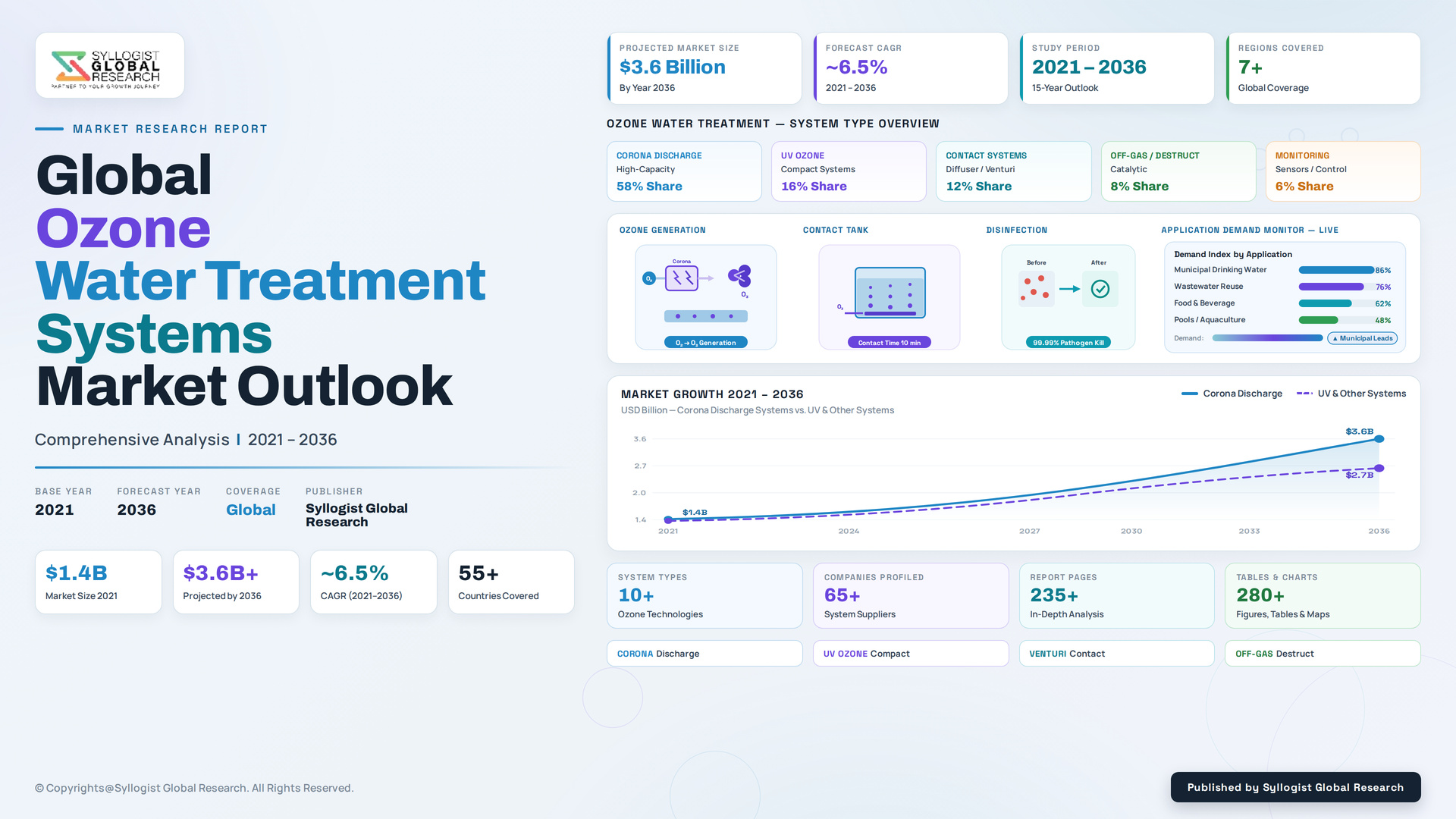
The global ozone water treatment systems market is entering a sustained expansion phase driven by tightening disinfection by-product regulations, accelerating regulatory focus on emerging contaminants including PFAS, pharmaceuticals, and endocrine disruptors, the structural ramp of semiconductor ultrapure water demand, and the broader shift toward chemical-free, sustainable disinfection across municipal, industrial, and recreational applications. The market was valued at USD 1.92 billion in 2025 and is projected to reach USD 4.36 billion by 2034, advancing at a compound annual growth rate of 9.5% through the forecast period, supported by greenfield ozone system procurement across municipal drinking water and wastewater facilities, capacity additions in semiconductor and pharmaceutical ultrapure water applications, and rising adoption of advanced oxidation processes combining ozone with hydrogen peroxide or UV across micropollutant abatement programs.
Municipal drinking water and wastewater applications collectively represent nearly 58% of global ozone water treatment system revenue in 2025, anchored by primary disinfection, taste and odor control, color removal, manganese and iron oxidation, and emerging micropollutant abatement programs across utilities in Europe, North America, and developed Asia-Pacific. Switzerland mandated nationwide micropollutant removal from municipal wastewater under the 2014 Water Protection Act revision, requiring upgrades at over 120 wastewater plants serving 50% of national connected population by 2040, with ozone-based advanced oxidation emerging as the dominant compliance technology alongside powdered activated carbon. Germany, the Netherlands, France, and the United Kingdom are advancing parallel micropollutant programs, while California and Arizona water reuse initiatives at Orange County Water District, Los Angeles Sanitation, Pure Water San Diego, and Scottsdale Water Campus are anchoring durable ozone procurement across potable water reuse facilities.
Semiconductor ultrapure water applications have emerged as the highest growth segment, advancing at over 13.4% CAGR through 2034, supported by the global ramp of leading-edge fab capacity at TSMC, Samsung, Intel, SK hynix, Micron, GlobalFoundries, and SMIC, where ozone-based dissolved organic carbon reduction is essential to achieving sub-1 ppb total organic carbon specifications. Each new leading-edge 300 mm fab requires ozone water treatment capacity capable of supporting 30,000 to 80,000 cubic meters per day of ultrapure water production, with ozone procurement at TSMC Arizona, Samsung Taylor, Intel Ohio, Micron Boise and Syracuse, TSMC Kumamoto, and Chinese self-sufficiency fab projects collectively generating substantial incremental demand. Pharmaceutical, food and beverage, aquaculture, swimming pool, and cooling tower applications collectively contribute the balance of demand, with each segment advancing at 7% to 11% CAGR.
Europe represents the largest regional market with approximately 34% revenue share in 2025, anchored by Switzerland, Germany, the Netherlands, France, and the United Kingdom, where stringent disinfection by-product regulations, micropollutant abatement mandates, and the EU Urban Wastewater Treatment Directive recast imposing energy neutrality and quaternary treatment obligations are driving structural ozone procurement. North America represents the second largest regional market with nearly 30% share, driven by EPA disinfection by-product regulations, water reuse expansion, and PFAS-driven advanced oxidation investment at major utilities. Asia-Pacific is the fastest growing regional market advancing at over 11.8% CAGR through 2034, supported by China 14th Five-Year Plan urban wastewater infrastructure scaling, Singapore PUB NEWater expansion, Japanese and South Korean semiconductor ultrapure water demand, and Indian wastewater infrastructure investment under Namami Gange, AMRUT 2.0, and the Jal Jeevan Mission programs.
Key Drivers
Tightening Micropollutant, PFAS, and Disinfection By-Product Regulations Driving Advanced Oxidation Investment Across Municipal Operators
Tightening micropollutant abatement mandates including the Switzerland 2014 Water Protection Act revision requiring upgrades at over 120 wastewater plants by 2040, the EU Urban Wastewater Treatment Directive recast imposing quaternary treatment, and US EPA disinfection by-product regulations are anchoring durable ozone water treatment system procurement. PFAS pre-oxidation, pharmaceutical compound destruction, and endocrine disruptor abatement programs across Germany, the Netherlands, France, the UK, California, Arizona, and emerging Asian markets are reinforcing structural ozone demand through 2034, with regulatory-driven capex projected to exceed USD 14 billion across municipal operators.
Semiconductor Ultrapure Water Demand Across Leading-Edge Fabs Driving High-Capacity Ozone System Procurement
Leading-edge semiconductor fab capacity additions at TSMC, Samsung, Intel, SK hynix, Micron, GlobalFoundries, and SMIC are anchoring durable high-capacity ozone procurement, with each new 300 mm fab requiring ozone water treatment capacity supporting 30,000 to 80,000 cubic meters per day of ultrapure water output. CHIPS Act, European Chips Act, and Asian self-sufficiency fab investments at TSMC Arizona, Samsung Taylor, Intel Ohio, Micron Boise and Syracuse, TSMC Kumamoto, and Chinese facilities are collectively committing capital exceeding USD 240 billion through 2030, generating substantial incremental ozone equipment demand.
Water Reuse Expansion, Direct Potable Reuse, and Indirect Potable Reuse Driving Sustainable Disinfection Adoption
Accelerating water reuse expansion including direct potable reuse and indirect potable reuse programs at Orange County Water District, Los Angeles Sanitation, Pure Water San Diego, Scottsdale Water Campus, Singapore PUB NEWater, and Windhoek Goreangab is anchoring durable ozone procurement across potable reuse facilities. Ozone-based advanced oxidation combined with biological activated carbon, UV, and membrane filtration is the established treatment template, with global potable reuse capacity projected to advance at 14% CAGR through 2034 across drought-stressed regions.
Key Challenges
High Capital and Operating Costs, Energy Intensity, and Ozone Generation Complexity Constraining Adoption Across Smaller Operators
Ozone water treatment systems are materially capital intensive, with integrated drinking water and wastewater ozone installations typically requiring USD 8 million to USD 65 million of capital deployment per facility, alongside electricity consumption ranging from 10 to 22 kWh per kilogram of ozone produced. Operating cost escalation driven by electricity price volatility, oxygen feedstock supply chain dynamics, and skilled labor inflation is compressing operator budgets, while affordability concerns at smaller utilities, project financing constraints, and competing infrastructure priorities are slowing capital allocation toward ozone upgrades across multiple jurisdictions through 2034.
Bromate Formation, Disinfection By-Product Risks, and Operational Complexity Limiting Ozone Adoption Across Bromide-Rich Source Waters
Ozone disinfection of bromide-containing source waters produces bromate as a regulated disinfection by-product, with US EPA maximum contaminant level of 10 micrograms per liter and EU drinking water directive limit similarly stringent, creating compliance complexity at utilities sourcing from coastal aquifers, estuarine intakes, and bromide-impacted surface waters. Operational complexity around ozone dose optimization, contact time management, and bromate mitigation strategies including pH suppression, ammonia addition, and hydrogen peroxide co-dosing is constraining adoption at smaller utilities lacking specialized process engineering capability.
Competition from UV, Chlorine Dioxide, and Advanced Membrane Technologies Pressuring Ozone Market Share Across Selected Applications
Competing disinfection and oxidation technologies including UV disinfection, chlorine dioxide, peracetic acid, and advanced membrane filtration platforms are pressuring ozone market share across selected municipal, industrial, and recreational applications. UV LED disinfection adoption is advancing at over 18% CAGR, displacing ozone in selected swimming pool, bottled water, and food and beverage applications, while reverse osmosis and nanofiltration are increasingly preferred for PFAS removal where regulatory targets demand near-complete elimination rather than oxidation transformation, reshaping technology selection across multiple end-use categories.
Market Segmentation
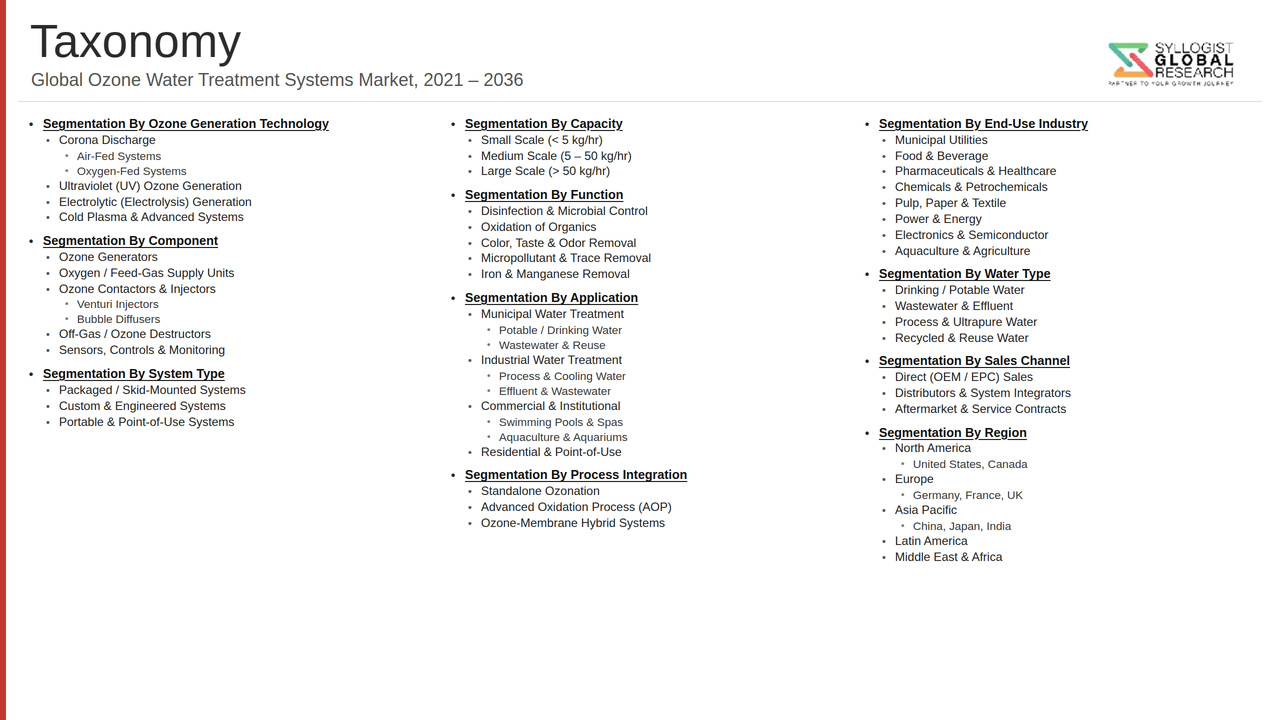
- Segmentation By System Type
- Ozone Generators (Stand-Alone)
- Integrated Turnkey Skid-Mounted Systems
- Advanced Oxidation Process (AOP) Systems
- Point-of-Use and Point-of-Entry Systems
- Mobile and Containerized Ozone Systems
- Others
- Segmentation By Generation Technology
- Corona Discharge
- Ultraviolet (UV) Ozone Generation
- Electrolytic Ozone Generation
- Plasma and Cold Plasma Technologies
- Others
- Segmentation By Capacity
- Small Scale (Below 100 g/h)
- Medium Scale (100 g/h to 5 kg/h)
- Large Scale (Above 5 kg/h)
- Mega Scale (Above 50 kg/h)
- Others
- Segmentation By Application
- Primary and Residual Disinfection
- Taste, Odor, and Color Removal
- Micropollutant and Pharmaceutical Compound Abatement
- PFAS Pre-Oxidation
- Iron and Manganese Oxidation
- Biofilm and Algae Control
- Ultrapure Water TOC Reduction
- Cooling Tower Disinfection
- Aquaculture and Recirculating Aquaculture Systems (RAS)
- Others
- Segmentation By End User
- Municipal Drinking Water Utilities
- Municipal Wastewater Utilities
- Semiconductor Manufacturing
- Pharmaceuticals and Biotechnology
- Food and Beverage
- Bottled Water and Beverages
- Aquaculture and Fisheries
- Swimming Pools and Aquatics
- Industrial Process Water and Cooling Towers
- Others
- Segmentation By Region
- Europe
- North America
- Asia-Pacific (China, India, Japan, South Korea, Singapore, Southeast Asia)
- Middle East and Africa
- Latin America
All market revenues are presented in USD
Historical Year: 2021-2024 | Base Year: 2025 | Estimated Year: 2026 | Forecast Period: 2027-2034
Key Questions this Study Will Answer
- What is the total market valuation of the Global Ozone Water Treatment Systems Market in 2025, projected through 2034, disaggregated by system type, generation technology, capacity, application, and end user, enabling ozone equipment suppliers, municipal utilities, semiconductor fab operators, industrial process water operators, and investors to identify the highest-growth opportunities and most durable revenue corridors across the ozone water treatment value chain?
- How are tightening micropollutant abatement mandates including the Switzerland 2014 Water Protection Act revision, the EU Urban Wastewater Treatment Directive recast, and US EPA disinfection by-product regulations reshaping ozone procurement across municipal drinking water and wastewater operators through 2034?
- Which ozone generation technologies including corona discharge, ultraviolet, electrolytic, and emerging plasma platforms are generating the highest growth rates, and how is the supply landscape evolving across Suez Water Technologies (Ozonia), Xylem (Wedeco), Mitsubishi Electric, Toshiba, Primozone, BWT, Pinnacle Ozone Solutions, ProMinent, Spartan Environmental Technologies, Newland EnTech, and Ebara?
- How is leading-edge semiconductor fab capacity expansion at TSMC, Samsung, Intel, SK hynix, Micron, GlobalFoundries, and SMIC driving high-capacity ozone procurement, and what ultrapure water TOC reduction specifications are reshaping equipment design and capacity requirements across CHIPS Act, European Chips Act, and Asian self-sufficiency fab projects?
- How is water reuse expansion including direct potable reuse and indirect potable reuse at Orange County Water District, Los Angeles Sanitation, Pure Water San Diego, Scottsdale Water Campus, Singapore PUB NEWater, and Windhoek Goreangab anchoring durable ozone procurement across potable reuse facilities through 2034?
- How are bromate formation, disinfection by-product compliance risks, and operational complexity around ozone dose optimization, contact time management, and pH suppression constraining ozone adoption at utilities sourcing from coastal aquifers, estuarine intakes, and bromide-impacted surface waters?
- How are competing disinfection and oxidation technologies including UV disinfection, UV LED platforms, chlorine dioxide, peracetic acid, and advanced membrane filtration pressuring ozone market share across selected municipal, industrial, and recreational applications, and what technology positioning strategies are leading ozone suppliers pursuing through 2034?
- Product Definition
- Research Methodology
- Research Design & Framework
- Overall Research Approach: Descriptive, Exploratory & Quantitative Mixed-Method Design
- Market Definition & Scope Boundaries: What is Included and Excluded
- Segmentation Framework
- Key Research Assumptions & Limitations
- Secondary Research
- Primary Research Design & Execution
- Data Triangulation & Validation
- Market Sizing & Forecasting Methodology
- Competitive Intelligence Methodology
- Quality Assurance & Peer Review
- Definitions, Abbreviations & Data Notes
- Research Design & Framework
- Executive Summary
- Market Snapshot & Headline Numbers
- Key Findings & Research Highlights
- Market Dynamics
- Regional Market Summary
- Competitive Landscape Snapshot
- Technology & Innovation Highlights
- Market Dynamics
- Drivers
- Restraints
- Opportunities
- Challenges
- Porter’s Five Forces Analysis
- PESTLE Analysis
- Market Trends & Developments
- Emerging Trends
- Technological Developments
- Regulatory & Policy Changes
- Supply Chain & Sourcing Trends
- Manufacturing & Process Trends
- Investment & Funding Activity
- Sustainability & ESG Trends
- Risk Assessment Framework
- Bromate & Disinfection By-Product Formation & Compliance Risk
- Energy Cost, Power Consumption & Operating Cost Volatility Risk
- Technology Substitution (UV, Chlorine & Membrane) & Competitive Displacement Risk
- Equipment Reliability, Ozone Leakage & Operational Safety Risk
- Project Financing, Long Sales-Cycle & Capital Intensity Risk
- Regulatory Framework & Standards
- Drinking Water, Disinfection & Bromate Limit Regulatory Frameworks
- Wastewater Discharge, Reuse & Effluent Quality Standards
- Ozone Generation, Off-Gas Destruction & Worker Safety Standards
- Equipment Certification, Material & System Performance Standards (NSF, CE & Equivalent)
- Green Finance, Carbon Accounting, ESG Disclosure & Sustainable Procurement Standards
- Global Ozone Water Treatment Systems Market Outlook
- Market Size & Forecast by Value
- Market Size & Forecast by Volume (Units & Installed Capacity)
- Market Size & Forecast by Component
- Ozone Generators
- Gas Feed & Oxygen Concentration Systems
- Ozone Contactors & Injection Systems
- Off-Gas Destruction Units
- Power Supply & Control Systems
- Monitoring, Sensors & Instrumentation
- Piping, Fittings & Ancillary Components
- Complete Packaged & Skid-Mounted Systems
- Other Components & Spare Parts
- Market Size & Forecast by Generation Technology
- Corona Discharge Ozone Generation Technology
- Cold Plasma Ozone Generation Technology
- Ultraviolet (UV) Ozone Generation Technology
- Electrolytic Ozone Generation Technology
- Air-Fed Ozone Generation Systems
- Oxygen-Fed Ozone Generation Systems
- Low-Frequency & Medium-Frequency Generation Technology
- High-Concentration & High-Output Generation Technology
- Other Emerging & Hybrid Generation Technologies
- Market Size & Forecast by Treatment Stage & Function
- Pre-Oxidation & Pre-Treatment
- Primary Disinfection
- Taste, Odour & Color Control
- Micropollutant & Trace Contaminant Removal
- Advanced Oxidation Process (AOP) Integration
- Market Size & Forecast by System Capacity
- Large-Capacity Systems (Above 50 kg per hour Ozone Output)
- Medium-Capacity Systems (5 to 50 kg per hour Ozone Output)
- Small-Capacity & Compact Systems (Below 5 kg per hour Ozone Output)
- Market Size & Forecast by Application
- Municipal Drinking Water Treatment
- Municipal Wastewater & Water Reuse
- Industrial Process & Cooling Water Treatment
- Food, Beverage & Bottled Water Treatment
- Pharmaceutical, Ultrapure & Laboratory Water
- Pools, Aquaculture & Other Applications
- Market Size & Forecast by End-User
- Municipal Water & Wastewater Utilities
- Industrial & Manufacturing Facilities
- Food, Beverage & Pharmaceutical Companies
- Commercial, Institutional & Recreational Operators
- Aquaculture, Agriculture & Other End-Users
- Market Size & Forecast by Sales Channel
- Direct Sales & OEM Supply
- EPC, System Integrator & Engineering Contractor Channel
- Distributors & Authorised Resellers
- Aftermarket, Spare Parts & Service Contract
- North America Ozone Water Treatment Systems Market Outlook
- Market Size & Forecast
- By Value
- By Volume (Units & Installed Capacity)
- By Component
- By Generation Technology
- By Treatment Stage & Function
- By System Capacity
- By Application
- By End-User
- By Country
- By Sales Channel
- Europe Ozone Water Treatment Systems Market Outlook
- Market Size & Forecast
- By Value
- By Volume (Units & Installed Capacity)
- By Component
- By Generation Technology
- By Treatment Stage & Function
- By System Capacity
- By Application
- By End-User
- By Country
- By Sales Channel
- Asia-Pacific Ozone Water Treatment Systems Market Outlook
- Market Size & Forecast
- By Value
- By Volume (Units & Installed Capacity)
- By Component
- By Generation Technology
- By Treatment Stage & Function
- By System Capacity
- By Application
- By End-User
- By Country
- By Sales Channel
- Latin America Ozone Water Treatment Systems Market Outlook
- Market Size & Forecast
- By Value
- By Volume (Units & Installed Capacity)
- By Component
- By Generation Technology
- By Treatment Stage & Function
- By System Capacity
- By Application
- By End-User
- By Country
- By Sales Channel
- Middle East & Africa Ozone Water Treatment Systems Market Outlook
- Market Size & Forecast
- By Value
- By Volume (Units & Installed Capacity)
- By Component
- By Generation Technology
- By Treatment Stage & Function
- By System Capacity
- By Application
- By End-User
- By Country
- By Sales Channel
- Country-Wise* Ozone Water Treatment Systems Market Outlook
- Market Size & Forecast
- By Value
- By Volume (Units & Installed Capacity)
- By Component
- By Generation Technology
- By Treatment Stage & Function
- By System Capacity
- By Application
- By End-User
- By Country
- By Sales Channel
- *Countries Analyzed in the Syllogist Global Research Portfolio: United States, Canada, Mexico, Germany, France, United Kingdom, Netherlands, Spain, Italy, Norway, Sweden, China, Japan, India, Australia, South Korea, Singapore, Brazil, Chile, Saudi Arabia, UAE, Egypt, South Africa, Israel
- Technology Landscape & Innovation Analysis
- Corona Discharge Ozone Generation Technology Deep-Dive
- Cold Plasma & Electrolytic Ozone Generation Technology
- Oxygen Feed-Gas, PSA & Concentration System Technology
- Ozone Contacting, Mass Transfer & Injection Technology
- Advanced Oxidation Process (Ozone / Peroxide & Ozone / UV) Technology
- Off-Gas Destruction, Monitoring & Control Technology
- Energy Efficiency, Digitalisation & Smart Ozone System Technology
- Patent & IP Landscape in Ozone Water Treatment Technologies
- Value Chain & Supply Chain Analysis
- Ozone Generator & Dielectric Component Manufacturing Supply Chain
- Oxygen Concentrator, Gas Feed & Power Supply Component Supply Chain
- Contactor, Injector & Off-Gas Destruction Equipment Supply Chain
- System Integration, Skid Assembly & Packaging Landscape
- EPC Contractor, Engineering Firm & Project Developer Procurement Landscape
- Utility, Municipality & Industrial Operator Channel
- Aftermarket, Spare Parts, Service & Circular Economy
- Pricing Analysis
- Corona Discharge Ozone System Capital and Cost Analysis
- Cold Plasma & Electrolytic Ozone System Cost Analysis
- Packaged & Skid-Mounted System Pricing Analysis
- Energy, Oxygen Feed & Operating Cost Structure Analysis
- Aftermarket, Spare Parts & Service Contract Revenue Analysis
- Total Ozone System Economics: Lifecycle Cost and Cost-per-Volume-Treated Optimisation Analysis
- Sustainability & Environmental Analysis
- Lifecycle Assessment (LCA) of Ozone Water Treatment: Energy Intensity, Carbon Footprint & By-Product Profile vs. Alternative Disinfection
- Carbon Neutrality & Net Zero Contribution: Pathway to Energy-Efficient and Renewable-Powered Ozone Treatment
- Chemical-Free Disinfection & Resource Efficiency: Reduced Chlorine and By-Product Contribution
- Environmental Compliance, Bromate & Off-Gas Emission Consideration in System Operation
- Regulatory-Driven Sustainability, SDG 6 (Clean Water) & SDG 12 (Responsible Consumption) Alignment & Green Finance Eligibility
- Competitive Landscape
- Market Structure & Concentration
- Market Consolidation Level (Fragmented vs. Consolidated by Technology & Geography)
- Top 10 Players Market Share
- HHI (Herfindahl-Hirschman Index) Concentration Analysis
- Competitive Intensity Map by Generation Technology, Application & Geography
- Player Classification
- Integrated Water Treatment & Ozone System Companies
- Specialist Ozone Generator Manufacturers
- Corona Discharge Technology Providers
- Cold Plasma & Electrolytic Ozone Technology Providers
- Oxygen Feed-Gas & Gas System Suppliers
- Advanced Oxidation Process (AOP) Solution Providers
- EPC Contractors & System Integrators Specialising in Ozone
- Aftermarket, Spare Parts & Service Providers
- Competitive Analysis Frameworks
- Market Share Analysis by Generation Technology, Application & Region
- Company Profile
- Company Overview & Headquarters
- Ozone System Products & Technology Portfolio
- Key Customer Relationships & Reference Project Installations
- Manufacturing Footprint & Production Capacity
- Revenue (Ozone Systems Segment) & Backlog
- Technology Differentiators & IP
- Key Strategic Partnerships, JVs & M&A Activity
- Recent Developments (Contract Wins, Capacity Expansion, Product Launches)
- SWOT Analysis
- Strategic Focus Areas & Roadmap
- Competitive Positioning Map (Technology Capability vs. Market Penetration)
- Key Company Profiles
- Market Structure & Concentration
- Technology Landscape & Innovation Analysis
- Strategic Output
- Market Opportunity Matrix: By Generation Technology, Treatment Stage, Application, End-User & Geography
- White Space Opportunity Analysis
- Strategic Recommendations
- Product Portfolio & Technology Investment Strategy
- Manufacturing & Operational Excellence Strategy
- Geographic Expansion & Localisation Strategy
- Customer & End-User Engagement Strategy
- Partnership, M&A & Ecosystem Strategy
- Sustainability & Circular Economy Strategy
- Risk Mitigation & Future Roadmap
- Strategic Priority Matrix & Roadmap
- Near-term (2025-2028)
- Mid-term (2029-2032)
- Long-term (2033-2037)
- Strategic Output
- Market Size & Forecast
- Market Size & Forecast
- Market Size & Forecast
- Market Size & Forecast
- Market Size & Forecast
- Market Size & Forecast