Global Sludge Treatment and Disposal Market By Treatment Technology, By Sludge Source, By Disposal Method, By Application, By End User, By Region, Competition, Forecast & Opportunities, 2021-2036F
Market Definition
The Global Sludge Treatment and Disposal Market covers the engineering, supply, installation, operation, and outsourced service delivery of integrated sludge handling systems used to process, dewater, stabilize, valorize, and ultimately dispose of biosolids and industrial sludges generated from municipal wastewater treatment plants, industrial effluent treatment facilities, drinking water clarifiers, and emerging desalination plants. The market encompasses sludge thickening systems including gravity thickeners, dissolved air flotation, and rotary drum thickeners, dewatering equipment such as belt filter presses, centrifuges, screw presses, and plate-and-frame presses, stabilization technologies covering aerobic digestion, anaerobic digestion, lime stabilization, and thermal hydrolysis, drying systems, incineration, gasification, pyrolysis, and ultimate disposal pathways including land application, landfill, incineration ash recovery, and beneficial reuse as fertilizer, construction aggregate, or energy recovery feedstock. The supplier landscape is concentrated among integrated water technology providers including Veolia Environnement, SUEZ, Xylem, Andritz, Alfa Laval, Huber SE, FLSmidth, Bucher Industries, KEMIRA, Ovivo, Aqua-Aerobic Systems, Komline-Sanderson, Centrisys-CNP, Cambi, BDP Industries, and a broad ecosystem of regional engineering, procurement, and construction contractors operating across municipal and industrial markets. Customer demand is anchored by municipal water utilities, industrial wastewater operators across food and beverage, pulp and paper, textiles, pharmaceuticals, petrochemicals, mining, metals, and power generation sectors, alongside public-private partnership operators delivering build-operate-transfer wastewater infrastructure. Market dynamics are governed by tightening biosolids regulations covering PFAS, heavy metals, microplastics, and pathogen reduction across the European Union, the United States, India, and China, urbanization, water reuse mandates, circular economy frameworks, and the rising commercial importance of resource recovery and renewable biogas generation.
Market Insights
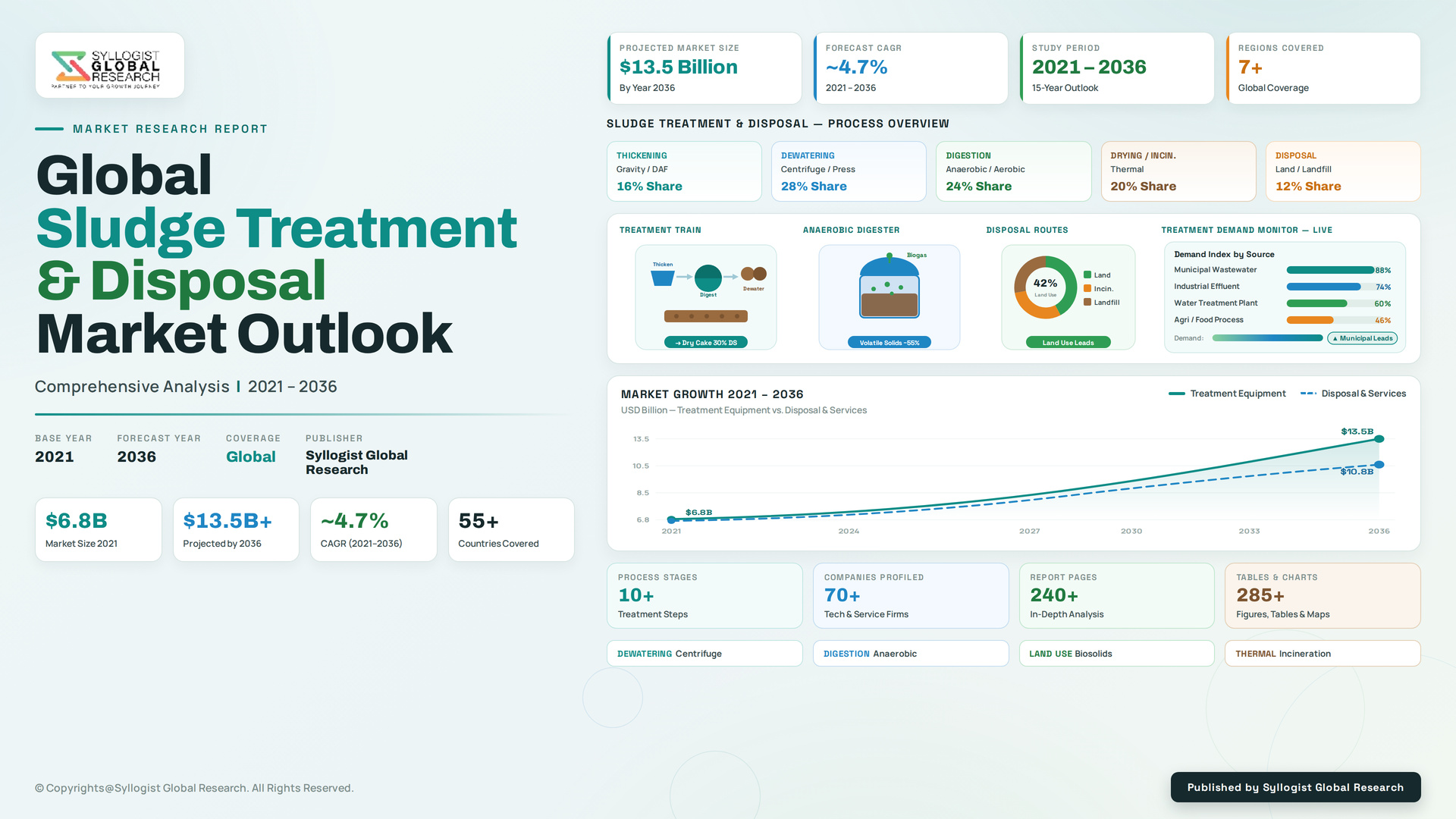
The global sludge treatment and disposal market is entering a sustained expansion phase driven by tightening biosolids regulations covering PFAS, heavy metals, microplastics, and pathogen reduction, rapid urbanization and wastewater infrastructure expansion across emerging markets, rising water reuse mandates, and the structural shift toward resource recovery and renewable biogas generation as central pillars of circular economy frameworks. The market was valued at USD 12.4 billion in 2025 and is projected to reach USD 24.8 billion by 2034, advancing at a compound annual growth rate of 8.0% through the forecast period, supported by municipal wastewater treatment plant capacity additions, industrial effluent treatment scaling across food and beverage, pulp and paper, pharmaceuticals, and petrochemicals, and accelerating biosolids valorization investment across major operators.
Municipal wastewater sludge accounts for nearly 68% of global sludge treatment market value in 2025, driven by structural urbanization, sewerage coverage expansion, and the rising biosolids generation rates that follow rising per capita water consumption and improved wastewater collection. Global biosolids generation is projected to advance from approximately 95 million dry tonnes in 2025 to over 142 million dry tonnes by 2034, reshaping infrastructure investment priorities across major operators including Veolia, SUEZ, Severn Trent, Thames Water, Anglian Water, DC Water, Metropolitan Water Reclamation District of Greater Chicago, Stockholm Vatten och Avfall, Singapore PUB, Beijing Drainage Group, and Mumbai Municipal Corporation. PFAS contamination concerns are reshaping biosolids land application practices across the European Union, the United States, and emerging Asian markets, with several US states including Maine, Connecticut, and Massachusetts imposing partial or complete restrictions on biosolids land application that are accelerating investment in thermal treatment, gasification, and pyrolysis alternatives.
Anaerobic digestion has emerged as the most consequential sludge stabilization technology, with global installed digester capacity advancing at over 10.4% CAGR through 2034, supported by thermal hydrolysis pre-treatment platforms from Cambi, Veolia Bio Thelys, and Sustec Lysotherm that increase biogas yield by 40% to 60% and reduce digestate volumes by approximately 30%. DC Water Blue Plains, Thames Water Beckton, Stockholm Henriksdal, and Beijing Gaobeidian have each deployed thermal hydrolysis at scale, anchoring the commercial template for integrated biosolids-to-biogas valorization. Sludge dewatering and drying equipment demand is simultaneously scaling, with high-performance centrifuges from Andritz, Alfa Laval, and Flottweg, alongside belt filter presses, screw presses, and emerging electro-dewatering platforms achieving cake dryness above 32% to support downstream incineration, gasification, and beneficial reuse pathways.
Asia-Pacific dominates the global sludge treatment and disposal market with approximately 42% revenue share in 2025, anchored by China, India, Japan, South Korea, and Southeast Asia as the principal demand centers supported by aggressive wastewater infrastructure investment and tightening discharge standards. China alone accounts for nearly 24% of global market value, supported by the 14th Five-Year Plan urban wastewater infrastructure framework targeting 95% urban sewerage coverage by 2030, while India is the fastest growing regional market advancing at over 11.6% CAGR through 2034, supported by Namami Gange, AMRUT 2.0, and the Jal Jeevan Mission. Europe represents a premium technology market driven by EU Urban Wastewater Treatment Directive recast requirements imposing energy neutrality on plants above 100,000 PE by 2045, while North America is advancing PFAS-driven thermal treatment investment and biosolids-to-energy projects at DC Water, MWRDGC Chicago, and California utilities. Latin America, the Middle East, and Africa are emerging as priority growth geographies under wastewater infrastructure expansion programs.
Key Drivers
Tightening Biosolids Regulations Covering PFAS, Heavy Metals, and Pathogens Driving Investment in Advanced Thermal and Stabilization Technologies
Tightening biosolids regulations across the European Union, the United States, India, and China, covering PFAS, heavy metals, microplastics, and pathogen reduction, are materially escalating investment in advanced thermal treatment, gasification, pyrolysis, and stabilization technologies. PFAS land application restrictions across Maine, Connecticut, Massachusetts, and emerging US states, alongside the EU Urban Wastewater Treatment Directive recast imposing energy neutrality on plants above 100,000 PE by 2045, are anchoring durable equipment procurement growth and accelerating the shift away from traditional biosolids land application toward thermal valorization and resource recovery pathways through 2034.
Anaerobic Digestion, Thermal Hydrolysis, and Biogas Valorization Driving Resource Recovery Investment Across Municipal Wastewater Operators
Anaerobic digestion capacity additions advancing at over 10.4% CAGR through 2034, supported by thermal hydrolysis pre-treatment platforms from Cambi, Veolia Bio Thelys, and Sustec Lysotherm delivering 40% to 60% biogas yield improvements, are driving sustained resource recovery investment across major municipal operators. DC Water Blue Plains, Thames Water Beckton, Stockholm Henriksdal, and Beijing Gaobeidian have established commercial templates for integrated biosolids-to-biogas valorization, while renewable biogas off-take agreements and renewable natural gas incentive frameworks across the United States and Europe are reinforcing project economics.
Wastewater Infrastructure Expansion Across China, India, and Southeast Asia Driving Greenfield Sludge Treatment Equipment Procurement
Aggressive wastewater infrastructure investment under the China 14th Five-Year Plan targeting 95% urban sewerage coverage by 2030, alongside Namami Gange, AMRUT 2.0, and the Jal Jeevan Mission in India, and parallel programs across Indonesia, Vietnam, Thailand, Philippines, and Bangladesh are driving sustained greenfield sludge treatment equipment procurement. Combined committed wastewater infrastructure capital deployment across Asia-Pacific exceeds USD 184 billion through 2030, anchoring durable sludge treatment market growth across the region.
Key Challenges
PFAS Contamination, Microplastic Concerns, and Public Resistance Restricting Biosolids Land Application and Beneficial Reuse Pathways
Rising PFAS contamination scrutiny, microplastic accumulation concerns, and public resistance to biosolids land application are restricting traditional disposal pathways across the European Union, the United States, and parts of Asia-Pacific. Maine, Connecticut, Massachusetts, and several European Union member states have imposed partial or complete restrictions on biosolids land application, forcing operators to redirect biosolids volumes toward thermal treatment, gasification, and landfill alternatives, while elevating tipping fees, operational complexity, and the urgency of investment in alternative disposal infrastructure across the global biosolids value chain.
Capital Intensity, Operating Cost Escalation, and Project Financing Constraints Limiting Municipal Operator Investment Capacity
Sludge treatment infrastructure is materially capital intensive, with integrated thermal hydrolysis, anaerobic digestion, dewatering, and biogas valorization projects typically requiring USD 80 million to USD 320 million of capital deployment per major facility. Operating cost escalation driven by energy, chemicals, polymer prices, and skilled labor inflation is compressing municipal operator budgets, while ratepayer affordability concerns, project financing constraints, and competing infrastructure priorities are slowing capital allocation toward sludge treatment upgrades across multiple emerging and developed market jurisdictions through 2034.
Workforce Shortages, Operational Complexity, and Aftermarket Service Capacity Constraints Limiting Equipment Suppliers and Plant Operators
Structural shortages of qualified process engineers, plant operators, instrumentation technicians, and skilled maintenance personnel across municipal water utilities in North America, Europe, and emerging Asia-Pacific markets are extending project commissioning timelines, complicating plant qualification cycles, and constraining operational ramp-up of new sludge treatment facilities. Aftermarket service capacity, spare parts supply chain resilience, and digital plant management expertise availability remain critical bottlenecks across the sludge treatment lifecycle, introducing execution risk into both greenfield project deployment and brownfield equipment refurbishment programs.
Market Segmentation
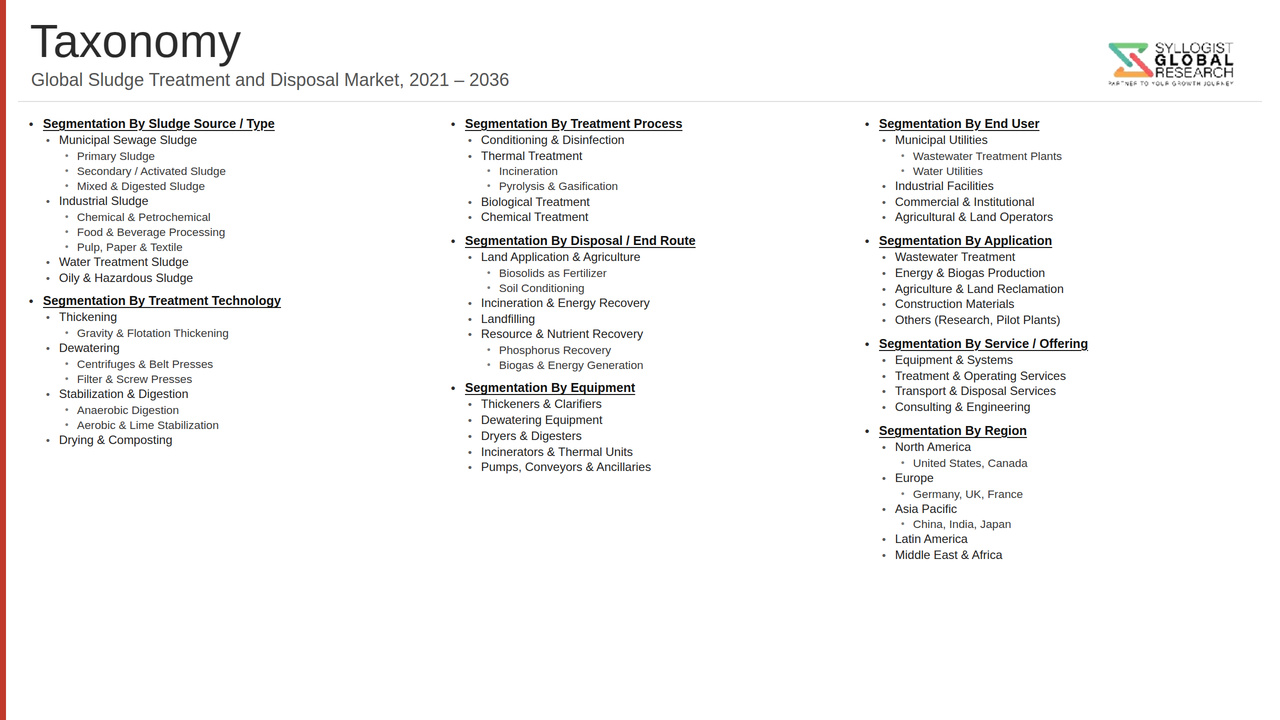
- Segmentation By Treatment Technology
- Sludge Thickening (Gravity, DAF, Rotary Drum)
- Dewatering (Belt Filter Press, Centrifuge, Screw Press, Plate-and-Frame)
- Aerobic Digestion
- Anaerobic Digestion
- Thermal Hydrolysis Pre-Treatment
- Lime Stabilization
- Thermal Drying
- Incineration
- Gasification and Pyrolysis
- Electro-Dewatering and Emerging Technologies
- Others
- Segmentation By Sludge Source
- Municipal Wastewater Sludge
- Drinking Water Treatment Sludge
- Industrial Wastewater Sludge
- Desalination Brine Sludge
- Agricultural and Animal Waste Sludge
- Others
- Segmentation By Disposal Method
- Land Application (Agriculture, Forestry)
- Landfill
- Incineration and Energy Recovery
- Gasification and Pyrolysis
- Construction Aggregate and Cement Co-Processing
- Beneficial Reuse as Fertilizer or Soil Amendment
- Others
- Segmentation By Application
- Municipal Sewage Treatment Plants
- Industrial Effluent Treatment Plants
- Drinking Water Treatment Facilities
- Desalination Plants
- Decentralized and Onsite Treatment Systems
- Others
- Segmentation By End User
- Municipal Water Utilities
- Food and Beverage
- Pulp and Paper
- Textiles and Apparel
- Pharmaceuticals and Chemicals
- Petrochemicals and Refineries
- Mining and Metals
- Power Generation
- Others
- Segmentation By Region
- Asia-Pacific (China, India, Japan, South Korea, Southeast Asia)
- Europe
- North America
- Middle East and Africa
- Latin America
All market revenues are presented in USD
Historical Year: 2021-2024 | Base Year: 2025 | Estimated Year: 2026 | Forecast Period: 2027-2034
Key Questions this Study Will Answer
- What is the total market valuation of the Global Sludge Treatment and Disposal Market in 2025, projected through 2034, disaggregated by treatment technology, sludge source, disposal method, application, and end user, enabling water technology suppliers, municipal utilities, industrial operators, and investors to identify the highest-growth opportunities and most durable revenue corridors across the sludge treatment value chain?
- How are tightening biosolids regulations covering PFAS, heavy metals, microplastics, and pathogen reduction across the European Union, the United States, India, and China reshaping investment priorities across advanced thermal treatment, gasification, pyrolysis, anaerobic digestion, and stabilization technologies through 2034?
- Which treatment technologies including sludge thickening, dewatering, anaerobic digestion, thermal hydrolysis, drying, incineration, gasification, and pyrolysis are generating the highest growth rates, and how are technology transitions reshaping competitive positioning across Veolia Environnement, SUEZ, Xylem, Andritz, Alfa Laval, Huber SE, FLSmidth, KEMIRA, Ovivo, Cambi, BDP Industries, and Komline-Sanderson?
- How are wastewater infrastructure expansion programs including the China 14th Five-Year Plan, India Namami Gange, AMRUT 2.0, and Jal Jeevan Mission, alongside Southeast Asian sanitation initiatives, driving greenfield sludge treatment equipment procurement and capacity additions across Asia-Pacific through 2034?
- How is anaerobic digestion, thermal hydrolysis pre-treatment, and biogas valorization at DC Water Blue Plains, Thames Water Beckton, Stockholm Henriksdal, and Beijing Gaobeidian establishing the commercial template for integrated biosolids-to-biogas resource recovery, and what scaling potential exists across municipal operators through 2034?
- How are PFAS contamination concerns, microplastic accumulation, and public resistance to biosolids land application restricting traditional disposal pathways across Maine, Connecticut, Massachusetts, and European Union member states, and what alternative thermal, gasification, and beneficial reuse infrastructure investments are emerging in response?
- How is the competitive landscape structured among integrated water technology providers Veolia Environnement, SUEZ, Xylem, and Andritz, equipment specialists Alfa Laval, Huber SE, FLSmidth, KEMIRA, Ovivo, Cambi, Komline-Sanderson, Centrisys-CNP, and BDP Industries, and regional EPC contractors, and what partnership, technology licensing, and capacity expansion strategies are reshaping market share dynamics through 2034?
- Product Definition
- Research Methodology
- Research Design & Framework
- Overall Research Approach: Descriptive, Exploratory & Quantitative Mixed-Method Design
- Market Definition & Scope Boundaries: What is Included and Excluded
- Segmentation Framework
- Key Research Assumptions & Limitations
- Secondary Research
- Primary Research Design & Execution
- Data Triangulation & Validation
- Market Sizing & Forecasting Methodology
- Competitive Intelligence Methodology
- Quality Assurance & Peer Review
- Definitions, Abbreviations & Data Notes
- Research Design & Framework
- Executive Summary
- Market Snapshot & Headline Numbers
- Key Findings & Research Highlights
- Market Dynamics
- Regional Market Summary
- Competitive Landscape Snapshot
- Technology & Innovation Highlights
- Market Dynamics
- Drivers
- Restraints
- Opportunities
- Challenges
- Porter’s Five Forces Analysis
- PESTLE Analysis
- Market Trends & Developments
- Emerging Trends
- Technological Developments
- Regulatory & Policy Changes
- Supply Chain & Sourcing Trends
- Manufacturing & Process Trends
- Investment & Funding Activity
- Sustainability & ESG Trends
- Risk Assessment Framework
- Regulatory, Land-Application Restriction & Disposal Route Closure Risk
- Emerging Contaminant (PFAS, Microplastics & Heavy Metals) & Liability Risk
- Public Acceptance, Odour & Community Opposition Risk
- Energy Cost, Carbon Pricing & Operating Cost Volatility Risk
- Financing, Project Development & Stranded Asset Risk
- Regulatory Framework & Standards
- Biosolids Land Application, Sludge Quality & Pathogen Reduction Standards
- Landfill, Incineration & Air Emissions Regulatory Frameworks
- Emerging Contaminant (PFAS & Microplastics) Monitoring & Disposal Regulations
- Resource Recovery, Circular Economy & Nutrient Recycling Policy Frameworks
- Green Finance, Carbon Accounting, ESG Disclosure & Sustainable Procurement Standards
- Global Sludge Treatment and Disposal Market Outlook
- Market Size & Forecast by Value
- Market Size & Forecast by Volume (Sludge Treated, Kilo Tonnes Dry Solids)
- Market Size & Forecast by Treatment Process
- Sludge Thickening
- Sludge Dewatering
- Anaerobic Digestion & Stabilisation
- Aerobic Digestion & Stabilisation
- Lime & Chemical Stabilisation
- Composting & Biological Treatment
- Thermal Drying
- Incineration & Thermal Oxidation
- Advanced Thermal Treatment (Pyrolysis, Gasification & Hydrothermal)
- Market Size & Forecast by Technology
- Centrifuge & Decanter Technology
- Belt Filter Press Technology
- Screw Press & Rotary Press Technology
- Plate & Frame Filter Press Technology
- Thermal Hydrolysis & Pre-Treatment Technology
- Anaerobic Digester & Biogas Recovery Technology
- Thermal Dryer (Direct & Indirect) Technology
- Incinerator & Fluidised Bed Combustion Technology
- Other Emerging & Advanced Treatment Technologies
- Market Size & Forecast by Disposal & End-Route Type
- Landfill Disposal
- Land Application & Agricultural Reuse (Biosolids)
- Incineration & Thermal Destruction
- Energy Recovery (Biogas, RDF & Heat)
- Building Materials, Construction & Other Reuse
- Market Size & Forecast by Treatment Scale
- Large-Scale Centralised Treatment Facilities (Above 100,000 Tonnes per Annum)
- Medium-Scale Treatment Facilities (10,000 to 100,000 Tonnes per Annum)
- Small-Scale & Decentralised Treatment Units (Below 10,000 Tonnes per Annum)
- Market Size & Forecast by Application
- Municipal Sewage Sludge
- Industrial Process Sludge
- Water Treatment & Potable Water Sludge
- Food & Beverage Industry Sludge
- Pulp, Paper & Textile Industry Sludge
- Oil, Gas, Chemical & Other Industrial Sludge
- Market Size & Forecast by End-User
- Municipal Wastewater Utilities
- Industrial & Manufacturing Facilities
- Water Utilities & Treatment Plant Operators
- Private Treatment & Waste Management Contractors
- Government Agencies & Other End-Users
- Market Size & Forecast by Sales Channel
- EPC & Turnkey Project Contract (Engineering, Procurement & Construction)
- Direct Equipment & Technology Supply with System Integration
- Operations, Maintenance & Service Contract
- Public-Private Partnership (PPP) & Concession Contract
- North America Sludge Treatment and Disposal Market Outlook
- Market Size & Forecast
- By Value
- By Volume (Sludge Treated, Kilo Tonnes Dry Solids)
- By Treatment Process
- By Technology
- By Disposal & End-Route Type
- By Treatment Scale
- By Application
- By End-User
- By Country
- By Sales Channel
- Europe Sludge Treatment and Disposal Market Outlook
- Market Size & Forecast
- By Value
- By Volume (Sludge Treated, Kilo Tonnes Dry Solids)
- By Treatment Process
- By Technology
- By Disposal & End-Route Type
- By Treatment Scale
- By Application
- By End-User
- By Country
- By Sales Channel
- Asia-Pacific Sludge Treatment and Disposal Market Outlook
- Market Size & Forecast
- By Value
- By Volume (Sludge Treated, Kilo Tonnes Dry Solids)
- By Treatment Process
- By Technology
- By Disposal & End-Route Type
- By Treatment Scale
- By Application
- By End-User
- By Country
- By Sales Channel
- Latin America Sludge Treatment and Disposal Market Outlook
- Market Size & Forecast
- By Value
- By Volume (Sludge Treated, Kilo Tonnes Dry Solids)
- By Treatment Process
- By Technology
- By Disposal & End-Route Type
- By Treatment Scale
- By Application
- By End-User
- By Country
- By Sales Channel
- Middle East & Africa Sludge Treatment and Disposal Market Outlook
- Market Size & Forecast
- By Value
- By Volume (Sludge Treated, Kilo Tonnes Dry Solids)
- By Treatment Process
- By Technology
- By Disposal & End-Route Type
- By Treatment Scale
- By Application
- By End-User
- By Country
- By Sales Channel
- Country-Wise* Sludge Treatment and Disposal Market Outlook
- Market Size & Forecast
- By Value
- By Volume (Sludge Treated, Kilo Tonnes Dry Solids)
- By Treatment Process
- By Technology
- By Disposal & End-Route Type
- By Treatment Scale
- By Application
- By End-User
- By Country
- By Sales Channel
- *Countries Analyzed in the Syllogist Global Research Portfolio: United States, Canada, Mexico, Germany, France, United Kingdom, Netherlands, Spain, Italy, Norway, Sweden, China, Japan, India, Australia, South Korea, Singapore, Brazil, Chile, Saudi Arabia, UAE, Egypt, South Africa, Israel
- Technology Landscape & Innovation Analysis
- Mechanical Dewatering (Centrifuge, Belt & Screw Press) Technology Deep-Dive
- Anaerobic Digestion, Thermal Hydrolysis & Biogas Recovery Technology
- Thermal Drying & Heat Integration Technology
- Incineration, Fluidised Bed & Mono-Combustion Technology
- Pyrolysis, Gasification & Hydrothermal Carbonisation Technology
- Nutrient (Phosphorus & Nitrogen) Recovery & Resource Recovery Technology
- Emerging Contaminant (PFAS) Destruction & Advanced Treatment Technology
- Patent & IP Landscape in Sludge Treatment Technologies
- Value Chain & Supply Chain Analysis
- Dewatering, Thickening & Mechanical Equipment Manufacturing Supply Chain
- Digester, Thermal Dryer & Incinerator Equipment Supply Chain
- Chemical, Polymer & Conditioning Agent Supply Chain
- EPC Contractor, Project Developer & System Integrator Procurement Landscape
- Utility, Municipality & Industrial Operator Channel
- Biosolids Offtake, Land Application & Disposal Partner Channel
- Resource Recovery, Nutrient Valorisation & Circular Economy
- Pricing Analysis
- Mechanical Dewatering Capital and Operating Cost Analysis
- Anaerobic Digestion & Biogas Recovery Plant Cost Analysis
- Thermal Drying & Incineration Capital and Operating Cost Analysis
- Disposal Route (Landfill, Land Application & Incineration) Gate-Fee Analysis
- Sludge Treatment Project Finance, PPP Tariff & Revenue Structure Analysis
- Total Sludge Treatment Economics: Cost-per-Tonne Dry Solids and Disposal-Cost Optimisation Analysis
- Sustainability & Environmental Analysis
- Lifecycle Assessment (LCA) of Sludge Treatment & Disposal: Carbon Footprint, Energy Intensity & Emissions Across Treatment Routes
- Carbon Neutrality & Net Zero Contribution: Pathway to Energy-Positive Sludge Treatment
- Circular Economy & Resource Recovery: Nutrient, Energy and Material Recovery Contribution
- Environmental Compliance, Emerging Contaminant & Soil and Water Impact Consideration in Disposal
- Regulatory-Driven Sustainability, SDG 6 (Clean Water) & SDG 12 (Responsible Consumption) Alignment & Green Finance Eligibility
- Competitive Landscape
- Market Structure & Concentration
- Market Consolidation Level (Fragmented vs. Consolidated by Treatment Process & Geography)
- Top 10 Players Market Share
- HHI (Herfindahl-Hirschman Index) Concentration Analysis
- Competitive Intensity Map by Treatment Process, Technology & Geography
- Player Classification
- Integrated Water & Sludge Treatment Technology Companies
- Specialist Dewatering & Mechanical Equipment Providers
- Anaerobic Digestion, Biogas & Thermal Hydrolysis Technology Providers
- Thermal Drying & Incineration Technology Providers
- Pyrolysis, Gasification & Advanced Thermal Technology Players
- Resource Recovery, Nutrient & PFAS Treatment Specialists
- EPC Contractors & Project Developers Specialising in Sludge Treatment
- Waste Management & Biosolids Disposal Service Providers
- Competitive Analysis Frameworks
- Market Share Analysis by Treatment Process, Technology & Region
- Company Profile
- Company Overview & Headquarters
- Sludge Treatment Products & Technology Portfolio
- Key Customer Relationships & Reference Project Installations
- Manufacturing Footprint & Production Capacity
- Revenue (Sludge Treatment Segment) & Backlog
- Technology Differentiators & IP
- Key Strategic Partnerships, JVs & M&A Activity
- Recent Developments (Contract Wins, Capacity Expansion, Product Launches)
- SWOT Analysis
- Strategic Focus Areas & Roadmap
- Competitive Positioning Map (Technology Capability vs. Market Penetration)
- Key Company Profiles
- Market Structure & Concentration
- Technology Landscape & Innovation Analysis
- Strategic Output
- Market Opportunity Matrix: By Treatment Process, Technology, Application, End-User & Geography
- White Space Opportunity Analysis
- Strategic Recommendations
- Product Portfolio & Technology Investment Strategy
- Manufacturing & Operational Excellence Strategy
- Geographic Expansion & Localisation Strategy
- Customer & End-User Engagement Strategy
- Partnership, M&A & Ecosystem Strategy
- Sustainability & Circular Economy Strategy
- Risk Mitigation & Future Roadmap
- Strategic Priority Matrix & Roadmap
- Near-term (2025-2028)
- Mid-term (2029-2032)
- Long-term (2033-2037)
- Strategic Output
- Market Size & Forecast
- Market Size & Forecast
- Market Size & Forecast
- Market Size & Forecast
- Market Size & Forecast
- Market Size & Forecast