Market Overview
The global Off-the-Road (OTR) tire market was valued at USD 33.78 billion in 2025 and is expanding steadily due to increasing mechanization across industries such as mining, construction, agriculture, and industrial material handling.
OTR tires are specifically engineered for vehicles operating on rugged terrains including mud, sand, gravel, and rock. These tires feature deeper tread patterns, reinforced sidewalls, and wider grooves that enhance traction, durability, and load-bearing capacity in harsh environments. Their structural design allows heavy machinery such as loaders, dump trucks, tractors, excavators, and haul trucks to operate efficiently in challenging off-road conditions.
Growing investments in infrastructure development, expansion of mining operations, and modernization of agriculture equipment are expected to sustain strong demand for OTR tires across both developed and emerging economies.
Key Market Drivers
Infrastructure Development and Construction Expansion
Infrastructure development remains one of the strongest growth drivers for the OTR tire market. Governments worldwide are investing heavily in highways, bridges, urban development projects, airports, railways, and industrial zones. These projects require heavy-duty equipment such as bulldozers, graders, excavators, wheel loaders, and articulated dump trucks that rely on high-performance OTR tires.
Emerging economies across Asia, the Middle East, and Africa are witnessing rapid urbanization and population growth, leading to increased construction activity. At the same time, developed markets continue to invest in upgrading aging infrastructure. These developments significantly increase the operating hours of construction machinery, driving replacement demand for OTR tires.
Growth of Mining and Extractive Industries
The mining sector is another major contributor to OTR tire demand. Large mining vehicles such as haul trucks, loaders, drilling rigs, and earthmovers require ultra-large OTR tires capable of operating in highly abrasive and rocky environments.
Global demand for minerals, metals, and rare earth elements used in energy transition technologies, electric vehicles, and electronics is encouraging the expansion of mining projects. New mining operations in regions such as Australia, South America, Africa, and Central Asia are increasing the requirement for specialized mining tires designed to withstand extreme loads and temperatures.
Mechanization of Agriculture
The agriculture sector also plays a significant role in the OTR tire market. Agricultural machinery such as tractors, harvesters, sprayers, and trailers use specialized OTR tires designed for soil protection, traction, and fuel efficiency.
As the global population continues to grow, agricultural productivity must increase to meet rising food demand. Farmers are adopting modern mechanized equipment to improve efficiency and reduce labor costs. Technological advancements in agricultural tires, including wider tires and low-pressure designs that minimize soil compaction, are further supporting market growth.
Expansion of Industrial and Material Handling Equipment
Industrial and logistics sectors also contribute significantly to OTR tire demand. Warehouses, logistics hubs, ports, and manufacturing plants rely on equipment such as forklifts, reach stackers, container handlers, and terminal tractors.
The rapid growth of global trade and e-commerce has increased demand for efficient logistics infrastructure. Ports and distribution centers require durable OTR tires capable of handling heavy loads while maintaining operational efficiency. As supply chains continue to expand and modernize, the industrial material handling segment is expected to remain a stable source of demand.
Technological Advancements in Tire Manufacturing
Continuous innovation in tire manufacturing is transforming the OTR tire industry. Manufacturers are developing advanced tire compounds, reinforced carcass structures, and specialized tread designs that improve durability, traction, and resistance to cuts and punctures.
Digital technologies are also being integrated into tire systems. Smart tires equipped with sensors and tire pressure monitoring systems (TPMS) allow real-time monitoring of tire pressure, temperature, and wear conditions. These technologies enable predictive maintenance and reduce unexpected downtime in mining and construction operations.
Additionally, improvements in tire retreading and lifecycle management are helping operators reduce operating costs and extend tire service life.
Increasing Focus on Sustainability
Environmental sustainability is becoming a major factor shaping the OTR tire market. Governments and industries are introducing stricter environmental regulations aimed at reducing carbon emissions and improving energy efficiency.
Tire manufacturers are responding by developing low rolling resistance tires that help reduce fuel consumption in heavy equipment. Sustainable manufacturing processes and recyclable tire materials are also gaining importance.
Furthermore, tire retreading and recycling programs are becoming increasingly popular as industries seek to reduce waste and adopt circular economy practices. These initiatives allow companies to extend the life of tire casings and reduce the environmental impact of tire disposal.
Key Market Challenges
Economic Cycles and Industrial Volatility
The OTR tire market is highly sensitive to economic cycles because it is closely tied to capital-intensive industries such as mining, construction, and agriculture. During economic downturns, infrastructure investments and mining projects may be delayed or canceled, reducing demand for heavy equipment and associated tires.
Similarly, fluctuations in commodity prices can influence mining activity, which in turn affects the demand for ultra-large mining tires.
Rising Raw Material Costs
The production of OTR tires requires significant quantities of natural rubber, synthetic rubber, carbon black, steel cord, and specialty chemicals. Price fluctuations in these raw materials can increase manufacturing costs and compress profit margins for tire manufacturers.
Supply chain disruptions, geopolitical tensions, and climate-related impacts on rubber production can further contribute to raw material volatility.
Increasing Product Complexity
Modern OTR tires are becoming more technologically advanced and specialized. While these innovations improve performance and durability, they also increase manufacturing complexity and cost.
Additionally, the integration of smart monitoring technologies requires compatibility with digital fleet management systems, which adds further complexity to tire design and maintenance.
Key Market Trends
Smart Tire Technologies and Digital Monitoring
One of the most significant trends in the OTR tire market is the adoption of digital monitoring technologies. Smart tires equipped with sensors and telemetry systems provide real-time data on tire pressure, temperature, load, and wear patterns.
This information allows fleet operators to optimize tire usage, prevent equipment downtime, and improve overall operational efficiency.
Sustainable Tire Manufacturing
Sustainability is becoming a central focus for tire manufacturers. Companies are investing in eco-friendly production processes, renewable materials, and energy-efficient manufacturing technologies.
Low rolling resistance tires are also gaining popularity as industries seek to reduce fuel consumption and carbon emissions in heavy equipment operations.
Customization and Application-Specific Tire Design
OTR tire manufacturers are increasingly offering customized tire solutions tailored to specific applications such as underground mining, open-pit mining, forestry, agriculture, and port operations.
These specialized designs help improve traction, load capacity, and durability under different operating conditions.
Expansion in Emerging Markets
Emerging markets in Asia-Pacific, Latin America, and Africa are becoming important growth centers for the OTR tire market. Rapid urbanization, infrastructure development, and mining expansion in these regions are driving demand for construction and mining equipment.
Countries such as China, India, Indonesia, Brazil, and South Africa are witnessing significant increases in heavy machinery deployment, which is boosting the demand for OTR tires.
Regional Insights
Asia-Pacific represents the largest and fastest-growing market for OTR tires due to strong demand from construction, mining, and agriculture sectors. China and India play a major role as both manufacturing hubs and major consumers of heavy machinery.
North America is a mature but stable market driven by mining operations, construction activities, and advanced agricultural mechanization.
Europe remains a technologically advanced market with strong demand for premium tires and increasing emphasis on sustainable tire solutions.
Recent Developments
Several strategic developments have taken place in the OTR tire industry:
- Tire manufacturers are launching new heavy-duty tire variants designed for mining environments with improved heat resistance and load capacity.
- Major industry players are expanding their production capacity and investing in new manufacturing technologies.
- Strategic mergers and acquisitions are reshaping the competitive landscape as companies seek to strengthen their global presence.
- Tire manufacturers are increasing investments in smart tire technology and predictive maintenance systems.
Market Segmentation
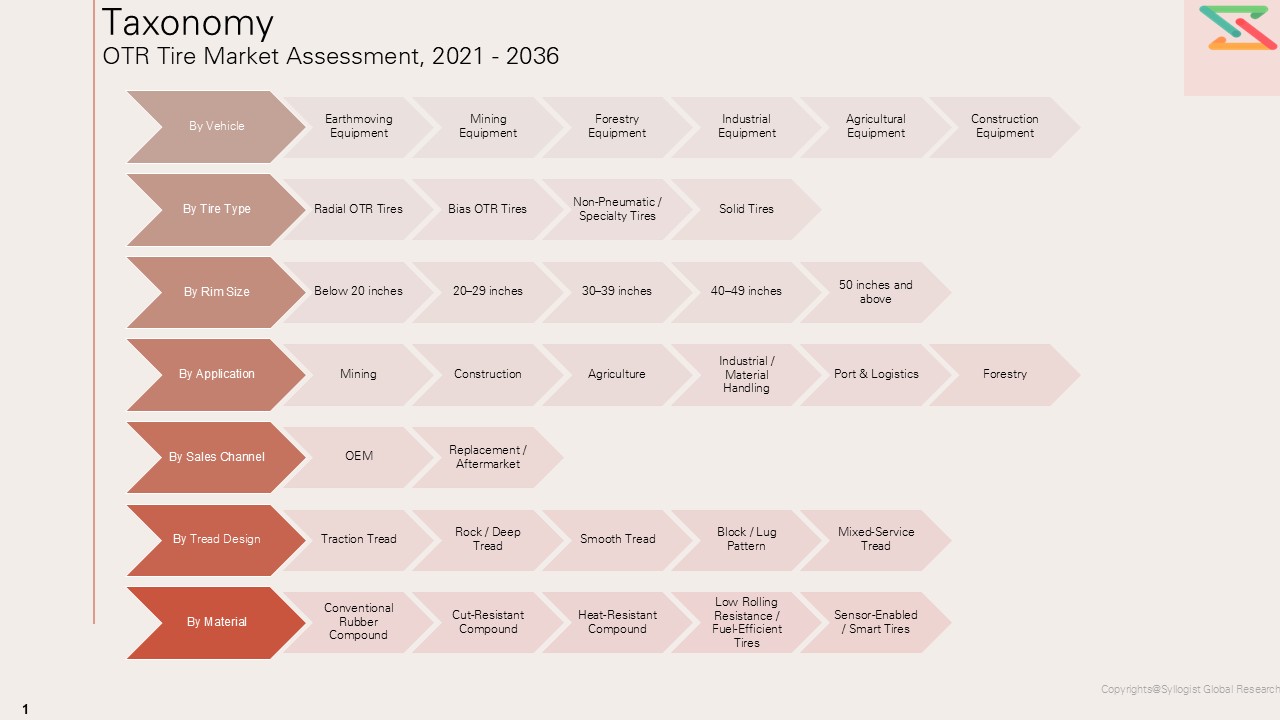
- Segmentation by Vehicle Type
- Earthmoving Equipment
- Excavators
- Loaders
- Dozers
- Graders
- Scrapers
- Backhoe Loaders
- Mining Equipment
- Rigid Dump Trucks
- Articulated Dump Trucks
- Wheel Loaders
- Underground Mining Vehicles
- Construction Equipment
- Cranes
- Compactors
- Pavers
- Telehandlers
- Agricultural Equipment
- Tractors
- Harvesters
- Sprayers
- Trailers / Implements
- Industrial Equipment
- Forklifts
- Port Handling Equipment
- Container Handlers
- Forestry Equipment
- Skidders
- Forwarders
- Harvesters
- Market Size & Forecast by Tire Type
- Radial OTR Tires
- Bias OTR Tires
- Solid Tires
- Non-Pneumatic / Specialty Tires
- Market Size & Forecast by Rim Size
- Below 20 inches
- 20–29 inches
- 30–39 inches
- 40–49 inches
- 50 inches and above
- Market Size & Forecast by Application
- Mining
- Construction
- Agriculture
- Industrial / Material Handling
- Port & Logistics
- Forestry
- Market Size & Forecast by Demand Type
- OEM
- Replacement / Aftermarket
- Market Size & Forecast by Thread Design
- Traction Tread
- Rock / Deep Tread
- Smooth Tread
- Block / Lug Pattern
- Mixed-Service Tread
- Market Size & Forecast by Material / Technology
- Conventional Rubber Compound
- Cut-Resistant Compound
- Heat-Resistant Compound
- Low Rolling Resistance / Fuel-Efficient Tires
- Sensor-Enabled / Smart Tires
- Earthmoving Equipment
- Market Foundations & Dynamics
- Product Overview
- Research Methodology
- Executive Summary
- Market Dynamics (Drivers, Restraints, Opportunities, Challenges, Porter’s Five Forces Analysis, PESTLE Analysis)
- Market Ecosystem & Value Chain
- Overview of Value Chain Participants
- Flow of Value and Material Through the Chain
- Value Addition and Margins at Each Stage
- Market Trends & Developments
- Emerging Raw Material Trends
- Raw Material Availability
- Technological Advancements
- Demand–Supply Gaps
- Investment Hotspots
- Unmet Needs and White Market Spaces
- Risk Assessment Framework
- Political / Geopolitical Risk
- Raw Material Supply Risk
- Environmental and Regulatory Risk
- Financial / Market Risk
- Regulatory Framework & Standards
- Global Policy and Mandate Overview
- Transportation and Storage Regulations
- Sustainability and GHG Reduction Standards
- Environmental & Liability Considerations
- Technology Landscape
- Overview of Technologies
- Cost Optimization Technologies
- Future Outlook
- Global OTR Tire Market Outlook
- Market Size & Forecast by Value
- Market Size & Forecast by Volume
- Market Size & Forecast by Vehicle Type
- Earthmoving Equipment
- Excavators
- Loaders
- Dozers
- Graders
- Scrapers
- Backhoe Loaders
- Mining Equipment
- Rigid Dump Trucks
- Articulated Dump Trucks
- Wheel Loaders
- Underground Mining Vehicles
- Construction Equipment
- Cranes
- Compactors
- Pavers
- Telehandlers
- Agricultural Equipment
- Tractors
- Harvesters
- Sprayers
- Trailers / Implements
- Industrial Equipment
- Forklifts
- Port Handling Equipment
- Container Handlers
- Forestry Equipment
- Skidders
- Forwarders
- Harvesters
- Market Size & Forecast by Tire Type
- Radial OTR Tires
- Bias OTR Tires
- Solid Tires
- Non-Pneumatic / Specialty Tires
- Market Size & Forecast by Rim Size
- Below 20 inches
- 20–29 inches
- 30–39 inches
- 40–49 inches
- 50 inches and above
- Market Size & Forecast by Application
- Mining
- Construction
- Agriculture
- Industrial / Material Handling
- Port & Logistics
- Forestry
- Market Size & Forecast by Demand Type
- OEM
- Replacement / Aftermarket
- Market Size & Forecast by Thread Design
- Traction Tread
- Rock / Deep Tread
- Smooth Tread
- Block / Lug Pattern
- Mixed-Service Tread
- Market Size & Forecast by Material / Technology
- Conventional Rubber Compound
- Cut-Resistant Compound
- Heat-Resistant Compound
- Low Rolling Resistance / Fuel-Efficient Tires
- Sensor-Enabled / Smart Tires
- Market Size & Forecast by Region
- North America
- Europe
- Asia-Pacific
- Middle East & Africa
- South America
- Asia-Pacific OTR Tire Market Outlook
- Market Size & Forecast by Value & Volume
- Market Size & Forecast by Vehicle Type
- Market Size & Forecast by Tire Type
- Market Size & Forecast by Rim Size
- Market Size & Forecast by Application
- Market Size & Forecast by Demand Type
- Market Size & Forecast by Thread Design
- Market Size & Forecast by Material
- Europe OTR Tire Market Outlook
- Market Size & Forecast by Value & Volume
- Market Size & Forecast by Vehicle Type
- Market Size & Forecast by Tire Type
- Market Size & Forecast by Rim Size
- Market Size & Forecast by Application
- Market Size & Forecast by Demand Type
- Market Size & Forecast by Thread Design
- Market Size & Forecast by Material
- North America OTR Tire Market Outlook
- Market Size & Forecast by Value & Volume
- Market Size & Forecast by Vehicle Type
- Market Size & Forecast by Tire Type
- Market Size & Forecast by Rim Size
- Market Size & Forecast by Application
- Market Size & Forecast by Demand Type
- Market Size & Forecast by Thread Design
- Market Size & Forecast by Material
- Latin America OTR Tire Market Outlook
- Market Size & Forecast by Value & Volume
- Market Size & Forecast by Vehicle Type
- Market Size & Forecast by Tire Type
- Market Size & Forecast by Rim Size
- Market Size & Forecast by Application
- Market Size & Forecast by Demand Type
- Market Size & Forecast by Thread Design
- Market Size & Forecast by Material
- Middle East & Africa OTR Tire Market Outlook
- Market Size & Forecast by Value & Volume
- Market Size & Forecast by Vehicle Type
- Market Size & Forecast by Tire Type
- Market Size & Forecast by Rim Size
- Market Size & Forecast by Application
- Market Size & Forecast by Demand Type
- Market Size & Forecast by Thread Design
- Market Size & Forecast by Material
- Country wise OTR Tire Market Outlook
- Market Size & Forecast by Value & Volume
- Market Size & Forecast by Vehicle Type
- Market Size & Forecast by Tire Type
- Market Size & Forecast by Rim Size
- Market Size & Forecast by Application
- Market Size & Forecast by Demand Type
- Market Size & Forecast by Thread Design
- Market Size & Forecast by Material
- Earthmoving Equipment
Countries Analyzed in the Syllogist Global Research Portfolio: China, India, Japan, Indonesia, South Korea, Thailand, Taiwan, Vietnam, Australia, Malaysia, Pakistan, Philippines, Bangladesh, United States, Canada, Mexico, Germany, France, Italy, United Kingdom, Spain, Poland, Czech Republic, Netherlands, Belgium, Russia, Sweden, Finland, Austria, Romania, Hungary, Portugal, Slovakia, Kazakhstan, Brazil, Argentina, Colombia, Chile, Turkey, Iran, Saudi Arabia, UAE, Oman, Qatar, South Africa, Egypt, Algeria, Kenya, Ethiopia, Angola, Zimbabwe
- Pricing Analysis
- Global Average Selling Price Trend
- Pricing Analysis by Tire Type (Radial OTR tires, Bias OTR tires, Solid / specialty OTR tires)
- Pricing Analysis by Application (Mining, Construction, Agriculture, etc.)
- Pricing Analysis by Rim Size
- Pricing Analysis by Sales Channel (OEM Pricing, Replacement / Aftermarket Pricing, Distributor Vs Direct Sales Pricing, Fleet / Contract Pricing)
- Raw Material Price Impact Analysis
- Natural Rubber
- Synthetic Rubber
- Carbon Black
- Steel Cord
- Fabric / Textile Reinforcement
- Chemicals And Additives
- Crude-Linked Cost Pass-Through
- Competition Outlook
- Market Concentration and Fragmentation Level
- Company Market Shares (Top 10 Producers)
- Competitive Strategies
- Benchmarking Matrix
- Recent Developments: Partnerships, M&A, and Policy-Driven Expansions
- Sales & Distribution Channel Analysis
- Overview of Go-to-Market Channels
- Channel Share by Region
- Distribution Strategies by Leading Players
- Strategic Recommendations & Roadmap
- Competitors’ Strategic Initiatives
- Future Outlook (Next 5–10 Years, Emerging Players, Success Factors)
- Strategic Recommendations
- Market Acceleration Roadmap
- Short-Term
- Mid-Term
- Long-Term
- Tailored Recommendations for:
- Producers
- Raw Material Suppliers
- Policymakers / Regulators
- Recommendations on Key Success Factors
- Raw Material Security
- Policy Alignment
- Supply Chain Integration
- Market Acceleration Roadmap