Market Definition
The Global Hydrogen Airport Infrastructure Market encompasses the planning, engineering, construction, commissioning, and operational management of the physical and digital systems required to produce, store, transport, dispense, and safely manage hydrogen as an energy carrier within and in the immediate vicinity of commercial, military, and general aviation airport facilities. This market addresses the comprehensive infrastructure value chain necessary to support hydrogen-powered aircraft operations, hydrogen fuel cell-based ground support equipment, hydrogen-fueled airport vehicles and airside transport systems, and hydrogen-based stationary power generation and heating applications within terminal and operational buildings. The infrastructure scope spans on-site green hydrogen electrolysis production plants powered by dedicated or grid-sourced renewable electricity, blue hydrogen receiving and processing terminals, liquid hydrogen storage tanks and associated vacuum-jacketed cryogenic vessel systems, compressed gaseous hydrogen buffer storage arrays, hydrogen pipeline distribution networks within airport boundaries, cryogenic liquid hydrogen aircraft refueling trucks and fixed hydrant dispensing systems, pre-conditioned air and ground power units operating on hydrogen fuel cells, safety monitoring systems including hydrogen leak detection sensor networks and emergency isolation and venting systems, and the digital management platforms governing hydrogen inventory, quality certification, dispensing metering, and safety compliance documentation. Key participants in this market include airport operators and authorities undertaking infrastructure capital investment programs, energy majors and green hydrogen producers establishing hydrogen supply agreements and on-site production joint ventures, engineering procurement and construction firms delivering hydrogen facility projects, aircraft OEMs and hydrogen propulsion technology developers specifying fueling interface standards, government agencies administering infrastructure co-investment programs, and independent safety certification bodies developing and enforcing hydrogen aviation ground handling standards and regulatory frameworks that currently lack the decades of operational precedent underpinning conventional jet fuel infrastructure governance.
Market Insights
The global hydrogen airport infrastructure market is at the earliest stage of what is expected to become one of the most capital-intensive infrastructure build-out cycles in the history of commercial aviation, driven by the irreversible commitment of the global aviation industry to achieve net-zero carbon emissions by 2050 and the emerging consensus among airframe OEMs, propulsion developers, and regulatory authorities that hydrogen, in both fuel cell and combustion turbine configurations, will be an indispensable propulsion energy carrier for regional and short-haul aviation segments that lie beyond the performance reach of battery-electric systems. As of 2026, fewer than 15 airports globally have operational or committed hydrogen infrastructure capable of supporting even demonstrator-scale aircraft fueling operations, underscoring the profound gap between the infrastructure that currently exists and the infrastructure that the projected commercial entry of hydrogen aircraft between 2028 and 2035 will demand. The global market valuation for hydrogen airport infrastructure stood at approximately USD 1.4 billion in 2025, encompassing early-stage production facilities, demonstrator fueling systems, ground support equipment electrolysis projects, and feasibility and engineering study program expenditure, and is projected to reach USD 14.7 billion by 2035, expanding at a compound annual growth rate of 26.4% over the forecast period from 2027 to 2035, as the transition from demonstrator-scale pilot programs to commercial-scale hub airport and regional airport network deployments generates exponentially larger capital investment requirements across production, storage, distribution, and dispensing infrastructure categories.
The choice between liquid hydrogen and compressed gaseous hydrogen as the primary dispensing modality at airport facilities constitutes the most consequential near-term infrastructure design decision facing airport operators, energy companies, and regulatory bodies, as the two options present fundamentally different capital cost structures, energy efficiency profiles, refueling time characteristics, safety envelope requirements, and scalability pathways that have direct implications for the economics and operational feasibility of hydrogen aviation across different airport sizes and traffic throughput levels. Liquid hydrogen, with a volumetric energy density approximately 1.8 times greater than compressed gaseous hydrogen at 700 bar, is widely regarded as the preferred long-term dispensing modality for commercial aviation given the large fuel volumes required per aircraft refueling cycle and the spatial constraints of existing airport infrastructure that limit the footprint available for high-pressure compressed gas storage arrays of equivalent energy content. However, liquid hydrogen liquefaction requires approximately 30% of the hydrogen’s own energy content to execute, demands storage vessels maintained at minus 253 degrees Celsius with associated boil-off management infrastructure, and requires specialized cryogenic-rated aircraft fueling trucks and dispensing hoses with vacuum-jacketed construction that are not currently produced in commercial-scale quantities. Compressed gaseous hydrogen infrastructure, while less energy-dense and more suitable for smaller aircraft and ground vehicle applications, presents a lower initial capital cost entry point and a more mature technology readiness level, making it the preferred first-deployment modality for early pilot programs at regional airports and for ground support equipment electrification applications where the fueling volume and throughput requirements are more modest. The airport hydrogen infrastructure market is therefore expected to evolve through a staged transition, with compressed gaseous hydrogen systems dominating early deployments through 2029 and liquid hydrogen infrastructure capturing an increasing share of investment as commercial hydrogen aircraft enter service and per-airport hydrogen throughput volumes cross the economic threshold at which liquefaction energy losses are offset by volumetric storage and dispensing efficiency gains.
The ground support equipment and airside vehicle electrification segment represents the most immediately commercially viable and operationally scalable application for hydrogen fuel cell technology within the airport environment, providing a pathway to generate real-world operational experience with hydrogen infrastructure management, safety protocols, maintenance procedures, and supply logistics at airports in advance of the more technically demanding and higher-stakes challenge of aircraft fueling system deployment. Major international hub airports including Schiphol in the Netherlands, Heathrow in the United Kingdom, Frankfurt in Germany, and Incheon in South Korea have each initiated hydrogen ground support equipment programs encompassing hydrogen fuel cell-powered baggage tractors, pushback tractors, aircraft de-icing vehicles, airfield maintenance equipment, and passenger boarding vehicles, collectively representing the deployment of over 340 hydrogen fuel cell ground support units across these facilities as of 2025. These programs are yielding operationally critical data on hydrogen consumption rates per equipment type and operational cycle, refueling time requirements and infrastructure throughput constraints, maintenance interval characteristics and component durability under airport operating conditions, and the organizational change management requirements of transitioning airport ground handling workforces to hydrogen safety competencies and fueling procedures. The hydrogen ground support equipment market generated approximately USD 380 million in revenue in 2025 across vehicle procurement, on-site refueling infrastructure, and hydrogen supply contracts, and represents a strategically important near-term revenue stream for the hydrogen airport infrastructure ecosystem that is building the supply chain, workforce capability, and regulatory confidence foundations upon which the larger commercial aircraft fueling infrastructure market will subsequently be constructed.
From a regional standpoint, Europe has established the most advanced and policy-coherent framework for hydrogen airport infrastructure development, anchored by the European Union’s Hydrogen Strategy, the ReFuelEU Aviation regulation, the Clean Hydrogen Partnership co-funding mechanism, and the Destination 2050 roadmap of European aviation stakeholders, which collectively identify hydrogen infrastructure at up to 45 European airports as a prerequisite for meeting the sector’s 2050 net-zero commitment and have mobilized public co-investment commitments of approximately USD 2.3 billion toward hydrogen airport and aviation infrastructure through 2030. Germany, the Netherlands, France, and the United Kingdom are the most advanced individual national markets, with each having identified specific hub and regional airports for hydrogen infrastructure pilot programs that are progressing from feasibility studies into front-end engineering and design phases supported by government grant funding. North America is the second-most-active regional market, with the United States Federal Aviation Administration’s Hydrogen Aviation Strategy, published in 2024, providing a regulatory roadmap for hydrogen airport operations and with California, Washington State, and the northeastern corridor states having committed state-level infrastructure co-investment through clean energy and aviation decarbonization funding programs that have activated hydrogen airport feasibility studies at more than 28 airports. Asia-Pacific is emerging rapidly, with Japan’s government having committed USD 3.4 billion toward hydrogen society infrastructure including aviation applications as part of its Green Innovation Fund, South Korea designating Incheon International Airport as a hydrogen aviation hub with a USD 480 million infrastructure commitment, and Australia progressing hydrogen airport feasibility programs at Sydney and Brisbane international airports in anticipation of hydrogen-powered regional aviation serving its extensive thin-route domestic network.
Key Drivers
Imminent Commercial Entry of Hydrogen-Powered Aircraft and the Corresponding Airport Infrastructure Readiness Imperative
The most immediate and commercially concrete driver of investment in hydrogen airport infrastructure is the confirmed and publicly committed development timeline of multiple hydrogen aircraft programs across regional commuter, turboprop replacement, and short-haul narrow-body categories, which are projecting entry into commercial service between 2028 and 2035 and which cannot operate commercially without a minimum viable network of airport hydrogen fueling facilities at their intended route terminal points. Unlike sustainable aviation fuel, which is a drop-in fuel that can be dispensed through existing jet fuel infrastructure with minimal modification, hydrogen aircraft require entirely new and purpose-built ground infrastructure that must be designed, permitted, constructed, and safety-certified before the first commercial hydrogen flight can be operated at any given airport. This infrastructure readiness imperative is creating a pressing first-mover strategic dynamic among airports in key regional aviation markets, particularly in Norway, Sweden, Japan, New Zealand, and Australia, where thin-route regional aviation networks and ambitious national decarbonization commitments make early hydrogen aircraft adoption both operationally rational and politically supported, as airport operators recognize that being infrastructure-ready for the first wave of commercial hydrogen aircraft deployments will determine which airports are selected as initial network nodes and which are bypassed in favor of infrastructure-ready competitors. The long infrastructure lead times associated with hydrogen production facility permitting, construction, and commissioning, typically 36 to 60 months from project initiation to operational certification, mean that airports targeting readiness for first-generation commercial hydrogen aircraft service must commit to infrastructure investment decisions in the 2025 to 2027 window, generating near-term investment decision urgency that is beginning to translate into funded front-end engineering and design contracts across the European and Asia-Pacific regional aviation markets.
Government Co-Investment Programs, Carbon Reduction Regulatory Mandates, and the Alignment of Energy and Aviation Decarbonization Policy
The hydrogen airport infrastructure market is structurally dependent on government co-investment to bridge the gap between the commercially justifiable capital expenditure threshold of airport operators and hydrogen energy companies operating under current hydrogen production cost economics and the actual capital investment required to construct first-of-kind hydrogen airport infrastructure at the scale and specification necessary to support commercial aviation operations. Governments across the European Union, United Kingdom, United States, Japan, South Korea, and Australia have collectively committed over USD 8.7 billion in public funding toward hydrogen infrastructure deployment programs that are directly or indirectly applicable to aviation and airport applications, including production facility capital grants, electrolyzer procurement support, storage and dispensing infrastructure co-investment, and research and demonstration program funding. The ReFuelEU Aviation regulation’s mandatory sustainable fuel blending obligations, which escalate from 2% in 2025 to 6% in 2030 and 70% in 2050, with a specific synthetic fuel sub-mandate of 35% by 2050 that can only realistically be met by hydrogen-derived fuels, creates a regulatory demand signal for hydrogen aviation that generates a corresponding infrastructure investment imperative that airport operators and energy companies operating within the European regulatory jurisdiction cannot commercially avoid as the mandate timelines approach. National hydrogen strategies in Germany, Japan, and South Korea that explicitly designate aviation as a priority hydrogen end-use sector are ensuring that airport applications receive preferential access to concessional financing facilities, hydrogen supply priority allocations, and permitting fast-track arrangements that substantially improve the investment economics and development timeline predictability of hydrogen airport infrastructure projects relative to unsubsidized market conditions.
Declining Green Hydrogen Production Costs and the Improving Lifecycle Economics of Hydrogen as an Aviation Energy Carrier
The commercial viability of hydrogen as an aviation fuel is fundamentally governed by the production cost of green hydrogen, which is generated through the electrolysis of water powered by renewable electricity and is the only hydrogen production pathway consistent with genuine lifecycle carbon emissions reduction in aviation applications. The levelized cost of green hydrogen production has declined from approximately USD 8.5 per kilogram in 2020 to approximately USD 5.8 per kilogram in 2025, driven by the rapidly falling capital cost of proton exchange membrane and alkaline electrolyzer systems, which declined by approximately 60% per unit of capacity installed between 2017 and 2024, combined with the continuing reduction in the levelized cost of renewable electricity from solar and wind generation that constitutes the dominant operating cost component of electrolysis-based hydrogen production. Independent techno-economic analyses project green hydrogen production costs reaching USD 2.0 to USD 2.5 per kilogram in regions with premium renewable energy resources by 2030 to 2032, a cost level at which hydrogen-powered regional aviation becomes broadly competitive with conventional jet fuel on a carbon-adjusted basis when carbon pricing mechanisms are incorporated into the economic comparison. This cost trajectory is improving the long-run investment case for airport hydrogen infrastructure by reducing the anticipated hydrogen fuel cost that airlines will face when operating hydrogen aircraft, which in turn improves airline willingness to commit to hydrogen aircraft orders and route network planning that provides the commercial off-take guarantee underpinning airport infrastructure investment decisions and enabling the construction of financially bankable hydrogen airport infrastructure project financing structures.
Key Challenges
Absence of Standardized Hydrogen Aircraft Fueling Interface Specifications and the Regulatory Vacuum Governing Airport Hydrogen Operations
The most operationally critical challenge constraining the development of hydrogen airport infrastructure is the current absence of internationally harmonized technical standards governing the physical fueling interface between hydrogen aircraft and airport dispensing systems, the safety separation distances and operational protocols applicable to liquid and compressed gaseous hydrogen fueling operations in proximity to aircraft and passengers, the qualification requirements for hydrogen airport infrastructure components including fueling trucks, dispensing nozzles, couplings, pressure control valves, and leak detection systems, and the competency and licensing standards applicable to personnel authorized to conduct hydrogen aircraft fueling operations. Unlike conventional jet fuel infrastructure, which is governed by decades of accumulated ICAO, IATA, and national civil aviation authority standards covering every aspect of fuel quality, storage, dispensing, spill management, and vehicle operation, hydrogen aviation ground operations are entering commercial deployment without an equivalent body of established regulatory guidance, compelling airport operators, fuel suppliers, and aircraft operators to navigate a patchwork of industrial gas handling standards, emerging aviation authority guidance material, and case-by-case regulatory approval processes that dramatically increase the cost, complexity, and timeline of hydrogen airport infrastructure projects. The International Air Transport Association, ICAO, the European Union Aviation Safety Agency, and the FAA have each initiated standards development working groups addressing aspects of hydrogen airport operations, but the timeline for the publication of comprehensive, mutually recognized, and operationally implementable hydrogen airport standards is estimated to extend through 2028 to 2030, creating a regulatory uncertainty window that is deterring airport operators from committing to large-scale infrastructure capital expenditure and complicating the insurance and financing of hydrogen airport projects in the interim period.
Capital Cost Magnitude, Investment Return Timeline Uncertainty, and the Chicken-and-Egg Commercial Coordination Failure
The capital investment required to develop hydrogen airport infrastructure at a major international hub airport capable of supporting meaningful commercial hydrogen aircraft traffic, encompassing on-site or pipeline-connected hydrogen production, liquefaction, storage, and multi-point dispensing infrastructure sized for the fueling cycle times and throughput volumes demanded by commercial operations, is estimated at between USD 250 million and USD 900 million per facility depending on hydrogen production pathway, throughput capacity, storage modality, and site-specific civil engineering requirements, representing a capital commitment of a magnitude and risk profile that airport operators and energy companies are structurally reluctant to assume without prior certainty regarding the commercial off-take volumes that hydrogen aircraft operations will generate and the timeline over which those volumes will materialize. The coordination failure at the heart of hydrogen aviation infrastructure investment is the mutual dependency between infrastructure availability and aircraft fleet commitment: airlines are unwilling to place large hydrogen aircraft orders that commit them to network routes and operating economics without the prior assurance of infrastructure availability at the relevant airports, while airports are unwilling to commit to infrastructure capital expenditure at the scale required without prior assurance of airline fleet orders and route commitments that guarantee the hydrogen fuel throughput volumes needed to service the infrastructure’s capital and operating cost structure. This recursive dependency is a structurally stable equilibrium that cannot be resolved through market mechanisms alone and requires government or multilateral coordination, through co-investment programs, infrastructure mandate frameworks, or government-backed off-take guarantee mechanisms, to break the coordination deadlock and catalyze the first tranche of commercial-scale hydrogen airport infrastructure investment in each regional market.
Hydrogen Safety Risk Management, Community Acceptance, and the Spatial and Operational Constraints of Airport Site Integration
The integration of hydrogen production, storage, and dispensing infrastructure within existing airport boundaries presents a complex and insufficiently resolved set of safety risk management, land use planning, and community acceptance challenges that are materially distinct from those associated with conventional aviation fuel infrastructure and that require careful resolution to avoid project delays, regulatory objections, and public opposition that could significantly extend the development timeline and capital cost of hydrogen airport projects. Liquid hydrogen storage at cryogenic temperatures of minus 253 degrees Celsius introduces fire and asphyxiation hazard profiles that differ qualitatively from those of conventional jet fuel, with hydrogen’s wide flammability range of 4% to 75% by volume in air, its colorless and odorless physical characteristics that make visual and olfactory detection impossible, and its buoyant dispersal behavior requiring safety exclusion zones, venting stack heights, wind dispersion modeling, and emergency response protocol designs that have not yet been fully standardized for airport operating environments where proximity to passenger terminal buildings, maintenance hangars, aircraft gates, and high-density vehicle and pedestrian traffic is unavoidable. The land footprint required for hydrogen production electrolyzers, liquefaction trains, cryogenic storage tanks, and associated safety exclusion zones at a facility sized for commercial aviation throughput is estimated to range from 2 to 8 hectares depending on capacity, representing a spatial demand that many constrained urban airports with limited undeveloped land reserves will find extremely difficult to accommodate within existing airport boundaries without displacing revenue-generating or operationally critical existing uses, and in some cases may require land acquisition or regulatory boundary renegotiation processes that add years to the infrastructure delivery timeline.
Market Segmentation
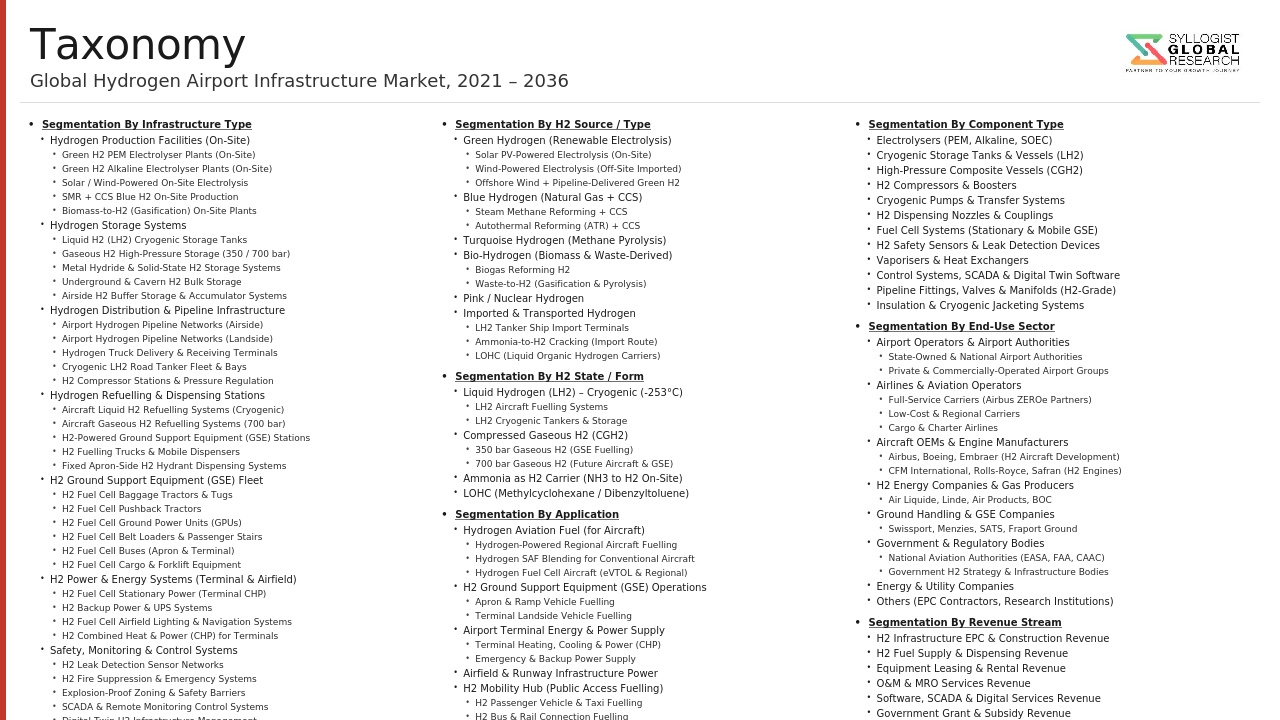
- Segmentation By Infrastructure Type
- On-Site Green Hydrogen Electrolysis Production Facilities
- Hydrogen Receiving Terminals and Pipeline Interface Stations
- Liquid Hydrogen Liquefaction Plants
- Liquid Hydrogen Cryogenic Storage Systems
- Compressed Gaseous Hydrogen Storage Arrays
- Hydrogen Pipeline and Distribution Networks (Airport-Internal)
- Mobile and Fixed Aircraft Hydrogen Refueling Systems
- Hydrogen Hydrant Dispensing Systems
- Hydrogen Ground Support Equipment Refueling Stations
- Hydrogen-Based Stationary Power Generation and UPS Systems
- Safety Monitoring and Emergency Management Systems
- Others
- Segmentation By Hydrogen State
- Liquid Hydrogen (LH2)
- Compressed Gaseous Hydrogen (CGH2), 350 Bar
- Compressed Gaseous Hydrogen (CGH2), 700 Bar
- Cryo-Compressed Hydrogen
- Others
- Segmentation By Hydrogen Production Pathway
- Green Hydrogen (Proton Exchange Membrane Electrolysis)
- Green Hydrogen (Alkaline Electrolysis)
- Green Hydrogen (Anion Exchange Membrane Electrolysis)
- Blue Hydrogen (Steam Methane Reforming with Carbon Capture and Storage)
- Hydrogen Imported via Pipeline
- Hydrogen Delivered via Road Tanker or Rail
- Others
- Segmentation By Application
- Commercial Hydrogen Aircraft Refueling (Fuel Cell Propulsion)
- Commercial Hydrogen Aircraft Refueling (Hydrogen Combustion Turbine)
- Hydrogen Fuel Cell Ground Support Equipment
- Hydrogen-Powered Airside Vehicles and Logistics Fleet
- Hydrogen Fuel Cell Terminal Power and Backup Generation
- Hydrogen-Based Aircraft Pre-Conditioning and De-Icing Equipment
- General Aviation and Business Aviation Hydrogen Refueling
- Military Aviation Hydrogen Infrastructure
- Others
- Segmentation By Airport Category
- Large International Hub Airports (Over 25 Million Annual Passengers)
- Medium International Airports (10 to 25 Million Annual Passengers)
- Regional Airports (1 to 10 Million Annual Passengers)
- Small and Remote Airports (Below 1 Million Annual Passengers)
- Military and Dual-Use Airports
- Others
- Segmentation By Component
- Electrolyzers and Hydrogen Generation Units
- Liquefaction Systems and Cold Boxes
- Cryogenic Storage Tanks and Vacuum-Jacketed Vessels
- High-Pressure Compressors and Buffer Storage Vessels
- Cryogenic Refueling Trucks and Mobile Dispensers
- Fixed Dispensing Arms and Nozzle Assemblies
- Hydrogen Quality Analyzers and Purity Monitoring Equipment
- Leak Detection and Safety Sensor Networks
- Digital Hydrogen Management Platforms and SCADA Systems
- Others
- Segmentation By Ownership and Operating Model
- Airport Authority-Owned and Operated Infrastructure
- Energy Company-Owned Infrastructure with Long-Term Supply Agreements
- Public-Private Partnership (PPP) and Joint Venture Models
- Government-Owned and Funded Demonstrator Infrastructure
- Third-Party Infrastructure as a Service (Hydrogen-as-a-Service)
- Others
- Segmentation By Renewable Energy Source Powering Electrolysis
- Dedicated On-Site Solar Photovoltaic Generation
- Dedicated On-Site Wind Generation
- Grid-Sourced Renewable Energy with Guarantee of Origin Certification
- Hybrid Solar-Wind-Grid Configuration
- Others
- Segmentation By Region
- North America
- Europe
- Asia-Pacific
- Middle East and Africa
- Latin America
All market revenues are presented in USD
Historical Year: 2021–2024 | Base Year: 2025 | Estimated Year: 2026 | Forecast Period: 2027–2035
Key Questions this Study Will Answer
- What is the total global market valuation of the Hydrogen Airport Infrastructure Market in the base year 2025, and what is the projected market size and compound annual growth rate through 2035, disaggregated by infrastructure type, production, liquefaction, storage, distribution, and dispensing, and by hydrogen state, liquid hydrogen versus compressed gaseous hydrogen, to enable airport operators, energy companies, engineering contractors, and infrastructure investors to identify which infrastructure categories and deployment modalities will attract the largest capital investment volumes across the near-term and long-term forecast horizon?
- How are the competing liquid hydrogen and compressed gaseous hydrogen dispensing modalities expected to evolve in market share, capital cost, operational efficiency, and regulatory acceptance across different airport categories, large international hubs, medium regional airports, and small remote airports, through 2035, and at what hydrogen aircraft throughput volume and annual fuel dispensing level does liquid hydrogen infrastructure become economically superior to compressed gaseous hydrogen infrastructure on a total cost of ownership basis at each airport scale category?
- What is the current state of international regulatory and technical standards development for hydrogen airport operations, encompassing fueling interface specifications, safety separation requirements, personnel competency frameworks, and infrastructure certification standards, across ICAO, EASA, FAA, and key national civil aviation authority jurisdictions, and what is the projected timeline for the publication and harmonization of comprehensive hydrogen airport operational standards that would enable unrestricted commercial hydrogen aircraft operations across international airport networks?
- How are government co-investment programs, green hydrogen production cost reduction trajectories, and carbon pricing and sustainable aviation fuel mandate frameworks across the European Union, United States, Japan, South Korea, and Australia expected to evolve in their combined impact on the commercial viability and investment timeline for hydrogen airport infrastructure projects through 2035, and which specific national markets and airport categories are projected to achieve commercially self-sustaining hydrogen infrastructure economics first within the forecast period?
- Who are the leading airport operators, energy majors, electrolyzer and liquefaction technology suppliers, cryogenic infrastructure developers, and engineering procurement and construction firms currently defining the competitive landscape of the global hydrogen airport infrastructure market, and what are their respective hydrogen airport program portfolios, technology investment strategies, public-private partnership models, geographic market priorities, and long-term commercial positioning strategies as the market transitions from demonstrator-scale pilot deployments toward commercially scaled hub airport and regional airport network infrastructure development through the forecast horizon?
- Product Definition
- Research Methodology
- Research Design & Framework
- Overall Research Approach: Descriptive, Exploratory & Quantitative Mixed-Method Design
- Market Definition & Scope Boundaries: What is Included and Excluded
- Segmentation Framework
- Key Research Assumptions & Limitations
- Secondary Research
- Primary Research Design & Execution
- Data Triangulation & Validation
- Market Sizing & Forecasting Methodology
- Competitive Intelligence Methodology
- Quality Assurance & Peer Review
- Definitions, Abbreviations & Data Notes
- Research Design & Framework
- Executive Summary
- Market Snapshot & Headline Numbers
- Key Findings & Research Highlights
- Market Dynamics
- Regional Market Summary
- Competitive Landscape Snapshot
- Technology & Innovation Highlights
- Market Dynamics
- Drivers
- Restraints
- Opportunities
- Challenges
- Porter’s Five Forces Analysis
- PESTLE Analysis
- Market Trends & Developments
- Emerging Trends
- Technological Developments
- Regulatory & Policy Changes
- Supply Chain & Sourcing Trends
- Investment & Funding Activity
- Sustainability & ESG Trends
- Risk Assessment Framework
- Safety & Hazard Risk
- Regulatory & Certification Risk
- Technology & Supply Chain Risk
- Commercial & Financial Risk
- Geopolitical & Energy Security Risk
- Environmental & Community Risk
- Regulatory Framework & Standards
- International Civil Aviation Standards for Hydrogen Infrastructure
- Regional Aviation Regulatory Frameworks
- Hydrogen Safety, Storage & Handling Standards
- Airport Infrastructure & Construction Standards
- Environmental & Planning Regulations
- Global Hydrogen Airport Infrastructure Market Outlook
- Market Size & Forecast by Value
- Market Size & Forecast by Hydrogen Production Capacity (Tonnes per Day / MW Electrolyser)
- Market Size & Forecast by Hydrogen Type
- Green Hydrogen (Renewable Electrolysis)
- Solar-Powered On-Site Electrolysis
- Wind-Powered On-Site Electrolysis
- Hybrid Renewable (Solar + Wind) On-Site Electrolysis
- Grid-Connected Green Hydrogen (Green Tariff PPA-Backed Electrolysis)
- Imported Green Hydrogen (Pipeline or Trucked-In LH2 / CGH2)
- Blue Hydrogen (Natural Gas with CCS)
- Steam Methane Reforming (SMR) + CCS at Airport Hub Scale
- Auto-Thermal Reforming (ATR) + CCS for Large Airport H2 Supply
- Turquoise Hydrogen (Methane Pyrolysis)
- Pink / Nuclear Hydrogen
- Others (Biomass Gasification, Waste-to-Hydrogen)
- Green Hydrogen (Renewable Electrolysis)
- Market Size & Forecast by Infrastructure Component
- Hydrogen Production Systems
- Proton Exchange Membrane (PEM) Electrolysers
- Alkaline Electrolysers (AEL)
- Solid Oxide Electrolysers (SOEL)
- Steam Methane Reformers (SMR) with CCS
- Waste-to-Hydrogen Gasification Units
- Biomass Gasification & Bio-Hydrogen Production Systems
- Hydrogen Storage Systems
- Compressed Gaseous Hydrogen (CGH2) Storage Vessels (350–700 Bar)
- Cryogenic Liquid Hydrogen (LH2) Bulk Storage Tanks
- Cryo-Compressed Hydrogen Storage Systems
- Solid-State Hydrogen Storage (Metal Hydride)
- Underground Hydrogen Storage (Salt Cavern / Lined Rock Cavern)
- Hydrogen Liquefaction Systems
- Large-Scale Industrial H2 Liquefaction Plants (> 10 TPD)
- Mid-Scale Airport H2 Liquefaction Units (1–10 TPD)
- Small Modular H2 Liquefaction Systems (< 1 TPD)
- Hydrogen Transport & Distribution Systems (Within Airport Boundary)
- Airport Hydrogen Pipeline Network (High-Pressure Steel & HDPE)
- Cryogenic LH2 Pipeline & Transfer Systems
- Mobile Hydrogen Refuelling Units (MHRU) & Tube Trailers
- Cryogenic LH2 Road Tanker Unloading & Transfer Stations
- Hydrogen Compressor Stations & Booster Compressors
- Pressure Regulation & Metering Stations
- Hydrogen Dispensing & Aircraft Fuelling Systems
- Compressed Gaseous H2 (CGH2) Aircraft Fuelling Dispensers
- Liquid Hydrogen (LH2) Aircraft Fuelling Dispensers & Couplings
- Hydrogen Fuelling Forecourt for Ground Support Equipment (GSE)
- Precooling & Temperature Management Systems for LH2 Dispensing
- Automated & Robotic Hydrogen Aircraft Fuelling Arms & Coupling Systems
- Hydrogen Fuelling Control Systems & Flow Meters
- Hydrogen Safety, Monitoring & Control Systems
- Hydrogen Leak Detection Sensor Networks (Catalytic, Electrochemical, IR)
- SCADA & Distributed Control Systems (DCS) for Airport H2 Operations
- Flame & Explosion Detection Systems for H2 Facilities
- Emergency Shutdown Systems (ESD) & Pressure Relief Devices
- Ventilation & Hazardous Area Classification Systems
- Hydrogen Quality Analyser & Fuel Quality Monitoring Systems
- Renewable Energy Generation (Dedicated to Airport H2 Production)
- On-Site Solar PV Arrays for Electrolysis Power Supply
- On-Site Wind Turbines for Electrolysis Power Supply
- Battery Energy Storage (BESS) for Renewable H2 Production Buffering
- Power Purchase Agreements (PPA) for Off-Site Renewable Energy Supply
- Electrical Infrastructure & Grid Connection
- High-Voltage Substation & Grid Connection Upgrades for Electrolysis
- On-Site Power Management & Distribution for H2 Production
- Smart Microgrid & Energy Management Systems (EMS)
- Civil & Structural Infrastructure
- Hydrogen Production Building & Electrolyser Hall Construction
- LH2 Storage Tank Civil Foundations & Bund Structures
- Safety Exclusion Zones, Blast Walls & Fire Suppression Systems
- Apron Works: New Hydrogen Fuelling Stands & Utility Trenches
- Control Room & Operations Building for H2 Facility
- Market Size & Forecast by Airport Type
- Large International Hub Airports (> 25 Million Passengers per Year)
- Long-Haul Hub Airport H2 Infrastructure (Future Liquid H2 for Commercial Aircraft)
- Short-Haul Hub with Pioneer Hydrogen Regional Routes
- Medium-Sized International Airports (10–25 Million Passengers per Year)
- Regional & Domestic Airports (2–10 Million Passengers per Year)
- Small & Remote Airports (< 2 Million Passengers per Year)
- Island-Hopping & Short-Range Electric / H2 Aircraft Routes
- Remote Northern & Arctic Airports as Pioneer H2 Aviation Hubs
- Cargo & Freight Airports
- Military Airfields with Hydrogen Infrastructure
- Vertiport & Advanced Air Mobility Hubs with H2 Provision
- Large International Hub Airports (> 25 Million Passengers per Year)
- Market Size & Forecast by End-Use Consumer at Airport
- Hydrogen Aviation: Aircraft Fuelling (Primary End-Use)
- Regional Hydrogen Fuel Cell Aircraft (ZeroAvia, Universal Hydrogen, Heart Aerospace H2)
- Future Liquid H2 Short-Haul Commercial Aircraft (Airbus ZEROe Turbofan / Turboprop)
- eVTOL & Advanced Air Mobility H2-Powered Aircraft
- H2 Combustion Engine Aircraft (Airbus ZEROe Blended Wing Body)
- Hydrogen Ground Support Equipment (GSE) & Airside Vehicles
- H2 Fuel Cell Ground Power Units (GPU)
- H2 Fuel Cell Baggage Tractors & Belt Loaders
- H2 Fuel Cell Pushback Tugs & Aircraft Towbars
- H2 Fuel Cell Aircraft Catering & Cargo Trucks
- H2 Fuel Cell Airside Bus & Passenger Transfer Vehicles
- H2 Fuel Cell Apron Sweepers & Maintenance Vehicles
- Airport Terminal & Landside Operations
- H2 Fuel Cell Stationary Power for Terminal Buildings & Control Towers
- H2 Combined Heat & Power (CHP) for Airport Heating & Cooling
- H2-Powered Car Parks, Taxi & Bus Forecourt Refuelling
- Cargo, Logistics & Ground Transport
- Airport Cargo Terminal H2 Forklift & Material Handling Equipment
- Landside H2 Truck & HGV Refuelling Station Adjacent to Airport
- Rail & Transit H2 Connection at Airport Intermodal Hubs
- Export to Adjacent Industrial & Community Users
- Airport H2 Export to Nearby Industrial Parks & Manufacturing Facilities
- H2 Export to Municipal Transport Fleets via Airport H2 Hub
- Market Size & Forecast by Infrastructure Ownership & Business Model
- Airport Authority-Owned & Operated H2 Infrastructure
- Independent H2 Infrastructure Developer (IPP / H2 Developer Model)
- Energy Major & Industrial Gas Company-Owned Airport H2 Infrastructure
- Public-Private Partnership (PPP) Hydrogen Infrastructure Model
- Airline-Led or OEM-Led H2 Infrastructure Consortium
- Government-Funded & Grant-Supported Pioneer Infrastructure Projects
- Market Size & Forecast by Hydrogen Delivery & Supply Model
- On-Site Green Hydrogen Production (Electrolysis at Airport)
- Trucked-In Compressed Gaseous Hydrogen (CGH2 Tube Trailer Delivery)
- Trucked-In Liquid Hydrogen (LH2 Cryogenic Road Tanker Delivery)
- Hydrogen Pipeline Grid Connection (Regional or National H2 Pipeline)
- Hydrogen Import Terminal Connection (Port-to-Airport H2 Supply)
- Hydrogen Aviation: Aircraft Fuelling (Primary End-Use)
- Hydrogen Production Systems
- North America Hydrogen Airport Infrastructure Market Outlook
- Market Size & Forecast
- By Value
- By Hydrogen Type
- By Infrastructure Component
- By Airport Type
- By End-Use Consumer at Airport
- By Infrastructure Ownership & Business Model
- By Hydrogen Delivery & Supply Model
- Market Size & Forecast
- Europe Hydrogen Airport Infrastructure Market Outlook
- Market Size & Forecast
- By Value
- By Hydrogen Type
- By Infrastructure Component
- By Airport Type
- By End-Use Consumer at Airport
- By Infrastructure Ownership & Business Model
- By Hydrogen Delivery & Supply Model
- Market Size & Forecast
- Asia-Pacific Hydrogen Airport Infrastructure Market Outlook
- Market Size & Forecast
- By Value
- By Hydrogen Type
- By Infrastructure Component
- By Airport Type
- By End-Use Consumer at Airport
- By Infrastructure Ownership & Business Model
- By Hydrogen Delivery & Supply Model
- Market Size & Forecast
- Middle East & Africa Hydrogen Airport Infrastructure Market Outlook
- Market Size & Forecast
- By Value
- By Hydrogen Type
- By Infrastructure Component
- By Airport Type
- By End-Use Consumer at Airport
- By Infrastructure Ownership & Business Model
- By Hydrogen Delivery & Supply Model
- Market Size & Forecast
- Latin America Hydrogen Airport Infrastructure Market Outlook
- Market Size & Forecast
- By Value
- By Hydrogen Type
- By Infrastructure Component
- By Airport Type
- By End-Use Consumer at Airport
- By Infrastructure Ownership & Business Model
- By Hydrogen Delivery & Supply Model
- Market Size & Forecast
- Country-Wise* Hydrogen Airport Infrastructure Market Outlook
- Market Size & Forecast
- By Value
- By Hydrogen Type
- By Infrastructure Component
- By Airport Type
- By End-Use Consumer at Airport
- By Infrastructure Ownership & Business Model
- By Hydrogen Delivery & Supply Model
- Market Size & Forecast
*Countries Analyzed in the Syllogist Global Research Portfolio: United States, Canada, United Kingdom, Germany, France, Netherlands, Norway, Sweden, Spain, Italy, Switzerland, Australia, Japan, South Korea, China, Singapore, India, UAE, Saudi Arabia, Brazil, South Africa
- Pioneer Hydrogen Airport Projects & Case Studies
- Europe Pioneer Hydrogen Airport Projects
- North America Pioneer Hydrogen Airport Projects
- Middle East & Africa Pioneer Hydrogen Airport Projects
- Technology Landscape & Innovation Analysis
- Green Hydrogen Production Technology for Airport Applications
- Hydrogen Liquefaction Technology for Airports
- Cryogenic LH2 Storage Technology for Airports
- Compressed Gaseous Hydrogen (CGH2) Storage Technology for Airports
- Hydrogen Dispensing & Aircraft Fuelling Technology
- Hydrogen Safety Technology for Airport Environments
- Digital Technology & Smart Airport H2 Operations
- Hydrogen Ground Support Equipment (GSE) Technology
- Patent & IP Landscape in Airport Hydrogen Infrastructure
- Value Chain & Supply Chain Analysis
- Renewable Energy Supply for Airport Green H2 Production
- Electrolyser & H2 Production Equipment Supply Chain
- Hydrogen Liquefaction & Cryogenic Equipment Supply Chain
- CGH2 Compression & Storage Equipment Supply Chain
- Hydrogen Dispensing & Fuelling System Supply Chain
- Hydrogen Safety, Monitoring & Control System Supply Chain
- Civil, Structural & EPC Contractors for Airport H2 Infrastructure
- Airport Operators, Developers & Concessionaires
- Airlines, Hydrogen Aircraft OEMs & Ground Handlers
- Industrial Gas Companies & Energy Majors
- Pricing Analysis
- Green Hydrogen Production Cost Analysis at Airport Scale
- Hydrogen Liquefaction & Storage Cost Analysis
- Hydrogen Transport & Delivery Cost Analysis
- Hydrogen Dispensing & Airport Fuelling Infrastructure Capital Cost
- Total Airport H2 Infrastructure Capital Cost Modelling
- Airport H2 Fuel Dispensed Price to Aircraft ($/kg H2 at Wing)
- Sustainability & Energy Efficiency
- Carbon Emission Reduction Potential of Airport Hydrogen Infrastructure
- Airport Net-Zero & Sustainability Pathway Integration
- Lifecycle Assessment (LCA) of Airport Hydrogen Infrastructure
- Water Consumption & Environmental Management
- ESG Reporting & Sustainability Disclosure
- Competitive Landscape
- Market Structure & Concentration
- Player Classification
- Competitive Analysis Frameworks
- Market Share Analysis by Component, Region & Airport Type
- Company Profile
- Company Overview & Headquarters
- Hydrogen Airport Infrastructure Products, Systems & Services Portfolio
- Key Airport H2 Projects, Contracts & Deployment Status
- Technology Capabilities & IP in Airport H2 Infrastructure
- Revenue & Investment in Airport H2 Segment
- Key Strategic Partnerships, JVs & Consortium Memberships
- Recent Developments (Contract Wins, Project Launches, Certifications, M&A)
- SWOT Analysis
- Strategic Focus Areas & Roadmap for Airport H2 Infrastructure
- Competitive Positioning Map (Technology Maturity vs. Airport H2 Market Penetration)
- Key Company Profiles
- Strategic Output
- Market Opportunity Matrix – By Infrastructure Component, Airport Type & Geography
- White Space Opportunity Analysis
- Strategic Recommendations
- Infrastructure Investment & Phasing Strategy
- Green Hydrogen Supply Strategy
- Regulatory Engagement & Safety Certification Strategy
- Partnership & Ecosystem Development Strategy
- Financing & Business Model Strategy
- Sustainability & Net-Zero Integration Strategy
- Risk Mitigation & Future Roadmap
- Strategic Priority Matrix & Roadmap
- Near-term (2025–2028)
- Mid-term (2029–2032)
- Long-term (2033–2038)