Market Definition
The Global Directed Energy Weapons Market encompasses the research, development, engineering, manufacturing, integration, testing, and procurement of weapons systems that achieve their intended effect by emitting highly focused energy in the form of high-energy laser beams, high-power microwave radiation, particle beams, or millimeter-wave electromagnetic pulses directed at target objects, personnel, electronic systems, or airborne threats to disable, damage, destroy, or deter without the use of conventional kinetic projectiles or explosive warheads. A directed energy weapon is a beam-form energy projection system engineered to deliver sufficient power density at operationally relevant ranges to achieve defined mission effects, integrating a primary energy source, a beam generation subsystem, a beam control and tracking architecture incorporating high-precision electro-optical or radar-based target acquisition and fire control, a thermal management system capable of dissipating the substantial waste heat generated during high-power operation, and a power conditioning and storage subsystem that manages the conversion of prime power into the precise electrical waveforms required by the beam generation technology. The market encompasses the complete directed energy weapon system value chain, including laser gain media and resonator assemblies, fiber laser and solid-state laser modules, high-power microwave magnetron and gyrotron sources, adaptive optics and beam director assemblies, gimbal and pointing and tracking systems, power generation and energy storage subsystems, thermal management and cooling systems, battle management and fire control software, and operator interface and system integration hardware that constitute the complete directed energy weapon system delivered to military operational units. Key participants include prime defense systems integrators, specialist high-energy laser and microwave technology developers, photonics and laser component manufacturers, power electronics and energy storage system suppliers, defense procurement agencies of major military powers, and allied interoperability standardization bodies whose operational requirements and safety certification frameworks define the engineering performance parameters governing directed energy weapon system qualification globally.
Market Insights
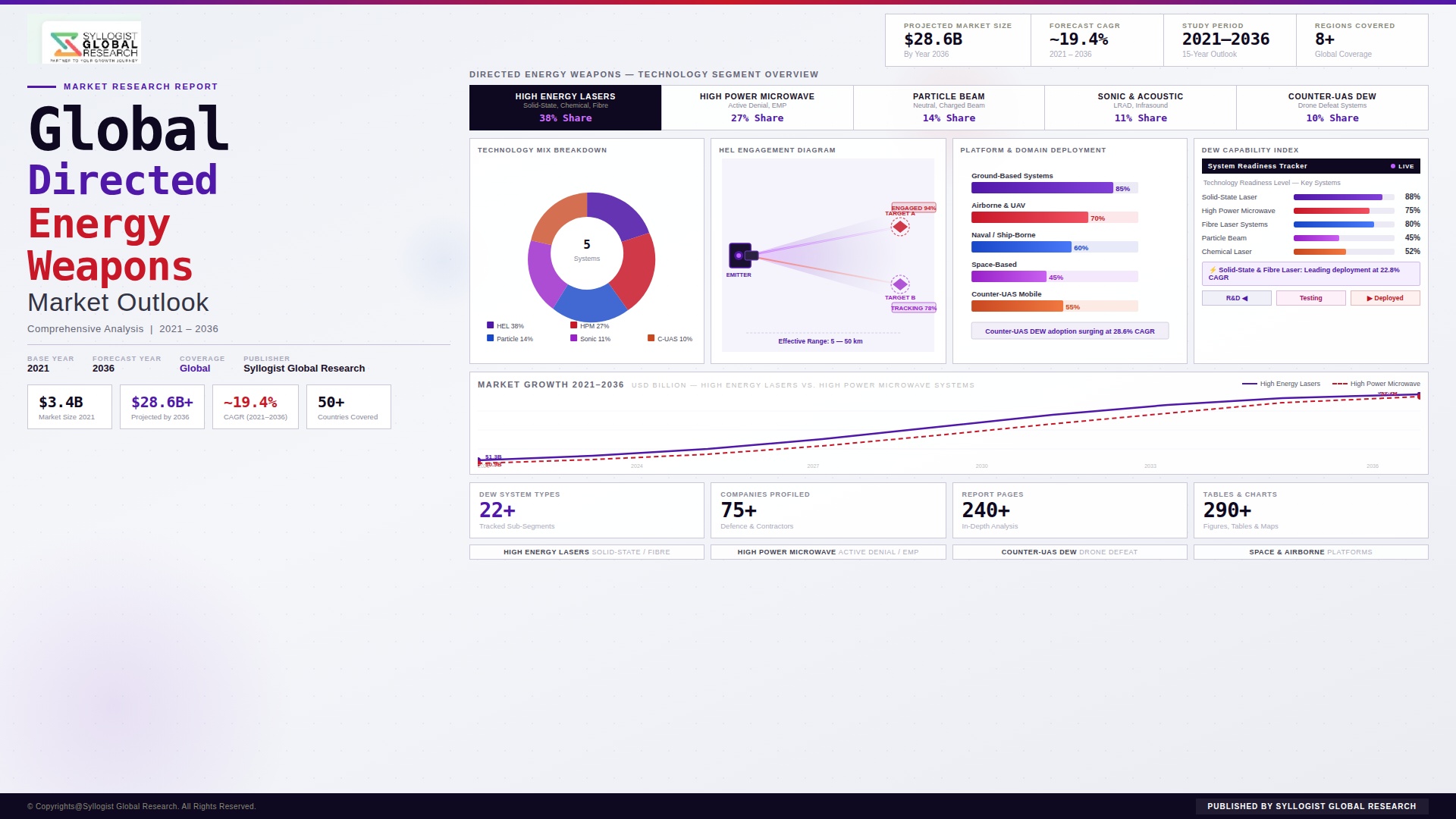
The global directed energy weapons market is transitioning from a decades-long research and development phase into a commercially significant procurement and fielding phase, driven by the convergence of mature solid-state and fiber laser technology now capable of sustaining multi-kilowatt to multi-hundred-kilowatt output power levels in ruggedized military platform configurations, escalating threat environments characterized by proliferating low-cost unmanned aerial vehicle swarms and cruise missile salvos that are economically unsustainable to defeat with conventional kinetic interceptors, and a broad defense establishment recognition that directed energy systems offer a near-zero marginal cost-per-shot engagement model that fundamentally transforms the cost exchange ratio governing missile defense and counter-drone operations. The global directed energy weapons market was valued at approximately USD 8.3 billion in 2025 and is projected to reach USD 24.6 billion by 2034, advancing at a compound annual growth rate of 12.8% over the forecast period from 2027 to 2034, as multiple national defense establishments transition from technology demonstration programs to series production procurement contracts for operationally deployed laser and high-power microwave weapon systems across ground-based, naval, and airborne platform integration programs. The structural demand foundation for directed energy weapon procurement is reinforced by the multi-year defense budget growth commitments of NATO member states, the accelerating Indo-Pacific defense investment of treaty allies, and the directed energy weapon capability development programs of major competing military powers that are compelling defense establishments to accelerate their own fielding timelines to avoid strategic capability gaps in the high-intensity conflict environments for which current and next-generation military forces are being structured.
The technology landscape of directed energy weapons is characterized by three principal beam generation approaches whose maturity levels, operational capability profiles, and procurement trajectories are diverging significantly as the market transitions toward series production. High-energy laser systems represent approximately 61% of total directed energy weapon market revenue in 2025, with fiber laser and solid-state laser platforms in the 10-kilowatt to 300-kilowatt output power range demonstrating sufficient atmospheric propagation performance, beam quality, and target dwell capability in realistic operational environments to support the deployment of counter-unmanned aerial vehicle, counter-rocket artillery mortar, and counter-cruise missile laser weapon systems aboard naval vessels, ground-based air defense platforms, and increasingly aboard airborne tactical aircraft. High-power microwave weapons represent the second principal technology family, offering the tactically distinctive capability to disable the electronics of multiple simultaneous targets within a defined engagement cone through a single transmission event, providing area-effect soft-kill capability against drone swarms, communications infrastructure, and vehicle electronic systems that high-energy laser single-target engagement geometries cannot replicate, and generating growing procurement interest for perimeter security, base protection, and counter-swarm applications. Particle beam weapons remain at the most nascent development and deployment readiness stage among the three principal directed energy technology families, with accelerator physics, power conditioning, and atmospheric propagation challenges continuing to constrain particle beam weapon capability to laboratory and experimental platform demonstrations rather than operationally deployed systems within the current forecast horizon, while millimeter-wave active denial systems for non-lethal crowd control and area denial applications represent a separate commercially deployed sub-segment with an established but limited procurement base primarily among United States and allied military and law enforcement customers.
From a regional standpoint, North America constitutes the largest and most technologically advanced regional market for directed energy weapons, driven by sustained United States Department of Defense investment across all military services, with the Army High Energy Laser Mobile Demonstrator and Mobile Short-Range Air Defense laser programs, the Navy Solid-State Laser Technology Maturation and High Energy Laser with Integrated Optical-dazzler and Surveillance programs, and the Air Force Self-Protect High Energy Laser Demonstrator airborne laser weapon integration initiative collectively representing a generational transformation of military directed energy weapon capability from laboratory demonstrator to program-of-record procurement status. The United States directed energy weapons procurement budget allocated approximately USD 1.2 billion in fiscal year 2025 across active programs spanning all service branches and operational domain requirements, with future year defense program projections indicating continued budget growth as laser weapon programs transition from engineering and manufacturing development to low-rate initial production and full-rate production milestones. Asia-Pacific is the fastest-growing regional procurement market, driven by Chinese directed energy weapon capability development encompassing naval ship-mounted laser systems, ground-based counter-drone laser batteries, and airborne laser self-protection systems across multiple parallel development programs, as well as substantial investment by Japan, South Korea, India, and Australia responding to regional strategic dynamics. Europe has experienced a marked acceleration in directed energy weapon investment, with Germany, France, the United Kingdom, and Israel advancing ground-based and naval laser weapon programs that are progressing toward initial production commitments within the forecast period.
The operational deployment experience accumulating across early fielded directed energy weapon systems is generating performance insights and capability limitation recognitions that are substantially reshaping second-generation system design requirements across major defense programs. Atmospheric propagation degradation under adverse weather conditions, including maritime humidity, fog, rain, dust, and battlefield smoke, has emerged as the most operationally consequential limitation of currently deployed high-energy laser systems, with beam propagation attenuation under realistic operational atmospheric conditions reducing effective engagement ranges to levels substantially below clear-air test environment performance figures, driving investment in adaptive optics compensation technology, higher output power scaling, and operational employment doctrine that incorporates environmental engagement window management as a core tactical planning consideration. Thermal management and continuous operation duty cycle limitations represent the second major operational constraint emerging from early deployment experience, as the substantial waste heat generated during sustained high-power laser operation exceeds the cooling capacity of currently integrated platform thermal management architectures at the duty cycles demanded by sustained counter-swarm engagement scenarios, driving a second-generation system engineering priority toward higher wall-plug efficiency laser modules and energy storage buffer systems that enable burst engagement capacity beyond instantaneous generator output limits. These operationally derived lessons are directly informing the requirements documents and acquisition specifications of the next procurement generation of directed energy weapon systems being written across major defense programs, ensuring that second-generation systems address the capability gaps identified through first-generation operational deployment experience in the field.
Key Drivers
Proliferation of Low-Cost Unmanned Aerial Vehicle Threats and Asymmetric Swarm Attack Tactics Creating Economically Unsustainable Kinetic Interceptor Cost Exchange Ratios
The global proliferation of commercially derived and purpose-built military unmanned aerial vehicles, loitering munitions, and autonomous drone systems at unit costs ranging from a few hundred to tens of thousands of dollars per platform has created a strategically acute and economically unsustainable cost exchange problem for conventional kinetic air defense systems whose interceptor missiles cost between USD 30,000 and USD 3 million per round, generating a defense procurement imperative for near-zero marginal cost-per-engagement directed energy weapon systems capable of defeating low-cost drone and cruise missile threats at an engagement cost measured in electrical energy consumed per shot rather than in the cost of a consumed interceptor round. The tactical employment of large-format drone swarms by state and non-state adversaries has been operationally demonstrated in multiple recent conflict theaters as an effective technique for saturating conventional air defense interceptor inventories and kinetic point-defense systems, exposing high-value military assets and infrastructure to successful penetration by follow-on platforms after kinetic interceptor stocks are exhausted, creating a structural operational requirement for directed energy counter-swarm capability that conventional missile and gun-based air defense architectures are physically and economically incapable of satisfying at the salvo sizes and engagement rates required to defeat coordinated multi-hundred or multi-thousand drone swarm attacks. The directed energy weapon solution to this cost-exchange asymmetry, offering a marginal cost per laser engagement of approximately USD 1 to USD 3 of electrical energy consumption regardless of target cost or salvo size, represents a structurally transformative inversion of the cost exchange mathematics that has historically favored offensive missile and drone attack over defensive kinetic interception, providing defense establishments with a compelling economic and operational rationale for directed energy weapon procurement investment that is structurally independent of broader geopolitical and budget expansion drivers.
Maturation of High-Power Fiber Laser and Solid-State Laser Technology Enabling Transition from Laboratory Demonstration to Operationally Deployable Ruggedized Weapon Systems
The directed energy weapons market has reached a pivotal technology maturity inflection point at which the convergence of fiber laser beam combining architectures capable of scaling to multi-hundred-kilowatt continuous wave output power, high-brightness pump diode efficiency improvements that have raised laser wall-plug efficiency from below 20% to above 40% in current-generation systems, ruggedized thermally managed laser head assemblies qualified for mobile platform shock, vibration, and temperature cycling environments, and high-precision adaptive optics beam control systems capable of maintaining near-diffraction-limited beam quality through dynamic atmospheric turbulence compensation, has produced high-energy laser weapon systems whose operational capability, reliability, and size, weight, and power characteristics are sufficient for integration into operational military platform configurations rather than requiring the laboratory infrastructure and operating conditions of earlier technology generation demonstrators. The commercial photonics industry investment in high-power fiber laser technology driven by industrial cutting and welding applications has generated a commercially mature supply chain for laser gain fiber, pump diodes, beam delivery components, and fiber optic power combining hardware that defense laser weapon programs are able to leverage to reduce directed energy weapon system development costs and procurement unit costs relative to the dedicated military-only development pathways of earlier program generations, creating a commercially anchored technology base that continues to improve in performance and reduce in cost at rates driven by the high-volume commercial market rather than by military procurement volumes alone. This technology maturity transition is the enabling condition for the market shift from perpetual demonstration to active procurement that is projected to sustain the compound annual growth rate of 12.8% forecast for the global directed energy weapons market through 2034.
Expanding Multi-Domain Defense Requirements and Platform Integration Programs Across Naval, Ground, and Airborne Applications Broadening the Addressable Procurement Market
The operational requirements for directed energy weapon capability are expanding across all military platform domains simultaneously, driven by the recognition among defense establishments that the drone, cruise missile, and hypersonic threat environments characterizing near-peer conflict scenarios require directed energy capability at the individual platform level rather than solely at fixed installation or dedicated air defense system level, generating a structural broadening of the directed energy weapon addressable market from a historically narrow set of specialized ground-based and naval platform integration programs toward a diverse and high-volume requirement spanning tactical vehicles, naval surface combatants, expeditionary force protection systems, airborne self-protection and offensive strike platforms, and evolving space-based directed energy applications. Naval directed energy weapon integration programs represent the most advanced and well-funded current procurement segment, driven by the operational requirement to defend naval surface combatants against anti-ship missile saturation attacks and drone swarm threats in contested maritime environments where the finite interceptor magazine capacity of conventional shipboard air defense systems represents a critical vulnerability that directed energy unlimited-magazine engagement capacity is uniquely capable of addressing. Ground-based directed energy weapon systems for base and force protection, counter-unmanned aerial vehicle operations, and convoy security are the fastest-growing procurement sub-segment in unit volume terms, with multiple national defense establishments fielding or contracting initial ground-based laser weapon batteries for deployment to operational theaters, generating the operational experience base that is informing next-generation system performance requirements and procurement specifications across the global directed energy weapon market.
Key Challenges
Atmospheric Propagation Degradation Under Adverse Weather and Battlefield Environmental Conditions Limiting Operational Range and Engagement Reliability
The fundamental physical dependency of high-energy laser directed energy weapons on unobstructed atmospheric propagation paths between the weapon system and the intended target represents the most operationally consequential and technically challenging performance limitation confronting deployed directed energy weapon systems, as the beam attenuation, scattering, and thermal blooming effects induced by maritime humidity, fog, rain, dust, smoke, and aerosol environments can reduce effective weapon engagement ranges to a fraction of clear-air theoretical maximum values, creating operational availability constraints that limit the tactical scenarios and geographic environments in which laser directed energy weapons can be relied upon as primary air defense or counter-drone engagement systems rather than as supplementary capability to conventional kinetic interceptors. The maritime operational environment, which represents the largest current directed energy weapon procurement segment through naval platform integration programs, is also among the most demanding atmospheric propagation environments for high-energy laser weapon performance, with maritime boundary layer humidity, sea spray aerosol, and frequent fog and low cloud conditions generating engagement range variability that requires operational planning frameworks to account for significant day-to-day and hour-to-hour fluctuation in laser weapon effective range, complicating the doctrinal integration of directed energy systems into naval air defense engagement sequencing alongside conventional kinetic interceptors. The technical response to atmospheric propagation limitations through output power scaling, adaptive optics wavefront correction, and shorter wavelength laser selection each involve system engineering tradeoffs in terms of platform size, weight, power requirement, and cost that constrain the degree to which atmospheric propagation performance can be improved without driving directed energy weapon system specifications beyond the integration capacity of the tactical platform classes for which they are intended.
Power Generation, Energy Storage, and Thermal Management Requirements Imposing Substantial Size, Weight, and Platform Integration Constraints on High-Energy Laser Weapon Systems
High-energy laser directed energy weapon systems impose power generation, energy storage, and thermal management demands on their host platforms that are substantially more complex and volume-intensive than those associated with conventional kinetic weapon system integration, creating platform integration engineering challenges that continue to constrain the range of military vehicle, vessel, and aircraft classes into which operationally meaningful laser weapon power levels can be integrated within the size, weight, and available power budgets of current platform designs without requiring dedicated platform reconfiguration or purpose-built unmanned platform design. A 300-kilowatt continuous wave laser weapon system requires a prime power input of approximately 750 kilowatts accounting for current wall-plug efficiency levels, generates approximately 450 kilowatts of waste heat requiring active thermal rejection through coolant loop and heat exchanger systems of substantial volume and weight, and requires an energy storage buffer capable of sustaining burst engagement capacity during engagement sequences that momentarily exceed generator output capacity, collectively defining a power and thermal management system whose integration competes directly with propulsion, fuel, payload, and crew accommodation volume budgets that are tightly constrained in most tactical platform classes. The engineering response to these platform integration constraints is driving directed energy weapon system development along two parallel paths: the development of increasingly efficient laser modules whose higher wall-plug efficiency reduces waste heat generation and prime power requirement per unit of laser output power, and the development of modular containerized directed energy weapon system architectures that consolidate laser, power, cooling, and fire control into self-contained deployable units, accepting a degree of operational flexibility constraint in exchange for practical integration into existing platform inventories.
Acquisition Cost, Lifecycle Sustainment Investment, and Long Development-to-Fielding Timelines Creating Procurement Risk and Budget Competition with Mature Kinetic Weapon Alternatives
The development and initial procurement of operationally capable directed energy weapon systems involves program investment levels substantially higher than the procurement cost of the conventional kinetic weapon systems they are intended to supplement or replace in specific mission roles, with high-energy laser weapon system development programs at the 100-kilowatt to 300-kilowatt power class incurring total development and initial production costs in the range of USD 400 million to USD 1.1 billion before the first operational units are delivered, creating substantial upfront procurement budget commitments that must compete with the immediate operational capability and established logistics support infrastructure of mature kinetic air defense and counter-drone systems that defense procurement authorities can acquire at lower program risk and shorter delivery timelines. The lifecycle sustainment cost structure of directed energy weapon systems, while benefiting from near-zero consumable ammunition cost per engagement, involves complex maintenance requirements for precision optical components, laser gain media with finite operational lifetime, cooling system servicing, and fire control sensor calibration that require specialist sustainment support infrastructure and technical workforce capability not currently present within the organic maintenance establishments of most operational military units, necessitating contractor logistics support arrangements that add materially to the total ownership cost calculation evaluated against kinetic weapon system alternatives with established and widely distributed organic maintenance capability. The extended development timelines of directed energy weapon programs, which typically span 8 to 15 years from technology maturation initiation to initial operational capability declaration, create technology obsolescence and threat environment evolution risks that can result in fielded system capability being mismatched to the threat environment at the time of deployment if adversary drone, missile, and electronic attack capabilities evolve faster than the directed energy weapon program development cycle.
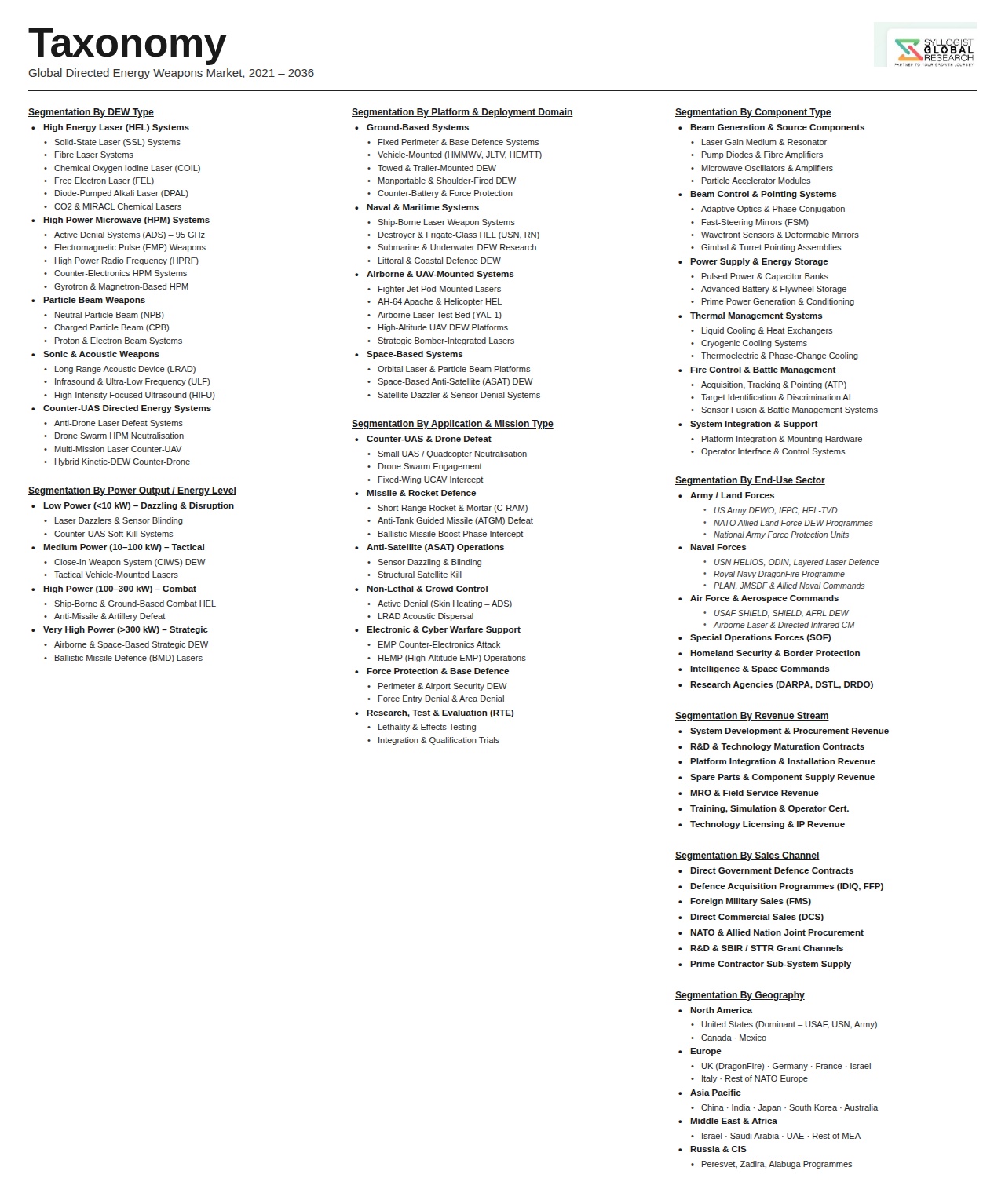
Market Segmentation
- Segmentation By Technology Type
- High-Energy Laser (HEL) Weapons
- High-Power Microwave (HPM) Weapons
- Particle Beam Weapons
- Millimeter-Wave Active Denial Systems
- Others
- Segmentation By Laser Type
- Fiber Laser Systems
- Solid-State Laser Systems
- Chemical Laser Systems
- Free Electron Laser Systems
- Diode-Pumped Laser Systems
- Others
- Segmentation By Power Output Level
- Below 10 kW (Low-Power Systems)
- 10 kW to 50 kW (Medium-Power Systems)
- 51 kW to 150 kW (High-Power Systems)
- 151 kW to 300 kW (Very High-Power Systems)
- Above 300 kW (Strategic-Class Systems)
- Segmentation By Platform
- Ground-Based Fixed Installation Systems
- Ground-Based Mobile and Vehicle-Mounted Systems
- Naval Surface Vessel-Mounted Systems
- Airborne Platform-Integrated Systems
- Space-Based Directed Energy Systems
- Others
- Segmentation By Mission Application
- Counter-Unmanned Aerial Vehicle (C-UAV) and Counter-Drone
- Counter-Rocket, Artillery, and Mortar (C-RAM)
- Anti-Cruise Missile and Anti-Ship Missile Defense
- Counter-Hypersonic Glide Vehicle Defense
- Electronic System Disruption and Soft Kill
- Perimeter and Base Force Protection
- Non-Lethal Crowd Control and Area Denial
- Anti-Satellite and Space Domain Operations
- Others
- Segmentation By Component
- Laser Source and Beam Generation Subsystem
- Beam Director and Adaptive Optics Assembly
- Pointing, Tracking, and Fire Control System
- Power Generation and Energy Storage Subsystem
- Thermal Management and Cooling System
- Battle Management and C2 Software
- Operator Interface and System Integration Hardware
- Others
- Segmentation By Engagement Effect
- Lethal Hard-Kill (Structural Destruction)
- Soft-Kill (Electronics Disruption and Sensor Denial)
- Non-Lethal Dazzling and Temporary Incapacitation
- Area Denial and Anti-Personnel Effects
- Segmentation By End User
- Army and Land Forces
- Navy and Marine Corps
- Air Force and Aerospace Defense
- Special Operations Forces
- Space Force and Strategic Defense Commands
- Homeland Security and Critical Infrastructure Protection
- Others
- Segmentation By Region
- North America
- Europe
- Asia-Pacific
- Middle East and Africa
- Latin America
All market revenues are presented in USD
Historical Year: 2021-2024 | Base Year: 2025 | Estimated Year: 2026 | Forecast Period: 2027-2034
Key Questions this Study Will Answer
- What is the total global market valuation of the Directed Energy Weapons Market in the base year 2025, and what is the projected market size and compound annual growth rate through 2034, disaggregated by technology type, high-energy laser, high-power microwave, particle beam, and millimeter-wave, and by platform, ground-based, naval, airborne, and space-based, to enable defense contractors, directed energy system developers, component suppliers, defense procurement agencies, and strategic investors to identify which technology family and platform integration segment will generate the highest absolute revenue and the most durable procurement growth trajectory across the forecast period in the context of the global counter-drone and missile defense capability investment cycle?
- How is the escalating proliferation of low-cost unmanned aerial vehicle threats, loitering munitions, and coordinated drone swarm attack tactics reshaping defense establishment air defense procurement priorities, engagement cost exchange ratio evaluations, and directed energy weapon program funding allocations across North America, Europe, Asia-Pacific, and the Middle East, and what is the projected addressable market size for directed energy counter-drone and counter-swarm systems specifically, disaggregated by platform class and power output tier, through 2034 as operational deployment experience from fielded systems accumulates and second-generation procurement programs are initiated?
- What is the current operational readiness level, program-of-record procurement status, and projected fielding timeline of the leading national directed energy weapon programs across the United States, United Kingdom, Germany, Israel, China, and other major military powers, and which specific platform integration programs, including naval vessel-mounted laser systems, ground-based mobile air defense laser batteries, and airborne self-protection laser systems, are expected to transition from engineering and manufacturing development to low-rate initial production and full-rate production status within the forecast period, generating the largest incremental procurement revenue contributions to the global market?
- How are atmospheric propagation performance limitations, platform power and thermal management integration constraints, and operational duty cycle restrictions identified through first-generation directed energy weapon deployment experience reshaping the technical requirements, power output targets, beam control architecture specifications, and platform integration approaches of second-generation directed energy weapon system development programs, and what is the estimated performance improvement and unit procurement cost reduction trajectory for 100-kilowatt to 300-kilowatt class high-energy laser weapon systems between 2025 and 2034 as technology maturation and manufacturing scale combine to improve system capability and reduce program unit costs?
- Who are the leading prime defense contractors, specialist directed energy system developers, high-power laser and microwave component manufacturers, adaptive optics and beam control technology suppliers, and power electronics and thermal management system integrators currently defining the competitive landscape of the global directed energy weapons market, and what are their respective program portfolios across laser, high-power microwave, and particle beam technology families, manufacturing and system integration capacity strategies, technology development roadmaps for next-generation higher-power and higher-efficiency directed energy systems, and competitive positioning in the key national procurement programs expected to generate the largest directed energy weapon contract awards through 2034?
- Product Definition
- Research Methodology
- Research Design & Framework
- Overall Research Approach: Descriptive, Exploratory & Quantitative Mixed-Method Design
- Market Definition & Scope Boundaries: What is Included and Excluded
- Segmentation Framework
- Key Research Assumptions & Limitations
- Secondary Research
- Primary Research Design & Execution
- Data Triangulation & Validation
- Market Sizing & Forecasting Methodology
- Competitive Intelligence Methodology
- Quality Assurance & Peer Review
- Definitions, Abbreviations & Data Notes
- Research Design & Framework
- Executive Summary
- Market Snapshot & Headline Numbers
- Key Findings & Research Highlights
- Market Dynamics
- Regional Market Summary
- Competitive Landscape Snapshot
- Technology & Innovation Highlights
- Market Dynamics
- Drivers
- Restraints
- Opportunities
- Challenges
- Porter’s Five Forces Analysis
- PESTLE Analysis
- Market Trends & Developments
- Emerging Trends
- Technological Developments
- Regulatory & Policy Changes
- Supply Chain & Sourcing Trends
- Manufacturing & Process Trends
- Investment & Funding Activity
- Sustainability & ESG Trends
- Risk Assessment Framework
- Geopolitical Tensions, Arms Race Escalation & Export Control Risk
- Technology Maturity, Reliability & Operational Readiness Risk
- Regulatory, International Law & Weapons Convention Compliance Risk
- Cybersecurity, Electronic Warfare Countermeasures & Spoofing Risk
- Budget Volatility, Long Development Cycles & Programme Cancellation Risk
- Regulatory Framework & Standards
- National Defence Acquisition Frameworks & Directed Energy Weapons Procurement Policy
- Export Control Regulations: ITAR, EAR & Wassenaar Arrangement Applicability to Directed Energy Systems
- International Humanitarian Law, Convention on Certain Conventional Weapons (CCW) & Legal Review of DEW
- Electromagnetic Spectrum Management, RF Emission & Safety Standards for High-Power Systems
- Environmental & Health Safety Standards: Laser Eye Safety, RF Exposure & High-Power Microwave Regulations
- Global Directed Energy Weapons Market Outlook
- Market Size & Forecast by Value
- Market Size & Forecast by Volume (Units Procured & Systems Deployed)
- Market Size & Forecast by Weapon Type
- High-Energy Laser (HEL) Weapons Systems
- High-Power Microwave (HPM) & Radio Frequency (RF) Weapons Systems
- Particle Beam Weapons Systems
- Sonic & Acoustic Directed Energy Systems
- Non-Lethal & Counter-Personnel Directed Energy Systems
- Hybrid & Multi-Mode Directed Energy Systems
- Market Size & Forecast by Technology
- Solid-State Laser (SSL) & Fibre Laser Technology
- Chemical Oxygen Iodine Laser (COIL) & Gas Laser Technology
- Free Electron Laser (FEL) Technology
- High-Power Microwave (HPM) & Gyrotron-Based Emitter Technology
- Beam Control, Adaptive Optics & Atmospheric Compensation Technology
- Power Generation, Energy Storage & Thermal Management Technology
- Target Acquisition, Fire Control & Tracking System Technology
- AI-Enabled Engagement Automation & Multi-Target Prioritisation Technology
- Market Size & Forecast by Power Output Level
- Low-Power Systems (Below 10 kW): Counter-UAS, Dazzlers & Non-Lethal Applications
- Medium-Power Systems (10 kW to 100 kW): Tactical Air & Missile Defence
- High-Power Systems (Above 100 kW): Strategic Missile Defence & Ship-Based Applications
- Market Size & Forecast by Platform
- Ground-Based Fixed & Mobile Platforms
- Airborne Platforms: Combat Aircraft, Transport Aircraft & UAV Integration
- Naval & Shipborne Platforms
- Space-Based Platforms
- Man-Portable & Vehicle-Mounted Short-Range Systems
- Market Size & Forecast by Application
- Counter-Unmanned Aerial Systems (C-UAS) & Drone Defence
- Air & Missile Defence: Short, Medium & Long-Range Threat Intercept
- Counter-Swarm & Area Denial Operations
- Intelligence, Surveillance & Reconnaissance (ISR) Disruption
- Electronic Attack, Jamming & Cyber-Physical Disruption
- Non-Lethal Crowd Control, Perimeter & Force Protection
- Anti-Satellite (ASAT) & Space Asset Disruption
- Market Size & Forecast by End-User
- Army & Land Forces
- Air Force & Air Defence Commands
- Navy & Maritime Forces
- Space Forces & Strategic Command
- National Security, Border Protection & Homeland Defence Agencies
- Market Size & Forecast by Sales Channel
- Direct Government-to-Government (G2G) & Foreign Military Sales (FMS)
- Prime Defence Contractor & OEM Direct Supply
- System Integration, Technology Licensing & Co-Development Partnership
- Maintenance, Upgrade, Spares & Through-Life Support Contract
- North America Directed Energy Weapons Market Outlook
- Market Size & Forecast
- By Value
- By Volume (Units Procured & Systems Deployed)
- By Weapon Type
- By Technology
- By Power Output Level
- By Platform
- By Application
- By End-User
- By Country
- By Sales Channel
- Market Size & Forecast
- Europe Directed Energy Weapons Market Outlook
- Market Size & Forecast
- By Value
- By Volume (Units Procured & Systems Deployed)
- By Weapon Type
- By Technology
- By Power Output Level
- By Platform
- By Application
- By End-User
- By Country
- By Sales Channel
- Market Size & Forecast
- Asia-Pacific Directed Energy Weapons Market Outlook
- Market Size & Forecast
- By Value
- By Volume (Units Procured & Systems Deployed)
- By Weapon Type
- By Technology
- By Power Output Level
- By Platform
- By Application
- By End-User
- By Country
- By Sales Channel
- Market Size & Forecast
- Latin America Directed Energy Weapons Market Outlook
- Market Size & Forecast
- By Value
- By Volume (Units Procured & Systems Deployed)
- By Weapon Type
- By Technology
- By Power Output Level
- By Platform
- By Application
- By End-User
- By Country
- By Sales Channel
- Market Size & Forecast
- Middle East & Africa Directed Energy Weapons Market Outlook
- Market Size & Forecast
- By Value
- By Volume (Units Procured & Systems Deployed)
- By Weapon Type
- By Technology
- By Power Output Level
- By Platform
- By Application
- By End-User
- By Country
- By Sales Channel
- Market Size & Forecast
- Country-Wise* Directed Energy Weapons Market Outlook
- Market Size & Forecast
- By Value
- By Volume (Units Procured & Systems Deployed)
- By Weapon Type
- By Technology
- By Power Output Level
- By Platform
- By Application
- By End-User
- By Country
- By Sales Channel
- Market Size & Forecast
*Countries Analyzed in the Syllogist Global Research Portfolio: United States, Canada, United Kingdom, Germany, France, Israel, Russia, China, Japan, India, South Korea, Australia, Turkey, Saudi Arabia, UAE, Brazil, Poland, Sweden, Italy, Norway
- Technology Landscape & Innovation Analysis
- High-Energy Laser (HEL): Solid-State, Fibre & Chemical Laser Technology Deep-Dive
- High-Power Microwave (HPM) & Gyrotron Emitter Technology Deep-Dive
- Beam Control, Adaptive Optics & Atmospheric Turbulence Compensation Technology
- Power Generation, Energy Storage & Thermal Management for Directed Energy Systems
- AI-Enabled Fire Control, Target Tracking & Multi-Threat Engagement Automation
- Counter-DEW, Hardening & Directed Energy Survivability Technology
- Miniaturisation, Integration & Platform Packaging Technology for Tactical DEW
- Patent & IP Landscape in Directed Energy Weapons Technologies
- Value Chain & Supply Chain Analysis
- Laser Gain Media, Optics & Photonic Component Manufacturing Supply Chain
- High-Power RF Source, Antenna & Microwave Component Supply Chain
- Power Electronics, Energy Storage & Thermal Management Systems Supply Chain
- Beam Control, Gimbal, Turret & Precision Pointing Mechanism Supply Chain
- Fire Control Software, AI Engagement Systems & Sensor Integration Supply Chain
- Prime Defence Contractor, System Integrator & OEM Landscape
- MRO, Field Support, Upgrades & Through-Life Support Channel
- Pricing Analysis
- Low-Power Counter-UAS & Non-Lethal DEW System Unit Cost & Programme Cost Analysis
- Medium-Power Tactical Laser System Procurement & Operating Cost Analysis
- High-Power Naval & Strategic DEW Platform Development & Unit Cost Analysis
- HPM & RF Directed Energy System Unit Pricing & Lifecycle Cost Analysis
- Power Source, Beam Control & Optics Sub-System Cost Structure Analysis
- Total Programme Economics: Development, Qualification, Procurement & Sustainment Cost Modelling
- Sustainability & Environmental Analysis
- Lifecycle Environmental Impact Assessment of Directed Energy Weapons: Energy Consumption, Materials & Emissions
- Transition from Kinetic to Directed Energy: Logistics Footprint Reduction & Operational Sustainability Benefits
- Electromagnetic Radiation, RF Exposure & Environmental Safety Assessment
- Ethical & Legal Frameworks: International Humanitarian Law Compliance & Proportionality in DEW Deployment
- Defence Industry ESG Commitments, Sustainability Reporting & Responsible Innovation Policy Alignment
- Competitive Landscape
- Market Structure & Concentration
- Market Consolidation Level (Fragmented vs. Consolidated by Weapon Type & Geography)
- Top 10 Players Market Share
- HHI (Herfindahl-Hirschman Index) Concentration Analysis
- Competitive Intensity Map by Weapon Type, Technology & Geography
- Player Classification
- Prime Defence Contractors with Integrated Directed Energy Divisions
- Specialist High-Energy Laser (HEL) System Developers
- High-Power Microwave (HPM) & RF Weapons System Providers
- Beam Control, Optics & Photonics Component Specialists
- Power Electronics, Energy Storage & Thermal Management System Providers
- AI Fire Control, Target Acquisition & Engagement Software Providers
- Non-Lethal & Counter-Personnel Directed Energy System Developers
- Defence Technology Start-ups & Dual-Use Photonics Companies
- Competitive Analysis Frameworks
- Market Share Analysis by Weapon Type, Technology & Region
- Company Profile
- Company Overview & Headquarters
- Directed Energy Weapons Products & System Portfolio
- Key Customer Relationships & Reference Programme Deliveries
- Manufacturing Footprint & Production Capacity
- Revenue (Directed Energy Segment) & Backlog
- Technology Differentiators & IP
- Key Strategic Partnerships, JVs & M&A Activity
- Recent Developments (Contract Wins, Programme Milestones, Product Launches)
- SWOT Analysis
- Strategic Focus Areas & Roadmap
- Competitive Positioning Map (Technology Capability vs. Market Penetration)
- Key Company Profiles
- Market Structure & Concentration
- Strategic Opportunity Analysis
- Strategic Output
- Market Opportunity Matrix: By Weapon Type, Technology, Application, End-User & Geography
- White Space Opportunity Analysis
- Strategic Recommendations
- Product Portfolio & Technology Investment Strategy
- Manufacturing & Operational Excellence Strategy
- Geographic Expansion & Localisation Strategy
- Customer & End-User Engagement Strategy
- Partnership, M&A & Ecosystem Strategy
- Sustainability & Responsible Innovation Strategy
- Risk Mitigation & Future Roadmap
- Strategic Priority Matrix & Roadmap
- Near-term (2025-2028)
- Mid-term (2029-2032)
- Long-term (2033-2037)
- Strategic Output