Market Definition
The Global Commercial Aircraft Market encompasses the design, manufacture, assembly, delivery, and aftermarket support of fixed-wing passenger and cargo transport aircraft operated by commercial airlines, cargo carriers, charter operators, and regional aviation companies across domestic and international route networks. The market includes narrowbody jets, widebody jets, regional jets, turboprops, and next-generation sustainable aviation fuel-compatible and hybrid-propulsion platforms, along with associated propulsion systems, avionics, cabin interiors, and maintenance, repair, and overhaul services procured by commercial operators, aircraft lessors, and cargo logistics companies globally.
Market Insights
The global commercial aircraft market is navigating a defining period of structural renewal, shaped by the strongest sustained order backlog in the industry’s history, accelerating replacement demand for aging fuel-inefficient narrowbody and widebody fleets, and a post-pandemic air travel recovery that has outpaced early projections across nearly all major route categories. The market was valued at approximately USD 186.3 billion in 2025 and is projected to reach USD 342.7 billion by 2034, advancing at a compound annual growth rate of 7.0% through the forecast period, as airlines across Asia-Pacific, the Middle East, and emerging markets execute large-scale fleet modernization programs while North American and European carriers accelerate the retirement of legacy platforms in response to fuel cost pressures and tightening carbon emissions regulations.
The narrowbody segment continues to dominate commercial aircraft deliveries by volume, driven by the structural expansion of low-cost carrier networks across Asia-Pacific, South Asia, and Latin America and the replacement of first-generation narrowbody fleets that represent the single largest source of near-term delivery demand across airline order books. Airlines are increasingly prioritizing fuel burn efficiency, extended range capability, and reduced maintenance cost as primary procurement criteria, reflecting operating economics that have materially elevated the financial imperative of fleet modernization relative to historical replacement cycles. The widebody segment is recovering at an accelerating pace as international long-haul travel demand approaches and in several corridor categories exceeds pre-pandemic levels, with carriers in the Middle East, Asia-Pacific, and Europe placing significant new orders for next-generation twin-engine widebody platforms offering substantially improved per-seat fuel economics compared with retiring four-engine aircraft. Cargo aircraft demand is sustaining elevated momentum driven by the continued structural expansion of global e-commerce logistics volumes and the conversion of passenger freighter capacity constrained by belly-hold limitations into dedicated freighter fleet investment.
Sustainable aviation represents the most structurally consequential long-term market dynamic, with airline decarbonization commitments, regulatory carbon pricing frameworks, and progressive sustainable aviation fuel blending mandates creating mounting commercial pressure to accelerate fuel-efficient platform procurement and advance hybrid-electric and hydrogen propulsion technology roadmaps for regional and short-haul aircraft categories. Asia-Pacific is projected to record the highest regional compound annual growth rate through 2034, underpinned by passenger traffic growth in China, India, and Southeast Asia that is generating the largest volume of new aircraft orders in the global commercial aviation pipeline. North America maintains the largest installed fleet and aftermarket services market, while the Middle East carriers continue to place landmark fleet orders that disproportionately influence widebody segment demand and manufacturer production planning horizons. Europe represents a major procurement market characterized by fleet renewal urgency driven by the European Union Emissions Trading System and progressive sustainable aviation fuel mandate implementation across member states.
Key Drivers
Record Commercial Aircraft Order Backlogs and Accelerating Fleet Modernization Programs Generating Sustained Multi-Year Delivery Demand Across Narrowbody and Widebody Segments
The combined order backlog of leading commercial aircraft manufacturers has reached historically unprecedented levels, representing more than a decade of production capacity at current manufacturing output rates, underpinned by airline fleet renewal programs driven by fuel efficiency imperatives, passenger experience upgrade requirements, and the retirement of aging first-generation narrowbody and widebody platforms that constitute the dominant share of near-term replacement demand. Low-cost and ultra-low-cost carriers expanding network coverage across underserved markets in Asia-Pacific, South Asia, and Latin America are generating structurally durable narrowbody demand that extends well beyond cyclical recovery, while network carriers in the Middle East and Asia-Pacific are placing transformative widebody orders that are reshaping long-haul capacity distribution and influencing manufacturer production planning across the full forecast horizon.
Robust Global Air Passenger Traffic Growth and Structural Expansion of Aviation Demand Across Emerging Markets Creating Incremental Fleet Procurement Beyond Replacement Cycle Volumes
Global air passenger traffic has recovered beyond pre-pandemic peak levels across most major markets, with structural growth in emerging aviation markets across South and Southeast Asia, Africa, and Latin America generating new route network development, airline formation activity, and fleet expansion that creates incremental aircraft demand beyond replacement cycle volumes. The expanding middle class across high-growth economies, combined with declining real airfare cost trajectories enabled by fuel-efficient aircraft operations and intensifying low-cost carrier competition, is unlocking latent demand from passenger cohorts previously excluded from regular air travel, creating a durable long-run demand foundation that supports sustained aircraft procurement activity through the full forecast period and reinforces order book stability for commercial aircraft manufacturers across narrowbody and regional aircraft categories.
Aviation Decarbonization Regulations and Airline Sustainability Commitments Accelerating Early Retirement of Legacy Aircraft and Advancing Procurement Timelines for Fuel-Efficient Platforms
Tightening carbon emissions regulations, expanding aviation sector inclusion within emissions trading systems, progressive sustainable aviation fuel blending mandates, and airline net-zero carbon commitment timelines are collectively compelling airlines to accelerate the retirement of fuel-inefficient legacy aircraft and advance procurement timelines for next-generation platforms offering materially superior fuel burn performance and sustainable aviation fuel compatibility. The European Union Emissions Trading System aviation coverage expansion, the International Civil Aviation Organization Carbon Offsetting and Reduction Scheme for International Aviation, and domestic carbon pricing schemes across multiple major aviation markets are imposing measurable financial consequences on continued operation of older-generation aircraft, reinforcing the commercial case for fleet modernization independent of organic traffic growth drivers and creating regulatory urgency that is compressing traditional fleet replacement decision timelines.
Key Challenges
Manufacturing Supply Chain Constraints, Production Ramp-Up Execution Risk, and Skilled Workforce Shortages Limiting Delivery Rate Recovery to Levels Required by Airline Fleet Plans
Commercial aircraft manufacturers are confronting severe supply chain disruption across aerostructures, propulsion systems, avionics, and cabin interior components, with supplier capacity constraints, raw material availability challenges, and workforce shortages across precision manufacturing trades creating systemic production rate limitations that are preventing delivery rate recovery to levels required by airline fleet renewal timelines and manufacturer revenue targets. The extended production ramp-up challenge is compounded by the departure of experienced manufacturing workforce during the pandemic period and the multi-year training investment required to rebuild skilled labor capacity at the precision engineering standards demanded by aircraft primary structure and propulsion component manufacturing, creating a talent pipeline constraint that is largely independent of capital investment and supply chain reorganization efforts by manufacturers and their tier-one partners.
Aircraft Financing Market Volatility, Elevated Interest Rates, and Lessor Portfolio Concentration Risk Constraining Fleet Expansion Investment Among Emerging Market and Regional Airlines
The sharp elevation of global interest rates from historically low post-pandemic levels has materially increased aircraft financing costs for airlines and operating lessors, raising the capital expenditure burden of fleet expansion and replacement programs and disproportionately constraining procurement activity among smaller regional carriers and emerging market airlines that depend on operating lease structures and export credit financing facilities to access new aircraft. Aircraft operating lessors, who collectively own more than half of the global commercial fleet, face portfolio concentration risk, residual value uncertainty for older-generation aircraft displaced by accelerating retirement programs, and rising cost of capital that is reducing lessor appetite for speculative order positions that historically provided production rate stability and order book depth for commercial aircraft manufacturers.
Sustainable Aviation Fuel Production Scale Limitations and Alternative Propulsion Technology Maturation Timelines Creating Strategic and Investment Planning Uncertainty Across the Industry
The commercial aviation industry faces a fundamental tension between near-term fleet renewal economics based on conventional jet fuel combustion technology and the long-term capital allocation requirements of sustainable aviation fuel production infrastructure investment, hybrid-electric propulsion technology development, and hydrogen distribution infrastructure that together define the sector decarbonization pathway. Sustainable aviation fuel production capacity remains a fraction of projected demand despite accelerating investment, with feedstock availability, production economics, and geographic distribution constraints creating near-term supply limitations that expose carriers to regulatory compliance risk under progressive blending mandates. Hydrogen and battery-electric propulsion technology maturation timelines for commercial aircraft applications remain extended beyond the current forecast period, creating strategic uncertainty in platform development planning for both manufacturers and airline fleet planners.
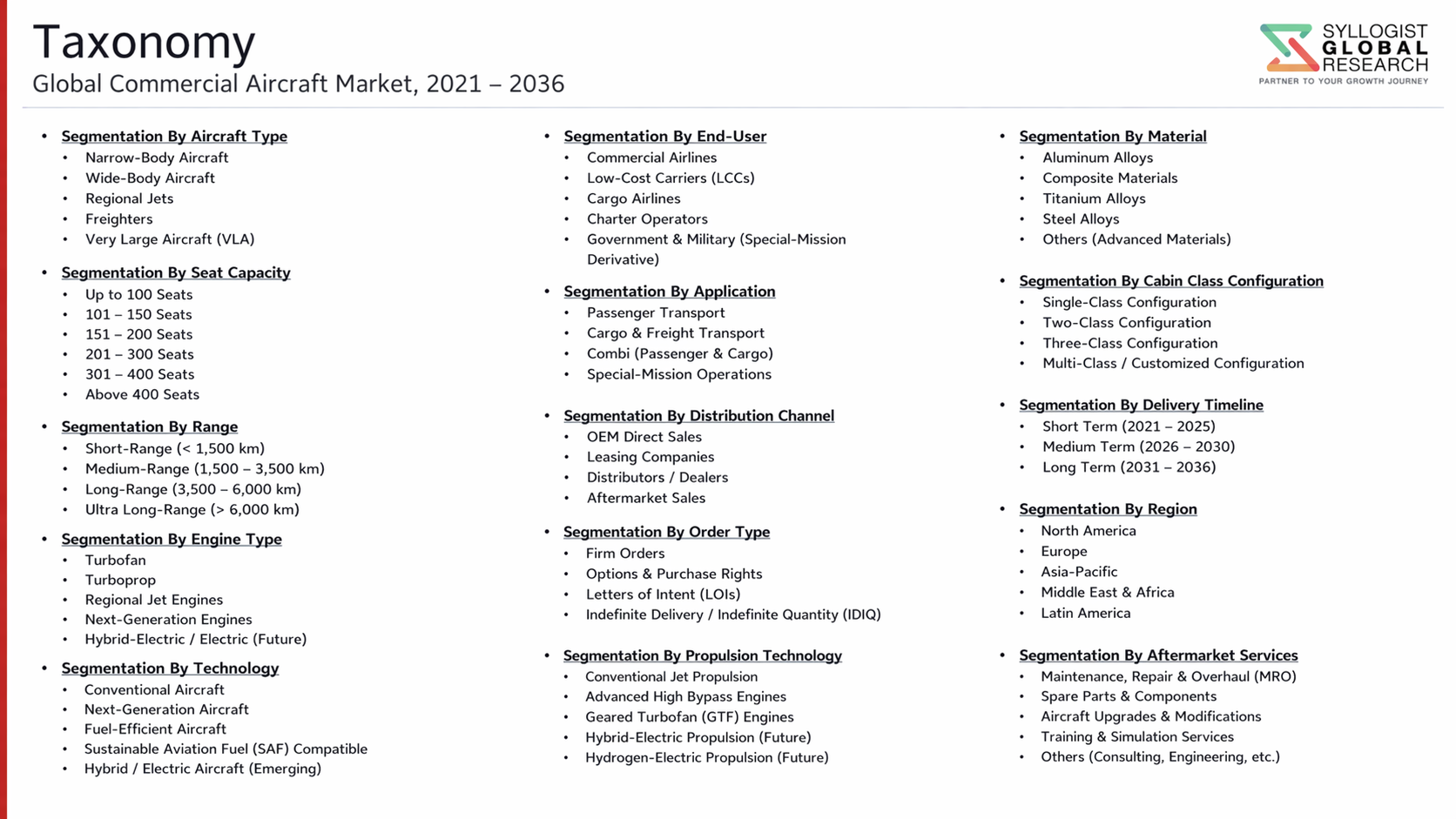
Market Segmentation
- Segmentation By Aircraft Type
- Narrowbody Jets
- Widebody Jets
- Regional Jets
- Turboprop Aircraft
- Freighter and Cargo Aircraft
- Business Jets and VIP Transport Aircraft
- Others
- Segmentation By Seating Capacity
- Below 100 Seats
- 100 to 200 Seats
- 201 to 300 Seats
- 301 to 400 Seats
- Above 400 Seats
- Segmentation By Range
- Short-Range Aircraft (Below 3,000 km)
- Medium-Range Aircraft (3,000 to 6,000 km)
- Long-Range Aircraft (6,000 to 12,000 km)
- Ultra-Long-Range Aircraft (Above 12,000 km)
- Segmentation By Technology
- Conventional Jet Fuel Combustion Technology
- Sustainable Aviation Fuel Compatible Platforms
- Advanced Composite Airframe Technology
- Hybrid-Electric Propulsion Aircraft
- Hydrogen Fuel Cell and Combustion Aircraft
- Others
- Segmentation By Propulsion Type
- High-Bypass Turbofan Engines
- Turboprop Engines
- Open Rotor and Next-Generation Turbofan
- Hybrid-Electric Propulsion Systems
- Hydrogen Propulsion Systems
- Others
- Segmentation By End User
- Full-Service Network Carriers
- Low-Cost and Ultra-Low-Cost Carriers
- Regional and Commuter Airlines
- Cargo and Express Freight Carriers
- Charter and Leisure Carriers
- Aircraft Leasing Companies
- Others
- Segmentation By Region
- North America
- Europe
- Asia-Pacific
- Middle East and Africa
- Latin America
All market revenues are presented in USD
Historical Year: 2021-2024 | Base Year: 2025 | Estimated Year: 2026 | Forecast Period: 2027-2034
Key Questions this Study Will Answer
- What is the total global market valuation of the Commercial Aircraft Market in 2025, projected through 2034, disaggregated by aircraft type, seating capacity, and range category, enabling airlines, lessors, manufacturers, and investors to identify the highest-growth procurement segments and most durable revenue opportunities across the commercial aviation value chain?
- How are leading commercial airlines across Asia-Pacific, the Middle East, North America, and Europe structuring narrowbody and widebody fleet renewal programs, and which aircraft platform families are capturing the largest order share and defining the economic and operational benchmarks shaping commercial aircraft procurement competitiveness through 2034?
- What impact are aviation decarbonization regulations, sustainable aviation fuel mandates, and airline net-zero commitments having on aircraft retirement timelines, new platform procurement priorities, and manufacturer technology development investment, and which propulsion technology pathways are most likely to achieve commercial deployment at scale within the forecast period?
- Which commercial aircraft segments, including narrowbody replacements, next-generation widebody platforms, and regional jet categories, are generating the highest order activity and delivery growth through 2034, and what fuel efficiency, operational range, and maintenance cost specifications are most critical to airline platform selection decisions?
- How are manufacturing supply chain disruptions, production ramp-up execution challenges, and skilled workforce shortages affecting aircraft delivery schedules and program timelines, and what investment and operational strategies are leading manufacturers and tier-one suppliers deploying to restore planned production rate targets?
- How is the aircraft financing and leasing market evolving in response to elevated interest rates and residual value risk for older-generation platforms, and what financing structure innovations and export credit developments are enabling commercial aircraft procurement among capital-constrained regional and emerging market airline operators?
- Which regional commercial aviation markets, specifically Asia-Pacific, the Middle East, and Latin America, are expected to generate the most substantial incremental aircraft demand through 2034, and what passenger traffic growth trajectories, airline formation activity, and airport infrastructure investment factors are shaping fleet procurement priorities in each region?
- Product Definition
- Research Methodology
- Research Design & Framework
- Overall Research Approach: Descriptive, Exploratory & Quantitative Mixed-Method Design
- Market Definition & Scope Boundaries: What is Included and Excluded
- Segmentation Framework
- Key Research Assumptions & Limitations
- Secondary Research
- Primary Research Design & Execution
- Data Triangulation & Validation
- Market Sizing & Forecasting Methodology
- Competitive Intelligence Methodology
- Quality Assurance & Peer Review
- Definitions, Abbreviations & Data Notes
- Research Design & Framework
- Executive Summary
- Market Snapshot & Headline Numbers
- Key Findings & Research Highlights
- Market Dynamics
- Regional Market Summary
- Competitive Landscape Snapshot
- Technology & Innovation Highlights
- Market Dynamics
- Drivers
- Restraints
- Opportunities
- Challenges
- Porter’s Five Forces Analysis
- PESTLE Analysis
- Market Trends & Developments
- Emerging Trends
- Technological Developments
- Regulatory & Policy Changes
- Supply Chain & Sourcing Trends
- Manufacturing & Process Trends
- Investment & Funding Activity
- Sustainability & ESG Trends
- Risk Assessment Framework
- Air Traffic Demand Cyclicality, Macroeconomic Shock & Pandemic-Driven Fleet Demand Disruption Risk
- Aircraft Certification, Airworthiness Authority Oversight & Regulatory Grounding Risk
- Aerospace Supply Chain Concentration, Sole-Source Dependency & Tier 1 Supplier Disruption Risk
- Fuel Price Volatility, Emissions Regulation Tightening & Carbon Cost Exposure Risk for Commercial Aircraft Operators
- Geopolitical Trade Restrictions, Export Licence Controls & Aircraft Delivery Sanctions Risk
- Regulatory Framework & Standards
- FAA Type Certification, Continued Airworthiness & Part 25 Airworthiness Standards for Commercial Transport Aircraft
- EASA CS-25, Certification Specifications & Air Operations Regulations for Large Aeroplanes in European Jurisdictions
- ICAO Annex 8 Airworthiness, Annex 6 Operations & Bilateral Airworthiness Agreements (BASA) Governing Global Aircraft Acceptance
- ICAO CORSIA, Carbon Offsetting & Reduction Scheme for International Aviation & Sustainable Aviation Fuel (SAF) Blending Mandate Frameworks
- Noise Certification Standards (ICAO Annex 16), Engine Emissions Standards (CAEP) & Environmental Performance Regulations for New-Generation Aircraft
- Global Commercial Aircraft Market Outlook
- Market Size & Forecast by Value
- Market Size & Forecast by Volume (Number of Aircraft Deliveries & Fleet in Service)
- Market Size & Forecast by Aircraft Type
- Single-Aisle Narrowbody Aircraft (100 to 200 Seats)
- Small Narrowbody & Regional Jet Aircraft (Below 100 Seats)
- Small Widebody Aircraft (200 to 300 Seats)
- Medium Widebody Aircraft (300 to 400 Seats)
- Large Widebody & Very Large Aircraft (Above 400 Seats)
- Freighter & Cargo Conversion Aircraft
- Next-Generation Narrowbody Aircraft: New Engine Option (NEO) & Re-Engined Variants
- New-Generation Widebody Aircraft: Composite Airframe & Advanced Propulsion Variants
- Market Size & Forecast by Range Category
- Short-Haul Aircraft (Up to 3,000 km Range)
- Medium-Haul Aircraft (3,000 to 7,000 km Range)
- Long-Haul Aircraft (7,000 to 12,000 km Range)
- Ultra-Long-Haul Aircraft (Above 12,000 km Range)
- Market Size & Forecast by Propulsion Technology
- Conventional Turbofan: High-Bypass Ratio Turbofan Powered Aircraft
- New-Generation High-Efficiency Turbofan: LEAP, PW1000G GTF & Equivalent Engine Family Aircraft
- Sustainable Aviation Fuel (SAF)-Compatible & SAF-Optimised Aircraft
- Hybrid-Electric Propulsion Aircraft
- Hydrogen-Powered Aircraft (Cryogenic Liquid Hydrogen & Hydrogen Combustion)
- Battery-Electric Aircraft (Short-Range & Regional Applications)
- Market Size & Forecast by Seating Configuration
- Single-Class High-Density Configuration
- Two-Class Mixed Configuration
- Three-Class Full-Service Configuration
- Business & First Class Long-Haul Premium Configuration
- Market Size & Forecast by Application
- Full-Service Carrier (FSC) & Legacy Airline Operations
- Low-Cost Carrier (LCC) & Ultra-Low-Cost Carrier (ULCC) Operations
- Charter, Leisure & Inclusive Tour Airline Operations
- Regional & Feeder Airline Operations
- Air Cargo, Express Freight & Integrator Operations
- Wet Lease, ACMI & Aircraft Leasing Operations
- Market Size & Forecast by End-User
- Full-Service Network Carriers & Alliance Members
- Low-Cost & Ultra-Low-Cost Carriers
- Regional Airlines & Commuter Operators
- Cargo Airlines, Integrators & Freighter Operators
- Aircraft Lessors & Asset Management Companies
- Government-Owned Flag Carriers & State Airlines
- Market Size & Forecast by Sales Channel
- Direct OEM Order & Delivery (Boeing, Airbus & Other Manufacturers)
- Aircraft Lessor Placement & Operating Lease Delivery
- Used Aircraft, Secondary Market & Cash Buyer Transaction
- Aircraft Purchasing Agent, Broker & Advisory Channel
- North America Commercial Aircraft Market Outlook
- Market Size & Forecast
- By Value
- By Volume (Number of Aircraft Deliveries & Fleet in Service)
- By Aircraft Type
- By Range Category
- By Propulsion Technology
- By Seating Configuration
- By Application
- By End-User
- By Country
- By Sales Channel
- Market Size & Forecast
- Europe Commercial Aircraft Market Outlook
- Market Size & Forecast
- By Value
- By Volume (Number of Aircraft Deliveries & Fleet in Service)
- By Aircraft Type
- By Range Category
- By Propulsion Technology
- By Seating Configuration
- By Application
- By End-User
- By Country
- By Sales Channel
- Market Size & Forecast
- Asia-Pacific Commercial Aircraft Market Outlook
- Market Size & Forecast
- By Value
- By Volume (Number of Aircraft Deliveries & Fleet in Service)
- By Aircraft Type
- By Range Category
- By Propulsion Technology
- By Seating Configuration
- By Application
- By End-User
- By Country
- By Sales Channel
- Market Size & Forecast
- Latin America Commercial Aircraft Market Outlook
- Market Size & Forecast
- By Value
- By Volume (Number of Aircraft Deliveries & Fleet in Service)
- By Aircraft Type
- By Range Category
- By Propulsion Technology
- By Seating Configuration
- By Application
- By End-User
- By Country
- By Sales Channel
- Market Size & Forecast
- Middle East & Africa Commercial Aircraft Market Outlook
- Market Size & Forecast
- By Value
- By Volume (Number of Aircraft Deliveries & Fleet in Service)
- By Aircraft Type
- By Range Category
- By Propulsion Technology
- By Seating Configuration
- By Application
- By End-User
- By Country
- By Sales Channel
- Market Size & Forecast
- Country-Wise* Commercial Aircraft Market Outlook
- Market Size & Forecast
- By Value
- By Volume (Number of Aircraft Deliveries & Fleet in Service)
- By Aircraft Type
- By Range Category
- By Propulsion Technology
- By Seating Configuration
- By Application
- By End-User
- By Country
- By Sales Channel
- Market Size & Forecast
*Countries Analyzed in the Syllogist Global Research Portfolio: United States, Canada, Mexico, Germany, France, United Kingdom, Netherlands, Spain, Italy, Norway, Sweden, China, Japan, India, Australia, South Korea, Singapore, Brazil, Chile, Saudi Arabia, UAE, Egypt, South Africa, Israel
- Technology Landscape & Innovation Analysis
- Next-Generation Turbofan Engine Technology: Geared Turbofan (GTF), LEAP & Open Fan Architecture Deep-Dive
- Advanced Composite Airframe, Lightweight Materials & Aerodynamic Design Technology
- Fly-by-Wire Flight Control, Avionics Architecture & Integrated Modular Avionics (IMA) Technology
- Sustainable Aviation Fuel (SAF) Compatibility, Drop-In Fuel Technology & Hydrogen Propulsion Development
- Hybrid-Electric & Electric Propulsion Architecture Technology for Short-Haul & Regional Aircraft
- Connected Aircraft, Real-Time Data Analytics, Predictive Maintenance & Digital Twin Technology
- Cabin Innovation: Advanced In-Flight Entertainment, Connectivity, Cabin Pressurisation & Passenger Comfort Technology
- Patent & IP Landscape in Commercial Aircraft Design, Propulsion & Systems Technologies
- Value Chain & Supply Chain Analysis
- Airframe Structures, Fuselage Section & Wing Assembly Manufacturing Supply Chain
- Commercial Turbofan Engine Design, Manufacturing & Assembly Supply Chain
- Avionics, Flight Control, Navigation & Communication Systems Supply Chain
- Landing Gear, Actuation, Hydraulics & Aircraft Systems Equipment Supply Chain
- Cabin Interiors, Seats, Galleys, In-Flight Entertainment & Connectivity Supply Chain
- Final Assembly Line (FAL), OEM Delivery & Aircraft Completion Centre Channel
- Aircraft Lessor, Airline Customer & End-Operator Delivery & Acceptance Channel
- Pricing Analysis
- Commercial Aircraft List Price, Catalogue Price & Estimated Transaction Price Analysis by Aircraft Type
- Engine Selection, Buyer-Furnished Equipment (BFE) & Customisation Option Cost Analysis
- Aircraft Operating Cost Analysis: Cash Operating Cost, Cost per Available Seat Kilometre (CASK) & Trip Cost by Aircraft Type
- Aircraft Ownership Cost: Depreciation, Financing, Insurance & Total Cost of Ownership Analysis for Lessors & Airlines
- Used Aircraft & Secondary Market Valuation: Half-Life Adjusted Base Value & Current Market Value Analysis
- Residual Value, Asset Depreciation Curve & Remarketing Risk Analysis by Aircraft Type & Vintage
- Sustainability & Environmental Analysis
- Lifecycle CO2 Emissions Assessment: Manufacturing, In-Service Operations & End-of-Life Dismantling Carbon Footprint by Aircraft Type
- Fuel Burn Performance Benchmarking: Block Fuel per Seat per 100 km Across Current & Next-Generation Aircraft
- Sustainable Aviation Fuel (SAF) Adoption Roadmap: Blend Rate Trajectory, Supply Constraint & Net Zero 2050 Contribution
- Noise Footprint, Community Impact & ICAO Chapter 14 Noise Certification Compliance by Aircraft Type
- Aircraft Recycling, End-of-Life Teardown, Parts Reclamation & Circular Economy Frameworks for Commercial Fleets
- Competitive Landscape
- Market Structure & Concentration
- Market Consolidation Level (Fragmented vs. Consolidated by Aircraft Type & Geography)
- Top 10 Players Market Share
- HHI (Herfindahl-Hirschman Index) Concentration Analysis
- Competitive Intensity Map by Aircraft Type, Propulsion Technology & Geography
- Player Classification
- Large Commercial Aircraft OEMs: Narrowbody & Widebody Jet Manufacturers
- Regional Jet & Turboprop Aircraft Manufacturers
- Commercial Turbofan Engine Manufacturers
- Tier 1 Aerostructures & Airframe Component Manufacturers
- Avionics, Flight Control & Integrated Systems Suppliers
- Cabin Interiors, Seats & Passenger Experience Equipment Suppliers
- Aircraft Lessors & Commercial Aircraft Asset Managers
- Emerging New Entrant & Next-Generation Aircraft Developers
- Competitive Analysis Frameworks
- Market Share Analysis by Aircraft Type, Propulsion Technology & Region
- Company Profile
- Company Overview & Headquarters
- Commercial Aircraft Products & Technology Portfolio
- Key Customer Relationships & Reference Airline Installations
- Manufacturing Footprint & Production Capacity
- Revenue (Commercial Aircraft Segment) & Order Backlog
- Technology Differentiators & IP
- Key Strategic Partnerships, JVs & M&A Activity
- Recent Developments (Order Wins, Capacity Expansion, Product Launches)
- SWOT Analysis
- Strategic Focus Areas & Roadmap
- Competitive Positioning Map (Technology Capability vs. Market Penetration)
- Key Company Profiles
- Market Structure & Concentration
- Market Opportunity Analysis
- Strategic Output
- Market Opportunity Matrix: By Aircraft Type, Propulsion Technology, Application, End-User & Geography
- White Space Opportunity Analysis
- Strategic Output
- Strategic Recommendations
- Product Portfolio & Technology Investment Strategy
- Manufacturing & Operational Excellence Strategy
- Geographic Expansion & Localisation Strategy
- Customer & End-User Engagement Strategy
- Partnership, M&A & Ecosystem Strategy
- Sustainability & Circular Economy Strategy
- Risk Mitigation & Future Roadmap
- Strategic Priority Matrix & Roadmap
- Near-term (2025-2028)
- Mid-term (2029-2032)
- Long-term (2033-2037)