Market Definition
The Global Quantum Navigation Systems for Defense Market encompasses the research, development, manufacturing, integration, and operational deployment of quantum inertial sensors, atom interferometry-based accelerometers and gyroscopes, quantum gravimeters, quantum magnetometers, and associated signal processing and navigation fusion architectures enabling GPS-independent precision positioning, navigation, and timing for military platforms across land, air, maritime, undersea, and space operational domains. The market includes supporting cryogenic and photonic hardware, laser systems, vibration isolation subsystems, and navigation software procured by defense ministries, military commands, research establishments, and allied defense procurement organizations globally.
Market Insights
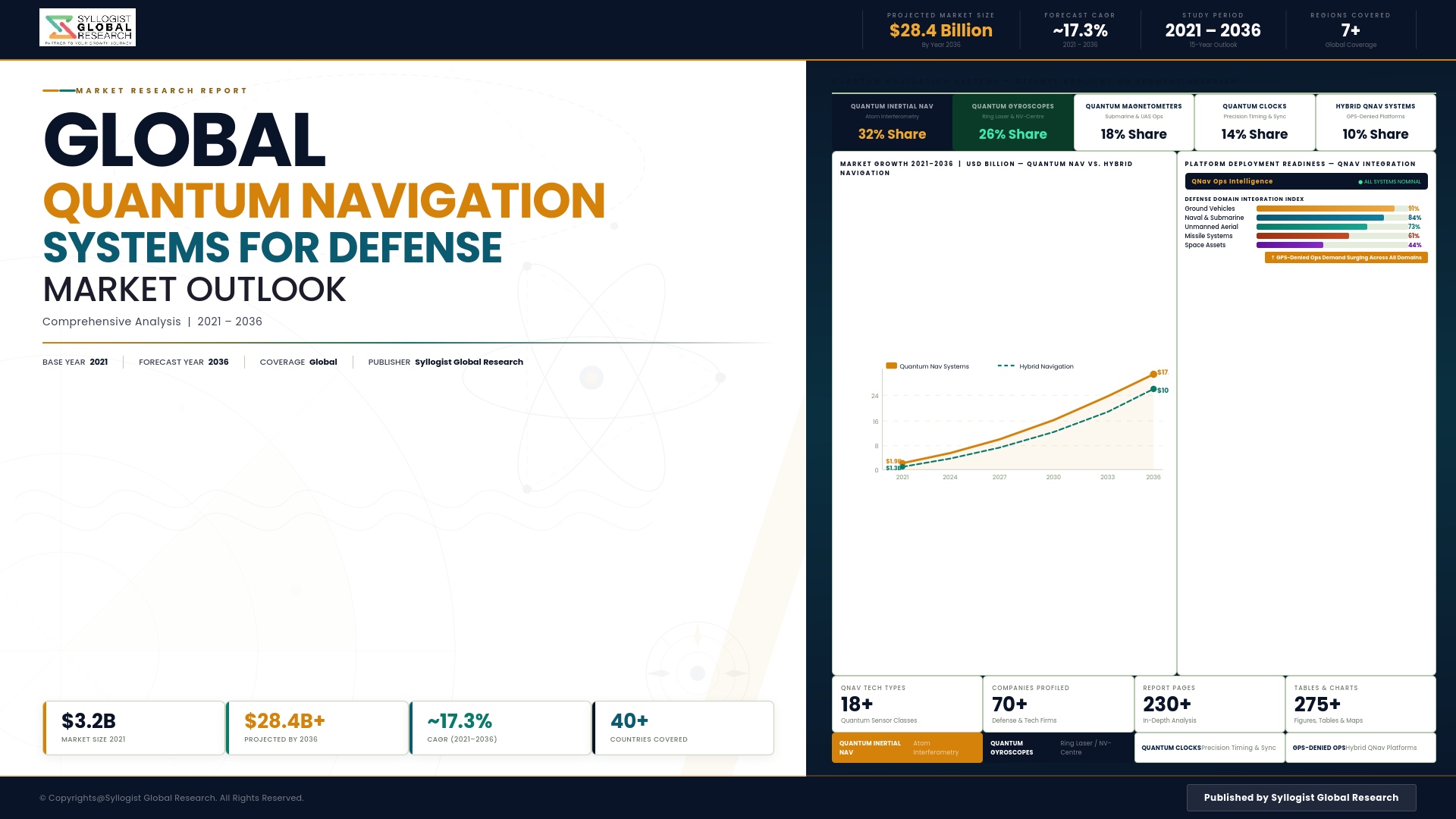
The global quantum navigation systems for defense market is undergoing a decisive transition from laboratory-scale scientific demonstration toward operationally deployable fielded systems, driven by the convergence of maturing atom interferometry and cold-atom sensor technologies, intensifying adversarial GPS jamming and spoofing threats across all warfighting domains, and the growing recognition among major defense establishments that GPS-dependent positioning and timing infrastructure represents a systemic operational vulnerability requiring near-term mitigation through quantum-enabled alternative navigation capabilities. The market was valued at approximately USD 1.8 billion in 2025 and is projected to reach USD 9.6 billion by 2034, advancing at a compound annual growth rate of 20.4% through the forecast period, as defense programs in the United States, United Kingdom, Australia, France, and China transition quantum navigation from technology readiness demonstration into platform integration and initial operational deployment across submarines, autonomous vehicles, precision munitions, and special operations assets.
The strategic imperative accelerating quantum navigation investment is rooted in the demonstrated capability of adversary electronic warfare systems to deny, degrade, and deceive GPS-dependent military platforms at operationally decisive scale across contested environments, rendering quantum inertial navigation a critical enabler of assured positioning for missions where communications and satellite signal access cannot be guaranteed. Quantum accelerometers and gyroscopes based on cold-atom and atom interferometry principles offer drift rates several orders of magnitude lower than the best available classical inertial measurement units, enabling sustained high-accuracy navigation over extended mission durations without external reference signals or periodic GPS updates. Submarine navigation represents the most immediate high-value application, where quantum gravimeters and inertial sensors operating without surfacing requirements can substantially extend covert operational endurance while maintaining the precision positioning required for strategic weapons employment and complex underwater mission execution.
Unmanned autonomous systems operating in GPS-denied environments including urban canyons, underground facilities, undersea domains, and electronically contested battlespaces represent the second major growth segment, with military robotics and autonomous platform developers integrating compact quantum navigation modules to enable reliable autonomous operation and precise weapons delivery without dependence on external positioning infrastructure. North America maintains the largest absolute market share, anchored by substantial United States defense investment in quantum navigation research and early fielding programs across all military services and the Defense Advanced Research Projects Agency portfolio. Europe represents the second major regional contributor, with coordinated investment through national defense programs in the United Kingdom, France, and Germany and quantum navigation development embedded within the broader European defense technology sovereignty agenda. Asia-Pacific is projected to record the highest compound annual growth rate through 2034, driven by China’s national quantum technology strategy channeling substantial civil and defense investment into quantum sensing and navigation capability development, alongside growing quantum defense programs in Australia, South Korea, and Japan responding to regional threat environment evolution.
Key Drivers
Escalating Adversarial GPS Jamming and Spoofing Threats Across Contested Operational Environments Compelling Defense Establishments to Accelerate Quantum Navigation Fielding Programs
The demonstrated and expanding capability of state-level adversaries and non-state actors to deny, degrade, and deceive GPS-dependent military positioning, navigation, and timing infrastructure across land, air, maritime, and space domains has elevated quantum navigation from a long-range modernization priority to an immediate operational requirement for defense establishments whose force employment concepts depend on precision navigation in contested environments. Operational incidents of GPS jamming and spoofing affecting military aviation, maritime navigation, and precision munitions guidance across multiple active theaters have created procurement urgency that is compressing development timelines, increasing program funding allocations, and driving accelerated technology maturation schedules across quantum inertial sensor programs in the United States, United Kingdom, Australia, and key NATO member nations.
Submarine and Undersea Warfare Modernization Programs Generating High-Value Long-Duration Procurement Demand for Quantum Gravimeter and Inertial Navigation System Integration
Strategic and attack submarine fleets operated by major naval powers represent the highest near-term value application for quantum navigation technology, driven by the operational imperative to maintain precise positioning over extended submerged patrol durations without surfacing for GPS updates that compromise acoustic and electromagnetic signature disciplines essential to submarine survivability in contested undersea environments. Quantum gravimeters enabling gravity map-aided navigation and quantum inertial measurement units delivering drift performance substantially superior to classical ring laser and fiber optic gyroscope systems are generating sustained high-budget procurement interest from submarine acquisition programs in the United States, United Kingdom, Australia, France, and China, each executing platform modernization programs that span multi-decade procurement horizons and require assured positioning capability independent of contested electromagnetic spectrum access.
Autonomous and Unmanned Military Platform Proliferation Across GPS-Denied Battlespace Domains Creating Durable Compact Quantum Sensor Integration Demand
The rapid proliferation of unmanned aerial vehicles, unmanned ground systems, autonomous underwater vehicles, and loitering munitions across military inventories worldwide is generating structural demand for compact, lightweight, and power-efficient quantum navigation modules capable of enabling precise autonomous operation in GPS-denied or GPS-degraded environments without crew intervention or external positioning support. Defense programs developing next-generation autonomous platforms for contested battlespace operations are incorporating quantum-enhanced inertial navigation as a baseline capability requirement rather than an optional system enhancement, creating multi-platform procurement demand that spans tactical unmanned systems, precision-guided munitions, autonomous logistics vehicles, and special operations support platforms across all military services and allied defense organizations.
Key Challenges
Sensor Miniaturization, Environmental Ruggedization, and Size, Weight, and Power Optimization Constraining Tactical Platform Integration of Current Quantum Navigation Technology Generations
Current quantum inertial sensor systems based on cold-atom and atom interferometry principles require cryogenic cooling infrastructure, precision laser systems, and vibration isolation architectures that collectively impose size, weight, power, and cost profiles substantially exceeding the integration envelope available on tactical unmanned platforms, precision munitions, and soldier-portable navigation systems, constraining near-term fielding to large platform categories including submarines, strategic aircraft, and surface vessels where installation volume and power availability accommodate current-generation quantum sensor hardware. Achieving the miniaturization, ruggedization, and power reduction necessary for broad tactical platform integration requires material advances in photonic integration, chip-scale vacuum technology, and robust quantum sensor packaging that represent multi-year technology development challenges beyond current demonstrated capability at operationally acceptable performance levels.
Manufacturing Scalability Constraints, Precision Fabrication Supply Chain Immaturity, and High Unit Costs Limiting Quantum Navigation System Procurement at Defense Program Scale
Quantum navigation sensors require precision fabrication of cold-atom physics packages, ultrastable laser systems, and ultra-high vacuum chambers using manufacturing processes and supply chain infrastructure that have not been scaled to the production volumes required by large defense platform integration programs, resulting in unit costs and production lead times that substantially constrain procurement quantities and delivery schedules relative to defense program requirements. The highly specialized nature of quantum sensor manufacturing, which draws on a limited pool of precision photonics fabricators, vacuum technology specialists, and quantum engineering talent operating predominantly within defense contractor and academic research environments, creates supply chain concentration risk and cost escalation vulnerability that complicates long-term defense program planning and budget forecasting for quantum navigation procurement at operationally significant scale.
Classified Technology Protection Requirements, Allied Interoperability Constraints, and Export Control Regimes Limiting International Program Cooperation and Commercial Market Development
Quantum navigation technologies developed within national defense programs are subject to stringent classification and technology protection requirements that limit information sharing between allied nations, restrict integration of quantum navigation capabilities within multinational platform programs, and complicate export licensing for allied defense sales involving advanced quantum sensing components and system architectures. The intersection of quantum navigation technology with nuclear submarine propulsion and strategic weapons employment contexts imposes particularly restrictive technology transfer controls that constrain the allied cooperation frameworks through which development costs could be shared and procurement volumes expanded, while simultaneously limiting the development of a commercially accessible industrial base with the manufacturing scale necessary to drive quantum navigation unit cost reduction toward tactically viable price points.
Market Segmentation
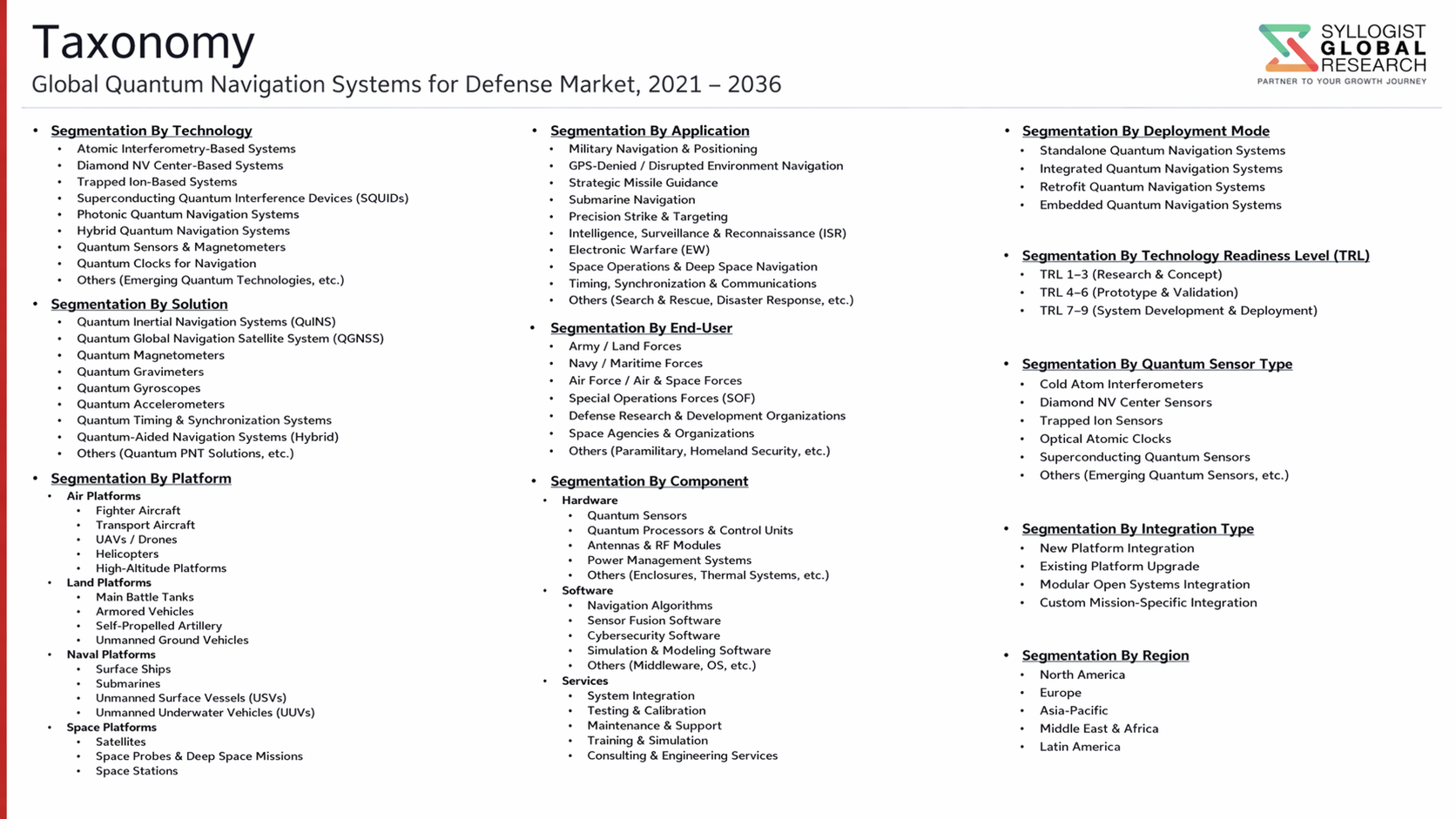
- Segmentation By Technology Type
- Cold-Atom Inertial Measurement Units and Gyroscopes
- Atom Interferometry Accelerometers
- Quantum Gravimeters and Gravity Gradiometers
- Quantum Magnetometers and Magnetic Anomaly Detection Systems
- Photonic and Chip-Scale Atomic Clock Systems
- Hybrid Quantum-Classical Navigation Fusion Architectures
- Others
- Segmentation By Platform
- Submarines and Undersea Vehicles
- Military Fixed-Wing Aircraft and Strategic Bombers
- Military Rotary-Wing and Tiltrotor Aircraft
- Unmanned Aerial Vehicles and Loitering Munitions
- Autonomous Underwater Vehicles
- Armored Ground Vehicles and Soldier-Portable Systems
- Space and Satellite Platforms
- Others
- Segmentation By Application
- Precision Positioning and Navigation in GPS-Denied Environments
- Strategic and Tactical Weapons Guidance
- Undersea Gravity Map-Aided Navigation
- Precision Timing and Synchronization
- Geophysical Mapping and Intelligence Collection
- Autonomous Platform Navigation and Mission Execution
- Others
- Segmentation By Component
- Quantum Sensor Physics Packages
- Laser and Photonic Systems
- Vacuum and Cryogenic Subsystems
- Signal Processing and Navigation Fusion Software
- Vibration Isolation and Environmental Control Hardware
- Human-Machine Interface and Operator Display Systems
- Others
- Segmentation By Autonomy Level
- Human-Operated Systems with Quantum Navigation Assistance
- Human-on-the-Loop Semi-Autonomous Navigation
- Fully Autonomous GPS-Independent Navigation
- Segmentation By End User
- Naval and Submarine Forces
- Air Force and Aerospace Commands
- Army and Land Combat Forces
- Special Operations Commands
- Strategic Missile and Nuclear Forces
- Defense Research and Development Establishments
- Others
- Segmentation By Region
- North America
- Europe
- Asia-Pacific
- Middle East and Africa
- Latin America
All market revenues are presented in USD
Historical Year: 2021-2024 | Base Year: 2025 | Estimated Year: 2026 | Forecast Period: 2027-2034
Key Questions this Study Will Answer
- What is the total global market valuation of the Quantum Navigation Systems for Defense Market in 2025, projected through 2034, disaggregated by technology type, platform, and application, enabling defense contractors, investors, and procurement planners to identify the highest-growth segments and most durable revenue opportunities across the quantum navigation landscape?
- How are the United States, United Kingdom, China, France, and Australia allocating defense investment across quantum gravimeters, atom interferometry inertial units, and chip-scale atomic clock programs, and which national initiatives are setting the technology and procurement benchmarks defining global quantum navigation market architecture through 2034?
- What are the current technology readiness levels and miniaturization development timelines for tactical quantum navigation sensor integration across unmanned platforms, precision munitions, and soldier-portable systems, and which technology development pathways are most critical to expanding the addressable platform market beyond large naval and strategic aircraft categories?
- Which quantum navigation platform segments, including submarines, autonomous underwater vehicles, and unmanned aerial systems, are generating the highest near-term procurement growth, and what sensor performance, size, weight, and power specifications are most critical to platform integration qualification within active defense acquisition programs?
- How is the competitive landscape structured among defense prime contractors, specialist quantum sensor developers, photonics firms, and academic spinouts, and what partnership, acquisition, and government-funded research strategies are enabling leading developers to advance technology readiness and secure initial platform integration contracts?
- What export control regimes, classification frameworks, and allied technology transfer restrictions are shaping international quantum navigation program cooperation, and how are defense establishments and contractors navigating technology protection requirements while pursuing the allied procurement volume necessary to drive manufacturing scale and unit cost reduction?
- Which regional defense markets, specifically North America, Europe, and Asia-Pacific, are expected to generate the most substantial incremental quantum navigation investment through 2034, and what threat environment evolution, platform modernization programs, and national quantum technology strategies are driving procurement priorities and supplier selection in each region?
- Product Definition
- Research Methodology
- Research Design & Framework
- Overall Research Approach: Descriptive, Exploratory & Quantitative Mixed-Method Design
- Market Definition & Scope Boundaries: What is Included and Excluded
- Segmentation Framework
- Key Research Assumptions & Limitations
- Secondary Research
- Primary Research Design & Execution
- Data Triangulation & Validation
- Market Sizing & Forecasting Methodology
- Competitive Intelligence Methodology
- Quality Assurance & Peer Review
- Definitions, Abbreviations & Data Notes
- Research Design & Framework
- Executive Summary
- Market Snapshot & Headline Numbers
- Key Findings & Research Highlights
- Market Dynamics
- Regional Market Summary
- Competitive Landscape Snapshot
- Technology & Innovation Highlights
- Market Dynamics
- Drivers
- Restraints
- Opportunities
- Challenges
- Porter’s Five Forces Analysis
- PESTLE Analysis
- Market Trends & Developments
- Emerging Trends
- Technological Developments
- Regulatory & Policy Changes
- Supply Chain & Sourcing Trends
- Manufacturing & Process Trends
- Investment & Funding Activity
- Sustainability & ESG Trends
- Risk Assessment Framework
- Technology Readiness, Miniaturisation Maturity & Transition from Laboratory to Operational Defense Deployment Risk
- Export Controls, ITAR, Dual-Use Classification & International Technology Transfer Risk for Quantum Navigation Systems
- Adversarial Quantum Sensing Countermeasures, Jamming Resilience & Electronic Warfare Vulnerability Risk
- Cryogenic & Ultra-High Vacuum Infrastructure, Operational Environment Robustness & Platform Integration Risk
- Program Cost Overrun, Long Development Timeline, Funding Continuity & Competing Navigation Technology Risk
- Regulatory Framework & Standards
- Defense Acquisition Regulations, MIL-SPEC Standards & NATO Interoperability Frameworks for Advanced Navigation Systems
- Export Control Regimes: ITAR, EAR & Wassenaar Arrangement Provisions Governing Quantum Sensing & Navigation Technology
- National Quantum Initiative (NQI) Legislation, Allied Quantum Technology Investment Programs & Defense R&D Policy Frameworks
- Positioning, Navigation & Timing (PNT) Policy Directives: US Space Policy Directive-7, NATO PNT Resilience Strategy & Allied Frameworks
- Cybersecurity, Classified System Certification & Accreditation Standards for Quantum Navigation System Integration in Defense Platforms
- Global Quantum Navigation Systems for Defense Market Outlook
- Market Size & Forecast by Value
- Market Size & Forecast by Volume (Number of Units & Systems Delivered)
- Market Size & Forecast by System Type
- Quantum Inertial Navigation Systems (Q-INS) Based on Cold Atom Accelerometers & Gyroscopes
- Atom Interferometry-Based Quantum Gravimeters & Gradiometers for Underwater & Subterranean Navigation
- Quantum Magnetometer-Aided Navigation Systems for GPS-Denied Environments
- Quantum Clock & Timing Systems for Precision PNT & Network Synchronisation
- Hybrid Quantum-Classical Navigation Systems Integrating Quantum Sensors with Legacy INS & GPS
- Quantum Gyroscope Systems Based on Atom Interferometry & Nuclear Magnetic Resonance (NMR)
- Quantum-Enhanced Terrain Referenced Navigation (TRN) & Gravity Map Matching Systems
- Market Size & Forecast by Technology
- Cold Atom Interferometry (CAI) Technology for Inertial Sensing & Navigation
- Bose-Einstein Condensate (BEC) Technology for Ultra-Precise Quantum Sensing
- Nuclear Magnetic Resonance (NMR) Gyroscope & Magnetometer Technology
- Optical Atomic Clock & Frequency Standard Technology for Defense PNT Applications
- Photonic Integrated Circuit (PIC) & Chip-Scale Quantum Sensor Technology
- Superconducting Quantum Interference Device (SQUID) Magnetometer Technology
- Laser Cooling, Trapping & Atom Manipulation Technology for Quantum Inertial Sensors
- AI-Aided Sensor Fusion, Kalman Filtering & Real-Time Navigation Data Processing Technology
- Market Size & Forecast by Component
- Quantum Sensor Core (Atom Chip, Vacuum System, Laser Assembly & Detection Module)
- Control Electronics, Signal Processing & Navigation Computation Unit
- Laser Sources, Optical Bench & Photonic Components
- Magnetic Shielding, Thermal Management & Vibration Isolation Sub-Systems
- Software: Navigation Algorithms, Sensor Fusion Middleware & Mission Management Software
- System Integration, Ruggedisation & Platform Interface Hardware
- Market Size & Forecast by Platform
- Land Platforms: Ground Combat Vehicles, Armoured Vehicles & Soldier-Worn Systems
- Naval Platforms: Submarines, Surface Combatants & Unmanned Maritime Vessels
- Airborne Platforms: Fixed-Wing Aircraft, Helicopters & Unmanned Aerial Vehicles (UAVs)
- Space Platforms: Navigation Satellites & Military Space Assets
- Hypersonic Vehicles, Guided Munitions & Autonomous Loitering Weapons
- Market Size & Forecast by Application
- GPS-Denied & GPS-Degraded Navigation for Combat Operations
- Submarine & Underwater Vehicle Covert Navigation & Positioning
- Precision Guided Munitions & Autonomous Weapons Platform Navigation
- Special Operations Forces (SOF) Individual Navigation & Positioning
- Strategic Nuclear Deterrent Missile & Ballistic Trajectory Guidance
- Underground, Tunnel & Urban Canyon Navigation for Ground Forces
- Resilient Positioning, Navigation & Timing (PNT) for Defense Network Synchronisation
- Market Size & Forecast by End-User
- Army & Land Forces Commands
- Naval Forces & Submarine Commands
- Air Force & Aerospace Commands
- Special Operations Forces (SOF) & Rapid Reaction Units
- Strategic Missile & Nuclear Deterrent Commands
- Defense Research Agencies & National Laboratories
- Market Size & Forecast by Sales Channel
- Direct Government-to-Government (G2G) Defense Procurement
- Prime Defense Contractor-Led Systems Integration & Platform Delivery
- Foreign Military Sales (FMS) & Security Cooperation Programs
- Defense R&D Contracts, DARPA, SBIR/STTR & National Quantum Initiative Programs
- North America Quantum Navigation Systems for Defense Market Outlook
- Market Size & Forecast
- By Value
- By Volume (Number of Units & Systems Delivered)
- By System Type
- By Technology
- By Component
- By Platform
- By Application
- By End-User
- By Country
- By Sales Channel
- Market Size & Forecast
- Europe Quantum Navigation Systems for Defense Market Outlook
- Market Size & Forecast
- By Value
- By Volume (Number of Units & Systems Delivered)
- By System Type
- By Technology
- By Component
- By Platform
- By Application
- By End-User
- By Country
- By Sales Channel
- Market Size & Forecast
- Asia-Pacific Quantum Navigation Systems for Defense Market Outlook
- Market Size & Forecast
- By Value
- By Volume (Number of Units & Systems Delivered)
- By System Type
- By Technology
- By Component
- By Platform
- By Application
- By End-User
- By Country
- By Sales Channel
- Market Size & Forecast
- Latin America Quantum Navigation Systems for Defense Market Outlook
- Market Size & Forecast
- By Value
- By Volume (Number of Units & Systems Delivered)
- By System Type
- By Technology
- By Component
- By Platform
- By Application
- By End-User
- By Country
- By Sales Channel
- Market Size & Forecast
- Middle East & Africa Quantum Navigation Systems for Defense Market Outlook
- Market Size & Forecast
- By Value
- By Volume (Number of Units & Systems Delivered)
- By System Type
- By Technology
- By Component
- By Platform
- By Application
- By End-User
- By Country
- By Sales Channel
- Market Size & Forecast
- Country-Wise* Quantum Navigation Systems for Defense Market Outlook
- Market Size & Forecast
- By Value
- By Volume (Number of Units & Systems Delivered)
- By System Type
- By Technology
- By Component
- By Platform
- By Application
- By End-User
- By Country
- By Sales Channel
- Market Size & Forecast
*Countries Analyzed in the Syllogist Global Research Portfolio: United States, Canada, Mexico, Germany, France, United Kingdom, Netherlands, Spain, Italy, Norway, Sweden, China, Japan, India, Australia, South Korea, Singapore, Brazil, Chile, Saudi Arabia, UAE, Egypt, South Africa, Israel
- Technology Landscape & Innovation Analysis
- Cold Atom Interferometry (CAI) & Bose-Einstein Condensate (BEC) Inertial Sensor Technology Deep-Dive
- Nuclear Magnetic Resonance (NMR) Gyroscope & Quantum Magnetometer Technology for Navigation
- Optical Atomic Clock, Frequency Standard & Precision Timing Technology for Defense PNT
- Photonic Integrated Circuit (PIC) & Chip-Scale Miniaturisation Technology for Deployable Quantum Sensors
- AI-Aided Sensor Fusion, Kalman Filtering & Real-Time Quantum Navigation Data Processing Technology
- Ruggedisation, Vibration Isolation, Magnetic Shielding & Operational Environment Hardening Technology
- Hybrid Quantum-Classical Navigation Architecture & Legacy INS Integration Technology
- Patent & IP Landscape in Quantum Navigation & Quantum Sensing Technologies
- Value Chain & Supply Chain Analysis
- Quantum Sensor Core Component: Atom Chip, Ultra-High Vacuum Cell & Laser Assembly Supply Chain
- Precision Laser Source, Optical Bench & Photonic Component Supply Chain
- Control Electronics, Signal Processing, FPGA & Navigation Computation Hardware Supply Chain
- Magnetic Shielding, Cryogenic Systems & Thermal Management Component Supply Chain
- Systems Integrator, Prime Defense Contractor & Ruggedised Platform Interface Supply Chain
- Defense Ministry, Procurement Agency & Military Platform End-User Channel
- Maintenance, Calibration, Overhaul & Lifecycle Support Channel
- Pricing Analysis
- Quantum Inertial Navigation System Unit Cost by Technology Maturity & Production Volume Analysis
- Quantum Sensor Core Component & Laser Assembly Capital Cost Benchmarking
- System Integration, Ruggedisation & Platform Qualification Cost Analysis by Platform Type
- Total Cost of Ownership (TCO): Acquisition, Integration, Calibration & Lifecycle Maintenance Cost Analysis
- Cost Trajectory & Learning Curve Analysis: Transition from Low-Rate Initial Production (LRIP) to Full-Rate Production Pricing
- Cost-Benefit Analysis: Quantum Navigation vs. Legacy INS, GPS-Aided & Conventional Navigation System Benchmarking
- Sustainability & Environmental Analysis
- Lifecycle Assessment (LCA) of Quantum Navigation Systems: Material Intensity, Energy Consumption & Carbon Footprint
- Rare Earth & Critical Material Dependency in Quantum Sensor Component Supply Chains: Sourcing Risk & Substitution Analysis
- Energy Efficiency of Miniaturised Quantum Sensors vs. Conventional INS & GPS Systems: Platform Power Budget Impact
- Circular Economy, Component Recoverability & End-of-Life Disposal for Quantum Navigation Hardware
- Responsible Sourcing, Conflict Mineral Compliance & Defense Supply Chain ESG Disclosure Frameworks
- Competitive Landscape
- Market Structure & Concentration
- Market Consolidation Level (Fragmented vs. Consolidated by System Type & Geography)
- Top 10 Players Market Share
- HHI (Herfindahl-Hirschman Index) Concentration Analysis
- Competitive Intensity Map by System Type, Technology & Geography
- Player Classification
- Prime Defense Contractors & Full-Spectrum Quantum Navigation System Integrators
- Specialist Quantum Sensing, Cold Atom & Atom Interferometry Technology Companies
- Optical Atomic Clock & Precision Timing System Manufacturers for Defense
- Photonic Integrated Circuit (PIC) & Chip-Scale Quantum Sensor Component Suppliers
- Academic Spin-Outs, Deep-Tech Startups & National Laboratory Commercialisation Ventures
- Legacy INS & Navigation System Manufacturers Integrating Quantum Sensing Capabilities
- Defense-Focused AI, Sensor Fusion & Navigation Algorithm Software Providers
- Government-Owned Defense Research Institutes & National Quantum Technology Hubs
- Competitive Analysis Frameworks
- Market Share Analysis by System Type, Technology & Region
- Company Profile
- Company Overview & Headquarters
- Quantum Navigation Systems Products & Technology Portfolio
- Key Customer Relationships & Reference Program Installations
- Manufacturing Footprint & Production Capacity
- Revenue (Quantum Navigation & Defense Sensing Segment) & Backlog
- Technology Differentiators & IP
- Key Strategic Partnerships, JVs & M&A Activity
- Recent Developments (Contract Wins, Capacity Expansion, Product Launches)
- SWOT Analysis
- Strategic Focus Areas & Roadmap
- Competitive Positioning Map (Technology Capability vs. Market Penetration)
- Key Company Profiles
- Market Structure & Concentration
- Market Opportunity Analysis
- Strategic Output
- Market Opportunity Matrix: By System Type, Technology, Platform, Application, End-User & Geography
- White Space Opportunity Analysis
- Strategic Output
- Strategic Recommendations
- Product Portfolio & Technology Investment Strategy
- Manufacturing & Operational Excellence Strategy
- Geographic Expansion & Localisation Strategy
- Customer & End-User Engagement Strategy
- Partnership, M&A & Ecosystem Strategy
- Sustainability & Circular Economy Strategy
- Risk Mitigation & Future Roadmap
- Strategic Priority Matrix & Roadmap
- Near-term (2025-2028)
- Mid-term (2029-2032)
- Long-term (2033-2037)