Global Quantum Computing Hardware Market By Qubit Technology, By System Architecture, By Cooling Technology, By Component Type, By Deployment Model, By End Use Industry, By Region, Competition, Forecast & Opportunities, 2021-2036F
Market Definition
The Global Quantum Computing Hardware Market encompasses the design, fabrication, assembly, and commercial supply of physical quantum processing units, cryogenic cooling infrastructure, quantum control electronics, qubit interconnect systems, quantum error correction hardware, and ancillary supporting components that collectively constitute the physical layer of gate-based, annealing, and photonic quantum computing systems, procured by technology corporations, government research agencies, national laboratories, defense organizations, financial institutions, pharmaceutical developers, and cloud quantum computing service providers worldwide.
Market Insights
The global quantum computing hardware market is navigating one of the most consequential technology development inflection points in the history of computing, as leading quantum hardware developers advance from early noisy intermediate-scale quantum processor demonstrations toward the fault-tolerant, error-corrected qubit systems required to deliver commercially transformative computational advantages over classical supercomputing architectures across optimization, simulation, cryptography, and machine learning workloads. The market was valued at approximately USD 1.6 billion in 2025 and is projected to expand at a compound annual growth rate of 34.8% through 2034, underpinned by a sustained wave of sovereign national quantum investment programs, growing corporate procurement of cloud-accessible quantum computing services, and the progressive transition of leading quantum hardware platforms from research-grade systems toward commercially engineered products with the reliability, reproducibility, and qubit quality metrics required for practical enterprise deployment.
Superconducting qubit architectures currently occupy the dominant position within the commercial quantum hardware landscape, anchored by the scale of corporate research investment from major cloud technology providers and the demonstrated progress in superconducting qubit count, gate fidelity, and coherence time that has positioned this modality as the leading candidate for near-term fault-tolerant quantum processor development. Superconducting quantum processors require dilution refrigerator cooling systems operating at temperatures approaching absolute zero, and the engineering complexity, physical footprint, and capital cost of cryogenic cooling infrastructure represents both a significant market for specialized cryogenic hardware suppliers and a critical engineering constraint limiting the miniaturization and deployment flexibility of superconducting quantum systems. Trapped ion quantum hardware platforms, which achieve substantially higher native gate fidelity and longer coherence times than superconducting counterparts at current qubit counts, are attracting growing commercial investment as a complementary modality for applications requiring precision quantum gate operations on smaller qubit registers, with photonic interconnect technology enabling modular trapped ion quantum processor architectures that offer a viable pathway toward scalable fault-tolerant operation.
Photonic quantum computing hardware, which encodes quantum information in photonic qubits manipulated by linear optical components operating at room temperature, is attracting significant venture and strategic investment as a hardware modality that circumvents the cryogenic cooling requirements of superconducting and trapped ion approaches, potentially enabling quantum hardware form factors more compatible with conventional data center infrastructure and telecommunications network integration. Neutral atom quantum processors using optical tweezer arrays to manipulate individual atoms are demonstrating rapid qubit count scaling and high-fidelity entanglement gate performance that has repositioned this hardware modality from academic curiosity to commercially competitive quantum hardware platform within a compressed development timeline, attracting dedicated startup investment and strategic interest from established quantum hardware developers. The quantum control electronics segment, encompassing the classical microwave and radio-frequency signal generation, digitization, and real-time feedback processing systems that drive quantum gate operations and implement error correction cycles, is growing rapidly as a commercially distinct and technically specialized hardware category with strong demand from both quantum hardware system developers and quantum cloud service operators scaling their processor fleet infrastructure.
North America dominates the global quantum computing hardware market, supported by the world’s highest concentration of quantum hardware startups, the largest corporate research investment in quantum processor development, and comprehensive federal quantum initiative funding through programs spanning the Department of Energy national laboratory network, the National Science Foundation, and the Defense Advanced Research Projects Agency. Europe represents the second most significant regional quantum hardware market, anchored by the European Quantum Flagship program coordinating member state investment and the concentration of superconducting and photonic quantum hardware research capacity in Germany, the Netherlands, the United Kingdom, and the Nordic countries. Asia-Pacific is the fastest-growing regional market, driven by the scale and pace of China’s national quantum technology investment program and the expanding quantum hardware research ecosystems of Japan, Australia, South Korea, and Singapore.
Key Drivers
Sovereign National Quantum Investment Programs and Strategic Technology Competition Among Major Powers Providing Sustained Multi-Year Funding Foundations for Quantum Hardware Development Ecosystems
Governments across the United States, European Union, China, United Kingdom, Japan, Canada, Australia, and India have committed tens of billions of dollars in aggregate national quantum technology investment programs that fund quantum hardware research, development, and early commercialization across university laboratories, national research facilities, and startup companies, establishing a sovereign-funded demand base for quantum computing hardware that operates substantially independently of near-term commercial return requirements and provides the multi-decade investment horizon that quantum hardware development timescales require. The framing of quantum computing hardware capability as a national security and strategic economic competitiveness priority by major government programs is sustaining procurement, research contracts, and co-investment commitments that are critical to maintaining quantum hardware development momentum through the technically challenging path to fault-tolerant operation.
Post-Quantum Cryptography Transition Urgency and Harvest-Now-Decrypt-Later Threat Creating Immediate Defense and Intelligence Sector Procurement Demand for Quantum Hardware Capabilities
The recognized threat that sufficiently capable fault-tolerant quantum computers will render current public-key cryptographic infrastructure vulnerable to decryption is generating urgent quantum computing hardware investment demand from defense ministries, intelligence agencies, and national security establishments that must develop quantum computing capabilities to understand, simulate, and defend against quantum cryptographic attacks while simultaneously implementing post-quantum cryptographic standard transitions across classified and sensitive government communications infrastructure. The harvest-now-decrypt-later threat model, in which adversaries are currently collecting encrypted communications with the intent of decrypting them once quantum computing capability matures, is creating time-critical quantum hardware development urgency in defense and intelligence procurement programs that extends well beyond the commercial technology adoption timeline driven by near-term computational advantage applications.
Pharmaceutical and Materials Science Quantum Simulation Applications Defining a High-Value Commercial Use Case Pathway That Justifies Long-Term Enterprise Quantum Hardware Investment
Quantum simulation of molecular and chemical systems at a level of accuracy inaccessible to classical computers represents the most clearly defined and commercially validated near-term application for fault-tolerant quantum hardware, with pharmaceutical drug discovery, catalyst design for green chemistry applications, battery materials optimization, and high-temperature superconductor modeling each representing multi-billion dollar commercial value creation opportunities contingent on quantum simulation capability that motivates sustained enterprise investment in quantum hardware access and procurement. Major pharmaceutical corporations, specialty chemicals developers, and energy technology companies are establishing quantum computing research programs, cloud quantum computing procurement agreements, and co-development partnerships with quantum hardware providers that are translating speculative technology interest into funded commercial demand commitments with measurable near-term hardware performance and capability milestone objectives.
Key Challenges
Qubit Decoherence, Gate Error Rates, and the Formidable Engineering Scale of Fault-Tolerant Quantum Error Correction Representing the Central Unsolved Hardware Development Challenge
Physical qubits in all current hardware modalities remain susceptible to decoherence from environmental noise, thermal fluctuations, electromagnetic interference, and fabrication imperfections that accumulate gate errors at rates precluding reliable deep circuit execution on current noisy intermediate-scale quantum processors, and achieving fault-tolerant quantum computation through quantum error correction requires encoding each logical qubit across hundreds to thousands of physical qubits with sufficiently low individual physical error rates to make the encoded logical qubit more reliable than its constituent physical components. The engineering challenge of fabricating, controlling, and interconnecting the thousands to millions of high-quality physical qubits required for commercially useful fault-tolerant quantum processors represents a hardware development undertaking of extraordinary complexity that current qubit manufacturing yield, control electronics scaling, and cryogenic infrastructure capacity are not yet equipped to support at the required scale.
Cryogenic Infrastructure Engineering Constraints and the Physical Scalability Limits of Dilution Refrigerator-Based Quantum Processor Cooling Architectures
The superconducting qubit modality that currently leads commercial quantum hardware development requires processor operation at millikelvin temperatures achievable only through dilution refrigerator cryogenic systems whose physical size, cooling power capacity, vibration sensitivity, and capital cost impose fundamental constraints on the number of qubit control lines, the quantum processor chip footprint, and the system integration density achievable within a single cryogenic enclosure, creating a scalability bottleneck that must be resolved through advances in cryogenic multiplexing, quantum interconnect technology, and modular multi-processor architectures before superconducting quantum systems can achieve the qubit counts required for fault-tolerant operation. Developing cryogenic control and interconnect solutions that enable thousands of qubit control lines within commercially manufacturable dilution refrigerator form factors is a critical hardware engineering challenge with no fully demonstrated solution at the required scale.
Quantum Hardware Fabrication Reproducibility, Qubit Uniformity, and the Absence of Mature Quantum Semiconductor Manufacturing Infrastructure Creating Supply Chain and Yield Constraints
Quantum processor fabrication requires semiconductor manufacturing processes of extraordinary precision, including Josephson junction deposition for superconducting qubits and ion trap microfabrication for trapped ion systems, that are highly sensitive to process variation, contamination, and substrate quality at levels substantially exceeding conventional semiconductor manufacturing tolerances, resulting in qubit frequency distribution, coherence time variability, and gate fidelity non-uniformity across processor chips that constrain achievable circuit depth and complicate quantum error correction implementation. The quantum computing industry currently lacks the dedicated high-volume quantum processor foundry infrastructure, mature process design kits, and standardized fabrication quality metrics that enable cost-competitive, reproducible, and scalable quantum chip manufacturing, limiting production volumes and sustaining unit costs that restrict quantum hardware deployment beyond the research and early enterprise evaluation contexts currently served.
Market Segmentation
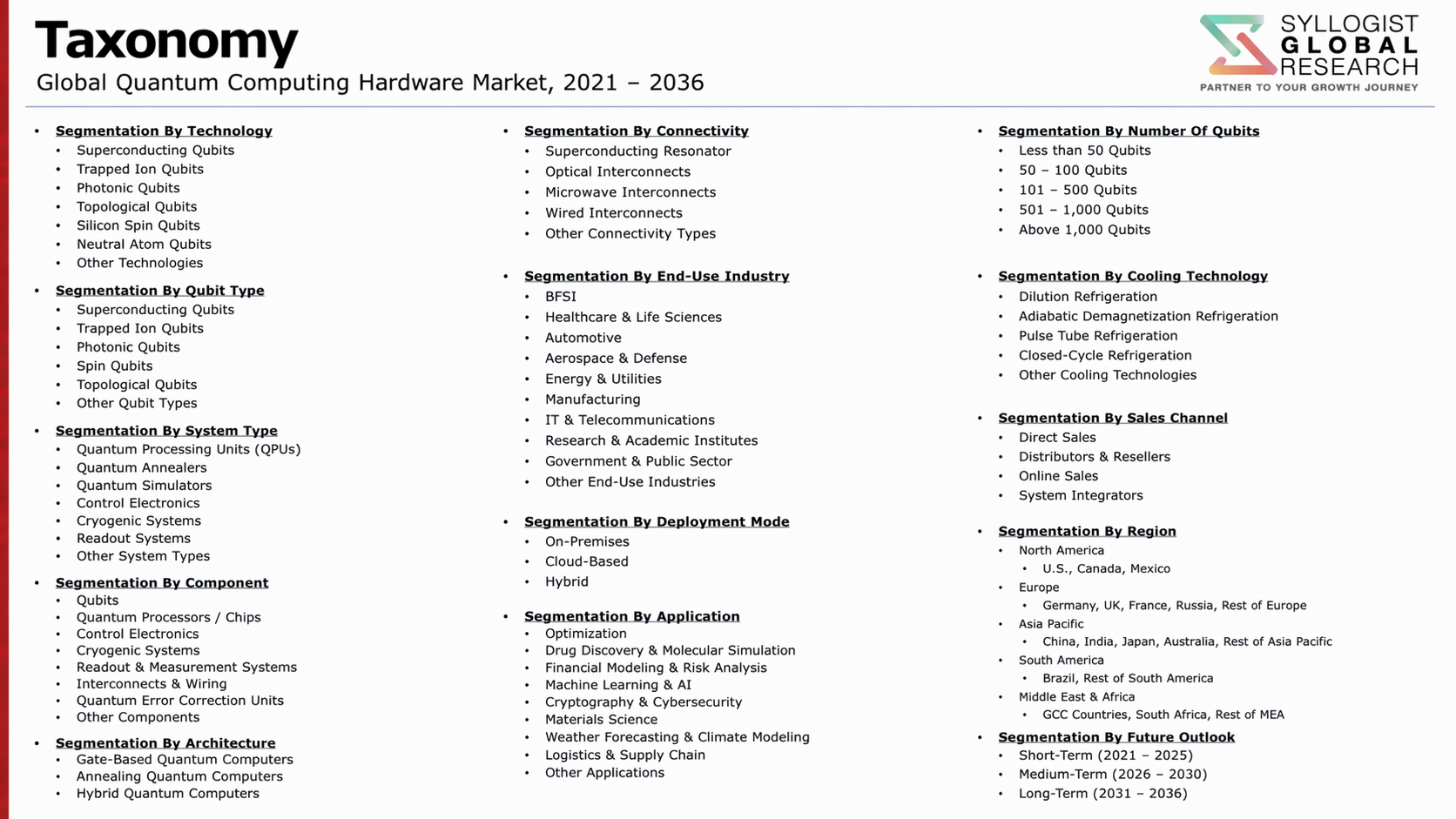
- Segmentation By Qubit Technology
- Superconducting Qubits
- Trapped Ion Qubits
- Photonic Qubits
- Neutral Atom and Optical Tweezer Qubits
- Topological Qubits
- Silicon Spin Qubits
- Others
- Segmentation By System Architecture
- Gate-Based Universal Quantum Processors
- Quantum Annealing and Optimization Systems
- Quantum Simulation Hardware
- Hybrid Classical-Quantum Processing Systems
- Others
- Segmentation By Cooling Technology
- Dilution Refrigerator Cryogenic Systems
- Pulse Tube and Closed-Cycle Cryocoolers
- Laser Cooling and Magneto-Optical Trap Systems
- Room Temperature Photonic Systems
- Others
- Segmentation By Component Type
- Quantum Processing Units and Qubit Chips
- Cryogenic Cooling and Dilution Refrigerator Systems
- Quantum Control Electronics and Signal Generation
- Quantum Interconnects and Qubit Coupler Hardware
- Quantum Memory and Transducer Devices
- Classical Co-Processor and Interface Hardware
- Others
- Segmentation By Deployment Model
- On-Premises and Private Quantum System Installation
- Cloud-Based Quantum Computing Access
- Hybrid On-Premises and Cloud Quantum Infrastructure
- Government and National Laboratory Dedicated Systems
- Segmentation By End Use Industry
- Defense, Intelligence, and National Security
- Pharmaceutical and Life Sciences
- Financial Services and Quantitative Finance
- Energy and Materials Science
- Logistics and Supply Chain Optimization
- Semiconductor and Advanced Manufacturing
- Academic and Government Research Institutions
- Others
- Segmentation By Region
- North America
- Europe
- Asia-Pacific
- Middle East and Africa
- Latin America
All market revenues are presented in USD
Historical Year: 2021-2024 | Base Year: 2025 | Estimated Year: 2026 | Forecast Period: 2027-2034
Key Questions this Study Will Answer
- What is the total global quantum computing hardware market valuation in 2025, projected through 2034, segmented by qubit technology, component type, and end use industry, enabling quantum hardware developers, government procurement agencies, and technology investors to identify the highest-growth hardware categories and most strategically significant commercial adoption opportunities across the global quantum computing landscape?
- How do superconducting, trapped ion, photonic, neutral atom, and silicon spin qubit hardware modalities compare across gate fidelity, coherence time, qubit count scalability, operating temperature requirements, and projected fault-tolerant operation timelines, and which modalities are best positioned to achieve the physical qubit quality and scale required for commercially transformative fault-tolerant quantum computation through 2034?
- Which end use industry segments, specifically defense and national security, pharmaceutical simulation, financial optimization, and materials science discovery, represent the most commercially validated near-term demand drivers for quantum computing hardware procurement, and what specific computational problem classes and performance threshold requirements are defining hardware capability benchmarks for enterprise quantum adoption decisions in each segment?
- How is the competitive landscape structured among established technology corporations, specialized quantum hardware startups, and national laboratory quantum programs, and what intellectual property development, foundry partnership, talent acquisition, and cloud quantum service commercialization strategies are enabling leading quantum hardware developers to build sustainable competitive positions across qubit technology and system architecture categories?
- What engineering advances in cryogenic multiplexing, qubit control electronics integration, modular quantum processor interconnects, and quantum semiconductor manufacturing process standardization are most critical to overcoming the physical scalability constraints limiting superconducting and trapped ion quantum hardware platforms, and what development timelines are realistic for achieving the fault-tolerant qubit counts required for commercially transformative applications?
- How are sovereign national quantum investment programs across the United States, European Union, China, Japan, and Australia shaping the geographic distribution of quantum hardware research capacity, commercial ecosystem development, and technology leadership, and what implications do diverging national quantum strategies and export control frameworks carry for the global quantum hardware supply chain and international research collaboration architecture?
- What role are cloud-based quantum computing access models playing in expanding the addressable market for quantum hardware procurement beyond sovereign and large enterprise direct system purchasers, and how are quantum cloud service operators structuring hardware procurement, system refreshment cycles, and capacity scaling investments to meet growing developer and enterprise demand for accessible quantum computational resources?
- Product Definition
- Research Methodology
- Research Design & Framework
- Overall Research Approach: Descriptive, Exploratory & Quantitative Mixed-Method Design
- Market Definition & Scope Boundaries: What is Included and Excluded
- Segmentation Framework
- Key Research Assumptions & Limitations
- Secondary Research
- Primary Research Design & Execution
- Data Triangulation & Validation
- Market Sizing & Forecasting Methodology
- Competitive Intelligence Methodology
- Quality Assurance & Peer Review
- Definitions, Abbreviations & Data Notes
- Research Design & Framework
- Executive Summary
- Market Snapshot & Headline Numbers
- Key Findings & Research Highlights
- Market Dynamics
- Regional Market Summary
- Competitive Landscape Snapshot
- Technology & Innovation Highlights
- Market Dynamics
- Drivers
- Restraints
- Opportunities
- Challenges
- Porter’s Five Forces Analysis
- PESTLE Analysis
- Market Trends & Developments
- Emerging Trends
- Technological Developments
- Regulatory & Policy Changes
- Supply Chain & Sourcing Trends
- Manufacturing & Process Trends
- Investment & Funding Activity
- Sustainability & ESG Trends
- Risk Assessment Framework
- Qubit Coherence, Decoherence & Error Rate Limitation Risk
- Cryogenic Infrastructure Complexity, Scalability & Cost Risk
- Talent Scarcity, Quantum Engineering Expertise & Workforce Availability Risk
- Geopolitical Export Controls, Dual-Use Technology Classification & National Security Risk
- Standards Fragmentation, Software Ecosystem Immaturity & Customer Adoption Timeline Risk
- Regulatory Framework & Standards
- Quantum Technology Export Controls, EAR & ITAR Classification Frameworks for Quantum Hardware
- National Quantum Initiative (NQI), EU Quantum Flagship & Global Government Quantum Programme Frameworks
- Post-Quantum Cryptography (PQC) Standards, NIST PQC Framework & Quantum-Safe Security Mandates
- Quantum Hardware Safety, Cryogenic Systems & High-Vacuum Equipment Regulatory Standards
- Intellectual Property Protection, Open Standards & Interoperability Frameworks for Quantum Computing
- Data Centre Energy, Cooling & Environmental Compliance Standards for Quantum Computing Facilities
- Global Quantum Computing Hardware Market Outlook
- Market Size & Forecast by Value
- Market Size & Forecast by Volume (Units Shipped & Total Qubit Capacity Deployed)
- Market Size & Forecast by Hardware Type
- Quantum Processors & Qubit Chips
- Cryogenic Dilution Refrigerators & Cooling Systems
- Quantum Control Electronics & Microwave Signal Generation Systems
- Quantum Interconnects, Cables & Cryogenic Wiring
- Quantum Memory & Buffer Systems
- Quantum Error Correction Co-Processors & Classical Interface Hardware
- Photonic Quantum Hardware Components (Photon Sources, Detectors & Waveguides)
- Quantum Networking & Quantum Repeater Hardware
- Full-Stack Integrated Quantum Computing Systems
- Market Size & Forecast by Qubit Technology
- Superconducting Qubits (Transmon, Fluxonium & Flux Qubits)
- Trapped Ion Qubits
- Photonic Qubits (Linear Optical & Continuous Variable)
- Neutral Atom & Rydberg Atom Qubits
- Topological Qubits (Majorana Fermion-Based)
- Silicon Spin & Quantum Dot Qubits
- Nitrogen-Vacancy (NV) Centre & Diamond-Based Qubits
- Nuclear Magnetic Resonance (NMR) & Molecular Spin Qubits
- Market Size & Forecast by Qubit Count & System Scale
- Early-Stage Systems (Below 100 Physical Qubits)
- Intermediate-Scale Systems (100 to 1,000 Physical Qubits)
- Advanced NISQ-Era Systems (1,000 to 10,000 Physical Qubits)
- Fault-Tolerant Systems (Above 10,000 Physical Qubits & Logical Qubit Capable)
- Market Size & Forecast by Operating Temperature & Infrastructure
- Cryogenic Systems Operating Below 1 Kelvin (Dilution Refrigerator-Based)
- Cryogenic Systems Operating at 4 Kelvin (Helium-4 Cooled)
- Room-Temperature Quantum Systems (Photonic & NV Centre Based)
- Modular & Rack-Mountable Quantum Processing Units
- Market Size & Forecast by Application
- Quantum Simulation (Materials Science, Chemistry & Drug Discovery)
- Quantum Optimisation (Logistics, Finance & Supply Chain)
- Quantum Machine Learning & AI Acceleration
- Quantum Cryptography, Key Distribution & Post-Quantum Security
- Financial Modelling, Portfolio Optimisation & Risk Analysis
- Defence, Intelligence & Government Classified Computing
- Climate Modelling, Energy Optimisation & Clean Technology Simulation
- Quantum Sensing & Metrology Hardware
- Market Size & Forecast by End-User
- Cloud & Hyperscale Computing Operators
- Government, Defence & Intelligence Agencies
- Financial Services & Banking Institutions
- Pharmaceutical, Biotech & Life Sciences Companies
- Automotive, Aerospace & Advanced Manufacturing Companies
- Energy, Utilities & Oil and Gas Companies
- Research Universities & National Laboratories
- Technology & Semiconductor Companies
- Market Size & Forecast by Sales Channel
- Direct OEM & Quantum Hardware Manufacturer Sales
- Quantum-Computing-as-a-Service (QCaaS) & Cloud Access Channel
- Government, National Lab & Strategic Procurement Channel
- System Integrator & Consulting Partner Channel
- Academic & Research Institution Channel
- North America Quantum Computing Hardware Market Outlook
- Market Size & Forecast
- By Value
- By Volume (Units Shipped & Total Qubit Capacity Deployed)
- By Hardware Type
- By Qubit Technology
- By Qubit Count & System Scale
- By Operating Temperature & Infrastructure
- By Application
- By End-User
- By Country
- By Sales Channel
- Market Size & Forecast
- Europe Quantum Computing Hardware Market Outlook
- Market Size & Forecast
- By Value
- By Volume (Units Shipped & Total Qubit Capacity Deployed)
- By Hardware Type
- By Qubit Technology
- By Qubit Count & System Scale
- By Operating Temperature & Infrastructure
- By Application
- By End-User
- By Country
- By Sales Channel
- Market Size & Forecast
- Asia-Pacific Quantum Computing Hardware Market Outlook
- Market Size & Forecast
- By Value
- By Volume (Units Shipped & Total Qubit Capacity Deployed)
- By Hardware Type
- By Qubit Technology
- By Qubit Count & System Scale
- By Operating Temperature & Infrastructure
- By Application
- By End-User
- By Country
- By Sales Channel
- Market Size & Forecast
- Latin America Quantum Computing Hardware Market Outlook
- Market Size & Forecast
- By Value
- By Volume (Units Shipped & Total Qubit Capacity Deployed)
- By Hardware Type
- By Qubit Technology
- By Qubit Count & System Scale
- By Operating Temperature & Infrastructure
- By Application
- By End-User
- By Country
- By Sales Channel
- Market Size & Forecast
- Middle East & Africa Quantum Computing Hardware Market Outlook
- Market Size & Forecast
- By Value
- By Volume (Units Shipped & Total Qubit Capacity Deployed)
- By Hardware Type
- By Qubit Technology
- By Qubit Count & System Scale
- By Operating Temperature & Infrastructure
- By Application
- By End-User
- By Country
- By Sales Channel
- Market Size & Forecast
- Country-Wise* Quantum Computing Hardware Market Outlook
- Market Size & Forecast
- By Value
- By Volume (Units Shipped & Total Qubit Capacity Deployed)
- By Hardware Type
- By Qubit Technology
- By Qubit Count & System Scale
- By Operating Temperature & Infrastructure
- By Application
- By End-User
- By Country
- By Sales Channel
- Market Size & Forecast
*Countries Analyzed in the Syllogist Global Research Portfolio: United States, Canada, Germany, France, United Kingdom, Netherlands, Sweden, Finland, Australia, China, Japan, South Korea, India, Singapore, Taiwan, Israel, Brazil, Saudi Arabia, UAE, South Africa
- Technology Landscape & Innovation Analysis
- Superconducting Qubit Technology Deep-Dive: Transmon Architecture, Gate Fidelity, Coherence Time Advances & Scaling Roadmap
- Trapped Ion Qubit Technology: Ion Trap Design, Shuttling Architecture, High-Fidelity Operations & Modular Scaling
- Neutral Atom & Rydberg Qubit Technology: Optical Tweezer Arrays, Programmability & 2D/3D Qubit Grid Scaling
- Photonic Quantum Computing Technology: Linear Optics, Boson Sampling, Integrated Photonics & Room-Temperature Operation
- Topological Qubit Technology: Majorana Zero Modes, Error-Protected Qubits & Microsoft Station Q Research Advances
- Quantum Error Correction (QEC) Technology: Surface Code, Colour Code, Logical Qubit Overheads & Fault-Tolerant Thresholds
- Cryogenic Control Electronics & Classical-Quantum Interface Technology: Cryo-CMOS, SFQ Logic & Signal Multiplexing
- Patent & IP Landscape in Quantum Computing Hardware Technologies
- Value Chain & Supply Chain Analysis
- Specialty Substrate, Sapphire, Silicon & High-Purity Material Supply Chain for Qubit Fabrication
- Josephson Junction, Superconducting Film & Thin-Film Deposition Equipment Supply Chain
- Dilution Refrigerator, Cryostat & Cryogenic Cooling System Supply Chain
- Microwave Electronics, AWG, Signal Generators & Control Hardware Supply Chain
- Cryogenic Cabling, Attenuators, Circulators & Microwave Component Supply Chain
- Quantum Chip Fabrication, Cleanroom Processing & Packaging Supply Chain
- Software, SDK, Quantum OS & Circuit Compilation Toolchain Supply Chain
- Cloud Provider, System Integrator & End-User Procurement Channel
- Pricing Analysis
- Quantum Processor & Qubit Chip Cost Analysis by Technology & Qubit Count
- Dilution Refrigerator & Cryogenic System Capital Cost & Total Cost of Ownership Analysis
- Full-Stack Quantum Computing System Capex & Annual Operating Cost Analysis
- Cost per Logical Qubit, Cost per Gate Operation & Quantum Volume Cost Benchmarking
- Quantum-Computing-as-a-Service (QCaaS) Cloud Pricing: Per-Shot, Per-Task & Subscription Model Analysis
- Price Roadmap: Impact of Volume Scale, Error Rate Improvements & Competing Qubit Technology on Hardware Cost
- Sustainability & Environmental Analysis
- Energy Consumption of Cryogenic Quantum Systems: Dilution Refrigerator Power Draw, Cooling Overhead & PUE Analysis
- Carbon Footprint of Quantum Hardware Fabrication: Cleanroom Energy, Process Gases & Specialty Material Impact
- Helium-3 Scarcity, Helium Supply Chain Sustainability & Cryogen Recycling for Quantum Computing Facilities
- Long-Term Energy Efficiency Promise: Quantum Advantage in Optimisation & Simulation vs. Classical HPC Carbon Cost
- Conflict Mineral Sourcing, Responsible Procurement & ESG Supply Chain Standards for Quantum Hardware
- Competitive Landscape
- Market Structure & Concentration
- Market Consolidation Level (Fragmented vs. Consolidated by Hardware Type & Geography)
- Top 10 Players Market Share
- HHI (Herfindahl-Hirschman Index) Concentration Analysis
- Competitive Intensity Map by Qubit Technology, Application & Geography
- Player Classification
- Large Technology & Cloud Companies with Proprietary Quantum Hardware Programmes
- Dedicated Quantum Computing Hardware Startups & Pure-Play Companies
- Cryogenic Equipment, Dilution Refrigerator & Cooling System Manufacturers
- Quantum Control Electronics, Microwave & Signal Generation Hardware Providers
- Photonic Quantum Hardware & Integrated Photonics Component Companies
- Government-Backed National Quantum Computing Centres & Research Institutes
- Competitive Analysis Frameworks
- Market Share Analysis by Qubit Technology, Hardware Type & Region
- Company Profile
- Company Overview & Headquarters
- Quantum Computing Hardware Products & Technology Portfolio
- Key Customer Relationships & Reference Deployments
- Manufacturing Footprint & Fabrication Partnerships
- Revenue (Quantum Hardware Segment) & Funding Raised
- Technology Differentiators & IP
- Key Strategic Partnerships, JVs & M&A Activity
- Recent Developments (Product Launches, Qubit Milestones, Contract Wins)
- SWOT Analysis
- Strategic Focus Areas & Roadmap
- Competitive Positioning Map (Technology Capability vs. Market Penetration)
- Key Company Profiles
- Market Structure & Concentration
- Technology Landscape & Innovation Analysis
- Strategic Output
- Market Opportunity Matrix: By Hardware Type, Qubit Technology, Application, End-User & Geography
- White Space Opportunity Analysis
- Strategic Recommendations
- Product Portfolio & Technology Investment Strategy
- Manufacturing & Operational Excellence Strategy
- Geographic Expansion & Localisation Strategy
- Customer & End-User Engagement Strategy
- Partnership, M&A & Ecosystem Strategy
- Sustainability & Circular Economy Strategy
- Risk Mitigation & Future Roadmap
- Strategic Priority Matrix & Roadmap
- Near-term (2025-2028)
- Mid-term (2029-2032)
- Long-term (2033-2037)
- Strategic Output