
Global Digital Health Platforms Market By Platform Type, By Technology, By Deployment Mode, By Application, By End User, By Region, Competition, Forecast & Opportunities, 2021-2036F
Market Definition
The Global Digital Health Platforms Market encompasses the development, deployment, and commercial operation of integrated software, data management, and connectivity infrastructure enabling the delivery, coordination, and monitoring of healthcare services through digital channels, including electronic health record systems, telehealth and virtual care platforms, remote patient monitoring solutions, AI-powered clinical decision support tools, health information exchange networks, patient engagement applications, and population health management systems, procured by hospitals, healthcare networks, insurance providers, government health agencies, pharmaceutical companies, and employer wellness programs globally.
Market Insights
The global digital health platforms market is advancing through a phase of structural consolidation and capability deepening, as the rapid deployment surge driven by pandemic-era telehealth adoption transitions into a more measured but fundamentally durable expansion anchored by healthcare system efficiency imperatives, chronic disease management demands of aging global populations, and the growing commercial maturity of AI-powered clinical intelligence tools that are demonstrably improving diagnostic accuracy, care pathway efficiency, and population health outcome metrics at scales that justify sustained enterprise investment from health systems, payers, and pharmaceutical organizations. The market was valued at approximately USD 86.4 billion in 2025 and is projected to expand at a compound annual growth rate of 14.2% through 2034, as healthcare delivery organizations across developed and developing economies accelerate technology-enabled care transformation programs that integrate patient data, automate administrative workflows, extend clinical reach through virtual care channels, and generate the longitudinal health outcome evidence required to support value-based care contracting models with payers seeking demonstrable return on healthcare expenditure.
Electronic health record systems remain the foundational procurement category within the digital health platforms market, representing the clinical data backbone upon which telehealth, remote monitoring, population health, and AI analytics capabilities are layered, and the ongoing replacement of legacy on-premises EHR systems with cloud-native architectures is generating a sustained upgrade and migration investment cycle among hospital networks, physician groups, and integrated delivery systems seeking the interoperability, scalability, and application integration capabilities that first-generation client-server EHR deployments cannot support. Telehealth and virtual care platforms have transitioned from emergency pandemic deployment tools to established care delivery channels with permanent utilization levels substantially above pre-pandemic baselines, reflecting patient acceptance, clinician workflow integration, and payer reimbursement policy normalization that collectively embed virtual care as a durable component of the care delivery model rather than a temporary crisis response measure. AI-powered clinical decision support and diagnostic imaging analysis platforms are registering the strongest growth momentum within the digital health software segment, with regulatory clearances for AI-assisted radiology, pathology, cardiology, and ophthalmology applications accumulating at accelerating rates as clinical validation evidence supporting diagnostic accuracy improvement and workflow efficiency gains for clinicians overcomes the initial adoption caution that characterized early AI clinical tool procurement.
Remote patient monitoring platforms integrating wearable biosensors, implantable devices, and home-based diagnostic equipment with cloud-connected care management software are emerging as a strategically significant growth driver within the digital health platforms market, as health systems and payers invest in continuous monitoring infrastructure that enables proactive clinical intervention before acute deterioration events generate costly hospital admissions for high-risk chronic disease patients with heart failure, diabetes, chronic obstructive pulmonary disease, and hypertension. The demonstrated ability of structured remote monitoring programs to reduce thirty-day hospital readmission rates and emergency department utilization for enrolled chronic disease populations is generating measurable return on investment for health system and payer procurement justifications, establishing remote monitoring platforms as a commercially sustainable care management tool rather than a speculative digital health investment. Pharmaceutical digital health partnerships, in which digital platforms are integrated with therapeutic programs to generate real-world evidence, support medication adherence, and demonstrate treatment outcomes to payers in value-based contracts, represent a rapidly growing commercial revenue channel for digital health platform developers extending beyond traditional healthcare provider and payer customer segments.
North America dominates the global digital health platforms market by revenue, anchored by the United States healthcare system’s combination of high per-patient technology expenditure, active venture and private equity digital health investment ecosystem, sophisticated value-based care contracting infrastructure creating financial incentives for technology-enabled outcomes improvement, and a regulatory framework through the Office of the National Coordinator for Health Information Technology and the Centers for Medicare and Medicaid Services that progressively mandates interoperability and digital health capability adoption. Europe represents the second largest regional market, driven by national health service digital transformation programs, cross-border health data sharing infrastructure development under the European Health Data Space initiative, and universal coverage health systems with strong policy interest in digital health’s potential to improve population health efficiency. Asia-Pacific is the fastest-growing regional market, driven by rapidly expanding digital health investment in China, India, South Korea, Australia, and Southeast Asia, where mobile-first healthcare delivery models, large underserved populations, and government digital health infrastructure initiatives are creating extensive platform deployment opportunities.
Key Drivers
Healthcare System Capacity Constraints, Clinical Workforce Shortages, and Value-Based Care Transition Compelling Investment in Efficiency-Enabling Digital Health Platform Infrastructure
Persistent clinical workforce shortages across nursing, primary care, specialist, and allied health professions in major healthcare systems globally are creating structural capacity constraints that healthcare organizations cannot resolve through staffing alone, compelling investment in digital health platforms that automate administrative burden, extend clinical reach through virtual and asynchronous care channels, enable non-physician care team members to manage larger patient panels with AI-augmented decision support, and reduce avoidable care utilization through proactive remote monitoring and population health interventions. The accelerating transition of healthcare reimbursement from fee-for-service to value-based care models that reward health outcomes, care quality, and cost efficiency is simultaneously incentivizing health system investment in digital platforms generating the longitudinal outcome data, care coordination infrastructure, and population risk stratification capabilities that value-based contract performance requires.
Aging Global Populations and Rising Chronic Disease Burden Creating Durable Demand for Remote Monitoring, Chronic Care Management, and Digital Population Health Management Platforms
The demographic aging of populations across North America, Europe, Japan, South Korea, and increasingly China is generating a growing proportion of healthcare utilization from patients with multiple chronic conditions requiring continuous monitoring, medication management, and coordinated multi-specialist care that traditional episodic in-person care delivery models are poorly designed to manage efficiently at the scale that aging population health needs demand. Digital health platforms enabling continuous remote monitoring of vital signs, medication adherence tracking, patient-reported outcome collection, and automated clinical alert generation for deteriorating chronic disease patients are providing health systems and payers with tools to extend clinical reach across large chronic disease populations without proportional expansion of in-person clinical capacity, creating compelling return on investment justifications that are driving sustained enterprise procurement of remote monitoring and population health platform capabilities.
AI-Powered Clinical Decision Support and Diagnostic Assistance Applications Demonstrating Validated Clinical Outcomes Improvements That Are Progressively Overcoming Clinician Adoption Barriers
The accumulation of peer-reviewed clinical evidence demonstrating that AI-assisted diagnostic imaging interpretation, clinical deterioration prediction algorithms, sepsis early warning systems, and drug interaction screening tools deliver measurable improvements in diagnostic accuracy, clinical response timeliness, and patient safety outcomes relative to unassisted clinical practice is progressively converting initial clinician skepticism about AI clinical tools into evidence-based adoption endorsement from professional medical societies, hospital clinical leadership, and regulatory agencies whose clearance decisions validate AI performance claims with independent review rigor. The growing regulatory clarity from the United States Food and Drug Administration on AI and machine learning-based medical device approval pathways is simultaneously reducing the market authorization uncertainty that previously constrained AI digital health platform developer investment in clinical validation programs required for regulatory clearance in major markets.
Key Challenges
Health Data Privacy Regulation Complexity, Cross-Border Data Transfer Restrictions, and Patient Consent Framework Requirements Creating Platform Architecture and Compliance Cost Burdens
Digital health platforms collecting, processing, and transmitting patient health data are subject to complex and jurisdiction-specific data privacy and security regulatory requirements including HIPAA in the United States, GDPR in Europe, and a growing body of national health data protection legislation across Asia-Pacific and Latin America that impose varying patient consent frameworks, data residency requirements, breach notification obligations, and access rights provisions that require platform developers to implement geographically differentiated data governance architectures adding compliance cost and technical complexity to multi-market deployment strategies. The ongoing evolution of health data regulations, including the anticipated expansion of health data subject categories and the tightening of algorithmic transparency obligations for AI clinical tools under proposed regulatory frameworks, creates ongoing compliance uncertainty that increases development and operational costs for global digital health platform providers.
Healthcare System Interoperability Fragmentation and Legacy IT Infrastructure Integration Complexity Creating Implementation Barriers and Prolonged Deployment Timelines for Digital Health Platforms
The heterogeneous landscape of electronic health record systems, hospital information systems, laboratory information management systems, and medical device data standards across healthcare organizations within and between national markets creates significant technical integration complexity for digital health platform deployment, as platform developers must build and maintain connectivity with dozens of incumbent EHR and clinical system APIs, translate data across incompatible clinical terminology and coding standards, and manage the security and governance of federated data exchange in environments where incomplete interoperability standards adoption limits the completeness and reliability of patient data available for clinical analytics and care coordination applications. Extended implementation timelines, high customization costs, and persistent data quality limitations from incomplete integration with legacy clinical systems reduce the speed-to-value achievable from digital health platform investments.
Digital Health Platform Reimbursement Uncertainty and Payer Coverage Policy Variability Limiting Revenue Sustainability for Virtual Care and Remote Monitoring Service Providers
The reimbursement landscape for digital health services including telehealth consultations, remote physiological monitoring, digital therapeutic programs, and AI-assisted diagnostic interpretation varies significantly across payer types, national healthcare systems, and regulatory jurisdictions in ways that create revenue model uncertainty for digital health platform operators dependent on sustainable fee-for-service or value-based reimbursement rather than pure technology licensing revenue streams. The risk of reimbursement policy reversal, rate reduction, or coverage restriction by government payers and commercial insurers responding to budget pressure or utilization management concerns creates structural revenue sustainability risk for digital health business models built on care delivery reimbursement that may be reduced or eliminated through administrative policy changes without the statutory procedural protections governing other healthcare coverage determinations.1
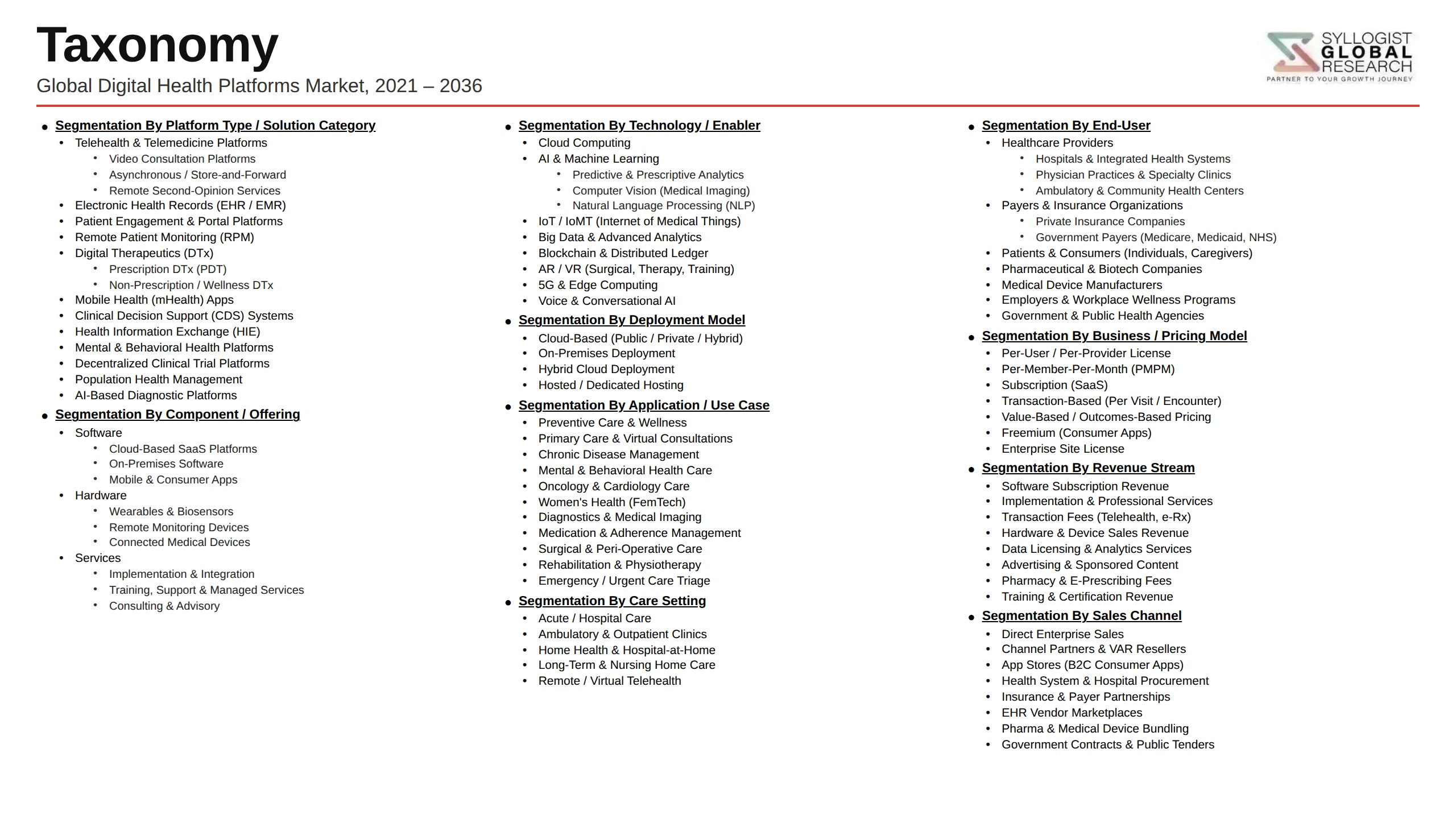
Market Segmentation
- Segmentation By Platform Type
- Electronic Health Record and Clinical Information Systems
- Telehealth and Virtual Care Platforms
- Remote Patient Monitoring Systems
- AI-Powered Clinical Decision Support Platforms
- Patient Engagement and Consumer Health Applications
- Population Health Management Platforms
- Health Information Exchange and Interoperability Networks
- Others
- Segmentation By Technology
- Artificial Intelligence and Machine Learning
- Internet of Things and Wearable Device Integration
- Cloud Computing and SaaS Delivery
- Blockchain and Distributed Health Data Management
- Big Data Analytics and Real-World Evidence Platforms
- Natural Language Processing and Voice Technology
- Others
- Segmentation By Deployment Mode
- Cloud-Based and SaaS Platforms
- On-Premises Enterprise Deployments
- Hybrid Cloud and On-Premises Architectures
- Mobile and App-Based Delivery
- Segmentation By Application
- Chronic Disease Management and Remote Monitoring
- Mental Health and Behavioral Health Services
- Primary Care and Preventive Health
- Radiology and Diagnostic Imaging AI
- Hospital Operations and Clinical Workflow Automation
- Pharmacy and Medication Management
- Clinical Trials and Real-World Evidence
- Others
- Segmentation By End User
- Hospitals and Health Systems
- Physician Groups and Ambulatory Clinics
- Health Insurance Payers and Managed Care Organizations
- Pharmaceutical and Life Sciences Companies
- Government Health Agencies and National Health Services
- Employers and Corporate Wellness Programs
- Patients and Individual Healthcare Consumers
- Others
- Segmentation By Region
- North America
- Europe
- Asia-Pacific
- Middle East and Africa
- Latin America
All market revenues are presented in USD
Historical Year: 2021-2024 | Base Year: 2025 | Estimated Year: 2026 | Forecast Period: 2027-2034
Key Questions this Study Will Answer
- What is the total global digital health platforms market valuation in 2025, projected through 2034, segmented by platform type, technology, and end user, enabling healthcare technology developers, health system investors, and payer procurement teams to identify the highest-growth platform categories and most strategically significant digital health investment opportunities across the global healthcare technology landscape?
- How are AI-powered clinical decision support, diagnostic imaging analysis, and early warning system applications accumulating regulatory clearances and clinical validation evidence across radiology, cardiology, pathology, and sepsis detection use cases, and what performance benchmarks, real-world outcome evidence, and clinician adoption metrics are most critically influencing health system enterprise procurement decisions for AI clinical tool deployment?
- Which remote patient monitoring, chronic disease management, and population health platform categories are demonstrating the most compelling return on investment evidence for health system and payer procurement justification, and what reductions in hospital readmission rates, emergency department utilization, and total cost of care for enrolled chronic disease populations are commercially deployed remote monitoring programs achieving in real-world deployment environments?
- How is the competitive landscape structured among large electronic health record platform vendors, specialized digital health software developers, consumer health technology companies, and AI clinical analytics startups, and what platform consolidation, API ecosystem development, AI capability integration, and value-based care contract performance differentiation strategies are enabling leading competitors to defend and expand enterprise customer relationships?
- What healthcare interoperability standard implementation timelines, FHIR API adoption requirements, health information exchange network development programs, and national patient data access policy frameworks are governments and regulatory agencies advancing across the United States, European Union, Australia, and Asia-Pacific, and how are these interoperability mandates reshaping digital health platform architecture requirements and competitive positioning for enterprise EHR and data integration vendors?
- How are pharmaceutical company investments in digital therapeutic programs, real-world evidence generation platforms, medication adherence applications, and connected care management tools integrating with healthcare provider and payer digital health infrastructures, and what commercial partnership, data sharing, and value-based reimbursement models are emerging to align pharmaceutical, provider, payer, and patient incentives in digital health-enabled therapeutic programs?
- Which regional digital health platform markets, specifically Asia-Pacific, Latin America, and the Middle East and Africa, are expected to generate the highest proportional growth through 2034, and what combinations of government digital health infrastructure investment, mobile-first healthcare delivery model adoption, expanding insurance coverage driving care coordination needs, and healthcare workforce scarcity creating efficiency technology imperative are defining digital health platform demand trajectories in each emerging regional market?
- Product Definition
- Research Methodology
- Research Design & Framework
- Overall Research Approach: Descriptive, Exploratory & Quantitative Mixed-Method Design
- Market Definition & Scope Boundaries: What is Included and Excluded
- Segmentation Framework
- Key Research Assumptions & Limitations
- Secondary Research
- Primary Research Design & Execution
- Data Triangulation & Validation
- Market Sizing & Forecasting Methodology
- Competitive Intelligence Methodology
- Quality Assurance & Peer Review
- Definitions, Abbreviations & Data Notes
- Research Design & Framework
- Executive Summary
- Market Snapshot & Headline Numbers
- Key Findings & Research Highlights
- Market Dynamics
- Regional Market Summary
- Competitive Landscape Snapshot
- Technology & Innovation Highlights
- Market Dynamics
- Drivers
- Restraints
- Opportunities
- Challenges
- Porter’s Five Forces Analysis
- PESTLE Analysis
- Market Trends & Developments
- Emerging Trends
- Technological Developments
- Regulatory & Policy Changes
- Supply Chain & Sourcing Trends
- Manufacturing & Process Trends
- Investment & Funding Activity
- Sustainability & ESG Trends
- Risk Assessment Framework
- Data Privacy, Cybersecurity Breach & Health Record Exposure Risk
- Regulatory Approval, FDA/CE Digital Health Classification & Compliance Burden Risk
- Clinician & Patient Adoption Barrier, Digital Divide & Low Engagement Risk
- Reimbursement Uncertainty, Payer Coverage & Revenue Model Sustainability Risk
- Interoperability Failure, EHR Integration Complexity & Data Silo Risk
- AI Algorithmic Bias, Clinical Validation Gap & Liability Risk
- Regulatory Framework & Standards
- FDA Digital Health Center of Excellence, Software as a Medical Device (SaMD) & Pre-Determined Change Control Plan Frameworks
- EU Medical Device Regulation (MDR 2017/745), EU AI Act & CE Marking for Digital Health Software & AI Tools
- HIPAA, GDPR, PDPA & Global Health Data Privacy, Consent & Cross-Border Transfer Regulatory Frameworks
- HL7 FHIR, SNOMED CT, ICD-11 & Health Data Interoperability & Exchange Standards
- National Digital Health Strategy Frameworks: UK NHS Long-Term Plan, India ABDM, US ONC Interoperability Rules
- Digital Therapeutics (DTx) Reimbursement Frameworks: DiGA (Germany), NHS Evidence Standards & CMS Digital Health Coverage
- Global Digital Health Platforms Market Outlook
- Market Size & Forecast by Value
- Market Size & Forecast by Volume (Number of Active Users & Platform Deployments)
- Market Size & Forecast by Platform Type
- Electronic Health Record (EHR) & Electronic Medical Record (EMR) Platforms
- Telehealth & Telemedicine Platforms (Video Consultation, Store-and-Forward & Remote Monitoring)
- Personal Health Record (PHR) & Patient Portal Platforms
- Clinical Decision Support (CDS) & AI Diagnostic Platforms
- Remote Patient Monitoring (RPM) & Chronic Disease Management Platforms
- Digital Therapeutics (DTx) & Prescription Digital Therapeutics (PDT) Platforms
- Hospital Information System (HIS) & Clinical Workflow Management Platforms
- Population Health Management & Payer Analytics Platforms
- Pharmacy, Medication Management & e-Prescribing Platforms
- Mental Health & Behavioural Health Digital Platforms
- Wellness, Preventive Care & Consumer Health App Platforms
- Market Size & Forecast by Technology
- Artificial Intelligence (AI) & Machine Learning-Enabled Health Platforms
- Cloud-Based & SaaS Health Platform Architecture
- IoT & Wearable Device-Integrated Health Platforms
- Blockchain-Based Health Data Security & Interoperability Platforms
- Natural Language Processing (NLP) & Voice-Enabled Clinical Documentation
- Big Data Analytics, Predictive Modelling & Real-World Evidence Platforms
- Augmented Reality (AR) & Virtual Reality (VR) in Clinical & Training Platforms
- Market Size & Forecast by Deployment Mode
- Cloud-Hosted & Public Cloud Deployment
- On-Premises & Private Cloud Deployment
- Hybrid Cloud Deployment
- Market Size & Forecast by Application
- Primary Care, General Practice & Outpatient Management
- Chronic Disease Management (Diabetes, Hypertension, COPD & Heart Failure)
- Mental Health, Psychiatry & Behavioural Health Management
- Oncology, Speciality & Complex Care Management
- Maternal & Child Health, Women’s Health & Fertility Management
- Post-Acute, Rehabilitation & Long-Term Care Management
- Surgical Planning, Medical Imaging & Radiology AI Platforms
- Clinical Trial Management, Drug Discovery & Pharmacovigilance
- Wellness, Fitness, Nutrition & Preventive Health
- Market Size & Forecast by End-User
- Hospitals & Health Systems
- Ambulatory Care Centres, Clinics & Primary Care Practices
- Payers, Insurers & Managed Care Organisations
- Pharmaceutical & Life Sciences Companies
- Government & Public Health Agencies
- Employers & Corporate Wellness Programmes
- Patients & Individual Healthcare Consumers
- Market Size & Forecast by Revenue Model
- SaaS Subscription & Per-Seat Licence Model
- Per-Encounter, Per-Transaction & Usage-Based Model
- Perpetual Licence & On-Premises Installation Model
- Value-Based Care & Outcomes-Linked Revenue Model
- Freemium, D2C Consumer App & In-App Purchase Model
- North America Digital Health Platforms Market Outlook
- Market Size & Forecast
- By Value
- By Volume (Number of Active Users & Platform Deployments)
- By Platform Type
- By Technology
- By Deployment Mode
- By Application
- By End-User
- By Country
- By Revenue Model
- Market Size & Forecast
- Europe Digital Health Platforms Market Outlook
- Market Size & Forecast
- By Value
- By Volume (Number of Active Users & Platform Deployments)
- By Platform Type
- By Technology
- By Deployment Mode
- By Application
- By End-User
- By Country
- By Revenue Model
- Market Size & Forecast
- Asia-Pacific Digital Health Platforms Market Outlook
- Market Size & Forecast
- By Value
- By Volume (Number of Active Users & Platform Deployments)
- By Platform Type
- By Technology
- By Deployment Mode
- By Application
- By End-User
- By Country
- By Revenue Model
- Market Size & Forecast
- Latin America Digital Health Platforms Market Outlook
- Market Size & Forecast
- By Value
- By Volume (Number of Active Users & Platform Deployments)
- By Platform Type
- By Technology
- By Deployment Mode
- By Application
- By End-User
- By Country
- By Revenue Model
- Market Size & Forecast
- Middle East & Africa Digital Health Platforms Market Outlook
- Market Size & Forecast
- By Value
- By Volume (Number of Active Users & Platform Deployments)
- By Platform Type
- By Technology
- By Deployment Mode
- By Application
- By End-User
- By Country
- By Revenue Model
- Market Size & Forecast
- Country-Wise* Digital Health Platforms Market Outlook
- Market Size & Forecast
- By Value
- By Volume (Number of Active Users & Platform Deployments)
- By Platform Type
- By Technology
- By Deployment Mode
- By Application
- By End-User
- By Country
- By Revenue Model
- Market Size & Forecast
- *Countries Analyzed in the Syllogist Global Research Portfolio: United States, Canada, Germany, France, United Kingdom, Netherlands, Sweden, Denmark, Spain, Italy, Australia, China, Japan, South Korea, India, Singapore, Israel, Brazil, Mexico, Saudi Arabia, UAE, South Africa
- Technology Landscape & Innovation Analysis
- Generative AI & Large Language Model (LLM) Technology in Digital Health: Clinical Note Generation, Summarisation & Differential Diagnosis
- AI Diagnostic Imaging Technology: Radiology AI, Pathology AI, Dermatology AI & FDA-Cleared Medical AI Device Landscape
- HL7 FHIR API, Smart on FHIR & Interoperability Platform Technology for EHR Integration & Data Exchange
- Wearable, Biosensor & Continuous Monitoring Technology Integration with Digital Health Platforms
- Digital Therapeutics (DTx) Clinical Validation, Software-as-a-Medical-Device (SaMD) Pathway & Evidence Generation Technology
- Federated Learning, Privacy-Preserving AI & Synthetic Data Technology for Health AI Model Training
- Virtual Care, Asynchronous Telehealth & AI Triage Technology for High-Volume Primary Care Delivery
- Patent & IP Landscape in Digital Health Platform Technologies
- Value Chain & Supply Chain Analysis
- Cloud Infrastructure, Data Centre & Healthcare-Grade Hosting Supply Chain
- AI Model, Foundation Model & Medical NLP Technology Supply Chain
- EHR System, Clinical Data Repository & Health Information Exchange (HIE) Supply Chain
- Wearable Device, Connected Sensor & Medical IoT Hardware Supply Chain
- Cybersecurity, Identity Management & Health Data Encryption Supply Chain
- Platform Integrator, Implementation Partner & Clinical Workflow Consultant Supply Chain
- Payer, Provider, Pharma & Government Procurement & Contracting Channel
- Pricing Analysis
- EHR & Hospital Information System Annual Licence & Per-Bed Pricing Analysis
- Telehealth Platform Per-Consultation, Monthly Subscription & Enterprise Pricing Analysis
- Remote Patient Monitoring Platform Per-Patient Per-Month (PPPM) Pricing Analysis
- Digital Therapeutics Prescription, Reimbursement Rate & DiGA Fee Schedule Analysis
- AI Diagnostic & Clinical Decision Support Module Add-On Pricing Analysis
- Consumer Health App Freemium, Premium Subscription & D2C Revenue Model Analysis
- Sustainability & Environmental Analysis
- Carbon Footprint of Digital Health Infrastructure: Cloud Data Centre Energy Consumption, PUE & Renewable Energy Procurement
- Role of Digital Health Platforms in Reducing Unnecessary Clinical Visits, Paper Use & Healthcare System Carbon Footprint
- Health Equity, Digital Access & SDG 3 (Good Health & Well-Being) Contribution of Digital Health Platforms
- AI Bias, Algorithmic Fairness & Responsible AI Standards for Health Platform Developers
- ESG Reporting, Responsible Data Stewardship & Patient-Centric Privacy Standards for Digital Health Companies
- Competitive Landscape
- Market Structure & Concentration
- Market Consolidation Level (Fragmented vs. Consolidated by Platform Type & Geography)
- Top 10 Players Market Share
- HHI (Herfindahl-Hirschman Index) Concentration Analysis
- Competitive Intensity Map by Platform Type, Application & Geography
- Player Classification
- Large Diversified Health IT & EHR Platform Companies
- Telehealth & Virtual Care Platform Specialists
- AI Diagnostics, Clinical Decision Support & Medical AI Companies
- Digital Therapeutics (DTx) & Prescription Digital Health Companies
- Remote Patient Monitoring & Chronic Disease Management Platform Providers
- Big Tech & Cloud Hyperscalers with Digital Health Platform Offerings
- Competitive Analysis Frameworks
- Market Share Analysis by Platform Type, Application & Region
- Company Profile
- Company Overview & Headquarters
- Digital Health Platform Products & Solution Portfolio
- Key Customer Relationships & Reference Health System Deployments
- Technology Infrastructure, AI Capabilities & Regulatory Certifications
- Revenue (Digital Health Segment) & Active User Base
- Technology Differentiators & IP
- Key Strategic Partnerships, JVs & M&A Activity
- Recent Developments (Product Launches, Regulatory Clearances, Contract Wins)
- SWOT Analysis
- Strategic Focus Areas & Roadmap
- Competitive Positioning Map (Clinical Depth vs. Platform Breadth)
- Key Company Profiles
- Market Structure & Concentration
- Technology Landscape & Innovation Analysis
- Strategic Output
- Market Opportunity Matrix: By Platform Type, Technology, Application, End-User & Geography
- White Space Opportunity Analysis
- Strategic Recommendations
- Product Portfolio & Technology Investment Strategy
- Clinical Validation, Regulatory Approval & Evidence Generation Strategy
- Geographic Expansion & Localisation Strategy
- Health System, Payer & Customer Engagement Strategy
- Partnership, M&A & Digital Health Ecosystem Strategy
- Reimbursement, Value-Based Care & Revenue Model Strategy
- Sustainability, Health Equity & Responsible AI Strategy
- Risk Mitigation & Future Roadmap
- Strategic Priority Matrix & Roadmap
- Near-term (2025-2028)
- Mid-term (2029-2032)
- Long-term (2033-2037)
- Strategic Output