Global Grid Automation Systems Market By Component, By Communication Technology, By Voltage Level, By Application, By Deployment Mode, By Utility Type, By End User, By Region, Competition, Forecast & Opportunities, 2021-2036F
Market Definition
The Global Grid Automation Systems Market encompasses the engineering, supply, integration, commissioning, and lifecycle support of intelligent electronic devices, supervisory control and data acquisition platforms, distribution management systems, energy management systems, advanced distribution automation hardware, feeder remote terminal units, smart reclosers, automated capacitor banks, fault detection isolation and restoration software, phasor measurement units, communication infrastructure, and associated cybersecurity layers deployed across transmission, sub-transmission, and distribution networks of electric utilities, independent system operators, and large captive power consumers worldwide. The market covers solutions that digitize, monitor, control, and optimize the flow of electricity from generation interconnection through the bulk power transmission grid down to the distribution feeder, customer transformer, and meter, transforming traditional manually operated networks into self-aware, self-healing, and remotely controllable infrastructure capable of integrating distributed energy resources, electric vehicle charging loads, energy storage assets, and demand response programs. Within scope are substation automation systems including protection relays, bay controllers, gateways, and IEC 61850-compliant station bus architectures; distribution automation hardware including pole-mounted reclosers, sectionalizers, and smart switchgear; software platforms covering ADMS, OMS, DERMS, and asset performance management; and edge computing, wireless mesh, fiber optic, cellular, and private LTE and 5G communication layers that link field assets to control centers. The market also covers the cybersecurity, identity management, and operational technology security stack required for compliance with NERC CIP, IEC 62443, ISO 27019, and equivalent regional frameworks. End users include investor-owned utilities, public power authorities, municipal utilities, electricity distribution companies, transmission system operators, and industrial campuses with private grid assets. For this study, the market is measured by hardware, software, and services revenue in USD across new-build and retrofit deployments.
Market Insights
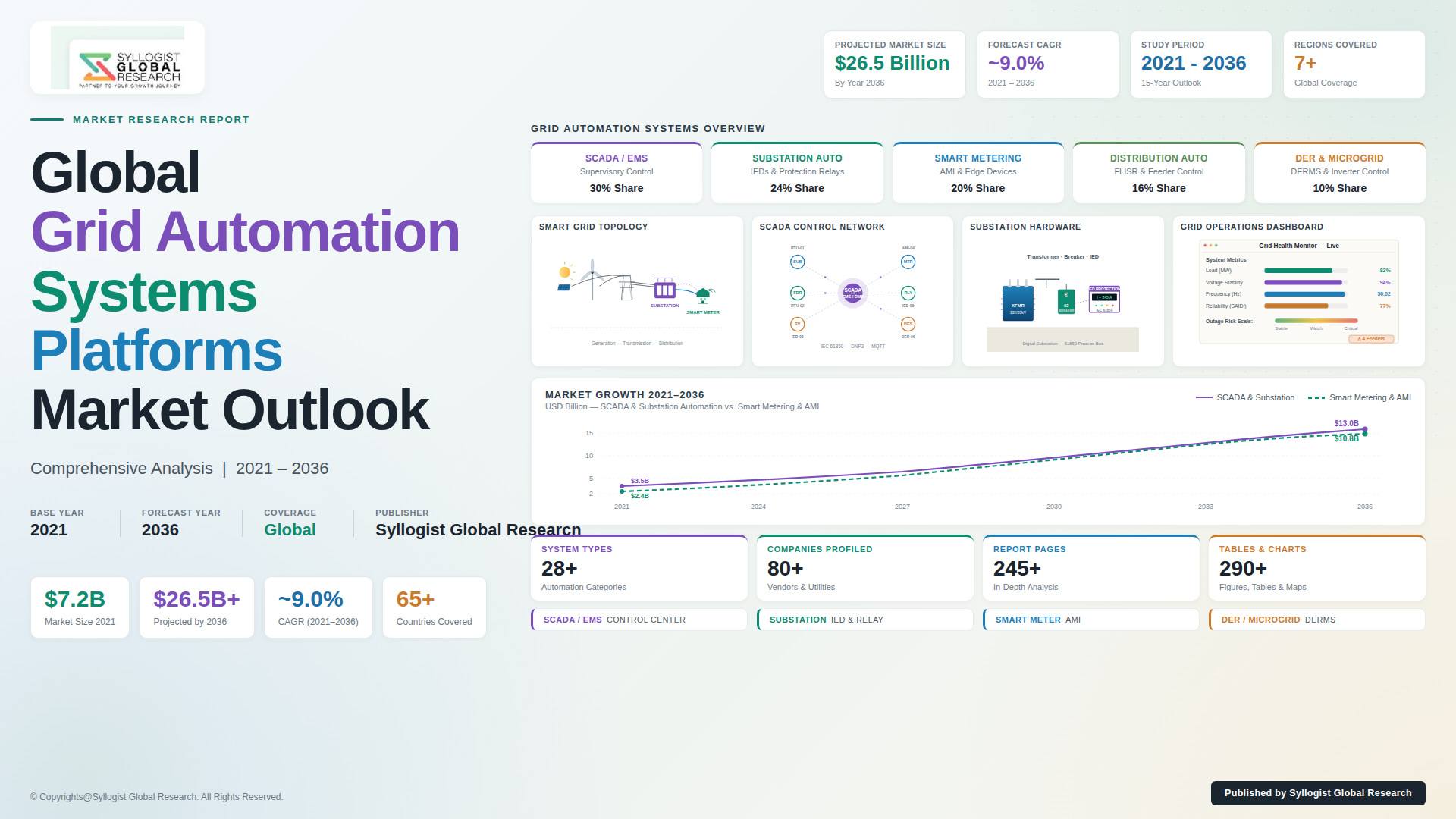
The global grid automation systems market is entering a structural expansion phase, anchored by the dual imperatives of decarbonizing electricity supply and ensuring the resilience of aging power infrastructure against rising load complexity. The market was valued at approximately USD 38.6 billion in 2025 and is projected to reach USD 96.4 billion by 2034, advancing at a compound annual growth rate of 10.7% through the forecast period, as electric utilities transition grid management from manually operated, asset-centric architectures to data-driven, software-defined operating models that integrate distributed energy resources, electric vehicle charging loads, storage assets, and real-time demand-side flexibility. Substation automation hardware accounts for the largest revenue category at 31% of the market, followed by advanced distribution management software at 23%, distribution automation field devices at 19%, communication infrastructure at 14%, and grid cybersecurity solutions at 13%.
The strategic urgency behind grid automation investment is reinforced by the scale and pace at which distributed energy resources, variable renewables, and electrified loads are altering grid operating physics. Global installed solar PV capacity crossed 2.1 TW in 2025, and behind-the-meter solar adoption is generating reverse power flows across LV feeders that were never designed for bidirectional electricity transit, making real-time visibility and dynamic protection coordination indispensable. Electric vehicle penetration is adding 4.8 GW of incremental peak demand annually in mature markets, while the connection queue for utility-scale solar, wind, and battery storage projects exceeds 2,600 GW globally, with interconnection delays averaging 4.5 years pushing utilities to deploy automated hosting capacity analysis, real-time line ratings, and dynamic switching schemes that reduce traditional reinforcement costs by 22% on average across the projects studied.
Asia Pacific is projected to record the highest regional compound annual growth rate through 2034, underpinned by large grid modernization programs in China, India, and Southeast Asia. India’s RDSS program has earmarked USD 36 billion through 2026 for distribution automation, smart metering, and feeder segregation, while China’s State Grid Corporation has committed in excess of USD 89 billion to ultra-high-voltage transmission digitization and provincial distribution automation. North America represents the largest absolute revenue market, with the Infrastructure Investment and Jobs Act providing USD 65 billion in grid resilience grants, transmission siting, and smart grid demonstration programs, supplemented by accelerated state-level distribution automation rollouts across California, Texas, and Florida. Europe constitutes the third major regional market, where the EU Action Plan for Grids has identified investment requirements of approximately USD 644 billion through 2030 to absorb renewable interconnection volumes and decarbonize cross-border power flows.
The competitive structure of the market is shifting toward software-centric solutions as utilities migrate from siloed SCADA-OMS deployments to converged ADMS and DERMS platforms that orchestrate field devices, distributed energy resources, and customer-side flexibility on a unified data fabric. ADMS implementations now represent 47% of new software contract value, replacing fragmented legacy systems and accelerating the shift toward cloud-native, vendor-agnostic architectures. Grid cybersecurity has emerged as a procurement priority following an 84% year-over-year increase in OT-targeted intrusion attempts across utility networks in 2024, with NERC CIP Version 7 and the EU NIS2 Directive elevating security spend to 11% of total grid automation budgets. Mergers and acquisitions among grid software vendors, automation hardware suppliers, and cybersecurity specialists have accelerated, with 47 disclosed transactions across the sector in 2024 reshaping the competitive landscape and consolidating mid-tier vendors into integrated platform providers.
Key Drivers
Renewable Integration, Distributed Energy Resource Proliferation, and Bidirectional Power Flow Management Driving Mandatory Distribution Automation Deployment
Utilities worldwide are confronting an operational reality in which distribution feeders designed for one-directional power delivery must now accommodate variable injection from rooftop solar, residential battery storage, vehicle-to-grid discharge, and community-scale renewable assets. Automated voltage regulation, dynamic protection coordination, real-time hosting capacity calculation, and DER management platforms are transitioning from optional pilots to mandatory deployment across utilities reaching DER penetration of 15% on any given feeder, anchoring multi-year procurement commitments spanning hardware, software, and managed services.
Grid Resilience Mandates, Extreme Weather Frequency, and Self-Healing Network Investment Programs Accelerating Across Major Regulatory Jurisdictions
The rising frequency of severe weather events, wildfires, and grid-stressing temperature extremes has elevated grid resilience to a board-level operational imperative, with US utilities reporting weather-driven outage costs exceeding USD 152 billion cumulatively over the last decade. Regulatory frameworks across North America, Europe, Australia, and Japan now require utilities to demonstrate quantitative SAIDI and SAIFI improvement plans, driving accelerated investment in fault detection, isolation, and restoration software, automated sectionalizing switches, and distributed intelligence platforms capable of reducing customer interruption minutes by 38% within targeted feeder zones.
Substation Modernization Imperatives and IEC 61850 Migration Pathways Driving Long-Cycle Replacement of Electromechanical and Early Digital Protection Equipment
A substantial installed base of electromechanical relays, early-generation digital protection devices, and proprietary substation control systems is reaching end of operational life across mature utility geographies, with approximately 58% of substations in North America and 64% in Western Europe operating equipment more than 25 years old. Reliability and regulatory pressures are accelerating multi-year programs to replace legacy protection schemes with IEC 61850-compliant station bus architectures, process bus solutions, and centralized substation automation platforms, generating durable demand for relays, bay controllers, merging units, and station gateways.
Key Challenges
Legacy Systems Integration Complexity and Multi-Vendor Interoperability Constraints Slowing Enterprise-Scale Grid Automation Programs
Most utility grid automation programs operate against a backdrop of decades-old SCADA installations, proprietary protocol environments, and overlapping vendor ecosystems that resist unified data modeling, common information model translation, and converged operational technology workflows. Migration from legacy DNP3, IEC 60870-5-101, and bespoke vendor protocols to IEC 61850 station bus and CIM-aligned enterprise architectures requires extensive engineering rework, control system testing, and operator retraining, extending program timelines and elevating system integration costs to 38% of total project value on average.
OT Cybersecurity Risk Exposure, Sophisticated State-Level Threat Actors, and Compliance Cost Escalation Across the Operational Technology Stack
The convergence of operational technology, information technology, and cloud-hosted analytics environments has expanded the cybersecurity attack surface of utility grid automation deployments, with confirmed OT-targeted intrusion attempts increasing 84% year over year in 2024 across the global utility sector. State-level threat actors increasingly target substation IEDs, ADMS servers, and remote terminal units, requiring continuous threat detection, zero-trust segmentation, and supply chain integrity assurance. Compliance under NERC CIP, IEC 62443, NIS2, and equivalent frameworks now consumes 11% of total grid automation budgets.
Workforce Shortage in Power Systems Engineering and Grid Automation Talent Limiting Deployment Velocity Across Regulatory Jurisdictions
The global utility industry confronts a structural workforce constraint at the intersection of power systems engineering depth, OT cybersecurity competency, and software-defined grid operations expertise, where the addressable talent pool is materially smaller than demand generated by parallel modernization programs across North America, Europe, Asia Pacific, and the Middle East. Approximately 41% of the US utility engineering workforce is projected to retire by 2030, while developing markets face similar gaps in distribution planning, protection coordination, and ADMS deployment, extending program timelines and elevating engineering costs.
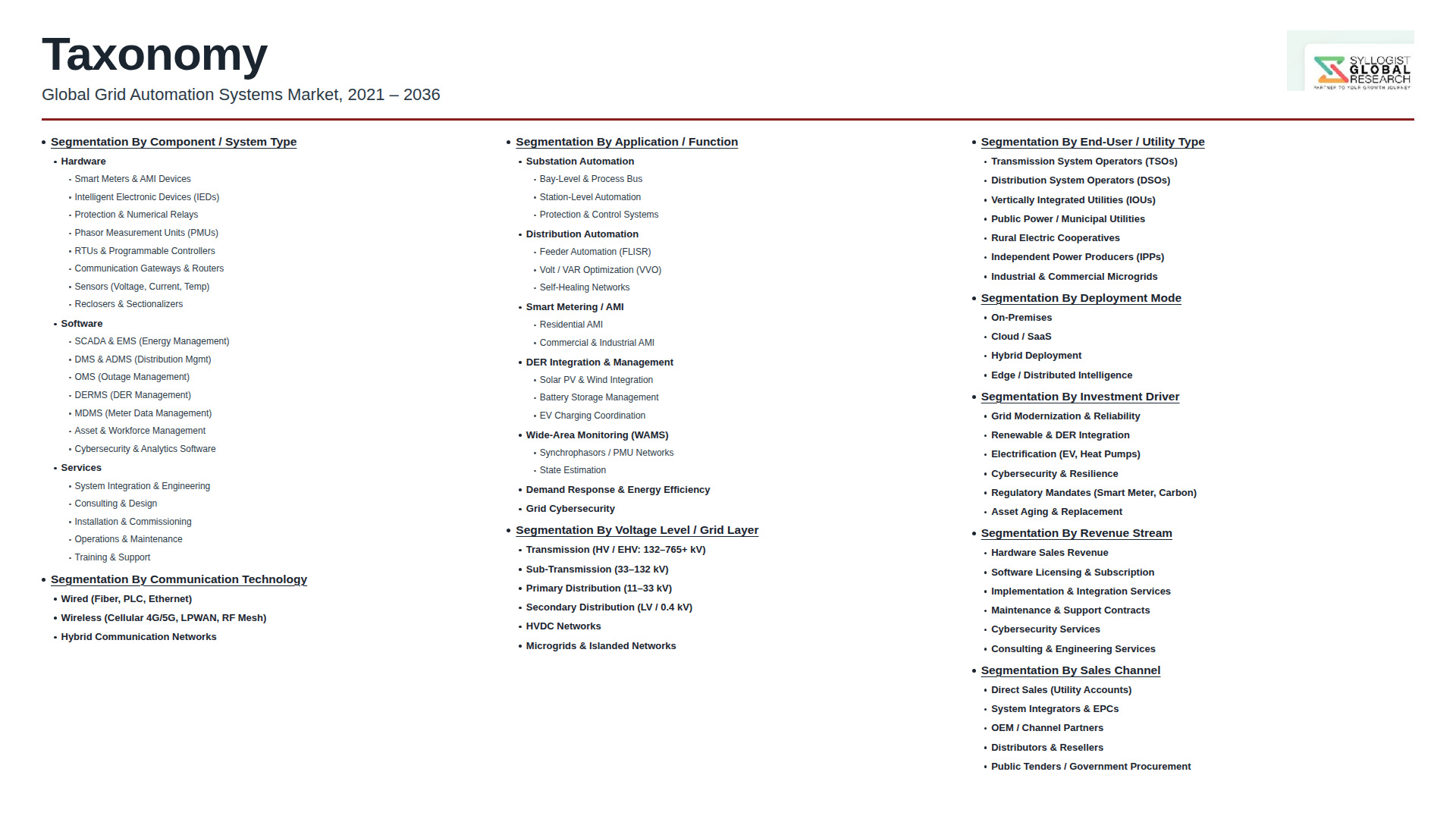
Market Segmentation
- Segmentation By Component
- Hardware (IEDs, RTUs, Protection Relays, Smart Reclosers, Sectionalizers, Capacitor Banks)
- Software (SCADA, ADMS, OMS, DERMS, EMS, GIS Integration, Asset Performance Management)
- Services (Engineering, Integration, Maintenance, Managed Services)
- Others
- Segmentation By Communication Technology
- Fiber Optic
- Wireless Mesh and Radio Frequency
- Cellular (4G and LTE)
- Private LTE and 5G
- Power Line Communication
- Satellite and Microwave
- Others
- Segmentation By Voltage Level
- High Voltage (Transmission)
- Medium Voltage (Sub-Transmission and Primary Distribution)
- Low Voltage (Secondary Distribution)
- Segmentation By Application
- Substation Automation
- Distribution Automation
- Transmission Network Automation
- Demand Response and DER Integration
- Outage Management and Self-Healing
- Asset Performance Monitoring
- Grid Cybersecurity
- Others
- Segmentation By Deployment Mode
- New Installation
- Retrofit and Brownfield Upgrade
- Segmentation By Utility Type
- Investor-Owned Utilities
- Public Power and Municipal Utilities
- Cooperative Utilities
- Transmission System Operators
- Independent Power Producers
- Captive and Industrial Microgrids
- Others
- Segmentation By End User
- Electric Utilities
- Industrial Facilities
- Commercial Campuses and Data Centers
- Renewable IPPs and Storage Operators
- Transportation and EV Charging Network Operators
- Others
- Segmentation By Region
- North America
- Europe
- Asia-Pacific
- Middle East and Africa
- Latin America
All market revenues are presented in USD
Historical Year: 2021-2024 | Base Year: 2025 | Estimated Year: 2026 | Forecast Period: 2027-2034
Key Questions this Study Will Answer
- What is the total global market valuation of the Grid Automation Systems Market in 2025, projected through 2034, disaggregated by component, voltage level, and application, enabling utility procurement teams, technology vendors, investors, and infrastructure planners to identify highest-growth segments and most durable revenue opportunities across the grid digitalization landscape?
- How are leading utilities in the United States, China, India, the European Union, and the Middle East allocating grid automation capital across substation modernization, distribution automation, ADMS and DERMS rollouts, and OT cybersecurity, and which national programs are defining the technical and procurement benchmarks shaping global grid automation architecture through 2034?
- What are the operational, regulatory, and reliability impacts of accelerating distributed energy resource integration, electric vehicle charging buildout, and behind-the-meter solar adoption on distribution feeder design, protection coordination, and hosting capacity analysis, and how are utilities responding through automated voltage regulation, dynamic line ratings, and self-healing network deployment?
- Which grid automation segments, including substation automation hardware, advanced distribution management systems, distribution automation field devices, fiber optic and private LTE communications, and OT cybersecurity platforms, are generating the highest growth rates through 2034, and what edge intelligence, software architectures, and interoperability standards are most critical to performance leadership in each category?
- How is the competitive landscape structured among multinational automation prime contractors, specialist grid software firms, and emerging cybersecurity vendors pursuing utility contracts, and what partnership, acquisition, and platformization strategies are enabling new entrants to compete against established suppliers in next-generation grid automation programs?
- What are the most significant OT cybersecurity vulnerabilities affecting grid automation deployments in operational service, and how are utilities, regulators, and system developers addressing zero-trust segmentation, secure supply chain assurance, and anti-spoofing requirements within NERC CIP, IEC 62443, NIS2, and equivalent regulatory and certification frameworks?
- Which regional grid automation markets, specifically Asia Pacific, North America, Europe, and the Middle East, are expected to generate the most substantial incremental investment through 2034, and what regulatory, decarbonization, electrification, and industrial base factors are driving capability investment priorities and supplier selection in each regional market?
- Product Definition
- Research Methodology
- Research Design & Framework
- Overall Research Approach: Descriptive, Exploratory & Quantitative Mixed-Method Design
- Market Definition & Scope Boundaries: What is Included and Excluded
- Segmentation Framework
- Key Research Assumptions & Limitations
- Secondary Research
- Primary Research Design & Execution
- Data Triangulation & Validation
- Market Sizing & Forecasting Methodology
- Competitive Intelligence Methodology
- Quality Assurance & Peer Review
- Definitions, Abbreviations & Data Notes
- Research Design & Framework
- Executive Summary
- Market Snapshot & Headline Numbers
- Key Findings & Research Highlights
- Market Dynamics
- Regional Market Summary
- Competitive Landscape Snapshot
- Technology & Innovation Highlights
- Market Dynamics
- Drivers
- Restraints
- Opportunities
- Challenges
- Porter’s Five Forces Analysis
- PESTLE Analysis
- Market Trends & Developments
- Emerging Trends
- Technological Developments
- Regulatory & Policy Changes
- Supply Chain & Sourcing Trends
- Manufacturing, Deployment & Commissioning Trends
- Investment, Grid Modernisation Programme & Funding Activity
- Sustainability & ESG Trends
- Risk Assessment Framework
- Aging Grid Infrastructure, Asset Reliability & Modernisation Investment Risk
- Renewable Integration Variability, DER Intermittency & Grid Stability Risk
- Regulatory, Tariff Reform & Cross-Jurisdictional Grid Code Compliance Risk
- Cybersecurity, OT / IT Convergence & Critical Infrastructure Protection Risk
- Interoperability, Legacy System Migration & Communication Standards Fragmentation Risk
- Regulatory Framework & Standards
- National Grid Codes, Smart Grid Roadmaps, Grid Modernisation Programmes & Integrated Resource Planning Frameworks
- IEC 61850, IEEE 1547, DNP3 & Cyber-Physical Substation, Communication & Interoperability Standards
- NERC CIP, ENISA NIS2, IEC 62443 & National Critical Infrastructure Cybersecurity Standards Applicable to Grid Automation
- Renewable, DER & EV Charging Interconnection, Grid Support & Inverter-Based Resource Performance Standards
- Data Privacy, Cloud Sovereignty, Smart Metering Consumer Data & ESG Disclosure Standards for Grid Operators
- Global Grid Automation Systems Market Outlook
- Market Size & Forecast by Value
- Market Size & Forecast by Volume (Number of Automated Substations, Feeders & Endpoints)
- Market Size & Forecast by Component & Solution Type
- Supervisory Control & Data Acquisition (SCADA) Systems
- Substation Automation Systems & Intelligent Electronic Devices (IEDs)
- Distribution Management Systems (DMS) & Advanced Distribution Management Systems (ADMS)
- Energy Management Systems (EMS) & Wide-Area Monitoring, Protection & Control (WAMPAC)
- Outage Management Systems (OMS) & FLISR (Fault Location, Isolation & Service Restoration)
- Distributed Energy Resource Management Systems (DERMS) & Microgrid Controllers
- Advanced Metering Infrastructure (AMI), Smart Meters & Meter Data Management
- Volt / VAR Optimisation, Conservation Voltage Reduction & Power Quality Systems
- Remote Terminal Units (RTUs), Programmable Logic Controllers, Smart Sensors & Reclosers
- Grid Cybersecurity, OT Protection & Identity / Access Management Systems
- Communication Network & Grid Connectivity Infrastructure
- Engineering, Integration, Commissioning & Lifecycle Services
- Market Size & Forecast by Technology
- IEC 61850-Based Substation Automation Technology
- DNP3, Modbus & Legacy Protocol-Based Grid Control Systems
- Cloud-Native & SaaS-Delivered Grid Automation Platforms
- Edge Computing, IoT & Distributed Intelligence at the Grid Edge
- Artificial Intelligence, Machine Learning & Predictive Grid Analytics
- Digital Twin, Real-Time Simulation & Grid Operations Modelling
- 5G, Private LTE, RF Mesh & Hybrid Grid Communication Technology
- Market Size & Forecast by Voltage Level
- High Voltage & Extra-High Voltage Transmission Grid (Above 230 kV)
- Sub-Transmission Grid (66 kV to 230 kV)
- Medium Voltage Distribution Grid (11 kV to 33 kV)
- Low Voltage Distribution Grid (Below 11 kV)
- Market Size & Forecast by Project Scale
- Large-Scale National & Regional Grid Modernisation Programmes
- Medium-Scale Utility-Wide Distribution Automation Projects
- Small-Scale Substation, Feeder & Microgrid Automation Projects
- Market Size & Forecast by Application
- Transmission Grid Automation & Wide-Area Control
- Distribution Grid Automation & Self-Healing Feeder Operations
- Substation Automation & Protection
- Advanced Metering, Demand Response & Customer Engagement
- Renewable Integration, DER Aggregation & Virtual Power Plant Operations
- EV Charging Network Integration & Grid-to-Vehicle Coordination
- Microgrid, Resilience & Islanding Operations
- Grid Cybersecurity, Situational Awareness & OT Threat Management
- Market Size & Forecast by End-User
- Investor-Owned Electric Utilities (IOUs)
- Public, Municipal & Cooperative Utilities
- Transmission System Operators (TSOs) & Independent System Operators (ISOs)
- Independent Power Producers & Renewable Energy Plant Operators
- Industrial, Mining & Process Plant Microgrid Operators
- Commercial Campus, Data Centre & Building Energy Operators
- Government Agencies, Defence & Critical Infrastructure Authorities
- Market Size & Forecast by Sales Channel
- Direct OEM & Original Equipment Manufacturer Channel
- EPC, System Integrator & Turnkey Project Channel
- Distributor, Value-Added Reseller & Regional Partner Channel
- Long-Term Operations, Maintenance & Lifecycle Service Contract Channel
- North America Grid Automation Systems Market Outlook
- Market Size & Forecast
- By Value
- By Volume (Number of Automated Substations, Feeders & Endpoints)
- By Component & Solution Type
- By Technology
- By Voltage Level
- By Project Scale
- By Application
- By End-User
- By Country
- By Sales Channel
- Europe Grid Automation Systems Market Outlook
- Market Size & Forecast
- By Value
- By Volume (Number of Automated Substations, Feeders & Endpoints)
- By Component & Solution Type
- By Technology
- By Voltage Level
- By Project Scale
- By Application
- By End-User
- By Country
- By Sales Channel
- Asia-Pacific Grid Automation Systems Market Outlook
- Market Size & Forecast
- By Value
- By Volume (Number of Automated Substations, Feeders & Endpoints)
- By Component & Solution Type
- By Technology
- By Voltage Level
- By Project Scale
- By Application
- By End-User
- By Country
- By Sales Channel
- Latin America Grid Automation Systems Market Outlook
- Market Size & Forecast
- By Value
- By Volume (Number of Automated Substations, Feeders & Endpoints)
- By Component & Solution Type
- By Technology
- By Voltage Level
- By Project Scale
- By Application
- By End-User
- By Country
- By Sales Channel
- Middle East & Africa Grid Automation Systems Market Outlook
- Market Size & Forecast
- By Value
- By Volume (Number of Automated Substations, Feeders & Endpoints)
- By Component & Solution Type
- By Technology
- By Voltage Level
- By Project Scale
- By Application
- By End-User
- By Country
- By Sales Channel
- Country-Wise* Grid Automation Systems Market Outlook
- Market Size & Forecast
- By Value
- By Volume (Number of Automated Substations, Feeders & Endpoints)
- By Component & Solution Type
- By Technology
- By Voltage Level
- By Project Scale
- By Application
- By End-User
- By Country
- By Sales Channel
- *Countries Analyzed in the Syllogist Global Research Portfolio: United States, Canada, Mexico, Germany, France, United Kingdom, Netherlands, Spain, Italy, Norway, Sweden, China, Japan, India, Australia, South Korea, Singapore, Brazil, Chile, Saudi Arabia, UAE, Egypt, South Africa, Israel
- Technology Landscape & Innovation Analysis
- SCADA, EMS & Grid Control Centre Architecture Deep-Dive
- IEC 61850-Based Substation Automation, GOOSE, Sampled Values & Process Bus Technology
- ADMS, DMS & Advanced Distribution Grid Operations Technology
- DERMS, Microgrid Controller, Virtual Power Plant & DER Aggregation Technology
- AMI, Smart Meter, Meter Data Management & Head-End System Technology
- FLISR, Self-Healing Networks, Volt / VAR Optimisation & Conservation Voltage Reduction Technology
- Edge Computing, IoT, 5G & Private Network Grid Communication Technology
- Artificial Intelligence, Machine Learning, Digital Twin & Predictive Grid Analytics Technology
- Grid Cybersecurity, IEC 62443, Zero-Trust OT & Threat Detection Technology
- Patent & IP Landscape in Grid Automation Technologies
- Value Chain & Supply Chain Analysis
- IED, RTU, Smart Sensor, Recloser & Grid Hardware OEM Manufacturing Supply Chain
- SCADA, ADMS, DERMS, EMS, OMS & Grid Software Platform Vendor Landscape
- Communication Network Equipment, Fibre, Wireless & Private 5G Connectivity Provider Channel
- Grid Cybersecurity & OT Protection Specialist Channel
- Engineering, EPC, System Integrator, Consulting & Commissioning Service Provider Channel
- Utility, TSO / ISO, IPP & End-User Procurement & Tendering Channel
- Operations, Maintenance, Lifecycle Service & Performance Contract Provider Channel
- Pricing Analysis
- IED, RTU, Smart Sensor & Substation Automation Hardware Capital Cost Analysis
- SCADA, ADMS, DERMS & Grid Software Perpetual License, Subscription & SaaS Pricing Analysis
- AMI, Smart Meter & Meter Data Management System Per-Endpoint Pricing Analysis
- Communication Network, Private 5G & Connectivity Capex and Subscription Pricing Analysis
- EPC, System Integration, Commissioning & Turnkey Project Pricing Analysis
- Operations, Maintenance, Cybersecurity & Lifecycle Service Pricing Analysis
- Total Cost of Ownership (TCO) & Return on Investment (ROI) Analysis for Grid Automation Programmes
- Sustainability & Environmental Analysis
- Role of Grid Automation in Renewable Integration, DER Orchestration & Power Sector Decarbonisation
- Reduction of Technical & Non-Technical Losses, Energy Efficiency & Demand Response Contribution
- Lifecycle Carbon Footprint, Materials Use & Embodied Emissions of Grid Automation Hardware
- E-Waste, Material Recyclability & Circular Economy Considerations in Grid Hardware Refresh Cycles
- Alignment of Grid Automation with SDG 7 (Affordable Clean Energy), SDG 9 (Industry & Innovation) & Green Finance Eligibility
- Competitive Landscape
- Market Structure & Concentration
- Market Consolidation Level (Fragmented vs. Consolidated by Component & Solution Type & Geography)
- Top 10 Players Market Share
- HHI (Herfindahl-Hirschman Index) Concentration Analysis
- Competitive Intensity Map by Component & Solution Type, Technology & Geography
- Player Classification
- Integrated Global Grid Automation & Power Technology Majors
- Substation Automation, Protection Relay & IED Specialists
- SCADA, ADMS, EMS & OMS Software Platform Specialists
- DERMS, Microgrid Controller & Virtual Power Plant Specialists
- Advanced Metering Infrastructure & Smart Meter Specialists
- Communication Network, Industrial Networking & Private 5G Equipment Providers
- Grid Cybersecurity & OT Protection Specialists
- EPC Contractors, System Integrators & Engineering Service Specialists
- Competitive Analysis Frameworks
- Market Share Analysis by Component & Solution Type, Technology & Region
- Company Profile
- Company Overview & Headquarters
- Grid Automation Products, Solution Portfolio & Platform Coverage
- Key Customer Relationships & Reference Utility Deployments
- Manufacturing & R&D Footprint, Production Capacity & Engineering Centres
- Revenue (Grid Automation Segment) & Order Backlog
- Technology Differentiators & IP
- Key Strategic Partnerships, JVs & M&A Activity
- Recent Developments (Utility Contract Wins, Platform Releases, Module Launches)
- SWOT Analysis
- Strategic Focus Areas & Roadmap
- Competitive Positioning Map (Technology Capability vs. Market Penetration)
- Key Company Profiles
- Market Structure & Concentration
- Technology Landscape & Innovation Analysis
- Strategic Output
- Market Opportunity Matrix: By Component & Solution Type, Technology, Application, End-User & Geography
- White Space Opportunity Analysis
- Strategic Recommendations
- Product Portfolio, Platform & Technology Investment Strategy
- Cloud, Edge, AI & Cybersecurity Operational Excellence Strategy
- Geographic Expansion & Localisation Strategy
- Utility, TSO / ISO & End-User Engagement Strategy
- Partnership, M&A & Ecosystem Strategy
- Sustainability, Decarbonisation & Grid Resilience Strategy
- Risk Mitigation & Future Roadmap
- Strategic Priority Matrix & Roadmap
- Near-term (2025-2028)
- Mid-term (2029-2032)
- Long-term (2033-2037)
- Market Size & Forecast
- Market Size & Forecast
- Market Size & Forecast
- Market Size & Forecast
- Market Size & Forecast
- Market Size & Forecast