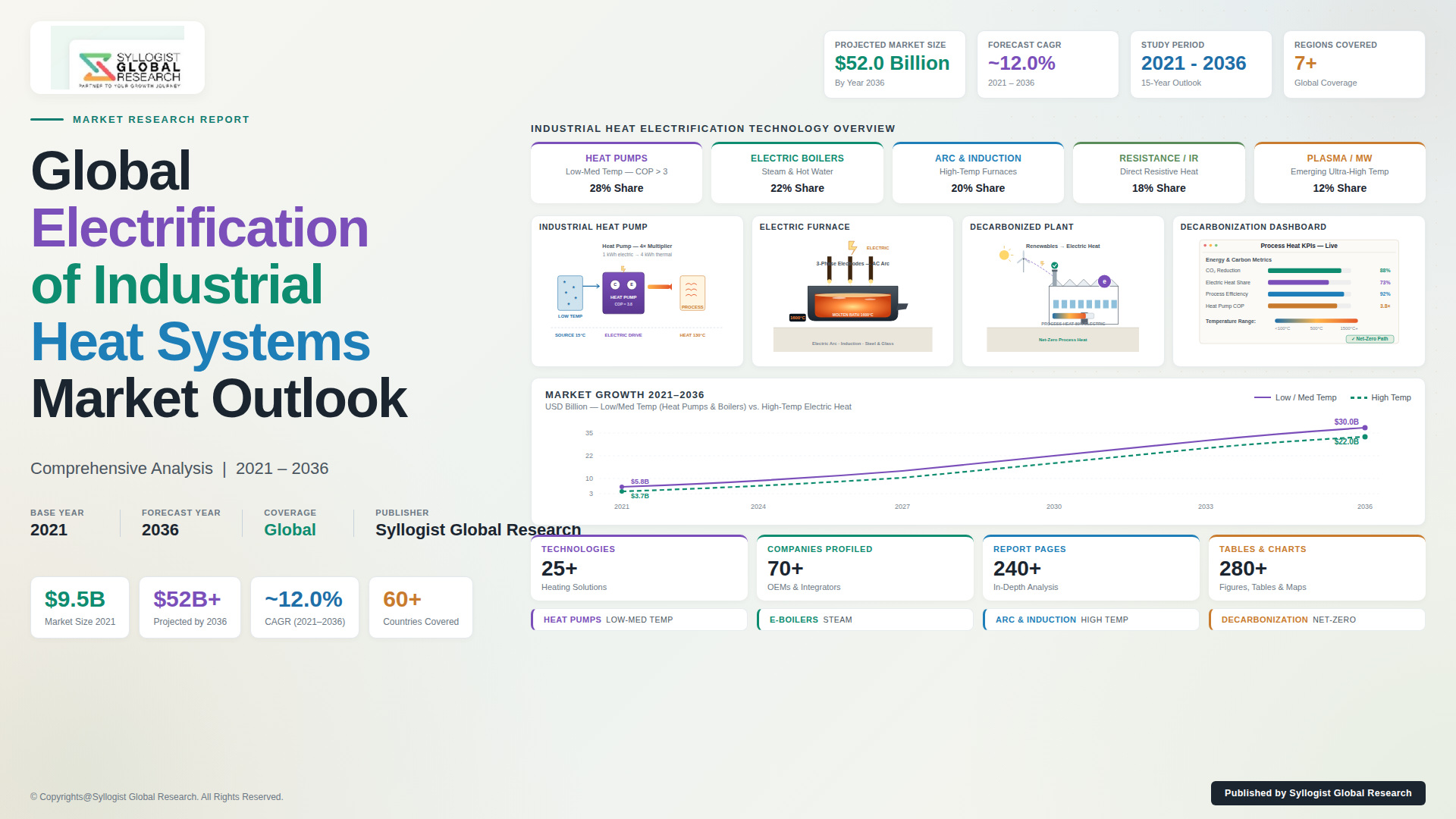
Global Electrification of Industrial Heat Market By Technology, By Temperature Range, By Heat Source Coupling, By Component, By Deployment Mode, By End User Industry, By Region, Competition, Forecast & Opportunities, 2021-2036F
Market Definition
The Global Electrification of Industrial Heat Market encompasses the engineering, manufacturing, supply, integration, commissioning, and aftermarket servicing of electric thermal equipment and integrated energy systems that displace fossil-fuel-fired process heating across low, medium, high, and ultra-high temperature industrial duty cycles. The market includes industrial heat pumps operating up to 200 degrees Celsius based on closed Carnot, transcritical CO2, and high-pressure water vapor cycles; electric resistance and electrode boilers producing saturated and superheated steam up to 350 degrees Celsius; mechanical vapor recompression and thermal vapor recompression systems that upgrade waste heat to process-relevant temperatures; medium-voltage electric process heaters, hot air generators, and immersion heaters serving chemicals, food, and pulp and paper duty; high-temperature induction, infrared, microwave, and dielectric heating systems for metals, ceramics, glass, and composites; plasma heating, electric arc furnaces, and electric calciners for steel, alumina, cement, and lime; and thermal energy storage technologies including refractory brick heat batteries, molten salt, sand and silica storage, and metal phase change media that buffer renewable electricity into firm process heat at temperatures spanning 400 degrees Celsius to 1,800 degrees Celsius. The market also covers heat recovery integration, controls, instrumentation, electrical infrastructure upgrades, and balance-of-plant retrofits needed to convert legacy fossil-fired plants into electrified configurations. End users span chemicals, refining, pulp and paper, food and beverage, dairy, brewing, textiles, ceramics, glass, cement, lime, alumina, primary and secondary steel, hydrogen and ammonia production, district industrial parks, and mining and mineral processing facilities. For this study, the market is measured by equipment, integration service, and project revenue in USD across greenfield, retrofit, and capacity expansion deployments.
Market Insights
The global market for electrification of industrial heat is moving from a portfolio of demonstration-scale pilots into a strategic capital-allocation category as industrial operators, utilities, and policymakers confront the structural reality that process heat accounts for approximately 26 EJ of annual global final energy demand and 7.2 GtCO2 of annual emissions, roughly 20% of total energy-related emissions. The market was valued at approximately USD 27.6 billion in 2025 and is projected to reach USD 92.4 billion by 2034, advancing at a compound annual growth rate of 14.4% through the forecast period, as falling renewable power prices, accelerating carbon border adjustment regimes, and major industrial demonstration funding programs converge on commercially relevant project economics. Electrified solutions today serve approximately 7% of total industrial heat demand, weighted overwhelmingly toward sub-150 degrees Celsius applications, with the next-decade growth concentrated in 150 degrees Celsius to 800 degrees Celsius duty cycles.
Industrial heat pumps and high-temperature thermal energy storage have emerged as the two most consequential technology vectors. Industrial heat pump installations crossed 28,400 units in 2024 across food and beverage, dairy, brewing, pulp and paper, and chemicals, with delivered heat capacity of 41.6 GW thermal. Manufacturers including MAN Energy Solutions, Mitsubishi, Mayekawa, Johnson Controls, GEA, and Star Refrigeration have brought 165 degrees Celsius and 200 degrees Celsius product platforms to commercial status, with COPs ranging from 3.1 to 5.4 depending on temperature lift and source-sink configuration. Refractory brick and solid-media heat batteries from Rondo Energy, Antora Energy, Brenmiller Energy, and Electrified Thermal Solutions have moved into industrial deployment, with announced installed capacity reaching 1.9 GWh thermal at the end of 2024 and a project pipeline above 12 GWh thermal across the United States, the European Union, Australia, and India.
Steel decarbonization is reshaping high-temperature electrification, with electric arc furnaces now producing 31% of global crude steel and direct reduction iron paired with EAF routes attracting USD 87 billion in committed greenfield capex across Sweden, Germany, the United States, India, and the Middle East through 2032. Chemicals operators including Dow, BASF, Linde, and INEOS have approved demonstration-scale electric crackers and electrified steam methane reformers, while Holcim, Heidelberg Materials, and CRH have committed capital to electric calcination demonstration plants targeting cement clinker electrification at 1,450 degrees Celsius. Pulp and paper operators across Sweden, Finland, Brazil, and the United States have begun replacing recovery boilers and lime kilns with hybrid electric and biomass configurations, while glass manufacturers including Saint-Gobain, NSG, and AGC are commissioning hybrid electric-boost furnaces that displace 40% to 80% of fuel-fired duty.
Policy momentum is accelerating the pace of project sanction. The US Industrial Demonstrations Program has committed USD 6.3 billion across 33 industrial decarbonization projects, the Section 48C Advanced Energy Project Credit has allocated USD 6 billion to qualifying retrofits, and the EU Innovation Fund has awarded EUR 4.6 billion to industrial electrification projects across two funding rounds. The EU Carbon Border Adjustment Mechanism, fully phased in by 2026, is reshaping competitive economics for cement, steel, fertilizer, aluminum, and hydrogen producers. Regionally, Europe leads the market at 37% revenue share, supported by EU ETS carbon pricing at EUR 78 per ton, followed by North America at 29%, Asia Pacific at 24% led by China’s heat pump rollout, and the remaining 10% split across Middle East, Africa, and Latin America. The competitive landscape spans incumbent boiler OEMs, heat pump specialists, EAF and induction equipment manufacturers, and a wave of thermal storage startups, with the top 10 vendors accounting for 56% of revenue.
Key Drivers
Industrial Decarbonization Mandates, Carbon Border Adjustment Mechanisms, and Corporate Net-Zero Commitments Accelerating Replacement of Fossil-Fired Process Heat
The convergence of mandatory climate disclosure regimes including the EU CSRD and ISSB standards, science-based emissions targets validated by the SBTi framework across more than 7,800 companies, and the phase-in of the EU Carbon Border Adjustment Mechanism in 2026 is converting industrial heat electrification from an optional sustainability initiative into a board-level capital-allocation decision. Industrial process heat accounts for approximately 20% of energy-related emissions globally, anchoring the strategic case for capex-intensive electrification programs across chemicals, cement, steel, glass, refining, and food processing operators with multi-decade infrastructure exposure.
Falling Renewable Electricity Costs, Industrial PPA Adoption, and Improving Cost Parity Versus Natural Gas Across Sub-300 Degrees Celsius Duty Cycles
Renewable electricity costs have fallen 67% for solar PV and 49% for onshore wind over the last decade, with corporate PPA prices for US solar averaging USD 41 per MWh in 2024 and European PPA prices averaging EUR 62 per MWh. Industrial heat pump COPs of 3.5 to 5.0 deliver delivered-heat costs below natural gas equivalents at industrial gas prices above USD 12 per MMBtu across most European, Japanese, and Korean jurisdictions, with the addressable cost-parity envelope extending continuously as renewable PPA prices fall and grid carbon intensity declines.
Industrial Demonstrations Program Funding, Section 48C and 45X Tax Credits, and Innovation Fund Allocations Underwriting First-of-Kind Electrification Projects
Public funding programs have de-risked first-of-kind industrial heat electrification at unprecedented scale, with the US Industrial Demonstrations Program committing USD 6.3 billion across 33 projects, Section 48C Advanced Energy Project Credit allocating USD 6 billion, the EU Innovation Fund awarding EUR 4.6 billion, and the German federal Klimaschutzvertraege program signing carbon contracts for difference with industrial operators. These instruments materially lower the cost of capital and accelerate the financial close of first-mover EAF, electric cracker, electric calciner, and high-temperature heat pump deployments.
Key Challenges
Industrial Electricity Tariff Structures, Grid Connection Capacity Constraints, and Sub-Optimal Time-of-Use Pricing Eroding Electrified Heat Project Economics
Industrial electricity tariffs in many jurisdictions remain materially higher than natural gas on a delivered-energy basis, with EU industrial users facing tariff escalation that pushed average industrial electricity prices to EUR 158 per MWh in late 2024 against EUR 38 per MWh natural gas. Grid connection capacity for large industrial loads exceeding 100 MW often requires transmission system operator reinforcement timelines of 4 to 7 years, while time-of-use pricing structures penalize continuous industrial duty cycles relative to flexible loads, eroding the business case for retrofit electrification programs.
Capex Intensity, Retrofit Complexity, and Multi-Year Outage Requirements Slowing Brownfield Electrification of Existing Industrial Heat Assets
Retrofit electrification of existing industrial sites often requires turnaround outages of 9 to 18 months, complete reconfiguration of fuel handling, steam distribution, and refractory systems, and capital intensity of USD 800 to USD 1,400 per kW of installed heat capacity for ultra-high-temperature applications. The interdependence between thermal, electrical, and process control systems in chemicals, cement, and steel facilities creates execution complexity that conventional plant engineering teams are not staffed or trained to manage, slowing project delivery and elevating cost overruns.
Ultra-High-Temperature Technology Maturity Gaps, Limited Reference Plants, and Cement, Glass, and Refining Process Integration Challenges
Electrified thermal solutions remain commercially immature above 1,200 degrees Celsius, with limited reference plants for electric calcination, electrified glass melting, and electrified ammonia steam reformer routes. Cement clinker production at 1,450 degrees Celsius and glass melt at 1,550 degrees Celsius require sustained, uniform, and high-power heating that current electric heating architectures have not yet demonstrated at full commercial scale, while integration with existing kiln, regenerator, and refractory designs requires extensive engineering work that prevents straightforward technology drop-in.
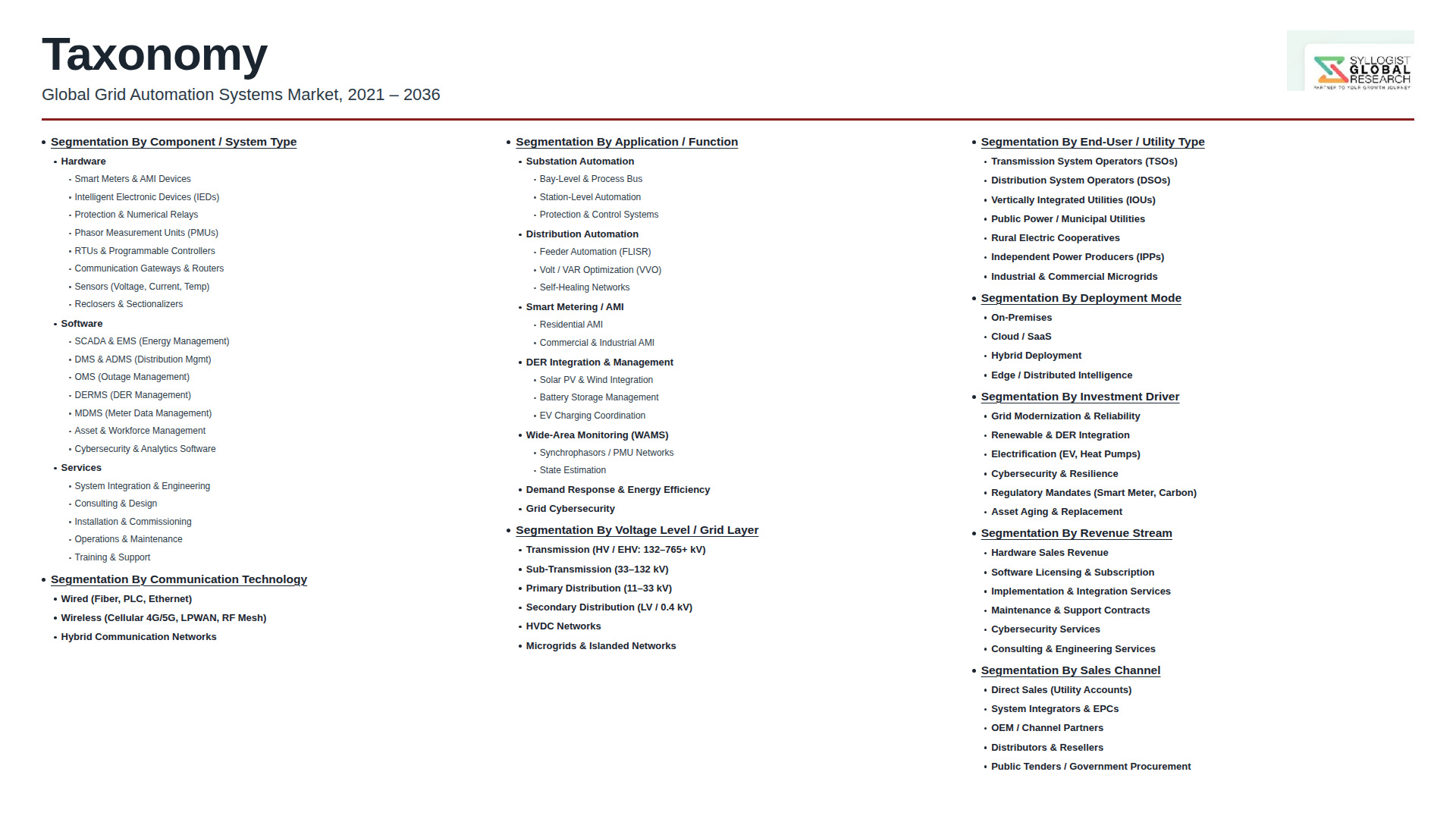
Market Segmentation
- Segmentation By Technology
- Industrial Heat Pumps (Carnot, Transcritical CO2, High-Pressure Water Vapor)
- Electric Resistance and Electrode Boilers
- Mechanical and Thermal Vapor Recompression Systems
- Electric Process Heaters and Hot Air Generators
- Induction, Infrared, Microwave, and Dielectric Heating
- Electric Arc Furnaces and Plasma Heating
- Electric Calciners, Reformers, and Crackers
- Thermal Energy Storage (Refractory Brick, Molten Salt, Sand, Phase Change)
- Others
- Segmentation By Temperature Range
- Low Temperature (Up to 150 degrees Celsius)
- Medium Temperature (150 to 500 degrees Celsius)
- High Temperature (500 to 1,000 degrees Celsius)
- Ultra-High Temperature (Above 1,000 degrees Celsius)
- Segmentation By Heat Source Coupling
- Grid-Connected
- Behind-the-Meter Renewable PPA
- Hybrid Grid and On-Site Generation
- Coupled with Thermal Energy Storage
- Coupled with Green Hydrogen
- Others
- Segmentation By Component
- Heating Equipment and Vessels
- Controls, Instrumentation, and SCADA
- Electrical Infrastructure and Switchgear Upgrades
- Thermal Storage Media and Containment
- Heat Recovery and Balance-of-Plant
- Engineering, Integration, and Aftermarket Services
- Others
- Segmentation By Deployment Mode
- Greenfield Industrial Facilities
- Brownfield Retrofit and Capacity Expansion
- Hybrid Fossil-Electric Configurations
- Segmentation By End User Industry
- Chemicals and Petrochemicals
- Refining and Hydrogen Production
- Iron, Steel, and Direct Reduction Iron
- Cement, Lime, and Alumina
- Glass and Ceramics
- Pulp and Paper
- Food, Beverage, Dairy, and Brewing
- Textiles and Apparel
- Mining and Mineral Processing
- Others
- Segmentation By Region
- North America
- Europe
- Asia-Pacific
- Middle East and Africa
- Latin America
All market revenues are presented in USD
Historical Year: 2021-2024 | Base Year: 2025 | Estimated Year: 2026 | Forecast Period: 2027-2034
Key Questions this Study Will Answer
- What is the total global market valuation of the Electrification of Industrial Heat Market in 2025, projected through 2034, disaggregated by technology, temperature range, end-user industry, and component, enabling equipment OEMs, EPC contractors, industrial operators, utilities, and infrastructure investors to identify the highest-growth segments and most durable revenue opportunities across the industrial heat decarbonization landscape?
- How are leading industrial economies including the United States, Germany, the Netherlands, Sweden, the United Kingdom, China, Japan, South Korea, India, and the Gulf Cooperation Council region allocating capital across industrial heat pumps, electric boilers, electric arc furnaces, electric crackers, electric calciners, and thermal energy storage, and which national policy frameworks are defining the technical and procurement benchmarks shaping the global market through 2034?
- What are the relative levelized cost of heat, COP, capacity factor, footprint, and integration complexity advantages of industrial heat pumps, electrode boilers, induction heating, infrared, plasma, electric arc furnaces, and refractory thermal storage systems across low, medium, high, and ultra-high temperature applications, and which technologies are most likely to capture incremental share between 2025 and 2034?
- Which end-user industries, including chemicals, refining, steel, cement, glass, pulp and paper, food and beverage, hydrogen and ammonia, and mining and mineral processing, are generating the highest contracting velocity through 2034, and what carbon border adjustment exposure, cost-of-carbon evolution, and product premium economics are most critical to converting decarbonization mandates into bankable electrification projects?
- How is the competitive landscape structured among incumbent boiler OEMs, heat pump specialists, electric arc furnace and induction equipment manufacturers, thermal energy storage innovators including Rondo, Antora, Brenmiller, and Electrified Thermal Solutions, and EPC and integration service providers, and what partnership, acquisition, and platformization strategies are enabling new entrants to compete with established players in next-generation industrial electrification programs?
- What are the most significant industrial electricity tariff, grid connection capacity, retrofit outage, ultra-high-temperature maturity, and process integration challenges affecting industrial heat electrification deployments in operational delivery, and how are equipment vendors, utilities, transmission system operators, and regulators addressing tariff design, grid reinforcement, technology demonstration, and risk allocation within evolving electrification regulatory and technical frameworks?
- Which regional industrial heat electrification markets, specifically Europe, North America, Asia Pacific, the Middle East and Africa, and Latin America, are expected to generate the most substantial incremental electrification investment through 2034, and what regulatory frameworks, carbon pricing regimes, Industrial Demonstrations and Innovation Fund grants, and corporate net-zero mandates are driving capability investment priorities and supplier selection in each regional market?
- Product Definition
- Research Methodology
- Research Design & Framework
- Overall Research Approach: Descriptive, Exploratory & Quantitative Mixed-Method Design
- Market Definition & Scope Boundaries: What is Included and Excluded
- Segmentation Framework
- Key Research Assumptions & Limitations
- Secondary Research
- Primary Research Design & Execution
- Data Triangulation & Validation
- Market Sizing & Forecasting Methodology
- Competitive Intelligence Methodology
- Quality Assurance & Peer Review
- Definitions, Abbreviations & Data Notes
- Research Design & Framework
- Executive Summary
- Market Snapshot & Headline Numbers
- Key Findings & Research Highlights
- Market Dynamics
- Regional Market Summary
- Competitive Landscape Snapshot
- Technology & Innovation Highlights
- Market Dynamics
- Drivers
- Restraints
- Opportunities
- Challenges
- Porter’s Five Forces Analysis
- PESTLE Analysis
- Market Trends & Developments
- Emerging Trends
- Technological Developments
- Regulatory & Policy Changes
- Supply Chain, Critical Component & Sourcing Trends
- Process Conversion, Retrofit & Commissioning Trends
- Investment, Industrial Decarbonisation Programme & Funding Activity
- Sustainability & ESG Trends
- Risk Assessment Framework
- Electricity Price Volatility, Power-to-Gas Cost Spread & Operating Margin Risk
- Grid Capacity Headroom, Industrial Connection Lead Time & Power Quality Risk
- Technology Maturity, Reliability & Long-Term Performance Risk for High-Temperature Electrification
- Capital Cost Inflation, Stranded Asset & Process Conversion Project Execution Risk
- Regulatory, Carbon Price (EU ETS, CBAM, Carbon Tax) & Cross-Jurisdictional Compliance Risk
- Regulatory Framework & Standards
- National Industrial Decarbonisation Strategies, Net-Zero Industry Plans & Heat Electrification Roadmaps
- Carbon Pricing, EU ETS, CBAM, IRA Tax Credits (48 ITC, 48C Advanced Manufacturing, 45X) & Industrial Subsidy Frameworks
- Industrial Energy Efficiency, ISO 50001 & Process Heat Performance Standards
- Electric Heating Equipment Safety, IEC 60519, IEC 60204 & Pressure Vessel Standards for Electric Boilers
- ESG Disclosure, Scope 1 & 2 Reporting, Science-Based Targets & Green Finance Eligibility for Industrial Electrification
- Global Electrification of Industrial Heat Market Outlook
- Market Size & Forecast by Value
- Market Size & Forecast by Volume (Installed Thermal Capacity, MWth & Annual Electrified Heat, TWh)
- Market Size & Forecast by Equipment Type
- Industrial Heat Pumps
- Electric Boilers (Resistance & Electrode)
- Electric Furnaces (Electric Arc, Induction, Resistance)
- Plasma Heating Systems & Plasma Torches
- Microwave & Radio Frequency (RF) Dielectric Heating Systems
- Infrared, Resistance Element & Electromagnetic Induction Heating Systems
- Thermal Energy Storage (TES) Integrated Electric Heat Systems
- Hybrid & Dual-Fuel Electric-Fired Process Heating Systems
- Market Size & Forecast by Process Technology
- Mechanical Vapour Recompression (MVR) Heat Pumps
- High-Temperature Heat Pumps (HTHP, Above 100 °C Delivery)
- Resistance Electric Boiler Technology
- Electrode Electric Boiler Technology
- Electric Arc Furnace (EAF) Technology
- Induction Furnace Technology
- Direct & Indirect Resistance Heating Technology
- Solid-State Microwave & RF Heating Technology
- Sensible Heat & Solid-State Thermal Battery Technology
- Latent Heat & Phase-Change Material Thermal Energy Storage Technology
- Market Size & Forecast by Temperature Range
- Low-Temperature Process Heat (Below 100 °C)
- Medium-Temperature Process Heat (100 °C to 400 °C)
- Medium-High Temperature Process Heat (400 °C to 1,000 °C)
- High & Ultra-High Temperature Process Heat (Above 1,000 °C)
- Market Size & Forecast by Project Scale
- Large-Scale Industrial Electrification Projects (Above 100 MWth)
- Medium-Scale Industrial Electrification Projects (10 to 100 MWth)
- Small-Scale Industrial Electrification Projects (1 to 10 MWth)
- Distributed & Modular Industrial Electrification Projects (Below 1 MWth)
- Market Size & Forecast by Application & Industry
- Iron & Steel (Electric Arc Furnace, Reheat, Annealing & Direct Reduced Iron)
- Chemicals & Petrochemicals (Distillation, Steam Crackers, Reactors)
- Cement, Lime & Mineral Processing (Calcination & Clinker Production)
- Aluminium & Non-Ferrous Metals (Smelting, Secondary Remelting, Holding Furnaces)
- Pulp, Paper & Wood Processing (Drying, Evaporation, Black Liquor Concentration)
- Food, Beverage & Agro-Processing (Pasteurisation, Drying, Sterilisation)
- Glass, Ceramics & Refractories
- Textiles, Apparel & Dyeing Processes
- Pharmaceuticals, Fine Chemicals & Specialty Manufacturing
- Refining, Hydrocarbon Processing & Heater / Furnace Service
- Automotive, General Manufacturing & Assembly Line Heat
- Market Size & Forecast by End-User
- Large Industrial Corporates & Process Industry Majors
- Mid-Sized Industrial Operators
- Small & Medium Industrial Enterprises (SMEs)
- Industrial Park, Cluster & Eco-Industrial Operators
- Utility & Energy Service Company (ESCO) Operating Industrial Heat Assets
- Government & State-Owned Industrial Enterprises
- Market Size & Forecast by Sales Channel
- Direct OEM & Original Equipment Manufacturer Sales
- EPC, Turnkey Project & Process System Integrator Channel
- Distributor, Reseller & Regional Partner Channel
- Heat-as-a-Service, Energy-as-a-Service & Long-Term Service Contract Channel
- North America Electrification of Industrial Heat Market Outlook
- Market Size & Forecast
- By Value
- By Volume (Installed Thermal Capacity, MWth & Annual Electrified Heat, TWh)
- By Equipment Type
- By Process Technology
- By Temperature Range
- By Project Scale
- By Application & Industry
- By End-User
- By Country
- By Sales Channel
- Europe Electrification of Industrial Heat Market Outlook
- Market Size & Forecast
- By Value
- By Volume (Installed Thermal Capacity, MWth & Annual Electrified Heat, TWh)
- By Equipment Type
- By Process Technology
- By Temperature Range
- By Project Scale
- By Application & Industry
- By End-User
- By Country
- By Sales Channel
- Asia-Pacific Electrification of Industrial Heat Market Outlook
- Market Size & Forecast
- By Value
- By Volume (Installed Thermal Capacity, MWth & Annual Electrified Heat, TWh)
- By Equipment Type
- By Process Technology
- By Temperature Range
- By Project Scale
- By Application & Industry
- By End-User
- By Country
- By Sales Channel
- Latin America Electrification of Industrial Heat Market Outlook
- Market Size & Forecast
- By Value
- By Volume (Installed Thermal Capacity, MWth & Annual Electrified Heat, TWh)
- By Equipment Type
- By Process Technology
- By Temperature Range
- By Project Scale
- By Application & Industry
- By End-User
- By Country
- By Sales Channel
- Middle East & Africa Electrification of Industrial Heat Market Outlook
- Market Size & Forecast
- By Value
- By Volume (Installed Thermal Capacity, MWth & Annual Electrified Heat, TWh)
- By Equipment Type
- By Process Technology
- By Temperature Range
- By Project Scale
- By Application & Industry
- By End-User
- By Country
- By Sales Channel
- Country-Wise* Electrification of Industrial Heat Market Outlook
- Market Size & Forecast
- By Value
- By Volume (Installed Thermal Capacity, MWth & Annual Electrified Heat, TWh)
- By Equipment Type
- By Process Technology
- By Temperature Range
- By Project Scale
- By Application & Industry
- By End-User
- By Country
- By Sales Channel
- *Countries Analyzed in the Syllogist Global Research Portfolio: United States, Canada, Mexico, Germany, France, United Kingdom, Netherlands, Spain, Italy, Norway, Sweden, China, Japan, India, Australia, South Korea, Singapore, Brazil, Chile, Saudi Arabia, UAE, Egypt, South Africa, Israel
- Technology Landscape & Innovation Analysis
- Industrial Heat Pump Technology Deep-Dive (MVR, HTHP, CO2-Based, Compression-Absorption Hybrid)
- Electric Boiler Technology (Resistance & Electrode) for Steam, Hot Water & Process Heat
- Electric Arc Furnace (EAF), Induction Furnace & Resistance Furnace Technology for Metals Processing
- Plasma Heating, Plasma Torch & Ultra-High-Temperature Electrification Technology
- Microwave, Radio Frequency (RF) & Solid-State Dielectric Heating Technology
- Infrared, Resistance Element & Electromagnetic Induction Heating Technology
- Thermal Energy Storage (TES): Sensible, Latent & Solid-State Heat Battery Technology for Process Heat
- Hybrid & Dual-Fuel Electric-Fossil System Technology & Process Integration
- Digital Twin, AI-Enabled Process Heat Optimisation & Predictive Maintenance Technology
- Patent & IP Landscape in Industrial Heat Electrification Technologies
- Value Chain & Supply Chain Analysis
- Heat Pump, Electric Boiler & Electric Furnace OEM Manufacturing Landscape
- Plasma, Microwave, RF & Infrared Heating Equipment Supply Chain
- Thermal Energy Storage (TES) Module, Refractory & Heat Storage Material Supply Chain
- Power Electronics, Variable Frequency Drive, Transformer & Electrification Component Supply Chain
- Refractory, Insulation, Specialty Alloy & Process-Critical Material Supply Chain
- EPC Contractor, Process Engineering, System Integrator & Commissioning Channel
- Industrial Customer Procurement (Steel, Chemicals, Cement, Food, Paper) Channel
- Operations, Maintenance, Lifecycle Service & Heat-as-a-Service Provider Channel
- Pricing Analysis
- Industrial Heat Pump Capital Cost & Total Cost of Ownership Analysis
- Electric Boiler (Resistance vs. Electrode) Capital and Operating Cost Analysis
- Electric Arc Furnace, Induction Furnace & Resistance Furnace Capex & OPEX Analysis
- Thermal Energy Storage (TES) Integrated Electrification Capital and Operating Cost Analysis
- Plasma, Microwave & RF Heating Capex, OPEX & Premium Analysis vs. Conventional Fossil-Fired Designs
- Levelised Cost of Industrial Heat (LCOH-Industrial) & Sensitivity to Electricity Price, Carbon Price, Capacity Factor & Tax Credit
- Electrification vs. Green Hydrogen Pathway Cost Benchmarking by Temperature Range
- Sustainability & Environmental Analysis
- Contribution of Industrial Heat Electrification to Scope 1 Emission Reduction & Net-Zero Industry Targets
- Lifecycle Carbon Footprint of Electrified Heat Pathways vs. Fossil Combustion & Hydrogen Alternatives
- Renewable Power Sourcing, 24/7 Carbon-Free Energy Matching & Additionality Considerations for Electrified Heat
- Material Efficiency, Refractory & Specialty Component Circularity in Industrial Electrification Assets
- Alignment of Industrial Heat Electrification with SDG 7 (Clean Energy), SDG 9 (Industry & Innovation), SDG 13 (Climate Action) & Green Finance Eligibility
- Competitive Landscape
- Market Structure & Concentration
- Market Consolidation Level (Fragmented vs. Consolidated by Equipment Type & Geography)
- Top 10 Players Market Share
- HHI (Herfindahl-Hirschman Index) Concentration Analysis
- Competitive Intensity Map by Equipment Type, Process Technology & Geography
- Player Classification
- Integrated Industrial Equipment OEMs with Multi-Technology Electrification Portfolios
- Industrial Heat Pump Specialists (MVR & HTHP Manufacturers)
- Electric Boiler Manufacturers (Resistance & Electrode)
- Electric Furnace OEMs (EAF, Induction, Resistance) for Metals & Process Industry
- Plasma, Microwave, RF & Solid-State Heating Technology Innovators
- Thermal Energy Storage (TES) Innovators & Heat Battery Specialists
- Power Electronics, Variable Frequency Drive & Electrification Component Specialists
- EPC Contractors, Process Engineering & Industrial System Integrator Specialists
- Competitive Analysis Frameworks
- Market Share Analysis by Equipment Type, Process Technology & Region
- Company Profile
- Company Overview & Headquarters
- Industrial Heat Electrification Products, Technology & Solution Portfolio
- Key Customer Relationships & Reference Industrial Site Deployments
- Manufacturing Footprint, R&D Centres & Production Capacity
- Revenue (Industrial Heat Electrification Segment) & Order Backlog
- Technology Differentiators & IP
- Key Strategic Partnerships, JVs & M&A Activity
- Recent Developments (Customer Wins, Capacity Expansions, Product Launches)
- SWOT Analysis
- Strategic Focus Areas & Roadmap
- Competitive Positioning Map (Technology Capability vs. Market Penetration)
- Key Company Profiles
- Market Structure & Concentration
- Technology Landscape & Innovation Analysis
- Strategic Output
- Market Opportunity Matrix: By Equipment Type, Process Technology, Application & Industry, End-User & Geography
- White Space Opportunity Analysis
- Strategic Recommendations
- Product Portfolio & Multi-Temperature-Range Technology Investment Strategy
- Manufacturing Capacity, Critical Component & Operational Excellence Strategy
- Geographic Expansion & Localisation Strategy (Industrial Heartlands, Net-Zero Industry Hubs)
- Customer & End-User Engagement Strategy (Hard-to-Abate Sector Focus)
- Partnership, M&A & Ecosystem Strategy
- Heat-as-a-Service, Energy-as-a-Service & Business Model Innovation Strategy
- Sustainability, Renewable Power Sourcing & ESG-Aligned Strategy
- Risk Mitigation & Future Roadmap
- Strategic Priority Matrix & Roadmap
- Near-term (2025-2028)
- Mid-term (2029-2032)
- Long-term (2033-2037)
- Market Size & Forecast
- Market Size & Forecast
- Market Size & Forecast
- Market Size & Forecast
- Market Size & Forecast
- Market Size & Forecast