Global Geothermal Power Market By Technology, By Resource Type, By Plant Type, By Power Cycle, By Capacity, By Application, By End User, By Region, Competition, Forecast & Opportunities, 2021-2036F
Market Definition
The Global Geothermal Power Market encompasses the exploration, drilling, resource development, plant engineering, construction, commissioning, operation, and lifecycle servicing of utility-scale power generation facilities that convert subsurface heat into electricity using hydrothermal reservoirs, hot dry rock formations, and engineered subsurface heat exchangers. The market includes conventional hydrothermal projects exploiting naturally occurring steam and hot water reservoirs through dry steam, single flash, double flash, and triple flash configurations, as well as binary cycle plants based on organic Rankine cycle and Kalina cycle technology that recover power from medium and low-temperature resources. Within scope are next-generation Enhanced Geothermal Systems that create artificial fracture networks in hot dry rock formations using horizontal drilling and stimulation techniques borrowed from the oil and gas industry, Advanced or closed-loop Geothermal Systems that circulate working fluid through sealed wellbore configurations without subsurface contact, supercritical geothermal projects targeting reservoir temperatures above 374 degrees Celsius, and co-produced geothermal recovered from depleted oil and gas wells. The market covers the steam turbines, ORC modules, condensers, cooling towers, geothermal wellheads, downhole pumps, brine handling systems, non-condensable gas abatement equipment, plant control systems, and reinjection infrastructure used in geothermal facilities, along with the upstream resource assessment, drilling, well stimulation, and reservoir engineering services that anchor project development. End users include utilities, independent power producers, hyperscale data center operators executing 24/7 carbon-free energy procurement, industrial process heat consumers, district heating networks, and oil and gas operators monetizing legacy wellbore assets. For this study, the market is measured by installed capacity, generation, and underlying USD project, equipment, and aftermarket service revenue across greenfield and brownfield deployments.
Market Insights
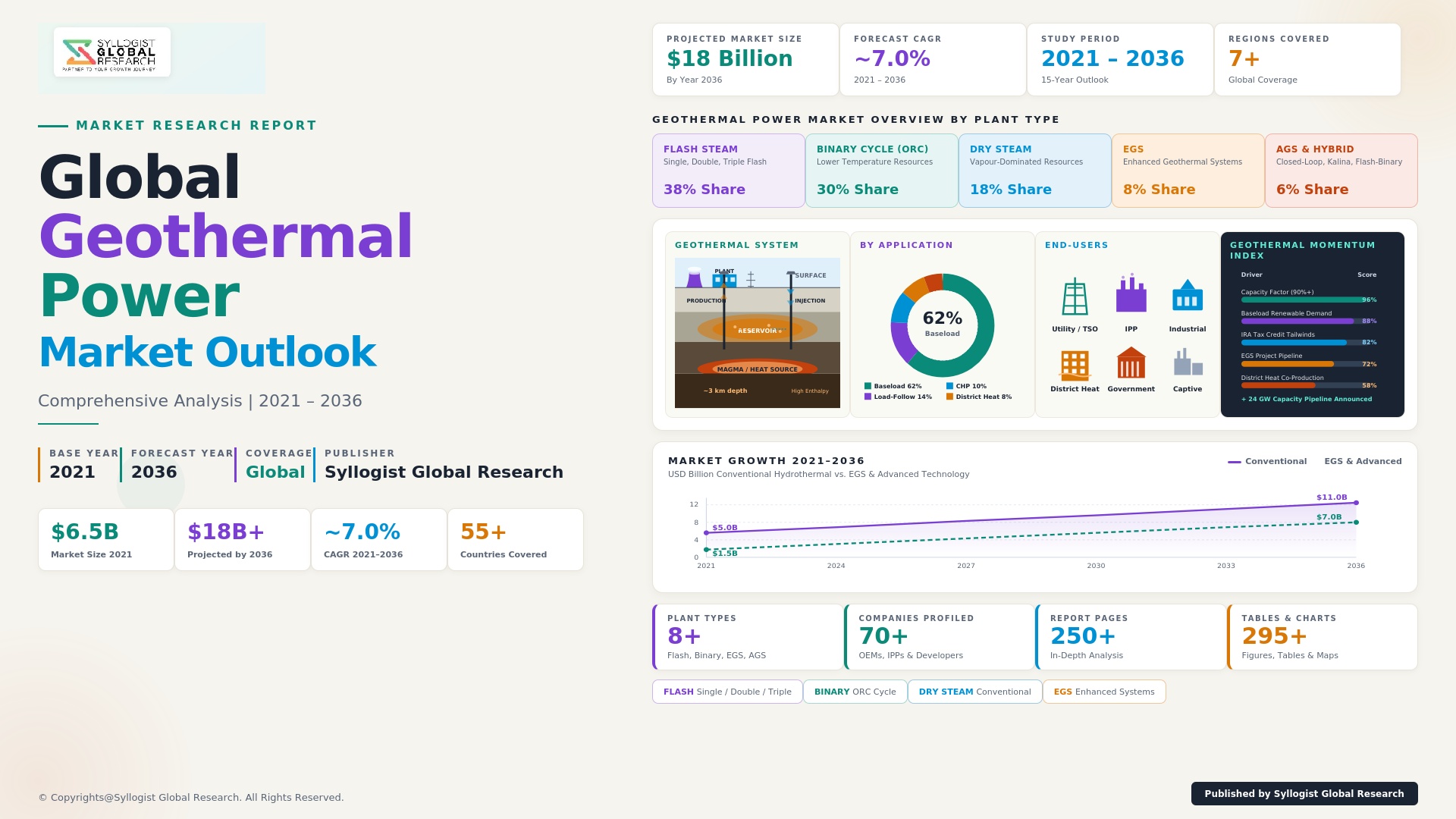
The global geothermal power market is transitioning from a regionally concentrated baseload renewable segment into a strategic 24/7 carbon-free electricity category propelled by next-generation drilling technologies, hyperscaler offtake commitments, and policy frameworks rewarding firm clean power. The market was valued at approximately USD 6.8 billion in 2025 and is projected to reach USD 14.2 billion by 2034, advancing at a compound annual growth rate of 8.5% through the forecast period, with EGS-led upside scenarios placing the trajectory closer to 11.2% as Enhanced Geothermal Systems move from demonstration to commercial bankability. Global installed geothermal power capacity reached 16.4 GW at the end of 2024 across 32 producing countries, with the project pipeline under planning, drilling, or construction representing an additional 13.6 GW expected to commission between 2026 and 2032.
The geographic concentration of installed capacity remains pronounced, with the United States hosting 3.9 GW, Indonesia 2.4 GW, the Philippines 1.9 GW, Turkey 1.7 GW, Kenya 0.95 GW, New Zealand 1.04 GW, Mexico 0.97 GW, Italy 0.92 GW, Iceland 0.76 GW, and Japan 0.58 GW. Indonesia’s Geothermal Roadmap targets 8 GW of installed capacity by 2030, Kenya is advancing the Menengai field beyond the current 165 MW toward 465 MW, the Philippines has restarted exploration of 26 new prospects, and Turkey continues to expand binary plant deployment in the Aydin and Denizli geothermal corridors. Capacity factors for conventional hydrothermal plants average 82% globally and frequently exceed 90% in well-managed assets, making geothermal one of the highest-capacity-factor renewable resources available.
Enhanced Geothermal Systems are the most consequential structural shift in the market since the commercial introduction of binary cycle technology. The Fervo Energy Cape Station project in Utah is scheduled to deliver 115 MW of EGS capacity beginning 2026, anchored by a 24/7 carbon-free electricity offtake agreement with Google, while Microsoft, Meta, and Amazon have entered multi-hundred-megawatt EGS and Advanced Geothermal Systems offtake discussions with developers including Fervo, Eavor, Sage Geosystems, and GreenFire Energy. The US Department of Energy FORGE testbed in Utah, the Earthshot target of USD 45 per MWh by 2035, and the 30% Investment Tax Credit and 2.75 cents per kWh Production Tax Credit under the Inflation Reduction Act are accelerating EGS bankability, with announced project pipelines totaling 4.2 GW under various stages of development across the United States, the United Kingdom, Germany, France, Switzerland, and Australia.
Hyperscaler 24/7 clean energy demand has emerged as the single most important demand-side catalyst, with announced multi-decade geothermal power purchase agreements crossing USD 18 billion in committed contract value through 2024, driven by Microsoft, Google, Meta, and Amazon. The economics of geothermal are also being reshaped by the convergence with oil and gas service sector cost curves, with horizontal drilling rig day rates falling 38% from 2014 peaks, geothermal well costs declining from USD 12 million per well to USD 7.5 million per well on EGS demonstration projects, and the integration of geothermal heat into long-duration energy storage and direct-air-capture applications opening adjacent revenue streams. The competitive landscape is consolidating around five turbine OEMs that collectively account for 84% of installed capacity, while EGS innovators are emerging as a parallel new ecosystem of vertically integrated developers.
Key Drivers
Hyperscale 24/7 Carbon-Free Electricity Procurement Imperatives and AI-Led Data Center Power Demand Driving Long-Tenor Geothermal Offtake Commitments
The acceleration of AI workloads and the surge in hyperscale data center electricity consumption beyond 1,000 TWh annually by 2026 is generating unprecedented demand for firm 24/7 carbon-free electricity that wind and solar with batteries cannot economically deliver at the required reliability profile. Microsoft, Google, Meta, and Amazon have collectively committed over USD 18 billion in geothermal offtake contracts through 2024, anchoring development financing for EGS and conventional projects through 2035 and establishing geothermal as a strategic baseload renewable for technology-sector clean energy roadmaps.
Enhanced Geothermal Systems Commercialization, Horizontal Drilling Cost Curves, and Oil and Gas Service Sector Convergence Unlocking Global Resource Potential
The maturation of horizontal drilling, multi-stage stimulation, and downhole instrumentation borrowed from the unconventional oil and gas industry is collapsing geothermal exploration risk and reducing EGS well costs from USD 12 million to USD 7.5 million per well across recent demonstrations. EGS unlocks the geographic constraints that historically limited geothermal to volcanic and rift zones, enabling commercial deployment across hot dry rock provinces in the United States, the United Kingdom, Germany, France, Australia, and Japan, and pushing the addressable resource base to over 5 TW of theoretical global capacity.
Policy Incentives, Tax Credits, and Firm Clean Power Mandates Across the United States, the European Union, Indonesia, Kenya, and Turkey Anchoring Project Bankability
The 30% Investment Tax Credit, 2.75 cents per kWh Production Tax Credit, and FORGE testbed funding under the Inflation Reduction Act are accelerating US geothermal bankability. The European Union has set a 2030 geothermal capacity target of 5.6 GW with Innovation Fund grants up to EUR 200 million per project, while Indonesia’s Geothermal Roadmap targets 8 GW by 2030, Kenya’s 5,000 MW geothermal plan, and Turkey’s feed-in tariff at USD 105 per MWh underpin sustained development.
Key Challenges
Subsurface Exploration Risk, High Upfront Drilling Capital Intensity, and Long Pre-Commercial Development Timelines Slowing Project Financial Close
Geothermal project development confronts a structural risk profile in which 35% to 50% of total project capex is committed before resource confirmation, drilling cost per well averages USD 7.5 million for EGS and USD 5.4 million for conventional hydrothermal, and pre-commercial development timelines stretch beyond 7 years on greenfield resources. Dry-hole risk on initial exploration wells remains material in unproven plays, and limited availability of risk capital, geothermal-specific insurance products, and exploration-stage public funding constrains the financial close pipeline relative to its underlying resource opportunity.
Induced Seismicity Concerns, Permitting Friction, and Community Acceptance Challenges in EGS and Stimulation-Intensive Project Architectures
Hydraulic stimulation activities used in Enhanced Geothermal Systems carry induced seismicity risk that has historically resulted in project shutdowns, most notably in Basel in 2009 and Pohang in 2017, creating sustained regulatory and community opposition in stimulation-sensitive jurisdictions. Permitting timelines for new geothermal wells regularly exceed 36 months in the United States, 48 months in Germany, and 30 months in Indonesia, while environmental review of brine handling, non-condensable gas emissions, and well field footprint adds compounding delay across project milestones.
Limited Drilling Rig Availability, Specialized Workforce Shortages, and Oil and Gas Service Cost Inflation Constraining EGS Scale-Up Velocity
The geothermal sector competes directly with oil and gas exploration and unconventional production for high-temperature horizontal drilling rigs, specialist directional drilling crews, and downhole completion services. Rig day rates rose 28% between 2022 and 2024 amid sustained oil and gas activity, and the addressable pool of crews experienced in high-temperature drilling above 200 degrees Celsius remains structurally small, extending project schedules and elevating well delivery costs. Skilled reservoir engineers, geothermal-specific completion engineers, and stimulation specialists are similarly oversubscribed across competing EGS programs.
Market Segmentation
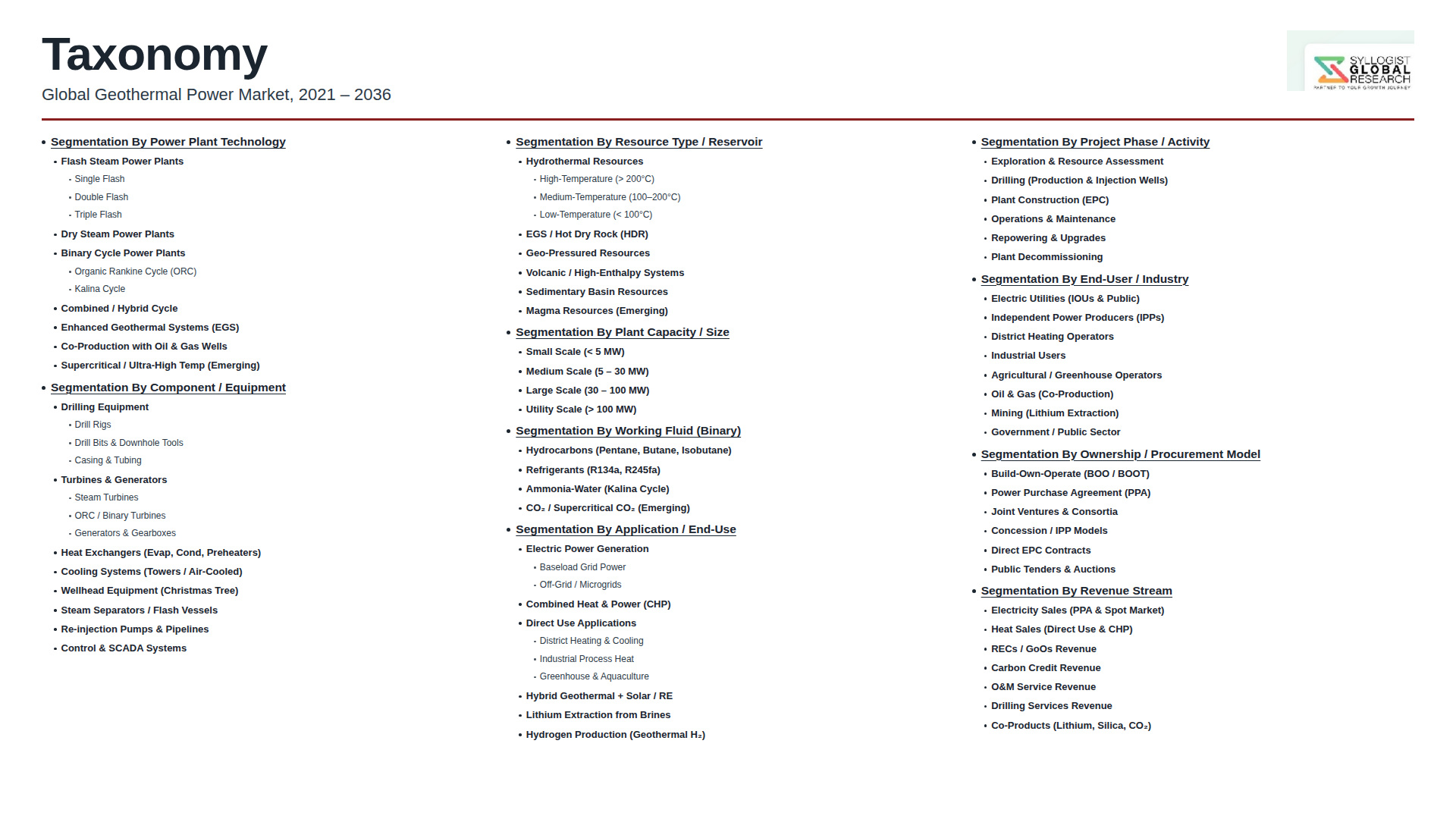
- Segmentation By Technology
- Conventional Hydrothermal
- Enhanced Geothermal Systems (EGS)
- Advanced or Closed-Loop Geothermal Systems (AGS)
- Supercritical Geothermal
- Co-Produced Geothermal from Oil and Gas Wells
- Hybrid Geothermal Systems
- Others
- Segmentation By Resource Type
- High-Temperature Resources (Above 180 degrees Celsius)
- Medium-Temperature Resources (90 to 180 degrees Celsius)
- Low-Temperature Resources (Below 90 degrees Celsius)
- Hot Dry Rock and Engineered Reservoirs
- Segmentation By Plant Type
- Dry Steam Plants
- Single Flash Plants
- Double Flash Plants
- Triple Flash Plants
- Binary Cycle Plants
- Hybrid Flash-Binary Plants
- Others
- Segmentation By Power Cycle
- Steam Rankine Cycle
- Organic Rankine Cycle (ORC)
- Kalina Cycle
- Supercritical CO2 Cycle
- Others
- Segmentation By Capacity
- Small Scale (Up to 5 MW)
- Medium Scale (5 MW to 30 MW)
- Utility Scale (30 MW to 100 MW)
- Large Utility Scale (Above 100 MW)
- Segmentation By Application
- Utility-Scale Power Generation
- 24/7 Carbon-Free Energy Supply to Data Centers
- Industrial Process Heat and Cogeneration
- District Heating Integration
- Direct Air Capture and Hydrogen Production Coupling
- Long-Duration Energy Storage Coupling
- Others
- Segmentation By End User
- Utilities
- Independent Power Producers
- Hyperscale Data Center Operators
- Industrial Process Heat Consumers
- District Heating Network Operators
- Oil and Gas Operators Monetizing Legacy Wells
- Mining and Heavy Industry
- Others
- Segmentation By Region
- North America
- Europe
- Asia-Pacific
- Middle East and Africa
- Latin America
All market revenues are presented in USD
Historical Year: 2021-2024 | Base Year: 2025 | Estimated Year: 2026 | Forecast Period: 2027-2034
Key Questions this Study Will Answer
- What is the total global market valuation of the Geothermal Power Market in 2025, projected through 2034, disaggregated by technology, plant type, capacity class, and application, enabling developers, turbine OEMs, drilling service providers, hyperscale off-takers, and infrastructure investors to identify the highest-growth segments and most durable revenue opportunities across the geothermal power landscape?
- How are leading geothermal jurisdictions in the United States, Indonesia, the Philippines, Turkey, Kenya, Italy, Iceland, New Zealand, Mexico, and Japan allocating capital across conventional hydrothermal, Enhanced Geothermal Systems, Advanced Geothermal Systems, and supercritical geothermal, and which national programs are setting the technical specification, drilling depth, and procurement benchmarks shaping the global geothermal market through 2034?
- What are the relative levelized cost of electricity, capacity factor, drilling risk, resource flexibility, and scalability advantages of conventional hydrothermal, EGS, AGS, supercritical, and co-produced geothermal technologies across utility-scale generation, 24/7 carbon-free supply to data centers, industrial process heat, and district heating applications, and which technologies are most likely to capture incremental share between 2025 and 2034?
- Which end-user cohorts, including hyperscale data center operators, vertically integrated utilities, industrial process heat consumers, direct air capture developers, and oil and gas operators monetizing legacy wellbore assets, are generating the highest contracting velocity through 2034, and what offtake architectures, project finance structures, and tax credit applications are most critical to converting demand into bankable geothermal capacity?
- How is the competitive landscape structured among multinational steam turbine OEMs, ORC module specialists, EGS innovators including Fervo, Eavor, Sage Geosystems, and GreenFire Energy, drilling service providers, and integrated geothermal developers, and what partnership, joint venture, capacity expansion, and acquisition strategies are enabling new entrants to compete with established players in next-generation geothermal programs?
- What are the most significant subsurface exploration risks, induced seismicity concerns, permitting frictions, drilling rig availability constraints, and skilled workforce shortages affecting geothermal deployments, and how are developers, regulators, insurers, and service providers addressing resource confirmation, seismic monitoring, completion engineering, and risk allocation within evolving geothermal regulatory and technical frameworks?
- Which regional geothermal markets, specifically North America, Europe, Asia Pacific, Middle East and Africa, and Latin America, are expected to generate the most substantial incremental geothermal capacity additions through 2034, and what regulatory frameworks, Investment Tax Credit and Production Tax Credit regimes, feed-in tariffs, capacity auctions, and 24/7 clean energy mandates are driving project development priorities and supplier selection in each regional market?
- Product Definition
- Research Methodology
- Research Design & Framework
- Overall Research Approach: Descriptive, Exploratory & Quantitative Mixed-Method Design
- Market Definition & Scope Boundaries: What is Included and Excluded
- Segmentation Framework
- Key Research Assumptions & Limitations
- Secondary Research
- Primary Research Design & Execution
- Data Triangulation & Validation
- Market Sizing & Forecasting Methodology
- Competitive Intelligence Methodology
- Quality Assurance & Peer Review
- Definitions, Abbreviations & Data Notes
- Research Design & Framework
- Executive Summary
- Market Snapshot & Headline Numbers
- Key Findings & Research Highlights
- Market Dynamics
- Regional Market Summary
- Competitive Landscape Snapshot
- Technology & Innovation Highlights
- Market Dynamics
- Drivers
- Restraints
- Opportunities
- Challenges
- Porter’s Five Forces Analysis
- PESTLE Analysis
- Market Trends & Developments
- Emerging Trends
- Technological Developments
- Regulatory & Policy Changes
- Exploration, Drilling & Sub-Surface Sourcing Trends
- Plant Construction, Commissioning & Operational Trends
- Investment, Project Pipeline & Funding Activity
- Sustainability & ESG Trends
- Risk Assessment Framework
- Resource Risk, Reservoir Productivity Decline & Sub-Surface Geological Uncertainty
- Drilling Cost Overrun, Well Productivity Shortfall & Sub-Surface Capex Risk
- Project Permitting, Land Rights, Indigenous Community & Environmental Approval Risk
- Power Off-Take, PPA Counterparty Credit & Tariff Stability Risk
- Induced Seismicity, Reservoir Sustainability, Reinjection Performance & Long-Term Asset Risk
- Regulatory Framework & Standards
- National Geothermal Policy, Resource Concession, Licensing & Resource Classification (UNFC) Frameworks Across Resource-Rich Jurisdictions
- Renewable Energy Tariff, Auction, Feed-in & Power Purchase Agreement Frameworks Applicable to Geothermal Power
- Drilling, Well Integrity, Reservoir Management, Reinjection & Operational Compliance Standards
- Environmental Permitting, Induced Seismicity Management, Water Use & Brine Discharge Standards for Geothermal Operations
- IRA 45Y / 48E Tax Credit, EU RED III, Green Bond Eligibility & Sustainable Finance Frameworks for Geothermal Assets
- Global Geothermal Power Market Outlook
- Market Size & Forecast by Value
- Market Size & Forecast by Volume (Installed Capacity, MW & GW)
- Market Size & Forecast by Plant Type
- Dry Steam Plants
- Single Flash Plants
- Double Flash & Triple Flash Plants
- Binary Cycle (Organic Rankine Cycle, ORC) Plants
- Kalina Cycle Plants
- Flash-Binary Hybrid & Combined Cycle Plants
- Back-Pressure & Wellhead Modular Plants
- Market Size & Forecast by Resource & System Technology
- Conventional Hydrothermal (Liquid-Dominated Reservoirs)
- Conventional Hydrothermal (Vapour-Dominated Reservoirs)
- Enhanced Geothermal Systems (EGS) & Engineered Reservoir Technology
- Advanced / Closed-Loop Geothermal Systems (AGS)
- Co-Produced Geothermal from Oil & Gas Wells
- Geopressured, Supercritical & Deep Geothermal Innovations
- Market Size & Forecast by Resource Temperature & Enthalpy
- High Enthalpy (Above 180 °C)
- Medium Enthalpy (100 °C to 180 °C)
- Low Enthalpy (Below 100 °C, for Binary Power Applications)
- Market Size & Forecast by Project Scale
- Large-Scale Geothermal Power Projects (Above 50 MW)
- Medium-Scale Geothermal Power Projects (10 MW to 50 MW)
- Small-Scale Geothermal Power Projects (1 MW to 10 MW)
- Micro-Scale & Wellhead Modular Geothermal Projects (Below 1 MW)
- Market Size & Forecast by Application
- Baseload Power Generation (Standalone Geothermal)
- Combined Heat & Power (CHP) & Cogeneration
- Utility-Scale District Heating Integration
- Industrial Process Heat & Power Co-Supply
- Lithium & Mineral Co-Extraction from Geothermal Brines
- Direct Air Capture (DAC) Integration & Carbon Removal Co-Located Power
- Green Hydrogen Production from Geothermal Electricity
- Off-Grid, Remote, Mine-Site & Island Power Supply
- Market Size & Forecast by End-User
- Independent Power Producers (IPPs)
- Utility-Owned Geothermal Operators & Vertically Integrated Utilities
- Government & State-Owned Geothermal Corporations
- Oil & Gas Operators Diversifying into Geothermal
- Industrial, Mining & Captive Load Operators
- Direct Heat Off-Takers & District Heating Operators
- Lithium, Mineral Brine Processors & Co-Production Off-Takers
- Market Size & Forecast by Sales Channel
- Direct OEM, Turbine & Power Block Manufacturer Sales
- EPC, Turnkey Project & Consortium Channel
- Build-Own-Operate (BOO), Build-Operate-Transfer (BOT) & IPP-Led Channel
- Long-Term Operations, Maintenance & Performance Contract Channel
- North America Geothermal Power Market Outlook
- Market Size & Forecast
- By Value
- By Volume (Installed Capacity, MW & GW)
- By Plant Type
- By Resource & System Technology
- By Resource Temperature & Enthalpy
- By Project Scale
- By Application
- By End-User
- By Country
- By Sales Channel
- Europe Geothermal Power Market Outlook
- Market Size & Forecast
- By Value
- By Volume (Installed Capacity, MW & GW)
- By Plant Type
- By Resource & System Technology
- By Resource Temperature & Enthalpy
- By Project Scale
- By Application
- By End-User
- By Country
- By Sales Channel
- Asia-Pacific Geothermal Power Market Outlook
- Market Size & Forecast
- By Value
- By Volume (Installed Capacity, MW & GW)
- By Plant Type
- By Resource & System Technology
- By Resource Temperature & Enthalpy
- By Project Scale
- By Application
- By End-User
- By Country
- By Sales Channel
- Latin America Geothermal Power Market Outlook
- Market Size & Forecast
- By Value
- By Volume (Installed Capacity, MW & GW)
- By Plant Type
- By Resource & System Technology
- By Resource Temperature & Enthalpy
- By Project Scale
- By Application
- By End-User
- By Country
- By Sales Channel
- Middle East & Africa Geothermal Power Market Outlook
- Market Size & Forecast
- By Value
- By Volume (Installed Capacity, MW & GW)
- By Plant Type
- By Resource & System Technology
- By Resource Temperature & Enthalpy
- By Project Scale
- By Application
- By End-User
- By Country
- By Sales Channel
- Country-Wise* Geothermal Power Market Outlook
- Market Size & Forecast
- By Value
- By Volume (Installed Capacity, MW & GW)
- By Plant Type
- By Resource & System Technology
- By Resource Temperature & Enthalpy
- By Project Scale
- By Application
- By End-User
- By Country
- By Sales Channel
- *Countries Analyzed in the Syllogist Global Research Portfolio: United States, Canada, Mexico, Germany, France, United Kingdom, Netherlands, Spain, Italy, Norway, Sweden, China, Japan, India, Australia, South Korea, Singapore, Brazil, Chile, Saudi Arabia, UAE, Egypt, South Africa, Israel
- Technology Landscape & Innovation Analysis
- Dry Steam, Single Flash & Double Flash Geothermal Plant Technology Deep-Dive
- Binary Cycle (Organic Rankine Cycle, ORC) & Kalina Cycle Power Block Technology
- Flash-Binary Hybrid, Combined Cycle & Back-Pressure Wellhead Modular Plant Technology
- Enhanced Geothermal Systems (EGS) & Engineered Reservoir Stimulation Technology
- Advanced Geothermal Systems (AGS) & Closed-Loop Subsurface Heat Exchange Technology
- Deep Drilling, High-Temperature Materials, Supercritical & Plasma / Millimetre-Wave Drilling Innovations
- Geothermal-Lithium Co-Production, Brine Processing & Direct Lithium Extraction (DLE) Technology
- Digital Reservoir Modelling, AI-Enabled Reservoir Management & Predictive Maintenance Technology
- Patent & IP Landscape in Geothermal Power Technologies
- Value Chain & Supply Chain Analysis
- Geothermal Resource Developer, Exploration & Drilling Operator Landscape
- Geothermal Steam Turbine, ORC & Power Block OEM Landscape
- Wellhead, Pipeline, Steam Separator, Condenser & Surface Equipment Supply Chain
- Drilling Rig, Bit, Casing, Cementing & Sub-Surface Services Supply Chain
- EPC Contractor, Power Plant Constructor & System Integrator Channel
- IPP, Utility, State-Owned & Industrial Off-Taker Procurement Channel
- Operations, Maintenance, Reservoir Management, Reinjection & Lifecycle Service Channel
- Specialty Co-Product (Lithium, Silica, Mineral Brine) Off-Taker Channel
- Pricing Analysis
- Geothermal Power Plant Capital Cost (Per MW Installed) & Total Cost of Ownership Analysis
- Geothermal Drilling Cost Per Metre, Per Well & Exploration Capex Analysis
- Binary (ORC) vs. Flash vs. Dry Steam Plant Capital & Operating Cost Analysis
- Enhanced & Advanced Geothermal Systems (EGS, AGS) Capex, OPEX & Premium Analysis vs. Conventional Hydrothermal Designs
- Operations, Maintenance, Reservoir Management & Lifecycle Service Pricing Analysis
- Levelised Cost of Geothermal Electricity (LCOE) & Sensitivity to Resource Temperature, Capacity Factor, Drilling Cost & Tax Credit
- Sustainability & Environmental Analysis
- Lifecycle Carbon Footprint of Geothermal Power Across Plant Technologies & Comparison with Other Renewables
- Contribution of Baseload Geothermal to Grid Decarbonisation, Capacity Firming & Renewable Portfolio Diversification
- Induced Seismicity, Water Use, Brine Discharge & Reservoir Sustainability Considerations
- Land Use, Biodiversity, Indigenous Community Engagement & Project Siting Considerations
- Alignment of Geothermal Power with SDG 7 (Affordable Clean Energy), SDG 13 (Climate Action) & Green Finance Eligibility
- Competitive Landscape
- Market Structure & Concentration
- Market Consolidation Level (Fragmented vs. Consolidated by Plant Type & Geography)
- Top 10 Players Market Share
- HHI (Herfindahl-Hirschman Index) Concentration Analysis
- Competitive Intensity Map by Plant Type, Resource & System Technology & Geography
- Player Classification
- Integrated Geothermal Developer-Operators (Vertically Integrated IPPs)
- Pure-Play Geothermal Independent Power Producers
- Steam Turbine OEMs Serving Flash & Dry Steam Geothermal Plants
- Binary Cycle (ORC) & Kalina Cycle Specialist OEMs
- EGS, AGS & Advanced Geothermal Technology Innovators
- Geothermal Drilling, Well Services & Sub-Surface Specialists
- National Geothermal Champions & State-Owned Geothermal Corporations
- Oil & Gas Majors Diversifying into Geothermal
- Competitive Analysis Frameworks
- Market Share Analysis by Plant Type, Resource & System Technology & Region
- Company Profile
- Company Overview & Headquarters
- Geothermal Products, Plant Technology & Resource Portfolio
- Key Customer Relationships & Reference Geothermal Project Installations
- Manufacturing, Drilling & Project Execution Footprint
- Revenue (Geothermal Power Segment) & Project Backlog
- Technology Differentiators & IP
- Key Strategic Partnerships, JVs, Drilling Alliances & M&A Activity
- Recent Developments (Project Awards, Capacity Expansions, Technology Launches)
- SWOT Analysis
- Strategic Focus Areas & Roadmap
- Competitive Positioning Map (Technology Capability vs. Market Penetration)
- Key Company Profiles
- Market Structure & Concentration
- Technology Landscape & Innovation Analysis
- Strategic Output
- Market Opportunity Matrix: By Plant Type, Resource & System Technology, Application, End-User & Geography
- White Space Opportunity Analysis
- Strategic Recommendations
- Resource Portfolio, Exploration & Reservoir Replenishment Strategy
- Plant Technology, ORC, EGS & AGS Investment Strategy
- Geographic Expansion & Localisation Strategy (Pacific Ring of Fire, East African Rift, Tethyan Belt)
- IPP, Utility & End-User Engagement Strategy
- Partnership, JV, Drilling Alliance & M&A Strategy
- Sustainability, Lithium Co-Production & ESG-Aligned Geothermal Strategy
- Risk Mitigation & Future Roadmap
- Strategic Priority Matrix & Roadmap
- Near-term (2025-2028)
- Mid-term (2029-2032)
- Long-term (2033-2037)
- Market Size & Forecast
- Market Size & Forecast
- Market Size & Forecast
- Market Size & Forecast
- Market Size & Forecast
- Market Size & Forecast