Global Offshore Support Vessels Market By Vessel Type, By End Market, By Water Depth, By Propulsion, By Charter Type, By Application, By Operator Type, By Region, Competition, Forecast & Opportunities, 2021-2036F
Market Definition
The Global Offshore Support Vessels Market encompasses the construction, ownership, chartering, operation, and lifecycle management of specialized marine vessels that provide logistical, technical, and operational support to offshore oil and gas, offshore wind, subsea construction, and offshore decommissioning activities across continental shelves, deepwater, and ultra-deepwater operating environments. The market includes Platform Supply Vessels that transport fuel, drilling fluids, cement, drinking water, dry bulk, and deck cargo to offshore installations; Anchor Handling Tug Supply vessels and Anchor Handling Tugs that move drilling rigs, handle anchors, and provide towage; Multi-Purpose Support Vessels and Subsea Construction Vessels equipped with active heave-compensated cranes, ROV spreads, and saturation diving systems for IRM, installation, and decommissioning duty; Diving Support Vessels for saturation and air diving operations; Crew Boats and Fast Supply Vessels for personnel transfer; Service Operation Vessels and Commissioning Service Operation Vessels with walk-to-work gangways for offshore wind farm operations and maintenance; and Cable Lay Vessels, Heavy Lift Vessels, Well Stimulation Vessels, and Standby and Rescue Vessels for specialized duty. Within scope are dynamically positioned DP2 and DP3 vessels, low-emission and dual-fuel hybrid propulsion architectures including LNG, methanol, ammonia-ready and battery-hybrid systems, and the digital monitoring, dynamic positioning control, and emissions reporting platforms integrated across modern OSV fleets. End users span integrated oil and gas majors, national oil companies, independent E&P operators, offshore drilling contractors, offshore wind developers, subsea construction contractors, decommissioning specialists, and pipeline installation companies. For this study, the market is measured by charter day rate revenue, vessel sale revenue, and lifecycle aftermarket service revenue in USD across spot and term charter arrangements globally.
Market Insights
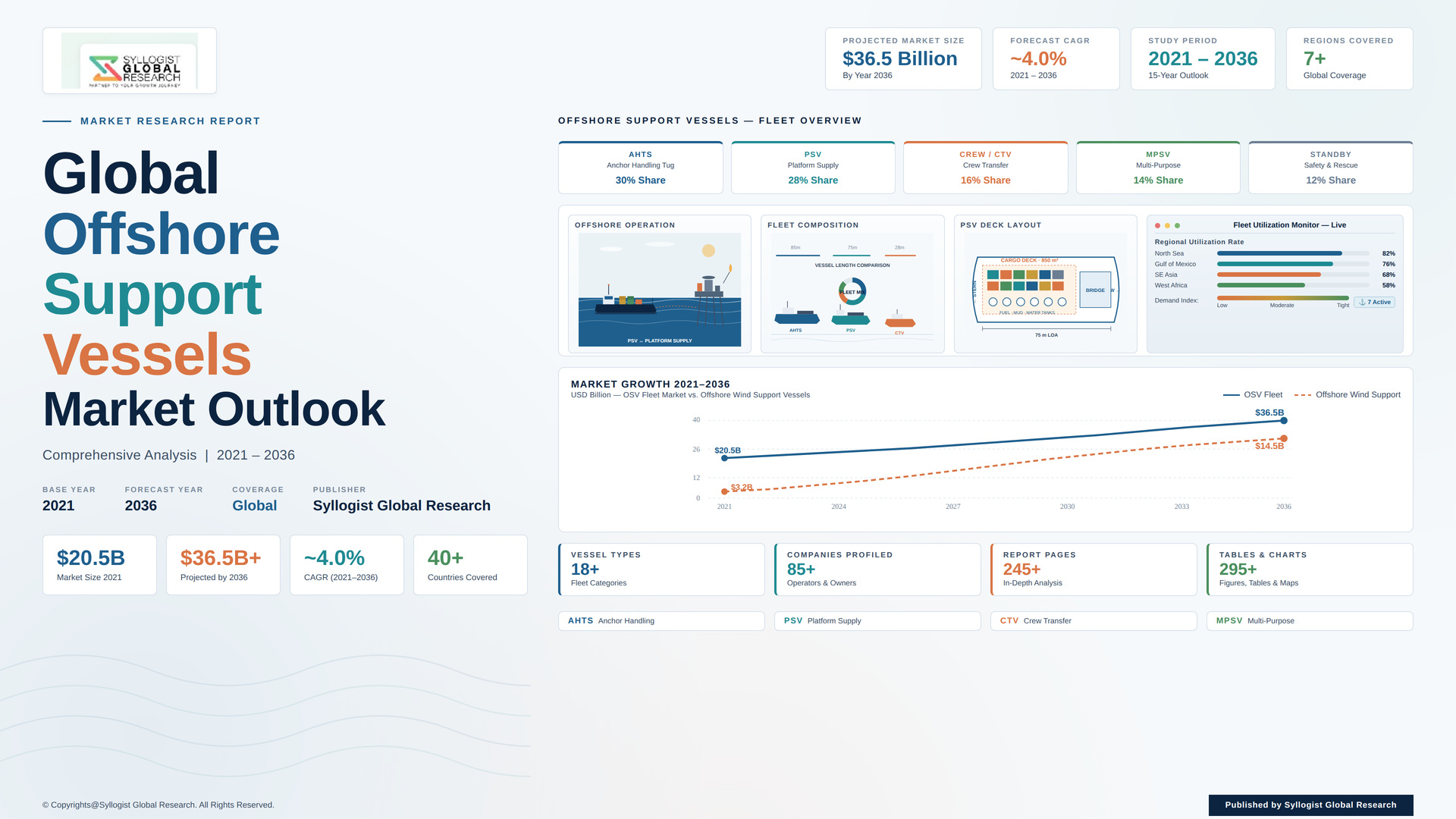
The global offshore support vessels market is moving through the strongest investment and earnings cycle in over a decade, anchored by deepwater oil and gas FID resurgence, an accelerating offshore wind installation pipeline, structurally tight vessel supply after years of underinvestment, and the parallel emergence of decommissioning as a durable demand vector. The market was valued at approximately USD 28.4 billion in 2025 and is projected to reach USD 51.8 billion by 2034, advancing at a compound annual growth rate of 6.9% through the forecast period, as charter rates remain elevated across PSV, AHTS, subsea, and offshore wind support segments. Platform Supply Vessels account for the largest revenue category at 35%, Anchor Handling Tug Supply at 26%, Subsea Construction Vessels and Diving Support Vessels combined at 18%, Service Operation Vessels and Commissioning Service Operation Vessels at 9%, Crew Boats and Fast Supply Vessels at 5%, and Cable Lay, Heavy Lift, and Standby vessels at the remaining 7%.
Fleet supply economics have inverted from the 2014 to 2021 oversupply cycle into a structurally tight market. The global OSV fleet stood at approximately 5,540 active vessels in 2024, with 38% of the global fleet over 15 years old and a further 14% over 25 years old, against a newbuild orderbook of only 132 vessels representing 2.4% of the active fleet. Global fleet utilization reached 86% in 2024, up from 62% in 2020, and high-specification DP2 PSV day rates in the North Sea, Brazil, and West Africa crossed USD 31,500 per day, AHTS rates above 12,000 BHP traded above USD 48,000 per day, and high-end subsea construction vessels achieved term charter rates exceeding USD 215,000 per day. Brazil’s Petrobras OSV demand alone is projected to require 280 active support vessels through 2030 to service the pre-salt development program.
Deepwater oil and gas activity remains the structural anchor of demand. Global deepwater and ultra-deepwater FIDs sanctioned USD 132 billion in 2024 across Brazil’s Buzios, Mero, and Sepia fields, Guyana’s Stabroek block (Yellowtail, Uaru, Whiptail), Suriname’s Block 58, Namibia’s Orange Basin (Venus and Graff discoveries), Mozambique’s Area 4, Senegal’s GTA Phase 2, and the US Gulf of Mexico (Anchor, Whale, Shenandoah). ExxonMobil’s Guyana program targets 1.2 million barrels per day by 2027 across eight FPSOs, requiring approximately 28 dedicated support vessels per FPSO across drilling, completion, and steady-state operations. The under-construction West African and Brazilian FPSO pipeline of 24 hulls through 2028 will sustain elevated PSV and AHTS demand and elongate term charter visibility.
Offshore wind is reshaping fleet composition and unlocking a distinct vessel class growth profile. Global offshore wind installations reached 12.6 GW in 2024 with a project pipeline exceeding 510 GW through 2034, generating sustained demand for purpose-built Service Operation Vessels, Commissioning Service Operation Vessels, walk-to-work platforms, and Cable Lay Vessels. The active SOV and CSOV fleet expanded from 88 vessels in 2022 to 137 vessels in 2024, with 64 additional vessels on order at South Korean, Chinese, Vietnamese, and European yards, representing committed capex of USD 6.4 billion. Decarbonization is reshaping the entire OSV competitive landscape, with 22% of newbuild orders in 2024 specifying methanol dual-fuel, battery-hybrid, or ammonia-ready configurations to meet FuelEU Maritime, IMO 2050, and charterer ESG requirements. The competitive landscape spans Tidewater, Solstad Offshore, Bourbon, Edison Chouest, Maersk Supply Service, DOF Subsea, Esvagt, North Star, Cyan Renewables, MMA Offshore, and Vroon, with the top 10 owners controlling 41% of global fleet capacity.
Key Drivers
Deepwater and Ultra-Deepwater FID Resurgence Across Brazil, Guyana, Namibia, Suriname, and Sub-Saharan Africa Anchoring Multi-Year PSV, AHTS, and Subsea Demand
Global deepwater and ultra-deepwater FIDs sanctioned USD 132 billion in 2024 across Brazil’s pre-salt, Guyana Stabroek, Suriname Block 58, Namibia’s Orange Basin, Mozambique, Senegal’s GTA, and the US Gulf of Mexico, generating durable procurement of high-specification PSV, AHTS, Subsea Construction Vessel, and Diving Support Vessel capacity. ExxonMobil’s Guyana program targets 1.2 million barrels per day by 2027 across eight FPSOs, requiring approximately 28 dedicated support vessels per FPSO across drilling, completion, and steady-state operations, while Petrobras has committed to 280 active support vessels through 2030.
Offshore Wind Buildout, SOV and CSOV Fleet Expansion, and Cable Lay Vessel Capacity Constraints Driving a Distinct Vessel Class Growth Profile
Global offshore wind installations of 12.6 GW in 2024 and a project pipeline of 510 GW through 2034 are generating sustained demand for purpose-built Service Operation Vessels, Commissioning Service Operation Vessels, walk-to-work platforms, and Cable Lay Vessels. The active SOV and CSOV fleet expanded from 88 vessels in 2022 to 137 in 2024 with 64 additional vessels on order representing USD 6.4 billion of committed newbuild capex, while floating wind commercialization in France, the United Kingdom, South Korea, Norway, and California adds further specification requirements through 2034.
Structurally Tight Fleet Supply, Aging Vessel Profile, and Limited Newbuild Pipeline Sustaining Elevated Charter Day Rates Across Vessel Classes
The global OSV fleet of 5,540 active vessels carries 38% of capacity over 15 years old and 14% over 25 years old, against a newbuild orderbook of only 132 vessels representing 2.4% of the fleet, generating structural supply tightness that has driven North Sea PSV day rates above USD 31,500, AHTS above 12,000 BHP above USD 48,000, and high-end subsea construction vessel term rates above USD 215,000 per day. Global utilization at 86% in 2024 supports a multi-year orderbook visibility window that incentivizes selective newbuild capex by tier-one operators.
Key Challenges
Decarbonization Regulation Under FuelEU Maritime, IMO 2050, and Carbon Intensity Indicator Requirements Driving Mid-Life Retrofit Capex and Stranded Asset Risk
FuelEU Maritime carbon intensity reduction requirements escalating to 80% by 2050, IMO 2050 net-zero targets, the EU Emissions Trading System extension to maritime shipping, and the Carbon Intensity Indicator regime are imposing material lifecycle compliance costs on the existing OSV fleet. Mid-life retrofits to methanol dual-fuel, battery-hybrid, and ammonia-ready propulsion architectures cost USD 22 million to USD 38 million per vessel, while non-compliant vessels face progressive charter market exclusion as oil major and offshore wind charterers tighten ESG procurement criteria across new tenders.
Shipyard Capacity Constraints, Newbuild Lead Time Extension, and Specialty Component Bottlenecks Slowing Fleet Renewal Velocity
South Korean, Chinese, Singaporean, and European shipyards capable of delivering high-specification OSVs are oversubscribed across competing newbuild programs for LNG carriers, container ships, and offshore wind installation vessels, with available slot delivery dates pushed beyond 2028 for new orders. Specialty components including DP2 and DP3 control systems, active heave-compensated cranes, walk-to-work gangways, and saturation diving systems carry lead times exceeding 30 months, while skilled marine engineering and project management capacity is structurally tight across the global newbuild ecosystem.
Charter Rate Cyclicality, Oil and Gas Demand Uncertainty, and Crew Shortage Constraining Long-Cycle Operator Capex and Operating Stability
OSV operators face structural exposure to oil and gas commodity cycles, with Brent oil price swings between USD 68 and USD 96 per barrel through 2024 driving counter-cyclical operator capex discipline that historically produced sharp utilization and day rate corrections. Skilled marine officer and engineer shortages have intensified, with Filipino, Indian, and Eastern European crew supply pools structurally insufficient against demand, pushing crew costs up 18% in 2024 and complicating fleet expansion economics across PSV, AHTS, and subsea construction vessel operators.
Market Segmentation
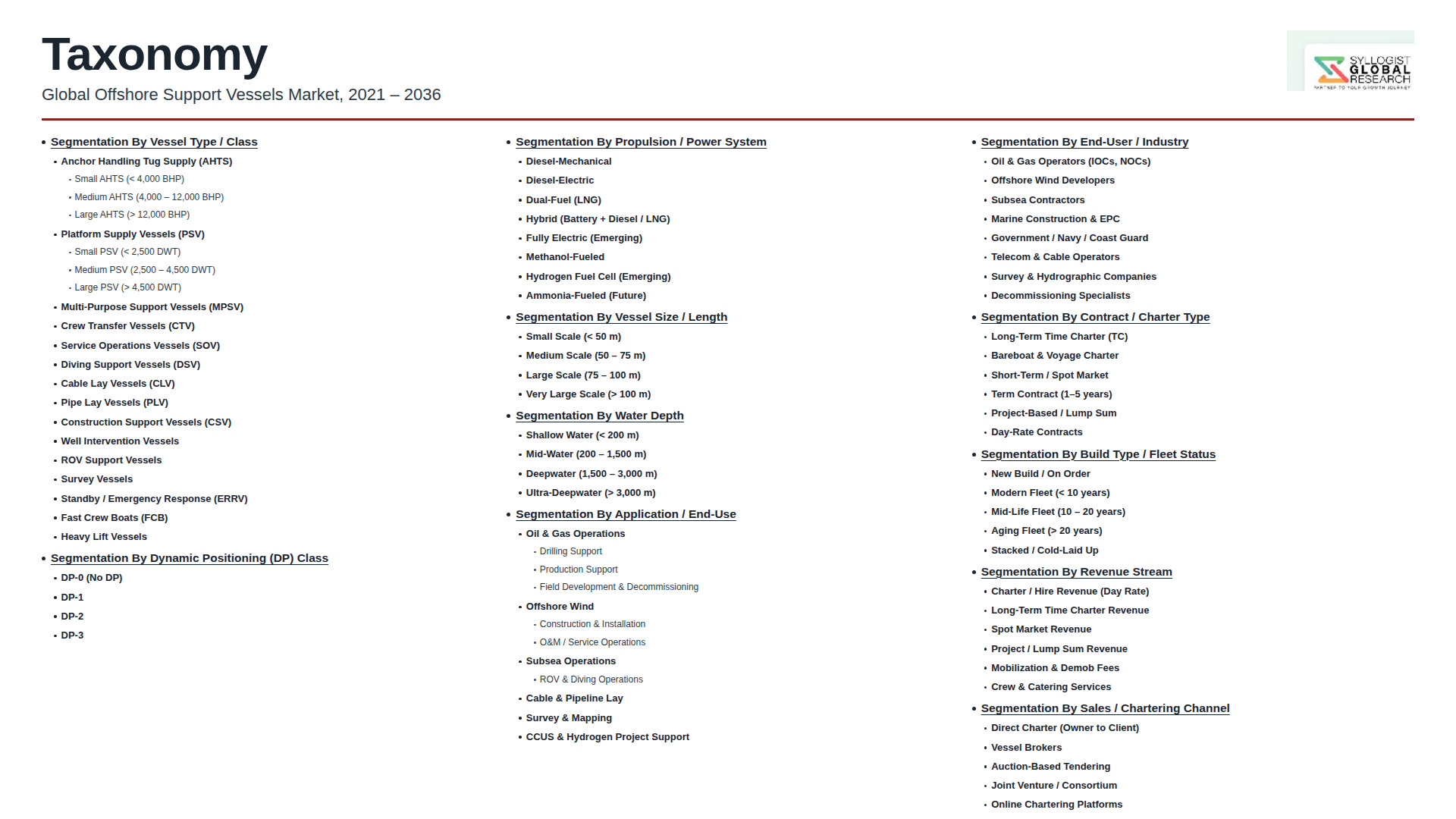
- Segmentation By Vessel Type
- Platform Supply Vessels (PSV)
- Anchor Handling Tug Supply (AHTS) and Anchor Handling Tugs (AHT)
- Multi-Purpose Support Vessels (MPSV)
- Subsea Construction Vessels and Diving Support Vessels (DSV)
- Service Operation Vessels (SOV) and Commissioning Service Operation Vessels (CSOV)
- Crew Boats and Fast Supply Vessels (FSV)
- Cable Lay Vessels and Heavy Lift Vessels
- Well Stimulation Vessels
- Standby and Rescue Vessels
- Others
- Segmentation By End Market
- Offshore Oil and Gas Exploration and Production
- Offshore Wind Installation and Operations
- Subsea Construction and IRM
- Offshore Decommissioning
- Pipeline and Cable Installation
- Others
- Segmentation By Water Depth
- Shallow Water (Up to 200 meters)
- Deepwater (200 to 1,500 meters)
- Ultra-Deepwater (Above 1,500 meters)
- Segmentation By Propulsion
- Conventional Diesel
- Diesel-Electric
- LNG and Dual-Fuel LNG
- Methanol Dual-Fuel
- Ammonia-Ready
- Battery-Hybrid
- Hydrogen-Ready and Alternative Fuel
- Others
- Segmentation By Charter Type
- Spot Charter
- Short-Term Charter (Up to 1 Year)
- Medium-Term Charter (1 to 3 Years)
- Long-Term Charter (Above 3 Years)
- Bareboat Charter
- Segmentation By Application
- Drilling Rig Support and Towage
- Production Platform Logistics
- FPSO Support and Mooring
- Subsea Installation and Inspection
- Offshore Wind Farm O&M
- Decommissioning and Plug and Abandonment
- Cable and Pipeline Laying
- Crew Transfer and Personnel Logistics
- Standby, Safety, and Rescue
- Others
- Segmentation By Operator Type
- Integrated Marine Service Companies
- Pureplay OSV Owners
- Subsea Contractors with In-House Fleets
- Offshore Wind Specialist Operators
- National Marine Services Companies
- Independent Asset Owners
- Others
- Segmentation By Region
- North Sea and Northwest Europe
- Gulf of Mexico and Americas
- South America (Brazil, Guyana, Suriname)
- West Africa
- Middle East
- Asia-Pacific
- Mediterranean and Other Regions
All market revenues are presented in USD
Historical Year: 2021-2024 | Base Year: 2025 | Estimated Year: 2026 | Forecast Period: 2027-2034
Key Questions this Study Will Answer
- What is the total global market valuation of the Offshore Support Vessels Market in 2025, projected through 2034, disaggregated by vessel type, end market, water depth, propulsion architecture, and charter type, enabling shipyards, OSV owners, oil and gas operators, offshore wind developers, and infrastructure investors to identify the highest-growth segments and most durable revenue opportunities across the offshore support vessel landscape?
- How are leading offshore deepwater jurisdictions including Brazil, Guyana, Suriname, Namibia, Mozambique, Senegal, Angola, the US Gulf of Mexico, and Norway allocating capital across PSV, AHTS, subsea construction, and diving support vessel demand, and which national offshore programs are setting the technical specification and procurement benchmarks shaping the global OSV market through 2034?
- What are the relative day rate, utilization, lifecycle cost, decarbonization, and operational flexibility advantages of Platform Supply Vessels, Anchor Handling Tug Supply vessels, Multi-Purpose Support Vessels, Subsea Construction Vessels, Diving Support Vessels, Service Operation Vessels, Commissioning Service Operation Vessels, and Cable Lay Vessels across offshore oil and gas, offshore wind, subsea, and decommissioning applications, and which vessel classes are most likely to capture incremental share between 2025 and 2034?
- Which vessel segments, including high-specification DP2 and DP3 PSV, high-bollard-pull AHTS, subsea construction with active heave-compensated cranes, SOV and CSOV for offshore wind, and floating-wind-capable support vessels, are generating the highest day rate and utilization growth through 2034, and what propulsion, dynamic positioning, and walk-to-work technologies are most critical to charter contract competitive positioning?
- How is the competitive landscape structured among integrated marine service majors including Tidewater, Solstad Offshore, Bourbon, Edison Chouest, Maersk Supply Service, and DOF Subsea, offshore wind specialists including Esvagt, North Star, and Cyan Renewables, and Asia Pacific regional owners, and what consolidation, newbuild, mid-life retrofit, and ESG positioning strategies are enabling new entrants to compete in next-generation OSV programs?
- What are the most significant FuelEU Maritime, IMO 2050, CII, EU ETS extension, shipyard capacity, specialty component, charter rate cyclicality, and crew shortage risks affecting OSV deployments in operational service, and how are owners, charterers, financiers, and classification societies addressing decarbonization retrofit, fleet renewal, term charter visibility, and risk allocation within evolving offshore support vessel frameworks?
- Which regional offshore support vessel markets, specifically the North Sea and Northwest Europe, South America, the Gulf of Mexico, West Africa, the Middle East, Asia Pacific, and the Mediterranean, are expected to generate the most substantial incremental OSV demand through 2034, and what regulatory frameworks, deepwater FID pipelines, offshore wind capacity targets, decommissioning programs, and decarbonization mandates are driving charter market dynamics and supplier selection in each regional market?
- Product Definition
- Research Methodology
- Research Design & Framework
- Overall Research Approach: Descriptive, Exploratory & Quantitative Mixed-Method Design
- Market Definition & Scope Boundaries: What is Included and Excluded
- Segmentation Framework
- Key Research Assumptions & Limitations
- Secondary Research
- Primary Research Design & Execution
- Data Triangulation & Validation
- Market Sizing & Forecasting Methodology
- Competitive Intelligence Methodology
- Quality Assurance & Peer Review
- Definitions, Abbreviations & Data Notes
- Research Design & Framework
- Executive Summary
- Market Snapshot & Headline Numbers
- Key Findings & Research Highlights
- Market Dynamics
- Regional Market Summary
- Competitive Landscape Snapshot
- Technology & Innovation Highlights
- Market Dynamics
- Drivers
- Restraints
- Opportunities
- Challenges
- Porter’s Five Forces Analysis
- PESTLE Analysis
- Market Trends & Developments
- Emerging Trends
- Technological Developments
- Regulatory & Policy Changes
- Fleet, Newbuild & Yard Capacity Sourcing Trends
- Charter Market, Day Rate & Utilisation Trends
- Investment, Offshore Project Pipeline & Funding Activity
- Sustainability & ESG Trends
- Risk Assessment Framework
- Day Rate Volatility, Charter Cycle & Vessel Utilisation Risk
- Offshore Oil & Gas vs. Offshore Wind Demand Mix & End-Market Cyclicality Risk
- Vessel Newbuild Capacity, Yard Slot Availability & Capital Investment Risk
- Regulatory, IMO Decarbonisation (CII, EEXI, FuelEU Maritime) & Cross-Jurisdictional Compliance Risk
- HSE, Marine Casualty, Crew Safety & Operational Reliability Risk
- Regulatory Framework & Standards
- International Maritime Organisation (IMO) Conventions (SOLAS, MARPOL Annex VI, Special Purpose Ships Code) for Offshore Vessels
- Class Society Standards (DNV, ABS, Lloyd’s Register, Bureau Veritas, ClassNK, RINA) & DP Notations (DP1, DP2, DP3) for OSVs
- IMO Decarbonisation Framework (CII, EEXI, IMO 2030 / 2050 GHG Strategy), FuelEU Maritime, EU MRV & ETS Inclusion of Maritime
- Industry Codes & Guidelines (IMCA, OCIMF, IOGP, OPITO) for Offshore Vessel Operations & Crew Competence
- Cabotage, Local Content, Flag State, Jones Act (US) & Domestic Vessel Operation Frameworks Across Jurisdictions
- Global Offshore Support Vessels Market Outlook
- Market Size & Forecast by Value
- Market Size & Forecast by Volume (Number of Active Vessels & Aggregate Fleet Capacity)
- Market Size & Forecast by Vessel Type
- Anchor Handling Tug Supply (AHTS) Vessels
- Platform Supply Vessels (PSV)
- Multi-Purpose Support Vessels (MPSV) & Offshore Construction Vessels (OCV)
- Diving Support Vessels (DSV)
- Standby, Emergency Response & Rescue Vessels (ERRV)
- Crew Transfer Vessels (CTV)
- Service Operation Vessels (SOV) & Commissioning Service Operation Vessels (CSOV)
- Wind Turbine Installation Vessels (WTIV) & Foundation Installation Vessels
- Heavy Lift Vessels (HLV)
- Cable Laying Vessels (CLV) & Pipe Lay Vessels (PLV)
- Survey, Geotechnical & ROV Support Vessels
- Well Intervention & Light Well Intervention Vessels (LWIV)
- Accommodation Vessels & Floatels
- Market Size & Forecast by Propulsion & Fuel Technology
- Conventional Diesel & Marine Gas Oil (MGO) Propulsion
- LNG Dual-Fuel & LNG-Powered Vessels
- Methanol Dual-Fuel & Methanol-Powered Vessels
- Ammonia & Hydrogen-Ready Future-Fuel Vessels
- Battery-Hybrid Electric & Shore Power Capable Vessels
- Wind-Assisted Propulsion & Auxiliary Sail Technology
- Diesel-Electric & Variable Speed Drive Propulsion
- Market Size & Forecast by Water Depth & Operating Capability
- Shallow Water Operations (Below 150 m)
- Mid-Water & Deepwater Operations (150 m to 1,500 m)
- Ultra-Deepwater Operations (Above 1,500 m)
- Harsh Environment & Arctic / Ice-Class Operations
- Market Size & Forecast by Vessel Size & Capacity Class
- Large & Heavy-Duty Vessels (Above 150 t Bollard Pull or 5,000+ DWT)
- Medium-Class Vessels (80 to 150 t Bollard Pull or 2,000 to 5,000 DWT)
- Small-Class Vessels (Below 80 t Bollard Pull or Below 2,000 DWT)
- Specialty, Custom-Built & DP3 / Harsh Environment Vessels
- Market Size & Forecast by Application & End-Use
- Offshore Oil & Gas Exploration & Drilling Support
- Offshore Oil & Gas Production Support
- Offshore Wind Construction & Installation
- Offshore Wind Operations & Maintenance (O&M)
- Subsea Construction & Pipeline Installation
- Cable Laying (HVDC Export & Inter-Array)
- Decommissioning, Plug & Abandonment & Removal
- Survey, Inspection, Repair & Maintenance (IRM) & Geotechnical
- Defence, Security & Maritime Patrol Support
- Accommodation, Hotel Services & Offshore Workforce Welfare
- Market Size & Forecast by End-User
- International Oil Companies (IOCs)
- National Oil Companies (NOCs)
- Offshore Drilling Contractors
- Subsea EPC Contractors
- Offshore Wind Developers & Operators
- Cable Installation & Subsea Power Cable Operators
- Government, Defence & Naval Authorities
- Survey, Inspection & Geotechnical Service Companies
- Decommissioning, Removal & Salvage Operators
- Market Size & Forecast by Sales & Chartering Channel
- Spot Market & Short-Term Charter
- Term Charter (3 to 12 Months)
- Long-Term Bareboat & Time Charter (Above 1 Year)
- Strategic Alliance & Dedicated Fleet Contract
- Direct Vessel Sale & Newbuild Capital Expenditure
- Lease, Sale-and-Leaseback & Vessel Financing Arrangement
- North America Offshore Support Vessels Market Outlook
- Market Size & Forecast
- By Value
- By Volume (Number of Active Vessels & Aggregate Fleet Capacity)
- By Vessel Type
- By Propulsion & Fuel Technology
- By Water Depth & Operating Capability
- By Vessel Size & Capacity Class
- By Application & End-Use
- By End-User
- By Country
- By Sales & Chartering Channel
- Europe Offshore Support Vessels Market Outlook
- Market Size & Forecast
- By Value
- By Volume (Number of Active Vessels & Aggregate Fleet Capacity)
- By Vessel Type
- By Propulsion & Fuel Technology
- By Water Depth & Operating Capability
- By Vessel Size & Capacity Class
- By Application & End-Use
- By End-User
- By Country
- By Sales & Chartering Channel
- Asia-Pacific Offshore Support Vessels Market Outlook
- Market Size & Forecast
- By Value
- By Volume (Number of Active Vessels & Aggregate Fleet Capacity)
- By Vessel Type
- By Propulsion & Fuel Technology
- By Water Depth & Operating Capability
- By Vessel Size & Capacity Class
- By Application & End-Use
- By End-User
- By Country
- By Sales & Chartering Channel
- Latin America Offshore Support Vessels Market Outlook
- Market Size & Forecast
- By Value
- By Volume (Number of Active Vessels & Aggregate Fleet Capacity)
- By Vessel Type
- By Propulsion & Fuel Technology
- By Water Depth & Operating Capability
- By Vessel Size & Capacity Class
- By Application & End-Use
- By End-User
- By Country
- By Sales & Chartering Channel
- Middle East & Africa Offshore Support Vessels Market Outlook
- Market Size & Forecast
- By Value
- By Volume (Number of Active Vessels & Aggregate Fleet Capacity)
- By Vessel Type
- By Propulsion & Fuel Technology
- By Water Depth & Operating Capability
- By Vessel Size & Capacity Class
- By Application & End-Use
- By End-User
- By Country
- By Sales & Chartering Channel
- Country-Wise* Offshore Support Vessels Market Outlook
- Market Size & Forecast
- By Value
- By Volume (Number of Active Vessels & Aggregate Fleet Capacity)
- By Vessel Type
- By Propulsion & Fuel Technology
- By Water Depth & Operating Capability
- By Vessel Size & Capacity Class
- By Application & End-Use
- By End-User
- By Country
- By Sales & Chartering Channel
- *Countries Analyzed in the Syllogist Global Research Portfolio: United States, Canada, Mexico, Germany, France, United Kingdom, Netherlands, Spain, Italy, Norway, Sweden, China, Japan, India, Australia, South Korea, Singapore, Brazil, Chile, Saudi Arabia, UAE, Egypt, South Africa, Israel
- Technology Landscape & Innovation Analysis
- Anchor Handling Tug Supply (AHTS) Vessel Technology Deep-Dive (Bollard Pull, Anchor Handling Winch, Towing Capability)
- Platform Supply Vessel (PSV) Technology (Cargo Capacity, Tank Configuration, Deck Space)
- Multi-Purpose Support Vessel (MPSV) & Offshore Construction Vessel (OCV) Technology
- Service Operation Vessel (SOV), CSOV & Walk-to-Work Gangway System Technology for Offshore Wind
- Wind Turbine Installation Vessel (WTIV), Jack-Up & Foundation Installation Vessel Technology
- Dynamic Positioning (DP1, DP2, DP3) & Station-Keeping Technology
- Alternative Fuel & Hybrid Propulsion (LNG, Methanol, Ammonia, Battery-Electric) Technology
- ROV, AUV, Saturation Diving & Subsea Robotics Vessel Integration Technology
- Digital Twin, AI-Enabled Vessel Performance Optimisation, Voyage Planning & Predictive Maintenance Technology
- Patent & IP Landscape in Offshore Support Vessel Technologies
- Value Chain & Supply Chain Analysis
- OSV Owner-Operator & Vessel Charterer Landscape
- Shipbuilder, Newbuild Yard & Conversion Yard Supply Chain
- Marine Equipment OEM (Winches, Cranes, DP Systems, Engines, Thrusters) Supply Chain
- Subsea Equipment (ROV, AUV, Saturation Diving Systems) Manufacturer Supply Chain
- Marine Fuel, Bunkering, Alternative Fuel & Shore Power Supply Chain
- Crew, Manning Agency & Maritime Training Service Channel
- IOC, NOC, Offshore Wind Developer, Subsea EPC & End-User Procurement Channel
- Marine Insurance, P&I Club, Classification & Survey Service Provider Channel
- Pricing Analysis
- AHTS Vessel Day Rate Benchmark Analysis by Bollard Pull Class & Region
- Platform Supply Vessel (PSV) Day Rate Benchmark Analysis by Deck Area & DWT Class
- MPSV, OCV & DSV Day Rate Benchmark Analysis
- SOV, CSOV & WTIV Day Rate Benchmark Analysis for Offshore Wind Service
- Cable Lay, Pipe Lay & Heavy Lift Vessel Project-Based Pricing Analysis
- Newbuild Capital Cost, Conversion Cost & Vessel Resale Value Analysis
- Long-Term Charter vs. Spot Charter Pricing & Margin Analysis
- Total Cost of Ownership, Operating Expense (OPEX) & Day Rate Break-Even Analysis
- Sustainability & Environmental Analysis
- IMO Decarbonisation Pathway, Carbon Intensity Indicator (CII) & EEXI Compliance Performance of OSV Fleets
- Alternative Fuel Adoption (LNG, Methanol, Ammonia, Battery-Hybrid) & Newbuild Fleet Renewal Pathways
- Role of OSVs in Offshore Wind Decarbonisation, Subsea Cable Build-Out & Renewable Energy Transition
- Vessel Recycling, Hong Kong Convention Compliance, EU Ship Recycling Regulation & Circular Economy Considerations
- Alignment of OSV Operations with FuelEU Maritime, EU ETS Maritime Inclusion, SDG 9 (Industry & Innovation), SDG 13 (Climate Action) & Sustainable Finance Eligibility
- Competitive Landscape
- Market Structure & Concentration
- Market Consolidation Level (Fragmented vs. Consolidated by Vessel Type & Geography)
- Top 10 Players Market Share
- HHI (Herfindahl-Hirschman Index) Concentration Analysis
- Competitive Intensity Map by Vessel Type, Application & Geography
- Player Classification
- Integrated Global OSV Owner-Operator Majors
- Pure-Play AHTS & PSV Specialist Operators
- Subsea Construction & Offshore Construction Vessel (OCV) Specialists
- Offshore Wind Vessel Specialists (CTV, SOV, CSOV, WTIV)
- Cable Lay, Pipe Lay & Heavy Lift Vessel Specialists
- Diving Support, ROV & Subsea Service Vessel Specialists
- Regional & National OSV Operators
- Shipbuilders, Newbuild Yards & Conversion Yards
- State-Owned & National Flag OSV Companies
- Competitive Analysis Frameworks
- Market Share Analysis by Vessel Type, Application & Region
- Company Profile
- Company Overview & Headquarters
- OSV Fleet Portfolio, Vessel Type Mix & Capability Coverage
- Key Customer Relationships & Reference Charter Engagements
- Fleet Footprint, Geographic Coverage & Active Vessel Count
- Revenue (OSV Segment) & Charter Backlog
- Technology Differentiators & IP
- Key Strategic Partnerships, JVs & M&A Activity
- Recent Developments (Newbuild Orders, Alternative Fuel Conversions, Charter Wins)
- SWOT Analysis
- Strategic Focus Areas & Roadmap
- Competitive Positioning Map (Fleet Capability vs. Market Penetration)
- Key Company Profiles
- Market Structure & Concentration
- Technology Landscape & Innovation Analysis
- Strategic Output
- Market Opportunity Matrix: By Vessel Type, Propulsion & Fuel Technology, Application, End-User & Geography
- White Space Opportunity Analysis
- Strategic Recommendations
- Fleet Portfolio, Vessel Type Diversification & Newbuild Investment Strategy
- Decarbonisation, Alternative Fuel Conversion & Operational Excellence Strategy
- Geographic Expansion & Regional Hub Strategy (North Sea, Gulf of Mexico, Brazil, Asia-Pacific, Middle East)
- Customer & End-User Engagement Strategy (Oil & Gas vs. Offshore Wind Mix)
- Partnership, JV, Alliance & M&A Strategy
- Sustainability, IMO Compliance & ESG-Aligned Fleet Strategy
- Risk Mitigation & Future Roadmap
- Strategic Priority Matrix & Roadmap
- Near-term (2025-2028)
- Mid-term (2029-2032)
- Long-term (2033-2037)
- Market Size & Forecast
- Market Size & Forecast
- Market Size & Forecast
- Market Size & Forecast
- Market Size & Forecast
- Market Size & Forecast