Global High-Voltage Direct Current Systems Market By Technology, By Component, By Transmission Type, By Configuration, By Voltage Level, By Application, By End User, By Region, Competition, Forecast & Opportunities, 2021-2036F
Market Definition
The Global High-Voltage Direct Current Systems Market encompasses the engineering, manufacturing, supply, installation, commissioning, and lifecycle servicing of integrated power transmission systems that convert and transfer bulk electrical energy at direct current voltages typically above 100 kV across long onshore corridors, submarine interconnectors, and asynchronous network interfaces. The market includes line commutated converter systems based on thyristor valves, voltage source converter systems based on insulated gate bipolar transistors with modular multilevel converter topologies, hybrid HVDC systems combining the strengths of both technologies, and ultra-high-voltage direct current systems operating at 800 kV and 1,100 kV class. Within scope are converter stations, converter transformers, thyristor and IGBT valves, smoothing reactors, harmonic and AC filters, DC switchgear, HVDC circuit breakers, control and protection platforms, valve cooling systems, and reactive power compensation infrastructure deployed at both ends of an HVDC link. The market also covers DC transmission media including extruded XLPE and mass impregnated paper-insulated DC cables for submarine and underground installations, overhead bipolar and monopolar DC line conductors, and electrode systems for sea and land return paths. HVDC systems are deployed across offshore wind farm grid connections, long-distance bulk power corridors above 800 km, asynchronous interconnections between AC grids of different frequencies, controllable cross-border interconnectors, urban infeed solutions for megacities, and embedded HVDC links that reinforce congested AC networks. End users include transmission system operators, vertically integrated utilities, offshore wind developers, mining and oil and gas operators, and large industrial campuses. For this study, the market is measured by project, equipment, software, and aftermarket service revenue in USD across greenfield and capacity expansion deployments.
Market Insights
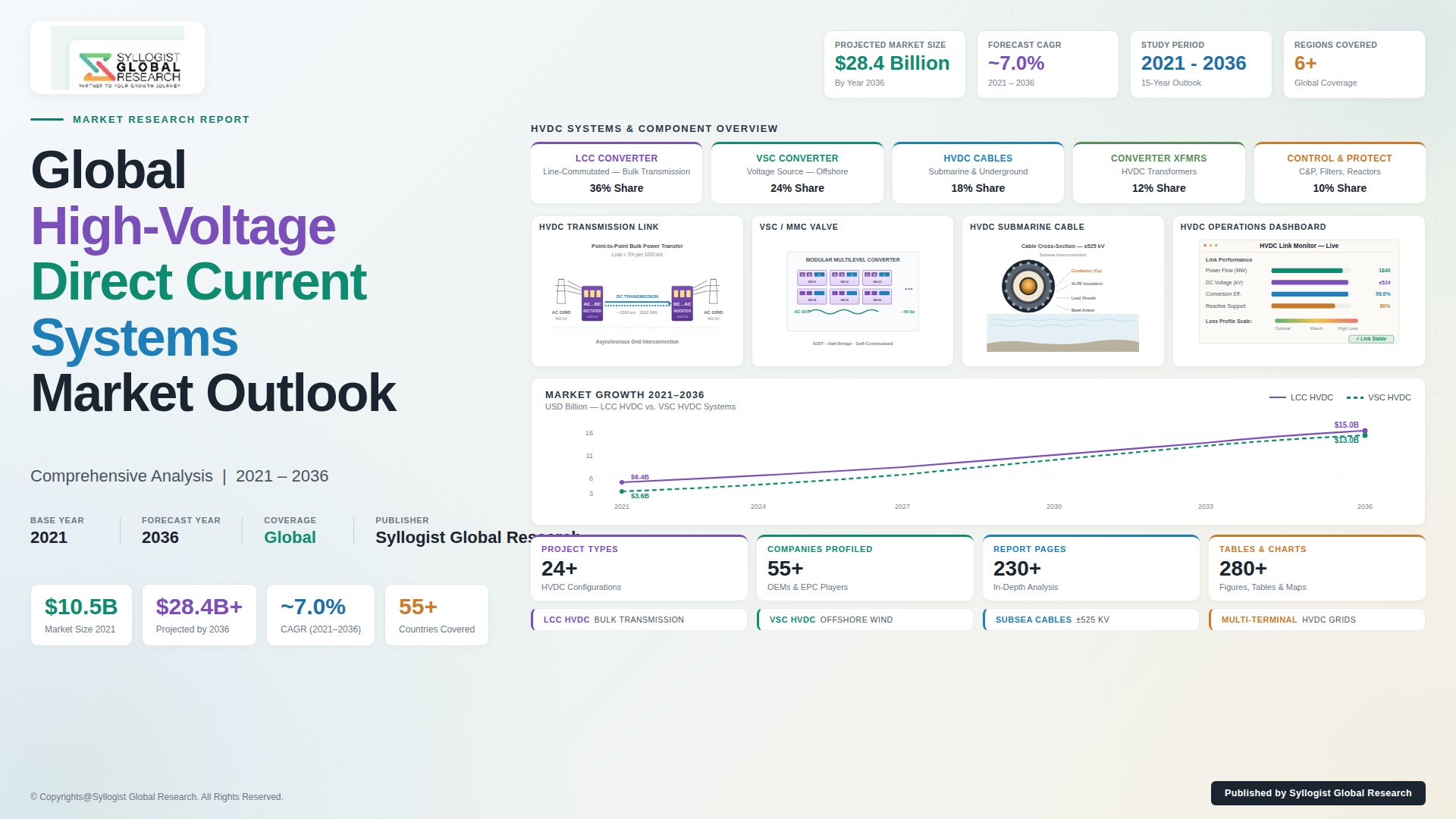
The global HVDC systems market is moving from a specialist long-distance transmission segment into a strategic backbone of the energy transition, driven by offshore wind grid integration, ultra-long-distance renewable corridors, cross-border interconnection programs, and the structural need to operate increasingly stressed AC networks with controllable DC overlays. The market was valued at approximately USD 13.4 billion in 2025 and is projected to reach USD 41.2 billion by 2034, advancing at a compound annual growth rate of 13.3% through the forecast period, as HVDC moves from one-off megaprojects to a continuous orderbook of converter station, cable, and multi-terminal scheme commissioning across Europe, North America, China, India, and the Middle East. Voltage source converter systems account for 58% of new contract value in 2025, line commutated converter systems for 36%, and hybrid topologies for the remaining 6%, with VSC share rising as offshore wind and multi-terminal applications expand.
Offshore wind grid connection is the single fastest-growing application segment, anchored by Europe’s North Sea coordinated grid plan, the United Kingdom’s Holistic Network Design, and accelerating offshore programs in the United States East Coast, Taiwan, South Korea, and Japan. Cumulative HVDC capacity contracted for offshore wind transmission reached 28.6 GW by the end of 2024, with more than 64 GW of offshore HVDC links under planning, tendering, or construction through 2032, representing more than USD 96 billion in committed capital. Each 2 GW HVDC offshore link requires bipolar 525 kV converter platforms, approximately 280 km of submarine HVDC cable, and onshore converter stations occupying 50,000 square meters, creating a multi-year specification queue across cable manufacturers, converter OEMs, and offshore platform fabricators.
Long-distance ultra-HVDC corridors continue to anchor the highest absolute capacity additions, dominated by China’s State Grid program that has commissioned 38 ultra-HVDC links totaling 312 GW of installed transmission capacity at ±800 kV and ±1,100 kV class, the largest of which moves 12 GW of bulk power across 3,300 km. India’s Power Grid Corporation has commissioned six ±800 kV ultra-HVDC corridors with another four under construction to evacuate solar power from Rajasthan and Gujarat to load centers in the south and east. The United States CHIPS reshoring program, the Inflation Reduction Act, and FERC Order 2023 have unlocked transmission planning for at least 14 long-distance HVDC corridors that together exceed 32 GW of planned capacity, including SunZia, Grain Belt Express, TransWest Express, and Champlain Hudson Power Express.
Cross-border HVDC interconnection is emerging as a third structural demand vector, driven by European Network of Transmission System Operators planning, ASEAN Power Grid coordination, and Middle East and Gulf Cooperation Council interconnection programs. Cumulative committed cross-border HVDC interconnector capacity reached 41 GW by mid-2025, with notable projects including the Viking Link between Denmark and the United Kingdom at 1.4 GW, the Xlinks Morocco-UK interconnector at 3.6 GW over 3,800 km of submarine cable, the EuroAsia Interconnector linking Israel, Cyprus, and Greece at 2 GW, and the IndoGulf interconnector under feasibility study. Submarine HVDC cable manufacturing capacity is the binding constraint, with global production of 525 kV XLPE DC cable limited to approximately 4,800 km per year against an annual demand profile above 9,200 km through 2030, driving cable price escalation of 36% over 2022 levels and triggering capacity expansions by the top six cable OEMs.
Key Drivers
Offshore Wind Grid Connection Buildout and Coordinated North Sea, US Atlantic, and Asia Pacific Offshore Transmission Programs Driving Sustained HVDC Procurement
The synchronized expansion of offshore wind capacity across Europe, the United States East Coast, Taiwan, South Korea, and Japan is generating durable multi-decade procurement commitments for VSC-HVDC converter platforms, 525 kV submarine cables, and modular multilevel converter stations. Final investment decisions on more than 64 GW of offshore HVDC links through 2032 represent over USD 96 billion of committed capital, with 2 GW bipolar 525 kV becoming the de facto offshore standard, anchoring orderbooks for converter OEMs, cable manufacturers, and offshore platform fabricators.
Ultra-Long-Distance Renewable Evacuation Corridors and 800 kV and 1,100 kV Ultra-HVDC Buildout Across China, India, and Emerging Solar Superpower Geographies
The need to move bulk solar and wind power from resource-rich regions to load centers across distances exceeding 1,500 km is sustaining a continuous pipeline of ultra-HVDC corridor commissioning. China has committed an additional 14 ultra-HVDC corridors through 2030, India is tendering 4 ±800 kV evacuation links, and Australia, Saudi Arabia, Morocco, and Egypt have launched feasibility studies for long-distance HVDC backbone projects, generating sustained demand for thyristor valves, converter transformers, and large-footprint converter stations.
Asynchronous Grid Interconnection, Cross-Border Power Trading, and Controllable Network Reinforcement Driving HVDC Adoption as an AC Overlay Solution
Increasing power system stress from variable renewable integration, declining synchronous inertia, and rising congestion in mature AC networks is driving transmission system operators to deploy embedded HVDC links and back-to-back stations as controllable overlays. ENTSO-E, ASEAN Power Grid, and GCC Interconnection programs have committed 41 GW of new cross-border HVDC capacity through 2030, while controllable DC overlays are emerging as a preferred solution to congestion bottlenecks that cannot be economically resolved through incremental AC reinforcement.
Key Challenges
Submarine HVDC Cable Manufacturing Capacity Constraints and 525 kV XLPE Bottleneck Limiting Project Execution Timelines
Global production of 525 kV XLPE submarine HVDC cable is limited to approximately 4,800 km per year against demand exceeding 9,200 km per year through 2030, creating a structural supply gap that is delaying offshore wind grid connection programs by 18 to 30 months on key projects. Cable factory expansions by the top six manufacturers require capital intensity of approximately USD 480 million per facility and lead times of 4 years, sustaining cable price escalation of 36% over 2022 levels and shifting more execution risk onto offshore wind developers and transmission operators.
HVDC Circuit Breaker Maturity Constraints and Multi-Terminal HVDC Protection Coordination Limiting Meshed DC Grid Deployment
Commercial deployment of high-power DC circuit breakers capable of clearing faults within 3 milliseconds at 525 kV class remains limited, with only a small number of OEMs having type-tested products available, constraining the deployment of meshed multi-terminal HVDC networks that would unlock pan-European and pan-Asian offshore grid architectures. Protection coordination across multi-vendor multi-terminal HVDC systems remains an unsolved engineering challenge, forcing transmission operators to deploy point-to-point HVDC links that are simpler to protect but less efficient than fully meshed DC grids.
Project Execution Risk, EPC Resource Bottlenecks, and Permitting Delays Across Long-Distance Onshore and Submarine HVDC Corridors
HVDC project execution is highly resource-intensive, requiring specialist EPC contractors, marine installation vessels, and converter station commissioning crews that are simultaneously oversubscribed by parallel offshore wind, ultra-HVDC, and interconnector programs. Right-of-way permitting for long-distance onshore HVDC corridors regularly extends timelines by 3 to 5 years, while submarine cable laying vessel availability is fully booked through 2029. Cost overruns averaging 18% above sanction and schedule slippage of 24 months on recent European HVDC projects are elevating risk premiums.
Market Segmentation
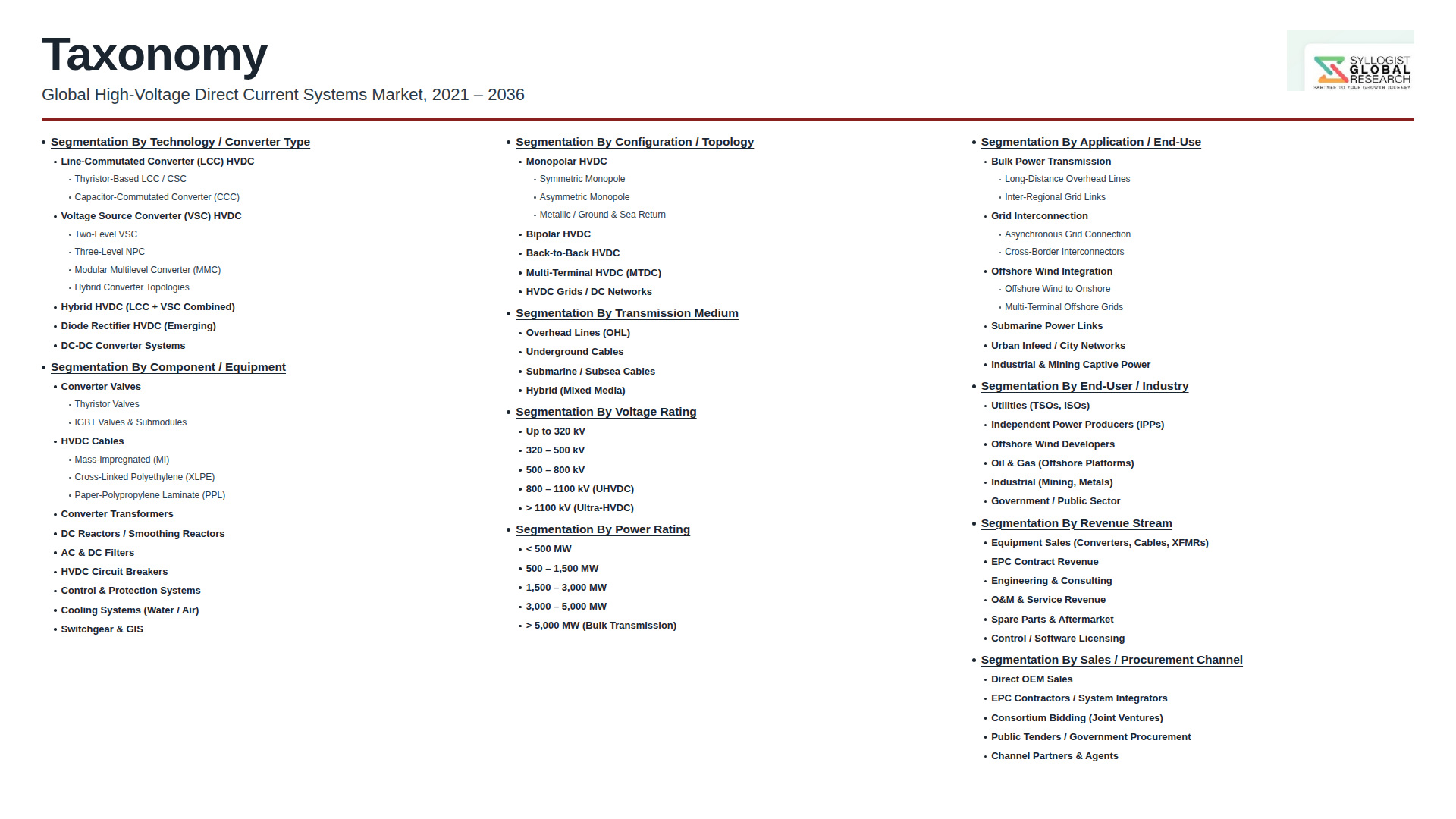
- Segmentation By Technology
- Line Commutated Converter (LCC) HVDC
- Voltage Source Converter (VSC) HVDC
- Hybrid HVDC Systems
- Ultra-High-Voltage Direct Current (UHVDC) Systems
- Segmentation By Component
- Converter Stations
- Converter Transformers
- Thyristor and IGBT Valves
- HVDC Cables (XLPE, Mass Impregnated, MI-PPL)
- DC Switchgear and HVDC Circuit Breakers
- Smoothing Reactors and Harmonic Filters
- Control and Protection Systems
- Valve Cooling Systems and Auxiliaries
- Others
- Segmentation By Transmission Type
- Overhead Transmission
- Submarine Cable Transmission
- Underground Cable Transmission
- Back-to-Back (No Transmission Distance)
- Segmentation By Configuration
- Monopolar
- Bipolar
- Back-to-Back
- Multi-Terminal HVDC
- Meshed DC Grid
- Segmentation By Voltage Level
- Up to 320 kV
- 320 kV to 525 kV
- 525 kV to 800 kV
- Above 800 kV (Ultra-HVDC)
- Segmentation By Application
- Offshore Wind Grid Connection
- Long-Distance Bulk Power Transmission
- Cross-Border and International Interconnection
- Asynchronous Grid Interconnection
- Urban Infeed and Embedded HVDC
- Oil, Gas, and Mining Platform Power Supply
- Renewable Energy Evacuation Corridors
- Others
- Segmentation By End User
- Transmission System Operators
- Vertically Integrated Utilities
- Offshore Wind Developers
- Independent Power Producers and IPP Consortia
- Industrial and Mining Operators
- Oil and Gas Operators
- Others
- Segmentation By Region
- North America
- Europe
- Asia-Pacific
- Middle East and Africa
- Latin America
All market revenues are presented in USD
Historical Year: 2021-2024 | Base Year: 2025 | Estimated Year: 2026 | Forecast Period: 2027-2034
Key Questions this Study Will Answer
- What is the total global market valuation of the High-Voltage Direct Current Systems Market in 2025, projected through 2034, disaggregated by technology, voltage level, configuration, and application, enabling converter OEMs, cable manufacturers, EPC contractors, transmission system operators, and infrastructure investors to identify the highest-growth segments and most durable revenue opportunities across the HVDC landscape?
- How are leading transmission system operators in Germany, the Netherlands, the United Kingdom, the United States, China, India, Japan, South Korea, and the Gulf Cooperation Council region allocating capital across offshore wind grid connection, long-distance renewable evacuation, cross-border interconnection, and urban infeed, and which national programs are defining the technical specification, voltage class, and procurement benchmarks shaping the global HVDC market through 2034?
- What are the relative performance, lifecycle cost, footprint, and reliability advantages of line commutated converter, voltage source converter, hybrid HVDC, and ultra-HVDC technologies across offshore wind, long-distance bulk transmission, asynchronous interconnection, and embedded HVDC applications, and which technologies are most likely to capture incremental share between 2025 and 2034?
- Which application segments, including offshore wind transmission, ultra-long-distance renewable corridors, cross-border interconnectors, asynchronous tie-lines, and embedded urban infeed, are generating the highest growth rates through 2034, and what converter station specifications, cable technologies, and multi-terminal protection architectures are most critical to operational performance in each category?
- How is the competitive landscape structured among multinational converter OEMs, specialist HVDC cable manufacturers, EPC consortia, and emerging Asian and Middle Eastern challengers, and what partnership, joint venture, capacity expansion, and acquisition strategies are enabling new entrants to compete with established suppliers in next-generation HVDC programs?
- What are the most significant submarine cable manufacturing constraints, HVDC circuit breaker maturity gaps, multi-vendor interoperability issues, and EPC resource bottlenecks affecting HVDC deployments in operational delivery, and how are OEMs, transmission operators, and regulators addressing capacity expansion, type testing, interoperability standardization, and risk allocation under evolving HVDC technical frameworks?
- Which regional HVDC markets, specifically Europe, Asia Pacific, North America, the Middle East and Africa, and Latin America, are expected to generate the most substantial incremental HVDC procurement through 2034, and what regulatory frameworks, offshore wind targets, renewable evacuation mandates, and interconnection treaty arrangements are driving capability investment priorities and supplier selection in each regional market?
- Product Definition
- Research Methodology
- Research Design & Framework
- Overall Research Approach: Descriptive, Exploratory & Quantitative Mixed-Method Design
- Market Definition & Scope Boundaries: What is Included and Excluded
- Segmentation Framework
- Key Research Assumptions & Limitations
- Secondary Research
- Primary Research Design & Execution
- Data Triangulation & Validation
- Market Sizing & Forecasting Methodology
- Competitive Intelligence Methodology
- Quality Assurance & Peer Review
- Definitions, Abbreviations & Data Notes
- Research Design & Framework
- Executive Summary
- Market Snapshot & Headline Numbers
- Key Findings & Research Highlights
- Market Dynamics
- Regional Market Summary
- Competitive Landscape Snapshot
- Technology & Innovation Highlights
- Market Dynamics
- Drivers
- Restraints
- Opportunities
- Challenges
- Porter’s Five Forces Analysis
- PESTLE Analysis
- Market Trends & Developments
- Emerging Trends
- Technological Developments
- Regulatory & Policy Changes
- Supply Chain, Cable Capacity & Sourcing Trends
- Manufacturing, Marine Installation & Commissioning Trends
- Investment, Project Pipeline & Funding Activity
- Sustainability & ESG Trends
- Risk Assessment Framework
- Project Execution, Schedule Delay & Cost Overrun Risk in Large-Scale HVDC Programmes
- Cable Manufacturing Capacity, Specialty Insulation Material & Critical Component Supply Risk
- Regulatory, Permitting, Submarine Cable Route, Marine Spatial Planning & Cross-Border Authorisation Risk
- Grid Code Compliance, AC / DC Interaction, Sub-Synchronous Resonance & System Integration Risk
- Cybersecurity, Control System Reliability & Long-Term Asset Performance Risk
- Regulatory Framework & Standards
- National Grid Codes, ENTSO-E HVDC Connection Codes & Cross-Border Interconnector Authorisation Frameworks
- IEC 60633, IEC 60919, IEC TR 62543, IEEE 1709 & CIGRE B4 HVDC Technical Standards
- Marine Spatial Planning, Submarine Cable Permitting & Environmental Impact Assessment Frameworks for HVDC Routes
- Offshore Wind Grid Connection Standards, Offshore Hub Frameworks & Tendering Models (German OSP, UK OFTO)
- ESG Disclosure, Sustainable Finance Taxonomy & Green Bond Eligibility Standards for HVDC Transmission Assets
- Global High-Voltage Direct Current Systems Market Outlook
- Market Size & Forecast by Value
- Market Size & Forecast by Volume (Installed Transmission Capacity, GW)
- Market Size & Forecast by Component & System Type
- HVDC Converter Stations & Converter Valve Modules
- Converter Transformers, Smoothing Reactors & Specialty Power Components
- HVDC Overhead Transmission Lines
- HVDC Underground Cables
- HVDC Submarine Cables
- DC Circuit Breakers & DC Switchgear
- AC & DC Harmonic Filters, Reactive Power Compensation & Auxiliary Equipment
- Control, Protection, SCADA & Communication Systems
- Engineering, EPC, Marine Installation & Lifecycle Services
- Market Size & Forecast by Converter Technology
- Line-Commutated Converter (LCC) Technology
- Voltage-Source Converter (VSC) Technology
- Modular Multilevel Converter (MMC) Technology
- Capacitor-Commutated Converter (CCC) Technology
- Hybrid LCC / VSC & Grid-Forming Converter Technology
- Market Size & Forecast by Voltage Level
- Up to ±320 kV
- ±400 kV to ±525 kV
- ±550 kV to ±800 kV (Ultra-High Voltage DC)
- Above ±800 kV (Including ±1100 kV Ultra-UHV DC)
- Market Size & Forecast by Project Scale
- Ultra-Large-Scale HVDC Projects (Above 3,000 MW)
- Large-Scale HVDC Projects (1,000 to 3,000 MW)
- Medium-Scale HVDC Projects (300 to 1,000 MW)
- Small-Scale HVDC Projects (Below 300 MW)
- Market Size & Forecast by Application
- Long-Distance Bulk Power Transmission (Overhead)
- Offshore Wind Farm Integration & Offshore Hub Connection
- Submarine Interconnector & Island Power Supply
- Asynchronous Grid Interconnection (Back-to-Back HVDC)
- Embedded HVDC Within AC Grid Reinforcement
- Multi-Terminal HVDC & HVDC Supergrid
- Urban Underground Power Transmission Corridor
- Industrial, Mine-Site & Captive Bulk Load HVDC Supply
- Market Size & Forecast by End-User
- Transmission System Operators (TSOs)
- Independent System Operators (ISOs)
- Vertically Integrated Utilities
- Offshore Wind Developers & Renewable Energy Generators
- Independent Transmission Companies & Merchant Transmission Operators
- Government Power Authorities & National Grid Corporations
- Industrial, Mining & Captive Bulk Load Operators
- Market Size & Forecast by Sales Channel
- Direct OEM & Original Equipment Manufacturer Sales
- EPC, Turnkey Project & Consortium Channel
- Cable & Specialty Component Supply Channel
- Long-Term Operations, Maintenance, Spare Parts & Lifecycle Service Contract Channel
- North America HVDC Systems Market Outlook
- Market Size & Forecast
- By Value
- By Volume (Installed Transmission Capacity, GW)
- By Component & System Type
- By Converter Technology
- By Voltage Level
- By Project Scale
- By Application
- By End-User
- By Country
- By Sales Channel
- Europe HVDC Systems Market Outlook
- Market Size & Forecast
- By Value
- By Volume (Installed Transmission Capacity, GW)
- By Component & System Type
- By Converter Technology
- By Voltage Level
- By Project Scale
- By Application
- By End-User
- By Country
- By Sales Channel
- Asia-Pacific HVDC Systems Market Outlook
- Market Size & Forecast
- By Value
- By Volume (Installed Transmission Capacity, GW)
- By Component & System Type
- By Converter Technology
- By Voltage Level
- By Project Scale
- By Application
- By End-User
- By Country
- By Sales Channel
- Latin America HVDC Systems Market Outlook
- Market Size & Forecast
- By Value
- By Volume (Installed Transmission Capacity, GW)
- By Component & System Type
- By Converter Technology
- By Voltage Level
- By Project Scale
- By Application
- By End-User
- By Country
- By Sales Channel
- Middle East & Africa HVDC Systems Market Outlook
- Market Size & Forecast
- By Value
- By Volume (Installed Transmission Capacity, GW)
- By Component & System Type
- By Converter Technology
- By Voltage Level
- By Project Scale
- By Application
- By End-User
- By Country
- By Sales Channel
- Country-Wise* HVDC Systems Market Outlook
- Market Size & Forecast
- By Value
- By Volume (Installed Transmission Capacity, GW)
- By Component & System Type
- By Converter Technology
- By Voltage Level
- By Project Scale
- By Application
- By End-User
- By Country
- By Sales Channel
- *Countries Analyzed in the Syllogist Global Research Portfolio: United States, Canada, Mexico, Germany, France, United Kingdom, Netherlands, Spain, Italy, Norway, Sweden, China, Japan, India, Australia, South Korea, Singapore, Brazil, Chile, Saudi Arabia, UAE, Egypt, South Africa, Israel
- Technology Landscape & Innovation Analysis
- Line-Commutated Converter (LCC) Technology Deep-Dive for Bulk Power Transmission
- Voltage-Source Converter (VSC) & Modular Multilevel Converter (MMC) Technology
- Capacitor-Commutated Converter (CCC), Hybrid LCC / VSC & Grid-Forming Converter Technology
- DC Circuit Breaker, Hybrid Mechanical-Electronic Breaker & DC Grid Protection Technology
- HVDC Cable Insulation Technology (Mass-Impregnated, XLPE Extruded, Polypropylene)
- Multi-Terminal HVDC, HVDC Supergrid & Offshore Hub Operations Technology
- Control, Protection, SCADA, Communication & Digital Twin Technology for HVDC Systems
- Artificial Intelligence, Machine Learning, Predictive Maintenance & Power Flow Optimisation Technology
- Patent & IP Landscape in HVDC Technologies
- Value Chain & Supply Chain Analysis
- HVDC Converter Station, Valve Module & System Integration OEM Landscape
- HVDC Cable, Submarine Cable & Specialty Insulation Manufacturing Supply Chain
- Converter Transformer, Smoothing Reactor & Specialty Power Component Supply Chain
- DC Circuit Breaker, Switchgear & Specialty Protection Equipment Supply Chain
- Control, Protection, SCADA & Communication System Supply Chain
- EPC Contractor, Cable-Laying Vessel, Marine Installation & System Integration Channel
- TSO, ISO, Utility, Offshore Wind Developer & End-User Procurement Channel
- Operations, Maintenance, Spare Parts & Lifecycle Service Provider Channel
- Pricing Analysis
- HVDC Converter Station Capital Cost & Per-MW Pricing Analysis (LCC vs. VSC vs. MMC)
- HVDC Submarine Cable Per-Kilometre Pricing Analysis by Voltage Level & Insulation Type
- HVDC Overhead Line & Underground Cable Per-Kilometre Pricing Analysis
- DC Circuit Breaker, Smoothing Reactor & Auxiliary Equipment Pricing Analysis
- EPC, Cable Laying, Marine Installation & Turnkey Project Pricing Analysis
- Levelised Cost of Transmission (LCOT) for HVDC vs. HVAC Benchmark & Break-Even Distance Analysis
- Sustainability & Environmental Analysis
- Role of HVDC in Renewable Energy Integration, Offshore Wind Build-Out & Power Sector Decarbonisation
- HVDC vs. HVAC Lifecycle Carbon Footprint, Transmission Loss & Embodied Emissions Comparison
- Material Use, SF6-Free Switchgear, Critical Metal Dependency & Component Recyclability in HVDC Assets
- Submarine Cable Installation, Marine Biodiversity & Cable Route Environmental Impact Considerations
- Alignment of HVDC Transmission with SDG 7 (Clean Energy), SDG 9 (Industry & Innovation), SDG 13 (Climate Action) & Green Finance Eligibility
- Competitive Landscape
- Market Structure & Concentration
- Market Consolidation Level (Fragmented vs. Consolidated by Component & System Type & Geography)
- Top 10 Players Market Share
- HHI (Herfindahl-Hirschman Index) Concentration Analysis
- Competitive Intensity Map by Component & System Type, Converter Technology & Geography
- Player Classification
- Integrated Global HVDC System OEMs & Turnkey EPC Providers
- Chinese HVDC Technology Majors & State-Owned Converter Manufacturers
- Japanese & Korean HVDC Equipment Specialists
- HVDC Submarine & High-Voltage Cable Manufacturers
- Specialist DC Circuit Breaker, Switchgear & Component Manufacturers
- Control, Protection, Digital Substation & SCADA Specialists with HVDC Capability
- EPC Contractors, Cable-Laying Vessel Operators & Marine Installation Specialists
- Independent Engineering, Owner’s Engineer & Advisory Service Firms
- Competitive Analysis Frameworks
- Market Share Analysis by Component & System Type, Converter Technology & Region
- Company Profile
- Company Overview & Headquarters
- HVDC Products, Converter Technology & System Portfolio
- Key Customer Relationships & Reference HVDC Project Installations
- Manufacturing Footprint, Cable Plant & Production Capacity
- Revenue (HVDC Segment) & Order Backlog
- Technology Differentiators & IP
- Key Strategic Partnerships, JVs, Consortia & M&A Activity
- Recent Developments (Project Awards, Capacity Expansions, Technology Launches)
- SWOT Analysis
- Strategic Focus Areas & Roadmap
- Competitive Positioning Map (Technology Capability vs. Market Penetration)
- Key Company Profiles
- Market Structure & Concentration
- Technology Landscape & Innovation Analysis
- Strategic Output
- Market Opportunity Matrix: By Component & System Type, Converter Technology, Application, End-User & Geography
- White Space Opportunity Analysis
- Strategic Recommendations
- Product Portfolio, Converter Technology & Voltage Class Investment Strategy
- Cable Manufacturing, Marine Installation Capacity & Operational Excellence Strategy
- Geographic Expansion & Localisation Strategy (Offshore Wind Hubs, Asia, Latin America)
- TSO, ISO, Offshore Wind Developer & End-User Engagement Strategy
- Partnership, Consortium, JV & M&A Strategy
- Sustainability, Decarbonisation & ESG-Aligned HVDC Strategy
- Risk Mitigation & Future Roadmap
- Strategic Priority Matrix & Roadmap
- Near-term (2025-2028)
- Mid-term (2029-2032)
- Long-term (2033-2037)
- Market Size & Forecast
- Market Size & Forecast
- Market Size & Forecast
- Market Size & Forecast
- Market Size & Forecast
- Market Size & Forecast