Global Hydrogen Compressors Market By Compressor Type, By Technology, By Lubrication Type, By Stage, By Pressure Range, By Application, By End User, By Region, Competition, Forecast & Opportunities, 2021-2036F
Market Definition
The Global Hydrogen Compressors Market encompasses the design, manufacturing, supply, installation, and aftermarket servicing of mechanical and non-mechanical compression equipment specifically engineered to handle gaseous hydrogen across the production, storage, transportation, dispensing, and end-use stages of the hydrogen value chain. The market includes reciprocating piston compressors, diaphragm compressors, centrifugal turbo-compressors, oil-free screw compressors, ionic liquid compressors, electrochemical hydrogen compressors, metal hydride compressors, and linear motor compressors, along with their associated sealing systems, lubrication architectures, materials of construction, instrumentation, and safety interlocks. Hydrogen compression equipment is deployed across green and blue hydrogen production facilities downstream of electrolyzers and steam methane reformers with carbon capture, hydrogen pipeline boosting and gathering stations, salt cavern and depleted reservoir storage facilities, road and rail tube trailer loading terminals, liquefaction precooling trains, ammonia and methanol synthesis loops, oil refineries, petrochemical plants, semiconductor and float glass manufacturing facilities, fuel cell powertrain testbeds, and 350 bar and 700 bar hydrogen refueling stations serving fuel cell electric vehicles, buses, and heavy-duty trucks. Within scope are compression solutions covering low-pressure boosting from 5 bar to 30 bar, medium-pressure transmission and storage duty from 30 bar to 250 bar, and high-pressure dispensing duty up to 1,000 bar required for mobility refueling. The market also includes the metallurgy, valve technology, and seal systems engineered to mitigate hydrogen embrittlement, permeation, and accelerated wear that characterize hydrogen service. End users span hydrogen producers, gas distributors, refining and petrochemical operators, mobility infrastructure developers, industrial gas companies, utilities, and research institutions. For this study, the market is measured by equipment, service, and aftermarket revenue in USD across new installations and retrofit upgrades.
Market Insights
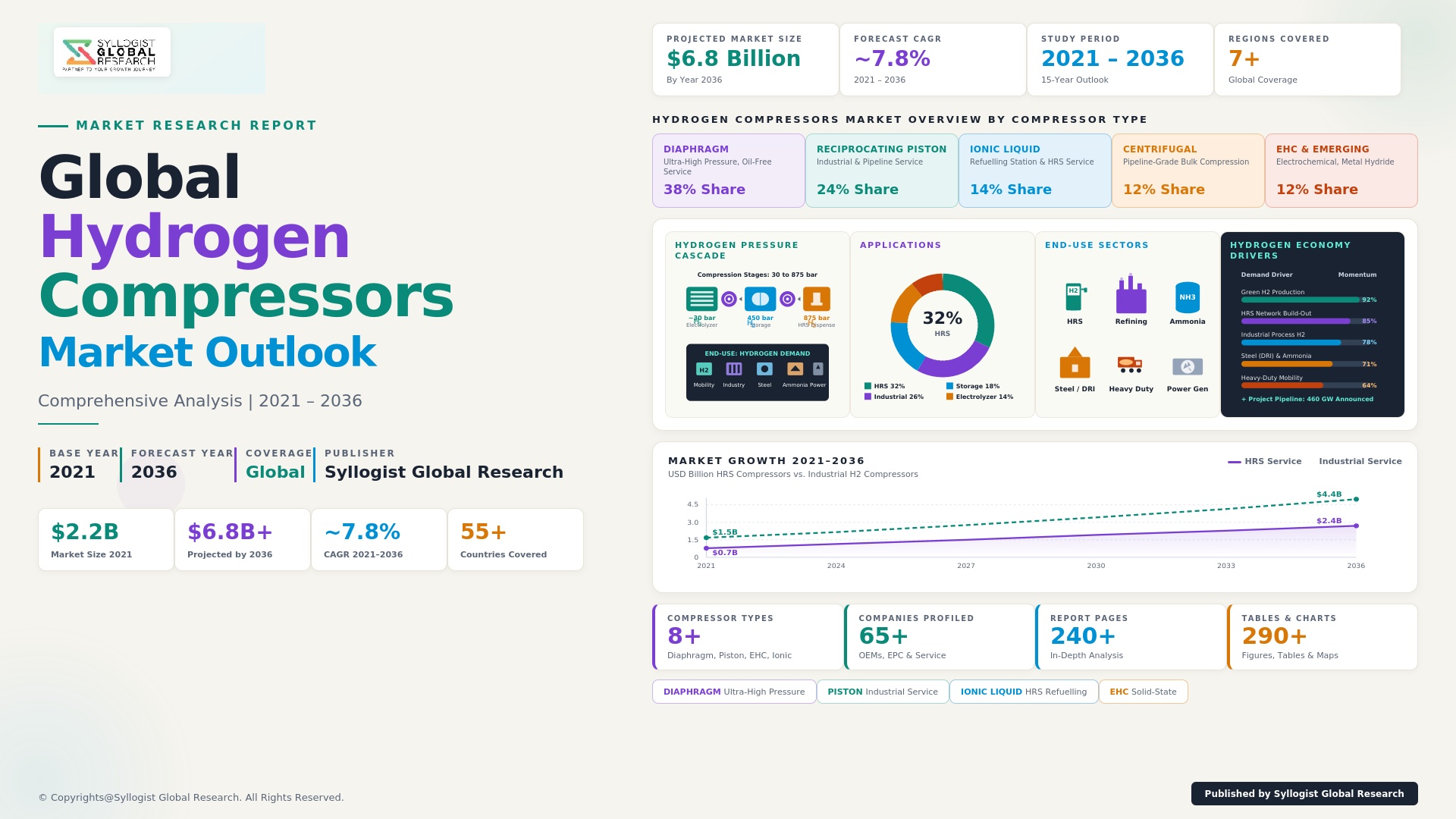
The global hydrogen compressors market is moving from a niche industrial gas equipment segment into a strategic infrastructure category aligned with the global low-carbon hydrogen buildout, refining decarbonization mandates, and mobility refueling network expansion. The market was valued at approximately USD 2.42 billion in 2025 and is projected to reach USD 7.18 billion by 2034, advancing at a compound annual growth rate of 12.8% through the forecast period, as electrolyzer-coupled compression duty, salt cavern injection projects, and high-pressure dispensing applications shift from demonstration scale to commercial scale deployment. Reciprocating compressors continue to dominate revenue share at 46%, supported by their pressure capability and proven hydrogen service track record, followed by diaphragm compressors at 22%, centrifugal compressors at 14%, ionic and electrochemical compressors at 11%, and other technologies at 7%.
Green hydrogen project pipelines are the dominant structural pull on equipment demand. Announced global electrolyzer capacity has crossed 540 GW across more than 1,650 projects, with approximately 84 GW reaching final investment decision and 38 GW under active construction in 2025. Every megawatt of electrolyzer capacity at 30 bar output requires downstream compression duty of approximately 0.18 to 0.24 MW of installed motor power to reach pipeline injection pressure of 70 bar or storage pressure of 250 bar, translating into a sizable compressor specification queue for the next five to seven years. Saudi Arabia’s NEOM project, Oman’s Duqm complex, Australia’s Pilbara hub, Egypt’s Sokhna corridor, and the European Union’s 38 Hydrogen Valleys collectively represent more than USD 320 billion in committed capital, with compressor packages representing 7% to 9% of equipment capex depending on outlet pressure and duty cycle.
Hydrogen mobility infrastructure is the fastest-growing application segment by unit count, even as it remains smaller than industrial duty by revenue. The global hydrogen refueling station population has expanded to 1,290 active stations in 2025, with 412 additional stations under construction and committed funding for 2,800 more through 2030, anchored by Japan’s Basic Hydrogen Strategy, South Korea’s Hydrogen Economy Roadmap, California’s heavy-duty corridor program, and the EU’s AFIR mandate requiring hydrogen refueling stations every 200 km on the TEN-T network. Each heavy-duty station serving 350 bar fuel cell trucks requires compression capacity of 120 kg per hour to 240 kg per hour at outlet pressures of 450 bar to 950 bar, and ionic liquid compressors have emerged as the preferred technology for high-throughput stations due to their reduced mechanical wear, oil-free operation, and ability to compress hydrogen to 1,000 bar in a single packaged unit.
Regionally, Europe leads the market at 34% revenue share in 2025, supported by aggressive REPowerEU targets of 20 million tons of clean hydrogen by 2030, the Hydrogen Bank auction mechanism, and dedicated grant funding through the Innovation Fund. Asia Pacific follows at 31%, driven by Chinese provincial green hydrogen mandates totaling 1.1 million tons of installed annual capacity, Japan’s liquefied hydrogen import corridor with Australia, and India’s National Green Hydrogen Mission targeting 5 million tons of annual production by 2030. North America captures 27% of revenue, supported by the USD 7 billion Hydrogen Hubs program, the 45V production tax credit at USD 3 per kg, and accelerated permitting reform for industrial hydrogen pipelines. The competitive landscape is consolidating, with the top eight equipment OEMs accounting for 71% of revenue and a wave of joint development agreements between traditional compressor manufacturers and electrolyzer OEMs creating integrated production-to-compression packaged solutions.
Key Drivers
Accelerating Green and Blue Hydrogen Production Buildout Generating Long-Cycle Demand for Electrolyzer-Coupled and Reformer-Coupled Compression Equipment
The commissioning wave of low-carbon hydrogen production projects across Europe, the Middle East, North America, Australia, and East Asia is generating durable multi-year procurement commitments for compressors deployed downstream of electrolyzer stacks and steam methane reformers with carbon capture. Final investment decisions on more than 84 GW of electrolyzer capacity and 12 million tons per year of blue hydrogen capacity translate into installed compression duty across 30 bar to 250 bar service envelopes, anchoring orderbooks for reciprocating, diaphragm, and centrifugal OEMs through 2032.
Hydrogen Mobility Infrastructure Rollout and High-Pressure Refueling Station Standardization Driving Demand for Ionic, Diaphragm, and Multi-Stage Reciprocating Compressors
Regulatory mandates including the EU AFIR requirement for hydrogen refueling stations every 200 km on the TEN-T network, California’s heavy-duty hydrogen corridor program, Japan’s 1,000-station target by 2030, and South Korea’s hydrogen-truck scheme are creating a synchronized buildout of 350 bar and 700 bar dispensing infrastructure. Each station requires compression to 950 bar storage with throughputs reaching 240 kg per hour, generating sustained demand for ionic liquid and oil-free diaphragm compressors meeting fuel cell vehicle duty cycle and purity requirements.
Industrial Decarbonization, Refinery Hydrogen Recycle Loop Upgrades, and Ammonia and Methanol Synthesis Capacity Expansion Sustaining Heavy-Duty Compressor Procurement
Decarbonization mandates affecting refineries, ammonia producers, methanol manufacturers, steel companies pursuing direct reduction iron routes, and semiconductor fabs are driving sustained procurement of heavy-duty hydrogen compressors with high reliability requirements. Refinery hydrogen recycle loops alone account for 38% of installed compressor capacity in oil and gas, while ammonia capacity additions of 24 million tons per year and green steel projects exceeding 16 million tons per year of DRI capacity through 2032 are creating recurrent demand for centrifugal and reciprocating units at 250 bar discharge pressure.
Key Challenges
Hydrogen Embrittlement, Material Compatibility Constraints, and Accelerated Wear Mechanisms Driving Higher Lifecycle Costs and Compressor Reliability Risk
Hydrogen molecules diffuse into metallic lattices and degrade ductility, fatigue strength, and crack propagation resistance in standard pressure-containing materials, requiring purpose-engineered alloys, specialty seals, and tightly controlled surface finishes that materially elevate procurement cost and lead time. Operators report mean time between major overhauls 28% lower than equivalent natural gas duty, and valve, ring, and packing replacement frequency is materially higher under hydrogen service, increasing aftermarket cost and pushing utilities and producers to demand performance guarantees that compress OEM margins.
Capital Cost Intensity of High-Pressure Hydrogen Compression and Limited Standardization Across Refueling Station Duty Cycles
High-pressure compression duty above 700 bar carries equipment capital intensity of approximately USD 4,200 per kg per hour of installed throughput, materially higher than industrial gas equivalents and creating financial barriers for early-stage refueling network operators with limited utilization. The absence of harmonized refueling station design codes across the United States, the European Union, Japan, South Korea, and China complicates serial manufacturing, prevents the cost reductions associated with platform standardization, and forces OEMs to deliver bespoke engineered solutions for each geography rather than catalog products.
Hydrogen Supply Chain Skills Shortage and Limited Specialist Workforce for High-Pressure Compressor Engineering, Commissioning, and Long-Term Service
The hydrogen equipment ecosystem confronts a structural shortage of engineers, technicians, and field service specialists with hands-on experience in high-pressure hydrogen compression, ATEX and IECEx compliant rotating equipment design, and hydrogen-specific commissioning protocols. Approximately 36% of OEM project leaders report delivery delays attributable to specialist labor constraints, while operators are unable to staff in-house reliability teams at the depth required for safe long-duration operation, slowing deployment timelines and shifting risk onto OEM warranty and managed service agreements.
Market Segmentation
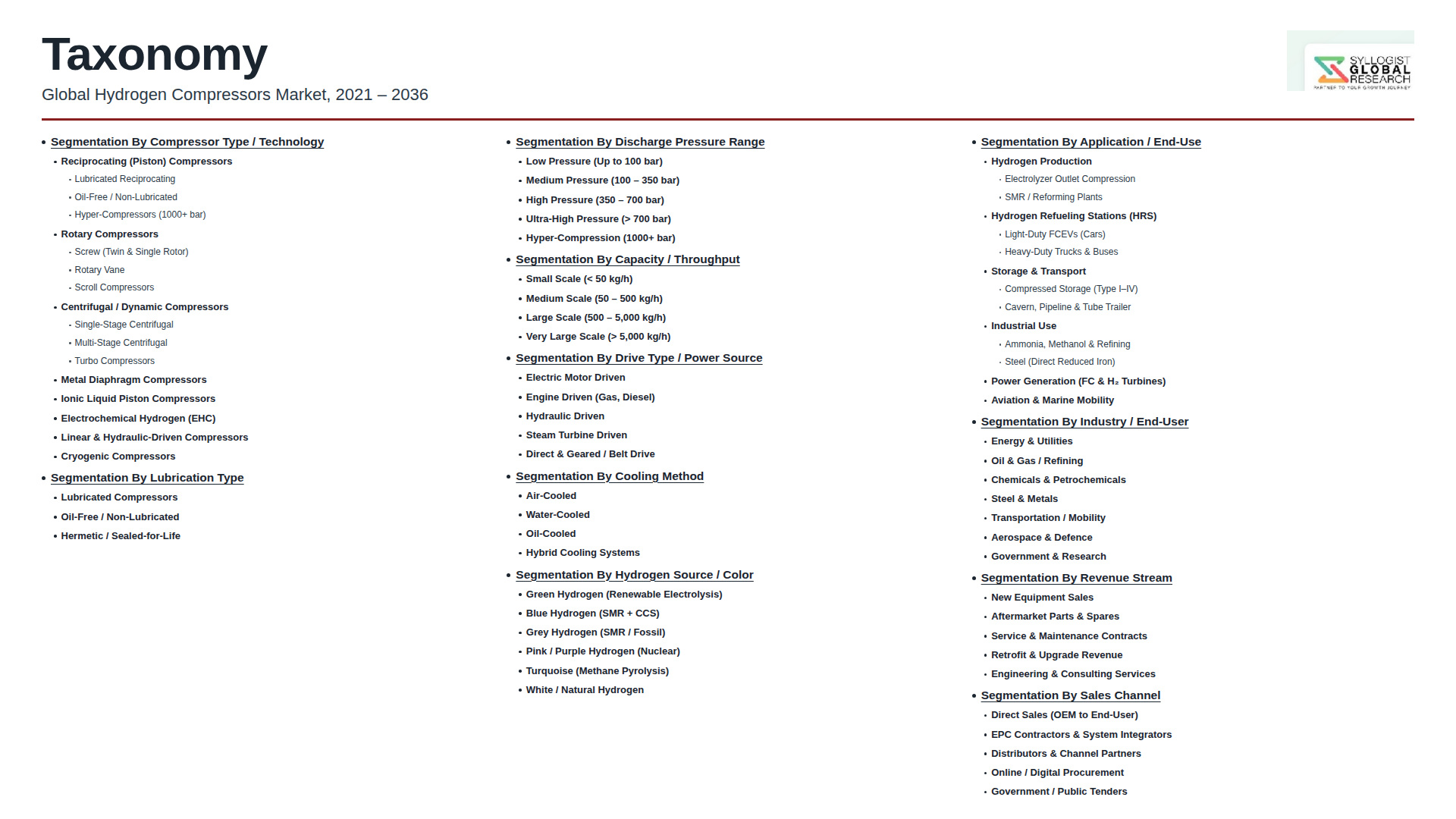
- Segmentation By Compressor Type
- Reciprocating Piston Compressors
- Diaphragm Compressors
- Centrifugal and Turbo-Compressors
- Oil-Free Screw Compressors
- Ionic Liquid Compressors
- Electrochemical Hydrogen Compressors
- Metal Hydride Compressors
- Linear Motor Compressors
- Others
- Segmentation By Technology
- Mechanical Compression
- Non-Mechanical Compression
- Segmentation By Lubrication Type
- Oil-Lubricated
- Oil-Free
- Segmentation By Stage
- Single-Stage
- Two-Stage
- Multi-Stage
- Segmentation By Pressure Range
- Low Pressure (Up to 30 bar)
- Medium Pressure (30 bar to 250 bar)
- High Pressure (250 bar to 700 bar)
- Ultra-High Pressure (Above 700 bar)
- Segmentation By Application
- Hydrogen Production and Electrolyzer-Coupled Boosting
- Hydrogen Storage and Salt Cavern Injection
- Hydrogen Transportation and Pipeline Boosting
- Hydrogen Refueling Stations and Mobility Dispensing
- Refinery Hydrocracking and Hydrotreating Loops
- Ammonia, Methanol, and Petrochemical Synthesis
- Direct Reduction Iron and Green Steel
- Power-to-Gas and Grid Injection
- Others
- Segmentation By End User
- Hydrogen Producers and Industrial Gas Companies
- Oil Refineries and Petrochemical Operators
- Ammonia, Methanol, and Fertilizer Manufacturers
- Steel, Glass, and Semiconductor Manufacturers
- Mobility Infrastructure Developers and Fuel Retailers
- Utilities and Power Generation Operators
- Research Institutions and Defense Programs
- Others
- Segmentation By Region
- North America
- Europe
- Asia-Pacific
- Middle East and Africa
- Latin America
All market revenues are presented in USD
Historical Year: 2021-2024 | Base Year: 2025 | Estimated Year: 2026 | Forecast Period: 2027-2034
Key Questions this Study Will Answer
- What is the total global market valuation of the Hydrogen Compressors Market in 2025, projected through 2034, disaggregated by compressor type, pressure range, and application, enabling equipment OEMs, EPC contractors, infrastructure investors, and hydrogen producers to identify highest-growth segments and most durable revenue opportunities across the hydrogen compression equipment landscape?
- How are leading hydrogen ecosystems in the European Union, the United States, China, Japan, South Korea, Saudi Arabia, and India allocating capital across green hydrogen production, salt cavern storage, pipeline transmission, and mobility refueling, and which national programs are defining the technical specification, pressure class, and procurement benchmarks shaping the global hydrogen compressor market through 2034?
- What are the relative performance, lifecycle cost, reliability, and footprint advantages of reciprocating, diaphragm, centrifugal, ionic liquid, electrochemical, and metal hydride compression technologies across electrolyzer-coupled boosting, pipeline transmission, storage injection, and high-pressure refueling duty cycles, and which technologies are most likely to capture share between 2025 and 2034?
- Which application segments, including refinery hydrogen recycle loops, ammonia and methanol synthesis, salt cavern injection, hydrogen mobility refueling, and direct reduction iron metallurgy, are generating the highest growth rates through 2034, and what compressor specifications, sealing technologies, and aftermarket service models are most critical to operational performance in each category?
- How is the competitive landscape structured among multinational rotating equipment OEMs, specialist hydrogen compressor manufacturers, ionic and electrochemical compression innovators, and integrated electrolyzer-compression package providers, and what partnership, acquisition, and platformization strategies are enabling new entrants to compete with established compressor manufacturers in next-generation hydrogen infrastructure programs?
- What are the most significant hydrogen embrittlement, material compatibility, safety, and certification challenges affecting hydrogen compressor deployments in operational service, and how are OEMs, certification bodies, and end users addressing alloy selection, sealing innovation, ATEX and IECEx compliance, and lifecycle reliability assurance within evolving hydrogen-specific design codes and standards?
- Which regional hydrogen markets, specifically Europe, Asia Pacific, North America, and the Middle East and Africa, are expected to generate the most substantial incremental hydrogen compressor procurement through 2034, and what regulatory frameworks, subsidy regimes, electrolyzer manufacturing footprints, and industrial decarbonization mandates are driving capability investment priorities and supplier selection in each regional market?
- Product Definition
- Research Methodology
- Research Design & Framework
- Overall Research Approach: Descriptive, Exploratory & Quantitative Mixed-Method Design
- Market Definition & Scope Boundaries: What is Included and Excluded
- Segmentation Framework
- Key Research Assumptions & Limitations
- Secondary Research
- Primary Research Design & Execution
- Data Triangulation & Validation
- Market Sizing & Forecasting Methodology
- Competitive Intelligence Methodology
- Quality Assurance & Peer Review
- Definitions, Abbreviations & Data Notes
- Research Design & Framework
- Executive Summary
- Market Snapshot & Headline Numbers
- Key Findings & Research Highlights
- Market Dynamics
- Regional Market Summary
- Competitive Landscape Snapshot
- Technology & Innovation Highlights
- Market Dynamics
- Drivers
- Restraints
- Opportunities
- Challenges
- Porter’s Five Forces Analysis
- PESTLE Analysis
- Market Trends & Developments
- Emerging Trends
- Technological Developments
- Regulatory & Policy Changes
- Supply Chain, Specialty Component & Sourcing Trends
- Manufacturing, Assembly & Commissioning Trends
- Investment, Hydrogen Project Pipeline & Funding Activity
- Sustainability & ESG Trends
- Risk Assessment Framework
- Hydrogen Embrittlement, Material Compatibility & Equipment Integrity Risk
- Hydrogen Project Pipeline Maturation, Final Investment Decision (FID) Delay & Demand Cycle Risk
- Safety, Pressure Vessel Code, Permitting & Cross-Jurisdictional Hydrogen Code Compliance Risk
- Manufacturing Capacity, Specialty Diaphragm, Seal & Critical Alloy Supply Chain Risk
- Technology Maturity, Reliability & Long-Term Service Life Risk for Emerging Compressor Designs
- Regulatory Framework & Standards
- National Hydrogen Strategies, Production Incentives, Tax Credits (IRA 45V, EU Hydrogen Bank) & Hydrogen Hub Frameworks
- ISO 19880, ISO 22734, SAE J2719 & Hydrogen Refuelling Station Standards Applicable to Compression Equipment
- ASME B31.12, ASME BPVC, EN 13445 & Pressure Equipment Directive (PED) Compliance Standards for Hydrogen Compressors
- Hydrogen Safety, Material Compatibility (NACE, ANSI / CSA HGV) & Industrial Operational Compliance Standards
- Green Hydrogen Certification, Clean Hydrogen Definitions (CertifHy, GH2, Renewable Fuel of Non-Biological Origin) & ESG Disclosure Standards
- Global Hydrogen Compressors Market Outlook
- Market Size & Forecast by Value
- Market Size & Forecast by Volume (Number of Units & Installed Capacity, Nm3/h)
- Market Size & Forecast by Compressor Type
- Diaphragm Compressors
- Reciprocating Piston Compressors
- Centrifugal & Pipeline-Grade Compressors
- Ionic Liquid Compressors
- Electrochemical Hydrogen Compressors (EHC)
- Metal Hydride & Solid-State Hydrogen Compressors
- Linear, Magnetic Drive & Other Emerging Compressor Designs
- Screw & Rotary Compressors (Limited-Scope Hydrogen Service)
- Market Size & Forecast by Technology
- Oil-Lubricated Reciprocating Compression Technology
- Oil-Free & Dry-Running Compression Technology
- Magnetic Bearing & Frictionless Compression Technology
- Variable Speed Drive (VSD) & Electrified Compression Technology
- Hydraulically Driven Compression Technology
- Cryogenic & Cold-End Compression Technology for Liquid Hydrogen
- IoT-Enabled, Smart Sensor & Digital Twin Compression Technology
- Market Size & Forecast by Pressure Range
- Low Pressure (Below 100 bar)
- Medium Pressure (100 to 350 bar)
- High Pressure (350 to 700 bar)
- Ultra-High Pressure (Above 700 bar, Including 875 bar Refuelling)
- Market Size & Forecast by Capacity Range
- Large-Scale Hydrogen Compression Systems (Above 10,000 Nm3/h)
- Medium-Scale Hydrogen Compression Systems (1,000 to 10,000 Nm3/h)
- Small-Scale & Distributed Hydrogen Compression Systems (Below 1,000 Nm3/h)
- Market Size & Forecast by Application
- Hydrogen Refuelling Stations (350 bar & 700 bar HRS)
- Industrial Hydrogen Process Compression (Refining, Hydrocracking, Hydrotreating)
- Ammonia, Methanol & Synthetic Fuel Production
- Hydrogen Storage (Salt Cavern, Underground & Above-Ground Tank Storage)
- Hydrogen Pipeline Transportation & Booster Compression
- Electrolyser & Green Hydrogen Production Plant Outlet Compression
- Power Generation (Hydrogen Turbine, Fuel Cell & Co-Firing)
- Aerospace, Defence & Laboratory / Research Applications
- Market Size & Forecast by End-User Industry
- Refining, Petrochemicals & Downstream Oil & Gas
- Ammonia, Fertiliser & Methanol Producers
- Steel & Direct Reduced Iron (DRI) Producers
- Mobility & Transportation Fuel (Heavy-Duty, Rail, Marine, Aviation)
- Power & Utility Sector (Hydrogen Turbine & Fuel Cell Operators)
- Electronics, Glass & Specialty Industrial Gas Users
- Food, Pharmaceuticals & Hydrogenation Process Users
- Aerospace, Defence & Research Institutions
- Market Size & Forecast by Sales Channel
- Direct OEM & Original Equipment Manufacturer Sales
- EPC, Turnkey Project & System Integrator Channel
- Distributor, Authorised Reseller & Regional Partner Channel
- Aftermarket, Spare Parts, Refurbishment & Long-Term Service Contract Channel
- North America Hydrogen Compressors Market Outlook
- Market Size & Forecast
- By Value
- By Volume (Number of Units & Installed Capacity, Nm3/h)
- By Compressor Type
- By Technology
- By Pressure Range
- By Capacity Range
- By Application
- By End-User Industry
- By Country
- By Sales Channel
- Europe Hydrogen Compressors Market Outlook
- Market Size & Forecast
- By Value
- By Volume (Number of Units & Installed Capacity, Nm3/h)
- By Compressor Type
- By Technology
- By Pressure Range
- By Capacity Range
- By Application
- By End-User Industry
- By Country
- By Sales Channel
- Asia-Pacific Hydrogen Compressors Market Outlook
- Market Size & Forecast
- By Value
- By Volume (Number of Units & Installed Capacity, Nm3/h)
- By Compressor Type
- By Technology
- By Pressure Range
- By Capacity Range
- By Application
- By End-User Industry
- By Country
- By Sales Channel
- Latin America Hydrogen Compressors Market Outlook
- Market Size & Forecast
- By Value
- By Volume (Number of Units & Installed Capacity, Nm3/h)
- By Compressor Type
- By Technology
- By Pressure Range
- By Capacity Range
- By Application
- By End-User Industry
- By Country
- By Sales Channel
- Middle East & Africa Hydrogen Compressors Market Outlook
- Market Size & Forecast
- By Value
- By Volume (Number of Units & Installed Capacity, Nm3/h)
- By Compressor Type
- By Technology
- By Pressure Range
- By Capacity Range
- By Application
- By End-User Industry
- By Country
- By Sales Channel
- Country-Wise* Hydrogen Compressors Market Outlook
- Market Size & Forecast
- By Value
- By Volume (Number of Units & Installed Capacity, Nm3/h)
- By Compressor Type
- By Technology
- By Pressure Range
- By Capacity Range
- By Application
- By End-User Industry
- By Country
- By Sales Channel
- *Countries Analyzed in the Syllogist Global Research Portfolio: United States, Canada, Mexico, Germany, France, United Kingdom, Netherlands, Spain, Italy, Norway, Sweden, China, Japan, India, Australia, South Korea, Singapore, Brazil, Chile, Saudi Arabia, UAE, Egypt, South Africa, Israel
- Technology Landscape & Innovation Analysis
- Diaphragm Compressor Technology Deep-Dive for Ultra-High Pressure Hydrogen Service
- Reciprocating Piston Compressor Technology for Industrial & Pipeline Hydrogen Service
- Centrifugal & Pipeline-Grade Hydrogen Compressor Technology
- Ionic Liquid Compressor Technology for Hydrogen Refuelling Applications
- Electrochemical Hydrogen Compressor (EHC) Technology & Stack Design
- Metal Hydride, Solid-State & Thermal-Driven Hydrogen Compression Technology
- Linear, Magnetic Drive, Cryogenic & Other Emerging Hydrogen Compression Innovations
- Digital Twin, IoT, Smart Sensor & Predictive Maintenance Technology for Hydrogen Compressors
- Patent & IP Landscape in Hydrogen Compression Technologies
- Value Chain & Supply Chain Analysis
- Hydrogen Compressor OEM & Original Equipment Manufacturer Landscape
- Specialty Diaphragm, Seal, Valve & Hydrogen-Grade Alloy Component Supply Chain
- Electric Motor, Variable Frequency Drive, Magnetic Bearing & Electrification Component Supply Chain
- Control System, PLC, Sensor & Hydrogen Detection & Safety Equipment Supply Chain
- EPC Contractor, Hydrogen Plant Developer & System Integrator Channel
- End-User Procurement (Refining, Mobility, Industrial, Power) Channel
- Aftermarket, Spare Parts, Diaphragm Replacement, Refurbishment & Lifecycle Service Channel
- Pricing Analysis
- Diaphragm Compressor Capital and Total Cost of Ownership Analysis
- Reciprocating Piston Compressor Capital and Operating Cost Analysis
- Centrifugal & Pipeline-Grade Hydrogen Compressor Capex & OPEX Analysis
- Ionic Liquid & Electrochemical Hydrogen Compressor Capex, OPEX & Premium Analysis vs. Conventional Designs
- Aftermarket, Spare Parts, Diaphragm Replacement & Service Pricing Analysis
- Levelised Cost of Hydrogen Compression (LCOHC) & Sensitivity to Pressure, Throughput, Power Cost & Utilisation
- Sustainability & Environmental Analysis
- Energy Efficiency, Electricity Consumption & Carbon Footprint of Hydrogen Compression Across Compressor Designs
- Role of Compressors in Green Hydrogen Project Economics & Contribution to Levelised Cost of Hydrogen (LCOH)
- Material Use, Critical Alloy Dependency, Diaphragm Lifecycle & Component Recyclability in Hydrogen Compressor Design
- Hydrogen Leakage, Fugitive Emissions, Indirect GWP & Safety / Environmental Impact Considerations
- Alignment of Hydrogen Compressors with SDG 7 (Clean Energy), SDG 9 (Industry & Innovation) & Green Finance Eligibility
- Competitive Landscape
- Market Structure & Concentration
- Market Consolidation Level (Fragmented vs. Consolidated by Compressor Type & Geography)
- Top 10 Players Market Share
- HHI (Herfindahl-Hirschman Index) Concentration Analysis
- Competitive Intensity Map by Compressor Type, Technology & Geography
- Player Classification
- Established Industrial Compressor OEMs with Hydrogen Portfolio
- Specialist Diaphragm & High-Pressure Hydrogen Compressor Manufacturers
- Reciprocating Piston Compressor Manufacturers with Hydrogen Service Capability
- Centrifugal & Pipeline-Grade Hydrogen Compressor Manufacturers
- Ionic Liquid Compressor Specialists
- Electrochemical Hydrogen Compressor (EHC) Specialists
- Metal Hydride & Solid-State Hydrogen Compression Innovators
- Aftermarket, Refurbishment, Service & EPC / System Integrator Specialists
- Competitive Analysis Frameworks
- Market Share Analysis by Compressor Type, Technology & Region
- Company Profile
- Company Overview & Headquarters
- Hydrogen Compressor Products & Technology Portfolio
- Key Customer Relationships & Reference Hydrogen Project Installations
- Manufacturing Footprint, Production Capacity & Engineering Centres
- Revenue (Hydrogen Compressor Segment) & Order Backlog
- Technology Differentiators & IP
- Key Strategic Partnerships, JVs & M&A Activity
- Recent Developments (Contract Wins, Capacity Expansions, Product Launches)
- SWOT Analysis
- Strategic Focus Areas & Roadmap
- Competitive Positioning Map (Technology Capability vs. Market Penetration)
- Key Company Profiles
- Market Structure & Concentration
- Technology Landscape & Innovation Analysis
- Strategic Output
- Market Opportunity Matrix: By Compressor Type, Technology, Application, End-User & Geography
- White Space Opportunity Analysis
- Strategic Recommendations
- Product Portfolio & Compressor Technology Investment Strategy
- Manufacturing Capacity, Specialty Component & Operational Excellence Strategy
- Geographic Expansion, Hydrogen Hub & Localisation Strategy
- Customer & End-User Engagement Strategy (Mobility, Refining, Industrial, Power)
- Partnership, M&A & Ecosystem Strategy
- Sustainability, Energy-Efficient & Low-Carbon Compressor Strategy
- Risk Mitigation & Future Roadmap
- Strategic Priority Matrix & Roadmap
- Near-term (2025-2028)
- Mid-term (2029-2032)
- Long-term (2033-2037)
- Market Size & Forecast
- Market Size & Forecast
- Market Size & Forecast
- Market Size & Forecast
- Market Size & Forecast
- Market Size & Forecast